HEMATOPOIESIS
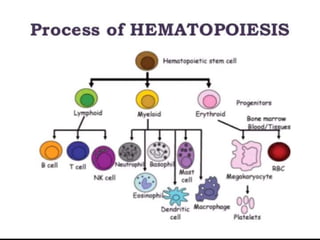
HEMATOPOIESIS.
• It is the formation of blood cellular components.
• It formed haematopoietic stem cell.
• If it becomes a red blood cell:- Hemocytoblast 
Erythroid stem cell  Red blood cell.
• If it become a lymphocyte white blood cell:-
Hemocytoblast  lymphoid stem cell 
lymphocyte.
• If it become a Non- Lymphocyte white blood cell:-
Hemocytoblast  Myeloid stem cell  Neutrophil,
Basophil, Monocyte, Eosinophil.
IN FETAL DEVELOPMENT:-
-- Yolk sac, and then liver as body matures.
IN ADULTS:- RBCs and Platelets are made in
the bone marrow.
-- WBCs are made in lymph tissue [ more on that
later].
STEM CELL:-
• Cells capable of asymmetrically dividing, one group
of cell is responsible for production of well
differentiated products and another group of cell is
responsible to maintain the original population if
stem cell and shows a character called as self –
renewal.
• DIFFERENT TYPES OF STEM CELL:-
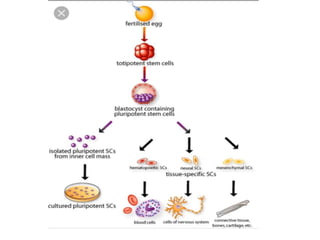
• TOTIPOTENT STEM CELL:- Have the ability to generate an
entire organism. Only embryonic stem cells are able to do
this.
• MULTIPOTENT STEM CELL:- Have the ability to differentiate
into several different cell types, for e.g. HSCs.
EXTRA MEDULLARY:-
In some cases, the liver, thymus, and spleen may
resume their haematopoietic function, if necessary.
This is called EXTRA MEDULLARY HAEMATOPOIESIS.
MATURATION:- As a stem cell matures it undergoes
changes in gene expression that limit the cell types
that it can become and moves it closer to a specific
cell types.
These changes can often be tracked by monitory
the presence of proteins on the surface of the cell.
Each successive changes moves the cell closer to
the final cell type.
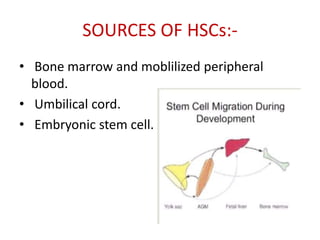
SOURCES OF HSCs:-
• Bone marrow and moblilized peripheral
blood.
• Umbilical cord.
• Embryonic stem cell.
HALLMARKS OS HSCs:-
• SELF- RENEWAL:- Ability to make copies the
same or very similar potential.
• DIFFERENTIATION:- Differentiation into several
different cellular components pf blood.
• MIGRATION:- Occurs at specific times during
development [ i.e. seeding of fetal liver, spleen,
and eventually bone marrow] and certain
condition [ e.g. Cytokine induced mobilization ]
later in life.
CELLS OF IMMUNE SYSTEM:-
• MYLOID LINEAGE:- The mononuclear phagocytic
system consists of monocytes circulating in the
blood and macrophages in the tissue.
• During hematopoiesis in the bone marrow,
granulocytes, monocytes progenitor cells
differentiate into promonocytes, which leave the
bone marrow and enter the blood where they
further differentiated into mature monocytes.
• Monocytes circulate in the bloodstream for about
8 hour.
MONOCYTES:-
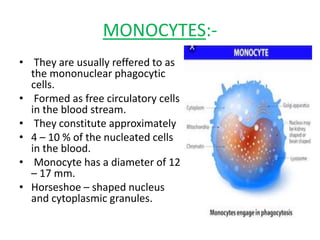
• They are usually reffered to as
the mononuclear phagocytic
cells.
• Formed as free circulatory cells
in the blood stream.
• They constitute approximately
• 4 – 10 % of the nucleated cells
in the blood.
• Monocyte has a diameter of 12
– 17 mm.
• Horseshoe – shaped nucleus
and cytoplasmic granules.
GRANULOCYTIC CELL:-
• Neutrophils from the
major part of the white
blood carpules [ 40- 75%]
they are mostly short
lived cells with multilobed
nucleus.
• The cytoplasmic contain
granules which do not
take up acidic or basic
stains strongly and hence
named Neutrophils.
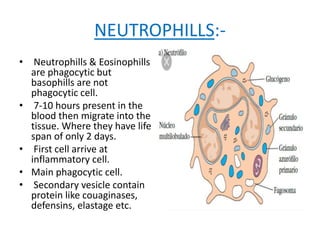
NEUTROPHILLS:-
• Neutrophills & Eosinophills
are phagocytic but
basophills are not
phagocytic cell.
• 7-10 hours present in the
blood then migrate into the
tissue. Where they have life
span of only 2 days.
• First cell arrive at
inflammatory cell.
• Main phagocytic cell.
• Secondary vesicle contain
protein like couaginases,
defensins, elastage etc.
BASOPHILLS:-
• Non- phagocytic granulocytes.
• vesicle having various signal
molecule like Histamins,
protaglanibins, [ response for
inflammation or pain] and inter- lucin
1.
• Degranulation to contain release
outside.
• immunoglobulin E receptor
recognise FC region immunoglobulin
E.
• Designaline molecules causes in
flammantory response.
• It creates hyper sensitivity type 1.
like  Allergy, pollen dust, perform.
• epethelial tissue of respiratory
,genital urinary tract, digestive tracts
also have mast cells.
• IgE mediated response is mediated
by both [ basophills, mast cell].
EOSINOPHILLS:-
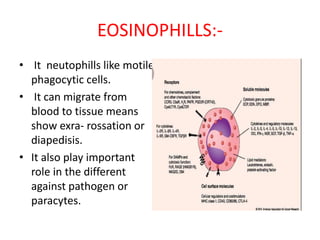
• It neutophills like motile
phagocytic cells.
• It can migrate from
blood to tissue means
show exra- rossation or
diapedisis.
• It also play important
role in the different
against pathogen or
paracytes.
AGRANULOCYTES:-
• Monocytes convert into microphages.
• Size of macrophages 10 fold layer then
monocyte.
• In lungs they known as Alveolar macrophages in
liver kuffer cell in brain microglial cell in holes
osteoplast, it provide primary line of defence.
• phagocytosis by Oxygen dependent 2
independent killing.
• Long half life.
DENDRITIC CELL:-
• Most active antigen prenting
cell[ ATC].
• It having long membranous
projections.
• It look like dendrites of
neuron.
• It have low surface area due
to presence of projetions.
• It express MHC class II With
antigen.
• It activates T- Helper cella
• Originated from both Myeloid
and lymohoid progeniter cell.
FOLLICULAR DENDRITIC CELL:-
Present in spleen & lymph nodes, it is not
antigen presenting cell.
Do not express MHC class II .
 They do not intermalise antigen but hold
the antigen and activate B – cell are generate
humoral mediated immunity.
LYMPHOID CELL:-
Lymohocytes constitute 20% - 40% of the
body’s White blood cells and 99% of the cells
in the lymph.
These lymphocytes constinually circulate in
the blood and lymph & are capable of
migrating into the tissue spaces and lympoid
organs.
T- LYMPHOCYTES:-
• T- lymphocyte mature in
thymus.
• Only 5% selective for T-
Lymphocyte.
• The T- cell play two
important function
effector and regulatory.
• T- cell receptor
recognise only antigen
which are bounded with
MHC class I, II.
• T-Helper cells:- It generate
antibody, HMR.
• T- Helper cell is a bridge b/w
specific and Non – specific
response as well as cell and
humoral mediated branch.
• T-helper lymphocytes that help B
lymphocytes to produce
antibodies and help phagocytes
to destroy ingest microbes.
• T- Cytotoxic cells:- T- cytotoxic
lymphocytes that kills cells
larbouring intercellular microbes.
• cyto- toxicity same as natural
killer cells.
B- LYMPHOCYTES:-
 Bone marrow is its major site of maturation .
 They are very important in antibody –
mediated immunity as they secrete specific
immunoglobins in response to antigenic
stimulus.
 The B- cells are of two subunits.
 The T- cell independent cell: Which do not
required the helper of T- Helper cells for the
production of immunoglobulins.
NATURAL KILLER CELLS:-
• NK cells were subsequently shown to play an
important role in host defense both against
tumor cells and against cells infected with some
, though not all, viruses.
• These cells, which constitute 5- 10% of
lymphocytes in human peripheral blood.
• They can recognize potential target cellsnin two
different ways.
HEMATOPOIETIC GROWTH FACTOR:-
• The discovery of growth factors has been a major
advance in this area. It is now known that a number of
cytokines play a role in the differentiation of blood cells.
Many cytokines that infleunce the development of the
various hematologic cells have been identified.
• It is the balance of these cytokines with the micro
environment surrounding the pluripotent stem cell and
its subsequently lineage that determines the pathway of
differentiation.
• Growth factors play a role in hematopoiesis is not only
by causing differntiation of stem cells toward a particular
cell type, but also by inducing the proliferation of cells.
Hematopoesis

Hematopoesis

  • 1.
  • 2.
    HEMATOPOIESIS. • It isthe formation of blood cellular components. • It formed haematopoietic stem cell. • If it becomes a red blood cell:- Hemocytoblast  Erythroid stem cell  Red blood cell. • If it become a lymphocyte white blood cell:- Hemocytoblast  lymphoid stem cell  lymphocyte. • If it become a Non- Lymphocyte white blood cell:- Hemocytoblast  Myeloid stem cell  Neutrophil, Basophil, Monocyte, Eosinophil.
  • 4.
    IN FETAL DEVELOPMENT:- --Yolk sac, and then liver as body matures. IN ADULTS:- RBCs and Platelets are made in the bone marrow. -- WBCs are made in lymph tissue [ more on that later].
  • 5.
    STEM CELL:- • Cellscapable of asymmetrically dividing, one group of cell is responsible for production of well differentiated products and another group of cell is responsible to maintain the original population if stem cell and shows a character called as self – renewal. • DIFFERENT TYPES OF STEM CELL:- • TOTIPOTENT STEM CELL:- Have the ability to generate an entire organism. Only embryonic stem cells are able to do this. • MULTIPOTENT STEM CELL:- Have the ability to differentiate into several different cell types, for e.g. HSCs.
  • 7.
    EXTRA MEDULLARY:- In somecases, the liver, thymus, and spleen may resume their haematopoietic function, if necessary. This is called EXTRA MEDULLARY HAEMATOPOIESIS. MATURATION:- As a stem cell matures it undergoes changes in gene expression that limit the cell types that it can become and moves it closer to a specific cell types. These changes can often be tracked by monitory the presence of proteins on the surface of the cell. Each successive changes moves the cell closer to the final cell type.
  • 8.
    SOURCES OF HSCs:- •Bone marrow and moblilized peripheral blood. • Umbilical cord. • Embryonic stem cell.
  • 9.
    HALLMARKS OS HSCs:- •SELF- RENEWAL:- Ability to make copies the same or very similar potential. • DIFFERENTIATION:- Differentiation into several different cellular components pf blood. • MIGRATION:- Occurs at specific times during development [ i.e. seeding of fetal liver, spleen, and eventually bone marrow] and certain condition [ e.g. Cytokine induced mobilization ] later in life.
  • 10.
    CELLS OF IMMUNESYSTEM:- • MYLOID LINEAGE:- The mononuclear phagocytic system consists of monocytes circulating in the blood and macrophages in the tissue. • During hematopoiesis in the bone marrow, granulocytes, monocytes progenitor cells differentiate into promonocytes, which leave the bone marrow and enter the blood where they further differentiated into mature monocytes. • Monocytes circulate in the bloodstream for about 8 hour.
  • 11.
    MONOCYTES:- • They areusually reffered to as the mononuclear phagocytic cells. • Formed as free circulatory cells in the blood stream. • They constitute approximately • 4 – 10 % of the nucleated cells in the blood. • Monocyte has a diameter of 12 – 17 mm. • Horseshoe – shaped nucleus and cytoplasmic granules.
  • 12.
    GRANULOCYTIC CELL:- • Neutrophilsfrom the major part of the white blood carpules [ 40- 75%] they are mostly short lived cells with multilobed nucleus. • The cytoplasmic contain granules which do not take up acidic or basic stains strongly and hence named Neutrophils.
  • 13.
    NEUTROPHILLS:- • Neutrophills &Eosinophills are phagocytic but basophills are not phagocytic cell. • 7-10 hours present in the blood then migrate into the tissue. Where they have life span of only 2 days. • First cell arrive at inflammatory cell. • Main phagocytic cell. • Secondary vesicle contain protein like couaginases, defensins, elastage etc.
  • 14.
    BASOPHILLS:- • Non- phagocyticgranulocytes. • vesicle having various signal molecule like Histamins, protaglanibins, [ response for inflammation or pain] and inter- lucin 1. • Degranulation to contain release outside. • immunoglobulin E receptor recognise FC region immunoglobulin E. • Designaline molecules causes in flammantory response. • It creates hyper sensitivity type 1. like  Allergy, pollen dust, perform. • epethelial tissue of respiratory ,genital urinary tract, digestive tracts also have mast cells. • IgE mediated response is mediated by both [ basophills, mast cell].
  • 15.
    EOSINOPHILLS:- • It neutophillslike motile phagocytic cells. • It can migrate from blood to tissue means show exra- rossation or diapedisis. • It also play important role in the different against pathogen or paracytes.
  • 16.
    AGRANULOCYTES:- • Monocytes convertinto microphages. • Size of macrophages 10 fold layer then monocyte. • In lungs they known as Alveolar macrophages in liver kuffer cell in brain microglial cell in holes osteoplast, it provide primary line of defence. • phagocytosis by Oxygen dependent 2 independent killing. • Long half life.
  • 17.
    DENDRITIC CELL:- • Mostactive antigen prenting cell[ ATC]. • It having long membranous projections. • It look like dendrites of neuron. • It have low surface area due to presence of projetions. • It express MHC class II With antigen. • It activates T- Helper cella • Originated from both Myeloid and lymohoid progeniter cell.
  • 18.
    FOLLICULAR DENDRITIC CELL:- Presentin spleen & lymph nodes, it is not antigen presenting cell. Do not express MHC class II .  They do not intermalise antigen but hold the antigen and activate B – cell are generate humoral mediated immunity.
  • 19.
    LYMPHOID CELL:- Lymohocytes constitute20% - 40% of the body’s White blood cells and 99% of the cells in the lymph. These lymphocytes constinually circulate in the blood and lymph & are capable of migrating into the tissue spaces and lympoid organs.
  • 20.
    T- LYMPHOCYTES:- • T-lymphocyte mature in thymus. • Only 5% selective for T- Lymphocyte. • The T- cell play two important function effector and regulatory. • T- cell receptor recognise only antigen which are bounded with MHC class I, II. • T-Helper cells:- It generate antibody, HMR. • T- Helper cell is a bridge b/w specific and Non – specific response as well as cell and humoral mediated branch. • T-helper lymphocytes that help B lymphocytes to produce antibodies and help phagocytes to destroy ingest microbes. • T- Cytotoxic cells:- T- cytotoxic lymphocytes that kills cells larbouring intercellular microbes. • cyto- toxicity same as natural killer cells.
  • 21.
    B- LYMPHOCYTES:-  Bonemarrow is its major site of maturation .  They are very important in antibody – mediated immunity as they secrete specific immunoglobins in response to antigenic stimulus.  The B- cells are of two subunits.  The T- cell independent cell: Which do not required the helper of T- Helper cells for the production of immunoglobulins.
  • 22.
    NATURAL KILLER CELLS:- •NK cells were subsequently shown to play an important role in host defense both against tumor cells and against cells infected with some , though not all, viruses. • These cells, which constitute 5- 10% of lymphocytes in human peripheral blood. • They can recognize potential target cellsnin two different ways.
  • 23.
    HEMATOPOIETIC GROWTH FACTOR:- •The discovery of growth factors has been a major advance in this area. It is now known that a number of cytokines play a role in the differentiation of blood cells. Many cytokines that infleunce the development of the various hematologic cells have been identified. • It is the balance of these cytokines with the micro environment surrounding the pluripotent stem cell and its subsequently lineage that determines the pathway of differentiation. • Growth factors play a role in hematopoiesis is not only by causing differntiation of stem cells toward a particular cell type, but also by inducing the proliferation of cells.