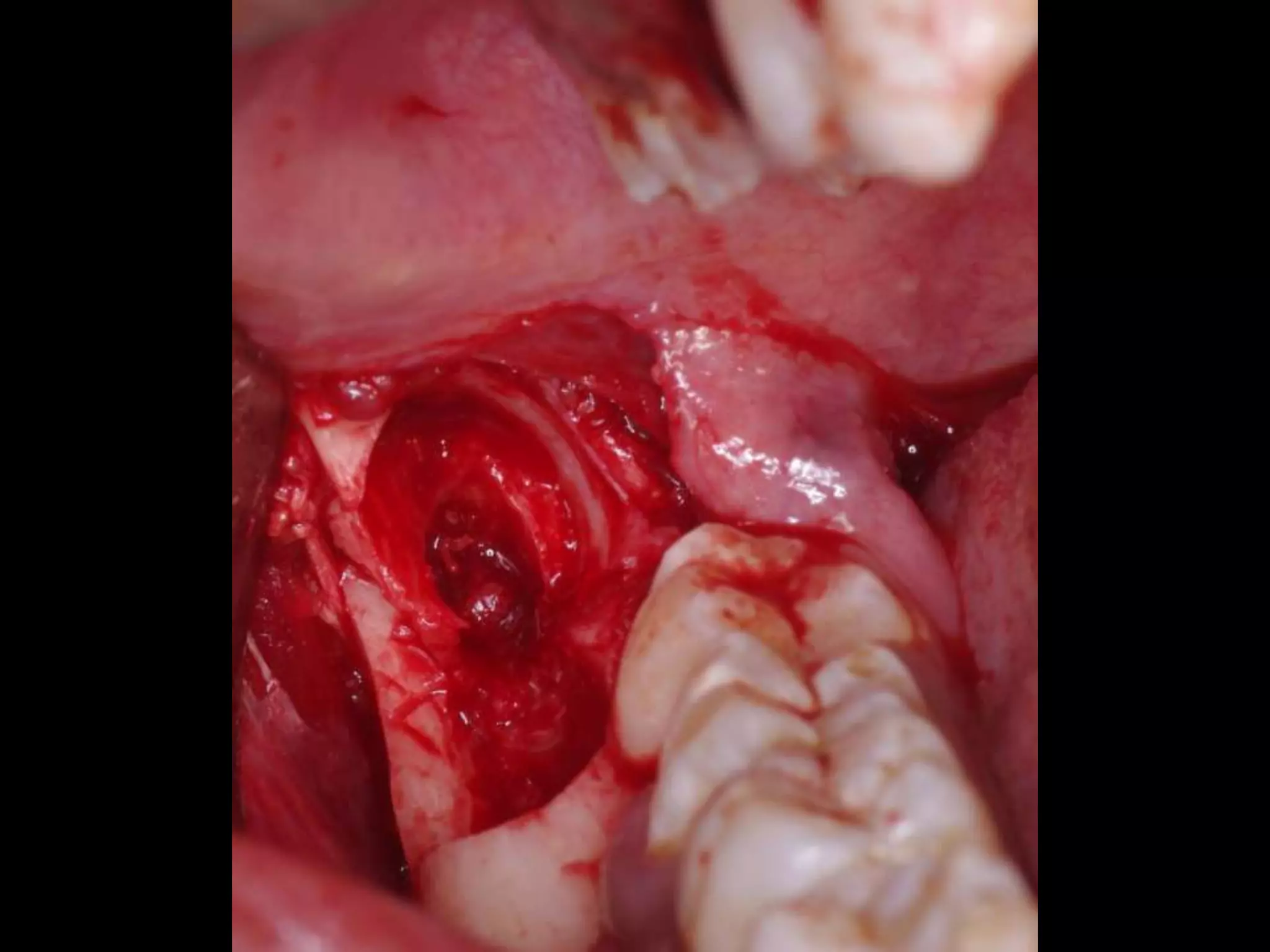
Biomaterials in GBR
• Bone Grafts
• GTR/GBR membranes/Titanium Mesh
• Fixation devices:Stabilizing Pins and Screws
• Bioactive Modifiers
Rationale
(Crist 1980, Brunsvold and
Mellonig 1993)
To enhance the regenerative capability of bone and to achieve a new
bone, an ideal bone graft should be able to trigger osteogenesis,
Mechanism of
Action
• Osteogenic
/Osteoproliferative: Refers
to the formation (or)
development of new bone
by cells contained in the
graft.
E.g. Autogenous grafts.
Osteoinduction: Is a chemical
process by which molecules
contained in the graft
(BMP’s) provide a biologic
stimulus that induces the
progression of mesenchymal
stem cells and other
osteoprogenitor cells
towards osteoblast lineage
Osteoconduction: Is a physical effect by
which the matrix of the graft forms a scaffold
that favours outside cells to penetrate the
graft and form new bone, e.g. Alloplasts.
Bone Replacement Grafts (Nasr et al 1999)
Human bone Bone Substitutes
Autografts
Allografts
Extraoral
Fresh Frozen
Freeze Dried
Demin. Freeze Dried
Intraoral
Xenografts
Alloplasts
Bovine, Equine, etc
Coralline Ca Carbonate
Polymers, Ceramics, TCP
HA Dense, Porous, Resorbable
Bioactive Glasses
Bone collector
Advantages of autografts:
Promotes osteogenesis.
Potential problems of histocompatibility differences is
avoided.
Risk of disease transfer avoided.
Can be easily procured.
Disadvantages of autografts:
Inadequate graft material from intra oral sites.
Patient refusal for hospitalization.
Necessitates inflicting surgical trauma on another part of
the patient’s body.
16
17
BONE ALLOGRAFTS
• Tissue (bone) grafts between individuals of the same species but of
non-identical genetic disposition. An allograft was formerly referred
homograft.
Need for an allogenic source arised from:
• Donor material to fill multiple or deep bone defects in the same
patient.
• The morbidity accompanying a second surgical site to procure
bone.
They are of three types:
Mineralized freeze-dried bone allograft (FDBA)
Demineralized freeze-dried bone allograft
(DFDBA)
Frozen iliac cancellous bone & marrow
Advantages of Allografts
Readily available.
Elimination of the need for a patient donor
site
Reduced anesthesia and surgical time
Decrease blood loss and fever complication
Disadvantages of Allografts
Use of tissue from another individual.
Cadaveric bone may also undergo rejection.
Disease transfer is a concern for both the patient and clinician.
There has never been a report of disease transfer with
mineralized freeze-dried bone allograft.
The risk of disease transfer with a fresh frozen bone allograft
has been calculated to be approximately one in 2 million of
the tissue bank use exclusionary techniques.
There is only one rare disease reported with allografts
“Creutzfeldt-Jacobs” disease, this disease is transmitted via
“PRIONS” – smallest proteinaceous infectious particles.
Sequence of processing (Mellonig 1991)
Cortical bone is harvested in a sterile manner
Cortical bone is rough cut - 500 um to 5mm
Material is immersed in 100% ethyl alcohol
Cortical bone is ground and sieved to a particle size - 250-750 um.
Decalcification with 0.6 or 0.5 N HCL
Bone is washed in a Sodium phosphate buffer
Cortical bone is frozen at -800C for 1 to 2 weeks
FREEZE DRYING
Removes more than 95%of the water content from the bone.
It preserves the 3 major specimen character:
• Size
• Solubility
• Chemical Integrity
Freeze drying destroys all cells and the graft is rendered non
viable.
It has the advantages of:
• Decreasing antigenicity
• Facilitating long term storage
• Vacuum sealing in glass containers protects against
contamination and degradation of the graft material for an
indefinite period of time.
FROZEN ILIAC CANCELLOUS
BONE & MARROW
Notably this is the only other graft material with reported
ability to correct "zero wall" defects.
However despite these encouraging results not recommended
because they have risk of disease transmission.
Mineralized Freeze Dried Bone Allograft (FDBA)
• An osteoconductive scaffold and elicits resorption when implanted
in mesenchymal tissues.
• This material is resorbed and replaced by host bone very slowly.
DFDBA material may vary from batch to batch.
THE lack of standardization shown in a study by Schwartz et al
(1996) :-DFDBA from donors over age of 50 showed significantly
less induction ability. 18% of DFDBA batches had no inductive
ability, and 40% had only modest induction ability.
Different DFDBA preparations varied significantly in particle size
and inductive properties.
The batches vary considerably in their abilities to promote bone
and cartilage formation.
(Becker W et al, 1995; Shigeyama et al, 1995).
Possible Reasons
• Commercial bone banks do not verify the specific amount of BMPs
or any level of inductive capacity in any graft material they sell
• Delaying the procurement of donor bone after death,
• Improper storage conditions, or other processing factors
Studies have determined that the minimal effective amount of BMP
necessary to affect bone growth is about 2 ug/40 mg wet weight of
explant. The optimal amount is about 10 ug (Sato K, 1983).
Another possible factor in the unreliability of DFDBA grafts may be
attributed to poor revascularization.
• One potential cause might be that bone induction proteins are
not present insufficient quantity to produce detectable bone
formation.
• Another possibility is that the bone-inductive components of
DFDBA are present but in an inactive form.
• Alternatively, it is possible that the natural variability in human
donors is reflected in the bone induction ability of the
preparations, and some DFDBA batches are simply more active
than others, even when identical procedures have been used to
prepare them.
Xenografts
A tissue (bone) graft between members of differing (heterograft) species
i.e. animal to man.
TWO AVAILABLE SOURCES
IMMUNOGENIC
PROPERTIES
INFECTIOUS DISEASE OSTEOCONDUCTIVE
READILY AVAILABLE
ANORGANIC BOVINE BONE (ABB)
Remove all organic components from a bovine bone source and
leaving behind a Non-organic bone matrix in an unchanged
inorganic form.
ABB is hydroxyapatite (HA) skeleton, which retains a high porous
structure similar to cancellous bone, that remains after chemical
or low heat extraction of the organic component.
Why Topography
• Xenografts macro, micro and nano structured surface
combined with its interconnected pore system,acts as a
guidance for fluids, nutrients, blood vessels, proteins,
growth factors, bone- and stem cells
Structure
Key success factor:
Hydrophilicity
• Xenografts rapid and complete hydration with blood or
saline solution is critical for superior handling
characteristics, new bone formation and for the ultimate
clinical success
Increase the surface
area that can act as an
osteoconductive
scaffold due to their
porosity
Mineral content
comparable to human
bone, allowing them to
integrate with host bone
Becomes revitalized
due to ingrowth of
blood vessels and
osteoblasts New bone laid down
directly on the
surface of GRAFT
Serve as a solid lattice
support to an
occlusive membrane
in GTR applications.
Biocompatible, amalgamate, and incorporates well within the newly formed
regenerated hard tissue, with almost no clinical postoperative
complications
Composite of Anorganic Bovine-derived Bone material (that mimics
the inorganic component of autogenous bone)
+
Synthetic Peptide (P-15) that mimics the organic component (Type-I
collagen) of autogenous bone.
PepGen P-15
Pepgen P-15 contains only about 200 nanograms of P-15 in 1 gm of
hydroxyapatite.
ALLOPLASTS
• A synthetic bone graft material, a bone graft substitute.
Available in variety of textures, sizes and shapes.
Based on their porosity, they can be classified as
 Dense, macroporous
 Microporous
They can be either crystalline or amorphous.
Types:
Plaster of paris,
Polymers
Calcium Carbonates
Tricalcium phosphate
Hydroxyapatite
• Dense, nonporous, nonresorbable
• Porous, nonresorbable (xenograft)
• Resorbable, low temperature derived
Bioglass.
Tricalcium phosphate
Porous form of calcium phosphate, the most commonly used form is ß-
tricalcium phosphate.
Biological filler partially resorbable and allows bone replacement.
first, serving as a scaffold for bone formation, and then permitting
replacement with bone
(Hashimoto-Uoshima et al, 1995; Shetty , 1991).
Hydroxyapatite
Ca10 (PO4)6 (OH)12, The primary mineral component of bone.
Synthetic hydroxyapatites have been marketed in a variety of
forms, primarily as a:-
A dense or solid nonresorbable– E.g. Periograf, Calcite,
Osteograf D,
Porous nonresorbable- E.g. Interpore 200 and
A resorbable (non-ceramic, porous) form – E.g. Osteograf
L/D.
OSTIMS
It is a nanocrystalline-precipitated hydroxyapatite
that still contains about 40% of water.
It has a viscous, fluid-like consistence and can
therefore be directly injected into a defect.
Composition
Silicon Dioxide – 45%
Sodium Oxide - 24.5%
Calcium Oxide – 24.4%
Phosphorous Pentoxide – 6%
The basis of the bone bonding property of
bioactive glasses is the chemical reactivity of the
glass in body fluids
Leaching
Dissolution
Precipitation
2 Particle sized composite mixture
Phase 1: 90-710 µ Calcium Phosphosilicate (CPS)
-Phase 2: 32-125 µ Calcium Phosphosilicate
Phase 2 particles provide the initial burst of calcium and phosphate
ions and also enhance the physical characteristics to improve
handling
Phase 2 resorbs at a faster rate than the larger particle phase
 Polyethylene Glycol and Glycerin
 Nontoxic materials used in food & pharma industries
 Water soluble - gets absorbed in 48-72hrs
 Enhances the working ability of the putty and keeps
it coherent
 Additive fills spaces between the particles of bioactive
phases
Enhances handling by giving a smooth surface to the putty
• After the clot forms - PEG, Glycerin & smaller CPS
particles get absorbed over 5-7 days
• A virtual porous network forms in the defect
• Smaller CPS particles provide the initial burst of calcium &
phosphorous
• Spaces between particles permit vascularization and bone in-
growth
• Multiple foci of osseous regeneration areas appear
throughout the defect thus enhancing the rate of bone
formation
Clam Shell (Tray) -
Easy to handle.
Can be used with any hand instrument.
Does not stick to gloves or instruments
Syringe -
Absolutely no handling required:
Expressed directly into the defect s'
Ideal for extraction sites, sinuses, cysts, third
molar extractions, etc.
Cartridge -
Snap pre-filied cartridges into the dispenser to
dispense
Ideal for minimally invasive surgeries, hard to
access defects, immediate implant surgeries.
Peri implantitis cases, etc.
Ideal for Tunnel grafts. Osteotome Technique.
Furcation defects, etc.
GEM 21 S® (Osteohealth Company)
It is an innovative combination of rhPDGF-BB and β-TCP.
(Nevins M et al, 2005).
Bone grafts -Characteristics
 Osteogenic- Has bone-forming cells
 Autograft
 Osteoinductive – Attracts bone-forming cells (GF’s)
 Autograft ,Allograft
 Osteoconductive - Scaffold for bone-forming cells
 Autograft, Allograft, Xenograft , Alloplast
Graft Properties
Osteoconductive Osteoinductive Osteogenic
Autograft + + +
Allograft + +/- -
Xenograft + - -
Alloplast + - -
Graft material characterstics
Graft type Source Source examples Bone regeneration
potential
Resorption time
Autograft Host Extraoral:iliac crest,
tibia ,calvaria
Intraoral: symphysis
, ramus , exostosis ,
contiguous ridge
Osteogenic Weeks to
months(particulate)
Allograft Genetically
dissimialar member
of same species
Human cadaver Osteoconductive Months
Xenograft Member of another
species
Pig
Cow
Osteoconductive Months to years
Synthetic Nonliving source Coral
Synthetic
compounds
Osteoconductive Wide range (rapid
to non resorbable)
PERIODONTAL WOUND HEALING
 In 1976, Melcher in a review paper suggested
that the type of cell which repopulates the root
surface after periodontal surgery determines
the nature of the attachment that will form.
After flap surgery the curetted root surface may be repopulated by
four different types of cells (Epithelial cells, Cells derived from the
gingival connective tissue, Cells derived from the bone, Cells derived from
the periodontal ligament.
BIOLOGIC RATIONALE OF GTR
 New attachment will occur only if periodontal ligament cells
repopulate the root surface during healing, as progenitor cells for
the formation of new attachment, are residing in the periodontal
ligament.
 Since gingival epithelium is the fastest tissue to proliferate,
followed by gingival connective tissue , it follows then by placing
a barrier to exclude the epithelium and connective tissue
selectively and allowing periodontal ligament cells to repopulate
the root, new attachment would be obtained.
BIOLOGIC RATIONALE OF GTR
 This view was confirmed in a study in monkeys in which both
gingival connective tissue and gingival epithelium were
prevented from contacting the root surface during healing by the
use of a barrier membrane (Gottlow et al. 1984).
Objectives of GTR
 Giving preference to cells that repopulate the wound and have
the potential to regenerate tissue.
 Excluding cells that may negatively interfere with tissue
regeneration.
 Creating sufficient space to allow formation of desired tissue.
 To protect and stabilize blood clot.
Barrier Materials For GTR
 First Generation (Non-resorbable):
 Millipore® filter
 Expanded polytetrafluroethylene (e-PTFE)
(Gore-Tex®)
 e-PTFE + Titanium reinforced (Ti reinforced
Gore-Tex®)
 Non porous e-PTFE (TefGen-FD®)
 Rubber dam
 Composition non absorbable device
Barrier Materials For GTR
 Second Generation (Bio-resorbable)
NATURAL
 Collagen (Biomed, Bioguide,
Paroguide, Tissue guide)
 Oxidized Cellulose
 Connective tissue grafts
 Duramater, Cargile
Membrane, Laminnar bone
SYNTHETIC
 Polylactic acid
(Atrisorb, Guidour,
Resolut)
 Polyglactin 910 (Vicryl
mesh)
 PLA + PGA
Barrier Materials For GTR
 Third Generation (Bio-resorbable with
growth factors)
 Being developed
GBR
Membrane
Non
resorbable
PTFE
Titanium
mesh
Bioabsorbable
Natural Synthetic
ePTFE
Gore-Tex
Titanium
reinforced
ePTFE
GoreTex
titanium
reinforced
dPTFE E
TefGen
Laminar bone
lambone
Pericardium
CopiOs
Puros
Collagen
Fascia lata
Acellualr
Dermal Matrix
AlloDerm GBR
Duramater
Polymeric
Calcium
Sulfate
CalForma
Resorbable Barriers
 General considerations:
 Do not require additional surgery for removal, which reduce patient
discomfort, chairside time and related cost.
 Limited control over length of application because the disintegration
process starts upon placement in the tissues and the ability of each
individual patient to degrade a particular biomaterial may vary
significantly particularly for materials requiring enzymatic degradation
(collagen).
Resorbable Barriers
 Collagen:
 The properties of collagen that makes it useful as a barrier
material (Wang HL & MacNeil RL, 1998)
 Natural component of periodontal tissues, well tolerated
 Weak immunogenic, favorable response
 Malleable – can be formed shaped & manipulated
 Possess haemostatic properties through its ability to aggregate platelets
 Supports cell proliferation via lattice structure & cell binding domains
 Facilitates early wound stabilization & maturation
 Chemotatic for fibroblasts
 Promotes cell migration, thus reduces chances of barrier exposure
Resorbable Barriers
 The various commercially available collagen barriers are:
Biomend &
Biomend Extend
Bio-Guide
Membrane
Resorbable Barriers
 Collagen:
 When a collagen membrane is implanted in the human body it is
resorbed by the enzymatic activity of macrophages and
polymorphonuclear leukocytes (Tatakis et al, 1999).
 Complications such as early degradation, epithelial downgrowth
along the material and premature loss of material were reported
following the use of collagen membranes.
 The varying results are probably due to the differences in the
properties of the material and the handling at the time of
implantation.
Resorbable Barriers
 Polylactic Acid & Polyglycolic Acid Polymers:
Membrane FDA Company Components
Guidor Yes Butler Co, Chicago, IL PLA & acetyltri-
butyl acetate
Vicryl Yes Ethicon Lab, New Brunswick, NJ PLA/PGA
Atrisorb Yes Atrix Lab, Fort Colins, CO PLA/PGA
Resolut Yes W.L, Gore, Flagstaff, AZ PLA/PGA
Epigude Yes THM Biomedical, Duluth, MN PLA (D, L forms)
Biofix No Bioscience LTD, Tempere, Finland PGA
Resorbable Barriers
 Polylactic Acid & Polyglycolic Acid Polymers:
 Atrisorb – Consisits of polymer of poly (D,L-lactide) (PLA), dissolved
in N-methyl-2-pyrrolidone (NMP).
 It is prepared as a solution that coagulates or sets to a firm
consistency on contact with water or other aqueous solution.
 This principle is used in forming a barrier that is partially coagulated
to a semirigid state in a chairside mixing kit.
 The barrier is trimmed to the required dimensions, and is flexible
enough to adapt to the defect, yet rigid enough to support the
overlying tissues. The barrier solidifies completely within the fluid
environment.
Membrane Advantages Disadvantages
Nonresorbable • Maintains space well
• Evidence supports its use
• Reliable bone regeneration
• Requires removal
• Does not integrate
• Possible higher exposure
rate
• Must be removed if exposed
,resulting in less
regenetration
• Collapsible
Bioabsorbable • Does not require removal
• Intergrates with body
• Pliable and shapeable
• Exposure may close
spontaneously
• May trigger immune
response
• May disintegrate faster than
desired
• Less well studied
• Less effective for vertical
defects
• Less occlusive(more fibrous
ingrowth)
4 Bone Grafting Opportunities
Immediate implant
GBR –Implant
Socket Preservation
Site development
Key Elements of Tissue Regeneration
Signaling Molecules
(rhPDGF, BMP ,PRGF)
Cells
( osteoblasts , fibroblasts )
Scaffolds
Collagen ,CaPO4)
Lynch .S. et al
Tissue engineering Application
OMFS & Perio
Quintessence 2008
In a Class II fenestration, there is a convexity, and a significant portion
of the implant is exposed outside the envelope of bone for reasons of
restorability.
In Class II dehiscences, the implant surface resides outside the
envelope of bone.
In Class I dehiscences, the implant surface resides within the
envelope of bone.
Class I HRD: The exposed implant
surface (> 50%) resides within the
envelope of bone.
Class II HRD: The exposed
implant surface (> 50%) resides outside
the envelope of bone.
Class I VRD: vertical insufficiency <3mm. Class II VRD: vertical insufficiency > 3mm.
Defect Class I Class II
Fenestration/dehiscence Implant surface penetrates
Bony wall but still lies
within the envelope of bone
Portion of implant exposed
,creating a convex
projection rising past the
envelope of bone
Horizontal deficiency • >50% implant diameter
exposed
• Any implant placed
remains within the
envelope of bone
• >50% implant surface
exposed
• Any implant placed is
outside the envelope of
bone
Vertical deficiency • <3mm height >3mm height loss
Classification of ridge defects in relation to implant placement
Fenestration or dehiscence Class
I
Class I
Place implant with
simultaneous GBR
Fenestration or
dehiscence
Class II
Restrorativ
e potential
OK
Place
implant
with
simultaneo
us GBR
Restorative
potential
poor
Do not
place
implant
GBR
Horizontal defect
Class I
Place implant with
simultaneous GBR
HorizontaldefectclassII
GBR Possibly supported
by tenting device
Delayed implant
placement
GBR With
simulataneo
us implant
as tenting
device
Class I or II
with < 3mm
of implant
exposed
supracrestall
y
Vertical
defect , upto
3mm
Prognosis Defect extent
Very good Single –tooth span
Mild horizontal loss only
Good Two-teeth span
Moderate horizontal loss only
Mild vertical loss only
Average Three-teeth span
Moderate horizontal loss only
Moderate vertical loss only
Questionable Four teeth span
Severe vertical loss only
Independent defect-related predictors of GBR Success
Fixation devices Mechanism:
• Screw
• Pin
• Tack
• Dental implant (used frequently as a part of vertical GBR )
Material
• Nonresorbable
• Titanium (Simon et al , 2007 ; von Arx and Buser , 2006)
• Stainless steel (Nakajima et al.,2007)
Resorbable
• Poly(D,L –Lactide ) acid (PDLLA ) (Raghoebar et al.,2006)
• Poly(lactic acid )(PLA) (Carpio et al., 2000)
• Poly(lactic acid /polyglycolic acid)(PLA/PGA) (Matsumbo
et al.,2005)
GUIDED BONE REGNERATION
4 major principles underlying
successful GBR
• The flap has to be a mucoperiosteal flap and must be
raised sufficiently over the mucogingival junction in an
apical direction for at least 10 mm.
• With a new scalpel (blade No. 15 or 15c), start at the
distal part of the flap perpendicular (or at a 60 angle) to
theperiosteum and, without stopping (that is,in one shot),
cut the periosteum in a depth of 1–3 mm always moving
the blade in a direction from distal to mesial
105
• The blade should cut the tissue in a level apical to the
mucogingival junction (to avoid flap perforation, do not
cut the area of keratinized mucosa).
• Always check the final result in such a way that the
buccal flap margin covers the lingual or palatal site at
least of 3–5 mm. If this overlapping does not occur, there
is a lot of tension in the flap, which means the closure is
insufficient.
107
Pre-operative photograph of site
Exposed implant
Recipient bed preparation
Autogenous bone graft
Collagen membrane stabilized with 2 tack screws
Graft placed over recipient bed
Flap sutured
Flap sutured
Bapuji Implant Center
After second stage surgery:
FGG Planned to increase width of attached
gingiva & to convert the gingival biotype
Recipient bed prepared
FGG harvested from palate &
placed over recipient bed
FGG sutured
FGG sutured
1 Week post-operative
4 month post-operative with prosthetic abutment
SBA technique
129
130
131
132
133
134
135
136
GBR WITH NASAL Lift with
Novabone morsel
137
Immediate Implant With GBR
&CTG
153
Tent pole GBR
Pre-Op
167
Curvilinear Beveled Incisions
168
Complete loss of Buccal bone
169
Decortication
170
Tuberosity bone stabilized
171
Tenting effect with the screw
172
173
Dual layered collagen Membrane
application
174
Platelet Rich Fibrin Membrane
placed
175
Passive tension Free suturing
176
4 months Post-Op during Implant
placement
177
178
SECONDARY CONTOUR AUGMENTATION
AFTER IMPLANT PLACEMEMT
179
PLATELET RICH PLASMA
&
PLATELET RICH FIBRIN
PRP (Platelet Rich Plasma) :
Tayapangsak 1994, Marx 1998
Autologous concentrate of human platelets in small
volume of plasma
PRP Controversies
 Damaged/Nonviable platelet : Doesnot secrete GF
Marx 2004
 Force>200 g for 10 min: Fragments platelets and
decreases enrichment
Landerberg et al 2000
 Wrong centrifuge: Poor/ Inadequate results
 Deleterious effects of bovine thrombin coagulation
factors & body cells
CMOUK 1993 & Karp 2004
PRGF (Plasma Rich Growh Factor): Anitua 1999
Whole Blood+ Anticoagulant containing tube+ Centrifuge
+ CaCl2 (Gelling agent)
No Thrombin
CONTROVERSIES
 Used only CaCl2
 Platelet gel obtained
 Not complete activation of platelet
 Low platelet degranulation & hence low GF
Gasperini 2005, Weinbich 2005
Platelet-rich fibrin (PRF):
Definition: Fibrin rich in platelet derived from manipulating
autologous blood.
Developed in France by Choukroun et al in 2001
Second generation platelet concentrate:
Doesn’t requires anticoagulant/bovine thrombin or any
other gelling agent
Fulfill French law related to blood derived product
reimplantation
Absence of anti-coagulant
Induce
Platelet activation
Release
Coagulation cascades (within minutes)
Bolstered by the presence of a mineral phase on the
tube walls (residual glass particles).
Fibrinogen concentrate (High part of the tube)
Fibrin clot (middle of the tube)
Thrombin
Platelet are trapped in large number in this fibrin mesh
TGF-β1 VEGF
PDGF-AB Thrombospondin 1
In PRF:
Dohan et al 2009
Release peak is after 7 days & not immediate
Platelet distribution in PRF
Lower part of the fibrin clot
Junction between red
thrombus and the PRF clot
PRF red extremity: more effective than
the higher part of the fibrin clot
Remain trapped in the fibrin meshes & in the fibrin polymers
3. Incorporation of platelets and cytokines in a fibrin
clot
PRF
IMMUNE CONTROL
Its not just the platelet which play an important role …
One crucial component of the PRF is…
LEUCOCYTES
PRF also called as Leucocyte-PRF/ L-PRF
POST restoration
205
POST-Op IOPA
206
207
222
223
GBR
224
Implant dehiscence and
Decortication
225
226
227
Sandwich bone augmentation
titanium Mesh appication
228
PRF membrane Placed on mesh
229
230
4 Months re-entry during second
stage
231
Post-Op
232
24 months post loading
233
237
PRE-
CBCT
Post-
CBCT
Mid-crestal Incision to get access to the
defect
Large Residual defect Having a combination of Horizontal and Vertical
bone defect
Defect after complete debridement to remove granulation
tissue
Novabone
Putty Graft
placed into the
defect
Titanium Micro
Mesh shaped
and stabilised
with Screw
PRF placed to cover the Mesh
5 Months Post-Operative showing good soft
tissue cover without any exposure of mesh
Note: Complete reconstruction of Bony defect
after removal of Ti mesh
Osteotomy prepared and 2 Implants
Placed in ideal 3D position
Risks Of Titanium Exposure
274
• Lack of tension free closure
• Surgical inexperience
• Overbuilding mesh graft
• Smoking
• Compromised flap vascularity
• Infection
• Soft tissue borne prosthesis
• Poor mesh fixation
• Thin mucosa
• Sharp edges/poor adaptation
Early
Late
CONCLUSION
 Many techniques exist for effective bone
augmentation.
 The approach largely is dependent on the extent of
the defect and specific procedures to be performed
for the implant reconstruction.
 It is most appropriate to use an evidenced-based
approach when a treatment plan is being developed
for bone augmentation cases.

Bone Grafts

  • 2.
    Biomaterials in GBR •Bone Grafts • GTR/GBR membranes/Titanium Mesh • Fixation devices:Stabilizing Pins and Screws • Bioactive Modifiers
  • 3.
    Rationale (Crist 1980, Brunsvoldand Mellonig 1993) To enhance the regenerative capability of bone and to achieve a new bone, an ideal bone graft should be able to trigger osteogenesis,
  • 4.
    Mechanism of Action • Osteogenic /Osteoproliferative:Refers to the formation (or) development of new bone by cells contained in the graft. E.g. Autogenous grafts. Osteoinduction: Is a chemical process by which molecules contained in the graft (BMP’s) provide a biologic stimulus that induces the progression of mesenchymal stem cells and other osteoprogenitor cells towards osteoblast lineage
  • 5.
    Osteoconduction: Is aphysical effect by which the matrix of the graft forms a scaffold that favours outside cells to penetrate the graft and form new bone, e.g. Alloplasts.
  • 6.
    Bone Replacement Grafts(Nasr et al 1999) Human bone Bone Substitutes Autografts Allografts Extraoral Fresh Frozen Freeze Dried Demin. Freeze Dried Intraoral Xenografts Alloplasts Bovine, Equine, etc Coralline Ca Carbonate Polymers, Ceramics, TCP HA Dense, Porous, Resorbable Bioactive Glasses
  • 12.
  • 14.
    Advantages of autografts: Promotesosteogenesis. Potential problems of histocompatibility differences is avoided. Risk of disease transfer avoided. Can be easily procured.
  • 15.
    Disadvantages of autografts: Inadequategraft material from intra oral sites. Patient refusal for hospitalization. Necessitates inflicting surgical trauma on another part of the patient’s body.
  • 16.
  • 17.
  • 18.
    BONE ALLOGRAFTS • Tissue(bone) grafts between individuals of the same species but of non-identical genetic disposition. An allograft was formerly referred homograft. Need for an allogenic source arised from: • Donor material to fill multiple or deep bone defects in the same patient. • The morbidity accompanying a second surgical site to procure bone.
  • 19.
    They are ofthree types: Mineralized freeze-dried bone allograft (FDBA) Demineralized freeze-dried bone allograft (DFDBA) Frozen iliac cancellous bone & marrow
  • 20.
    Advantages of Allografts Readilyavailable. Elimination of the need for a patient donor site Reduced anesthesia and surgical time Decrease blood loss and fever complication
  • 21.
    Disadvantages of Allografts Useof tissue from another individual. Cadaveric bone may also undergo rejection. Disease transfer is a concern for both the patient and clinician. There has never been a report of disease transfer with mineralized freeze-dried bone allograft.
  • 22.
    The risk ofdisease transfer with a fresh frozen bone allograft has been calculated to be approximately one in 2 million of the tissue bank use exclusionary techniques. There is only one rare disease reported with allografts “Creutzfeldt-Jacobs” disease, this disease is transmitted via “PRIONS” – smallest proteinaceous infectious particles.
  • 23.
    Sequence of processing(Mellonig 1991) Cortical bone is harvested in a sterile manner Cortical bone is rough cut - 500 um to 5mm Material is immersed in 100% ethyl alcohol Cortical bone is ground and sieved to a particle size - 250-750 um. Decalcification with 0.6 or 0.5 N HCL Bone is washed in a Sodium phosphate buffer Cortical bone is frozen at -800C for 1 to 2 weeks
  • 24.
    FREEZE DRYING Removes morethan 95%of the water content from the bone. It preserves the 3 major specimen character: • Size • Solubility • Chemical Integrity Freeze drying destroys all cells and the graft is rendered non viable.
  • 25.
    It has theadvantages of: • Decreasing antigenicity • Facilitating long term storage • Vacuum sealing in glass containers protects against contamination and degradation of the graft material for an indefinite period of time.
  • 26.
    FROZEN ILIAC CANCELLOUS BONE& MARROW Notably this is the only other graft material with reported ability to correct "zero wall" defects. However despite these encouraging results not recommended because they have risk of disease transmission.
  • 27.
    Mineralized Freeze DriedBone Allograft (FDBA) • An osteoconductive scaffold and elicits resorption when implanted in mesenchymal tissues. • This material is resorbed and replaced by host bone very slowly.
  • 28.
    DFDBA material mayvary from batch to batch. THE lack of standardization shown in a study by Schwartz et al (1996) :-DFDBA from donors over age of 50 showed significantly less induction ability. 18% of DFDBA batches had no inductive ability, and 40% had only modest induction ability. Different DFDBA preparations varied significantly in particle size and inductive properties. The batches vary considerably in their abilities to promote bone and cartilage formation. (Becker W et al, 1995; Shigeyama et al, 1995). Possible Reasons
  • 29.
    • Commercial bonebanks do not verify the specific amount of BMPs or any level of inductive capacity in any graft material they sell • Delaying the procurement of donor bone after death, • Improper storage conditions, or other processing factors Studies have determined that the minimal effective amount of BMP necessary to affect bone growth is about 2 ug/40 mg wet weight of explant. The optimal amount is about 10 ug (Sato K, 1983). Another possible factor in the unreliability of DFDBA grafts may be attributed to poor revascularization.
  • 30.
    • One potentialcause might be that bone induction proteins are not present insufficient quantity to produce detectable bone formation. • Another possibility is that the bone-inductive components of DFDBA are present but in an inactive form. • Alternatively, it is possible that the natural variability in human donors is reflected in the bone induction ability of the preparations, and some DFDBA batches are simply more active than others, even when identical procedures have been used to prepare them.
  • 31.
    Xenografts A tissue (bone)graft between members of differing (heterograft) species i.e. animal to man. TWO AVAILABLE SOURCES
  • 32.
  • 33.
    ANORGANIC BOVINE BONE(ABB) Remove all organic components from a bovine bone source and leaving behind a Non-organic bone matrix in an unchanged inorganic form. ABB is hydroxyapatite (HA) skeleton, which retains a high porous structure similar to cancellous bone, that remains after chemical or low heat extraction of the organic component.
  • 35.
    Why Topography • Xenograftsmacro, micro and nano structured surface combined with its interconnected pore system,acts as a guidance for fluids, nutrients, blood vessels, proteins, growth factors, bone- and stem cells
  • 36.
  • 37.
    Key success factor: Hydrophilicity •Xenografts rapid and complete hydration with blood or saline solution is critical for superior handling characteristics, new bone formation and for the ultimate clinical success
  • 40.
    Increase the surface areathat can act as an osteoconductive scaffold due to their porosity Mineral content comparable to human bone, allowing them to integrate with host bone Becomes revitalized due to ingrowth of blood vessels and osteoblasts New bone laid down directly on the surface of GRAFT Serve as a solid lattice support to an occlusive membrane in GTR applications. Biocompatible, amalgamate, and incorporates well within the newly formed regenerated hard tissue, with almost no clinical postoperative complications
  • 41.
    Composite of AnorganicBovine-derived Bone material (that mimics the inorganic component of autogenous bone) + Synthetic Peptide (P-15) that mimics the organic component (Type-I collagen) of autogenous bone. PepGen P-15 Pepgen P-15 contains only about 200 nanograms of P-15 in 1 gm of hydroxyapatite.
  • 42.
    ALLOPLASTS • A syntheticbone graft material, a bone graft substitute. Available in variety of textures, sizes and shapes. Based on their porosity, they can be classified as  Dense, macroporous  Microporous They can be either crystalline or amorphous.
  • 43.
    Types: Plaster of paris, Polymers CalciumCarbonates Tricalcium phosphate Hydroxyapatite • Dense, nonporous, nonresorbable • Porous, nonresorbable (xenograft) • Resorbable, low temperature derived Bioglass.
  • 44.
    Tricalcium phosphate Porous formof calcium phosphate, the most commonly used form is ß- tricalcium phosphate. Biological filler partially resorbable and allows bone replacement. first, serving as a scaffold for bone formation, and then permitting replacement with bone (Hashimoto-Uoshima et al, 1995; Shetty , 1991).
  • 45.
    Hydroxyapatite Ca10 (PO4)6 (OH)12,The primary mineral component of bone. Synthetic hydroxyapatites have been marketed in a variety of forms, primarily as a:- A dense or solid nonresorbable– E.g. Periograf, Calcite, Osteograf D, Porous nonresorbable- E.g. Interpore 200 and A resorbable (non-ceramic, porous) form – E.g. Osteograf L/D.
  • 46.
    OSTIMS It is ananocrystalline-precipitated hydroxyapatite that still contains about 40% of water. It has a viscous, fluid-like consistence and can therefore be directly injected into a defect.
  • 49.
    Composition Silicon Dioxide –45% Sodium Oxide - 24.5% Calcium Oxide – 24.4% Phosphorous Pentoxide – 6%
  • 50.
    The basis ofthe bone bonding property of bioactive glasses is the chemical reactivity of the glass in body fluids Leaching Dissolution Precipitation
  • 51.
    2 Particle sizedcomposite mixture Phase 1: 90-710 µ Calcium Phosphosilicate (CPS) -Phase 2: 32-125 µ Calcium Phosphosilicate Phase 2 particles provide the initial burst of calcium and phosphate ions and also enhance the physical characteristics to improve handling Phase 2 resorbs at a faster rate than the larger particle phase
  • 52.
     Polyethylene Glycoland Glycerin  Nontoxic materials used in food & pharma industries  Water soluble - gets absorbed in 48-72hrs  Enhances the working ability of the putty and keeps it coherent  Additive fills spaces between the particles of bioactive phases Enhances handling by giving a smooth surface to the putty
  • 53.
    • After theclot forms - PEG, Glycerin & smaller CPS particles get absorbed over 5-7 days • A virtual porous network forms in the defect • Smaller CPS particles provide the initial burst of calcium & phosphorous • Spaces between particles permit vascularization and bone in- growth • Multiple foci of osseous regeneration areas appear throughout the defect thus enhancing the rate of bone formation
  • 56.
    Clam Shell (Tray)- Easy to handle. Can be used with any hand instrument. Does not stick to gloves or instruments Syringe - Absolutely no handling required: Expressed directly into the defect s' Ideal for extraction sites, sinuses, cysts, third molar extractions, etc. Cartridge - Snap pre-filied cartridges into the dispenser to dispense Ideal for minimally invasive surgeries, hard to access defects, immediate implant surgeries. Peri implantitis cases, etc. Ideal for Tunnel grafts. Osteotome Technique. Furcation defects, etc.
  • 58.
    GEM 21 S®(Osteohealth Company) It is an innovative combination of rhPDGF-BB and β-TCP. (Nevins M et al, 2005).
  • 60.
    Bone grafts -Characteristics Osteogenic- Has bone-forming cells  Autograft  Osteoinductive – Attracts bone-forming cells (GF’s)  Autograft ,Allograft  Osteoconductive - Scaffold for bone-forming cells  Autograft, Allograft, Xenograft , Alloplast
  • 61.
    Graft Properties Osteoconductive OsteoinductiveOsteogenic Autograft + + + Allograft + +/- - Xenograft + - - Alloplast + - -
  • 62.
    Graft material characterstics Grafttype Source Source examples Bone regeneration potential Resorption time Autograft Host Extraoral:iliac crest, tibia ,calvaria Intraoral: symphysis , ramus , exostosis , contiguous ridge Osteogenic Weeks to months(particulate) Allograft Genetically dissimialar member of same species Human cadaver Osteoconductive Months Xenograft Member of another species Pig Cow Osteoconductive Months to years Synthetic Nonliving source Coral Synthetic compounds Osteoconductive Wide range (rapid to non resorbable)
  • 66.
    PERIODONTAL WOUND HEALING In 1976, Melcher in a review paper suggested that the type of cell which repopulates the root surface after periodontal surgery determines the nature of the attachment that will form. After flap surgery the curetted root surface may be repopulated by four different types of cells (Epithelial cells, Cells derived from the gingival connective tissue, Cells derived from the bone, Cells derived from the periodontal ligament.
  • 67.
    BIOLOGIC RATIONALE OFGTR  New attachment will occur only if periodontal ligament cells repopulate the root surface during healing, as progenitor cells for the formation of new attachment, are residing in the periodontal ligament.  Since gingival epithelium is the fastest tissue to proliferate, followed by gingival connective tissue , it follows then by placing a barrier to exclude the epithelium and connective tissue selectively and allowing periodontal ligament cells to repopulate the root, new attachment would be obtained.
  • 68.
    BIOLOGIC RATIONALE OFGTR  This view was confirmed in a study in monkeys in which both gingival connective tissue and gingival epithelium were prevented from contacting the root surface during healing by the use of a barrier membrane (Gottlow et al. 1984).
  • 69.
    Objectives of GTR Giving preference to cells that repopulate the wound and have the potential to regenerate tissue.  Excluding cells that may negatively interfere with tissue regeneration.  Creating sufficient space to allow formation of desired tissue.  To protect and stabilize blood clot.
  • 70.
    Barrier Materials ForGTR  First Generation (Non-resorbable):  Millipore® filter  Expanded polytetrafluroethylene (e-PTFE) (Gore-Tex®)  e-PTFE + Titanium reinforced (Ti reinforced Gore-Tex®)  Non porous e-PTFE (TefGen-FD®)  Rubber dam  Composition non absorbable device
  • 71.
    Barrier Materials ForGTR  Second Generation (Bio-resorbable) NATURAL  Collagen (Biomed, Bioguide, Paroguide, Tissue guide)  Oxidized Cellulose  Connective tissue grafts  Duramater, Cargile Membrane, Laminnar bone SYNTHETIC  Polylactic acid (Atrisorb, Guidour, Resolut)  Polyglactin 910 (Vicryl mesh)  PLA + PGA
  • 72.
    Barrier Materials ForGTR  Third Generation (Bio-resorbable with growth factors)  Being developed
  • 73.
    GBR Membrane Non resorbable PTFE Titanium mesh Bioabsorbable Natural Synthetic ePTFE Gore-Tex Titanium reinforced ePTFE GoreTex titanium reinforced dPTFE E TefGen Laminarbone lambone Pericardium CopiOs Puros Collagen Fascia lata Acellualr Dermal Matrix AlloDerm GBR Duramater Polymeric Calcium Sulfate CalForma
  • 74.
    Resorbable Barriers  Generalconsiderations:  Do not require additional surgery for removal, which reduce patient discomfort, chairside time and related cost.  Limited control over length of application because the disintegration process starts upon placement in the tissues and the ability of each individual patient to degrade a particular biomaterial may vary significantly particularly for materials requiring enzymatic degradation (collagen).
  • 75.
    Resorbable Barriers  Collagen: The properties of collagen that makes it useful as a barrier material (Wang HL & MacNeil RL, 1998)  Natural component of periodontal tissues, well tolerated  Weak immunogenic, favorable response  Malleable – can be formed shaped & manipulated  Possess haemostatic properties through its ability to aggregate platelets  Supports cell proliferation via lattice structure & cell binding domains  Facilitates early wound stabilization & maturation  Chemotatic for fibroblasts  Promotes cell migration, thus reduces chances of barrier exposure
  • 76.
    Resorbable Barriers  Thevarious commercially available collagen barriers are:
  • 77.
  • 78.
    Resorbable Barriers  Collagen: When a collagen membrane is implanted in the human body it is resorbed by the enzymatic activity of macrophages and polymorphonuclear leukocytes (Tatakis et al, 1999).  Complications such as early degradation, epithelial downgrowth along the material and premature loss of material were reported following the use of collagen membranes.  The varying results are probably due to the differences in the properties of the material and the handling at the time of implantation.
  • 79.
    Resorbable Barriers  PolylacticAcid & Polyglycolic Acid Polymers: Membrane FDA Company Components Guidor Yes Butler Co, Chicago, IL PLA & acetyltri- butyl acetate Vicryl Yes Ethicon Lab, New Brunswick, NJ PLA/PGA Atrisorb Yes Atrix Lab, Fort Colins, CO PLA/PGA Resolut Yes W.L, Gore, Flagstaff, AZ PLA/PGA Epigude Yes THM Biomedical, Duluth, MN PLA (D, L forms) Biofix No Bioscience LTD, Tempere, Finland PGA
  • 80.
    Resorbable Barriers  PolylacticAcid & Polyglycolic Acid Polymers:  Atrisorb – Consisits of polymer of poly (D,L-lactide) (PLA), dissolved in N-methyl-2-pyrrolidone (NMP).  It is prepared as a solution that coagulates or sets to a firm consistency on contact with water or other aqueous solution.  This principle is used in forming a barrier that is partially coagulated to a semirigid state in a chairside mixing kit.  The barrier is trimmed to the required dimensions, and is flexible enough to adapt to the defect, yet rigid enough to support the overlying tissues. The barrier solidifies completely within the fluid environment.
  • 81.
    Membrane Advantages Disadvantages Nonresorbable• Maintains space well • Evidence supports its use • Reliable bone regeneration • Requires removal • Does not integrate • Possible higher exposure rate • Must be removed if exposed ,resulting in less regenetration • Collapsible Bioabsorbable • Does not require removal • Intergrates with body • Pliable and shapeable • Exposure may close spontaneously • May trigger immune response • May disintegrate faster than desired • Less well studied • Less effective for vertical defects • Less occlusive(more fibrous ingrowth)
  • 82.
    4 Bone GraftingOpportunities Immediate implant GBR –Implant Socket Preservation Site development
  • 83.
    Key Elements ofTissue Regeneration Signaling Molecules (rhPDGF, BMP ,PRGF) Cells ( osteoblasts , fibroblasts ) Scaffolds Collagen ,CaPO4) Lynch .S. et al Tissue engineering Application OMFS & Perio Quintessence 2008
  • 84.
    In a ClassII fenestration, there is a convexity, and a significant portion of the implant is exposed outside the envelope of bone for reasons of restorability.
  • 85.
    In Class IIdehiscences, the implant surface resides outside the envelope of bone. In Class I dehiscences, the implant surface resides within the envelope of bone.
  • 86.
    Class I HRD:The exposed implant surface (> 50%) resides within the envelope of bone. Class II HRD: The exposed implant surface (> 50%) resides outside the envelope of bone.
  • 87.
    Class I VRD:vertical insufficiency <3mm. Class II VRD: vertical insufficiency > 3mm.
  • 88.
    Defect Class IClass II Fenestration/dehiscence Implant surface penetrates Bony wall but still lies within the envelope of bone Portion of implant exposed ,creating a convex projection rising past the envelope of bone Horizontal deficiency • >50% implant diameter exposed • Any implant placed remains within the envelope of bone • >50% implant surface exposed • Any implant placed is outside the envelope of bone Vertical deficiency • <3mm height >3mm height loss Classification of ridge defects in relation to implant placement
  • 89.
    Fenestration or dehiscenceClass I Class I Place implant with simultaneous GBR
  • 90.
    Fenestration or dehiscence Class II Restrorativ epotential OK Place implant with simultaneo us GBR Restorative potential poor Do not place implant GBR
  • 91.
    Horizontal defect Class I Placeimplant with simultaneous GBR
  • 92.
    HorizontaldefectclassII GBR Possibly supported bytenting device Delayed implant placement
  • 93.
    GBR With simulataneo us implant astenting device Class I or II with < 3mm of implant exposed supracrestall y Vertical defect , upto 3mm
  • 94.
    Prognosis Defect extent Verygood Single –tooth span Mild horizontal loss only Good Two-teeth span Moderate horizontal loss only Mild vertical loss only Average Three-teeth span Moderate horizontal loss only Moderate vertical loss only Questionable Four teeth span Severe vertical loss only Independent defect-related predictors of GBR Success
  • 95.
    Fixation devices Mechanism: •Screw • Pin • Tack • Dental implant (used frequently as a part of vertical GBR ) Material • Nonresorbable • Titanium (Simon et al , 2007 ; von Arx and Buser , 2006) • Stainless steel (Nakajima et al.,2007) Resorbable • Poly(D,L –Lactide ) acid (PDLLA ) (Raghoebar et al.,2006) • Poly(lactic acid )(PLA) (Carpio et al., 2000) • Poly(lactic acid /polyglycolic acid)(PLA/PGA) (Matsumbo et al.,2005)
  • 96.
    GUIDED BONE REGNERATION 4major principles underlying successful GBR
  • 101.
    • The flaphas to be a mucoperiosteal flap and must be raised sufficiently over the mucogingival junction in an apical direction for at least 10 mm. • With a new scalpel (blade No. 15 or 15c), start at the distal part of the flap perpendicular (or at a 60 angle) to theperiosteum and, without stopping (that is,in one shot), cut the periosteum in a depth of 1–3 mm always moving the blade in a direction from distal to mesial 105
  • 102.
    • The bladeshould cut the tissue in a level apical to the mucogingival junction (to avoid flap perforation, do not cut the area of keratinized mucosa). • Always check the final result in such a way that the buccal flap margin covers the lingual or palatal site at least of 3–5 mm. If this overlapping does not occur, there is a lot of tension in the flap, which means the closure is insufficient.
  • 103.
  • 105.
  • 106.
  • 107.
  • 108.
  • 109.
    Collagen membrane stabilizedwith 2 tack screws
  • 110.
    Graft placed overrecipient bed
  • 111.
  • 112.
  • 113.
  • 116.
    After second stagesurgery: FGG Planned to increase width of attached gingiva & to convert the gingival biotype
  • 117.
  • 118.
    FGG harvested frompalate & placed over recipient bed
  • 119.
  • 120.
  • 121.
  • 122.
    4 month post-operativewith prosthetic abutment
  • 125.
  • 126.
  • 127.
  • 128.
  • 129.
  • 130.
  • 131.
  • 132.
  • 133.
    GBR WITH NASALLift with Novabone morsel 137
  • 134.
  • 149.
  • 153.
  • 163.
  • 164.
  • 165.
    Complete loss ofBuccal bone 169
  • 166.
  • 167.
  • 168.
    Tenting effect withthe screw 172
  • 169.
  • 170.
    Dual layered collagenMembrane application 174
  • 171.
    Platelet Rich FibrinMembrane placed 175
  • 172.
  • 173.
    4 months Post-Opduring Implant placement 177
  • 174.
  • 175.
  • 176.
  • 178.
    PRP (Platelet RichPlasma) : Tayapangsak 1994, Marx 1998 Autologous concentrate of human platelets in small volume of plasma
  • 179.
    PRP Controversies  Damaged/Nonviableplatelet : Doesnot secrete GF Marx 2004  Force>200 g for 10 min: Fragments platelets and decreases enrichment Landerberg et al 2000  Wrong centrifuge: Poor/ Inadequate results  Deleterious effects of bovine thrombin coagulation factors & body cells CMOUK 1993 & Karp 2004
  • 180.
    PRGF (Plasma RichGrowh Factor): Anitua 1999 Whole Blood+ Anticoagulant containing tube+ Centrifuge + CaCl2 (Gelling agent) No Thrombin CONTROVERSIES  Used only CaCl2  Platelet gel obtained  Not complete activation of platelet  Low platelet degranulation & hence low GF Gasperini 2005, Weinbich 2005
  • 181.
    Platelet-rich fibrin (PRF): Definition:Fibrin rich in platelet derived from manipulating autologous blood. Developed in France by Choukroun et al in 2001 Second generation platelet concentrate: Doesn’t requires anticoagulant/bovine thrombin or any other gelling agent Fulfill French law related to blood derived product reimplantation
  • 182.
    Absence of anti-coagulant Induce Plateletactivation Release Coagulation cascades (within minutes) Bolstered by the presence of a mineral phase on the tube walls (residual glass particles). Fibrinogen concentrate (High part of the tube) Fibrin clot (middle of the tube) Thrombin Platelet are trapped in large number in this fibrin mesh
  • 183.
    TGF-β1 VEGF PDGF-AB Thrombospondin1 In PRF: Dohan et al 2009 Release peak is after 7 days & not immediate
  • 184.
    Platelet distribution inPRF Lower part of the fibrin clot Junction between red thrombus and the PRF clot
  • 185.
    PRF red extremity:more effective than the higher part of the fibrin clot
  • 186.
    Remain trapped inthe fibrin meshes & in the fibrin polymers 3. Incorporation of platelets and cytokines in a fibrin clot PRF
  • 190.
    IMMUNE CONTROL Its notjust the platelet which play an important role … One crucial component of the PRF is… LEUCOCYTES PRF also called as Leucocyte-PRF/ L-PRF
  • 201.
  • 202.
  • 203.
  • 218.
  • 219.
  • 220.
  • 221.
  • 222.
  • 223.
  • 224.
  • 225.
  • 226.
  • 227.
    4 Months re-entryduring second stage 231
  • 228.
  • 229.
    24 months postloading 233
  • 233.
  • 246.
    Mid-crestal Incision toget access to the defect
  • 247.
    Large Residual defectHaving a combination of Horizontal and Vertical bone defect
  • 248.
    Defect after completedebridement to remove granulation tissue
  • 249.
    Novabone Putty Graft placed intothe defect Titanium Micro Mesh shaped and stabilised with Screw
  • 250.
    PRF placed tocover the Mesh
  • 251.
    5 Months Post-Operativeshowing good soft tissue cover without any exposure of mesh
  • 252.
    Note: Complete reconstructionof Bony defect after removal of Ti mesh
  • 253.
    Osteotomy prepared and2 Implants Placed in ideal 3D position
  • 270.
    Risks Of TitaniumExposure 274 • Lack of tension free closure • Surgical inexperience • Overbuilding mesh graft • Smoking • Compromised flap vascularity • Infection • Soft tissue borne prosthesis • Poor mesh fixation • Thin mucosa • Sharp edges/poor adaptation Early Late
  • 289.
    CONCLUSION  Many techniquesexist for effective bone augmentation.  The approach largely is dependent on the extent of the defect and specific procedures to be performed for the implant reconstruction.  It is most appropriate to use an evidenced-based approach when a treatment plan is being developed for bone augmentation cases.