1
1
2
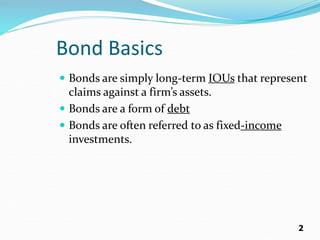
 Bonds are simply long-term IOUs that represent
claims against a firm’s assets.
 Bonds are a form of debt
 Bonds are often referred to as fixed-income
investments.
Bond Basics
3
Key Features of a Bond
 Debt instrument issued by a corp. or government.
 Par value = face amount of the bond, which is paid
at maturity (assume $1,000).
 Maturity date – when the bond must be repaid.
 Yield to maturity - rate of return earned on a bond
held until maturity.
 Coupon rate – stated interest rate (generally fixed)
paid by the issuer. Multiply by par to get dollar
payment of interest.
4
Bond Value
 Bond Value = PV(coupons) + PV(par)
 Bond Value = PV(annuity) + PV(lump sum)
5
5
Bond Valuation
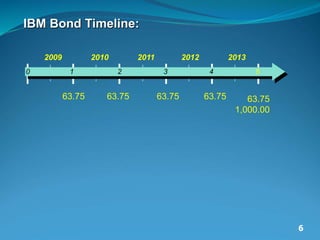
1. Compute the value for an IBM Bond with a
6.375% coupon that will mature in 5 years
given that you require an 8% return on your
investment.
6
6
0 1 2 3 4 5
2009 2010 2011 2012 2013
63.75 63.75 63.75 63.75 63.75
1,000.00
IBM Bond Timeline:
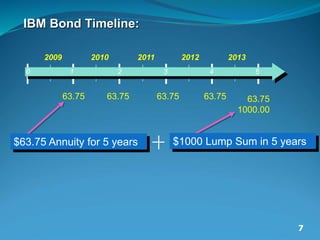
7
7
$63.75 Annuity for 5 years $1000 Lump Sum in 5 years
0 1 2 3 4 5
2009 2010 2011 2012 2013
63.75 63.75 63.75 63.75 63.75
1000.00
IBM Bond Timeline:
8
8
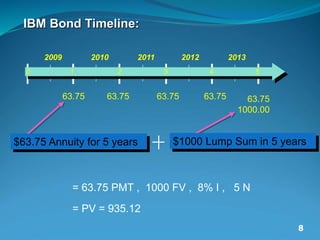
= 63.75 PMT , 1000 FV , 8% I , 5 N
= PV = 935.12
$63.75 Annuity for 5 years $1000 Lump Sum in 5 years
0 1 2 3 4 5
2009 2010 2011 2012 2013
63.75 63.75 63.75 63.75 63.75
1000.00
IBM Bond Timeline:
9
9
Semi -Annual Bonds:
Most Bonds Pay Interest Semi-Annually:
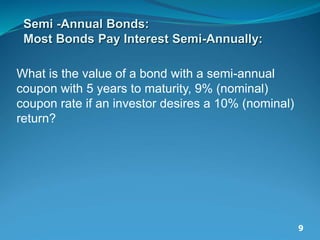
What is the value of a bond with a semi-annual
coupon with 5 years to maturity, 9% (nominal)
coupon rate if an investor desires a 10% (nominal)
return?
10
10
Most Bonds Pay Interest Semi-Annually:
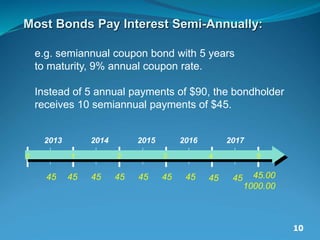
e.g. semiannual coupon bond with 5 years
to maturity, 9% annual coupon rate.
Instead of 5 annual payments of $90, the bondholder
receives 10 semiannual payments of $45.
0 1 2 3 4 5
2013 2014 2015 2016 2017
45 45.00
1000.00
45 45 45 45 45 45 45 45
11
11
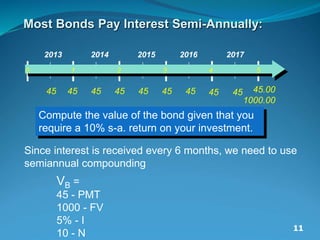
Compute the value of the bond given that you
require a 10% s-a. return on your investment.
Since interest is received every 6 months, we need to use
semiannual compounding
VB =
45 - PMT
1000 - FV
5% - I
10 - N
Most Bonds Pay Interest Semi-Annually:
0 1 2 3 4 5
2013 2014 2015 2016 2017
45 45.00
1000.00
45 45 45 45 45 45 45 45
12
12
Most Bonds Pay Interest Semi-Annually:
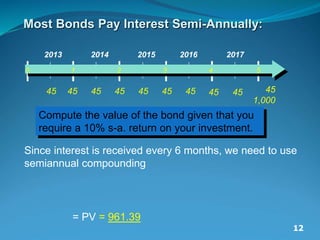
= PV = 961.39
Compute the value of the bond given that you
require a 10% s-a. return on your investment.
Since interest is received every 6 months, we need to use
semiannual compounding
0 1 2 3 4 5
2013 2014 2015 2016 2017
45 45
1,000
45 45 45 45 45 45 45 45
13
Semiannual Bonds
Ex 2
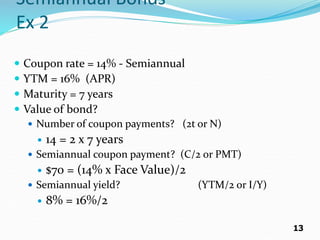
 Coupon rate = 14% - Semiannual
 YTM = 16% (APR)
 Maturity = 7 years
 Value of bond?
 Number of coupon payments? (2t or N)
 14 = 2 x 7 years
 Semiannual coupon payment? (C/2 or PMT)
 $70 = (14% x Face Value)/2
 Semiannual yield? (YTM/2 or I/Y)
 8% = 16%/2
14
Semiannual Bonds
 Semiannual coupon = $70
 Semiannual yield = 8%
 Periods to maturity = 14
 Bond value =
 70[1 – 1/(1.08)14] / .08 + 1000
/ (1.08)14 = 917.56
 
 2t
2t
2
YTM
1
F
2
YTM
2
YTM
1
1
-
1
2
C
Value
Bond


















14
14
)
08
.
1
(
1000
08
.
0
)
08
.
1
(
1
1
70
B 














Using the calculator:
14 N
8 I/Y
70 PMT
1000 FV
CPT PV = -917.56
Using Excel: =PV(0.08, 14, 70, 1000, 0)
15
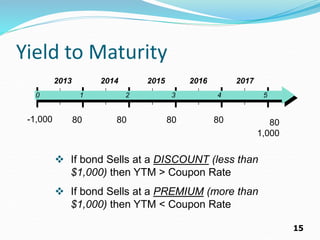
 If bond Sells at a DISCOUNT (less than
$1,000) then YTM > Coupon Rate
 If bond Sells at a PREMIUM (more than
$1,000) then YTM < Coupon Rate
Yield to Maturity
-1,000
0 1 2 3 4 5
2013 2014 2015 2016 2017
80 80 80 80 80
1,000
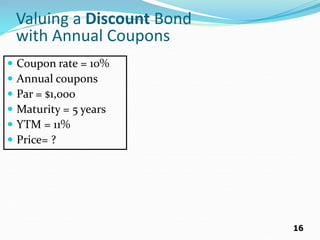
16
Valuing a Discount Bond
with Annual Coupons
 Coupon rate = 10%
 Annual coupons
 Par = $1,000
 Maturity = 5 years
 YTM = 11%
 Price= ?
17
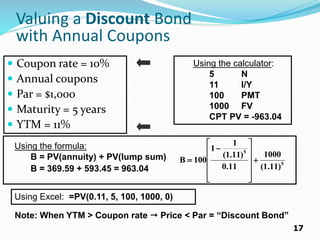
Valuing a Discount Bond
with Annual Coupons
 Coupon rate = 10%
 Annual coupons
 Par = $1,000
 Maturity = 5 years
 YTM = 11%
5
5
)
11
.
1
(
1000
11
.
0
)
11
.
1
(
1
1
100
B 














Using the formula:
B = PV(annuity) + PV(lump sum)
B = 369.59 + 593.45 = 963.04
Using the calculator:
5 N
11 I/Y
100 PMT
1000 FV
CPT PV = -963.04
Note: When YTM > Coupon rate  Price < Par = “Discount Bond”
Using Excel: =PV(0.11, 5, 100, 1000, 0)
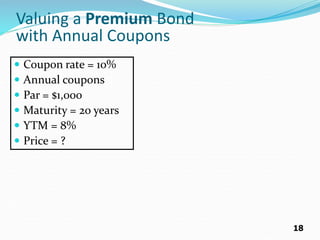
18
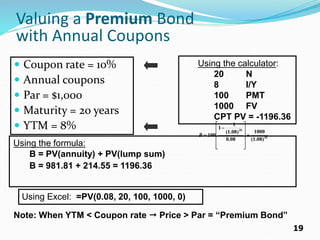
Valuing a Premium Bond
with Annual Coupons
 Coupon rate = 10%
 Annual coupons
 Par = $1,000
 Maturity = 20 years
 YTM = 8%
 Price = ?
19
Valuing a Premium Bond
with Annual Coupons
 Coupon rate = 10%
 Annual coupons
 Par = $1,000
 Maturity = 20 years
 YTM = 8%
20
20
)
08
.
1
(
1000
08
.
0
)
08
.
1
(
1
1
100 














B
Using the formula:
B = PV(annuity) + PV(lump sum)
B = 981.81 + 214.55 = 1196.36
Note: When YTM < Coupon rate  Price > Par = “Premium Bond”
Using the calculator:
20 N
8 I/Y
100 PMT
1000 FV
CPT PV = -1196.36
Using Excel: =PV(0.08, 20, 100, 1000, 0)
20
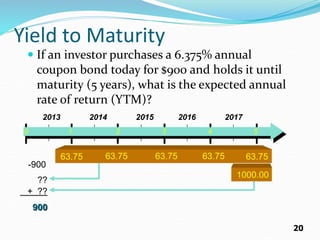
Yield to Maturity
 If an investor purchases a 6.375% annual
coupon bond today for $900 and holds it until
maturity (5 years), what is the expected annual
rate of return (YTM)?
-900
??
0 1 2 3 4 5
2013 2014 2015 2016 2017
63.75 63.75 63.75 63.75 63.75
1000.00
+ ??
900
21
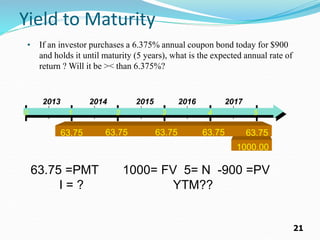
Yield to Maturity
63.75 =PMT 1000= FV 5= N -900 =PV
I = ? YTM??
• If an investor purchases a 6.375% annual coupon bond today for $900
and holds it until maturity (5 years), what is the expected annual rate of
return ? Will it be >< than 6.375%?
0 1 2 3 4 5
2013 2014 2015 2016 2017
63.75 63.75 63.75 63.75 63.75
1000.00
22
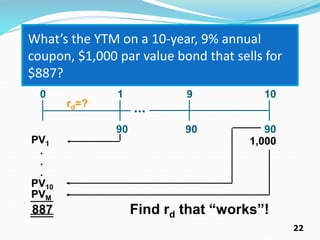
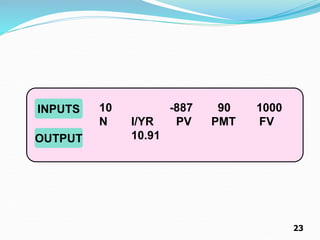
What’s the YTM on a 10-year, 9% annual
coupon, $1,000 par value bond that sells for
$887?
90 90
90
0 1 9 10
rd=?
1,000
PV1
.
.
.
PV10
PVM
887 Find rd that “works”!
...
23
10 -887 90 1000
N I/YR PV PMT FV
10.91
INPUTS
OUTPUT

bond,importance and characteristics.pptx

  • 1.
  • 2.
    2  Bonds aresimply long-term IOUs that represent claims against a firm’s assets.  Bonds are a form of debt  Bonds are often referred to as fixed-income investments. Bond Basics
  • 3.
    3 Key Features ofa Bond  Debt instrument issued by a corp. or government.  Par value = face amount of the bond, which is paid at maturity (assume $1,000).  Maturity date – when the bond must be repaid.  Yield to maturity - rate of return earned on a bond held until maturity.  Coupon rate – stated interest rate (generally fixed) paid by the issuer. Multiply by par to get dollar payment of interest.
  • 4.
    4 Bond Value  BondValue = PV(coupons) + PV(par)  Bond Value = PV(annuity) + PV(lump sum)
  • 5.
    5 5 Bond Valuation 1. Computethe value for an IBM Bond with a 6.375% coupon that will mature in 5 years given that you require an 8% return on your investment.
  • 6.
    6 6 0 1 23 4 5 2009 2010 2011 2012 2013 63.75 63.75 63.75 63.75 63.75 1,000.00 IBM Bond Timeline:
  • 7.
    7 7 $63.75 Annuity for5 years $1000 Lump Sum in 5 years 0 1 2 3 4 5 2009 2010 2011 2012 2013 63.75 63.75 63.75 63.75 63.75 1000.00 IBM Bond Timeline:
  • 8.
    8 8 = 63.75 PMT, 1000 FV , 8% I , 5 N = PV = 935.12 $63.75 Annuity for 5 years $1000 Lump Sum in 5 years 0 1 2 3 4 5 2009 2010 2011 2012 2013 63.75 63.75 63.75 63.75 63.75 1000.00 IBM Bond Timeline:
  • 9.
    9 9 Semi -Annual Bonds: MostBonds Pay Interest Semi-Annually: What is the value of a bond with a semi-annual coupon with 5 years to maturity, 9% (nominal) coupon rate if an investor desires a 10% (nominal) return?
  • 10.
    10 10 Most Bonds PayInterest Semi-Annually: e.g. semiannual coupon bond with 5 years to maturity, 9% annual coupon rate. Instead of 5 annual payments of $90, the bondholder receives 10 semiannual payments of $45. 0 1 2 3 4 5 2013 2014 2015 2016 2017 45 45.00 1000.00 45 45 45 45 45 45 45 45
  • 11.
    11 11 Compute the valueof the bond given that you require a 10% s-a. return on your investment. Since interest is received every 6 months, we need to use semiannual compounding VB = 45 - PMT 1000 - FV 5% - I 10 - N Most Bonds Pay Interest Semi-Annually: 0 1 2 3 4 5 2013 2014 2015 2016 2017 45 45.00 1000.00 45 45 45 45 45 45 45 45
  • 12.
    12 12 Most Bonds PayInterest Semi-Annually: = PV = 961.39 Compute the value of the bond given that you require a 10% s-a. return on your investment. Since interest is received every 6 months, we need to use semiannual compounding 0 1 2 3 4 5 2013 2014 2015 2016 2017 45 45 1,000 45 45 45 45 45 45 45 45
  • 13.
    13 Semiannual Bonds Ex 2 Coupon rate = 14% - Semiannual  YTM = 16% (APR)  Maturity = 7 years  Value of bond?  Number of coupon payments? (2t or N)  14 = 2 x 7 years  Semiannual coupon payment? (C/2 or PMT)  $70 = (14% x Face Value)/2  Semiannual yield? (YTM/2 or I/Y)  8% = 16%/2
  • 14.
    14 Semiannual Bonds  Semiannualcoupon = $70  Semiannual yield = 8%  Periods to maturity = 14  Bond value =  70[1 – 1/(1.08)14] / .08 + 1000 / (1.08)14 = 917.56    2t 2t 2 YTM 1 F 2 YTM 2 YTM 1 1 - 1 2 C Value Bond                   14 14 ) 08 . 1 ( 1000 08 . 0 ) 08 . 1 ( 1 1 70 B                Using the calculator: 14 N 8 I/Y 70 PMT 1000 FV CPT PV = -917.56 Using Excel: =PV(0.08, 14, 70, 1000, 0)
  • 15.
    15  If bondSells at a DISCOUNT (less than $1,000) then YTM > Coupon Rate  If bond Sells at a PREMIUM (more than $1,000) then YTM < Coupon Rate Yield to Maturity -1,000 0 1 2 3 4 5 2013 2014 2015 2016 2017 80 80 80 80 80 1,000
  • 16.
    16 Valuing a DiscountBond with Annual Coupons  Coupon rate = 10%  Annual coupons  Par = $1,000  Maturity = 5 years  YTM = 11%  Price= ?
  • 17.
    17 Valuing a DiscountBond with Annual Coupons  Coupon rate = 10%  Annual coupons  Par = $1,000  Maturity = 5 years  YTM = 11% 5 5 ) 11 . 1 ( 1000 11 . 0 ) 11 . 1 ( 1 1 100 B                Using the formula: B = PV(annuity) + PV(lump sum) B = 369.59 + 593.45 = 963.04 Using the calculator: 5 N 11 I/Y 100 PMT 1000 FV CPT PV = -963.04 Note: When YTM > Coupon rate  Price < Par = “Discount Bond” Using Excel: =PV(0.11, 5, 100, 1000, 0)
  • 18.
    18 Valuing a PremiumBond with Annual Coupons  Coupon rate = 10%  Annual coupons  Par = $1,000  Maturity = 20 years  YTM = 8%  Price = ?
  • 19.
    19 Valuing a PremiumBond with Annual Coupons  Coupon rate = 10%  Annual coupons  Par = $1,000  Maturity = 20 years  YTM = 8% 20 20 ) 08 . 1 ( 1000 08 . 0 ) 08 . 1 ( 1 1 100                B Using the formula: B = PV(annuity) + PV(lump sum) B = 981.81 + 214.55 = 1196.36 Note: When YTM < Coupon rate  Price > Par = “Premium Bond” Using the calculator: 20 N 8 I/Y 100 PMT 1000 FV CPT PV = -1196.36 Using Excel: =PV(0.08, 20, 100, 1000, 0)
  • 20.
    20 Yield to Maturity If an investor purchases a 6.375% annual coupon bond today for $900 and holds it until maturity (5 years), what is the expected annual rate of return (YTM)? -900 ?? 0 1 2 3 4 5 2013 2014 2015 2016 2017 63.75 63.75 63.75 63.75 63.75 1000.00 + ?? 900
  • 21.
    21 Yield to Maturity 63.75=PMT 1000= FV 5= N -900 =PV I = ? YTM?? • If an investor purchases a 6.375% annual coupon bond today for $900 and holds it until maturity (5 years), what is the expected annual rate of return ? Will it be >< than 6.375%? 0 1 2 3 4 5 2013 2014 2015 2016 2017 63.75 63.75 63.75 63.75 63.75 1000.00
  • 22.
    22 What’s the YTMon a 10-year, 9% annual coupon, $1,000 par value bond that sells for $887? 90 90 90 0 1 9 10 rd=? 1,000 PV1 . . . PV10 PVM 887 Find rd that “works”! ...
  • 23.
    23 10 -887 901000 N I/YR PV PMT FV 10.91 INPUTS OUTPUT