Welcome to Maastricht University
Economics & Business Economics A. Predtetchinski Program me  Coordinator IES Assistant Professor Tessa Voesenek 3 rd  year student IES
What is Economics/Business Economics? Economics  is a social science that studies the production, distribution, trade and consumption of goods and services. Applications of Economics:  Policy : competition policy, market regulation, monetary policy, fiscal policy.  Business : finance, strategy, organization, accounting. Business Economics  focuses on decision-making in firms based on economic principles. .
Example: economic crisis and public cuts Should governments bail out private companies using taxpayer money? How much market regulation is desirable? Public cuts: can they deepen the economic slowdown?  What is Economics/Business Economics?
Job Perspectives E&BE Source: Research Centre for Education and the Labour Market (ROA)
E&BE - year 1 Organisation  and Marketing Quantitative Methods 1 Microeconomics Accounting/Financial Information Systems Reflection on Academic Discourse in Business and Economics Macroeconomics Quantitative Methods 2 Finance International  Economic Relations Economy game
Specialisations in E&BE International Business Economics (IBE) International Economic Studies (IES) Infonomics
International Business Economics Decision-making in businesses based on the principles of Economics. Business  component: accounting, finance, supply chain management, marketing, strategy, organization, etc. Economics  component: financial markets, competition among firms, market regulation, etc.
IBE – year 2 Quantitative Business   Marketing and Supply Chain Management Accounting Banking Financial Markets Managerial Economics Industrial Organization International Business Strategy
IBE – year 3 One business specialization (major) Two business/economics electives One semester study abroad Bachelor’s thesis
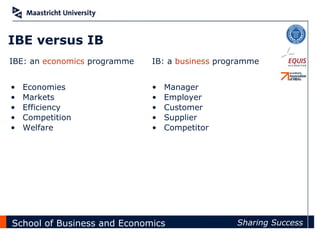
IBE versus IB IBE: an  economics  programme IB:  a  b usiness  programme Institutions Competition Competitors Supplier People Welfare Economies Markets Efficiency Competition Welfare Manager Employer Customer Supplier Competitor
Special isations  in E&BE International Business Economics (IBE) International Economic Studies (IES) Infonomics
International Economic Studies Applied economics on solid theoretical foundations. Policy focus: market regulation, competition policy, monetary and fiscal policy, public finance, etc. Multidisciplinary: aspects of sociology and psychology.
IES – year 2 Quantitative Methods Microeconomics: Choices, Markets and Welfare Macroeconomics and Economic Policy Public Economics Productivity International Economics Institutions, Behavior and Welfare Theories of Social Order
IES – year 3 One semesters of electives One semester study abroad Bachelor’s thesis
Specialisations in E&BE International Business Economics  International Economic Studies Infonomics
Infonomics Economics and Business of the Information Society Broad discipline within economics and business with a focus on  information society. Impact of information and information technologies on  firms, markets, governments, and societies What are the implications of the Internet for firms' strategies and market structures? How can a firm use information to become more competitive?
Infonomics – year 2 Economics and Business of the Information Society Quantitative Methods Introduction into the Information Society Information Management Knowledge Management ICT, Organisation and Income Systems Analysis & Design Productivity Network Economics
Infonomics – year 3 Economics and Business of the Information Society Two more compulsory courses: Information, Justice and the Political Process ERP and Business Intelligence Two electives One semester study or  internship  abroad Bachelor’s thesis
After the Bachelor … Enter the Job-market  Master elsewhere, inside or outside the Netherlands Internship before continuing studies Master at this faculty
Bachelor Economics Infonomics Intern. Economic Studies Intern. Business Economics Bachelor Fiscal  Economics Bachelor Econometrics and Operations Research Bachelor International Business Master Financial Economics Master International Economic Studies Master Fiscal Economics Master International Business Job market Master Infonomics Master Management of Learning Master Econometrics and Operations Research Research Master Business Research Research Master Economic & Financial Research PhD / Doctoral Programme Bachelor Economics and Business Economics Intern. Economic Studies Infonomics Intern. Business Economics Bachelor Fiscal  Economics Bachelor Econometrics and Operations Research Bachelor International Business Master International Business Master Financial Economics Master International Economic Studies Master Fiscal Economics Master Infonomics Master Management of Learning Master Econometrics and Operations Research Research Master Business Research Research Master Economic & Financial Research PhD / Doctoral Programme Job market
Why studying E&BE? High quality education  Applicable knowledge Choice of specialization (IBE, IES, or Infonomics) Internationally oriented Interactive Includes training in professional skills
Applications Numerus Fixus (total 450 places) Decentralised  Selection  (225 places).  Deadline: 1 May 2011 Motivation letter Essay on a topic in the field of Economics or Business Economics.  CV Indicate : education, all relevant experience (work, social activities etc.), language proficiency.  Central Selection  (225 places). Deadline: 15 May 2011
Information Fair Faculty of Economics and Business Administration ECT & OR FE IB Mensa Student Services DUO (Former IB-groep) PGE Study Abroad Master’s Programmes & Decentral Selection IB/EC Language Centre IES INF IBE EFM Academy UB Double degrees Education & Exams Office Student Life
Introduction Tessa Voesenek 3rd year Economics student Specialisation IES
IES, what is it again? IES is somewhat comparable to Economie 1/2 as taught in Dutch high schools, whereas IBE is more like M&O Macroeconomics: GDP, Government Budget, Exchange rate, Consumption, Inflation, Interest rate. Microeconomics: Individual behaviour, Constrained Utility maximisation, Monopolies, Oligopolies, Cartels.
So, what do I do? Time Monday Tuesday Wednesday Thursday Friday 08:30 10:30 11:00- 13:00 Tutorial Behav.Ec Tutorial Macroec. Tutorial Behav.Ec 13:30- 15:30 Lecture Macroec. 16:00- 18:00 18:00-
But it is not that empty! Time Monday Tuesday Wednesday Thursday Friday 08:30 10:30 Study  Sports Sports Sleep Sleep 11:00- 13:00 Tutoria Behav.Ec Tutorial Macroec. Study Tutorial Behav.Ec Still hangover…. 13:30- 15:30 Study Study  Lecture Macroec. Study Study  16:00- 18:00 Sports Meet friends Meeting SC Study Study 18:00- Dinner with friends Info session study abroad Party  Sorority evening Catch the train back home
So what can you do besides your studies?
Sports in Maastricht?  UM Sportscard : access to a large amount of sports    maastrichtuniversity.nl/sport e.g. Zumba, Yoga, Power kick, Basketball, Judo Student Sport Associations (SSA): 23 Associations:  Athletics, Badminton, Basketball, Climbing, Cycling/Mountainbiking, Dancing, Fencing, Field Hockey, Football/Futsal, Gymnastics, Handball,  Horseback riding, Karate, Korfball,    Lacrosse, Rowing, Rugby, Sailing/Surfing,  Swimming, Tennis, Triathlon,  Unihockey/Floorball, Volleyball
Board functions and internships Study associations:
Studentlife in Maastricht Student Associations Independent fraternities/ sororities
And all of that combined with..
Makes studying not that hard afterall!   Hope to see you next year!
Questions?
 

Economics and Business Economics

  • 1.
  • 2.
    Economics & BusinessEconomics A. Predtetchinski Program me Coordinator IES Assistant Professor Tessa Voesenek 3 rd year student IES
  • 3.
    What is Economics/BusinessEconomics? Economics is a social science that studies the production, distribution, trade and consumption of goods and services. Applications of Economics: Policy : competition policy, market regulation, monetary policy, fiscal policy. Business : finance, strategy, organization, accounting. Business Economics focuses on decision-making in firms based on economic principles. .
  • 4.
    Example: economic crisisand public cuts Should governments bail out private companies using taxpayer money? How much market regulation is desirable? Public cuts: can they deepen the economic slowdown? What is Economics/Business Economics?
  • 5.
    Job Perspectives E&BESource: Research Centre for Education and the Labour Market (ROA)
  • 6.
    E&BE - year1 Organisation and Marketing Quantitative Methods 1 Microeconomics Accounting/Financial Information Systems Reflection on Academic Discourse in Business and Economics Macroeconomics Quantitative Methods 2 Finance International Economic Relations Economy game
  • 7.
    Specialisations in E&BEInternational Business Economics (IBE) International Economic Studies (IES) Infonomics
  • 8.
    International Business EconomicsDecision-making in businesses based on the principles of Economics. Business component: accounting, finance, supply chain management, marketing, strategy, organization, etc. Economics component: financial markets, competition among firms, market regulation, etc.
  • 9.
    IBE – year2 Quantitative Business Marketing and Supply Chain Management Accounting Banking Financial Markets Managerial Economics Industrial Organization International Business Strategy
  • 10.
    IBE – year3 One business specialization (major) Two business/economics electives One semester study abroad Bachelor’s thesis
  • 11.
    IBE versus IBIBE: an economics programme IB: a b usiness programme Institutions Competition Competitors Supplier People Welfare Economies Markets Efficiency Competition Welfare Manager Employer Customer Supplier Competitor
  • 12.
    Special isations in E&BE International Business Economics (IBE) International Economic Studies (IES) Infonomics
  • 13.
    International Economic StudiesApplied economics on solid theoretical foundations. Policy focus: market regulation, competition policy, monetary and fiscal policy, public finance, etc. Multidisciplinary: aspects of sociology and psychology.
  • 14.
    IES – year2 Quantitative Methods Microeconomics: Choices, Markets and Welfare Macroeconomics and Economic Policy Public Economics Productivity International Economics Institutions, Behavior and Welfare Theories of Social Order
  • 15.
    IES – year3 One semesters of electives One semester study abroad Bachelor’s thesis
  • 16.
    Specialisations in E&BEInternational Business Economics International Economic Studies Infonomics
  • 17.
    Infonomics Economics andBusiness of the Information Society Broad discipline within economics and business with a focus on information society. Impact of information and information technologies on firms, markets, governments, and societies What are the implications of the Internet for firms' strategies and market structures? How can a firm use information to become more competitive?
  • 18.
    Infonomics – year2 Economics and Business of the Information Society Quantitative Methods Introduction into the Information Society Information Management Knowledge Management ICT, Organisation and Income Systems Analysis & Design Productivity Network Economics
  • 19.
    Infonomics – year3 Economics and Business of the Information Society Two more compulsory courses: Information, Justice and the Political Process ERP and Business Intelligence Two electives One semester study or internship abroad Bachelor’s thesis
  • 20.
    After the Bachelor… Enter the Job-market Master elsewhere, inside or outside the Netherlands Internship before continuing studies Master at this faculty
  • 21.
    Bachelor Economics InfonomicsIntern. Economic Studies Intern. Business Economics Bachelor Fiscal Economics Bachelor Econometrics and Operations Research Bachelor International Business Master Financial Economics Master International Economic Studies Master Fiscal Economics Master International Business Job market Master Infonomics Master Management of Learning Master Econometrics and Operations Research Research Master Business Research Research Master Economic & Financial Research PhD / Doctoral Programme Bachelor Economics and Business Economics Intern. Economic Studies Infonomics Intern. Business Economics Bachelor Fiscal Economics Bachelor Econometrics and Operations Research Bachelor International Business Master International Business Master Financial Economics Master International Economic Studies Master Fiscal Economics Master Infonomics Master Management of Learning Master Econometrics and Operations Research Research Master Business Research Research Master Economic & Financial Research PhD / Doctoral Programme Job market
  • 22.
    Why studying E&BE?High quality education Applicable knowledge Choice of specialization (IBE, IES, or Infonomics) Internationally oriented Interactive Includes training in professional skills
  • 23.
    Applications Numerus Fixus(total 450 places) Decentralised Selection (225 places). Deadline: 1 May 2011 Motivation letter Essay on a topic in the field of Economics or Business Economics. CV Indicate : education, all relevant experience (work, social activities etc.), language proficiency. Central Selection (225 places). Deadline: 15 May 2011
  • 24.
    Information Fair Facultyof Economics and Business Administration ECT & OR FE IB Mensa Student Services DUO (Former IB-groep) PGE Study Abroad Master’s Programmes & Decentral Selection IB/EC Language Centre IES INF IBE EFM Academy UB Double degrees Education & Exams Office Student Life
  • 25.
    Introduction Tessa Voesenek3rd year Economics student Specialisation IES
  • 26.
    IES, what isit again? IES is somewhat comparable to Economie 1/2 as taught in Dutch high schools, whereas IBE is more like M&O Macroeconomics: GDP, Government Budget, Exchange rate, Consumption, Inflation, Interest rate. Microeconomics: Individual behaviour, Constrained Utility maximisation, Monopolies, Oligopolies, Cartels.
  • 27.
    So, what doI do? Time Monday Tuesday Wednesday Thursday Friday 08:30 10:30 11:00- 13:00 Tutorial Behav.Ec Tutorial Macroec. Tutorial Behav.Ec 13:30- 15:30 Lecture Macroec. 16:00- 18:00 18:00-
  • 28.
    But it isnot that empty! Time Monday Tuesday Wednesday Thursday Friday 08:30 10:30 Study Sports Sports Sleep Sleep 11:00- 13:00 Tutoria Behav.Ec Tutorial Macroec. Study Tutorial Behav.Ec Still hangover…. 13:30- 15:30 Study Study Lecture Macroec. Study Study 16:00- 18:00 Sports Meet friends Meeting SC Study Study 18:00- Dinner with friends Info session study abroad Party Sorority evening Catch the train back home
  • 29.
    So what canyou do besides your studies?
  • 30.
    Sports in Maastricht? UM Sportscard : access to a large amount of sports  maastrichtuniversity.nl/sport e.g. Zumba, Yoga, Power kick, Basketball, Judo Student Sport Associations (SSA): 23 Associations: Athletics, Badminton, Basketball, Climbing, Cycling/Mountainbiking, Dancing, Fencing, Field Hockey, Football/Futsal, Gymnastics, Handball, Horseback riding, Karate, Korfball, Lacrosse, Rowing, Rugby, Sailing/Surfing, Swimming, Tennis, Triathlon, Unihockey/Floorball, Volleyball
  • 31.
    Board functions andinternships Study associations:
  • 32.
    Studentlife in MaastrichtStudent Associations Independent fraternities/ sororities
  • 33.
    And all ofthat combined with..
  • 34.
    Makes studying notthat hard afterall!  Hope to see you next year!
  • 35.
  • 36.

Editor's Notes

  • #9 Accounting: Measuring activities, and disclosing and providing assurance of information about those activities to improve decision-making in firms Finance: Financial management within firms; Functioning of capital markets Information Management: Systematic development of information systems; Implementation of information systems to enhance performance Supply Chain Management: Managing and controlling logistic activities within and between firms Marketing: Understanding the consumer markets in which organisations operate; Services marketing Organ isation: Focuses on the structure of organisations and their market environment; Organisational structure and behaviour , HRM Strategy: Development and implementation of corporate strategies; Organisation and management of projects and production