Unit-2
Subject: BUSINESS MATHEMATICS AND
STATISTICS
Code: M-103
By: Dr. Manish Dwivedi
MBA Department
Matrices and Determinants
11/27/20171 AIET, Jaipur
Unit 2: Introduction
Contents of Unit-2
 Solving linear equations by using matrices,
 Input-Output analysis.
 Application of matrices for solution to simple
business and economic problems.
11/27/20172 AIET, Jaipur
SOLUTION OF A SYSTEM OF LINEAR EQUATIONS
11/27/2017AIET, Jaipur3
 MATRIX METHOD
In this method, we first express the given system of
equation in the matrix form AX=B, where A is called the
co-efficient matrix.
 For example, if the given system of equation is a1x +
b1y = c1 and a2 x + b2y = c2, we express them in the
matrix equation form as :
SOLUTION OF A SYSTEM OF LINEAR EQUATIONS
Contd.
11/27/2017AIET, Jaipur4
 Example: Solve the following system of equations,
using matrix method.
SOLUTION OF A SYSTEM OF LINEAR EQUATIONS
Contd.
11/27/2017AIET, Jaipur5
SOLUTION OF A SYSTEM OF LINEAR EQUATIONS
Contd.
11/27/2017AIET, Jaipur6
Cramer’s Rule for Matrix solutions
 Cramer’s rule provide a simplified method of
solving a system of linear equations through the
use of determinants. Cramer’s rule states that
SOLUTION OF A SYSTEM OF LINEAR EQUATIONS
Contd.
11/27/2017AIET, Jaipur7
SOLUTION OF A SYSTEM OF LINEAR EQUATIONS
Contd.
11/27/2017AIET, Jaipur8
Input-Output Analysis
11/27/2017AIET, Jaipur9
Leontief's Input-Output Analysis
 Input-output analysis was first attempted by Prof. Leontief, hence the name of
this technique is Leontief's Input-Output Analysis. In every economy the output of
an industry is used as input by other industries and also consumed by ultimate
consumers (which includes government purchases, exports and consumption by
public). This output is said to equal to total demand. The part of output of
industries utilized as input in the economy is known as intermediate demand and
the part bought by ultimate consumers is known as final demand. Following
assumptions are inherent in this analysis.
(1) Each industry produces only one type of goods. If more than one type of items
are produced, then they are considered different industries.
(2) The total output of each industry is sufficient to meet the intermediate as well as
the final demand. Shortages or surpluses are not permitted.
(3) Xij = aij xj
 where xij= output of industry i that will be required by industry j
 aij = (Constant) proportion of output of industry i required by industry j for
producing
one unit.
 xj= Total output of industry j
Input-Output Analysis
11/27/2017AIET, Jaipur10
 Input-Output models are of two types : closed
model and open model.
 under the Closed model, total output in an
economy is consumed by industries and under
the open mode, ultimate consumers also
consume output in addition to consumption by
industries.
 In an open model if there are two industries. I
and II, output of industry I is used by industry I
and II and the remainder is used by final
consumers. Similar is the case with industry II.
Input-Output Analysis
11/27/2017AIET, Jaipur11
 The analysis emphasizes the inter-industry
interdependence i.e., each industry uses output of
various industries, including its own output as inputs.
Whatever is used up in production of a good by an
industry is called intermediate and the production is
considered to be an output. Let us assume that an
economy has n industries, each producing only one
kind of a good. Let be the total output of jth industry (j
= 1, 2, 3, … x) and denote the output of ith industry
used by jth industry as input to produce xj units.
Input-Output Analysis
11/27/2017AIET, Jaipur12
 Proportion of ith industry demand for ith industry
output (xij) to manufacture its total output xj is
constant.
 aijs are called technical coefficients or input
coefficients or input-output coefficients.
Thus, aij is the quantity of ith goods required to
produce one unit of jth good. (This interpretation
holds goods when and are expressed in terms
of physical units.
Input-Output Analysis
11/27/2017AIET, Jaipur13
 The Open Input-Output Model
 It is assumed that in addition to the n industries, which
produces various goods and uses or demands their
output to be used as input in the production process.
There is final demand or final consumption of these
goods as well. It is determined exogenously and is
denoted by di as final demand for the ith good (i = 1, 2, 3,
…, n).
 The objective is to compute output X1, X2,...,Xn of
the n industries which is required to meet the input
needs of various industries and final demand as well.
Input-Output Analysis
11/27/2017AIET, Jaipur14
 Total/Gross output of the industry will be the summation of all
intermediate demand for the product plus the final demand d is for the
product arising from ultimate or final consumers or users. Primary input
can be land, labour or capital.
 Thus,
 In matrix form, it can be written as
 X = AX + D
Input-Output Analysis
11/27/2017AIET, Jaipur15
Where,
Input-Output Analysis
11/27/2017AIET, Jaipur16
 Closed Input-Output Model
 The closed model does not have final demand by the ultimate users.
The entire production is consumed by the industries internally i.e.
whatever is produced consumed within the industries itself.
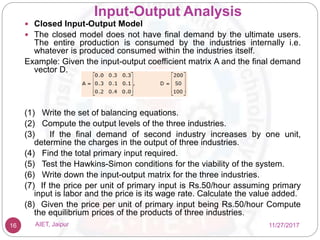
Example: Given the input-output coefficient matrix A and the final demand
vector D.
(1) Write the set of balancing equations.
(2) Compute the output levels of the three industries.
(3) If the final demand of second industry increases by one unit,
determine the charges in the output of three industries.
(4) Find the total primary input required.
(5) Test the Hawkins-Simon conditions for the viability of the system.
(6) Write down the input-output matrix for the three industries.
(7) If the price per unit of primary input is Rs.50/hour assuming primary
input is labor and the price is its wage rate. Calculate the value added.
(8) Given the price per unit of primary input being Rs.50/hour Compute
the equilibrium prices of the products of three industries.
Input-Output Analysis
11/27/2017AIET, Jaipur17
Input-Output Analysis
11/27/2017AIET, Jaipur18
Input-Output Analysis
11/27/2017AIET, Jaipur19
Input-Output Analysis
11/27/2017AIET, Jaipur20
 (6) Input -Output Table
 (7) Value Added = Primary Input Requirement x Price
Per Unit
 Value added = 350 (50)
 Value added = Rs.17,500
 (8) Let P1, P2 and P3 be the price unit of goods of three
industries:
Input-Output Analysis
11/27/2017AIET, Jaipur21
THANK YOU 
11/27/201722 AIET, Jaipur

Unit 2

  • 1.
    Unit-2 Subject: BUSINESS MATHEMATICSAND STATISTICS Code: M-103 By: Dr. Manish Dwivedi MBA Department Matrices and Determinants 11/27/20171 AIET, Jaipur
  • 2.
    Unit 2: Introduction Contentsof Unit-2  Solving linear equations by using matrices,  Input-Output analysis.  Application of matrices for solution to simple business and economic problems. 11/27/20172 AIET, Jaipur
  • 3.
    SOLUTION OF ASYSTEM OF LINEAR EQUATIONS 11/27/2017AIET, Jaipur3  MATRIX METHOD In this method, we first express the given system of equation in the matrix form AX=B, where A is called the co-efficient matrix.  For example, if the given system of equation is a1x + b1y = c1 and a2 x + b2y = c2, we express them in the matrix equation form as :
  • 4.
    SOLUTION OF ASYSTEM OF LINEAR EQUATIONS Contd. 11/27/2017AIET, Jaipur4  Example: Solve the following system of equations, using matrix method.
  • 5.
    SOLUTION OF ASYSTEM OF LINEAR EQUATIONS Contd. 11/27/2017AIET, Jaipur5
  • 6.
    SOLUTION OF ASYSTEM OF LINEAR EQUATIONS Contd. 11/27/2017AIET, Jaipur6 Cramer’s Rule for Matrix solutions  Cramer’s rule provide a simplified method of solving a system of linear equations through the use of determinants. Cramer’s rule states that
  • 7.
    SOLUTION OF ASYSTEM OF LINEAR EQUATIONS Contd. 11/27/2017AIET, Jaipur7
  • 8.
    SOLUTION OF ASYSTEM OF LINEAR EQUATIONS Contd. 11/27/2017AIET, Jaipur8
  • 9.
    Input-Output Analysis 11/27/2017AIET, Jaipur9 Leontief'sInput-Output Analysis  Input-output analysis was first attempted by Prof. Leontief, hence the name of this technique is Leontief's Input-Output Analysis. In every economy the output of an industry is used as input by other industries and also consumed by ultimate consumers (which includes government purchases, exports and consumption by public). This output is said to equal to total demand. The part of output of industries utilized as input in the economy is known as intermediate demand and the part bought by ultimate consumers is known as final demand. Following assumptions are inherent in this analysis. (1) Each industry produces only one type of goods. If more than one type of items are produced, then they are considered different industries. (2) The total output of each industry is sufficient to meet the intermediate as well as the final demand. Shortages or surpluses are not permitted. (3) Xij = aij xj  where xij= output of industry i that will be required by industry j  aij = (Constant) proportion of output of industry i required by industry j for producing one unit.  xj= Total output of industry j
  • 10.
    Input-Output Analysis 11/27/2017AIET, Jaipur10 Input-Output models are of two types : closed model and open model.  under the Closed model, total output in an economy is consumed by industries and under the open mode, ultimate consumers also consume output in addition to consumption by industries.  In an open model if there are two industries. I and II, output of industry I is used by industry I and II and the remainder is used by final consumers. Similar is the case with industry II.
  • 11.
    Input-Output Analysis 11/27/2017AIET, Jaipur11 The analysis emphasizes the inter-industry interdependence i.e., each industry uses output of various industries, including its own output as inputs. Whatever is used up in production of a good by an industry is called intermediate and the production is considered to be an output. Let us assume that an economy has n industries, each producing only one kind of a good. Let be the total output of jth industry (j = 1, 2, 3, … x) and denote the output of ith industry used by jth industry as input to produce xj units.
  • 12.
    Input-Output Analysis 11/27/2017AIET, Jaipur12 Proportion of ith industry demand for ith industry output (xij) to manufacture its total output xj is constant.  aijs are called technical coefficients or input coefficients or input-output coefficients. Thus, aij is the quantity of ith goods required to produce one unit of jth good. (This interpretation holds goods when and are expressed in terms of physical units.
  • 13.
    Input-Output Analysis 11/27/2017AIET, Jaipur13 The Open Input-Output Model  It is assumed that in addition to the n industries, which produces various goods and uses or demands their output to be used as input in the production process. There is final demand or final consumption of these goods as well. It is determined exogenously and is denoted by di as final demand for the ith good (i = 1, 2, 3, …, n).  The objective is to compute output X1, X2,...,Xn of the n industries which is required to meet the input needs of various industries and final demand as well.
  • 14.
    Input-Output Analysis 11/27/2017AIET, Jaipur14 Total/Gross output of the industry will be the summation of all intermediate demand for the product plus the final demand d is for the product arising from ultimate or final consumers or users. Primary input can be land, labour or capital.  Thus,  In matrix form, it can be written as  X = AX + D
  • 15.
  • 16.
    Input-Output Analysis 11/27/2017AIET, Jaipur16 Closed Input-Output Model  The closed model does not have final demand by the ultimate users. The entire production is consumed by the industries internally i.e. whatever is produced consumed within the industries itself. Example: Given the input-output coefficient matrix A and the final demand vector D. (1) Write the set of balancing equations. (2) Compute the output levels of the three industries. (3) If the final demand of second industry increases by one unit, determine the charges in the output of three industries. (4) Find the total primary input required. (5) Test the Hawkins-Simon conditions for the viability of the system. (6) Write down the input-output matrix for the three industries. (7) If the price per unit of primary input is Rs.50/hour assuming primary input is labor and the price is its wage rate. Calculate the value added. (8) Given the price per unit of primary input being Rs.50/hour Compute the equilibrium prices of the products of three industries.
  • 17.
  • 18.
  • 19.
  • 20.
    Input-Output Analysis 11/27/2017AIET, Jaipur20 (6) Input -Output Table  (7) Value Added = Primary Input Requirement x Price Per Unit  Value added = 350 (50)  Value added = Rs.17,500  (8) Let P1, P2 and P3 be the price unit of goods of three industries:
  • 21.
  • 22.