International
Economics
Dr.R.Alagesan,
Assistant Professor of Economics,
Department of Economics,
Mannar Thirumalai Naicker College,
Madurai
Meaning
• International economics is
concerned with the effects
upon economic activity from
international differences in
productive resources and
consumer preferences and the
international institutions that
affect them.
Nature of International Economics
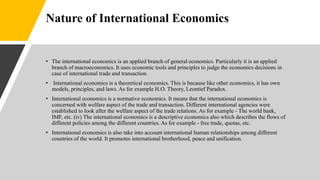
• The international economics is an applied branch of general economics. Particularly it is an applied
branch of macroeconomics. It uses economic tools and principles to judge the economics decisions in
case of international trade and transaction.
• International economics is a theoretical economics. This is because like other economics, it has own
models, principles, and laws. As for example H.O. Theory, Leontief Paradox.
• International economics is a normative economics. It means that the international economics is
concerned with welfare aspect of the trade and transaction. Different international agencies were
established to look after the welfare aspect of the trade relations. As for example - The world bank,
IMF, etc. (iv) The international economics is a descriptive economics also which describes the flows of
different policies among the different countries. As for example - free trade, quotas, etc.
• International economics is also take into account international human relationships among different
countries of the world. It promotes international brotherhood, peace and unification.
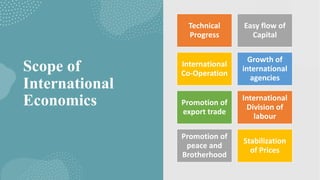
Scope of
International
Economics
Technical
Progress
Easy flow of
Capital
International
Co-Operation
Growth of
international
agencies
Promotion of
export trade
International
Division of
labour
Promotion of
peace and
Brotherhood
Stabilization
of Prices
IMPORTANCE OF INTERNATIONAL TRADE
MAKE MAXIMUM USE
OF RAW MATERIALS
COMPARATIVE BENEFIT GREAT CHOICE FOR
USERS
SPECIALIZATION AND
ECONOMY – MORE
EFFICIENCY
BUSINESS IN SERVICE
SECTOR
GLOBAL DEVELOPMENT
AND ECONOMIC
DEVELOPMENT
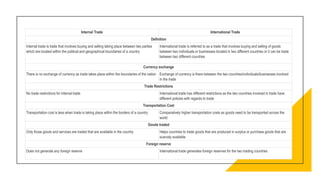
Internal Trade International Trade
Definition
Internal trade is trade that involves buying and selling taking place between two parties
which are located within the political and geographical boundaries of a country
International trade is referred to as a trade that involves buying and selling of goods
between two individuals or businesses located in two different countries or it can be trade
between two different countries
Currency exchange
There is no exchange of currency as trade takes place within the boundaries of the nation Exchange of currency is there between the two countries/individuals/businesses involved
in the trade
Trade Restrictions
No trade restrictions for internal trade International trade has different restrictions as the two countries involved in trade have
different policies with regards to trade
Transportation Cost
Transportation cost is less when trade is taking place within the borders of a country Comparatively higher transportation costs as goods need to be transported across the
world
Goods traded
Only those goods and services are traded that are available in the country Helps countries to trade goods that are produced in surplus or purchase goods that are
scarcely available
Foreign reserve
Does not generate any foreign reserve International trade generates foreign reserves for the two trading countries
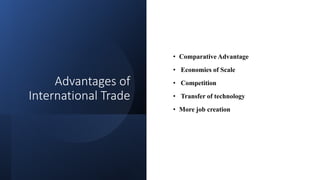
Advantages of
International Trade
• Comparative Advantage
• Economies of Scale
• Competition
• Transfer of technology
• More job creation

International Economics.pptx

  • 1.
    International Economics Dr.R.Alagesan, Assistant Professor ofEconomics, Department of Economics, Mannar Thirumalai Naicker College, Madurai
  • 2.
    Meaning • International economicsis concerned with the effects upon economic activity from international differences in productive resources and consumer preferences and the international institutions that affect them.
  • 3.
    Nature of InternationalEconomics • The international economics is an applied branch of general economics. Particularly it is an applied branch of macroeconomics. It uses economic tools and principles to judge the economics decisions in case of international trade and transaction. • International economics is a theoretical economics. This is because like other economics, it has own models, principles, and laws. As for example H.O. Theory, Leontief Paradox. • International economics is a normative economics. It means that the international economics is concerned with welfare aspect of the trade and transaction. Different international agencies were established to look after the welfare aspect of the trade relations. As for example - The world bank, IMF, etc. (iv) The international economics is a descriptive economics also which describes the flows of different policies among the different countries. As for example - free trade, quotas, etc. • International economics is also take into account international human relationships among different countries of the world. It promotes international brotherhood, peace and unification.
  • 4.
    Scope of International Economics Technical Progress Easy flowof Capital International Co-Operation Growth of international agencies Promotion of export trade International Division of labour Promotion of peace and Brotherhood Stabilization of Prices
  • 5.
    IMPORTANCE OF INTERNATIONALTRADE MAKE MAXIMUM USE OF RAW MATERIALS COMPARATIVE BENEFIT GREAT CHOICE FOR USERS SPECIALIZATION AND ECONOMY – MORE EFFICIENCY BUSINESS IN SERVICE SECTOR GLOBAL DEVELOPMENT AND ECONOMIC DEVELOPMENT
  • 6.
    Internal Trade InternationalTrade Definition Internal trade is trade that involves buying and selling taking place between two parties which are located within the political and geographical boundaries of a country International trade is referred to as a trade that involves buying and selling of goods between two individuals or businesses located in two different countries or it can be trade between two different countries Currency exchange There is no exchange of currency as trade takes place within the boundaries of the nation Exchange of currency is there between the two countries/individuals/businesses involved in the trade Trade Restrictions No trade restrictions for internal trade International trade has different restrictions as the two countries involved in trade have different policies with regards to trade Transportation Cost Transportation cost is less when trade is taking place within the borders of a country Comparatively higher transportation costs as goods need to be transported across the world Goods traded Only those goods and services are traded that are available in the country Helps countries to trade goods that are produced in surplus or purchase goods that are scarcely available Foreign reserve Does not generate any foreign reserve International trade generates foreign reserves for the two trading countries
  • 7.
    Advantages of International Trade •Comparative Advantage • Economies of Scale • Competition • Transfer of technology • More job creation