
MIMO
1
Presented by:
Name-Dilshad Ahmad
Roll No-MT/EC/10007/19
ECE Dept. BIT Mesra,Ranchi
Antennas and Diversity (EC503)
OUTLINE
• Introduction
• MIMO Configuration
• Earlier versons before MIMO
• MIMO Working
• Formats of MIMO
• MIMO System Model
• Actual Implement of MIMO
• Pros and Cons
• Conclusion
• Refrences 2
Introduction
• MIMO Stands for multiple input and multiple output
• In MIMO system we use multiple Transmitter antenna and
multiple Receiver Antenna
• We Break the Information and then send By Different
Antenna(MIMO-Spatial)
• Another is very similar that we send complete information by
all Transmitter Antenna that is Diversity Not specific MIMO
Called Diversity-MIMO
3
MIMO Configuration
Multiple Antenna at
Transmitter Side
Multiple Antenna
at Receiver Side
4
Came Before MIMO!
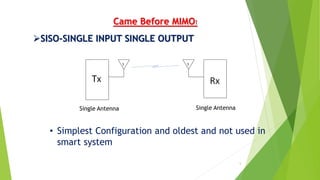
SISO-SINGLE INPUT SINGLE OUTPUT
• Simplest Configuration and oldest and not used in
smart system
Single Antenna Single Antenna
5
Came Before MIMO!
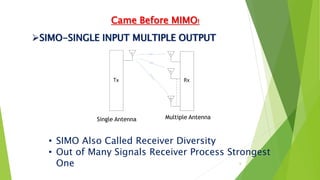
SIMO-SINGLE INPUT MULTIPLE OUTPUT
• SIMO Also Called Receiver Diversity
• Out of Many Signals Receiver Process Strongest
One
Single Antenna Multiple Antenna
6
Came Before MIMO!
MISO-MULTIPLE INPUT SINGLE OUTPUT
• MISO Also Called Transmitter Diversity
Single
Antenna
Multiple
Antenna
7
MIMO WORKING
• The Receiving end uses an algorithms or special
signal processing(DSP) to sort out many signals to
produce one signal that has the original information
which is transmitted at transmitter end
8
FORMATS OF MIMO
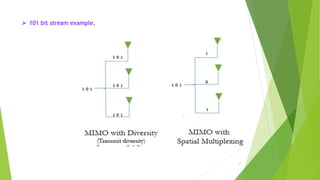
 Spatial Diversity
• Same information is transmitted by different
Antenna
• It Improves link reliability
• Improves Coverage
9
FORMATS OF MIMO
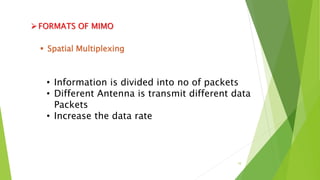
 Spatial Multiplexing
• Information is divided into no of packets
• Different Antenna is transmit different data
Packets
• Increase the data rate
10
 101 bit stream example.
11
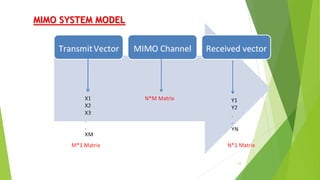
MIMO SYSTEM MODEL
12
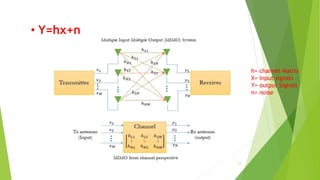
• Y=hx+n
h= channel Matrix
X= input signals
Y= output Signals
n= noise
13
Capacity Improved ?
 Without MIMO
C=B*log2(1+SNR)
 With MIMO
C=n*B*log2(1+SNR)
 So Capacity n times increases
14
15
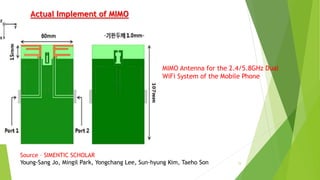
MIMO Antenna for the 2.4/5.8GHz Dual
WiFi System of the Mobile Phone
Source – SIMENTIC SCHOLAR
Young-Sang Jo, Mingil Park, Yongchang Lee, Sun-hyung Kim, Taeho Son
Actual Implement of MIMO
16
Reconfigurable MIMO Antennas
Source: Researchgate
Rifaqat Hussain1, *, Muhammad U. Khan2, Wajih Abu-
Al-Saud1,Ali H. Muqaibel1, and Mohammad S. Sharawi1
Published in 2016
In this paper, three different frequency reconfigurable
MIMO antennas are characterized in terms of their
channel capacity performance in an indoor environment.
Two 2 ×2 and one 4×4 MIMO antenna configurations are
investigated
17
Advantages:
• The higher data rate can be achieved with the help of multiple antennas and SM (Spatial Multiplexing)
technique. This helps in achieving higher downlink and uplink throughput
• There is lower susceptibility of tapping by unauthorized persons due to multiple antennas and algorithms
• The wide coverage supported by MIMO system helps in supporting large number of subscribers per cell.
Disadvantage
• The resource requirements and hardware complexity is higher compare to single antenna antenna based
system. Each antenna requires individual RF units for radio signal processing. Moreover advanced DSP chip
is needed to run advanced mathematical signal processing algorithms.
• The hardware resources increase power requirements. Battery gets drain faster due to processing of
complex and computationally intensive signal processing algorithms. This reduces battery lifetime of MIMO
based devices
18
Conclusion:
MIMO is a system which is full filling the todays requirement that is
high data rate ,improved security and many other enhancement in
antenna world, Most of latest wireless system integrated with MIMO
technology and Many other research is going on.
19
References
1. S. M. Alamouti, "A simple transmit diversity technique for wireless communications",
Selected Areas in Communications, IEEE Journal on , Volume: 16 Issue: 8, Oct. 1998,
Page(s): 1451 -1458
2. Lui, C.-Y., Wang, Y.-S., Chung, S.-J.: “Two nearby dual-band antennas with high port
isolation”, in Proc.IEEE AP-S Int. Symposium, Jun. 2008.
3. Young-Sang Jo, Mingil Park, Yongchang Lee, Sun-Hyung Kim, 1Taeho Son
“MIMO Antenna for the 2.4/5.8GHz Dual WiFi System of the Mobile Phone ”2016
4. Wang, X., Chen, W., Feng, Z., Zhang, H., “Compact dual-polarized antenna combining
printed monopole and half-slot antenna for MIMO applications”, in Proc. IEEE AP-S Int.
Symposium, 1-5, Jun. 2009.
5. Itoh, J., Michishita, N., Morishita, H., “A study on mutual coupling reduction between two
inverted-F antennas using mushroom-type EBG structure”, IEEE Antennas and Propagation
Society(APS), International Symposium(IS), pp.1-4, Jul. 2008.
6. Park, M., Son, T., Jo, Y.: “Hybrid Antenna and Suitable for Broadband Mobile Phone
MIMO System”, 2013 International Symposium on Antenna and Propagation (ISAP),
Vol.1, No.1, pp. 111-114, Oct, 2013.
20

MIMO Antenna and Technology installation

  • 1.
    MIMO 1 Presented by: Name-Dilshad Ahmad RollNo-MT/EC/10007/19 ECE Dept. BIT Mesra,Ranchi Antennas and Diversity (EC503)
  • 2.
    OUTLINE • Introduction • MIMOConfiguration • Earlier versons before MIMO • MIMO Working • Formats of MIMO • MIMO System Model • Actual Implement of MIMO • Pros and Cons • Conclusion • Refrences 2
  • 3.
    Introduction • MIMO Standsfor multiple input and multiple output • In MIMO system we use multiple Transmitter antenna and multiple Receiver Antenna • We Break the Information and then send By Different Antenna(MIMO-Spatial) • Another is very similar that we send complete information by all Transmitter Antenna that is Diversity Not specific MIMO Called Diversity-MIMO 3
  • 4.
    MIMO Configuration Multiple Antennaat Transmitter Side Multiple Antenna at Receiver Side 4
  • 5.
    Came Before MIMO! SISO-SINGLEINPUT SINGLE OUTPUT • Simplest Configuration and oldest and not used in smart system Single Antenna Single Antenna 5
  • 6.
    Came Before MIMO! SIMO-SINGLEINPUT MULTIPLE OUTPUT • SIMO Also Called Receiver Diversity • Out of Many Signals Receiver Process Strongest One Single Antenna Multiple Antenna 6
  • 7.
    Came Before MIMO! MISO-MULTIPLEINPUT SINGLE OUTPUT • MISO Also Called Transmitter Diversity Single Antenna Multiple Antenna 7
  • 8.
    MIMO WORKING • TheReceiving end uses an algorithms or special signal processing(DSP) to sort out many signals to produce one signal that has the original information which is transmitted at transmitter end 8
  • 9.
    FORMATS OF MIMO Spatial Diversity • Same information is transmitted by different Antenna • It Improves link reliability • Improves Coverage 9
  • 10.
    FORMATS OF MIMO Spatial Multiplexing • Information is divided into no of packets • Different Antenna is transmit different data Packets • Increase the data rate 10
  • 11.
     101 bitstream example. 11
  • 12.
  • 13.
    • Y=hx+n h= channelMatrix X= input signals Y= output Signals n= noise 13
  • 14.
    Capacity Improved ? Without MIMO C=B*log2(1+SNR)  With MIMO C=n*B*log2(1+SNR)  So Capacity n times increases 14
  • 15.
    15 MIMO Antenna forthe 2.4/5.8GHz Dual WiFi System of the Mobile Phone Source – SIMENTIC SCHOLAR Young-Sang Jo, Mingil Park, Yongchang Lee, Sun-hyung Kim, Taeho Son Actual Implement of MIMO
  • 16.
    16 Reconfigurable MIMO Antennas Source:Researchgate Rifaqat Hussain1, *, Muhammad U. Khan2, Wajih Abu- Al-Saud1,Ali H. Muqaibel1, and Mohammad S. Sharawi1 Published in 2016 In this paper, three different frequency reconfigurable MIMO antennas are characterized in terms of their channel capacity performance in an indoor environment. Two 2 ×2 and one 4×4 MIMO antenna configurations are investigated
  • 17.
    17 Advantages: • The higherdata rate can be achieved with the help of multiple antennas and SM (Spatial Multiplexing) technique. This helps in achieving higher downlink and uplink throughput • There is lower susceptibility of tapping by unauthorized persons due to multiple antennas and algorithms • The wide coverage supported by MIMO system helps in supporting large number of subscribers per cell. Disadvantage • The resource requirements and hardware complexity is higher compare to single antenna antenna based system. Each antenna requires individual RF units for radio signal processing. Moreover advanced DSP chip is needed to run advanced mathematical signal processing algorithms. • The hardware resources increase power requirements. Battery gets drain faster due to processing of complex and computationally intensive signal processing algorithms. This reduces battery lifetime of MIMO based devices
  • 18.
    18 Conclusion: MIMO is asystem which is full filling the todays requirement that is high data rate ,improved security and many other enhancement in antenna world, Most of latest wireless system integrated with MIMO technology and Many other research is going on.
  • 19.
    19 References 1. S. M.Alamouti, "A simple transmit diversity technique for wireless communications", Selected Areas in Communications, IEEE Journal on , Volume: 16 Issue: 8, Oct. 1998, Page(s): 1451 -1458 2. Lui, C.-Y., Wang, Y.-S., Chung, S.-J.: “Two nearby dual-band antennas with high port isolation”, in Proc.IEEE AP-S Int. Symposium, Jun. 2008. 3. Young-Sang Jo, Mingil Park, Yongchang Lee, Sun-Hyung Kim, 1Taeho Son “MIMO Antenna for the 2.4/5.8GHz Dual WiFi System of the Mobile Phone ”2016 4. Wang, X., Chen, W., Feng, Z., Zhang, H., “Compact dual-polarized antenna combining printed monopole and half-slot antenna for MIMO applications”, in Proc. IEEE AP-S Int. Symposium, 1-5, Jun. 2009. 5. Itoh, J., Michishita, N., Morishita, H., “A study on mutual coupling reduction between two inverted-F antennas using mushroom-type EBG structure”, IEEE Antennas and Propagation Society(APS), International Symposium(IS), pp.1-4, Jul. 2008. 6. Park, M., Son, T., Jo, Y.: “Hybrid Antenna and Suitable for Broadband Mobile Phone MIMO System”, 2013 International Symposium on Antenna and Propagation (ISAP), Vol.1, No.1, pp. 111-114, Oct, 2013.
  • 20.