Bluetooth & CDMA
Technology
Topics to be covered
   Bluetooth
       Introduction
       Name, Idea
       How Bluetooth Technology works
       Advantages
       Disadvantages
       Security
       Future
   CDMA
     Introduction & History
     Key Elements
     Advantages
     Disadvantages
Introduction to Bluetooth Technology
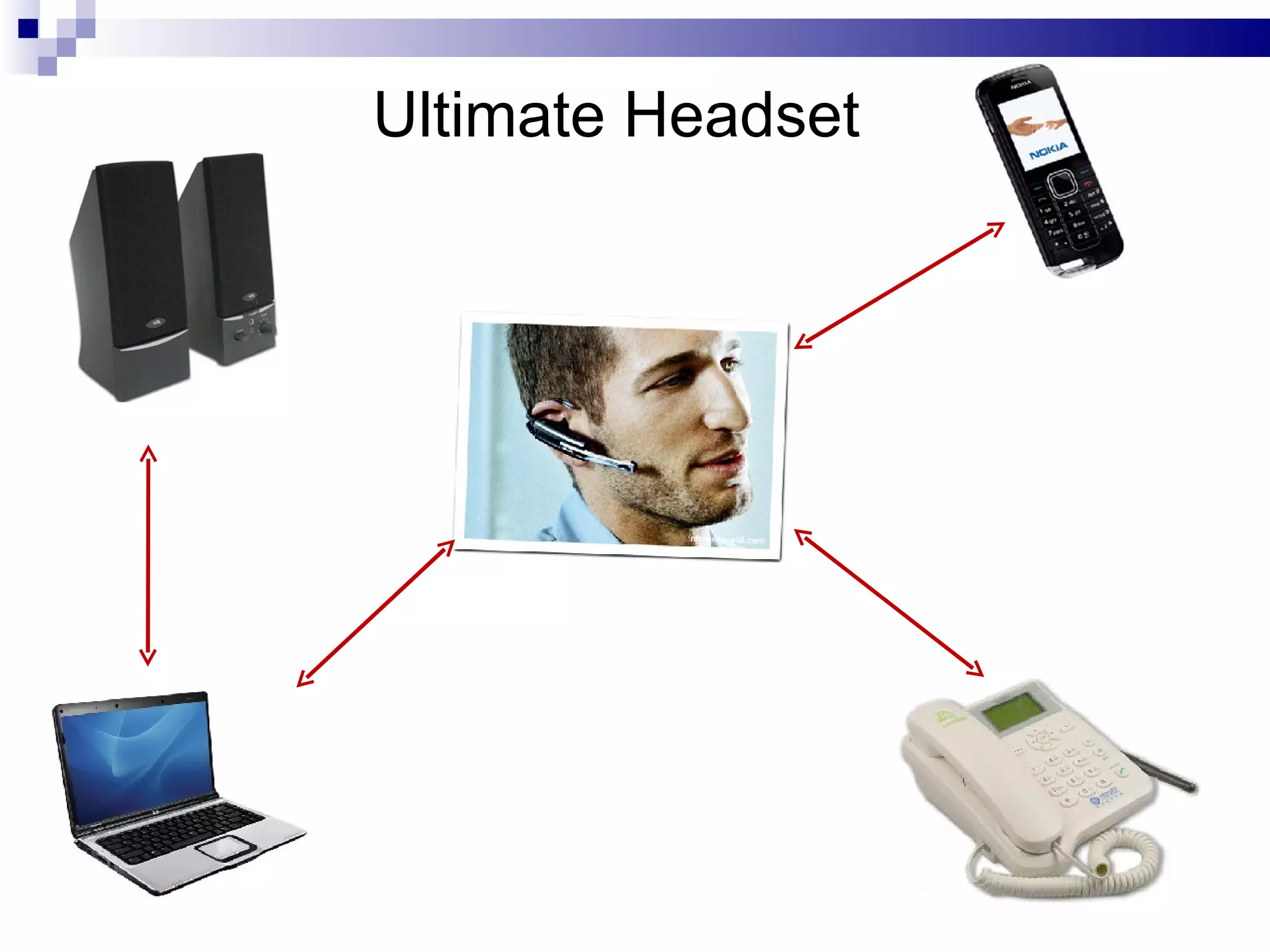
Ultimate Headset
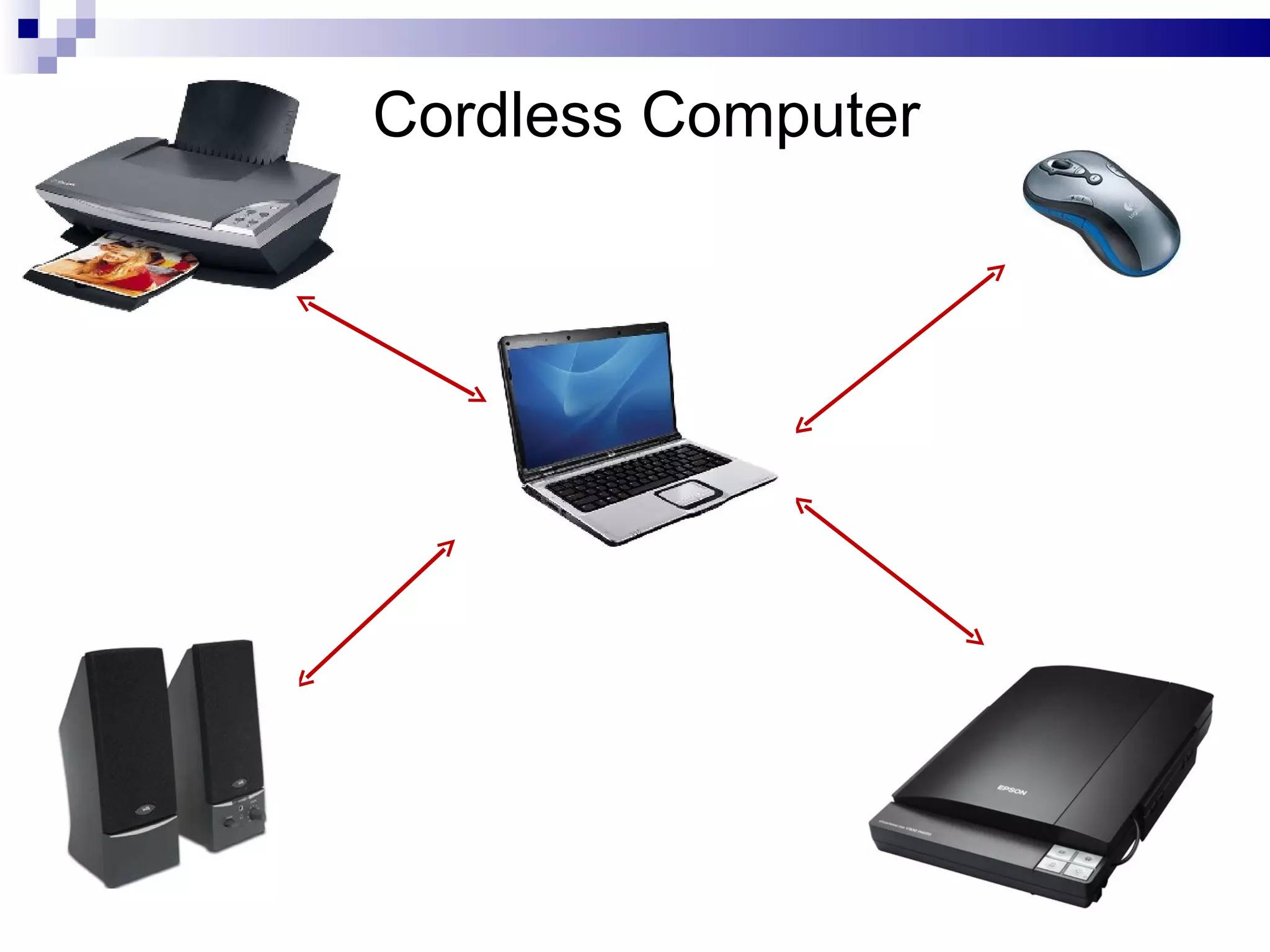
Cordless Computer
   Originally and commonly (in day to day life), it is used to connect
    headset to a mobile phone. Or transferring data from one mobile to
    another (songs, pics, docs, messages).
   Then Bluetooth started being used to connect headsets to a regular
    computer.
   Then progressed on to making printers wireless as well as being
    able to connect to a Bluetooth network.
   Bluetooth is a protocol that allows you to remotely access and use
    devices on a computer or phone without the use of wires.
   Bluetooth is a short-range wireless communications technology.
   These signals travel through walls, windows, doors.
   Uses short-wavelength radio transmissions in the ISM band from
    2400-2480 MHz
   Wireless alternative to data cables.
   BMW was the first motor vehicle manufacturer to install handsfree
    Bluetooth technology in its cars. Followed by Toyota and Lexus.
What’s in the name – Bluetooth?
   Bluetooth was named for the 10th Century Viking king, Harald
    Blatand (aka bluetooth) who peacefully united all tiny island
    kingdoms of Denmark, southern Sweden and Southern Norway into
    one country.
   In keeping with its namesake, Bluetooth, the new low-cost radio
    technology, is designed to unite or connect all different types of
    devices to effectively work as one.
Idea – Bluetooth
   Idea that resulted in the Bluetooth wireless technology was born in
    1994.
   Initiated by Ericsson to investigate feasibility of a low-power, low-
    cost radio interface.
   Bluetooth SIG (Special Interest Group) formed in1998.
   First specification released in July 1999.
   1900 member companies till date.
   Main players
        3Com Corporation
        Ericsson
        IBM
        Intel
        Agere
        Microsoft
        Motorola
        Nokia
How do Bluetooth Technology works?
   Instant formation of networks.
   A piconet is collection of devices connected via Bluetooth technology
        Simple connection between two devices or more devices.
   Unlike infra-red, Bluetooth does not require line-of-sight positioning
    of connected units.
   Embedding tiny, inexpensive, short-range transceivers into the
    electronic devices
   The radio operates on the globally-available unlicensed radio band,
    2.45 GHz
   Supports data speeds of up to 721 Kbps.
   The Bluetooth modules can be either built into electronic devices or
    used as an adaptor. For instance in a PC they can be built in as a
    PC card or externally attached via the USB port.
   Best alternative to data transfer as compared to corrupt DVD/CD
    ROM
What’s the use ????
   Freedom from cables
   Technology is Inexpensive
   Automatic
   Standardized Protocol
   Avoids Interference from other wireless devices
   Low Power Consumption
   Faster Voice and Data sharing
   Instant Personal Area Network (PAN)
   Upgradeable
   Universally accepted
   Simplifies communication while driving
   Best alternative to data transfer as compared to corrupt DVD/CD
    ROM
Core Bluetooth Products
   Notebooks PCs & Desktop Computers
   Printers
   PDAs
   Other Handheld devices
   Cell Phones
   Wireless Peripherals:
     Headsets
     Camers

   CD Player
   TV / VCR / DVD
   Telephone Answering Devices
   Cordless phones
   Cars
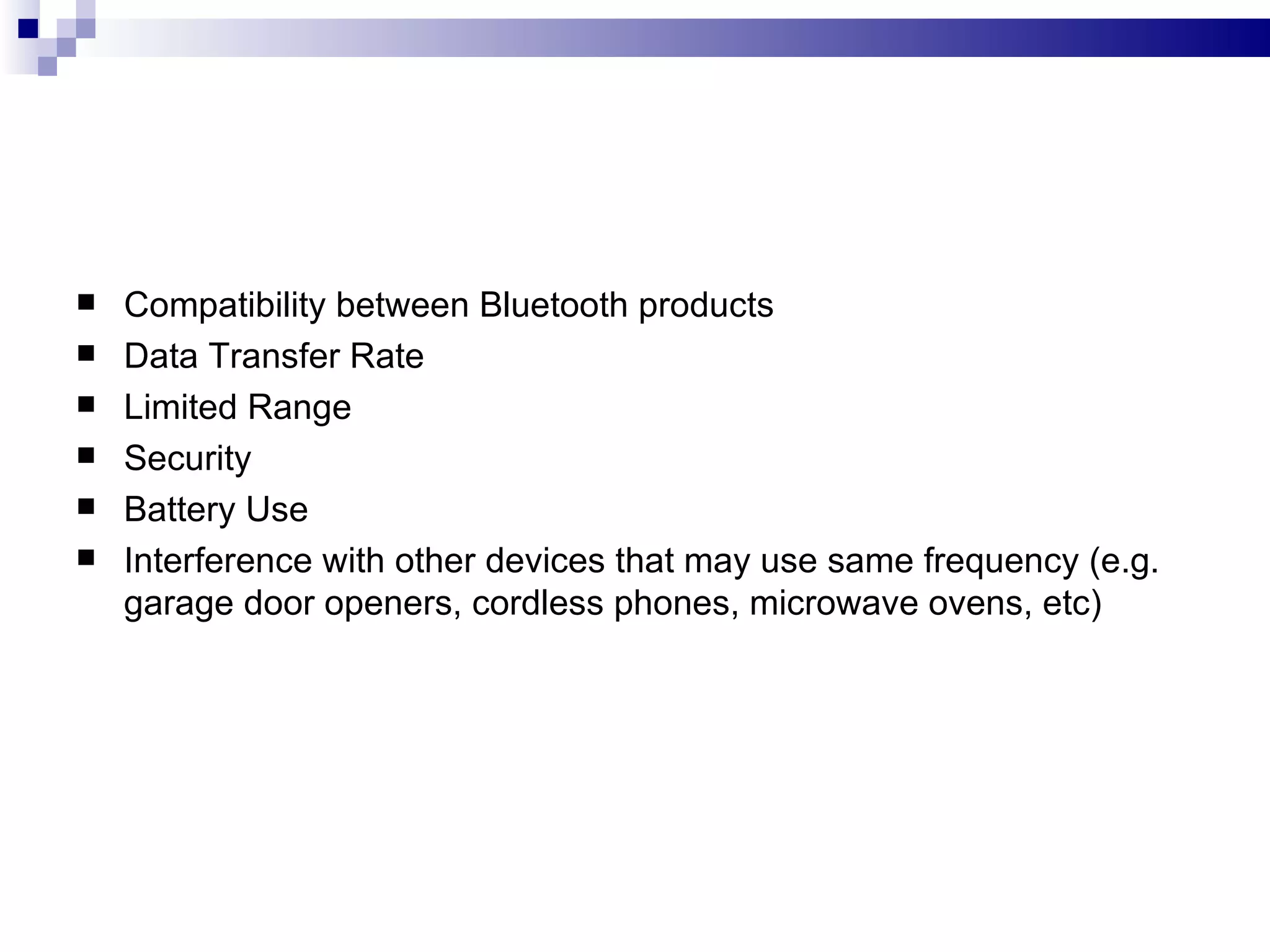
Limitations / Disadvantages
   Compatibility between Bluetooth products
   Data Transfer Rate
   Limited Range
   Security
   Battery Use
   Interference with other devices that may use same frequency (e.g.
    garage door openers, cordless phones, microwave ovens, etc)
Security
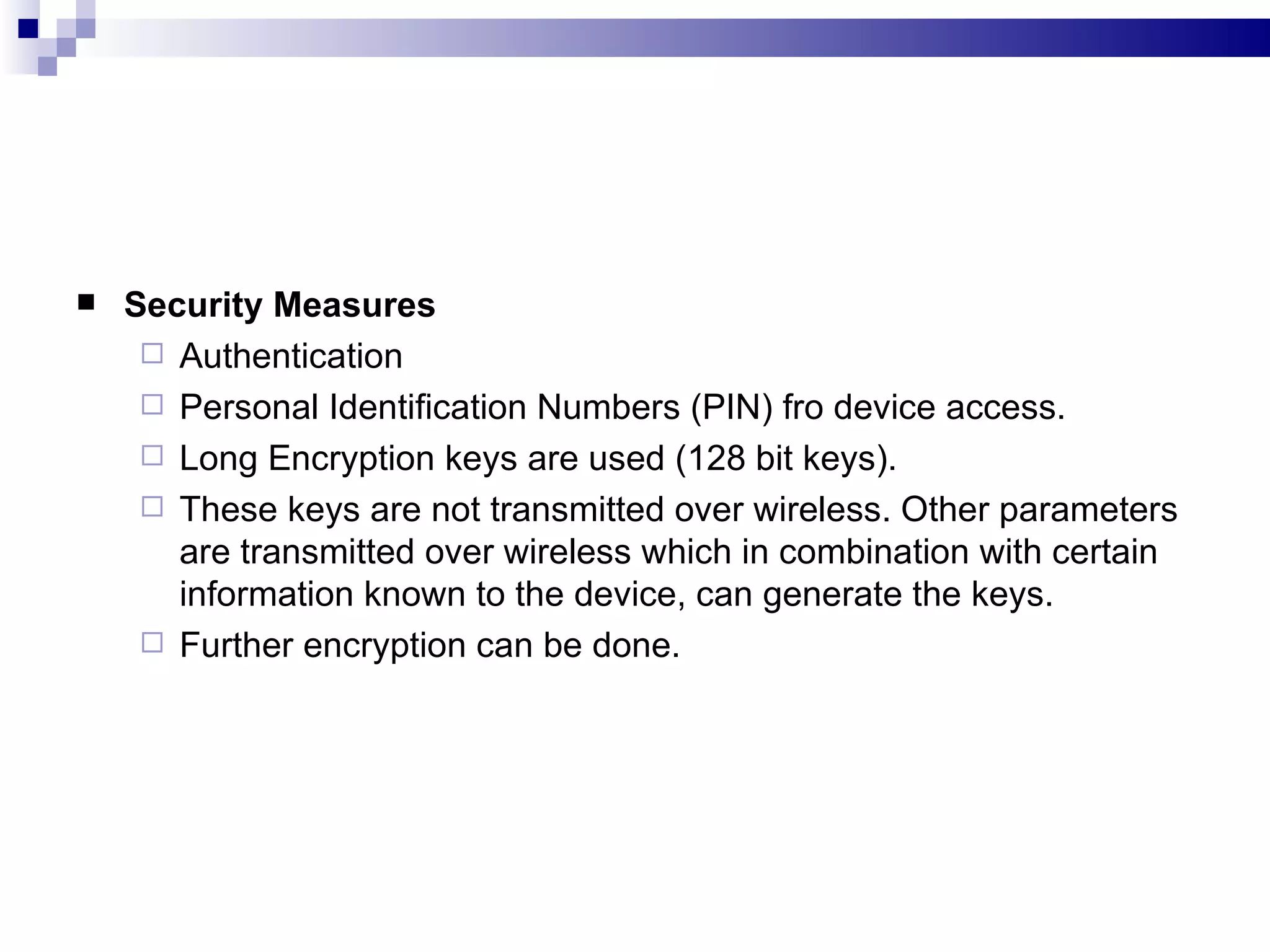
   Security Measures
      Authentication
      Personal Identification Numbers (PIN) fro device access.
      Long Encryption keys are used (128 bit keys).
      These keys are not transmitted over wireless. Other parameters
       are transmitted over wireless which in combination with certain
       information known to the device, can generate the keys.
      Further encryption can be done.
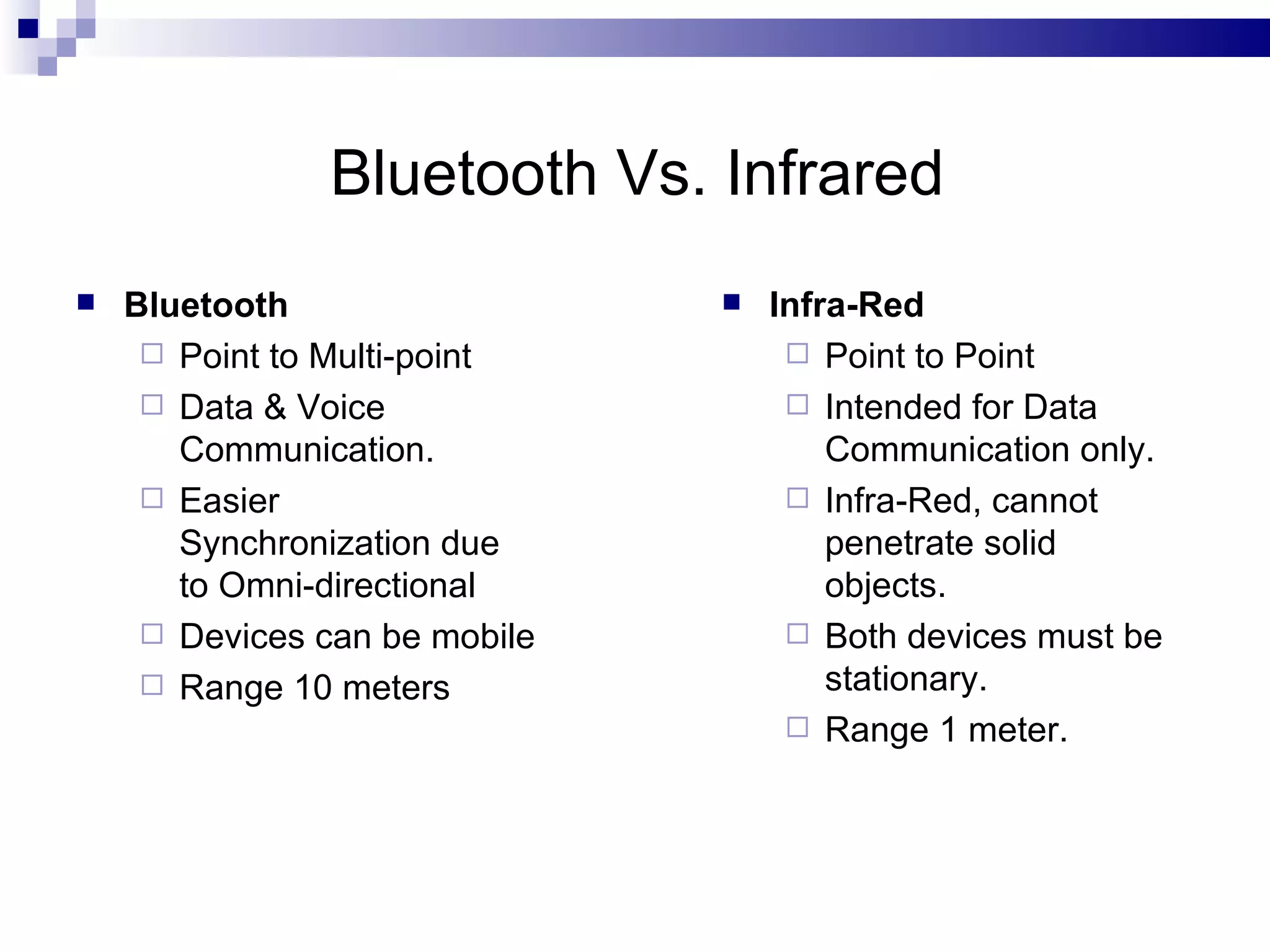
Bluetooth Vs. Infrared
   Bluetooth                     Infra-Red
      Point to Multi-point          Point to Point
      Data & Voice                  Intended for Data
       Communication.                  Communication only.
      Easier                        Infra-Red, cannot
       Synchronization due             penetrate solid
       to Omni-directional             objects.
      Devices can be mobile         Both devices must be
      Range 10 meters                 stationary.
                                     Range 1 meter.
Future of Bluetooth Technology
   Continually expanding technology.
   The Bluetooth SIG is trying to evolve the Bluetooth technology to
    provide greater bandwidth and distances, thus increasing the
    potential platforms and applications used in the emerging personal
    area networking marketplace.
   New application profiles.
CDMA Technology


Introduction & History
   CDMA (Code Division Multiple Access).
   Both data and voice are separated from signals using codes and
    then transmitted using a wide frequency.
   This leaves more Space left for data transfer.
   14% of the worldwide market goes to CDMA.
   CDMA uses a “spread-spectrum” technique whereby
    electromagnetic energy is spread to allow for a signal with a wider
    bandwidth.
   CDMA is military technology first used during World War II by
    English allies to foil German attempts at jamming transmissions.
    The allies decided to transmit over several frequencies, instead of
    one, making it difficult for the Germans to pick up the complete
    signal.
   The CDMA standard was originally designed by Qualcomm in the
    U.S. and is primarily used in the U.S. and portions of Asia by other
    carriers.
CDMA Technology


  Key Elements
   CDMA is a form of spread spectrum transmission technology. It has
    a number of distinguishing features that are key to spread spectrum
    transmission technologies:

      Use of wide bandwidth: CDMA, like other spread spectrum technologies uses
       a wider bandwidth than would otherwise be needed fort he transmission of the
       data. This results in a number of advantages including an increased immunity to
       interference or jamming, and multiple user access.
      Spreading Codes Used: In order to achieve the increased bandwidth, the data
       is spread by use of a code which is independent of the data.
      Level of security: In order to receive the data, the receiver must have a
       knowledge of the spreading code, without this it is not possible to decipher the
       transmitted data, and this gives a measure of security.
      Multiple access: The use of the spreading codes which are independent for
       each user along with synchronous reception allow multiple users to access the
       same channel simultaneously.
CDMA Technology


  Advantages
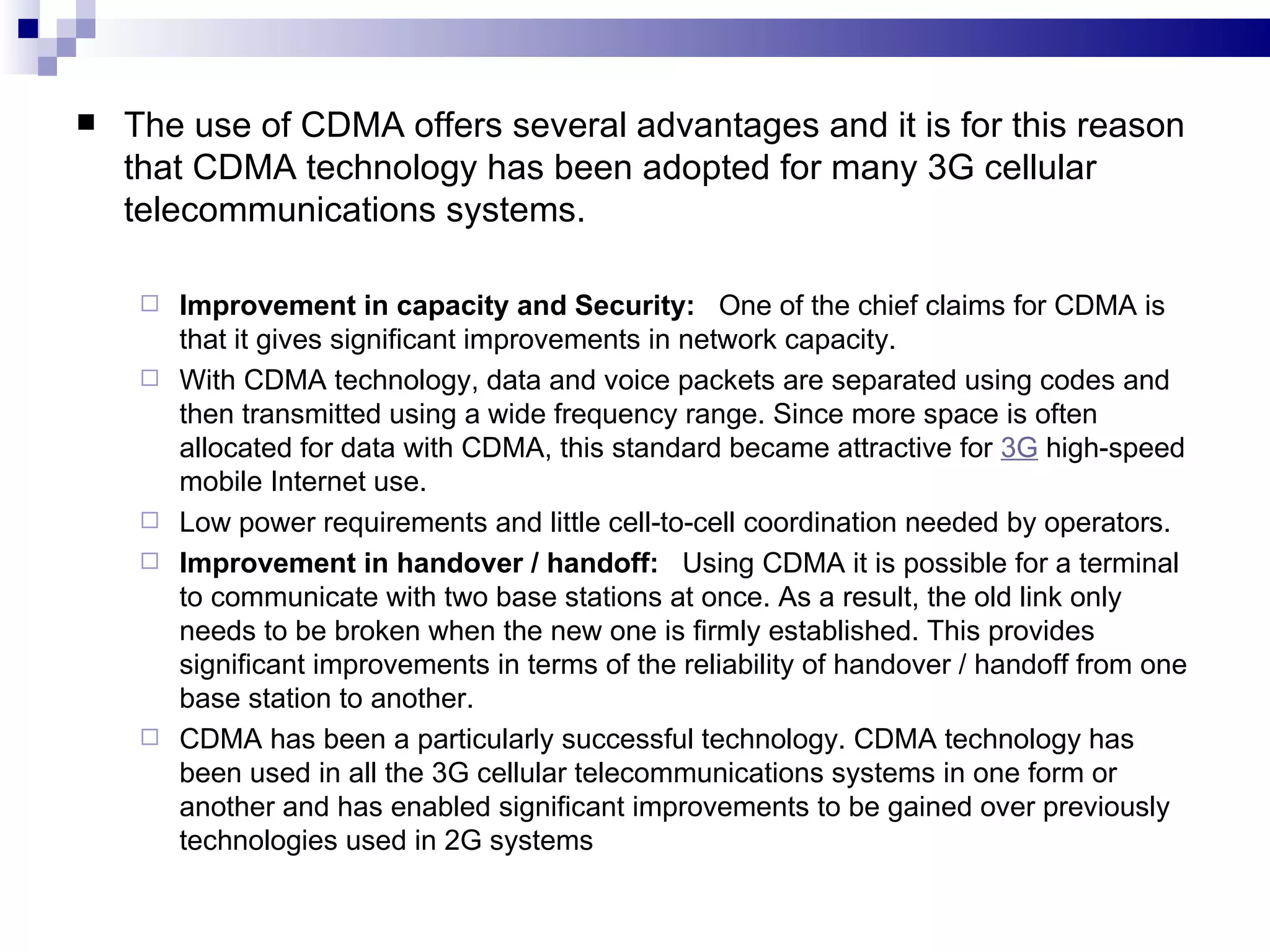
   The use of CDMA offers several advantages and it is for this reason
    that CDMA technology has been adopted for many 3G cellular
    telecommunications systems.

        Improvement in capacity and Security: One of the chief claims for CDMA is
         that it gives significant improvements in network capacity.
        With CDMA technology, data and voice packets are separated using codes and
         then transmitted using a wide frequency range. Since more space is often
         allocated for data with CDMA, this standard became attractive for 3G high-speed
         mobile Internet use.
        Low power requirements and little cell-to-cell coordination needed by operators.
        Improvement in handover / handoff: Using CDMA it is possible for a terminal
         to communicate with two base stations at once. As a result, the old link only
         needs to be broken when the new one is firmly established. This provides
         significant improvements in terms of the reliability of handover / handoff from one
         base station to another.
        CDMA has been a particularly successful technology. CDMA technology has
         been used in all the 3G cellular telecommunications systems in one form or
         another and has enabled significant improvements to be gained over previously
         technologies used in 2G systems
CDMA Technology


  Disadvantages
   Due to its proprietary nature, all of CDMA's flaws are not known to
    the engineering community.
   CDMA is relatively new, and the network is not as mature as GSM.
   CDMA cannot offer international roaming, a large GSM advantage.
Questions ??
Thank You.

Bluetooth & cdma technology

  • 1.
  • 2.
    Topics to becovered  Bluetooth  Introduction  Name, Idea  How Bluetooth Technology works  Advantages  Disadvantages  Security  Future  CDMA  Introduction & History  Key Elements  Advantages  Disadvantages
  • 3.
  • 4.
  • 5.
  • 6.
    Originally and commonly (in day to day life), it is used to connect headset to a mobile phone. Or transferring data from one mobile to another (songs, pics, docs, messages).  Then Bluetooth started being used to connect headsets to a regular computer.  Then progressed on to making printers wireless as well as being able to connect to a Bluetooth network.  Bluetooth is a protocol that allows you to remotely access and use devices on a computer or phone without the use of wires.  Bluetooth is a short-range wireless communications technology.  These signals travel through walls, windows, doors.  Uses short-wavelength radio transmissions in the ISM band from 2400-2480 MHz  Wireless alternative to data cables.  BMW was the first motor vehicle manufacturer to install handsfree Bluetooth technology in its cars. Followed by Toyota and Lexus.
  • 7.
    What’s in thename – Bluetooth?
  • 8.
    Bluetooth was named for the 10th Century Viking king, Harald Blatand (aka bluetooth) who peacefully united all tiny island kingdoms of Denmark, southern Sweden and Southern Norway into one country.  In keeping with its namesake, Bluetooth, the new low-cost radio technology, is designed to unite or connect all different types of devices to effectively work as one.
  • 9.
  • 10.
    Idea that resulted in the Bluetooth wireless technology was born in 1994.  Initiated by Ericsson to investigate feasibility of a low-power, low- cost radio interface.  Bluetooth SIG (Special Interest Group) formed in1998.  First specification released in July 1999.  1900 member companies till date.  Main players  3Com Corporation  Ericsson  IBM  Intel  Agere  Microsoft  Motorola  Nokia
  • 11.
    How do BluetoothTechnology works?
  • 12.
    Instant formation of networks.  A piconet is collection of devices connected via Bluetooth technology  Simple connection between two devices or more devices.  Unlike infra-red, Bluetooth does not require line-of-sight positioning of connected units.  Embedding tiny, inexpensive, short-range transceivers into the electronic devices  The radio operates on the globally-available unlicensed radio band, 2.45 GHz  Supports data speeds of up to 721 Kbps.  The Bluetooth modules can be either built into electronic devices or used as an adaptor. For instance in a PC they can be built in as a PC card or externally attached via the USB port.  Best alternative to data transfer as compared to corrupt DVD/CD ROM

  • 13.
  • 14.
    Freedom from cables  Technology is Inexpensive  Automatic  Standardized Protocol  Avoids Interference from other wireless devices  Low Power Consumption  Faster Voice and Data sharing  Instant Personal Area Network (PAN)  Upgradeable  Universally accepted  Simplifies communication while driving  Best alternative to data transfer as compared to corrupt DVD/CD ROM
  • 15.
    Core Bluetooth Products  Notebooks PCs & Desktop Computers  Printers  PDAs  Other Handheld devices  Cell Phones  Wireless Peripherals:  Headsets  Camers  CD Player  TV / VCR / DVD  Telephone Answering Devices  Cordless phones  Cars
  • 16.
  • 17.
    Compatibility between Bluetooth products  Data Transfer Rate  Limited Range  Security  Battery Use  Interference with other devices that may use same frequency (e.g. garage door openers, cordless phones, microwave ovens, etc)
  • 18.
  • 19.
    Security Measures  Authentication  Personal Identification Numbers (PIN) fro device access.  Long Encryption keys are used (128 bit keys).  These keys are not transmitted over wireless. Other parameters are transmitted over wireless which in combination with certain information known to the device, can generate the keys.  Further encryption can be done.
  • 20.
    Bluetooth Vs. Infrared  Bluetooth  Infra-Red  Point to Multi-point  Point to Point  Data & Voice  Intended for Data Communication. Communication only.  Easier  Infra-Red, cannot Synchronization due penetrate solid to Omni-directional objects.  Devices can be mobile  Both devices must be  Range 10 meters stationary.  Range 1 meter.
  • 21.
  • 22.
    Continually expanding technology.  The Bluetooth SIG is trying to evolve the Bluetooth technology to provide greater bandwidth and distances, thus increasing the potential platforms and applications used in the emerging personal area networking marketplace.  New application profiles.
  • 23.
  • 24.
    CDMA (Code Division Multiple Access).  Both data and voice are separated from signals using codes and then transmitted using a wide frequency.  This leaves more Space left for data transfer.  14% of the worldwide market goes to CDMA.  CDMA uses a “spread-spectrum” technique whereby electromagnetic energy is spread to allow for a signal with a wider bandwidth.  CDMA is military technology first used during World War II by English allies to foil German attempts at jamming transmissions. The allies decided to transmit over several frequencies, instead of one, making it difficult for the Germans to pick up the complete signal.  The CDMA standard was originally designed by Qualcomm in the U.S. and is primarily used in the U.S. and portions of Asia by other carriers.
  • 25.
    CDMA Technology Key Elements
  • 26.
    CDMA is a form of spread spectrum transmission technology. It has a number of distinguishing features that are key to spread spectrum transmission technologies:  Use of wide bandwidth: CDMA, like other spread spectrum technologies uses a wider bandwidth than would otherwise be needed fort he transmission of the data. This results in a number of advantages including an increased immunity to interference or jamming, and multiple user access.  Spreading Codes Used: In order to achieve the increased bandwidth, the data is spread by use of a code which is independent of the data.  Level of security: In order to receive the data, the receiver must have a knowledge of the spreading code, without this it is not possible to decipher the transmitted data, and this gives a measure of security.  Multiple access: The use of the spreading codes which are independent for each user along with synchronous reception allow multiple users to access the same channel simultaneously.
  • 27.
    CDMA Technology Advantages
  • 28.
    The use of CDMA offers several advantages and it is for this reason that CDMA technology has been adopted for many 3G cellular telecommunications systems.  Improvement in capacity and Security: One of the chief claims for CDMA is that it gives significant improvements in network capacity.  With CDMA technology, data and voice packets are separated using codes and then transmitted using a wide frequency range. Since more space is often allocated for data with CDMA, this standard became attractive for 3G high-speed mobile Internet use.  Low power requirements and little cell-to-cell coordination needed by operators.  Improvement in handover / handoff: Using CDMA it is possible for a terminal to communicate with two base stations at once. As a result, the old link only needs to be broken when the new one is firmly established. This provides significant improvements in terms of the reliability of handover / handoff from one base station to another.  CDMA has been a particularly successful technology. CDMA technology has been used in all the 3G cellular telecommunications systems in one form or another and has enabled significant improvements to be gained over previously technologies used in 2G systems
  • 29.
    CDMA Technology Disadvantages
  • 30.
    Due to its proprietary nature, all of CDMA's flaws are not known to the engineering community.  CDMA is relatively new, and the network is not as mature as GSM.  CDMA cannot offer international roaming, a large GSM advantage.
  • 31.
  • 32.