Blue print
By – Asst.Prof. Nilima Kamlu
S.M.S.&E.T. B.Ed. College
Talegaon dabhade ,Pune.
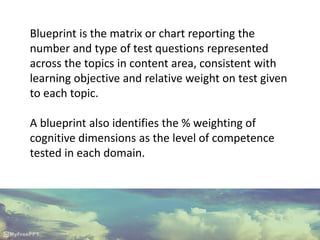
Blueprint is the matrix or chart reporting the
number and type of test questions represented
across the topics in content area, consistent with
learning objective and relative weight on test given
to each topic.
A blueprint also identifies the % weighting of
cognitive dimensions as the level of competence
tested in each domain.
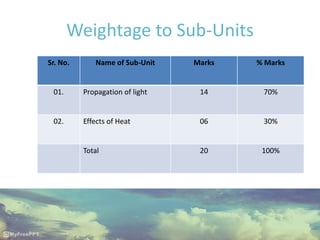
Weightage to Sub-Units
Sr. No. Name of Sub-Unit Marks % Marks
01. Propagation of light 14 70%
02. Effects of Heat 06 30%
Total 20 100%
Weightage to Objectives
Sr. No. Objective Marks % Marks
01. Knowledge 10 50%
02. Comprehension 04 20%
03. Application 04 20%
04. Skill 02 10%
Total 20 100%
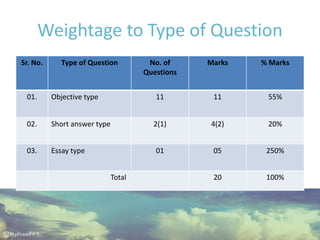
Weightage to Type of Question
Sr. No. Type of Question No. of
Questions
Marks % Marks
01. Objective type 11 11 55%
02. Short answer type 2(1) 4(2) 20%
03. Essay type 01 05 250%
Total 20 100%
3-dimensional Blue Print
Objectives Knowledge Comprehension Application Skill Total
Marks
Type of question E S O E S O E S O E S O
Name of Sub-Unit
1)Propagation of
light
3(3)
2(2)
1(1) ½(3)
1(1) 1(2)
½(2)
14
2)Effects of Heat 2(2)
2(2)
1(2)
[1(2)]
06
Total Marks 10 03 01 04 02 20
Importance of Blue Print
1. A Blueprint provides a conceptual map of examination format, the
objectives considered, variety of questions asked and the content
area represented in assessment.
2. Thus blue print gives an idea whether the question paper is meant
for homogenous or heterogeneous population.
3. The blueprint is a globally accepted tool used to construct
examination questions for ready reference of stakeholders engaged
in assessment process.
4. Blueprint also provides a readily available opportunity to vetting
members to ensure that the essential topics are not overlooked.
THANK YOU

Blue print

  • 1.
    Blue print By –Asst.Prof. Nilima Kamlu S.M.S.&E.T. B.Ed. College Talegaon dabhade ,Pune.
  • 2.
    Blueprint is thematrix or chart reporting the number and type of test questions represented across the topics in content area, consistent with learning objective and relative weight on test given to each topic. A blueprint also identifies the % weighting of cognitive dimensions as the level of competence tested in each domain.
  • 3.
    Weightage to Sub-Units Sr.No. Name of Sub-Unit Marks % Marks 01. Propagation of light 14 70% 02. Effects of Heat 06 30% Total 20 100%
  • 4.
    Weightage to Objectives Sr.No. Objective Marks % Marks 01. Knowledge 10 50% 02. Comprehension 04 20% 03. Application 04 20% 04. Skill 02 10% Total 20 100%
  • 5.
    Weightage to Typeof Question Sr. No. Type of Question No. of Questions Marks % Marks 01. Objective type 11 11 55% 02. Short answer type 2(1) 4(2) 20% 03. Essay type 01 05 250% Total 20 100%
  • 6.
    3-dimensional Blue Print ObjectivesKnowledge Comprehension Application Skill Total Marks Type of question E S O E S O E S O E S O Name of Sub-Unit 1)Propagation of light 3(3) 2(2) 1(1) ½(3) 1(1) 1(2) ½(2) 14 2)Effects of Heat 2(2) 2(2) 1(2) [1(2)] 06 Total Marks 10 03 01 04 02 20
  • 7.
    Importance of BluePrint 1. A Blueprint provides a conceptual map of examination format, the objectives considered, variety of questions asked and the content area represented in assessment. 2. Thus blue print gives an idea whether the question paper is meant for homogenous or heterogeneous population. 3. The blueprint is a globally accepted tool used to construct examination questions for ready reference of stakeholders engaged in assessment process. 4. Blueprint also provides a readily available opportunity to vetting members to ensure that the essential topics are not overlooked.
  • 8.