- Examine instructionalobjectives
- Make a table of specification (TOS)
- Construct test items
- Assemble test items
- Check assembled test items
- Write directions
- Make answers key
- Analyze and improve the test items
At the end of the session, the participants are expected to
be equipped with the knowledge and skills in developing
assessment items in Math.
5.
1. Examine theinstructional objectives of the topics
previously discussed.
2. Make a table of specification (TOS).
3. Construct the test items.
4. Assemble the test items.
5. Check the assembled test items.
6. Write directions.
7. Make the answers key.
8. Analyze and improve the test items.
Steps in Developing Assessment Tools
6.
Table of Specification(TOS)
Is a chart or table that details the content and
level of cognitive level assessed on a test as well
as the types and emphases of test items
(Gareis and Grant, 2008).
Provides the test constructor a way to ensure
that the assessment is based from the intended
learning outcomes.
7.
Preparing a Tableof
Specification
A. Selecting the learning outcomes to be
measured.
B. Make an outline of the subject matter to be
covered in the test.
C. Decide on the number of items per subtopic.
D. Make the two-way chart as shown in the format
2 and format 3 of a Table of Specification.
E. Construct the test items.
8.
Learning Competencies
Number of
Sessions
Taught
%of Sessions
per Competency
Number of
Items
Cognitive Process Dimensions
Remembering Understanding Applying Analyzing Evaluating Creating
1. Visualizes, Identifies, classifies and
describes half-circles and quarter circles
(Code: _________________)
3 12% 2 1 2
2.Creates figures that show symmetry in a
line (Code: __________________)
2 8% 1 3
3.Tessellates a surface using triangles and
squares (Code: _______________)
1 4% 1 4
4.Measures objects using standard units
of measure (Code: ________________)
2 8% 1 5 6
5. Solves 1-step word problems involving
linear measure using any of the fundamental
operations (Code: ________________)
3 12% 2 7 8
6. Finds the area of plane figures in square
unit (Code: ______________________)
2 8% 1 9
7. Measure Mass of object using standard
units of mass measure (Code: _________)
2 8% 1 10
8. Solves word problems involving mass
measures using any of the four
fundamental operations (Code:
_________________)
5 20% 3 11, 12 13
9. Converts standard from lower to higher
units (Code: _____________________)
2 8% 1 14
10. Solves word problems involving
body/weather temperature (Code:
__________)
3 12% 2 15
Total: 25 100% 15
___________ Quarter Table of Specifications
9.
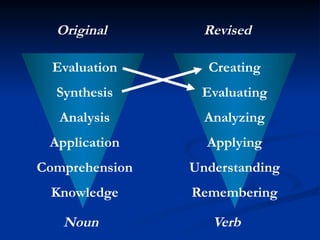
Bloom’s Revised Taxonomy
Taxonomyof Cognitive Objectives
1950s- developed by Benjamin Bloom
Means of expressing qualitatively different kinds of
thinking
Been adapted for classroom use as a planning tool
Continues to be one of the most universally applied
models
10.
Provides a wayto organize thinking skills into six levels,
from the most basic to the more complex levels of
thinking
1990s- Lorin Anderson (former student of Bloom)
revisited the taxonomy
As a result, a number of changes were made
Change in Terms
Categories noun to verb
Taxonomy reflects different forms of thinking
(thinking is an active process) verbs describe actions,
nouns do not
Reorganized categories
Knowledge = product/outcome of thinking
(inappropriate to describe a category of thinking) now
remembering
Comprehension now understanding
Synthesis now creating to better reflect nature of
thinking described by each category
Handout #
16.
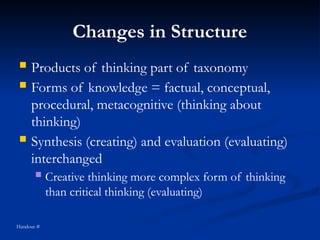
Changes in Structure
Products of thinking part of taxonomy
Forms of knowledge = factual, conceptual,
procedural, metacognitive (thinking about
thinking)
Synthesis (creating) and evaluation (evaluating)
interchanged
Creative thinking more complex form of thinking
than critical thinking (evaluating)
Handout #
17.
Remembering
The learner isable to recall, restate and
remember learned information
Describing
Finding
Identifying
Listing
Retrieving
Naming
Locating
Recognizing
Can students recall information?
18.
Understanding
Student grasps meaningof information
by interpreting and translating
what has been learned
Classifying
Comparing
Exemplifying
Explaining
Inferring
Interpreting
Paraphrasing
Summarizing
Can students explain ideas or concepts?
19.
Applying
Student makes useof information in a context
different from the one in which it was learned
Implementing
Carrying out
Using
Executing
Can students use the information in
another familiar situation?
c =
20.
Analyzing
Student breaks learnedinformation into
its parts to best understand that information
Attributing
Comparing
Deconstructing
Finding
Integrating
Organizing
Outlining
Structuring
Can students break information into parts to explore
understandings and relationships?
21.
Evaluating
Student makes decisionsbased on in-depth
reflection, criticism and assessment
Checking
Critiquing
Detecting
Experimenting
Hypothesising
Judging
Monitoring
Testing
Can students justify a decision or
a course of action?
22.
Creating
Student creates newideas and information using
what previously has been learned
Constructing
Designing
Devising
Inventing
Making
Planning
Producing
Can students generate new products,
ideas, or ways of viewing things?
23.
Remembering
Bloom’s Revised Taxonomy
Retrieving,recognizing, and recalling relevant
knowledge from long-term memory
Understanding
Constructing meaning from oral, written, and graphic
messages through interpreting, exemplifying,
classifying, summarizing, inferring, comparing, and
explaining
24.
Applying
Carrying out orusing a procedure through
executing or implementing
Analyzing
Breaking material into constituent parts,
determining how the parts relate to one another
and to an overall structure or purpose through
differentiating, organizing, and attributing
25.
Evaluating
Marking judgments basedon criteria and
standards through checking and critiquing
Creating
Putting elements together to form a coherent
or functional whole; reorganizing elements
into a new pattern or structure through
generating, planning, or producing
26.
Blooms Digital TaxonomyMap
Elements not underlined are recognized and existing verbs.
Elements underlined are new digital verbs.
Creating
Designing, constructing, planning,
producing, inventing, devising, making,
programming, filming, animating, blogging,
video blogging, mixing, remixing, wiki-ing,
publishing, videocasting, podcasting,
directing/producing
Remembering
Recognizing, listing, describing,identifying,
retrieving, naming, locating, finding, bullet
pointing, highlighting, bookmarking, social
networking, social bookmarking,
favoriting/local bookmarking, searching,
googling
32.
General Guidelines for
ConstructingTest Items
1. Begin writing items far enough or in advance so
that you will have time to revise them.
2. Match item to intended outcomes at appropriate
level of difficulty to provide valid measure of
instructional objectives.
3. Be sure each items deals with an important aspect
of the content area and not with trivia.
4. Be sure the problem posed is clear.
33.
5. Be surethat the item is independent with all the
other items.
6. Be sure the item has one or best answer on which
experts would agree.
7. Prevent unintended clues to an answer in the
statement or question.
8. Avoid replication of the textbook in writing test
items; do not quote directly from the textual
materials.
9. Avoid trick or catch questions in an achievement
test.
10. Try to write items that require HOTS.
A good lessonmakes a good question
A good question makes a good student
A good content makes a good test
A good test makes a good student
A good student makes a good
COMMUNITY
Jesus Ochave Ph.D.
PNU VP Research Planning & Development
Editor's Notes
#12 Remembering = Rote memorization
Classifying cognitive thinking into different levels, each building on the previous level, from the most simple to the most abstract
ORIGINAL = 8 years
REVISED = 6 years
Application (noun) to knowledge (verb)
#13 I FELT THAT THE ORIGINAL PYRAMID DID NOT FULLY ILLUSTRATE THE FACT THAT AS ONE MOVES UP THE HIERARCHY, MORE IS LEARNED, THUS, EXPANDING THE KNOWLEDGE GAINED. THE INVERTED PYRAMID MORE CLOSELY DEPICTS THIS EXPANDING KNOWLEDGE.
#14 BLOOM’S TAXONOMY MAY BE DEPICTED AS A SET OF STAIRS THAT STUDENTS CLIMB FROM ONE LEVEL TO THE NEXT.
#16 ONE CAN BE CRITICAL WITHOUT BEING CREATIVE (i.e., JUDGE AN IDEA AND JUSTIFY CHOICES) BUT CREATIVE PRODUCTION OFTEN REQUIRES CRITICAL THINKING (1.E., ACCEPTING AND REJECTING IDEAS ON THE PATH TO CREATING A NEW IDEA, PRODUCT, OR WAY OF LOOKING AT THINGS (POHL, 2000).
ONE DIMENTIONAL TO TWO-DIMENTIONAL FORM (SEE HANDOUT WITH VERBS AND OUTCOMES/PRODUCTS)
KNOWLEDGE DIMENSION – KIND OF KNOWLEDGE TO BE LEARNED (FACTUAL, CONCEPTUAL, PROCEDURAL, META-COGNITIVE)
COGNITIVE PROCESS DIMENSION – PROCESS USED TO LEARN (REMEMBER, UNDERSTAND, APPLY, ANALYZE, EVALUATE, CREATE)
(SOURCE: MARY FOREHAND, 2008)
#17 Make a story map showing the main events of the story.
Make a time line of your typical day.
Make a concept map of the topic.
Write a list of keywords you know about….
What characters were in the story?
Make a chart showing…
Make an acrostic poem about…
Recite a poem you have learned.
#18 Write in your own words…
Cut out, or draw pictures to illustrate a particular event in the story.
Report to the class…
Illustrate what you think the main idea may have been.
Make a cartoon strip showing the sequence of events in the story.
Write and perform a play based on the story.
Write a brief outline to explain this story to someone else
Explain why the character solved the problem in this particular way
Write a summary report of the event.
Prepare a flow chart to illustrate the sequence of events.
Make a coloring book.
Paraphrase this chapter in the book.
Retell in your own words.
Outline the main points.
#19 Construct a model to demonstrate how it looks or works
Practice a play and perform it for the class
Make a diorama to illustrate an event
Write a diary entry
Make a scrapbook about the area of study.
Prepare invitations for a character’s birthday party
Make a topographic map
Take and display a collection of photographs on a particular topic.
Make up a puzzle or a game about the topic.
Write an explanation about this topic for others.
Dress a doll in national costume.
Make a clay model…
Paint a mural using the same materials.
Continue the story…
#20 Use a Venn Diagram to show how two topics are the same and different
Design a questionnaire to gather information.
Survey classmates to find out what they think about a particular topic. Analyse the results.
Make a flow chart to show the critical stages.
Classify the actions of the characters in the book
Create a sociogram from the narrative
Construct a graph to illustrate selected information.
Make a family tree showing relationships.
Devise a roleplay about the study area.
Write a biography of a person studied.
Prepare a report about the area of study.
Conduct an investigation to produce information to support a view.
Review a work of art in terms of form, color and texture.
Draw a graph
Complete a Decision Making Matrix to help you decide which breakfast cereal to purchase
#21 Write a letter to the editor
Prepare and conduct a debate
Prepare a list of criteria to judge…
Write a persuasive speech arguing for/against…
Make a booklet about five rules you see as important. Convince others.
Form a panel to discuss viewpoints on….
Write a letter to. ..advising on changes needed.
Write a half-yearly report.
Prepare a case to present your view about...
Complete a PMI on…
Evaluate the character’s actions in the story
#22 Use the . . . strategy to invent a new type of sports shoe.
Invent a machine to do a specific task.
Design a robot to do your homework.
Create a new product. Give it a name and plan a marketing campaign.
Write about your feelings in relation to...
Write a TV show play, puppet show, role play, song or pantomime about..
Design a new monetary system
Develop a menu for a new restaurant using a variety of healthy foods
Design a CD, book or magazine cover for...
Sell an idea
Devise a way to...
Make up a new language and use it in an example
Write a jingle to advertise a new product.
(Adapted from Dalton, 1986)