

Autoimmunity
DR.PRINCE C P
HOD & Associate Professor
Department of Microbiology,
Mother Theresa
Post Graduate & Research Institute of Health Sciences
(Government of Puducherry Institution)
Pondicherry
Autoimmunity
 Autoimmunity is defined as the
presence of immune response of auto
Antibody against self Antigen.
 It can be a humoral or cell mediated
immune response against the
constituents of the body’s own tissues.
Autoimmune disorder
 An autoimmune disorder is a condition
that occurs when the immune system
attacks and destroys healthy body
tissue
Autoimmunity
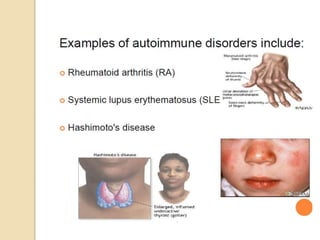
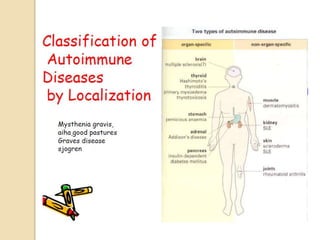
 Graves’ disease
 Hashimoto’s thyroiditis
 Addison’s disease
 Myasthenia gravis
 SLE
 Diabetes mellitus type 1
Auto or self antigens
 Are antigens that presents in ones
own cells
 Are altered by the action of bacteria,
viruses, chemicals or other drugs
Auto antibodies
 Altered cell (Auto Ag) - elicits the
productions of Antibody
Causes of autoimmune diseases
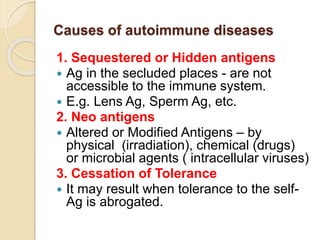
1. Sequestered or Hidden antigens
 Ag in the secluded places - are not
accessible to the immune system.
 E.g. Lens Ag, Sperm Ag, etc.
2. Neo antigens
 Altered or Modified Antigens – by
physical (irradiation), chemical (drugs)
or microbial agents ( intracellular viruses)
3. Cessation of Tolerance
 It may result when tolerance to the self-
Ag is abrogated.
Causes of autoimmune diseases
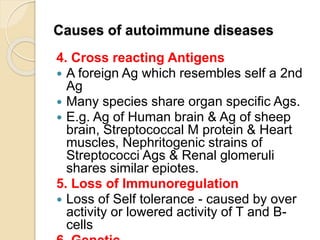
4. Cross reacting Antigens
 A foreign Ag which resembles self a 2nd
Ag
 Many species share organ specific Ags.
 E.g. Ag of Human brain & Ag of sheep
brain, Streptococcal M protein & Heart
muscles, Nephritogenic strains of
Streptococci Ags & Renal glomeruli
shares similar epiotes.
5. Loss of Immunoregulation
 Loss of Self tolerance - caused by over
activity or lowered activity of T and B-
cells
Classification of autoimmune
disorders
 1. Haemolytic autoimmune diseases
 2. Localised autoimmune diseases
 3. Systemic autoimmune diseases
Myasthenia Gravis
• 80 to 90% of patients have Autoantibodies
against acetylcholine receptor
• Combination of the Abs to the receptors blocks
the binding of acetylcholine which destroy the
receptors
• Muscle weakness
• Repetitive movements very difficult!
• In particular eye bulb muscles affected
• Life threatening when muscles for respiration
are affected
• Can be transferred to foetus .
• Abs can be detected with RIA methods
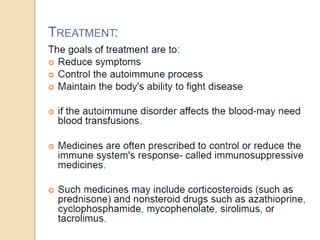
Anti-cholinesterase agents are employed in
therapy
Grave’s Disease
• Autoantibodies against receptor for
thyroid stimulating hormone (TSH)
• Activate receptor leading to excessive
thyroid hormone production
• Women are more susceptible than
men by a margin of 7:1 and usually
present between the ages of 30 and
40.
Systemic Lupus
Erythematosus
 It is a chronic systemic inflammatory disease
marked by alternating exacerbation and
remissions
Approximately 1 in every 2000 individuals are
affected
Age of onset is usually b/w 20 and 40 yrs of
age
Women are much more likely than men to be
stricken by a margin of 13 to 1
 Etiology is unknown but may be due to
genetic and environmental factors
Auto-antibodies against nuclearcomponents
(DNA, histones,ribosomes, snRNP, etc)
Local inflammation in skin, joints and
kidneys, multi-organ damage
Laboratory Diagnosis of SLE:
 A screening test for antinuclear antibody
(ANA) is usually the first test done
 Double-stranded DNA (ds-DNA):These Abs
are the most specific for SLE and are seen
only in patients with SLE
 Antihistone antibody: Histone is a major
component of chromatin, This antibody is
found in lupus patients
 Anti-Sm antibody:
 Antibody to extractable nuclear antigen was
first described in a patient named Smith
hence it is called anti-Sm
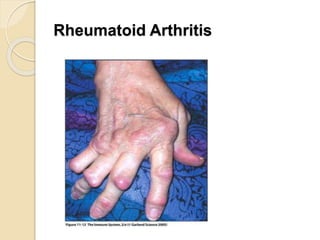
Rheumatoid Arthritis
 Rheumatoid arthritis is a systemic
autoimmune disorder
 It involves the synovial membrane of
multiple joints
 Women are more likely to be affected
than men and usually strikes between
the ages of 20 and 40
 The main immunologic finding is the
presence of RF
 RF is a 19S Ab directed against the Fc
portion of IgG(Rheumatoid Factor/RA
factor)
Rheumatoid Arthritis
THANK YOU

Autoimmunity & disorders ppt by DR.C P. PRINCE

  • 1.
    Autoimmunity DR.PRINCE C P HOD& Associate Professor Department of Microbiology, Mother Theresa Post Graduate & Research Institute of Health Sciences (Government of Puducherry Institution) Pondicherry
  • 2.
    Autoimmunity  Autoimmunity isdefined as the presence of immune response of auto Antibody against self Antigen.  It can be a humoral or cell mediated immune response against the constituents of the body’s own tissues.
  • 3.
    Autoimmune disorder  Anautoimmune disorder is a condition that occurs when the immune system attacks and destroys healthy body tissue
  • 4.
    Autoimmunity  Graves’ disease Hashimoto’s thyroiditis  Addison’s disease  Myasthenia gravis  SLE  Diabetes mellitus type 1
  • 5.
    Auto or selfantigens  Are antigens that presents in ones own cells  Are altered by the action of bacteria, viruses, chemicals or other drugs Auto antibodies  Altered cell (Auto Ag) - elicits the productions of Antibody
  • 8.
    Causes of autoimmunediseases 1. Sequestered or Hidden antigens  Ag in the secluded places - are not accessible to the immune system.  E.g. Lens Ag, Sperm Ag, etc. 2. Neo antigens  Altered or Modified Antigens – by physical (irradiation), chemical (drugs) or microbial agents ( intracellular viruses) 3. Cessation of Tolerance  It may result when tolerance to the self- Ag is abrogated.
  • 9.
    Causes of autoimmunediseases 4. Cross reacting Antigens  A foreign Ag which resembles self a 2nd Ag  Many species share organ specific Ags.  E.g. Ag of Human brain & Ag of sheep brain, Streptococcal M protein & Heart muscles, Nephritogenic strains of Streptococci Ags & Renal glomeruli shares similar epiotes. 5. Loss of Immunoregulation  Loss of Self tolerance - caused by over activity or lowered activity of T and B- cells
  • 10.
    Classification of autoimmune disorders 1. Haemolytic autoimmune diseases  2. Localised autoimmune diseases  3. Systemic autoimmune diseases
  • 12.
    Myasthenia Gravis • 80to 90% of patients have Autoantibodies against acetylcholine receptor • Combination of the Abs to the receptors blocks the binding of acetylcholine which destroy the receptors • Muscle weakness • Repetitive movements very difficult! • In particular eye bulb muscles affected • Life threatening when muscles for respiration are affected • Can be transferred to foetus . • Abs can be detected with RIA methods Anti-cholinesterase agents are employed in therapy
  • 13.
    Grave’s Disease • Autoantibodiesagainst receptor for thyroid stimulating hormone (TSH) • Activate receptor leading to excessive thyroid hormone production • Women are more susceptible than men by a margin of 7:1 and usually present between the ages of 30 and 40.
  • 14.
    Systemic Lupus Erythematosus  Itis a chronic systemic inflammatory disease marked by alternating exacerbation and remissions Approximately 1 in every 2000 individuals are affected Age of onset is usually b/w 20 and 40 yrs of age Women are much more likely than men to be stricken by a margin of 13 to 1  Etiology is unknown but may be due to genetic and environmental factors Auto-antibodies against nuclearcomponents (DNA, histones,ribosomes, snRNP, etc) Local inflammation in skin, joints and kidneys, multi-organ damage
  • 15.
    Laboratory Diagnosis ofSLE:  A screening test for antinuclear antibody (ANA) is usually the first test done  Double-stranded DNA (ds-DNA):These Abs are the most specific for SLE and are seen only in patients with SLE  Antihistone antibody: Histone is a major component of chromatin, This antibody is found in lupus patients  Anti-Sm antibody:  Antibody to extractable nuclear antigen was first described in a patient named Smith hence it is called anti-Sm
  • 16.
    Rheumatoid Arthritis  Rheumatoidarthritis is a systemic autoimmune disorder  It involves the synovial membrane of multiple joints  Women are more likely to be affected than men and usually strikes between the ages of 20 and 40  The main immunologic finding is the presence of RF  RF is a 19S Ab directed against the Fc portion of IgG(Rheumatoid Factor/RA factor)
  • 17.
  • 18.