Blood
and
Its Components
DR AMITHA G
Contents:
1. Introduction
2. RBC
3. WBC
1. Granulocytes
1. Neutrophils
2. Eosinophil’s
3. Basophils
2. Agranulocytes
1. Lymphocytes
2. Monocyte
1. PLATELETS
Blood
 Blood is a bright red, viscous, slightly alkaline fluid that accounts for
approximately 7 % of total body weight
Introduction:-
• The average human has 5 litres of blood (Average Blood Volume is 4 to 6 liters).
• It is a transporting fluid.
• Red colour is due to the presence of oxyhaemoglobin.
• Ph - 7.4 slightly alkaline.
• Specific gravity - 1.060
• Viscosity is 5 times greater then the water i.e thicker than water.
• Blood is the only fluid tissue.
• Blood is a complex connective tissue in which living cells, the formed elements, are
suspended in fluid componenet called plasma.
Functions of Blood
• Transport of:
– Gases, nutrients, waste products
– Processed molecules
– Regulatory molecules.
• Regulation of pH and osmosis.
• Maintenance of body temperature.
• Protection against foreign substances.
• Clot formation.
Blood composition
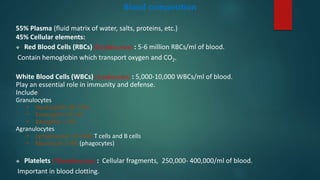
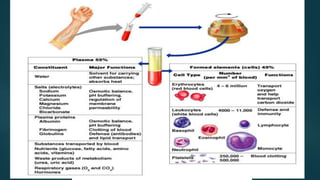
55% Plasma (fluid matrix of water, salts, proteins, etc.)
45% Cellular elements:
 Red Blood Cells (RBCs) (Erythrocytes) : 5-6 million RBCs/ml of blood.
Contain hemoglobin which transport oxygen and CO2.
White Blood Cells (WBCs) (Leukocytes) : 5,000-10,000 WBCs/ml of blood.
Play an essential role in immunity and defense.
Include:
Granulocytes
• Neutrophils 40-70%
• Eosinophil's 0-1%
• Basophils 1-5%
Agranulocytes
• Lymphocytes 25-40% T cells and B cells
• Monocyte 2-8% (phagocytes)
 Platelets (Thrombocytes) : Cellular fragments, 250,000- 400,000/ml of blood.
Important in blood clotting.
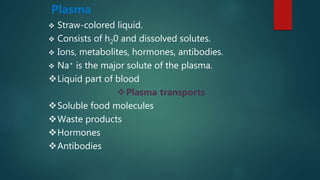
Plasma
 Straw-colored liquid.
 Consists of h20 and dissolved solutes.
 Ions, metabolites, hormones, antibodies.
 Na+ is the major solute of the plasma.
Liquid part of blood
Plasma transports
Soluble food molecules
Waste products
Hormones
Antibodies
Plasma
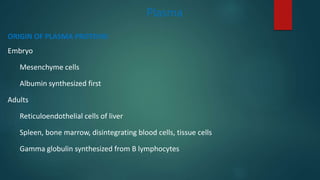
ORIGIN OF PLASMA PROTEINS
Embryo
Mesenchyme cells
Albumin synthesized first
Adults
Reticuloendothelial cells of liver
Spleen, bone marrow, disintegrating blood cells, tissue cells
Gamma globulin synthesized from B lymphocytes
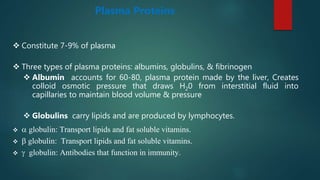
Plasma Proteins
 Constitute 7-9% of plasma
 Three types of plasma proteins: albumins, globulins, & fibrinogen
 Albumin accounts for 60-80, plasma protein made by the liver, Creates
colloid osmotic pressure that draws H20 from interstitial fluid into
capillaries to maintain blood volume & pressure
 Globulins carry lipids and are produced by lymphocytes.
 a globulin: Transport lipids and fat soluble vitamins.
 b globulin: Transport lipids and fat soluble vitamins.
 g globulin: Antibodies that function in immunity.
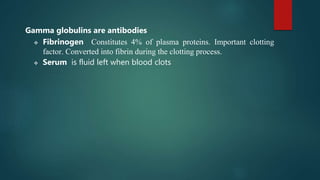
Gamma globulins are antibodies
 Fibrinogen Constitutes 4% of plasma proteins. Important clotting
factor. Converted into fibrin during the clotting process.
 Serum is fluid left when blood clots
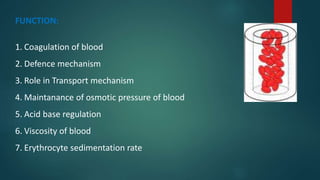
FUNCTION:
1. Coagulation of blood
2. Defence mechanism
3. Role in Transport mechanism
4. Maintanance of osmotic pressure of blood
5. Acid base regulation
6. Viscosity of blood
7. Erythrocyte sedimentation rate
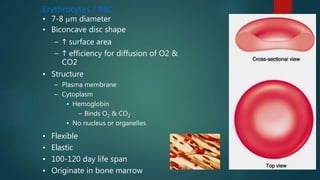
Erythrocytes / RBC
• 7-8 m diameter
• Biconcave disc shape
–  surface area
–  efficiency for diffusion of O2 &
CO2
• Flexible
• Elastic
• 100-120 day life span
• Originate in bone marrow
• Structure
– Plasma membrane
– Cytoplasm
• Hemoglobin
– Binds O2 & CO2
• No nucleus or organelles
Biconcave shape:
• Rapid diffusion
• Large surface area
• Minimal tension
• Squeeze through capillaries
Properties of RBS’s:
• Rouleaux formation
• Specific gravity : 1.092 to 1.101.
• Packed cell volume
• Suspension stability
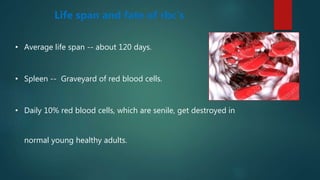
Life span and fate of rbc’s
• Average life span -- about 120 days.
• Spleen -- Graveyard of red blood cells.
• Daily 10% red blood cells, which are senile, get destroyed in
normal young healthy adults.
Leukocytes or white blood cells (wbcs)
Complete cells (nuclei, mitochondria and organelles)
Move in amoeboid fashion. Can squeeze (leave the blood vessels
through) capillary walls (diapedesis), respond to chemicals
 Almost invisible, so named after stains.
 Neutrophils are the most abundant WBC, accounts for 50 – 70% of
WBCs.
Involved in immune function. Crucial for defense.
Positive chemotaxis: they respond to chemical signals and move
toward damage or threats.
Body increases amount in response to infection
Leukocytosis: more than 11,000 cells/mm3 indicates infection
Leukopenia: abnormally low, usually due to corticosteroids and
chemotherapy.
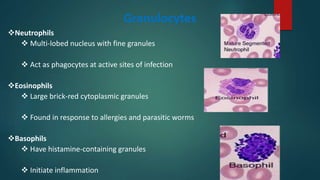
Granulocytes
Neutrophils
 Multi-lobed nucleus with fine granules
 Act as phagocytes at active sites of infection
Eosinophils
 Large brick-red cytoplasmic granules
 Found in response to allergies and parasitic worms
Basophils
 Have histamine-containing granules
 Initiate inflammation
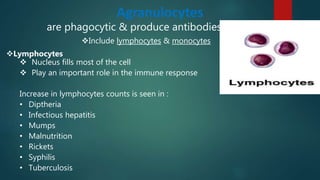
Agranulocytes
are phagocytic & produce antibodies
Include lymphocytes & monocytes
Lymphocytes
 Nucleus fills most of the cell
 Play an important role in the immune response
Increase in lymphocytes counts is seen in :
• Diptheria
• Infectious hepatitis
• Mumps
• Malnutrition
• Rickets
• Syphilis
• Tuberculosis
Monocytes:
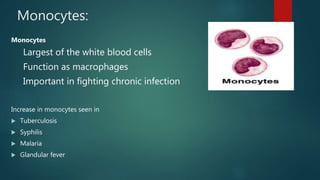
Monocytes
Largest of the white blood cells
Function as macrophages
Important in fighting chronic infection
Increase in monocytes seen in
 Tuberculosis
 Syphilis
 Malaria
 Glandular fever
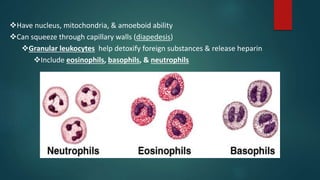
Have nucleus, mitochondria, & amoeboid ability
Can squeeze through capillary walls (diapedesis)
Granular leukocytes help detoxify foreign substances & release heparin
Include eosinophils, basophils, & neutrophils
Neutrophils
[Polymorphonuclear leukocytes]
 Constitute 60 – 70%
 12 – 15 µm in diameter in blood smear
 Nuclei having two to five lobes
 Cytoplasm contains abundant specific granules and azurophilic granules
 Short lived with a half life of 6 – 7hrs in blood and a life span of 1 – 4 days
in connective tissue(terminal cell)
23
Neutrophils
[Polymorphonuclear Leukocytes]
Specific granules:
1)Azurophilic(primary): cathepsin, elastase, aryl sulphatase, acid phosphatase
2)Specific (secondary): alkaline phosphatase, lysozyme, collagenase,
lactoferrin, NADPH oxidase
3) Tertiary : gelatinase, cethepsins, glycoprotein that are inserted into
plasmalemma
24
Neutrophils
[Polymorphonuclear Leukocytes]
1. Specific granules: contains varies enzymes and pharmacological agents that aid the
neutrophil in performing its antimicrobial functions. In EM granules appear oblong
2. Azurophilic granules: as already indicated, are lysosomes, containing acid hydrolysis,
myeloperoxidase, antibacterial agent lysozyme, bacterial permeability increasing protein,
cethepsin G, Elastase, Nonspecific collagenase
3. Tertiary granules: contain gelatinase and cethepsins as well as glycoprotein that are inserted
into plasmalemma
25
Neutrophils
[Polymorphonuclear Leukocytes]
26
Neutrophils
[Polymorphonuclear Leukocytes]
27
Neutrophils
[Polymorphonuclear Leukocytes]
 Functions :
 Considered as defence against invasion of micro organisms
 Active phagocytes of small particles and are termed microphages
28
Neutrophils
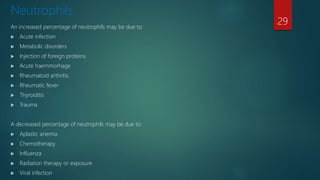
An increased percentage of neutrophils may be due to:
 Acute infection
 Metabolic disorders
 Injection of foreign proteins
 Acute haemmorhage
 Rheumatoid arthritis
 Rheumatic fever
 Thyroiditis
 Trauma
A decreased percentage of neutrophils may be due to:
 Aplastic anemia
 Chemotherapy
 Influenza
 Radiation therapy or exposure
 Viral infection
29
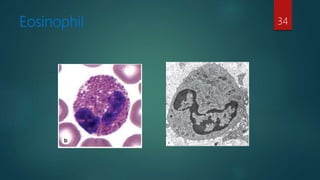
Eosinophils
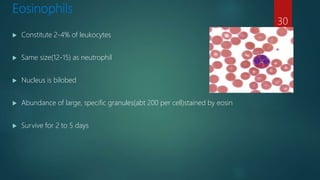
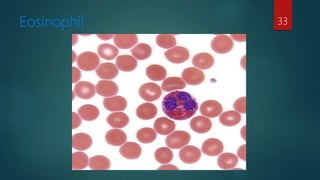
 Constitute 2-4% of leukocytes
 Same size(12-15) as neutrophil
 Nucleus is bilobed
 Abundance of large, specific granules(abt 200 per cell)stained by eosin
 Survive for 2 to 5 days
30
Specific granules:
 Acid phosphatase
 Arylsulfatase
 Beta- glucoranidase
 Cathepsin
 Phospholipase
 RNAase
 Eosinophilic peroxidase
 Major basic protein
Eosinophils
 Eosinophils are responsible for detoxification, disintegration and removal of foreign
proteins.
 The lethal substances present in the granules of eosinophils and released at the time of
exposure to parasites or foreign proteins are:
Internum :
1. Major basic protein (MBP) [50%]:arginin,histaminase
2. Eosinophil cationic protein (ECP)
3. Eosinophil-derived neurotoxin
Externum :
Chemotactic factor receptor
32
Eosinophil 33
Eosinophil 34
Eosinophils
Functions:
 Involved in immediate type of hypersensitivity.
 Granules release enzymes capable of degrading chemical mediaters of inflammation.
 Produce histaminase which inactivates histamine.
 Count is increased in parasitic infection.
35
Eosinophils
Reduced eosinophil count is seen in
 Bacterial infection
 Cushing syndrome or use of steroids
 Burns and acute infections
36
Eosinophils
An increased percentage of eosinophils may be due to:
 Asthma
 Allergic condition
 Collagen vascular disease
 Scarlet fewer
 Parasitic infection
37
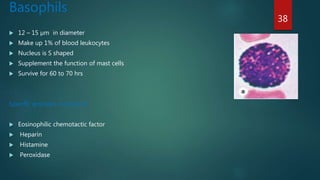
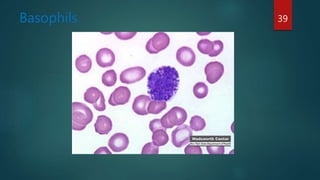
Basophils
 12 – 15 µm in diameter
 Make up 1% of blood leukocytes
 Nucleus is S shaped
 Supplement the function of mast cells
 Survive for 60 to 70 hrs
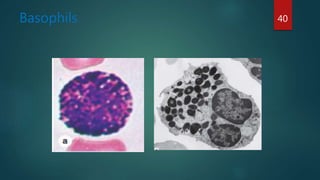
Specific granules consists of:
 Eosinophilic chemotactic factor
 Heparin
 Histamine
 Peroxidase
38
Basophils 39
Basophils 40
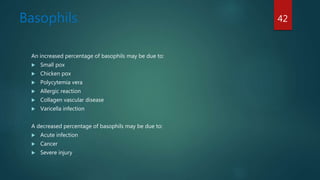
Basophils
Functions :
 Increased in allergic inflammation
 Cause release of histamine, SRS-A.
 Cell membrane bears the fc receptors that have affinity for plasma Ig E-
basophil is sensitized with Ig E
 Increased by certain harmones like cortisol
 Reduced count is seen in urticaria
41
Basophils
An increased percentage of basophils may be due to:
 Small pox
 Chicken pox
 Polycytemia vera
 Allergic reaction
 Collagen vascular disease
 Varicella infection
A decreased percentage of basophils may be due to:
 Acute infection
 Cancer
 Severe injury
42
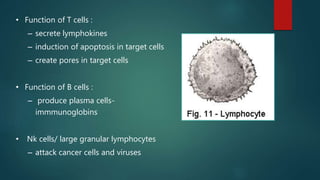
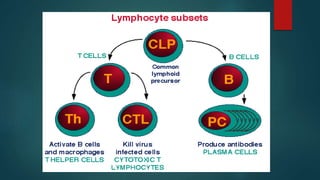
• Function of T cells :
– secrete lymphokines
– induction of apoptosis in target cells
– create pores in target cells
• Function of B cells :
– produce plasma cells-
immmunoglobins
• Nk cells/ large granular lymphocytes
– attack cancer cells and viruses
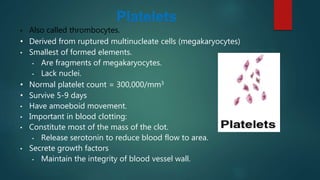
Platelets
• Also called thrombocytes.
• Derived from ruptured multinucleate cells (megakaryocytes)
• Smallest of formed elements.
• Are fragments of megakaryocytes.
• Lack nuclei.
• Normal platelet count = 300,000/mm3
• Survive 5-9 days
• Have amoeboid movement.
• Important in blood clotting:
• Constitute most of the mass of the clot.
• Release serotonin to reduce blood flow to area.
• Secrete growth factors
• Maintain the integrity of blood vessel wall.
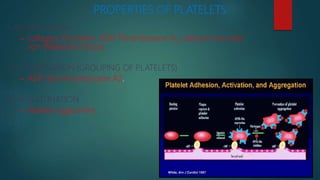
PROPERTIES OF PLATELETS
1. ADHESIVENESS
– collagen, thrombin, ADP, Thromboxane A2, calcium ions and
von Willebrand factor.
2. AGGREGATION (GROUPING OF PLATELETS)
– ADP and thromboxane A2.
3. AGGLUTINATION
– Platelet agglutinins.
Functions :-
– Blood coagulation
• Form temporary haemostatic plug
• Sealing blood vessels
– Clot retraction
– Phagocytic function
– Storage & transport of 5-HT & histamine
– Repair of blood vessel.
Thank you

Blood

  • 1.
  • 2.
    Contents: 1. Introduction 2. RBC 3.WBC 1. Granulocytes 1. Neutrophils 2. Eosinophil’s 3. Basophils 2. Agranulocytes 1. Lymphocytes 2. Monocyte 1. PLATELETS
  • 3.
    Blood  Blood isa bright red, viscous, slightly alkaline fluid that accounts for approximately 7 % of total body weight
  • 4.
    Introduction:- • The averagehuman has 5 litres of blood (Average Blood Volume is 4 to 6 liters). • It is a transporting fluid. • Red colour is due to the presence of oxyhaemoglobin. • Ph - 7.4 slightly alkaline. • Specific gravity - 1.060 • Viscosity is 5 times greater then the water i.e thicker than water. • Blood is the only fluid tissue. • Blood is a complex connective tissue in which living cells, the formed elements, are suspended in fluid componenet called plasma.
  • 5.
    Functions of Blood •Transport of: – Gases, nutrients, waste products – Processed molecules – Regulatory molecules. • Regulation of pH and osmosis. • Maintenance of body temperature. • Protection against foreign substances. • Clot formation.
  • 6.
    Blood composition 55% Plasma(fluid matrix of water, salts, proteins, etc.) 45% Cellular elements:  Red Blood Cells (RBCs) (Erythrocytes) : 5-6 million RBCs/ml of blood. Contain hemoglobin which transport oxygen and CO2. White Blood Cells (WBCs) (Leukocytes) : 5,000-10,000 WBCs/ml of blood. Play an essential role in immunity and defense. Include: Granulocytes • Neutrophils 40-70% • Eosinophil's 0-1% • Basophils 1-5% Agranulocytes • Lymphocytes 25-40% T cells and B cells • Monocyte 2-8% (phagocytes)  Platelets (Thrombocytes) : Cellular fragments, 250,000- 400,000/ml of blood. Important in blood clotting.
  • 8.
    Plasma  Straw-colored liquid. Consists of h20 and dissolved solutes.  Ions, metabolites, hormones, antibodies.  Na+ is the major solute of the plasma. Liquid part of blood Plasma transports Soluble food molecules Waste products Hormones Antibodies
  • 9.
    Plasma ORIGIN OF PLASMAPROTEINS Embryo Mesenchyme cells Albumin synthesized first Adults Reticuloendothelial cells of liver Spleen, bone marrow, disintegrating blood cells, tissue cells Gamma globulin synthesized from B lymphocytes
  • 10.
    Plasma Proteins  Constitute7-9% of plasma  Three types of plasma proteins: albumins, globulins, & fibrinogen  Albumin accounts for 60-80, plasma protein made by the liver, Creates colloid osmotic pressure that draws H20 from interstitial fluid into capillaries to maintain blood volume & pressure  Globulins carry lipids and are produced by lymphocytes.  a globulin: Transport lipids and fat soluble vitamins.  b globulin: Transport lipids and fat soluble vitamins.  g globulin: Antibodies that function in immunity.
  • 11.
    Gamma globulins areantibodies  Fibrinogen Constitutes 4% of plasma proteins. Important clotting factor. Converted into fibrin during the clotting process.  Serum is fluid left when blood clots
  • 12.
    FUNCTION: 1. Coagulation ofblood 2. Defence mechanism 3. Role in Transport mechanism 4. Maintanance of osmotic pressure of blood 5. Acid base regulation 6. Viscosity of blood 7. Erythrocyte sedimentation rate
  • 13.
    Erythrocytes / RBC •7-8 m diameter • Biconcave disc shape –  surface area –  efficiency for diffusion of O2 & CO2 • Flexible • Elastic • 100-120 day life span • Originate in bone marrow • Structure – Plasma membrane – Cytoplasm • Hemoglobin – Binds O2 & CO2 • No nucleus or organelles
  • 14.
    Biconcave shape: • Rapiddiffusion • Large surface area • Minimal tension • Squeeze through capillaries Properties of RBS’s: • Rouleaux formation • Specific gravity : 1.092 to 1.101. • Packed cell volume • Suspension stability
  • 15.
    Life span andfate of rbc’s • Average life span -- about 120 days. • Spleen -- Graveyard of red blood cells. • Daily 10% red blood cells, which are senile, get destroyed in normal young healthy adults.
  • 16.
    Leukocytes or whiteblood cells (wbcs) Complete cells (nuclei, mitochondria and organelles) Move in amoeboid fashion. Can squeeze (leave the blood vessels through) capillary walls (diapedesis), respond to chemicals  Almost invisible, so named after stains.  Neutrophils are the most abundant WBC, accounts for 50 – 70% of WBCs.
  • 17.
    Involved in immunefunction. Crucial for defense. Positive chemotaxis: they respond to chemical signals and move toward damage or threats. Body increases amount in response to infection Leukocytosis: more than 11,000 cells/mm3 indicates infection Leukopenia: abnormally low, usually due to corticosteroids and chemotherapy.
  • 18.
    Granulocytes Neutrophils  Multi-lobed nucleuswith fine granules  Act as phagocytes at active sites of infection Eosinophils  Large brick-red cytoplasmic granules  Found in response to allergies and parasitic worms Basophils  Have histamine-containing granules  Initiate inflammation
  • 19.
    Agranulocytes are phagocytic &produce antibodies Include lymphocytes & monocytes Lymphocytes  Nucleus fills most of the cell  Play an important role in the immune response Increase in lymphocytes counts is seen in : • Diptheria • Infectious hepatitis • Mumps • Malnutrition • Rickets • Syphilis • Tuberculosis
  • 20.
    Monocytes: Monocytes Largest of thewhite blood cells Function as macrophages Important in fighting chronic infection Increase in monocytes seen in  Tuberculosis  Syphilis  Malaria  Glandular fever
  • 22.
    Have nucleus, mitochondria,& amoeboid ability Can squeeze through capillary walls (diapedesis) Granular leukocytes help detoxify foreign substances & release heparin Include eosinophils, basophils, & neutrophils
  • 23.
    Neutrophils [Polymorphonuclear leukocytes]  Constitute60 – 70%  12 – 15 µm in diameter in blood smear  Nuclei having two to five lobes  Cytoplasm contains abundant specific granules and azurophilic granules  Short lived with a half life of 6 – 7hrs in blood and a life span of 1 – 4 days in connective tissue(terminal cell) 23
  • 24.
    Neutrophils [Polymorphonuclear Leukocytes] Specific granules: 1)Azurophilic(primary):cathepsin, elastase, aryl sulphatase, acid phosphatase 2)Specific (secondary): alkaline phosphatase, lysozyme, collagenase, lactoferrin, NADPH oxidase 3) Tertiary : gelatinase, cethepsins, glycoprotein that are inserted into plasmalemma 24
  • 25.
    Neutrophils [Polymorphonuclear Leukocytes] 1. Specificgranules: contains varies enzymes and pharmacological agents that aid the neutrophil in performing its antimicrobial functions. In EM granules appear oblong 2. Azurophilic granules: as already indicated, are lysosomes, containing acid hydrolysis, myeloperoxidase, antibacterial agent lysozyme, bacterial permeability increasing protein, cethepsin G, Elastase, Nonspecific collagenase 3. Tertiary granules: contain gelatinase and cethepsins as well as glycoprotein that are inserted into plasmalemma 25
  • 26.
  • 27.
  • 28.
    Neutrophils [Polymorphonuclear Leukocytes]  Functions:  Considered as defence against invasion of micro organisms  Active phagocytes of small particles and are termed microphages 28
  • 29.
    Neutrophils An increased percentageof neutrophils may be due to:  Acute infection  Metabolic disorders  Injection of foreign proteins  Acute haemmorhage  Rheumatoid arthritis  Rheumatic fever  Thyroiditis  Trauma A decreased percentage of neutrophils may be due to:  Aplastic anemia  Chemotherapy  Influenza  Radiation therapy or exposure  Viral infection 29
  • 30.
    Eosinophils  Constitute 2-4%of leukocytes  Same size(12-15) as neutrophil  Nucleus is bilobed  Abundance of large, specific granules(abt 200 per cell)stained by eosin  Survive for 2 to 5 days 30
  • 31.
    Specific granules:  Acidphosphatase  Arylsulfatase  Beta- glucoranidase  Cathepsin  Phospholipase  RNAase  Eosinophilic peroxidase  Major basic protein
  • 32.
    Eosinophils  Eosinophils areresponsible for detoxification, disintegration and removal of foreign proteins.  The lethal substances present in the granules of eosinophils and released at the time of exposure to parasites or foreign proteins are: Internum : 1. Major basic protein (MBP) [50%]:arginin,histaminase 2. Eosinophil cationic protein (ECP) 3. Eosinophil-derived neurotoxin Externum : Chemotactic factor receptor 32
  • 33.
  • 34.
  • 35.
    Eosinophils Functions:  Involved inimmediate type of hypersensitivity.  Granules release enzymes capable of degrading chemical mediaters of inflammation.  Produce histaminase which inactivates histamine.  Count is increased in parasitic infection. 35
  • 36.
    Eosinophils Reduced eosinophil countis seen in  Bacterial infection  Cushing syndrome or use of steroids  Burns and acute infections 36
  • 37.
    Eosinophils An increased percentageof eosinophils may be due to:  Asthma  Allergic condition  Collagen vascular disease  Scarlet fewer  Parasitic infection 37
  • 38.
    Basophils  12 –15 µm in diameter  Make up 1% of blood leukocytes  Nucleus is S shaped  Supplement the function of mast cells  Survive for 60 to 70 hrs Specific granules consists of:  Eosinophilic chemotactic factor  Heparin  Histamine  Peroxidase 38
  • 39.
  • 40.
  • 41.
    Basophils Functions :  Increasedin allergic inflammation  Cause release of histamine, SRS-A.  Cell membrane bears the fc receptors that have affinity for plasma Ig E- basophil is sensitized with Ig E  Increased by certain harmones like cortisol  Reduced count is seen in urticaria 41
  • 42.
    Basophils An increased percentageof basophils may be due to:  Small pox  Chicken pox  Polycytemia vera  Allergic reaction  Collagen vascular disease  Varicella infection A decreased percentage of basophils may be due to:  Acute infection  Cancer  Severe injury 42
  • 43.
    • Function ofT cells : – secrete lymphokines – induction of apoptosis in target cells – create pores in target cells • Function of B cells : – produce plasma cells- immmunoglobins • Nk cells/ large granular lymphocytes – attack cancer cells and viruses
  • 44.
    Platelets • Also calledthrombocytes. • Derived from ruptured multinucleate cells (megakaryocytes) • Smallest of formed elements. • Are fragments of megakaryocytes. • Lack nuclei. • Normal platelet count = 300,000/mm3 • Survive 5-9 days • Have amoeboid movement. • Important in blood clotting: • Constitute most of the mass of the clot. • Release serotonin to reduce blood flow to area. • Secrete growth factors • Maintain the integrity of blood vessel wall.
  • 45.
    PROPERTIES OF PLATELETS 1.ADHESIVENESS – collagen, thrombin, ADP, Thromboxane A2, calcium ions and von Willebrand factor. 2. AGGREGATION (GROUPING OF PLATELETS) – ADP and thromboxane A2. 3. AGGLUTINATION – Platelet agglutinins.
  • 46.
    Functions :- – Bloodcoagulation • Form temporary haemostatic plug • Sealing blood vessels – Clot retraction – Phagocytic function – Storage & transport of 5-HT & histamine – Repair of blood vessel.
  • 47.

Editor's Notes

  • #13 Fibrenogen helps in coagulation Gamma globulin helps in defence Albumin, alpha and beta globulin helps in transport Plasma protein donot pass through capillary so helps in osmotic pressure Plasma protein, albumin helps in acid base regulation Albumin helps In viscosity
  • #20 T lymphocytes : concerned with cellular immunity B lymphocytes : concerned with humoral immunity
  • #21 Its formed in bone marrow- ( CFU-GM ) colony formin unit-granulocyte-monocyte, > myeloblast > monoyte.
  • #22 T lymphocytes : concerned with cellular immunity B lymphocytes : concerned with humoral immunity
  • #24 3 types of granules : specific granules ( 0.1 micro meter in diameter) azurophilic granules ( 0. 5 ) teritiory granules
  • #25 Specific granules : have antimicrobial action and they are oblong
  • #31 Eosinphilis : phagocytose antigen- antibody complex and kill parasitic invaders
  • #32 They have specific granules called externum and internum
  • #33 Internum have highly efficacious agents in combating parasites Azurophilic granules are lysosomes (0.5 micro m) in diameter - helps in distruction of parasitic worms , hydrolysis of antigen-antibody complexes internalised by eosinophils
  • #36 Eosinophils : eliminates antigen-antibody comlexes and destroy parasitic worms.
  • #42 Basophils : initiators of inlammatory process. SRS-A slow reacting substance of anaphylaxis