Topics	
  
—  Introduc)ons	
  	
  
—  What	
  is	
  a	
  blog?	
  
—  Why	
  should	
  you	
  have	
  one?	
  
•  How	
  to	
  generate	
  blog	
  content	
  
•  How	
  to	
  Op)mize	
  Your	
  Blog	
  
•  How	
  to	
  Promote	
  Your	
  Blog	
  
•  How	
  to	
  Measure	
  Your	
  Blog	
  	
  
•  Best	
  Prac)ces	
  
•  4	
  Case	
  Studies	


2
3
What	
  is	
  a	
  blog?	
  
—  Blog	
  =	
  ‘web	
  log’	
  
—  A	
  website	
  or	
  part	
  of	
  a	
  website	
  updated	
  with	
  new	
  content	
  
    periodic	
  basis.	
  	
  
—  Usually	
  maintained	
  by	
  an	
  individual	
  or	
  individuals	
  with	
  
    regular	
  entries	
  of	
  commentary,	
  descrip)ons	
  of	
  events,	
  or	
  
    other	
  material	
  such	
  as	
  graphics	
  or	
  video.	
  	
  
—  Long-­‐term	
  marke)ng	
  asset	
  that	
  will	
  bring	
  traffic	
  to	
  your	
  
    business	
  
—  Can	
  be	
  setup	
  within	
  minutes	
  online	
  using	
  Wordpress	
  or	
  
    other	
  blogging	
  soQware.	
  
4
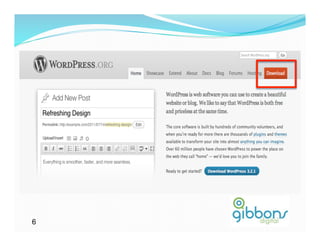
Wordpress	
  
— Wordpress.org	
  
— Install	
  soQware	
  onto	
  your	
  server	
  
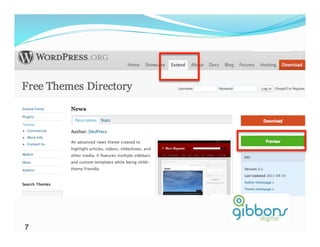
— Select	
  theme	
  (template),	
  or	
  create	
  custom	
  
    design	


5
6
7
8
‹#›   9
‹#›   10
Why	
  Should	
  You	
  Have	
  a	
  Blog?	
  
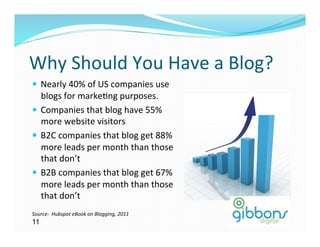
—  Nearly	
  40%	
  of	
  US	
  companies	
  use	
  
    blogs	
  for	
  marke)ng	
  purposes.	
  
—  Companies	
  that	
  blog	
  have	
  55%	
  
    more	
  website	
  visitors	
  
—  B2C	
  companies	
  that	
  blog	
  get	
  88%	
  
    more	
  leads	
  per	
  month	
  than	
  those	
  
    that	
  don’t	
  
—  B2B	
  companies	
  that	
  blog	
  get	
  67%	
  
    more	
  leads	
  per	
  month	
  than	
  those	
  
    that	
  don’t	
  
Source:	
  	
  Hubspot	
  eBook	
  on	
  Blogging,	
  2011	
  
11
Why	
  Should	
  You	
  Have	
  a	
  Blog?	
  
 —  Over	
  57	
  million	
  Americans	
  read	
  blogs	
  
 —  Technora)	
  is	
  currently	
  tracking	
  over	
  70	
  million	
  blogs	
  	
  
 —  Over	
  120	
  thousand	
  blogs	
  are	
  created	
  every	
  day	
  	
  
 —  There	
  are	
  over	
  1.4	
  million	
  new	
  blog	
  posts	
  every	
  day	
  	
  
 —  22	
  of	
  the	
  100	
  most	
  popular	
  websites	
  in	
  the	
  world	
  are	
  
     blogs	
  	
  
 —  51%	
  of	
  blog	
  readers	
  shop	
  online	
  	
  
 —  Blog	
  readers	
  average	
  23	
  hours	
  online	
  each	
  week	
  
 Source:	
  BlogWorldExpo.com	
  

12                                                                                            12
Why	
  Should	
  You	
  Have	
  a	
  Blog?	
  
—  83%	
  of	
  corporate	
  bloggers	
  saw	
  a	
  traffic	
  increase	
  to	
  their	
  
    site	
  
—  51%	
  took	
  less	
  than	
  1-­‐2	
  months	
  from	
  ini)al	
  concept	
  to	
  
    launch	
  of	
  blog	
  
—  88%	
  saw	
  a	
  boost	
  in	
  search	
  engine	
  ranking	
  within	
  3	
  
    months	
  of	
  launch	
  
—  62%	
  saw	
  an	
  increase	
  in	
  sales	
  within	
  3	
  months	
  of	
  launch	
  
Source:	
  Backbone	
  Media	
  Business	
  Blogging	
  Survey	


13
Why	
  Should	
  You	
  Have	
  a	
  Blog?	


  14
Why	
  Should	
  You	
  Have	
  a	
  Blog?	
  
—  Blogging	
  boosts	
  your	
  ranking	
  on	
  Google	
  searches	
  –	
  the	
  
    more	
  blog	
  posts	
  you	
  publish	
  the	
  be`er	
  
—  Establishes	
  you	
  as	
  a	
  thought	
  leader	
  –	
  helps	
  earn	
  people’s	
  
    trust	
  and	
  stay	
  top-­‐of-­‐mind	
  for	
  your	
  community	
  
—  Gives	
  you	
  a	
  plaborm	
  to	
  place	
  calls-­‐to-­‐ac)on	
  –	
  you	
  can	
  ask	
  
    people	
  to	
  a`end	
  a	
  fundraiser	
  or	
  community	
  event,	
  
    donate,	
  etc.	


15
Genera)ng	
  Blog	
  Content	
  
— Brainstorming	
  
— Editorial	
  Calendar	
  
— Repackaging	
  
— Guest	
  Blogging	
  
— Cura)on	
  
— Events	
  and	
  Calendar	
  
— Original	
  Content	
  
16
Brainstorming	
  
—  What	
  will	
  my	
  blog	
  be	
  about?	
  
—  What	
  are	
  the	
  goals	
  of	
  my	
  
    organiza)on?	
  
—  What	
  is	
  my	
  area	
  of	
  exper)se?	
  
—  What	
  are	
  my	
  professional	
  
    interests?	
  
—  Who	
  else	
  will	
  contribute	
  on	
  a	
  
    regular	
  basis?	
  

17
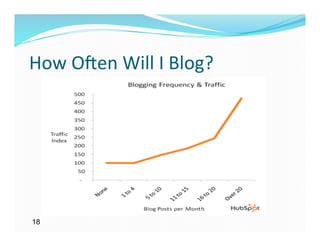
How	
  OQen	
  Will	
  I	
  Blog?	


18
How	
  Will	
  I	
  Organize	
  My	
  Blog?	
  
— Decide	
  on	
  content	
  categories	
  
— Look	
  at	
  the	
  calendar	
  
— Commit	
  to	
  pos)ng	
  2-­‐3	
  )mes	
  per	
  week	
  and	
  
     build	
  from	
  there	


19
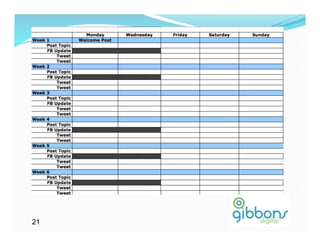
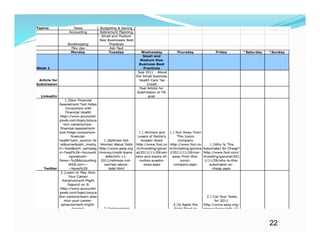
Editorial	
  Calendar	
  
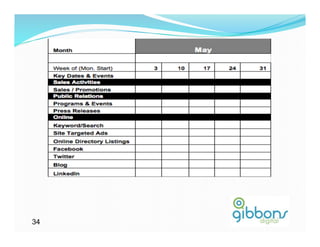
— An	
  editorial	
  calendar	
  helps	
  plan	
  both	
  the	
  
     subject	
  ma`er	
  and	
  frequency	
  for	
  blog	
  posts	
  
     for	
  3-­‐6	
  months	
  
     —  Maintains	
  balance	
  among	
  different	
  kind	
  of	
  
         posts	
  
     —  Keeps	
  bloggers	
  on	
  schedule	
  and	
  pos)ng	
  
         regularly	
  
     —  Provides	
  structure	
  and	
  flexibility	
  

20
21
22
Repackage	
  Exis)ng	
  Content	
  
—  Look	
  to	
  your	
  employees	
  
    and	
  staff	
  
—  Repurpose	
  internal	
  and	
  
    external	
  
    communica)ons	
  
    materials	
  
—  Provide	
  resources	
  for	
  
    the	
  communi)es	
  you	
  
    serve	
  
23
Guest	
  Blogging	
  
—  Generate	
  a	
  list	
  of	
  poten)al	
  
    guest	
  bloggers	
  
—  Invite	
  collaborators	
  to	
  write	
  
—  Keep	
  the	
  focus	
  on	
  their	
  
    projects	
  and	
  organiza)ons	
  
—  Maintain	
  the	
  rela)onship	
  by	
  
    referencing	
  the	
  organiza)on	
  
    in	
  future	
  blog	
  posts	
  

24
Cura)on	
  
— Research	
  bloggers	
  who	
  are	
  a	
  part	
  of	
  your	
  
     space	
  
     —  Katya	
  Andresen,	
  Network	
  for	
  Good	
  
     —  Beth	
  Kanter,	
  Beth’s	
  Blog	
  
     —  Allison	
  Fine,	
  A	
  Fine	
  Blog	
  
     —  Seth	
  Godin,	
  Seth’s	
  Blog	
  
     —  Sasha	
  Dichter	
  
     —  Many,	
  many	
  others	
  
25
Cura)on	
  
— Research	
  bloggers	
  outside	
  your	
  space	
  
    —  Personal	
  interests	
  
    —  Subjects	
  that	
  might	
  interest	
  the	
  clients	
  with	
  
        whom	
  you	
  work	
  
    —  Hobbies	
  
    —  Local	
  informa)on	
  
    —  Anything	
  par)cularly	
  well-­‐done	
  or	
  inspira)onal	


26
Cura)on	
  
— Set	
  up	
  a	
  blog	
  reader	
  to	
  keep	
  current	
  on	
  posts	
  
   from	
  favorite	
  blogs	
  (e.g.	
  Google	
  Reader,	
  etc.)	
  
— Check	
  your	
  reader	
  every	
  morning	
  when	
  you	
  
   check	
  your	
  e-­‐mail	
  
— Flag	
  relevant	
  posts	


27
28
29
30
31
Cura)on	
  
— Share	
  content	
  in	
  a	
  )mely	
  manner	
  
     —  Add	
  insight	
  and	
  value	
  
     —  Make	
  the	
  content	
  relevant	
  for	
  your	
  readers	
  
     —  Start	
  a	
  conversa)on	
  
—  Always,	
  always,	
  always	
  a`ribute	
  the	
  material	
  and    	
  
    ideas	
  to	
  the	
  original	
  author	
  

32
Events	
  and	
  Calendar	
  
— Focus	
  blog	
  posts	
  on	
  key	
  events	
  in	
  your	
  
   organiza)on’s	
  calendar	
  year	
  
— Incorporate	
  major	
  holidays	
  
— Don’t	
  forget	
  seasonal	
  issues	
  that	
  affect	
  your	
  
   work	
  and	
  your	
  clients	
  e.g.	
  the	
  start	
  of	
  the	
  
   school	
  year	
  

33
34
Original	
  Content	
  
— Start	
  with	
  the	
  basics	
  –	
  introduc)on,	
  mission	
  
   statement	
  for	
  the	
  blog	
  
— Keep	
  it	
  short	
  –	
  200-­‐300	
  words	
  
— Maintain	
  a	
  running	
  list	
  of	
  ideas	
  
— Don’t	
  expect	
  perfec)on	


35
Original	
  Content	
  
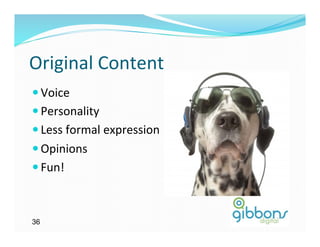
— Voice	
  
— Personality	
  
— Less	
  formal	
  expression	
  
— Opinions	
  
— Fun!	


36
Exercise	
  –	
  Part	
  1	
  
—  Brainstorm	
  4	
  ideas	
  for	
  blog	
  posts	
  	
  
—  Brainstorm	
  4	
  sources	
  for	
  blog	
  posts	
  for	
  your	
  
      organiza)on	
  
—  Read	
  them	
  out	
  loud	
  and	
  we’ll	
  discuss	


‹#›                                                                         37
How	
  to	
  Op)mize	
  Your	
  Blog	
  
—  Need	
  to	
  op)mize	
  to	
  grab	
  people’s	
  a`en)on	
  and	
  rank	
  well	
  
    with	
  search	
  engines	
  
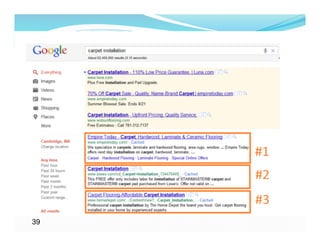
—  Search	
  engines	
  scan	
  each	
  page	
  of	
  your	
  website	
  looking	
  
    for	
  clues	
  about	
  what	
  topics	
  you	
  cover,	
  and	
  at	
  the	
  back-­‐
    end	
  code	
  for	
  important	
  tags	
  and	
  descrip)ons	
  
—  Your	
  ranking	
  on	
  the	
  search	
  engine	
  results	
  page	
  is	
  
    determined	
  by	
  how	
  relevant	
  and	
  authorita)ve	
  your	
  
    website	
  is	
  determined	
  to	
  be 	


38
39
How	
  to	
  Op)mize	
  you	
  Blog	
  
—  Keywords	
  -­‐	
  a	
  cri)cal	
  component	
  to	
  SEO	
  is	
  selec)ng	
  the	
  
    right	
  keywords.	


—  Select	
  7	
  to	
  10	
  words	
  or	
  phrases	
  that	
  best	
  describe	
  your	
  
    business	
  and	
  services.	
  	
  Ensure	
  each	
  page	
  of	
  your	
  website	
  
    is	
  op)mized	
  around	
  those	
  keywords.	
  
     —  Be	
  specific	
  –	
  child	
  care,	
  not	
  general	
  –	
  nonprofit	
  
—  For	
  example:	
  
     —  Store	
  sells	
  shoes	
  and	
  wants	
  website	
  to	
  rank	
  for	
  “shoe	
  
         store”	


     —  Be`er	
  bet	
  to	
  op)mize	
  for	
  “red	
  tennis	
  shoes	
  with	
  velcro”	
  
40
How	
  to	
  Op)mize	
  you	
  Blog	
  
—  Each	
  blog	
  post	
  should	
  focus	
  on	
  a	
  specific	
  topic,	
  and	
  
    should	
  include	
  the	
  appropriate	
  keywords.	
  	
  Be	
  sure	
  to	
  
    engage	
  readers	
  but	
  also	
  op)mize	
  each	
  ar)cle.	
  
—  Images	
  –	
  make	
  sure	
  image	
  file	
  names	
  describe	
  the	
  picture	
  
    and	
  that	
  each	
  image	
  has	
  a	
  descrip)ve	
  blurb	
  (alt	
  tag)	
  
—  Headline	
  tags	
  –	
  Use	
  keywords	
  in	
  your	
  blog	
  post	
  headlines	
  
—  Internal	
  linking	
  –	
  Within	
  your	
  blog	
  post,	
  link	
  to	
  other	
  
    pages	
  on	
  your	
  website	


41
How	
  to	
  Op)mize	
  Your	
  Blog	
  
—  Include	
  social	
  media	
  sharing	
  bu`ons	
  on	
  every	
  post	


42
Blog	
  Op)miza)on	
  Con)nued	
  
— Include	
  compelling	
  images	
  that	
  convey	
  the	
  
   blog	
  post	
  –	
  photograph,	
  graphic,	
  infographic	
  
— Eye-­‐catching	
  and	
  op)mized	
  )tles	
  capture	
  the	
  
   readers’	
  a`en)on	
  and	
  en)ce	
  them	
  to	
  view	
  
   your	
  post	
  
     —  Be	
  clear	
  and	
  direct	
  –	
  12	
  quick	
  )ps	
  …	
  
     —  Create	
  Urgency	
  –	
  Last	
  chance	
  to	
  …	
  
     —  How-­‐To’s	
  –	
  How	
  to	
  get	
  started	
  with	
  Facebook	
  ads	
  …	
  
     —  How	
  Not	
  To	
  –	
  Avoid	
  these	
  piballs	
  …	


43
44
Blog	
  Op)miza)on	
  Con)nued	
  
— Be	
  controversial	
  (but	
  not	
  too	
  controversial)	
  –	
  
   these	
  posts	
  spark	
  discussion	
  and	
  debate	
  	
  
— Be	
  simple,	
  keep	
  )tles	
  brief	
  and	
  concise	
  	
  -­‐	
  A	
  
   look	
  at	
  	
  Google+	
  
— Be	
  newsworthy	
  –	
  relevant	
  breaking	
  news-­‐type	
  
   post	
  perform	
  well	


45
Blog	
  Op)miza)on	
  Con)nued	
  
 — Formatng	
  is	
  important	
  –	
  break	
  up	
  blocks	
  of	
  
     text	
  into	
  chunks,	
  readers	
  scan	
  subheaders,	
  
     bold	
  text	
  and	
  bullet	
  points.	


46
47
Blog	
  Op)miza)on	
  Con)nued	
  
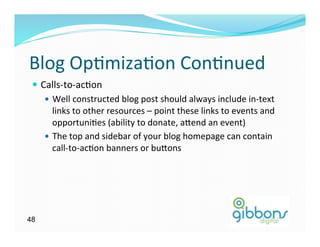
 —  Calls-­‐to-­‐ac)on	
  
      —  Well	
  constructed	
  blog	
  post	
  should	
  always	
  include	
  in-­‐text	
  
          links	
  to	
  other	
  resources	
  –	
  point	
  these	
  links	
  to	
  events	
  and	
  
          opportuni)es	
  (ability	
  to	
  donate,	
  a`end	
  an	
  event)	
  
      —  The	
  top	
  and	
  sidebar	
  of	
  your	
  blog	
  homepage	
  can	
  contain	
  
          call-­‐to-­‐ac)on	
  banners	
  or	
  bu`ons	


48
49
Blog	
  Op)miza)on	
  Con)nued	
  
 —  Solve	
  a	
  problem	
  –	
  people	
  share	
  a	
  post	
  with	
  others	
  
     because	
  of	
  the	
  insight	
  it	
  provides	
  to	
  solve	
  a	
  problem	
  
 —  Use	
  metaphors	
  as	
  a	
  valuable	
  way	
  to	
  generate	
  more	
  
     interest	
  in	
  a	
  subject	
  
 —  Be	
  entertaining	
  –	
  have	
  fun	
  	
  
 —  Take	
  a	
  stand	
  –	
  be	
  clear,	
  direct	
  and	
  defini)ve	
  –	
  be	
  the	
  
     expert	
  on	
  your	
  topic	


50
51
Exercise	
  –	
  Part	
  2	
  
—  Think	
  about	
  7	
  to	
  10	
  keywords	
  that	
  are	
  most	
  relevant	
  to	
  
    your	
  organiza)on	
  and	
  the	
  services	
  you	
  provide.	
  
—  Read	
  them	
  out	
  loud	
  and	
  we’ll	
  discuss	


‹#›                                                                                            52
How	
  to	
  Promote	
  Your	
  Blog	
  

“A	
  blog	
  is	
  much	
  easier	
  to	
  promote	
  if	
  it	
  has	
  been	
  
 op)mized	
  for	
  success.”	
  
     Hubspot	
  eBook	
  on	
  Blogging,	
  2011	


53
How	
  to	
  Promote	
  Your	
  Blog	
  
—  As	
  discussed	
  before	
  –	
  compelling	
  )tles,	
  images,	
  make	
  it	
  
    easy	
  to	
  share	
  
—  Leverage	
  your	
  exis)ng	
  connec)ons	
  to	
  create	
  new	
  
    rela)onships	
  –	
  reach	
  out	
  to	
  influen)al	
  bloggers	
  in	
  your	
  
    field	
  to	
  a`racted	
  their	
  a`en)on	
  through	
  men)ons	
  on	
  
    your	
  blog	
  and	
  social	
  media	
  
     —  Create	
  an	
  opportunity	
  for	
  them	
  to	
  share	
  your	
  blog	
  posts	
  
       across	
  their	
  networks	
  
—  Create	
  link-­‐building	
  opportuni)es	


54
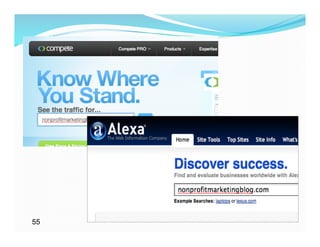
55
56
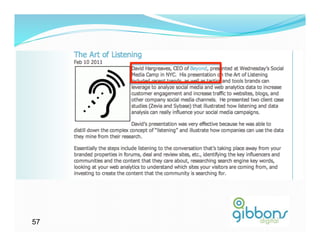
57
58
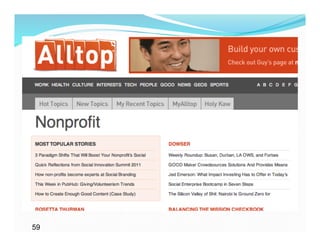
59
Promo)ng	
  Your	
  Blog	
  Con)nued	
  
 —  Social	
  sharing	
  –	
  we	
  discussed	
  the	
  sharing	
  bu`ons,	
  but	
  
     you	
  also	
  need	
  to	
  publish	
  your	
  post	
  to	
  Facebook,	
  Twi`er,	
  
     LinkedIn	
  and	
  Google+	
  
 —  Events	
  and	
  Presenta)on	
  –	
  if	
  you	
  are	
  presen)ng	
  refer	
  your	
  
     audience	
  to	
  your	
  blog	
  for	
  further	
  info	


60
61
62
63
64
65
Promo)ng	
  Your	
  Blog	
  Con)nued	
  
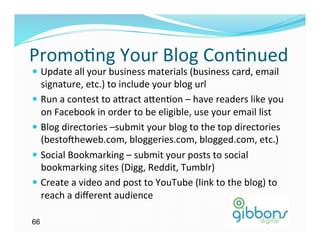
—  Update	
  all	
  your	
  business	
  materials	
  (business	
  card,	
  email	
  
    signature,	
  etc.)	
  to	
  include	
  your	
  blog	
  url	
  
—  Run	
  a	
  contest	
  to	
  a`ract	
  a`en)on	
  –	
  have	
  readers	
  like	
  you	
  
    on	
  Facebook	
  in	
  order	
  to	
  be	
  eligible,	
  use	
  your	
  email	
  list	
  
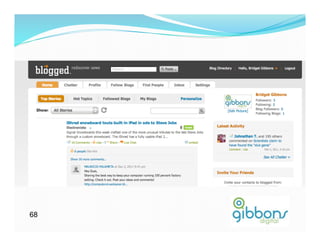
—  Blog	
  directories	
  –submit	
  your	
  blog	
  to	
  the	
  top	
  directories	
  
    (bestoQheweb.com,	
  bloggeries.com,	
  blogged.com,	
  etc.)	
  
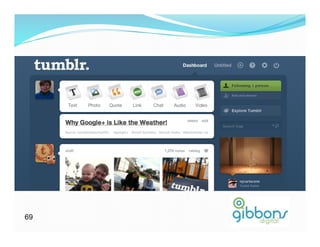
—  Social	
  Bookmarking	
  –	
  submit	
  your	
  posts	
  to	
  social	
  
    bookmarking	
  sites	
  (Digg,	
  Reddit,	
  Tumblr)	
  
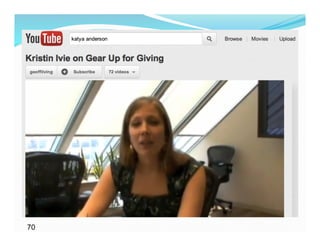
—  Create	
  a	
  video	
  and	
  post	
  to	
  YouTube	
  (link	
  to	
  the	
  blog)	
  to	
  
    reach	
  a	
  different	
  audience	
  

66
67
68
69
70
How	
  to	
  Measure	
  Your	
  Blog 	
  	
  
—  Visitors	
  –	
  the	
  count	
  of	
  people	
  who	
  actually	
  read	
  your	
  blog	
  
    content,	
  but	
  be`er	
  to	
  look	
  at	
  data	
  by	
  individual	
  blog	
  
    ar)cles	
  
—  Leads	
  –	
  analyze	
  at	
  what	
  rate	
  these	
  “leads”	
  convert	
  to	
  
    customers/donors/volunteers	
  (compared	
  to	
  other	
  
    marke)ng	
  channels)	


71
Measuring	
  Your	
  Blog	
  Con)nued	
  
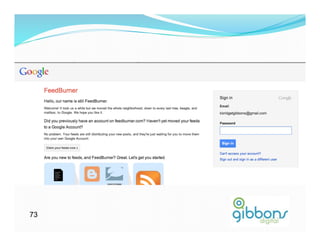
—  Subscriber	
  Count	
  –	
  Look	
  
     at	
  how	
  many	
  people	
  
     subscribe	
  to	
  your	
  blog	


72
73
74
Measuring	
  Your	
  Blog	
  Con)nued	
  
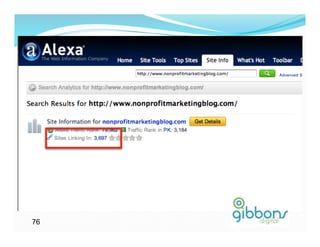
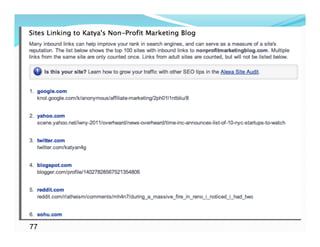
—  Tracking	
  Inbound	
  Links	
  –	
  when	
  another	
  website	
  links	
  to	
  a	
  
    page	
  on	
  your	
  website	
  that’s	
  an	
  inbound	
  link.	


—  Blog	
  posts	
  normally	
  are	
  great	
  at	
  genera)ng	
  	
  inbound	
  links	
  
—  Look	
  at	
  how	
  many	
  inbound	
  links	
  your	
  blog	
  posts	
  a`ract	
  –	
  
    different	
  topics	
  will	
  vary	
  the	
  number	
  of	
  inbound	
  links	
  
    they	
  drive	


75
76
77
Measuring	
  Your	
  Blog	
  Con)nued	
  
 —  Monitor	
  social	
  media	
  shares	
  –	
  look	
  at	
  the	
  historical	
  social	
  
     media	
  shares	
  for	
  your	
  blog	
  posts	
  to	
  determine	
  what	
  types	
  
     of	
  posts	
  get	
  the	
  most	
  short-­‐term	
  traffic	
  from	
  social	
  media	


78
Exercise	
  
— Write	
  sample	
  blog	
  post	


79
Best	
  Prac)ces	
  
— Create	
  relevant,	
  valuable	
  content	
  and	
  
   determine	
  the	
  best	
  methods	
  to	
  publicize	
  it	
  	
  
— Write	
  about	
  your	
  industry,	
  best	
  prac)ces,	
  
   answer	
  ques)ons	
  
— Ask	
  readers	
  what	
  they	
  to	
  read	
  about,	
  and	
  the	
  
   format	
  (e.g.,	
  text	
  vs.	
  video)	
  
— Connect	
  your	
  blog	
  to	
  your	
  website	
  

80
Examples	
  
— Katya	
  Andresen	
  
— Capstone	
  Connect	
  
— Holland	
  Bloorview	
  Kids	
  Rehabilita)on	
  Hospital	
  
— Adopt-­‐a-­‐Pet.com	


81
Katya	
  Andresen	


82
Why	
  It	
  Works	
  
— Individual	
  vs.	
  Organiza)onal	
  Blog	
  
— Strong	
  Images	
  
— Broad	
  topics	
  
— Useful	
  How-­‐to	


83
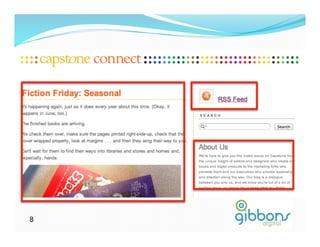
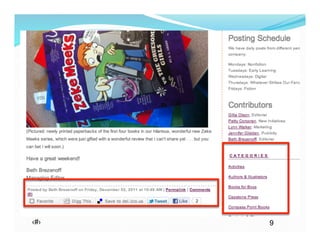
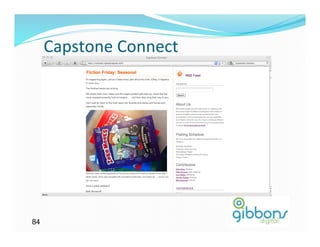
Capstone	
  Connect	


84
Why	
  It	
  Works	
  
— Strong	
  Organiza)on	
  
    —  Clear	
  content	
  categories	
  
    —  Different	
  voices	
  from	
  around	
  the	
  organiza)on	
  
— Eclec)c,	
  oveat	
  posts	
  show	
  personality	
  
— Varied	
  and	
  interes)ng	
  content	


85
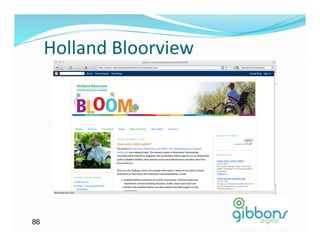
Holland	
  Bloorview	


86
Why	
  It	
  Works	
  
— Targeted	
  Audience	
  –	
  Parents	
  of	
  Children	
  with	
  
   disabili)es	
  
— Excellent	
  Cura)on	
  
— Go-­‐to	
  Resource	
  in	
  its	
  community	


87
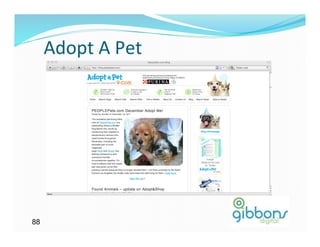
Adopt	
  A	
  Pet	


88
Why	
  It	
  Works	
  
— Highlights	
  the	
  work	
  of	
  others	
  
— Many	
  guest	
  bloggers	
  
— Informa)on	
  rich	
  posts	
  
— High	
  frequency	


89
Thank	
  You!	
  
              Bridget	
  Gibbons
                               	
  
        bridget@gibbonsdigital.com  	
  

             Gibbonsdigital.com	


90

Business blogging dec 2011

  • 2.
    Topics   —  Introduc)ons     —  What  is  a  blog?   —  Why  should  you  have  one?   •  How  to  generate  blog  content   •  How  to  Op)mize  Your  Blog   •  How  to  Promote  Your  Blog   •  How  to  Measure  Your  Blog     •  Best  Prac)ces   •  4  Case  Studies     2
  • 3.
  • 4.
    What  is  a  blog?   —  Blog  =  ‘web  log’   —  A  website  or  part  of  a  website  updated  with  new  content   periodic  basis.     —  Usually  maintained  by  an  individual  or  individuals  with   regular  entries  of  commentary,  descrip)ons  of  events,  or   other  material  such  as  graphics  or  video.     —  Long-­‐term  marke)ng  asset  that  will  bring  traffic  to  your   business   —  Can  be  setup  within  minutes  online  using  Wordpress  or   other  blogging  soQware.   4
  • 5.
    Wordpress   — Wordpress.org   — Install  soQware  onto  your  server   — Select  theme  (template),  or  create  custom   design   5
  • 6.
  • 7.
  • 8.
  • 9.
  • 10.
  • 11.
    Why  Should  You  Have  a  Blog?   —  Nearly  40%  of  US  companies  use   blogs  for  marke)ng  purposes.   —  Companies  that  blog  have  55%   more  website  visitors   —  B2C  companies  that  blog  get  88%   more  leads  per  month  than  those   that  don’t   —  B2B  companies  that  blog  get  67%   more  leads  per  month  than  those   that  don’t   Source:    Hubspot  eBook  on  Blogging,  2011   11
  • 12.
    Why  Should  You  Have  a  Blog?   —  Over  57  million  Americans  read  blogs   —  Technora)  is  currently  tracking  over  70  million  blogs     —  Over  120  thousand  blogs  are  created  every  day     —  There  are  over  1.4  million  new  blog  posts  every  day     —  22  of  the  100  most  popular  websites  in  the  world  are   blogs     —  51%  of  blog  readers  shop  online     —  Blog  readers  average  23  hours  online  each  week   Source:  BlogWorldExpo.com   12 12
  • 13.
    Why  Should  You  Have  a  Blog?   —  83%  of  corporate  bloggers  saw  a  traffic  increase  to  their   site   —  51%  took  less  than  1-­‐2  months  from  ini)al  concept  to   launch  of  blog   —  88%  saw  a  boost  in  search  engine  ranking  within  3   months  of  launch   —  62%  saw  an  increase  in  sales  within  3  months  of  launch   Source:  Backbone  Media  Business  Blogging  Survey   13
  • 14.
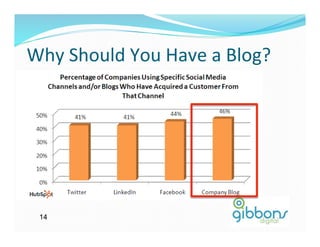
    Why  Should  You  Have  a  Blog?   14
  • 15.
    Why  Should  You  Have  a  Blog?   —  Blogging  boosts  your  ranking  on  Google  searches  –  the   more  blog  posts  you  publish  the  be`er   —  Establishes  you  as  a  thought  leader  –  helps  earn  people’s   trust  and  stay  top-­‐of-­‐mind  for  your  community   —  Gives  you  a  plaborm  to  place  calls-­‐to-­‐ac)on  –  you  can  ask   people  to  a`end  a  fundraiser  or  community  event,   donate,  etc.   15
  • 16.
    Genera)ng  Blog  Content   — Brainstorming   — Editorial  Calendar   — Repackaging   — Guest  Blogging   — Cura)on   — Events  and  Calendar   — Original  Content   16
  • 17.
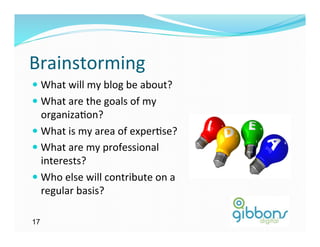
    Brainstorming   —  What  will  my  blog  be  about?   —  What  are  the  goals  of  my   organiza)on?   —  What  is  my  area  of  exper)se?   —  What  are  my  professional   interests?   —  Who  else  will  contribute  on  a   regular  basis?   17
  • 18.
    How  OQen  Will  I  Blog?   18
  • 19.
    How  Will  I  Organize  My  Blog?   — Decide  on  content  categories   — Look  at  the  calendar   — Commit  to  pos)ng  2-­‐3  )mes  per  week  and   build  from  there   19
  • 20.
    Editorial  Calendar   — An  editorial  calendar  helps  plan  both  the   subject  ma`er  and  frequency  for  blog  posts   for  3-­‐6  months   —  Maintains  balance  among  different  kind  of   posts   —  Keeps  bloggers  on  schedule  and  pos)ng   regularly   —  Provides  structure  and  flexibility   20
  • 21.
  • 22.
  • 23.
    Repackage  Exis)ng  Content   —  Look  to  your  employees   and  staff   —  Repurpose  internal  and   external   communica)ons   materials   —  Provide  resources  for   the  communi)es  you   serve   23
  • 24.
    Guest  Blogging   — Generate  a  list  of  poten)al   guest  bloggers   —  Invite  collaborators  to  write   —  Keep  the  focus  on  their   projects  and  organiza)ons   —  Maintain  the  rela)onship  by   referencing  the  organiza)on   in  future  blog  posts   24
  • 25.
    Cura)on   — Research  bloggers  who  are  a  part  of  your   space   —  Katya  Andresen,  Network  for  Good   —  Beth  Kanter,  Beth’s  Blog   —  Allison  Fine,  A  Fine  Blog   —  Seth  Godin,  Seth’s  Blog   —  Sasha  Dichter   —  Many,  many  others   25
  • 26.
    Cura)on   — Research  bloggers  outside  your  space   —  Personal  interests   —  Subjects  that  might  interest  the  clients  with   whom  you  work   —  Hobbies   —  Local  informa)on   —  Anything  par)cularly  well-­‐done  or  inspira)onal   26
  • 27.
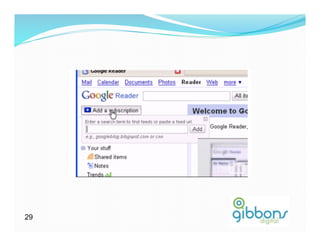
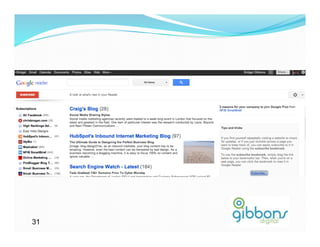
    Cura)on   — Set  up  a  blog  reader  to  keep  current  on  posts   from  favorite  blogs  (e.g.  Google  Reader,  etc.)   — Check  your  reader  every  morning  when  you   check  your  e-­‐mail   — Flag  relevant  posts     27
  • 28.
  • 29.
  • 30.
  • 31.
  • 32.
    Cura)on   — Share  content  in  a  )mely  manner   —  Add  insight  and  value   —  Make  the  content  relevant  for  your  readers   —  Start  a  conversa)on   —  Always,  always,  always  a`ribute  the  material  and   ideas  to  the  original  author   32
  • 33.
    Events  and  Calendar   — Focus  blog  posts  on  key  events  in  your   organiza)on’s  calendar  year   — Incorporate  major  holidays   — Don’t  forget  seasonal  issues  that  affect  your   work  and  your  clients  e.g.  the  start  of  the   school  year   33
  • 34.
  • 35.
    Original  Content   — Start  with  the  basics  –  introduc)on,  mission   statement  for  the  blog   — Keep  it  short  –  200-­‐300  words   — Maintain  a  running  list  of  ideas   — Don’t  expect  perfec)on   35
  • 36.
    Original  Content   — Voice   — Personality   — Less  formal  expression   — Opinions   — Fun!   36
  • 37.
    Exercise  –  Part  1   —  Brainstorm  4  ideas  for  blog  posts     —  Brainstorm  4  sources  for  blog  posts  for  your   organiza)on   —  Read  them  out  loud  and  we’ll  discuss   ‹#› 37
  • 38.
    How  to  Op)mize  Your  Blog   —  Need  to  op)mize  to  grab  people’s  a`en)on  and  rank  well   with  search  engines   —  Search  engines  scan  each  page  of  your  website  looking   for  clues  about  what  topics  you  cover,  and  at  the  back-­‐ end  code  for  important  tags  and  descrip)ons   —  Your  ranking  on  the  search  engine  results  page  is   determined  by  how  relevant  and  authorita)ve  your   website  is  determined  to  be     38
  • 39.
  • 40.
    How  to  Op)mize  you  Blog   —  Keywords  -­‐  a  cri)cal  component  to  SEO  is  selec)ng  the   right  keywords.       —  Select  7  to  10  words  or  phrases  that  best  describe  your   business  and  services.    Ensure  each  page  of  your  website   is  op)mized  around  those  keywords.   —  Be  specific  –  child  care,  not  general  –  nonprofit   —  For  example:   —  Store  sells  shoes  and  wants  website  to  rank  for  “shoe   store”       —  Be`er  bet  to  op)mize  for  “red  tennis  shoes  with  velcro”   40
  • 41.
    How  to  Op)mize  you  Blog   —  Each  blog  post  should  focus  on  a  specific  topic,  and   should  include  the  appropriate  keywords.    Be  sure  to   engage  readers  but  also  op)mize  each  ar)cle.   —  Images  –  make  sure  image  file  names  describe  the  picture   and  that  each  image  has  a  descrip)ve  blurb  (alt  tag)   —  Headline  tags  –  Use  keywords  in  your  blog  post  headlines   —  Internal  linking  –  Within  your  blog  post,  link  to  other   pages  on  your  website   41
  • 42.
    How  to  Op)mize  Your  Blog   —  Include  social  media  sharing  bu`ons  on  every  post   42
  • 43.
    Blog  Op)miza)on  Con)nued   — Include  compelling  images  that  convey  the   blog  post  –  photograph,  graphic,  infographic   — Eye-­‐catching  and  op)mized  )tles  capture  the   readers’  a`en)on  and  en)ce  them  to  view   your  post   —  Be  clear  and  direct  –  12  quick  )ps  …   —  Create  Urgency  –  Last  chance  to  …   —  How-­‐To’s  –  How  to  get  started  with  Facebook  ads  …   —  How  Not  To  –  Avoid  these  piballs  …     43
  • 44.
  • 45.
    Blog  Op)miza)on  Con)nued   — Be  controversial  (but  not  too  controversial)  –   these  posts  spark  discussion  and  debate     — Be  simple,  keep  )tles  brief  and  concise    -­‐  A   look  at    Google+   — Be  newsworthy  –  relevant  breaking  news-­‐type   post  perform  well   45
  • 46.
    Blog  Op)miza)on  Con)nued   — Formatng  is  important  –  break  up  blocks  of   text  into  chunks,  readers  scan  subheaders,   bold  text  and  bullet  points.   46
  • 47.
  • 48.
    Blog  Op)miza)on  Con)nued   —  Calls-­‐to-­‐ac)on   —  Well  constructed  blog  post  should  always  include  in-­‐text   links  to  other  resources  –  point  these  links  to  events  and   opportuni)es  (ability  to  donate,  a`end  an  event)   —  The  top  and  sidebar  of  your  blog  homepage  can  contain   call-­‐to-­‐ac)on  banners  or  bu`ons   48
  • 49.
  • 50.
    Blog  Op)miza)on  Con)nued   —  Solve  a  problem  –  people  share  a  post  with  others   because  of  the  insight  it  provides  to  solve  a  problem   —  Use  metaphors  as  a  valuable  way  to  generate  more   interest  in  a  subject   —  Be  entertaining  –  have  fun     —  Take  a  stand  –  be  clear,  direct  and  defini)ve  –  be  the   expert  on  your  topic   50
  • 51.
  • 52.
    Exercise  –  Part  2   —  Think  about  7  to  10  keywords  that  are  most  relevant  to   your  organiza)on  and  the  services  you  provide.   —  Read  them  out  loud  and  we’ll  discuss   ‹#› 52
  • 53.
    How  to  Promote  Your  Blog   “A  blog  is  much  easier  to  promote  if  it  has  been   op)mized  for  success.”   Hubspot  eBook  on  Blogging,  2011   53
  • 54.
    How  to  Promote  Your  Blog   —  As  discussed  before  –  compelling  )tles,  images,  make  it   easy  to  share   —  Leverage  your  exis)ng  connec)ons  to  create  new   rela)onships  –  reach  out  to  influen)al  bloggers  in  your   field  to  a`racted  their  a`en)on  through  men)ons  on   your  blog  and  social  media   —  Create  an  opportunity  for  them  to  share  your  blog  posts   across  their  networks   —  Create  link-­‐building  opportuni)es     54
  • 55.
  • 56.
  • 57.
  • 58.
  • 59.
  • 60.
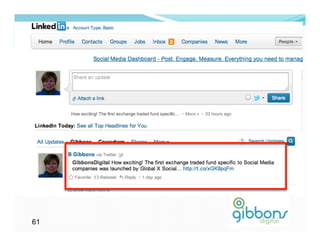
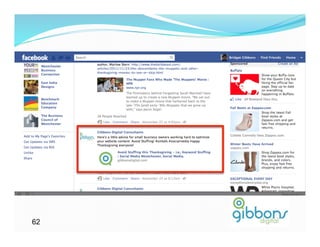
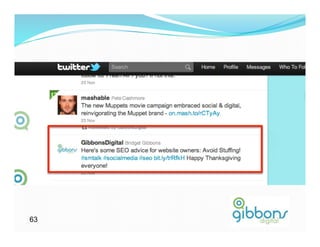
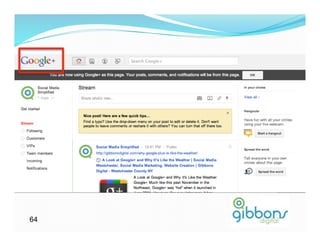
    Promo)ng  Your  Blog  Con)nued   —  Social  sharing  –  we  discussed  the  sharing  bu`ons,  but   you  also  need  to  publish  your  post  to  Facebook,  Twi`er,   LinkedIn  and  Google+   —  Events  and  Presenta)on  –  if  you  are  presen)ng  refer  your   audience  to  your  blog  for  further  info   60
  • 61.
  • 62.
  • 63.
  • 64.
  • 65.
  • 66.
    Promo)ng  Your  Blog  Con)nued   —  Update  all  your  business  materials  (business  card,  email   signature,  etc.)  to  include  your  blog  url   —  Run  a  contest  to  a`ract  a`en)on  –  have  readers  like  you   on  Facebook  in  order  to  be  eligible,  use  your  email  list   —  Blog  directories  –submit  your  blog  to  the  top  directories   (bestoQheweb.com,  bloggeries.com,  blogged.com,  etc.)   —  Social  Bookmarking  –  submit  your  posts  to  social   bookmarking  sites  (Digg,  Reddit,  Tumblr)   —  Create  a  video  and  post  to  YouTube  (link  to  the  blog)  to   reach  a  different  audience   66
  • 67.
  • 68.
  • 69.
  • 70.
  • 71.
    How  to  Measure  Your  Blog     —  Visitors  –  the  count  of  people  who  actually  read  your  blog   content,  but  be`er  to  look  at  data  by  individual  blog   ar)cles   —  Leads  –  analyze  at  what  rate  these  “leads”  convert  to   customers/donors/volunteers  (compared  to  other   marke)ng  channels)   71
  • 72.
    Measuring  Your  Blog  Con)nued   —  Subscriber  Count  –  Look   at  how  many  people   subscribe  to  your  blog   72
  • 73.
  • 74.
  • 75.
    Measuring  Your  Blog  Con)nued   —  Tracking  Inbound  Links  –  when  another  website  links  to  a   page  on  your  website  that’s  an  inbound  link.       —  Blog  posts  normally  are  great  at  genera)ng    inbound  links   —  Look  at  how  many  inbound  links  your  blog  posts  a`ract  –   different  topics  will  vary  the  number  of  inbound  links   they  drive   75
  • 76.
  • 77.
  • 78.
    Measuring  Your  Blog  Con)nued   —  Monitor  social  media  shares  –  look  at  the  historical  social   media  shares  for  your  blog  posts  to  determine  what  types   of  posts  get  the  most  short-­‐term  traffic  from  social  media   78
  • 79.
  • 80.
    Best  Prac)ces   — Create  relevant,  valuable  content  and   determine  the  best  methods  to  publicize  it     — Write  about  your  industry,  best  prac)ces,   answer  ques)ons   — Ask  readers  what  they  to  read  about,  and  the   format  (e.g.,  text  vs.  video)   — Connect  your  blog  to  your  website   80
  • 81.
    Examples   — Katya  Andresen   — Capstone  Connect   — Holland  Bloorview  Kids  Rehabilita)on  Hospital   — Adopt-­‐a-­‐Pet.com   81
  • 82.
  • 83.
    Why  It  Works   — Individual  vs.  Organiza)onal  Blog   — Strong  Images   — Broad  topics   — Useful  How-­‐to   83
  • 84.
  • 85.
    Why  It  Works   — Strong  Organiza)on   —  Clear  content  categories   —  Different  voices  from  around  the  organiza)on   — Eclec)c,  oveat  posts  show  personality   — Varied  and  interes)ng  content   85
  • 86.
  • 87.
    Why  It  Works   — Targeted  Audience  –  Parents  of  Children  with   disabili)es   — Excellent  Cura)on   — Go-­‐to  Resource  in  its  community   87
  • 88.
  • 89.
    Why  It  Works   — Highlights  the  work  of  others   — Many  guest  bloggers   — Informa)on  rich  posts   — High  frequency   89
  • 90.
    Thank  You!   Bridget  Gibbons   bridget@gibbonsdigital.com   Gibbonsdigital.com   90