Got Plagiarism?			 I Have a Cure!Ida M. Jones, J.D.Verna Mae & Wayne D. Brooks Professor of Business LawSpecial Assistant to the Senior Academic Technology OfficerCalifornia State University, Fresnoidaj@csufresno.edu559 278-5711
SymptomsWriting varies from assignment to assignmentPaper or other assignment:Demonstrates sophisticated mastery of terminology Includes information not specifically covered in the courseHas very sophisticated writing style
Plagiarism issues at California State University, FresnoOne Test to Determine Cause: Survey Data3
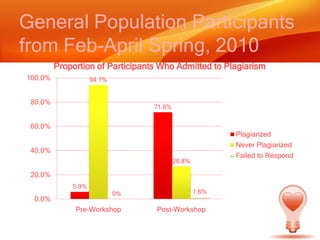
General Population Participants from Feb-April Spring, 2010 
Cures-multi-pronged treatments
TREATMENTS & CUREWorkshopsAssignment RedesignInstitutional Implementation of Policies & Enforcement
Treatment One: workshopsAddressing Students’ Lack of Clear Definitions
WorkshopsFace to Face WorkshopsAcademic Integrity WorkshopsEvery semester 12-14 workshops offeredMany faculty require attendanceOnline Plagiarism ModuleBlackboardDelivered in Face-to-Face or Online courses
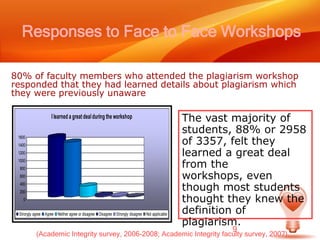
Responses to Face to Face Workshops80% of faculty members who attended the plagiarism workshop responded that they had learned details about plagiarism which they were previously unaware 9The vast majority of students, 88% or 2958 of 3357, felt they learned a great deal from the workshops, even though most students thought they knew the definition of plagiarism.(Academic Integrity survey, 2006-2008; Academic Integrity faculty survey, 2007).
Treatment Two: Assignment RedesignReducing students’ Ability to Find Assignments Elsewhere
Treat Students-Ability to Find Assignments Elsewhere-p. 1Re-design assignments to make them more plagiarism-resistant11
Treat Students-Ability to Find Assignments Elsewhere-p. 2Re-consider how you assess whether students have used sourcesUse plagiarism detection software such as Safe AssignRequire that students attach copies of their sources to their assignmentsOthers suggestions?12
Treat Students-Ability to Find Assignments Elsewhere-p. 3Ask students to prove what they have learnedBrief oral presentationsOffice meetings to ask for summariesOther suggestions?13
Treat Students-Ability to Find Assignments Elsewhere-p. 4Create assignment(s) that tie to personal or classroom experiencesRequire that assignments make specific reference to textbook, classroom discussionsRequire that assignments make specific reference to personal experiencesOther suggestions?14
Treat Students-Ability to Find Assignments Elsewhere-p. 5Re-evaluate course structure and assignmentsChange the assignments every semesterRequire submissions in stepsOther suggestions?15
Treatment Three: Institution-wide RemediesTreat Lack of Institutional Implementation & Enforcement
Institution-Wide RemediesCreate institutional definition of plagiarismInstitute an Honor CodeEncourage consistent enforcement of policiesImplement University-wide sanctions
Conclusion-Questions?18

Blend 101511

  • 1.
    Got Plagiarism? IHave a Cure!Ida M. Jones, J.D.Verna Mae & Wayne D. Brooks Professor of Business LawSpecial Assistant to the Senior Academic Technology OfficerCalifornia State University, Fresnoidaj@csufresno.edu559 278-5711
  • 2.
    SymptomsWriting varies fromassignment to assignmentPaper or other assignment:Demonstrates sophisticated mastery of terminology Includes information not specifically covered in the courseHas very sophisticated writing style
  • 3.
    Plagiarism issues atCalifornia State University, FresnoOne Test to Determine Cause: Survey Data3
  • 4.
    General Population Participantsfrom Feb-April Spring, 2010 
  • 5.
  • 6.
    TREATMENTS & CUREWorkshopsAssignmentRedesignInstitutional Implementation of Policies & Enforcement
  • 7.
    Treatment One: workshopsAddressingStudents’ Lack of Clear Definitions
  • 8.
    WorkshopsFace to FaceWorkshopsAcademic Integrity WorkshopsEvery semester 12-14 workshops offeredMany faculty require attendanceOnline Plagiarism ModuleBlackboardDelivered in Face-to-Face or Online courses
  • 9.
    Responses to Faceto Face Workshops80% of faculty members who attended the plagiarism workshop responded that they had learned details about plagiarism which they were previously unaware 9The vast majority of students, 88% or 2958 of 3357, felt they learned a great deal from the workshops, even though most students thought they knew the definition of plagiarism.(Academic Integrity survey, 2006-2008; Academic Integrity faculty survey, 2007).
  • 10.
    Treatment Two: AssignmentRedesignReducing students’ Ability to Find Assignments Elsewhere
  • 11.
    Treat Students-Ability toFind Assignments Elsewhere-p. 1Re-design assignments to make them more plagiarism-resistant11
  • 12.
    Treat Students-Ability toFind Assignments Elsewhere-p. 2Re-consider how you assess whether students have used sourcesUse plagiarism detection software such as Safe AssignRequire that students attach copies of their sources to their assignmentsOthers suggestions?12
  • 13.
    Treat Students-Ability toFind Assignments Elsewhere-p. 3Ask students to prove what they have learnedBrief oral presentationsOffice meetings to ask for summariesOther suggestions?13
  • 14.
    Treat Students-Ability toFind Assignments Elsewhere-p. 4Create assignment(s) that tie to personal or classroom experiencesRequire that assignments make specific reference to textbook, classroom discussionsRequire that assignments make specific reference to personal experiencesOther suggestions?14
  • 15.
    Treat Students-Ability toFind Assignments Elsewhere-p. 5Re-evaluate course structure and assignmentsChange the assignments every semesterRequire submissions in stepsOther suggestions?15
  • 16.
    Treatment Three: Institution-wideRemediesTreat Lack of Institutional Implementation & Enforcement
  • 17.
    Institution-Wide RemediesCreate institutionaldefinition of plagiarismInstitute an Honor CodeEncourage consistent enforcement of policiesImplement University-wide sanctions
  • 18.