
Republic of the Philippines
UNIVERSITY OF RIZAL SYSTEM
Province of Rizal
Distrit of Pililla
GRADUATE SCHOOL
LANGUAGE TESTING
TECHNIQUES
Reported by:
KIM C. QUINTANA
MAT-English Student
Presented to:
DR. ROMMEL R. CASTRO
Professional Lecturer
https://dyahrochmawati08.wordpress.com/2008/12/07lang/
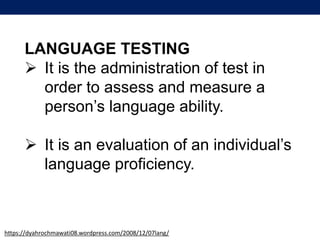
LANGUAGE TESTING
 It is the administration of test in
order to assess and measure a
person’s language ability.
 It is an evaluation of an individual’s
language proficiency.
DIRECT TESTING INDIRECT TESTING
 assess student
performance of
identified learning
outcomes, such as
mastery of a
lifelong skill.
 assess opinions or
thoughts about
student
knowledge, skills,
attitudes, learning
experiences, and
perceptions.
https://www.ccaurora.edu/getting-started/testing/direct-indirect
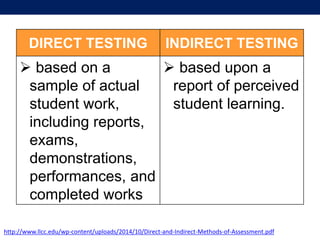
DIRECT TESTING INDIRECT TESTING
 based on a
sample of actual
student work,
including reports,
exams,
demonstrations,
performances, and
completed works
 based upon a
report of perceived
student learning.
http://www.llcc.edu/wp-content/uploads/2014/10/Direct-and-Indirect-Methods-of-Assessment.pdf
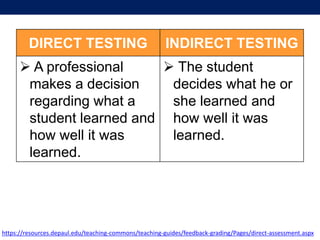
DIRECT TESTING INDIRECT TESTING
 A professional
makes a decision
regarding what a
student learned and
how well it was
learned.
 The student
decides what he or
she learned and
how well it was
learned.
https://resources.depaul.edu/teaching-commons/teaching-guides/feedback-grading/Pages/direct-assessment.aspx
 TESOL
 Pre- and post-tests
 Class Project
 Job Placement
Statistics
 Portfolio
 Survey
 Poster Presentation
 Percentage of
students who study
abroad
DISCRETE TESTING INTEGRATIVE TESTING
 Assumes that language
knowledge can be
divided into a number of
independent facts:
elements of grammar,
vocabulary, spelling and
punctuation,
pronunciation, intonation
and stress.
 Argues that any
realistic language use
requires the
coordination of many
kinds of knowledge in
one linguistic event, and
so uses items which
combine those kinds of
knowledge, like
comprehension tasks,
dictation, speaking and
listeninghttp://www.blackwellreference.com/public/tocnode?id
=g9780631214823_chunk_g97806312148238_ss1-16
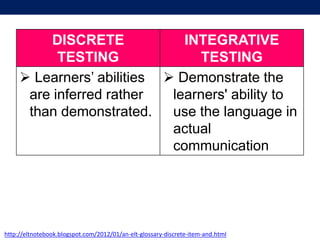
DISCRETE
TESTING
INTEGRATIVE
TESTING
 Learners’ abilities
are inferred rather
than demonstrated.
 Demonstrate the
learners' ability to
use the language in
actual
communication
http://eltnotebook.blogspot.com/2012/01/an-elt-glossary-discrete-item-and.html
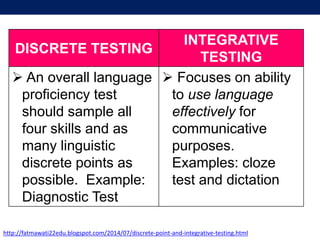
DISCRETE TESTING
INTEGRATIVE
TESTING
 An overall language
proficiency test
should sample all
four skills and as
many linguistic
discrete points as
possible. Example:
Diagnostic Test
 Focuses on ability
to use language
effectively for
communicative
purposes.
Examples: cloze
test and dictation
http://fatmawati22edu.blogspot.com/2014/07/discrete-point-and-integrative-testing.html
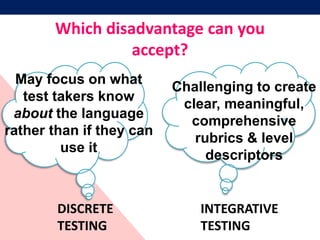
May focus on what
test takers know
about the language
rather than if they can
use it
Challenging to create
clear, meaningful,
comprehensive
rubrics & level
descriptors
DISCRETE
TESTING
INTEGRATIVE
TESTING
Which disadvantage can you
accept?
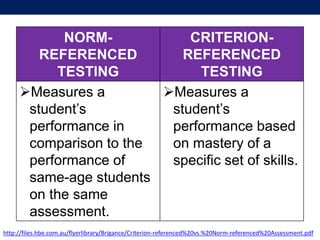
NORM-
REFERENCED
TESTING
CRITERION-
REFERENCED
TESTING
Measures a
student’s
performance in
comparison to the
performance of
same-age students
on the same
assessment.
Measures a
student’s
performance based
on mastery of a
specific set of skills.
http://files.hbe.com.au/flyerlibrary/Brigance/Criterion-referenced%20vs.%20Norm-referenced%20Assessment.pdf
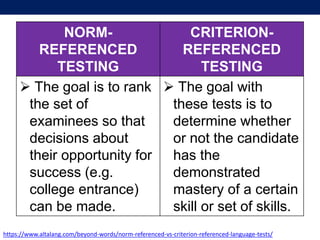
NORM-
REFERENCED
TESTING
CRITERION-
REFERENCED
TESTING
 The goal is to rank
the set of
examinees so that
decisions about
their opportunity for
success (e.g.
college entrance)
can be made.
 The goal with
these tests is to
determine whether
or not the candidate
has the
demonstrated
mastery of a certain
skill or set of skills.
https://www.altalang.com/beyond-words/norm-referenced-vs-criterion-referenced-language-tests/
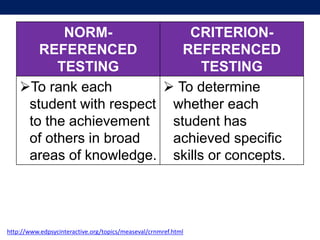
NORM-
REFERENCED
TESTING
CRITERION-
REFERENCED
TESTING
To rank each
student with respect
to the achievement
of others in broad
areas of knowledge.
 To determine
whether each
student has
achieved specific
skills or concepts.
http://www.edpsycinteractive.org/topics/measeval/crnmref.html
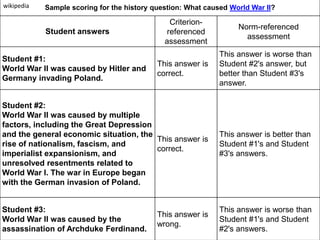
Sample scoring for the history question: What caused World War II?
Student answers
Criterion-
referenced
assessment
Norm-referenced
assessment
Student #1:
World War II was caused by Hitler and
Germany invading Poland.
This answer is
correct.
This answer is worse than
Student #2's answer, but
better than Student #3's
answer.
Student #2:
World War II was caused by multiple
factors, including the Great Depression
and the general economic situation, the
rise of nationalism, fascism, and
imperialist expansionism, and
unresolved resentments related to
World War I. The war in Europe began
with the German invasion of Poland.
This answer is
correct.
This answer is better than
Student #1's and Student
#3's answers.
Student #3:
World War II was caused by the
assassination of Archduke Ferdinand.
This answer is
wrong.
This answer is worse than
Student #1's and Student
#2's answers.
wikipedia
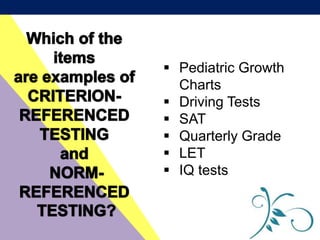
 Pediatric Growth
Charts
 Driving Tests
 SAT
 Quarterly Grade
 LET
 IQ tests
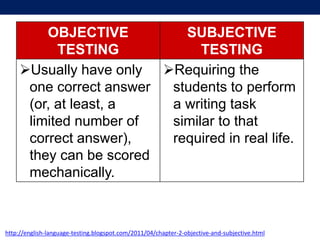
OBJECTIVE
TESTING
SUBJECTIVE
TESTING
Usually have only
one correct answer
(or, at least, a
limited number of
correct answer),
they can be scored
mechanically.
Requiring the
students to perform
a writing task
similar to that
required in real life.
http://english-language-testing.blogspot.com/2011/04/chapter-2-objective-and-subjective.html
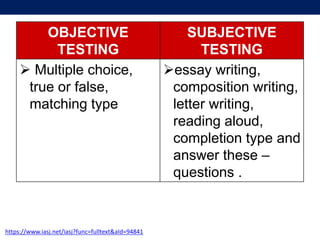
OBJECTIVE
TESTING
SUBJECTIVE
TESTING
 Multiple choice,
true or false,
matching type
essay writing,
composition writing,
letter writing,
reading aloud,
completion type and
answer these –
questions .
https://www.iasj.net/iasj?func=fulltext&aId=94841
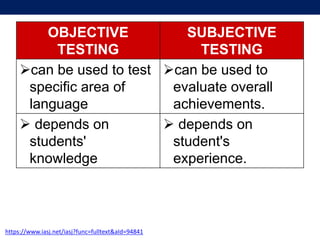
OBJECTIVE
TESTING
SUBJECTIVE
TESTING
can be used to test
specific area of
language
can be used to
evaluate overall
achievements.
 depends on
students'
knowledge
 depends on
student's
experience.
https://www.iasj.net/iasj?func=fulltext&aId=94841
Thank you!!!

Language Testing Techniques

  • 1.
    Republic of thePhilippines UNIVERSITY OF RIZAL SYSTEM Province of Rizal Distrit of Pililla GRADUATE SCHOOL LANGUAGE TESTING TECHNIQUES Reported by: KIM C. QUINTANA MAT-English Student Presented to: DR. ROMMEL R. CASTRO Professional Lecturer
  • 2.
    https://dyahrochmawati08.wordpress.com/2008/12/07lang/ LANGUAGE TESTING  Itis the administration of test in order to assess and measure a person’s language ability.  It is an evaluation of an individual’s language proficiency.
  • 3.
    DIRECT TESTING INDIRECTTESTING  assess student performance of identified learning outcomes, such as mastery of a lifelong skill.  assess opinions or thoughts about student knowledge, skills, attitudes, learning experiences, and perceptions. https://www.ccaurora.edu/getting-started/testing/direct-indirect
  • 4.
    DIRECT TESTING INDIRECTTESTING  based on a sample of actual student work, including reports, exams, demonstrations, performances, and completed works  based upon a report of perceived student learning. http://www.llcc.edu/wp-content/uploads/2014/10/Direct-and-Indirect-Methods-of-Assessment.pdf
  • 5.
    DIRECT TESTING INDIRECTTESTING  A professional makes a decision regarding what a student learned and how well it was learned.  The student decides what he or she learned and how well it was learned. https://resources.depaul.edu/teaching-commons/teaching-guides/feedback-grading/Pages/direct-assessment.aspx
  • 6.
     TESOL  Pre-and post-tests  Class Project  Job Placement Statistics  Portfolio  Survey  Poster Presentation  Percentage of students who study abroad
  • 7.
    DISCRETE TESTING INTEGRATIVETESTING  Assumes that language knowledge can be divided into a number of independent facts: elements of grammar, vocabulary, spelling and punctuation, pronunciation, intonation and stress.  Argues that any realistic language use requires the coordination of many kinds of knowledge in one linguistic event, and so uses items which combine those kinds of knowledge, like comprehension tasks, dictation, speaking and listeninghttp://www.blackwellreference.com/public/tocnode?id =g9780631214823_chunk_g97806312148238_ss1-16
  • 8.
    DISCRETE TESTING INTEGRATIVE TESTING  Learners’ abilities areinferred rather than demonstrated.  Demonstrate the learners' ability to use the language in actual communication http://eltnotebook.blogspot.com/2012/01/an-elt-glossary-discrete-item-and.html
  • 9.
    DISCRETE TESTING INTEGRATIVE TESTING  Anoverall language proficiency test should sample all four skills and as many linguistic discrete points as possible. Example: Diagnostic Test  Focuses on ability to use language effectively for communicative purposes. Examples: cloze test and dictation http://fatmawati22edu.blogspot.com/2014/07/discrete-point-and-integrative-testing.html
  • 10.
    May focus onwhat test takers know about the language rather than if they can use it Challenging to create clear, meaningful, comprehensive rubrics & level descriptors DISCRETE TESTING INTEGRATIVE TESTING Which disadvantage can you accept?
  • 11.
    NORM- REFERENCED TESTING CRITERION- REFERENCED TESTING Measures a student’s performance in comparisonto the performance of same-age students on the same assessment. Measures a student’s performance based on mastery of a specific set of skills. http://files.hbe.com.au/flyerlibrary/Brigance/Criterion-referenced%20vs.%20Norm-referenced%20Assessment.pdf
  • 12.
    NORM- REFERENCED TESTING CRITERION- REFERENCED TESTING  The goalis to rank the set of examinees so that decisions about their opportunity for success (e.g. college entrance) can be made.  The goal with these tests is to determine whether or not the candidate has the demonstrated mastery of a certain skill or set of skills. https://www.altalang.com/beyond-words/norm-referenced-vs-criterion-referenced-language-tests/
  • 13.
    NORM- REFERENCED TESTING CRITERION- REFERENCED TESTING To rank each studentwith respect to the achievement of others in broad areas of knowledge.  To determine whether each student has achieved specific skills or concepts. http://www.edpsycinteractive.org/topics/measeval/crnmref.html
  • 14.
    Sample scoring forthe history question: What caused World War II? Student answers Criterion- referenced assessment Norm-referenced assessment Student #1: World War II was caused by Hitler and Germany invading Poland. This answer is correct. This answer is worse than Student #2's answer, but better than Student #3's answer. Student #2: World War II was caused by multiple factors, including the Great Depression and the general economic situation, the rise of nationalism, fascism, and imperialist expansionism, and unresolved resentments related to World War I. The war in Europe began with the German invasion of Poland. This answer is correct. This answer is better than Student #1's and Student #3's answers. Student #3: World War II was caused by the assassination of Archduke Ferdinand. This answer is wrong. This answer is worse than Student #1's and Student #2's answers. wikipedia
  • 15.
     Pediatric Growth Charts Driving Tests  SAT  Quarterly Grade  LET  IQ tests
  • 16.
    OBJECTIVE TESTING SUBJECTIVE TESTING Usually have only onecorrect answer (or, at least, a limited number of correct answer), they can be scored mechanically. Requiring the students to perform a writing task similar to that required in real life. http://english-language-testing.blogspot.com/2011/04/chapter-2-objective-and-subjective.html
  • 17.
    OBJECTIVE TESTING SUBJECTIVE TESTING  Multiple choice, trueor false, matching type essay writing, composition writing, letter writing, reading aloud, completion type and answer these – questions . https://www.iasj.net/iasj?func=fulltext&aId=94841
  • 18.
    OBJECTIVE TESTING SUBJECTIVE TESTING can be usedto test specific area of language can be used to evaluate overall achievements.  depends on students' knowledge  depends on student's experience. https://www.iasj.net/iasj?func=fulltext&aId=94841
  • 19.