A standardized set of activities that accomplish a
specific task, such as processing a customer’s
order, time tracking, hiring.
Transformation of a set of inputs into a set of
outputs (goods or services) for another person or
process by using people and tools
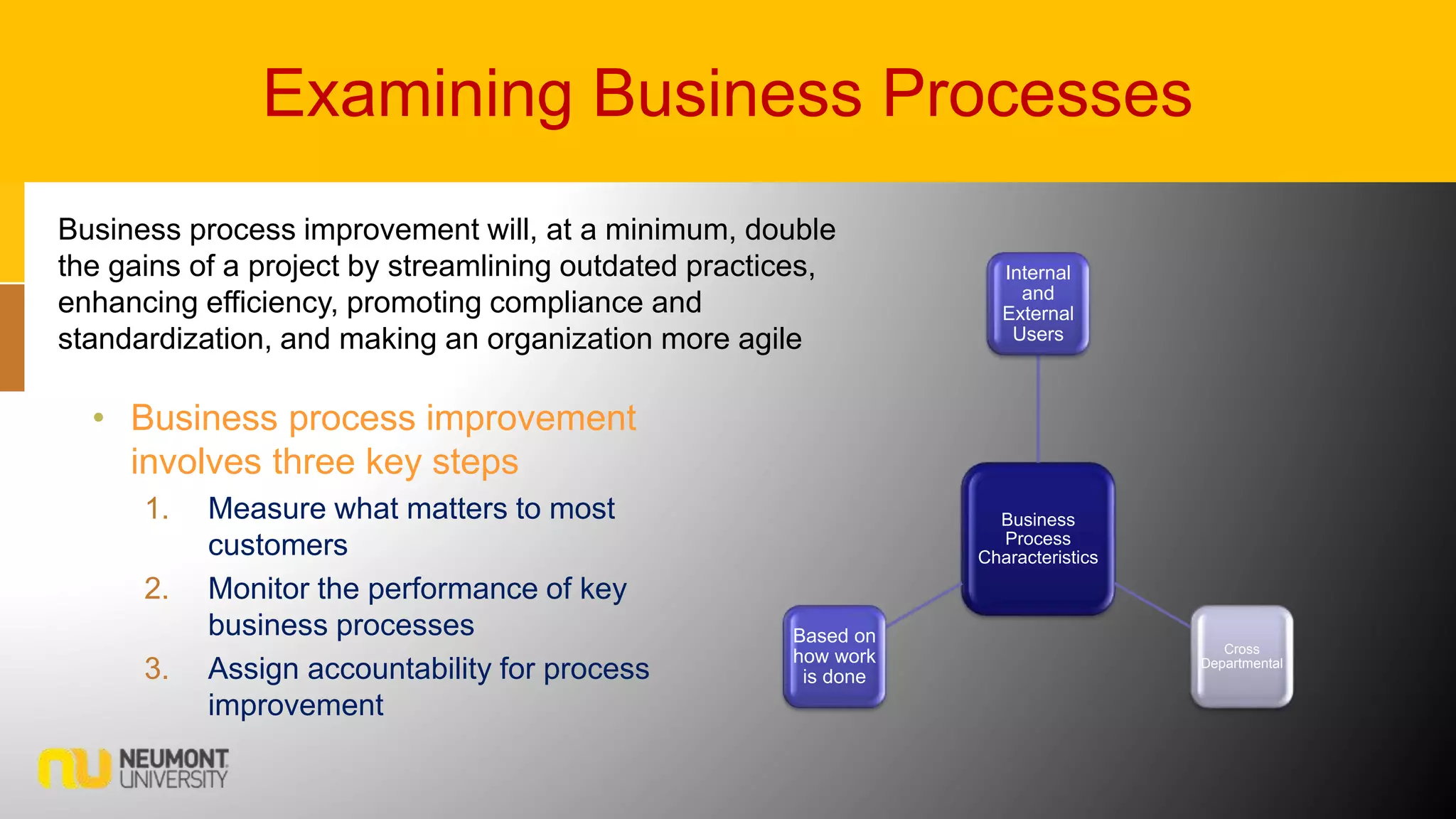
Examining Business Processes
Business
Process
Characteristics
Internal
and
External
Users
Cross
Departmental
Based on
how work
is done
Business process improvement will, at a minimum, double
the gains of a project by streamlining outdated practices,
enhancing efficiency, promoting compliance and
standardization, and making an organization more agile
• Business process improvement
involves three key steps
1. Measure what matters to most
customers
2. Monitor the performance of key
business processes
3. Assign accountability for process
improvement
Examining Business Processes
• The process steps are the activities the
customer and business personnel do to
complete the transaction
• Business process - a standardized
set of activities that accomplish a
specific task, such as processing a
customer’s order
• Business processes transform a set of
inputs into a set of outputs (goods or
services) for another person or
process by using people and tools
Examining Business Processes
• Business process characteristics:
– The processes have internal and external
users
– A process is cross-departmental
– The processes occur across organizations
– The processes are based on how work is
done in the organization
– Every process should be documented and
fully understood by everyone participating in
the process
– Processes should be modeled to promote
complete understanding
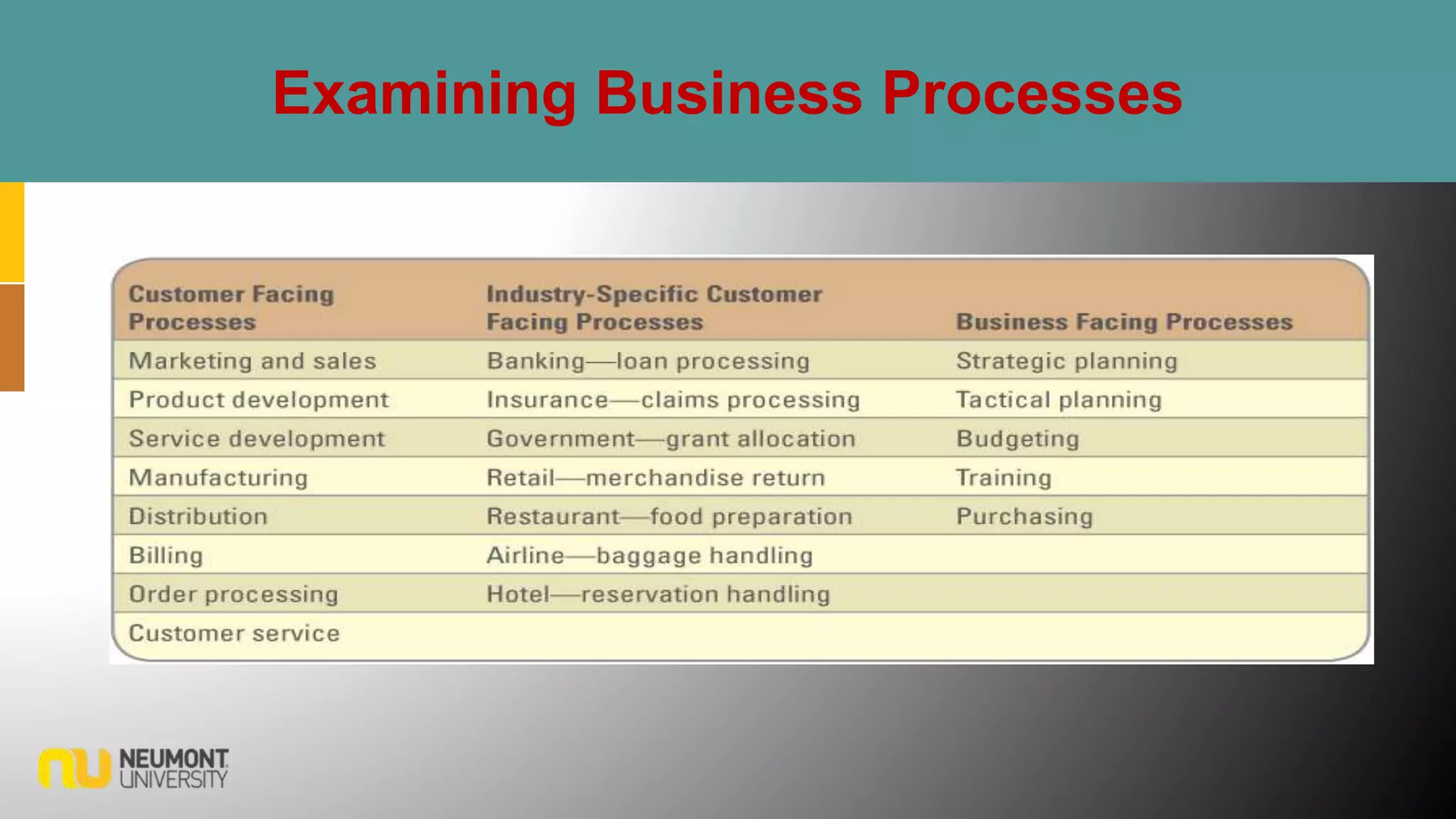
Examining Business Processes
• Customer facing process - results in a product
or service that is received by an organization’s
external customer
• Business facing process - invisible to
the external customer but essential to
the effective management of the
business
Examining Business Processes
Business Process Improvement
• Companies are forced
to improve their
business processes
because customers
are demanding better
products and services
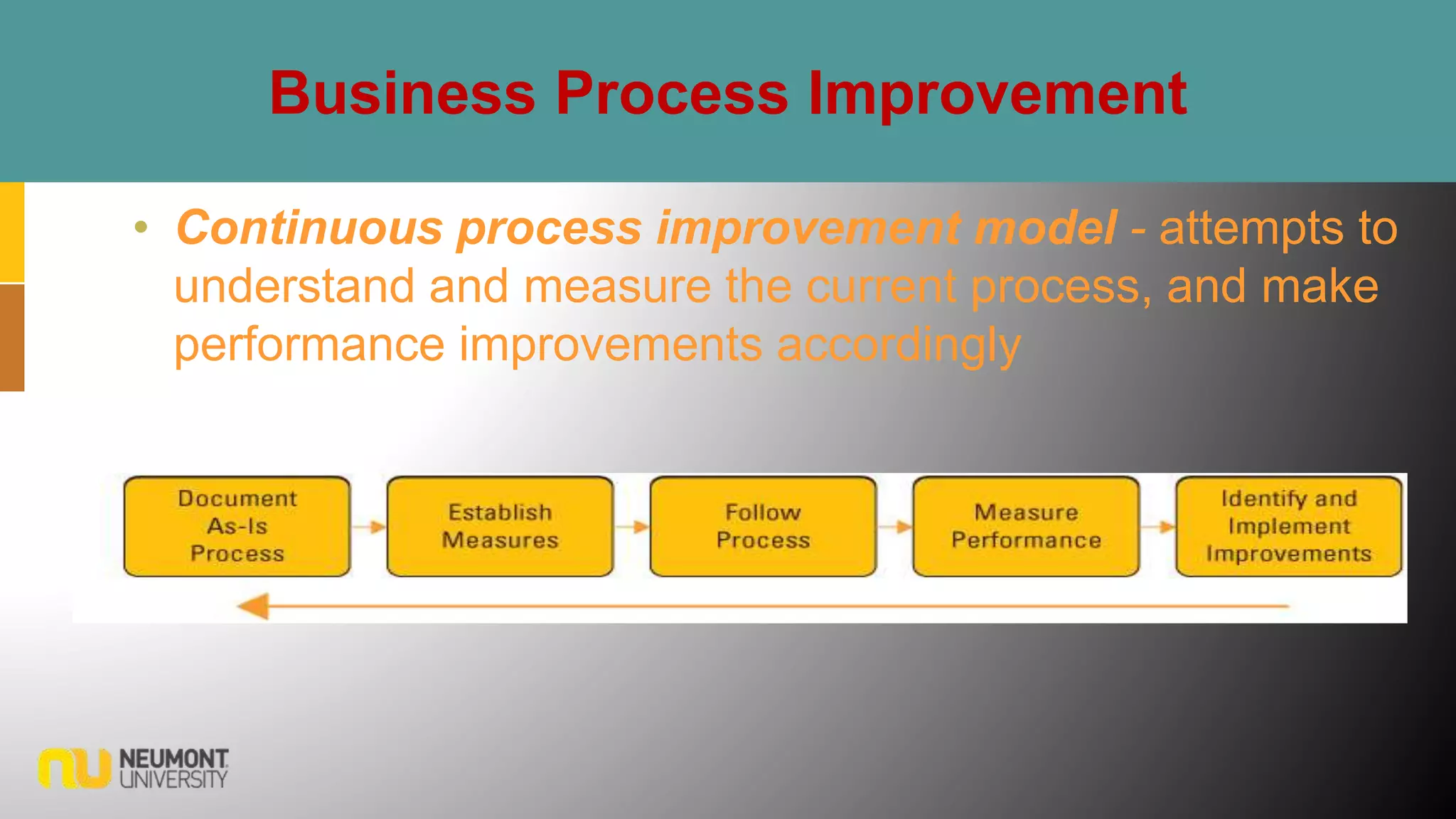
Business Process Improvement
• Continuous process improvement model - attempts to
understand and measure the current process, and make
performance improvements accordingly
BUSINESS PROCESS REENGINEERING
• Business process reengineering (BPR) - analysis and
redesign of workflow within and between enterprises
BUSINESS PROCESS REENGINEERING
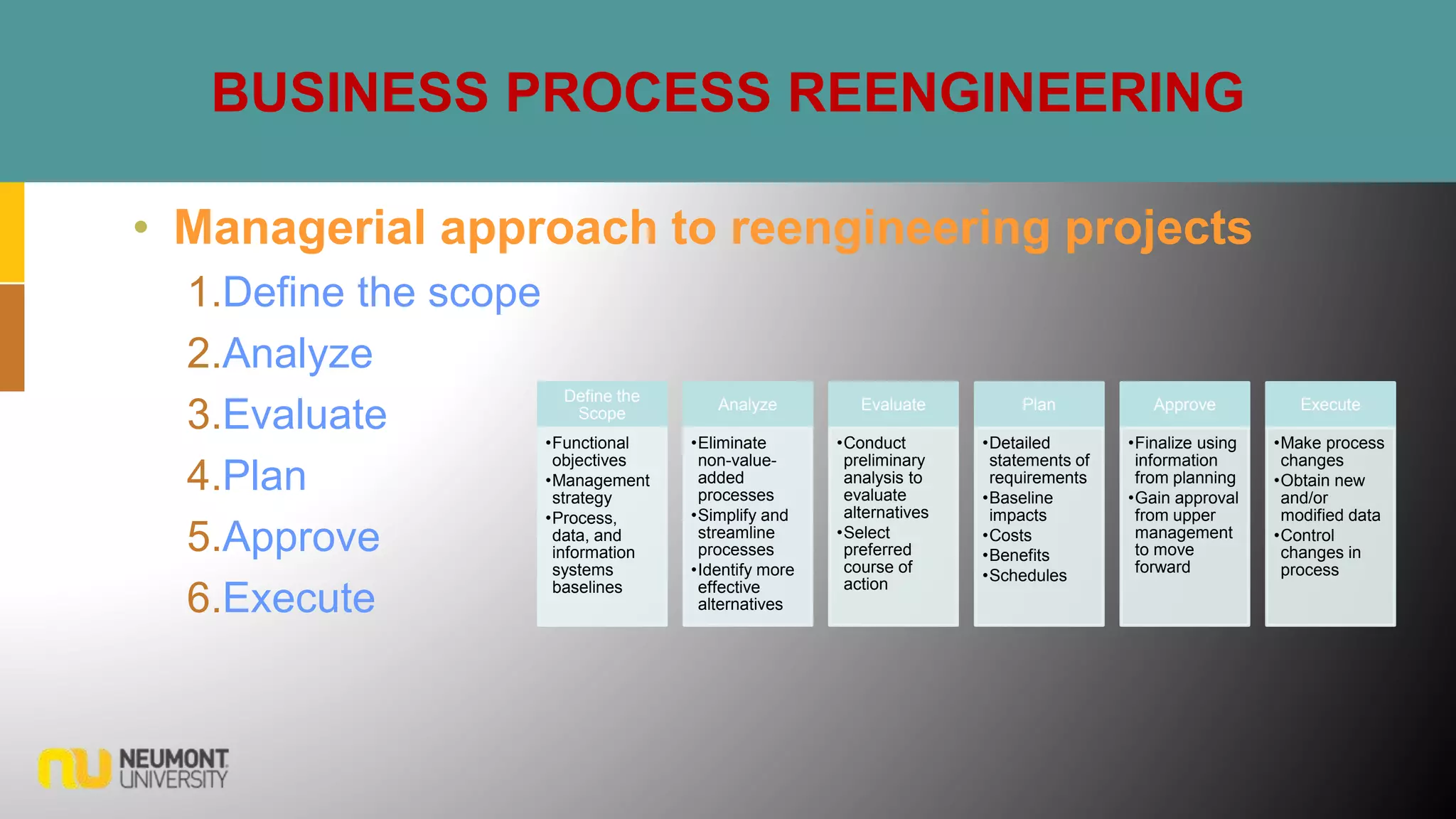
• Managerial approach to reengineering projects
1.Define the scope
2.Analyze
3.Evaluate
4.Plan
5.Approve
6.Execute
Define the
Scope
•Functional
objectives
•Management
strategy
•Process,
data, and
information
systems
baselines
Analyze
•Eliminate
non-value-
added
processes
•Simplify and
streamline
processes
•Identify more
effective
alternatives
Evaluate
•Conduct
preliminary
analysis to
evaluate
alternatives
•Select
preferred
course of
action
Plan
•Detailed
statements of
requirements
•Baseline
impacts
•Costs
•Benefits
•Schedules
Approve
•Finalize using
information
from planning
•Gain approval
from upper
management
to move
forward
Execute
•Make process
changes
•Obtain new
and/or
modified data
•Control
changes in
process
Business Process Design
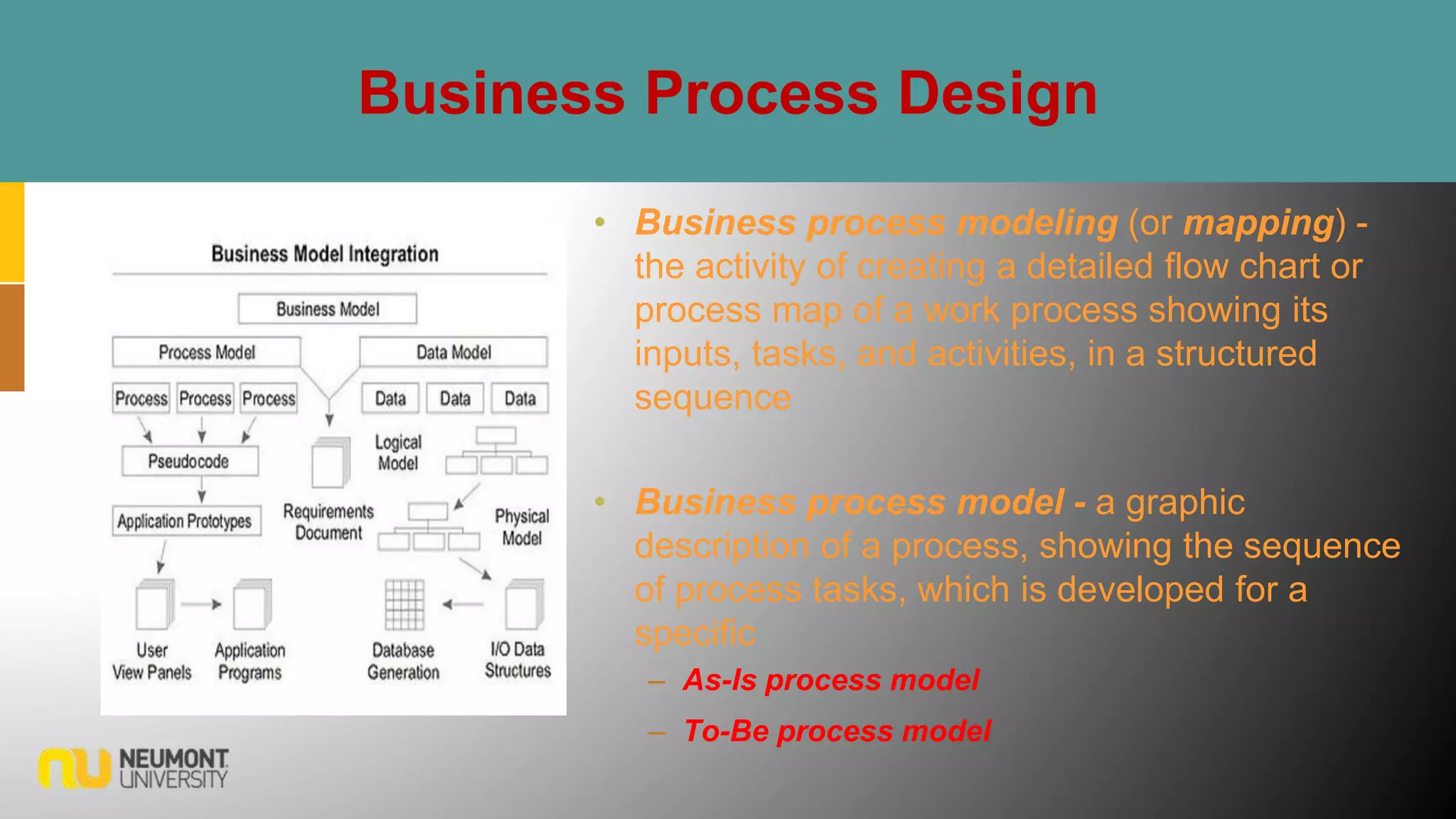
• Business process modeling (or mapping) -
the activity of creating a detailed flow chart or
process map of a work process showing its
inputs, tasks, and activities, in a structured
sequence
• Business process model - a graphic
description of a process, showing the sequence
of process tasks, which is developed for a
specific
– As-Is process model
– To-Be process model
SELECTING A PROCESS TO REENGINEER
• Criteria to determine the importance of the process:
– Is the process broken?
– Is it feasible that reengineering of this process will succeed?
– Does it have a high impact on the agency’s strategic direction?
– Does it significantly impact customer satisfaction?
– Is it antiquated?
– Does it fall far below best-in-class?
– Is it crucial for productivity improvement?
– Will savings from automation be clearly visible?
– Is the return on investment from implementation high and preferably
immediate?
Business Process Management
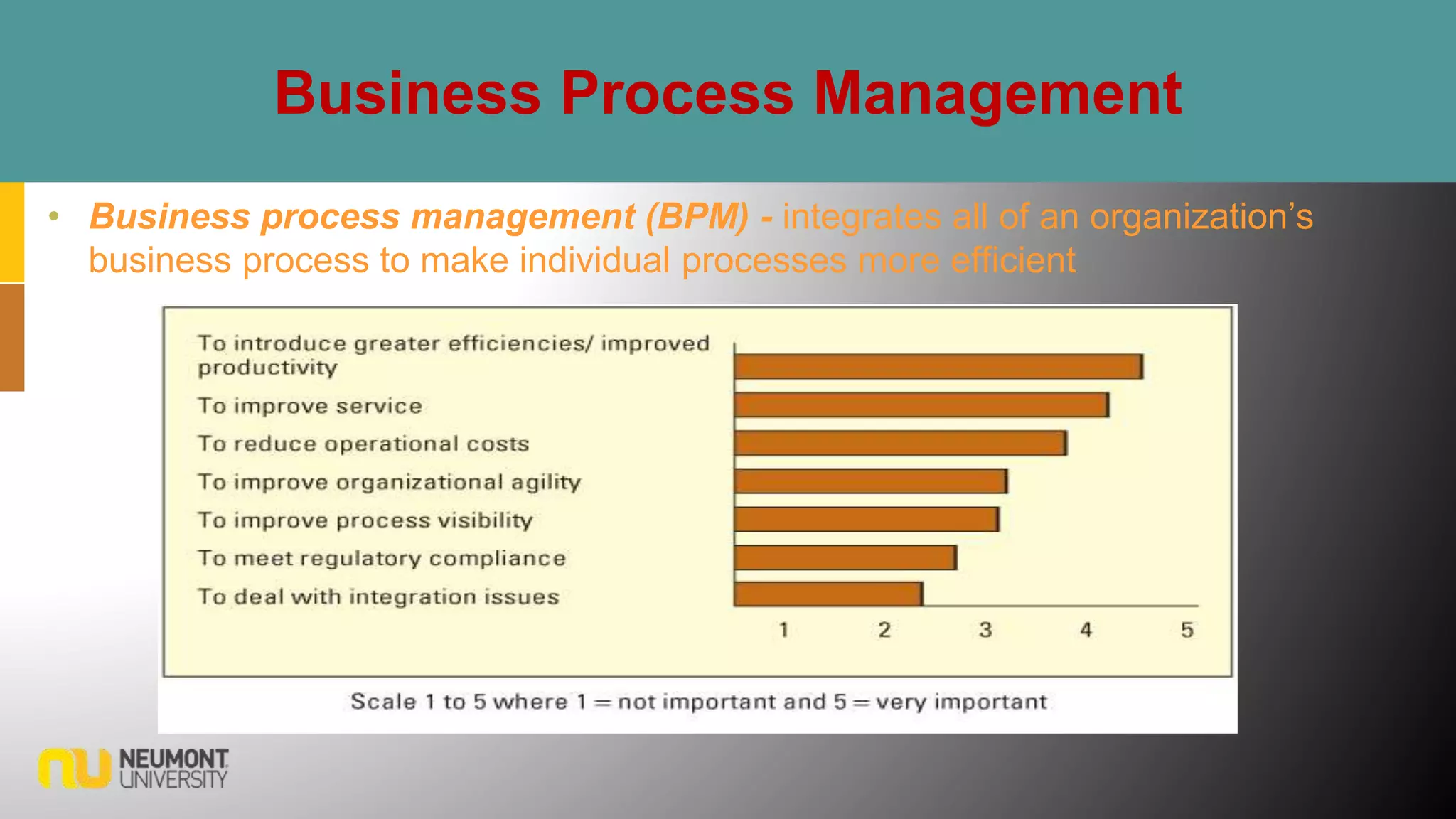
• Business process management (BPM) - integrates all of an organization’s
business process to make individual processes more efficient
Business Process Management
• BPM allows business process to be executed more efficiently and measures
performance and identifies opportunities for improvement, BPM benefits
include:
– Update processes in real-time
– Reduce overhead expenses
– Automate key decisions
– Reduce process maintenance cost
– Reduce operating cost
– Improve productivity
– Improve process cycle time
– Improve forecasting
– Improve customer service
CRITICAL SUCCESS FACTORS
1. Understand reengineering
2. Build a business and political case
3. Adopt a process management approach
4. Measure and track performance continuously
5. Practice change management and provide central
support
6. Manage reengineering projects for results

Bit120 m03 l06 - business process

  • 1.
    A standardized setof activities that accomplish a specific task, such as processing a customer’s order, time tracking, hiring. Transformation of a set of inputs into a set of outputs (goods or services) for another person or process by using people and tools
  • 2.
    Examining Business Processes Business Process Characteristics Internal and External Users Cross Departmental Basedon how work is done Business process improvement will, at a minimum, double the gains of a project by streamlining outdated practices, enhancing efficiency, promoting compliance and standardization, and making an organization more agile • Business process improvement involves three key steps 1. Measure what matters to most customers 2. Monitor the performance of key business processes 3. Assign accountability for process improvement
  • 3.
    Examining Business Processes •The process steps are the activities the customer and business personnel do to complete the transaction • Business process - a standardized set of activities that accomplish a specific task, such as processing a customer’s order • Business processes transform a set of inputs into a set of outputs (goods or services) for another person or process by using people and tools
  • 4.
    Examining Business Processes •Business process characteristics: – The processes have internal and external users – A process is cross-departmental – The processes occur across organizations – The processes are based on how work is done in the organization – Every process should be documented and fully understood by everyone participating in the process – Processes should be modeled to promote complete understanding
  • 5.
    Examining Business Processes •Customer facing process - results in a product or service that is received by an organization’s external customer • Business facing process - invisible to the external customer but essential to the effective management of the business
  • 6.
  • 7.
    Business Process Improvement •Companies are forced to improve their business processes because customers are demanding better products and services
  • 8.
    Business Process Improvement •Continuous process improvement model - attempts to understand and measure the current process, and make performance improvements accordingly
  • 9.
    BUSINESS PROCESS REENGINEERING •Business process reengineering (BPR) - analysis and redesign of workflow within and between enterprises
  • 10.
    BUSINESS PROCESS REENGINEERING •Managerial approach to reengineering projects 1.Define the scope 2.Analyze 3.Evaluate 4.Plan 5.Approve 6.Execute Define the Scope •Functional objectives •Management strategy •Process, data, and information systems baselines Analyze •Eliminate non-value- added processes •Simplify and streamline processes •Identify more effective alternatives Evaluate •Conduct preliminary analysis to evaluate alternatives •Select preferred course of action Plan •Detailed statements of requirements •Baseline impacts •Costs •Benefits •Schedules Approve •Finalize using information from planning •Gain approval from upper management to move forward Execute •Make process changes •Obtain new and/or modified data •Control changes in process
  • 11.
    Business Process Design •Business process modeling (or mapping) - the activity of creating a detailed flow chart or process map of a work process showing its inputs, tasks, and activities, in a structured sequence • Business process model - a graphic description of a process, showing the sequence of process tasks, which is developed for a specific – As-Is process model – To-Be process model
  • 12.
    SELECTING A PROCESSTO REENGINEER • Criteria to determine the importance of the process: – Is the process broken? – Is it feasible that reengineering of this process will succeed? – Does it have a high impact on the agency’s strategic direction? – Does it significantly impact customer satisfaction? – Is it antiquated? – Does it fall far below best-in-class? – Is it crucial for productivity improvement? – Will savings from automation be clearly visible? – Is the return on investment from implementation high and preferably immediate?
  • 13.
    Business Process Management •Business process management (BPM) - integrates all of an organization’s business process to make individual processes more efficient
  • 14.
    Business Process Management •BPM allows business process to be executed more efficiently and measures performance and identifies opportunities for improvement, BPM benefits include: – Update processes in real-time – Reduce overhead expenses – Automate key decisions – Reduce process maintenance cost – Reduce operating cost – Improve productivity – Improve process cycle time – Improve forecasting – Improve customer service
  • 15.
    CRITICAL SUCCESS FACTORS 1.Understand reengineering 2. Build a business and political case 3. Adopt a process management approach 4. Measure and track performance continuously 5. Practice change management and provide central support 6. Manage reengineering projects for results