M01L04 Slide: 1
M01L04 Slide: 2
M01L04 Slide: 3
M01L04 Slide: 4
Customer
Segments
Key
Activities
Key Resources
Key
Partnerships
Cost Structure
Value
Propositions
Channels
Customer
Relationships
Revenue
Streams
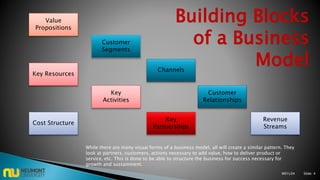
Building Blocks
of a Business
Model
While there are many visual forms of a business model, all will create a similar pattern. They
look at partners, customers, actions necessary to add value, how to deliver product or
service, etc. This is done to be able to structure the business for success necessary for
growth and sustainment.
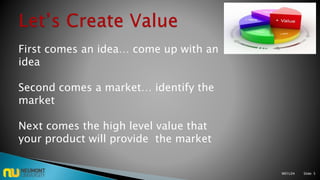
First comes an idea… come up with an
idea
Second comes a market… identify the
market
Next comes the high level value that
your product will provide the market
M01L04 Slide: 5
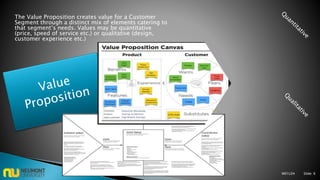
The Value Proposition creates value for a Customer
Segment through a distinct mix of elements catering to
that segment’s needs. Values may be quantitative
(price, speed of service etc.) or qualitative (design,
customer experience etc.)
M01L04 Slide: 6
 Newness
◦ Customer did not perceive a need
◦ Often technology related
 Performance
◦ Traditionally the path to value
◦ Becoming less effective
 Customization
◦ Tailoring products to specific needs
 Mass production and customer co-creation
 Getting the job done
◦ Helping customers do their job
 Design
◦ Difficult element to measure
 Brand/status
 Price
◦ Similar value at a lower price
◦ Lower value at a lower price
 Cost reduction
◦ Helping customers reduce costs
 Risk reduction
◦ Reduction in risk of purchase or
ownership – used car insurance
 Accessibility
◦ Providing to customers who did not
previously have access
 Convenience/usability
◦ Easier to use or acquire
M01L04 Slide: 7
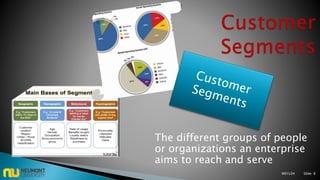
The different groups of people
or organizations an enterprise
aims to reach and serve
M01L04 Slide: 8
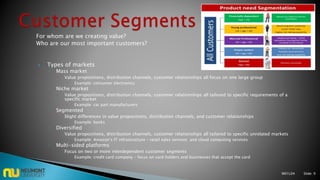
For whom are we creating value?
Who are our most important customers?
 Types of markets
◦ Mass market
 Value propositions, distribution channels, customer relationships all focus on one large group
 Example: consumer electronics
◦ Niche market
 Value propositions, distribution channels, customer relationships all tailored to specific requirements of a
specific market
 Example: car part manufacturers
◦ Segmented
 Slight differences in value propositions, distribution channels, and customer relationships
 Example: banks
◦ Diversified
 Value propositions, distribution channels, customer relationships all tailored to specific unrelated markets
 Example: Amazon’s IT infrastructure – retail sales services and cloud computing services
◦ Multi-sided platforms
 Focus on two or more interdependent customer segments
 Example: credit card company – focus on card holders and businesses that accept the card
M01L04 Slide: 9
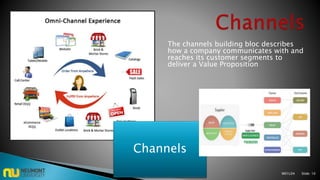
The channels building bloc describes
how a company communicates with and
reaches its customer segments to
deliver a Value Proposition
Channels
M01L04 Slide: 10
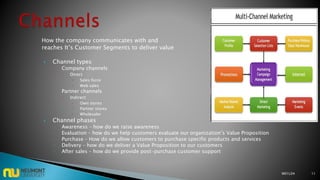
How the company communicates with and
reaches It’s Customer Segments to deliver value
 Channel types
◦ Company channels
 Direct
 Sales force
 Web sales
◦ Partner channels
 Indirect
 Own stores
 Partner stores
 Wholesaler
 Channel phases
◦ Awareness – how do we raise awareness
◦ Evaluation – how do we help customers evaluate our organization’s Value Proposition
◦ Purchase – How do we allow customers to purchase specific products and services
◦ Delivery – how do we deliver a Value Proposition to our customers
◦ After sales – how do we provide post-purchase customer support
M01L04 11
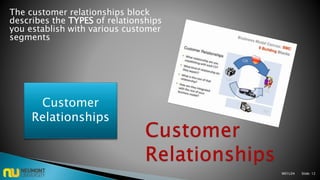
The customer relationships block
describes the TYPES of relationships
you establish with various customer
segments
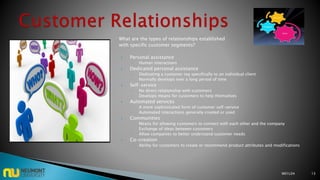
Customer
Relationships
M01L04 Slide: 12
What are the types of relationships established
with specific customer segments?
 Personal assistance
◦ Human interactions
 Dedicated personal assistance
◦ Dedicating a customer rep specifically to an individual client
◦ Normally develops over a long period of time
 Self-service
◦ No direct relationship with customers
◦ Develops means for customers to help themselves
 Automated services
◦ A more sophisticated form of customer self-service
◦ Automated interactions generally created or used
 Communities
◦ Means for allowing customers to connect with each other and the company
◦ Exchange of ideas between customers
◦ Allow companies to better understand customer needs
 Co-creation
◦ Ability for customers to create or recommend product attributes and modifications
M01L04 13
Revenue streams represents the cash you
generate from EACH customer segment.
This must be identified as earnings thus cost
must be subtracted from revenue.
Revenue
Streams
M01L04 Slide: 14
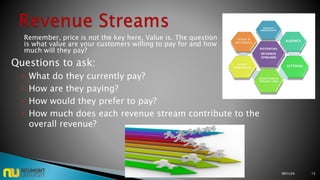
Remember, price is not the key here, Value is. The question
is what value are your customers willing to pay for and how
much will they pay?
Questions to ask:
 What do they currently pay?
 How are they paying?
 How would they prefer to pay?
 How much does each revenue stream contribute to the
overall revenue?
M01L04 15
 Asset Sale
◦ Selling ownership rights to a physical product.
 The most widely understood method
 Usage Fee
◦ Focused on service
 The more a service is used the more the customer pays
◦ Subscription Fee
 Selling continuous access to a service
◦ Lending/Renting/Leasing
 Temporary but exclusive right to use an asset
 Fixed return on the use for the period of time
 Licensing
◦ Use of protected intellectual property in exchange for a fee
 Brokerage Fee
◦ Intermediation services on behalf of two or more parties
 Advertising
◦ Fees for promoting a particular product, service, or brand
 Moving from just media to software and service providers as well as product providers
M01L04 16
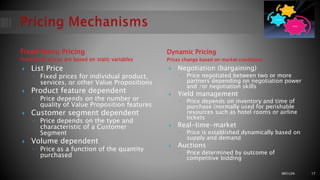
Fixed Menu Pricing
Predefined prices are based on static variables
Dynamic Pricing
Prices change based on market conditions
 List Price
◦ Fixed prices for individual product,
services, or other Value Propositions
 Product feature dependent
◦ Price depends on the number or
quality of Value Proposition features
 Customer segment dependent
◦ Price depends on the type and
characteristic of a Customer
Segment
 Volume dependent
◦ Price as a function of the quantity
purchased
 Negotiation (bargaining)
◦ Price negotiated between two or more
partners depending on negotiation power
and /or negotiation skills
 Yield management
◦ Price depends on inventory and time of
purchase (normally used for perishable
resources such as hotel rooms or airline
tickets
 Real-time-market
◦ Price is established dynamically based on
supply and demand
 Auctions
◦ Price determined by outcome of
competitive bidding
M01L04 17
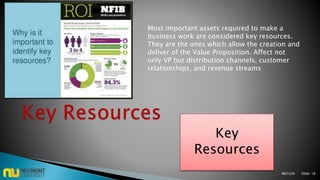
Most important assets required to make a
business work are considered key resources.
They are the ones which allow the creation and
deliver of the Value Proposition. Affect not
only VP but distribution channels, customer
relationships, and revenue streams
Key
Resources
M01L04 Slide: 18
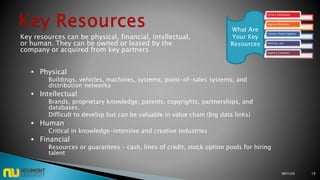
Key resources can be physical, financial, intellectual,
or human. They can be owned or leased by the
company or acquired from key partners
 Physical
 Buildings, vehicles, machines, systems, point-of-sales systems, and
distribution networks
 Intellectual
 Brands, proprietary knowledge, patents, copyrights, partnerships, and
databases.
 Difficult to develop but can be valuable in value chain (big data links)
 Human
 Critical in knowledge-intensive and creative industries
 Financial
 Resources or guarantees – cash, lines of credit, stock option pools for hiring
talent
M01L04 19
Online Databases
Agency Websites
Listserv Subscriptions
Mailing Lists
Agency Contacts
What Are
Your Key
Resources
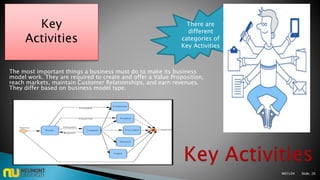
The most important things a business must do to make its business
model work. They are required to create and offer a Value Proposition,
reach markets, maintain Customer Relationships, and earn revenues.
They differ based on business model type.
Key
Activities
M01L04 Slide: 20
There are
different
categories of
Key Activities
Key activities can be categorized as
follows:
 Production
 Relate to designing, making and delivering a product
 Focus on quantity or quality or both
 Critical for manufacturing businesses
 Problem solving
 Developing new solutions to customer problems
 Primarily used in consultancies, hospitals, and service organizations
 Knowledge management and continuous training
 Platform/Network
 Maintaining a presence in the global society
 Relates to service provisioning and promotion
M01L04 21
There are
different
categories of
Key Activities
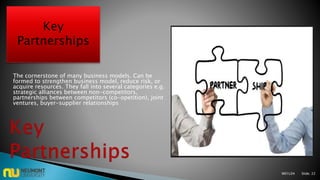
The cornerstone of many business models. Can be
formed to strengthen business model, reduce risk, or
acquire resources. They fall into several categories e.g.
strategic alliances between non-competitors,
partnerships between competitors (co-opetition), joint
ventures, buyer-supplier relationships
Key
Partnerships
M01L04 Slide: 22
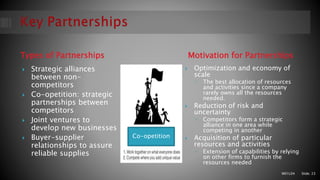
Types of Partnerships Motivation for Partnerships
 Strategic alliances
between non-
competitors
 Co-opetition: strategic
partnerships between
competitors
 Joint ventures to
develop new businesses
 Buyer-supplier
relationships to assure
reliable supplies
 Optimization and economy of
scale
◦ The best allocation of resources
and activities since a company
rarely owns all the resources
needed.
 Reduction of risk and
uncertainty
◦ Competitors form a strategic
alliance in one area while
competing in another
 Acquisition of particular
resources and activities
◦ Extension of capabilities by relying
on other firms to furnish the
resources needed
M01L04 Slide: 23
Co-opetition
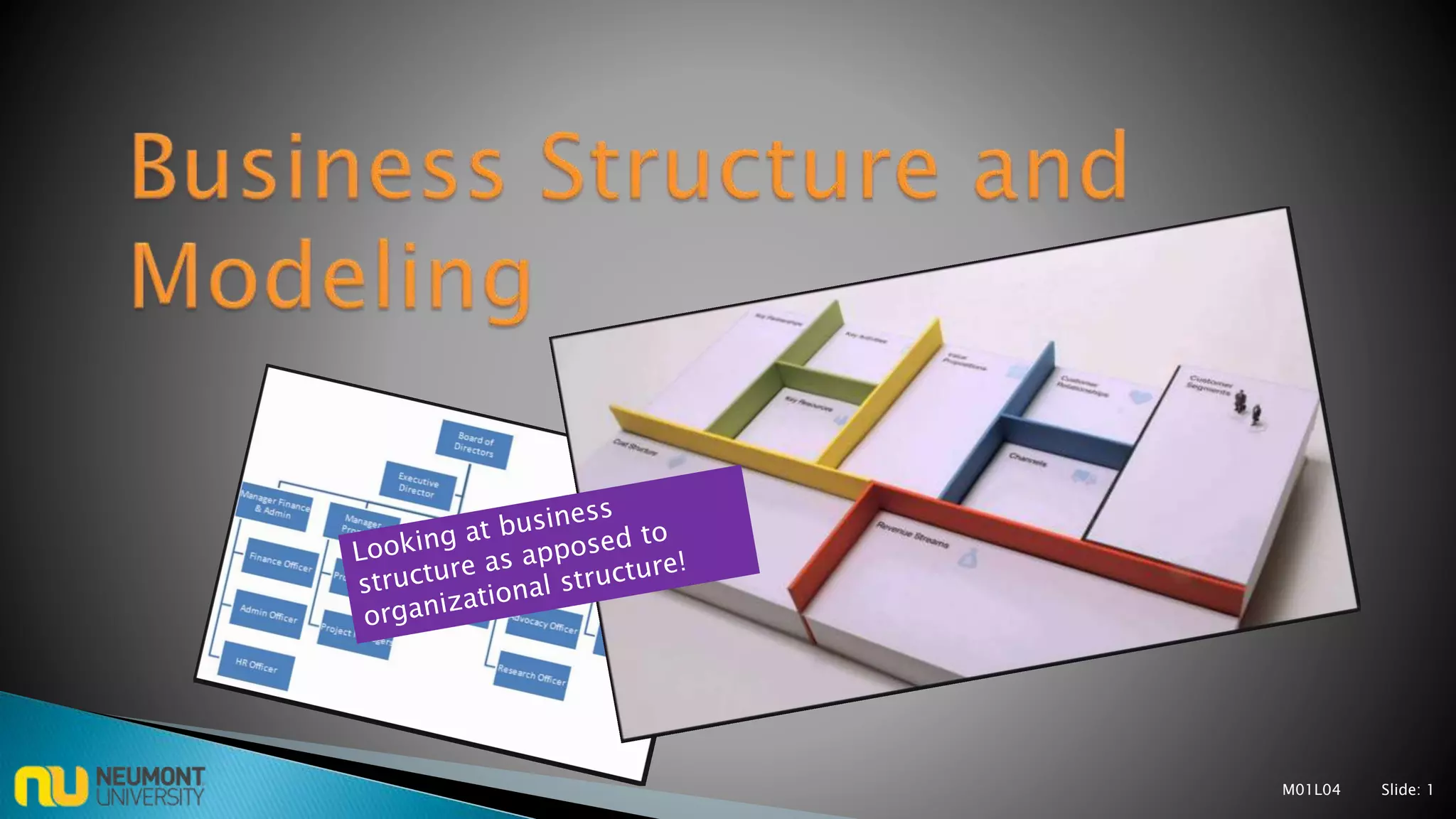
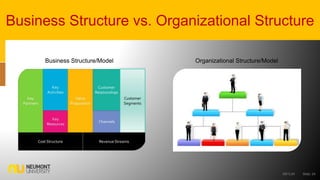
Business Structure vs. Organizational Structure
M01L04 Slide: 24
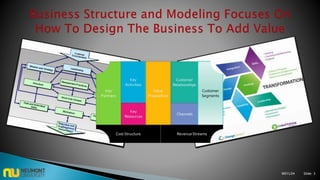
Business Structure/Model Organizational Structure/Model

Bit120 m01 l04 - business structure and modeling

  • 1.
  • 2.
  • 3.
  • 4.
    M01L04 Slide: 4 Customer Segments Key Activities KeyResources Key Partnerships Cost Structure Value Propositions Channels Customer Relationships Revenue Streams Building Blocks of a Business Model While there are many visual forms of a business model, all will create a similar pattern. They look at partners, customers, actions necessary to add value, how to deliver product or service, etc. This is done to be able to structure the business for success necessary for growth and sustainment.
  • 5.
    First comes anidea… come up with an idea Second comes a market… identify the market Next comes the high level value that your product will provide the market M01L04 Slide: 5
  • 6.
    The Value Propositioncreates value for a Customer Segment through a distinct mix of elements catering to that segment’s needs. Values may be quantitative (price, speed of service etc.) or qualitative (design, customer experience etc.) M01L04 Slide: 6
  • 7.
     Newness ◦ Customerdid not perceive a need ◦ Often technology related  Performance ◦ Traditionally the path to value ◦ Becoming less effective  Customization ◦ Tailoring products to specific needs  Mass production and customer co-creation  Getting the job done ◦ Helping customers do their job  Design ◦ Difficult element to measure  Brand/status  Price ◦ Similar value at a lower price ◦ Lower value at a lower price  Cost reduction ◦ Helping customers reduce costs  Risk reduction ◦ Reduction in risk of purchase or ownership – used car insurance  Accessibility ◦ Providing to customers who did not previously have access  Convenience/usability ◦ Easier to use or acquire M01L04 Slide: 7
  • 8.
    The different groupsof people or organizations an enterprise aims to reach and serve M01L04 Slide: 8
  • 9.
    For whom arewe creating value? Who are our most important customers?  Types of markets ◦ Mass market  Value propositions, distribution channels, customer relationships all focus on one large group  Example: consumer electronics ◦ Niche market  Value propositions, distribution channels, customer relationships all tailored to specific requirements of a specific market  Example: car part manufacturers ◦ Segmented  Slight differences in value propositions, distribution channels, and customer relationships  Example: banks ◦ Diversified  Value propositions, distribution channels, customer relationships all tailored to specific unrelated markets  Example: Amazon’s IT infrastructure – retail sales services and cloud computing services ◦ Multi-sided platforms  Focus on two or more interdependent customer segments  Example: credit card company – focus on card holders and businesses that accept the card M01L04 Slide: 9
  • 10.
    The channels buildingbloc describes how a company communicates with and reaches its customer segments to deliver a Value Proposition Channels M01L04 Slide: 10
  • 11.
    How the companycommunicates with and reaches It’s Customer Segments to deliver value  Channel types ◦ Company channels  Direct  Sales force  Web sales ◦ Partner channels  Indirect  Own stores  Partner stores  Wholesaler  Channel phases ◦ Awareness – how do we raise awareness ◦ Evaluation – how do we help customers evaluate our organization’s Value Proposition ◦ Purchase – How do we allow customers to purchase specific products and services ◦ Delivery – how do we deliver a Value Proposition to our customers ◦ After sales – how do we provide post-purchase customer support M01L04 11
  • 12.
    The customer relationshipsblock describes the TYPES of relationships you establish with various customer segments Customer Relationships M01L04 Slide: 12
  • 13.
    What are thetypes of relationships established with specific customer segments?  Personal assistance ◦ Human interactions  Dedicated personal assistance ◦ Dedicating a customer rep specifically to an individual client ◦ Normally develops over a long period of time  Self-service ◦ No direct relationship with customers ◦ Develops means for customers to help themselves  Automated services ◦ A more sophisticated form of customer self-service ◦ Automated interactions generally created or used  Communities ◦ Means for allowing customers to connect with each other and the company ◦ Exchange of ideas between customers ◦ Allow companies to better understand customer needs  Co-creation ◦ Ability for customers to create or recommend product attributes and modifications M01L04 13
  • 14.
    Revenue streams representsthe cash you generate from EACH customer segment. This must be identified as earnings thus cost must be subtracted from revenue. Revenue Streams M01L04 Slide: 14
  • 15.
    Remember, price isnot the key here, Value is. The question is what value are your customers willing to pay for and how much will they pay? Questions to ask:  What do they currently pay?  How are they paying?  How would they prefer to pay?  How much does each revenue stream contribute to the overall revenue? M01L04 15
  • 16.
     Asset Sale ◦Selling ownership rights to a physical product.  The most widely understood method  Usage Fee ◦ Focused on service  The more a service is used the more the customer pays ◦ Subscription Fee  Selling continuous access to a service ◦ Lending/Renting/Leasing  Temporary but exclusive right to use an asset  Fixed return on the use for the period of time  Licensing ◦ Use of protected intellectual property in exchange for a fee  Brokerage Fee ◦ Intermediation services on behalf of two or more parties  Advertising ◦ Fees for promoting a particular product, service, or brand  Moving from just media to software and service providers as well as product providers M01L04 16
  • 17.
    Fixed Menu Pricing Predefinedprices are based on static variables Dynamic Pricing Prices change based on market conditions  List Price ◦ Fixed prices for individual product, services, or other Value Propositions  Product feature dependent ◦ Price depends on the number or quality of Value Proposition features  Customer segment dependent ◦ Price depends on the type and characteristic of a Customer Segment  Volume dependent ◦ Price as a function of the quantity purchased  Negotiation (bargaining) ◦ Price negotiated between two or more partners depending on negotiation power and /or negotiation skills  Yield management ◦ Price depends on inventory and time of purchase (normally used for perishable resources such as hotel rooms or airline tickets  Real-time-market ◦ Price is established dynamically based on supply and demand  Auctions ◦ Price determined by outcome of competitive bidding M01L04 17
  • 18.
    Most important assetsrequired to make a business work are considered key resources. They are the ones which allow the creation and deliver of the Value Proposition. Affect not only VP but distribution channels, customer relationships, and revenue streams Key Resources M01L04 Slide: 18
  • 19.
    Key resources canbe physical, financial, intellectual, or human. They can be owned or leased by the company or acquired from key partners  Physical  Buildings, vehicles, machines, systems, point-of-sales systems, and distribution networks  Intellectual  Brands, proprietary knowledge, patents, copyrights, partnerships, and databases.  Difficult to develop but can be valuable in value chain (big data links)  Human  Critical in knowledge-intensive and creative industries  Financial  Resources or guarantees – cash, lines of credit, stock option pools for hiring talent M01L04 19 Online Databases Agency Websites Listserv Subscriptions Mailing Lists Agency Contacts What Are Your Key Resources
  • 20.
    The most importantthings a business must do to make its business model work. They are required to create and offer a Value Proposition, reach markets, maintain Customer Relationships, and earn revenues. They differ based on business model type. Key Activities M01L04 Slide: 20 There are different categories of Key Activities
  • 21.
    Key activities canbe categorized as follows:  Production  Relate to designing, making and delivering a product  Focus on quantity or quality or both  Critical for manufacturing businesses  Problem solving  Developing new solutions to customer problems  Primarily used in consultancies, hospitals, and service organizations  Knowledge management and continuous training  Platform/Network  Maintaining a presence in the global society  Relates to service provisioning and promotion M01L04 21 There are different categories of Key Activities
  • 22.
    The cornerstone ofmany business models. Can be formed to strengthen business model, reduce risk, or acquire resources. They fall into several categories e.g. strategic alliances between non-competitors, partnerships between competitors (co-opetition), joint ventures, buyer-supplier relationships Key Partnerships M01L04 Slide: 22
  • 23.
    Types of PartnershipsMotivation for Partnerships  Strategic alliances between non- competitors  Co-opetition: strategic partnerships between competitors  Joint ventures to develop new businesses  Buyer-supplier relationships to assure reliable supplies  Optimization and economy of scale ◦ The best allocation of resources and activities since a company rarely owns all the resources needed.  Reduction of risk and uncertainty ◦ Competitors form a strategic alliance in one area while competing in another  Acquisition of particular resources and activities ◦ Extension of capabilities by relying on other firms to furnish the resources needed M01L04 Slide: 23 Co-opetition
  • 24.
    Business Structure vs.Organizational Structure M01L04 Slide: 24 Business Structure/Model Organizational Structure/Model

Editor's Notes

  • #6 Have 3 students come up with ideas Have 3 different students identify markets for each idea Pick one of the ideas to increase the value on the next slide
  • #8 Use this slide to get students to identify 5 areas that they can add value to the product chosen. Let them know that this is item 3 in the instructions.
  • #10 Have students identify the type of market the product is fitting into.