Submitted to- Dr.A.Hussain Mir
Submitted by- Navdeep Singh
Section- B1724
Regd.No.- 11700891
 A bird nest is the spot in which a bird lays and
incubates its eggs and raises its young. Although the
term popularly refers to a specific structure made by
the bird itself
 For most birds, when a male and female form a
breeding pair nest building activities will follow.
 A nest site is first selected and nest building begins.
This can involve both birds as a pair or either sex alone.
 Different species of birds build different nests. Some
nests are very simple constructions, whilst others are
more complex.
Birds usually only build nests for holding their eggs
and rearing chicks
Birds build nests
 To lay their eggs in and keep them safe
 To incubate their eggs
 To raise their chicks
 To protect their eggs and chicks from predators
 To protect their eggs and chicks from adverse weather
conditions
Nests are built;
 in hedges, bushes and trees
 directly on the ground
 in holes in trees
 in reeds by rivers and lakes
 in tunnels in riverbanks and cliffs
 on cliff ledges
 on and in buildings
 on ledges and walls
 and under the eaves of roofs
 in nesting boxes
These materials include; •
 sticks and twigs
 grasses and reeds
 leaves
 mosses and lichens
 seaweed
 mud
 feathers
 bird saliva
 fur and hair from other animals
 plant down and seed heads from grasses and reeds
 cocoon silk and silk from spiders
 man-made materials.
 to construct the nest
 to hold it together
 for insulation,
 to quicken nest incubation
 for comfort
 to camouflage the nest.
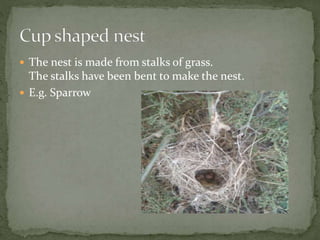
 The nest is made from stalks of grass.
The stalks have been bent to make the nest.
 E.g. Sparrow
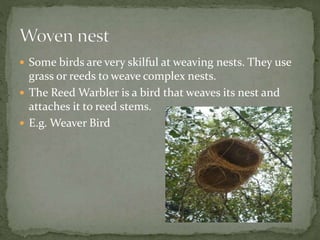
 Some birds are very skilful at weaving nests. They use
grass or reeds to weave complex nests.
 The Reed Warbler is a bird that weaves its nest and
attaches it to reed stems.
 E.g. Weaver Bird
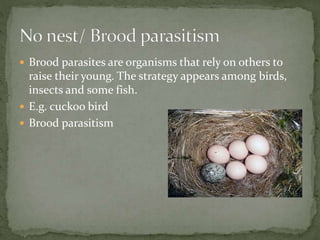
 Brood parasites are organisms that rely on others to
raise their young. The strategy appears among birds,
insects and some fish.
 E.g. cuckoo bird
 Brood parasitism
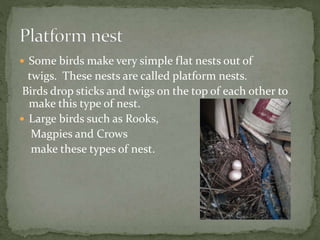
 Some birds make very simple flat nests out of
twigs. These nests are called platform nests.
Birds drop sticks and twigs on the top of each other to
make this type of nest.
 Large birds such as Rooks,
Magpies and Crows
make these types of nest.
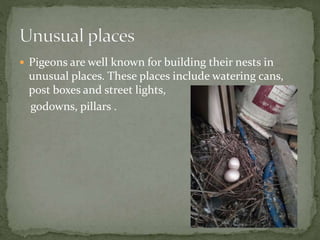
 Pigeons are well known for building their nests in
unusual places. These places include watering cans,
post boxes and street lights,
godowns, pillars .
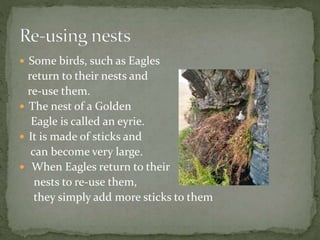
 Some birds, such as Eagles
return to their nests and
re-use them.
 The nest of a Golden
Eagle is called an eyrie.
 It is made of sticks and
can become very large.
 When Eagles return to their
nests to re-use them,
they simply add more sticks to them
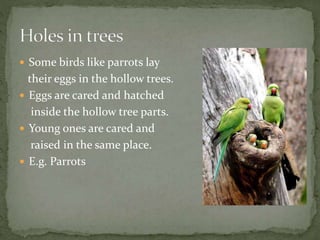
 Some birds like parrots lay
their eggs in the hollow trees.
 Eggs are cared and hatched
inside the hollow tree parts.
 Young ones are cared and
raised in the same place.
 E.g. Parrots
 A scrape is a very simple type of nest. It is simply a
slight hollow scraped in the ground by a bird using
its feet or its abdomen.
 the hollow is lined with grass to provide a cushion
between the ground and the eggs.
 Birds that make scrapes include
 Oystercatcher, Ringed Plover, Lapwing, Curlew,
Common Tern, Snowy Owl, Red Grouse, and Black
 Grouse.
 lay eggs on lands or either in the nest as depending on
the location.
 E.g. Red-wattled lapwing
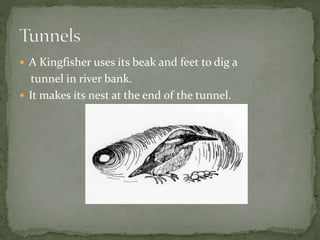
 A Kingfisher uses its beak and feet to dig a
tunnel in river bank.
 It makes its nest at the end of the tunnel.
Bird nest type and nesting behaviour in birds

Bird nest type and nesting behaviour in birds

  • 1.
    Submitted to- Dr.A.HussainMir Submitted by- Navdeep Singh Section- B1724 Regd.No.- 11700891
  • 2.
     A birdnest is the spot in which a bird lays and incubates its eggs and raises its young. Although the term popularly refers to a specific structure made by the bird itself
  • 3.
     For mostbirds, when a male and female form a breeding pair nest building activities will follow.  A nest site is first selected and nest building begins. This can involve both birds as a pair or either sex alone.  Different species of birds build different nests. Some nests are very simple constructions, whilst others are more complex.
  • 4.
    Birds usually onlybuild nests for holding their eggs and rearing chicks Birds build nests  To lay their eggs in and keep them safe  To incubate their eggs  To raise their chicks  To protect their eggs and chicks from predators  To protect their eggs and chicks from adverse weather conditions
  • 5.
    Nests are built; in hedges, bushes and trees  directly on the ground  in holes in trees  in reeds by rivers and lakes  in tunnels in riverbanks and cliffs  on cliff ledges  on and in buildings  on ledges and walls  and under the eaves of roofs  in nesting boxes
  • 6.
    These materials include;•  sticks and twigs  grasses and reeds  leaves  mosses and lichens  seaweed  mud  feathers  bird saliva  fur and hair from other animals  plant down and seed heads from grasses and reeds  cocoon silk and silk from spiders  man-made materials.
  • 7.
     to constructthe nest  to hold it together  for insulation,  to quicken nest incubation  for comfort  to camouflage the nest.
  • 9.
     The nestis made from stalks of grass. The stalks have been bent to make the nest.  E.g. Sparrow
  • 10.
     Some birdsare very skilful at weaving nests. They use grass or reeds to weave complex nests.  The Reed Warbler is a bird that weaves its nest and attaches it to reed stems.  E.g. Weaver Bird
  • 11.
     Brood parasitesare organisms that rely on others to raise their young. The strategy appears among birds, insects and some fish.  E.g. cuckoo bird  Brood parasitism
  • 12.
     Some birdsmake very simple flat nests out of twigs. These nests are called platform nests. Birds drop sticks and twigs on the top of each other to make this type of nest.  Large birds such as Rooks, Magpies and Crows make these types of nest.
  • 13.
     Pigeons arewell known for building their nests in unusual places. These places include watering cans, post boxes and street lights, godowns, pillars .
  • 14.
     Some birds,such as Eagles return to their nests and re-use them.  The nest of a Golden Eagle is called an eyrie.  It is made of sticks and can become very large.  When Eagles return to their nests to re-use them, they simply add more sticks to them
  • 15.
     Some birdslike parrots lay their eggs in the hollow trees.  Eggs are cared and hatched inside the hollow tree parts.  Young ones are cared and raised in the same place.  E.g. Parrots
  • 16.
     A scrapeis a very simple type of nest. It is simply a slight hollow scraped in the ground by a bird using its feet or its abdomen.  the hollow is lined with grass to provide a cushion between the ground and the eggs.  Birds that make scrapes include  Oystercatcher, Ringed Plover, Lapwing, Curlew, Common Tern, Snowy Owl, Red Grouse, and Black  Grouse.
  • 17.
     lay eggson lands or either in the nest as depending on the location.  E.g. Red-wattled lapwing
  • 18.
     A Kingfisheruses its beak and feet to dig a tunnel in river bank.  It makes its nest at the end of the tunnel.