MIGRATION OF BIRDS
Opoke Robert (MSc)
opokerobert@gmail.com
BIRDS
Birds are the only animals that have feathers which help them fly. They have two
wings instead of arms and two legs.
There are nearly 9000 kinds of birds in the world. They are of different colours,
shapes and sizes and they eat different sorts of food.
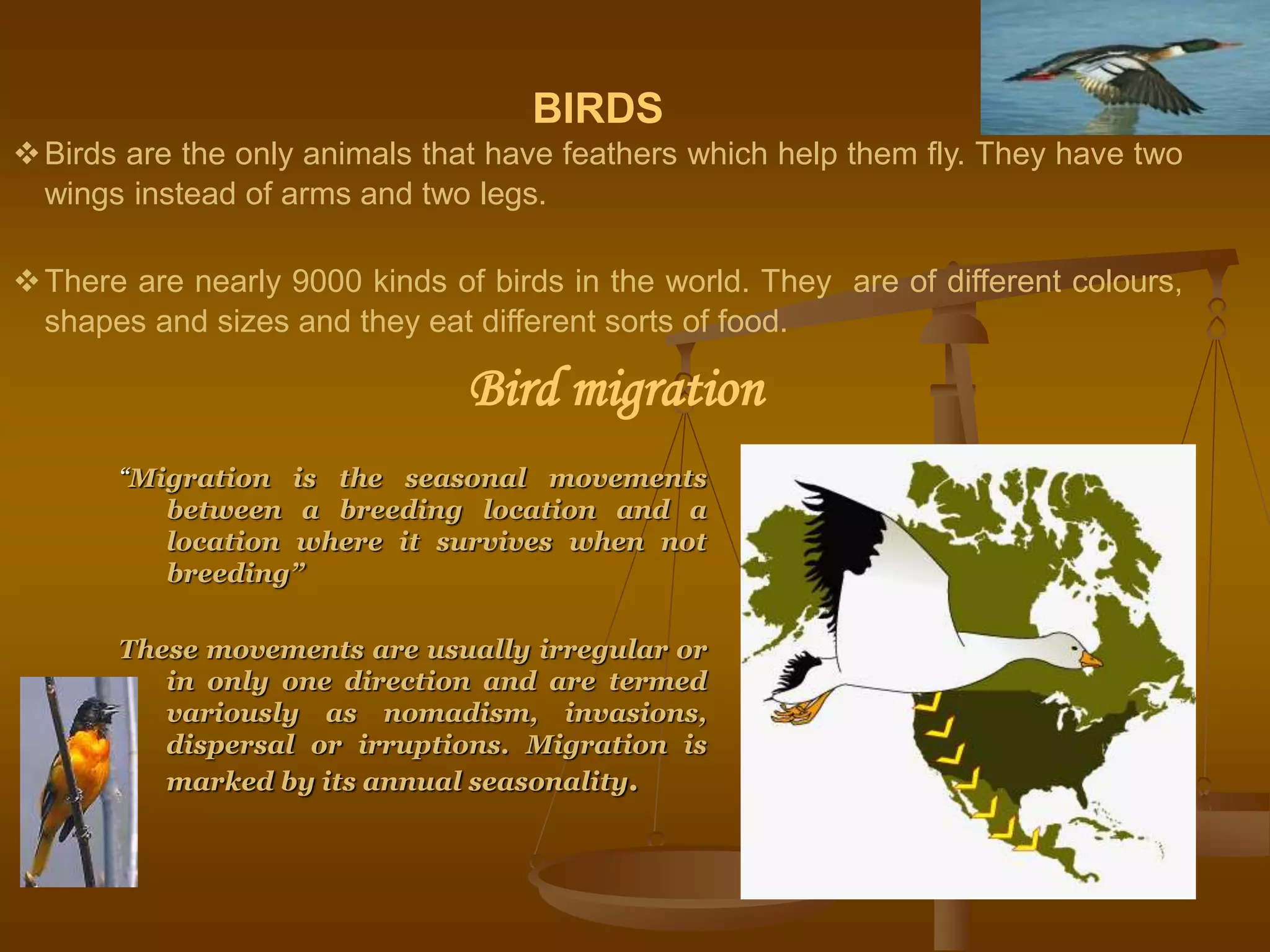
Bird migration
“Migration is the seasonal movements
between a breeding location and a
location where it survives when not
breeding”
These movements are usually irregular or
in only one direction and are termed
variously as nomadism, invasions,
dispersal or irruptions. Migration is
marked by its annual seasonality.
Why do birds migrate?
 The changing seasons can transform a comfortable environment of a bird
into an unlivable one; the food and water supply can dwindle or disappear,
plant cover can vanish, and competition with other animals can increase.
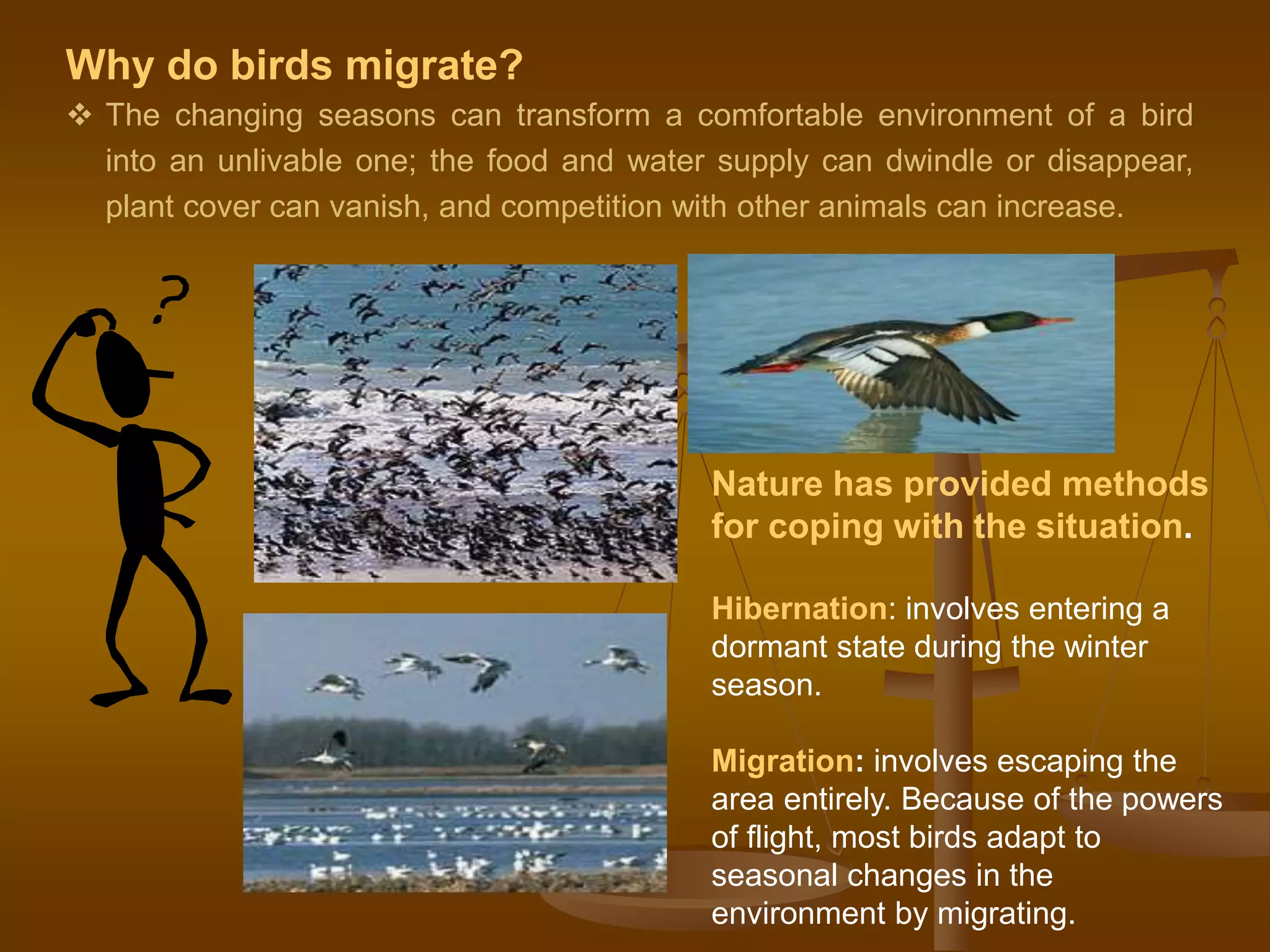
Nature has provided methods
for coping with the situation.
Hibernation: involves entering a
dormant state during the winter
season.
Migration: involves escaping the
area entirely. Because of the powers
of flight, most birds adapt to
seasonal changes in the
environment by migrating.
General patterns of bird migration
The most common pattern involves flying north
in the spring to breed in the temperate or Arctic
summer and returning in the fall to wintering
grounds in warmer regions to the south.
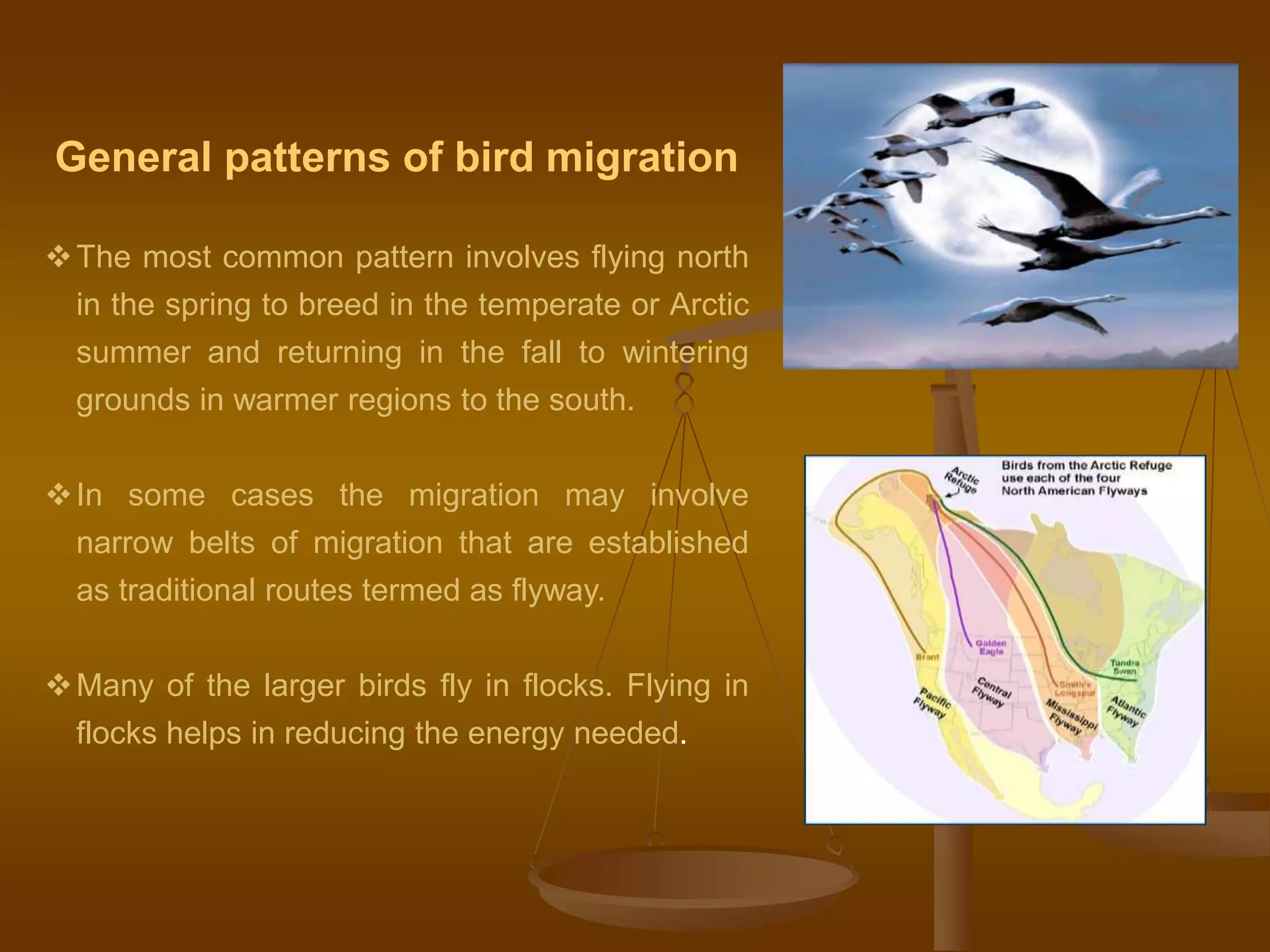
In some cases the migration may involve
narrow belts of migration that are established
as traditional routes termed as flyway.
Many of the larger birds fly in flocks. Flying in
flocks helps in reducing the energy needed.
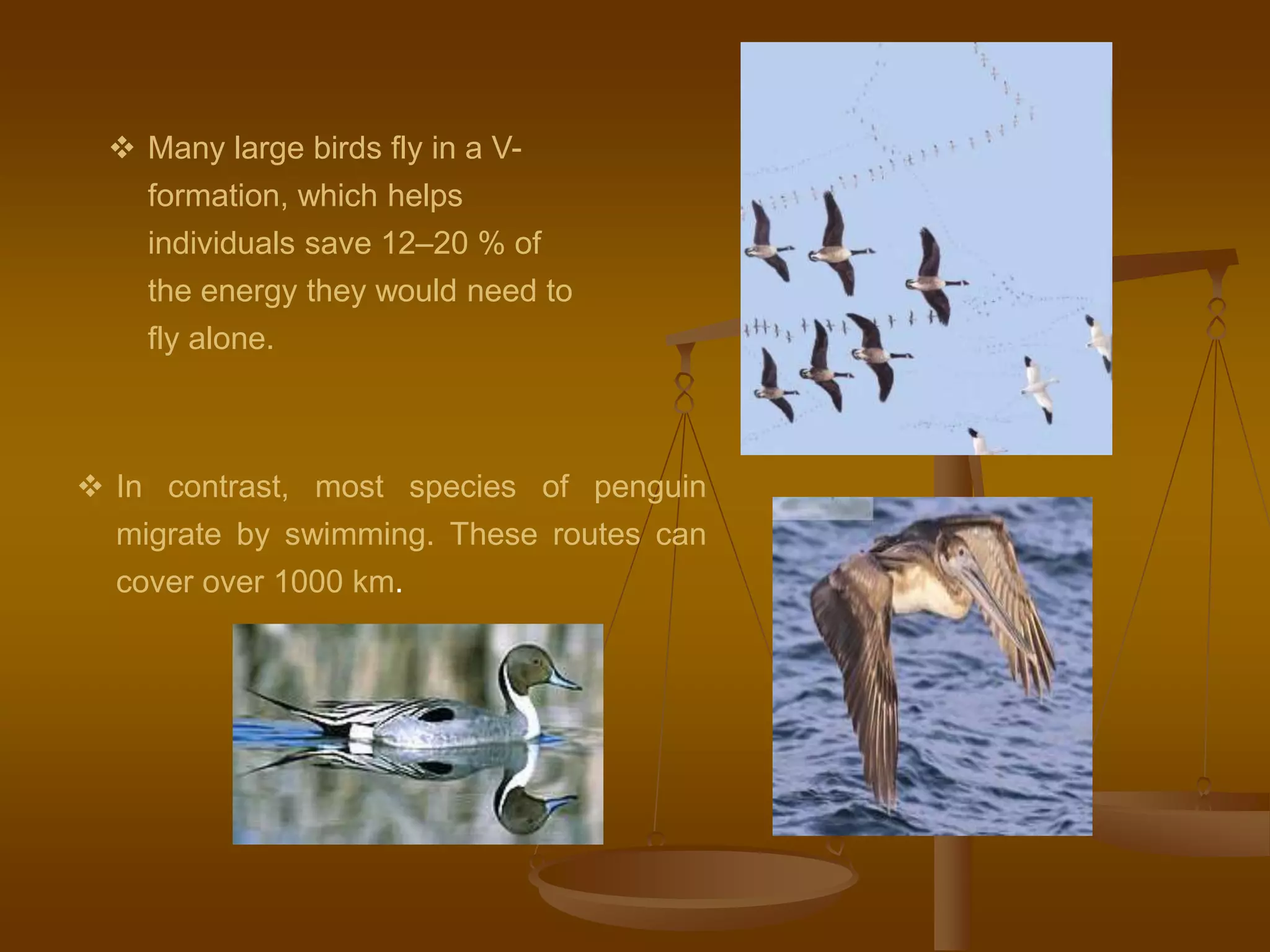
 Many large birds fly in a V-
formation, which helps
individuals save 12–20 % of
the energy they would need to
fly alone.
 In contrast, most species of penguin
migrate by swimming. These routes can
cover over 1000 km.
With seasonal movements/ migration, birds can
be classified as:
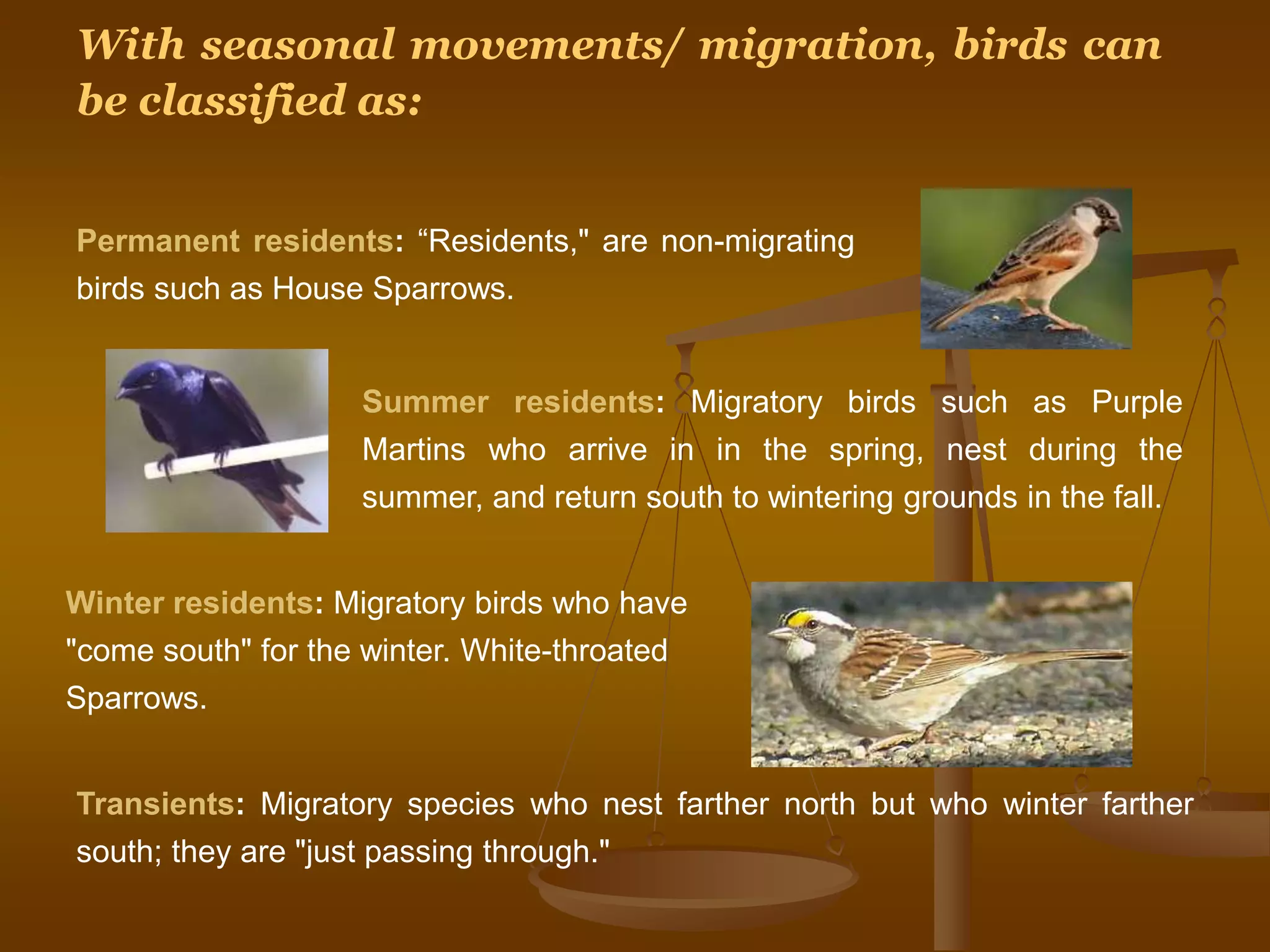
Permanent residents: “Residents," are non-migrating
birds such as House Sparrows.
Summer residents: Migratory birds such as Purple
Martins who arrive in in the spring, nest during the
summer, and return south to wintering grounds in the fall.
Winter residents: Migratory birds who have
"come south" for the winter. White-throated
Sparrows.
Transients: Migratory species who nest farther north but who winter farther
south; they are "just passing through."
Two Theories about the bird migration have been given:
 According to one theory, the birds spread over the northern hemisphere when
it was warm and abounded in food throughout the year.
 At the onset of ice age these were forced to shift southwards for survival. With
the end of ice age, they returned in spring, but had to shift southwards due to
sharp establishment of winter and summer seasons.
 Another theory says that the ancestral home of the birds was in tropics, and
some went to north to avoid overcrowding and competition during breeding
season. After breeding, they return and this became their permanent habit in due
course of time.
 Migratory behavior continues to evolve because of the changing environment in
which the birds live:
If environmental conditions favor migration, the number of birds that
migrate increases;
if conditions permit the birds to stay in one place, the sedentary type
predominates.
Evolution of bird migration
Stimulus for migration
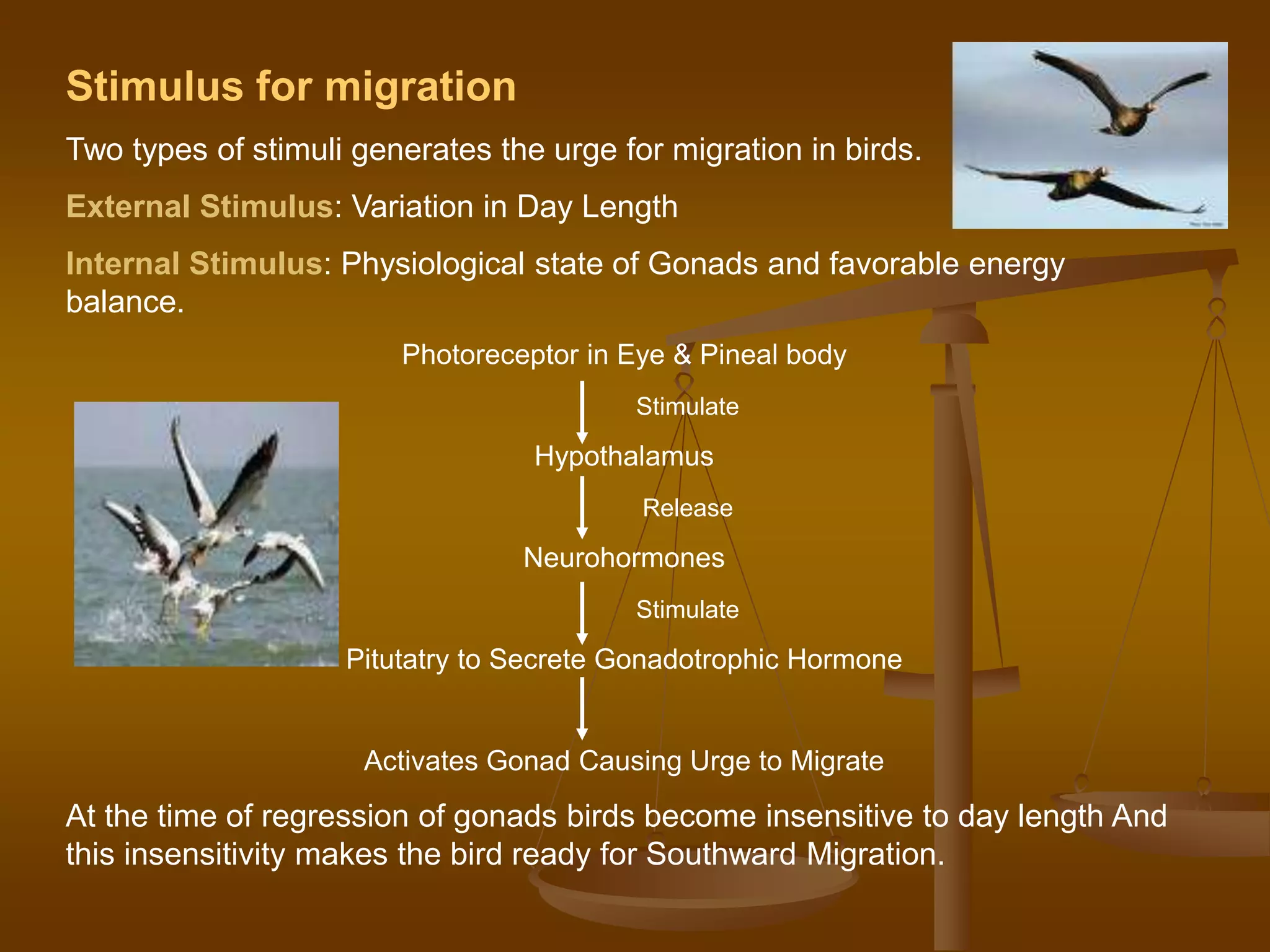
Two types of stimuli generates the urge for migration in birds.
External Stimulus: Variation in Day Length
Internal Stimulus: Physiological state of Gonads and favorable energy
balance.
Photoreceptor in Eye & Pineal body
Stimulate
Hypothalamus
Release
Neurohormones
Stimulate
Pitutatry to Secrete Gonadotrophic Hormone
Activates Gonad Causing Urge to Migrate
At the time of regression of gonads birds become insensitive to day length And
this insensitivity makes the bird ready for Southward Migration.
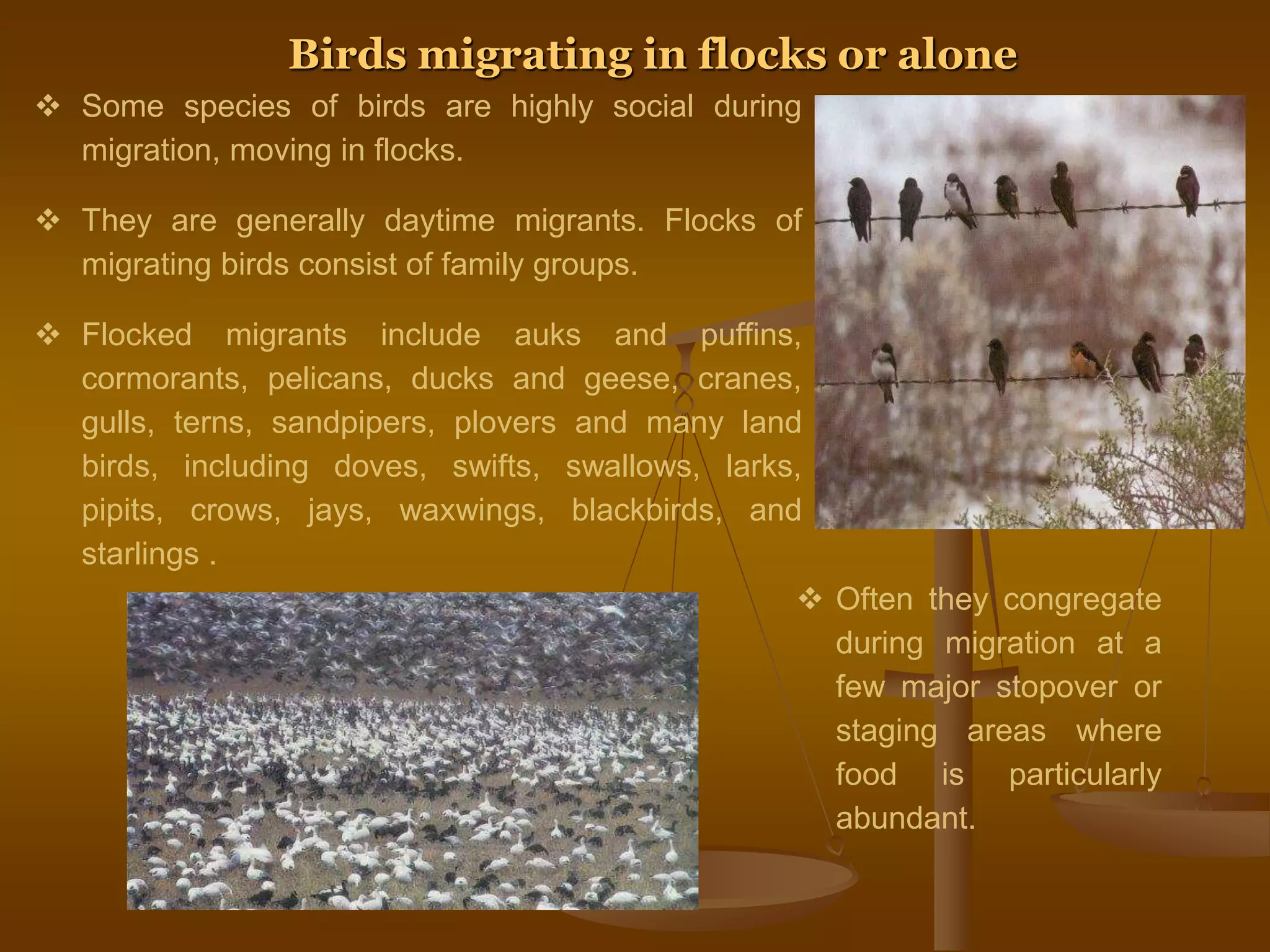
 Some species of birds are highly social during
migration, moving in flocks.
 They are generally daytime migrants. Flocks of
migrating birds consist of family groups.
 Flocked migrants include auks and puffins,
cormorants, pelicans, ducks and geese, cranes,
gulls, terns, sandpipers, plovers and many land
birds, including doves, swifts, swallows, larks,
pipits, crows, jays, waxwings, blackbirds, and
starlings .
Birds migrating in flocks or alone
 Often they congregate
during migration at a
few major stopover or
staging areas where
food is particularly
abundant.
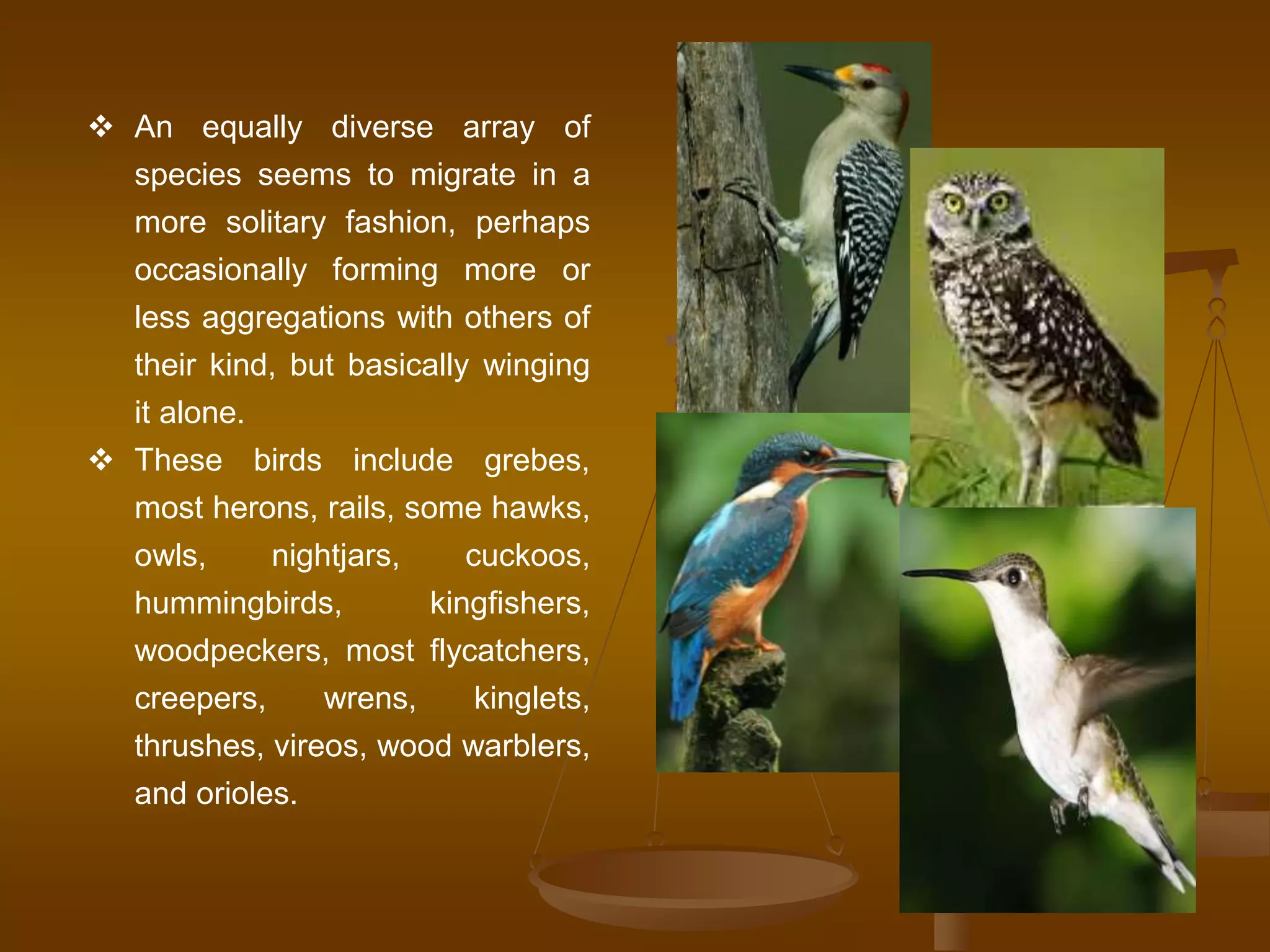
 An equally diverse array of
species seems to migrate in a
more solitary fashion, perhaps
occasionally forming more or
less aggregations with others of
their kind, but basically winging
it alone.
 These birds include grebes,
most herons, rails, some hawks,
owls, nightjars, cuckoos,
hummingbirds, kingfishers,
woodpeckers, most flycatchers,
creepers, wrens, kinglets,
thrushes, vireos, wood warblers,
and orioles.
Types of bird migration
On the basis of altitude migrations are of
two types:
Latitudinal Migration: Migration of birds
from North to South and back
Altitudinal Migration: Migration of birds
from east to west
On the basis of distance migrations are
again of two types:
Long-distance migration: Many northern-
breeding birds are long-distance migrants,
as they move from their Arctic breeding
grounds to far enough south to escape
frozen waters.
Short-distance migration: Many species
move shorter distances, but may do so only
in response to harsh weather conditions.
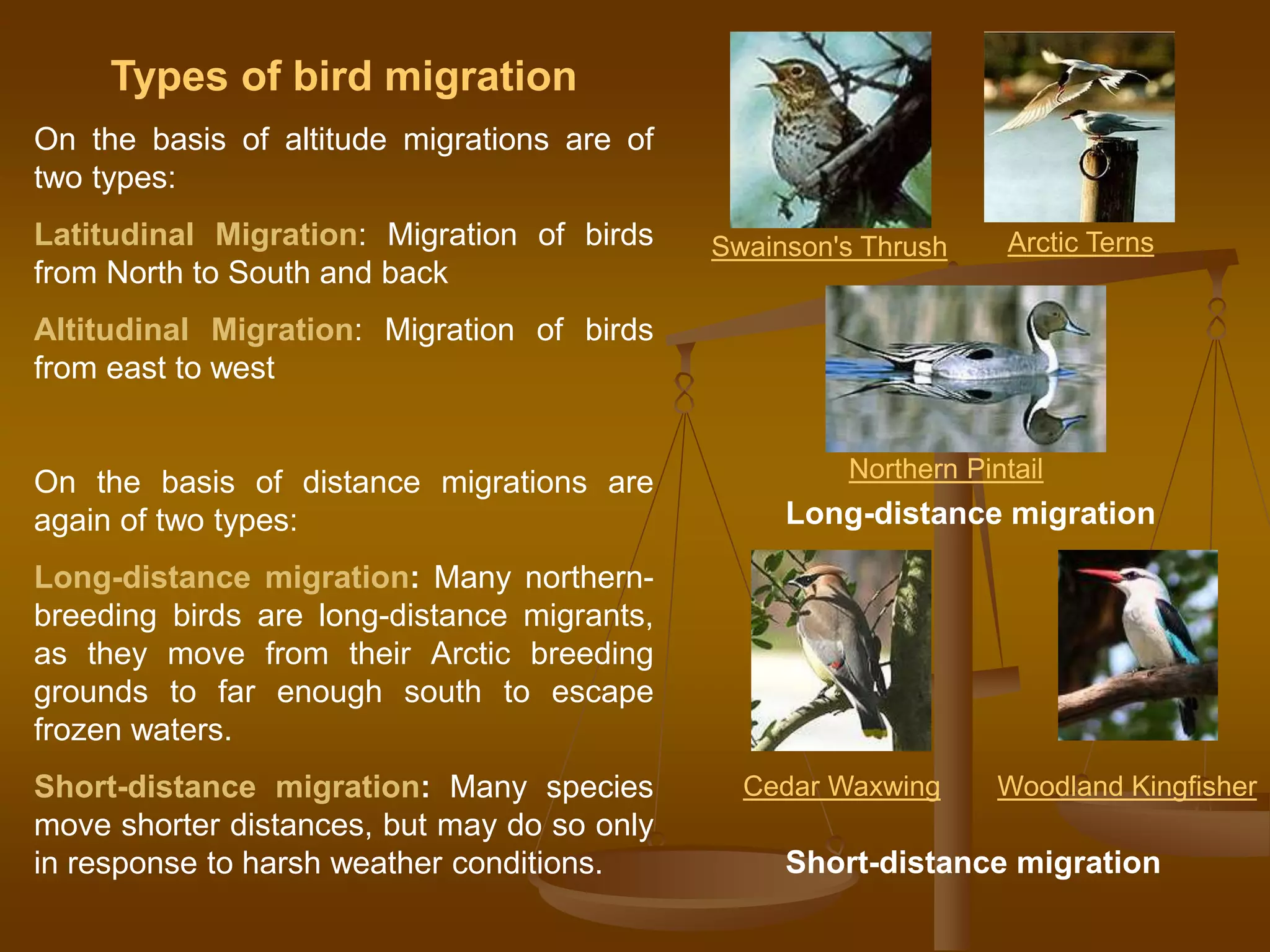
Swainson's Thrush
Northern Pintail
Arctic Terns
Long-distance migration
Cedar Waxwing Woodland Kingfisher
Short-distance migration
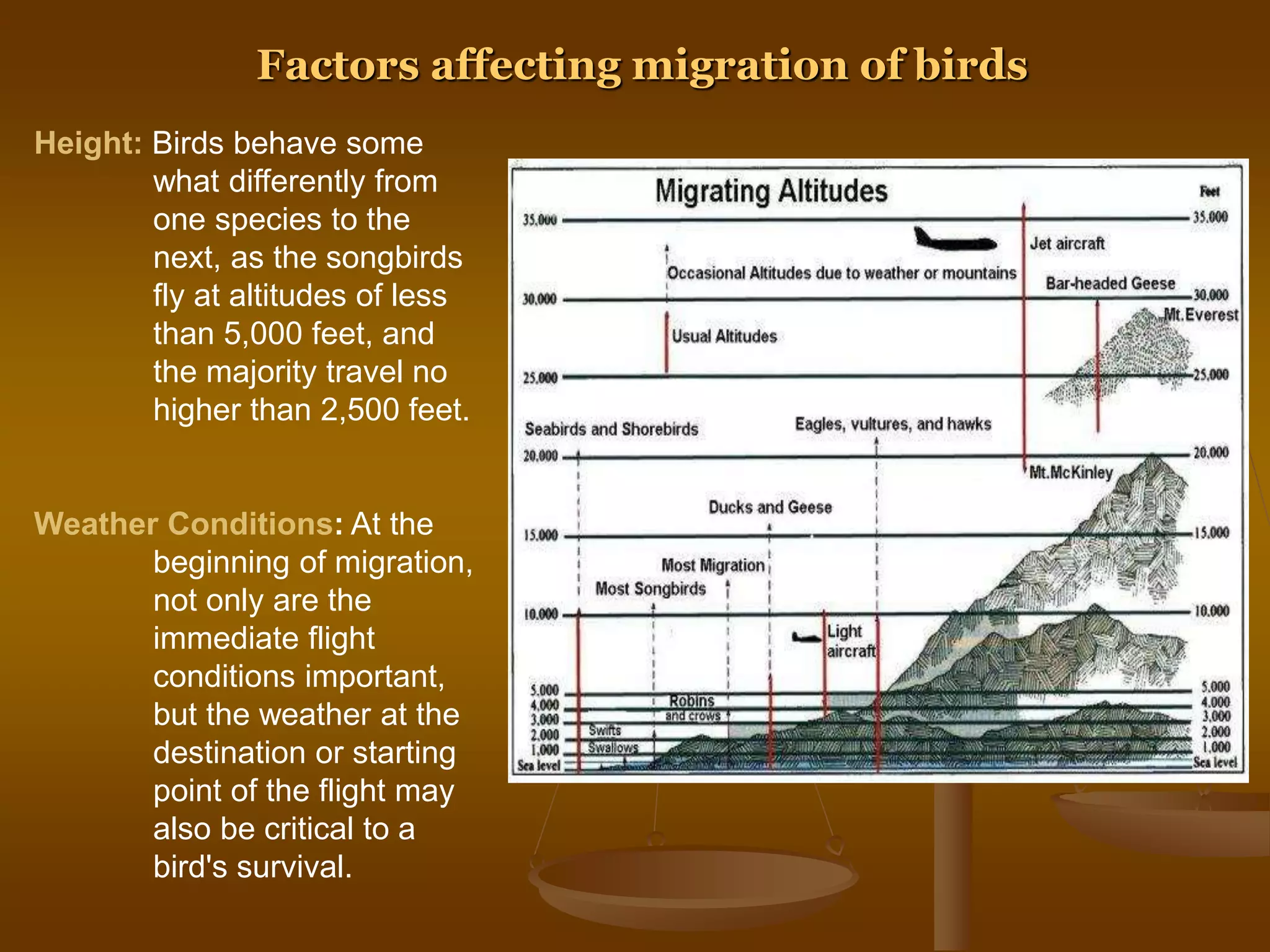
Height: Birds behave some
what differently from
one species to the
next, as the songbirds
fly at altitudes of less
than 5,000 feet, and
the majority travel no
higher than 2,500 feet.
Weather Conditions: At the
beginning of migration,
not only are the
immediate flight
conditions important,
but the weather at the
destination or starting
point of the flight may
also be critical to a
bird's survival.
Factors affecting migration of birds
Direction and Speed of Wind:
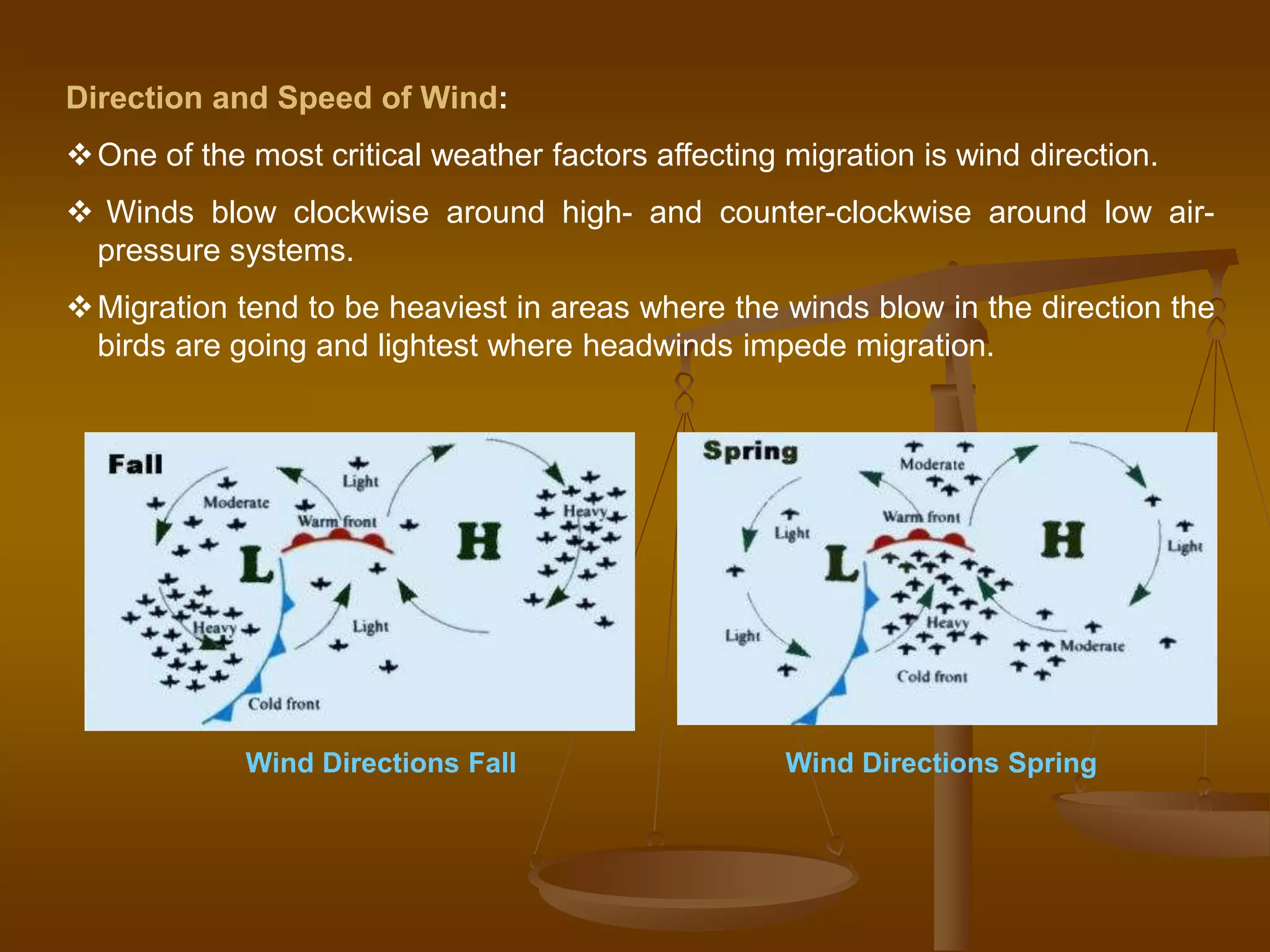
One of the most critical weather factors affecting migration is wind direction.
 Winds blow clockwise around high- and counter-clockwise around low air-
pressure systems.
Migration tend to be heaviest in areas where the winds blow in the direction the
birds are going and lightest where headwinds impede migration.
Wind Directions Fall Wind Directions Spring
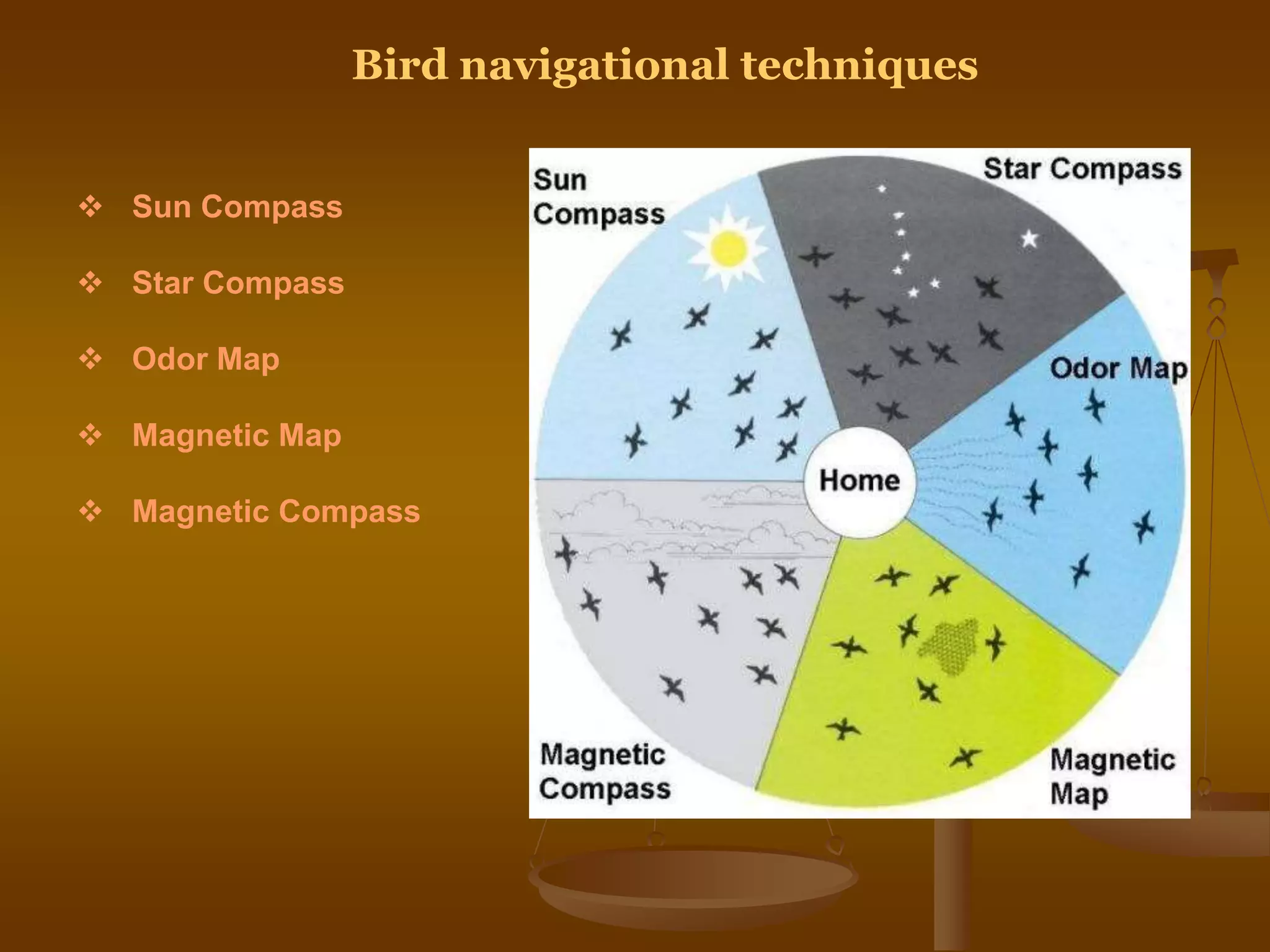
 Sun Compass
 Star Compass
 Odor Map
 Magnetic Map
 Magnetic Compass
Bird navigational techniques
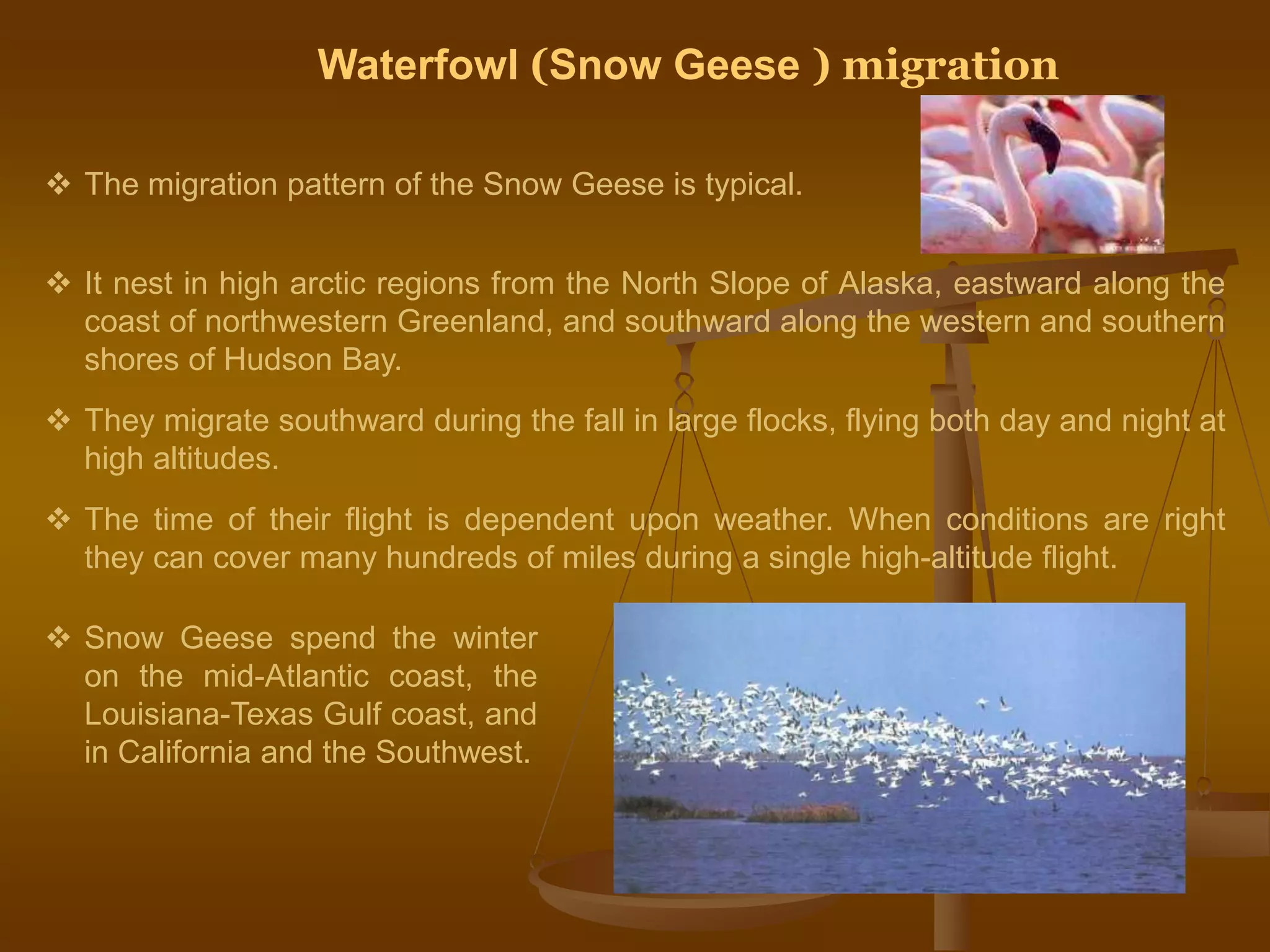
 The migration pattern of the Snow Geese is typical.
 It nest in high arctic regions from the North Slope of Alaska, eastward along the
coast of northwestern Greenland, and southward along the western and southern
shores of Hudson Bay.
 They migrate southward during the fall in large flocks, flying both day and night at
high altitudes.
 The time of their flight is dependent upon weather. When conditions are right
they can cover many hundreds of miles during a single high-altitude flight.
Waterfowl (Snow Geese ) migration
 Snow Geese spend the winter
on the mid-Atlantic coast, the
Louisiana-Texas Gulf coast, and
in California and the Southwest.
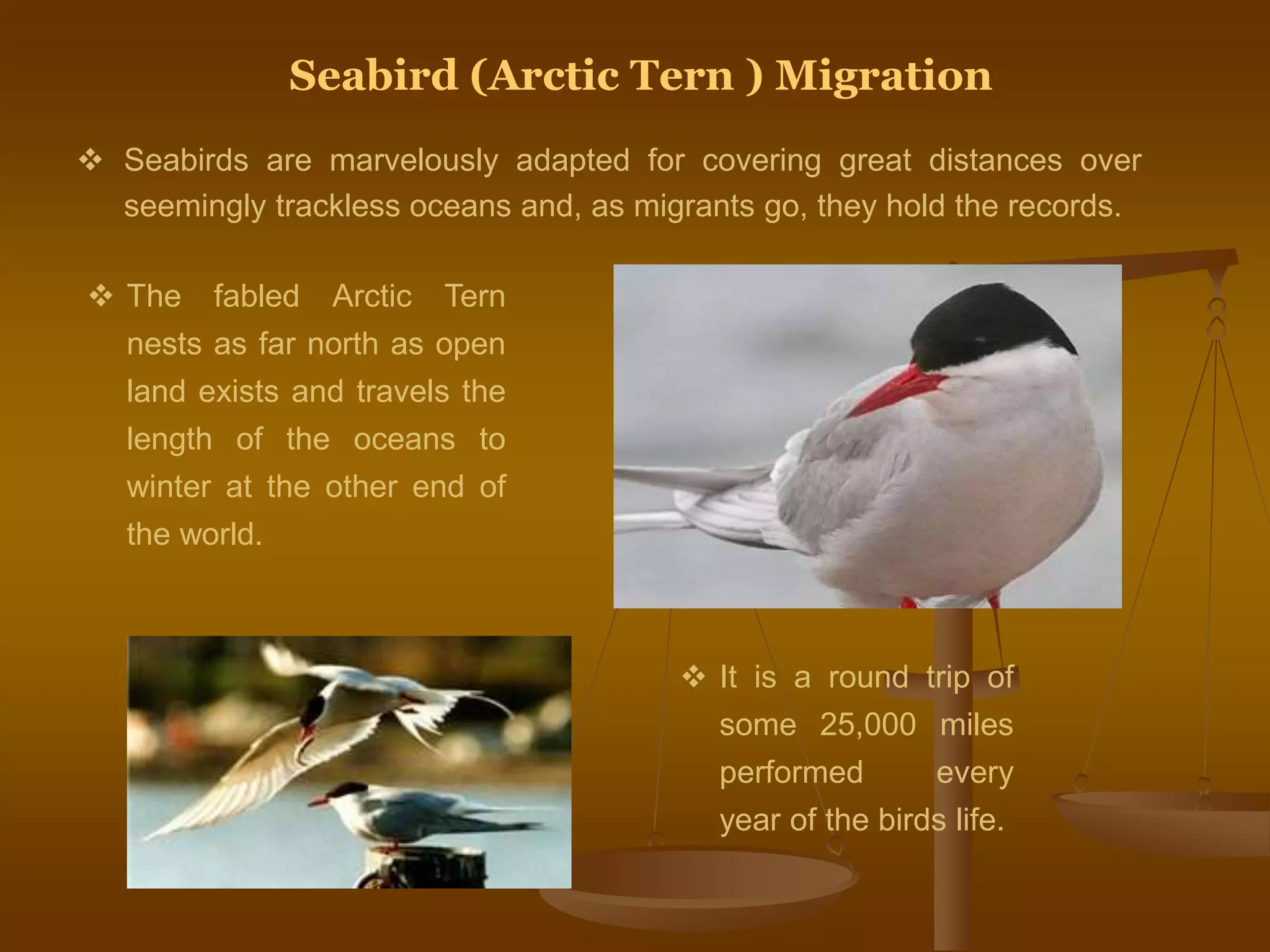
Seabird (Arctic Tern ) Migration
 Seabirds are marvelously adapted for covering great distances over
seemingly trackless oceans and, as migrants go, they hold the records.
 It is a round trip of
some 25,000 miles
performed every
year of the birds life.
 The fabled Arctic Tern
nests as far north as open
land exists and travels the
length of the oceans to
winter at the other end of
the world.
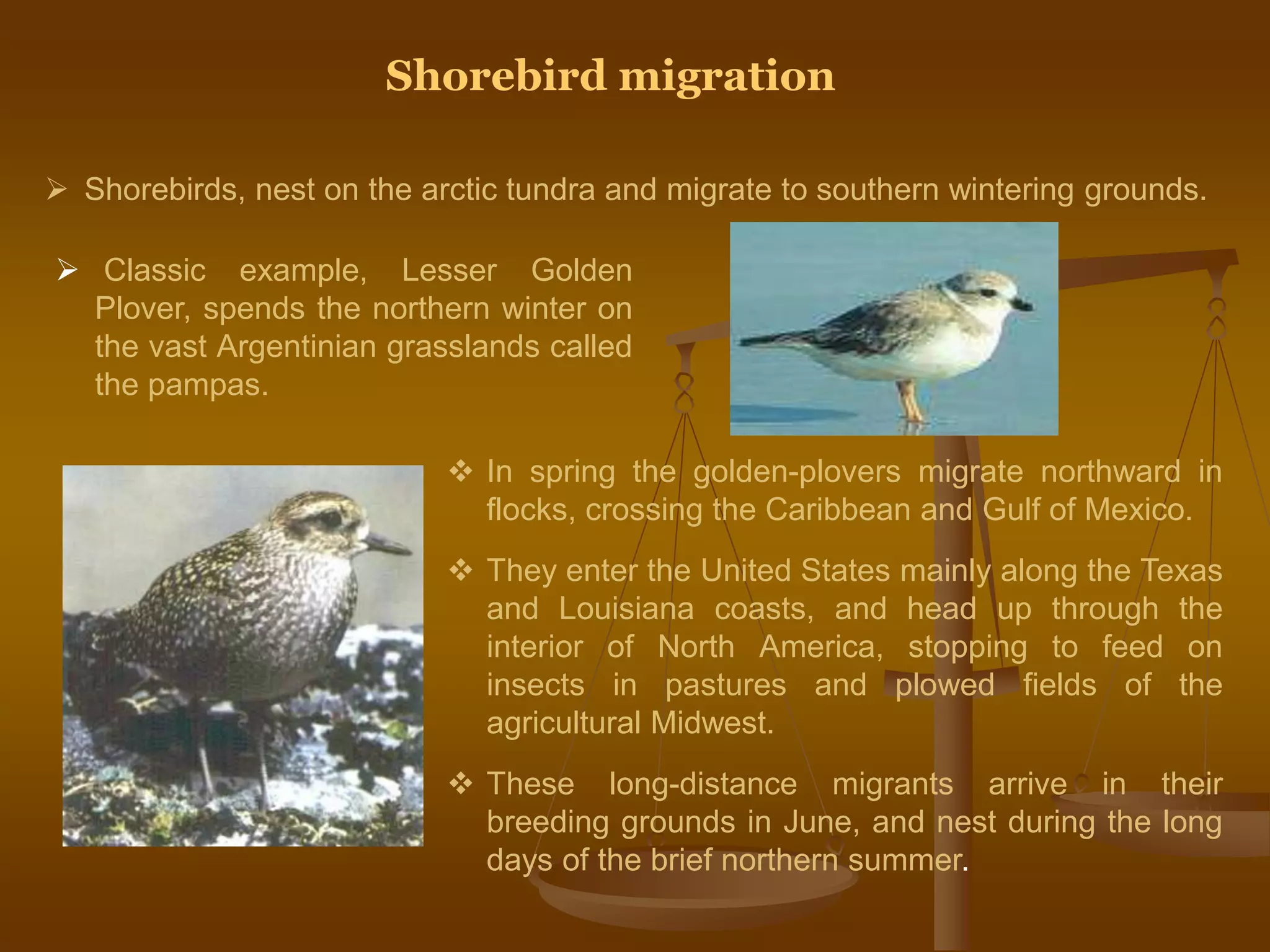
Shorebird migration
 Shorebirds, nest on the arctic tundra and migrate to southern wintering grounds.
 Classic example, Lesser Golden
Plover, spends the northern winter on
the vast Argentinian grasslands called
the pampas.
 In spring the golden-plovers migrate northward in
flocks, crossing the Caribbean and Gulf of Mexico.
 They enter the United States mainly along the Texas
and Louisiana coasts, and head up through the
interior of North America, stopping to feed on
insects in pastures and plowed fields of the
agricultural Midwest.
 These long-distance migrants arrive in their
breeding grounds in June, and nest during the long
days of the brief northern summer.
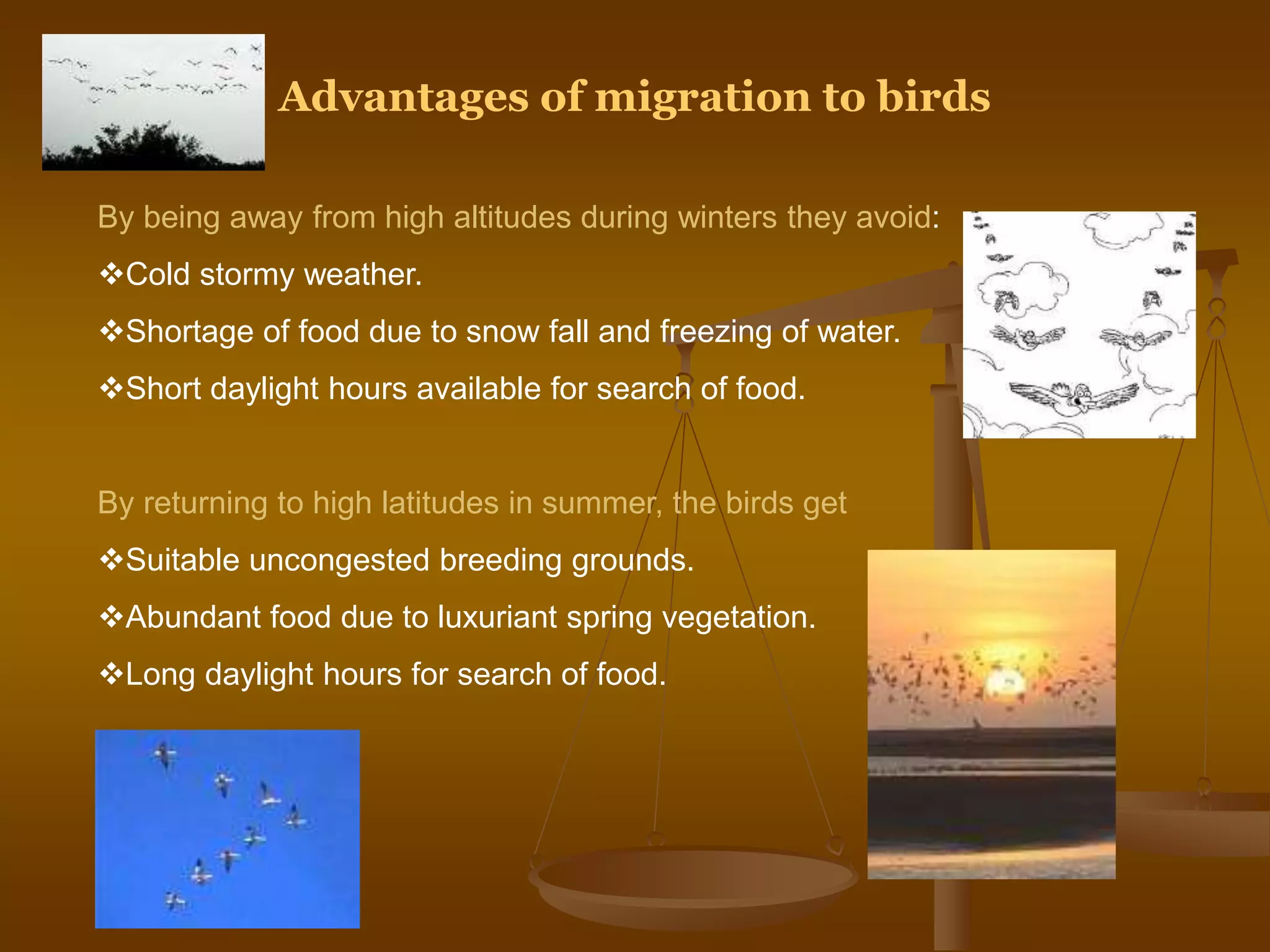
Advantages of migration to birds
By being away from high altitudes during winters they avoid:
Cold stormy weather.
Shortage of food due to snow fall and freezing of water.
Short daylight hours available for search of food.
By returning to high latitudes in summer, the birds get
Suitable uncongested breeding grounds.
Abundant food due to luxuriant spring vegetation.
Long daylight hours for search of food.

Migration birds ppt.ppt

  • 1.
    MIGRATION OF BIRDS OpokeRobert (MSc) opokerobert@gmail.com
  • 2.
    BIRDS Birds are theonly animals that have feathers which help them fly. They have two wings instead of arms and two legs. There are nearly 9000 kinds of birds in the world. They are of different colours, shapes and sizes and they eat different sorts of food. Bird migration “Migration is the seasonal movements between a breeding location and a location where it survives when not breeding” These movements are usually irregular or in only one direction and are termed variously as nomadism, invasions, dispersal or irruptions. Migration is marked by its annual seasonality.
  • 3.
    Why do birdsmigrate?  The changing seasons can transform a comfortable environment of a bird into an unlivable one; the food and water supply can dwindle or disappear, plant cover can vanish, and competition with other animals can increase. Nature has provided methods for coping with the situation. Hibernation: involves entering a dormant state during the winter season. Migration: involves escaping the area entirely. Because of the powers of flight, most birds adapt to seasonal changes in the environment by migrating.
  • 4.
    General patterns ofbird migration The most common pattern involves flying north in the spring to breed in the temperate or Arctic summer and returning in the fall to wintering grounds in warmer regions to the south. In some cases the migration may involve narrow belts of migration that are established as traditional routes termed as flyway. Many of the larger birds fly in flocks. Flying in flocks helps in reducing the energy needed.
  • 5.
     Many largebirds fly in a V- formation, which helps individuals save 12–20 % of the energy they would need to fly alone.  In contrast, most species of penguin migrate by swimming. These routes can cover over 1000 km.
  • 6.
    With seasonal movements/migration, birds can be classified as: Permanent residents: “Residents," are non-migrating birds such as House Sparrows. Summer residents: Migratory birds such as Purple Martins who arrive in in the spring, nest during the summer, and return south to wintering grounds in the fall. Winter residents: Migratory birds who have "come south" for the winter. White-throated Sparrows. Transients: Migratory species who nest farther north but who winter farther south; they are "just passing through."
  • 7.
    Two Theories aboutthe bird migration have been given:  According to one theory, the birds spread over the northern hemisphere when it was warm and abounded in food throughout the year.  At the onset of ice age these were forced to shift southwards for survival. With the end of ice age, they returned in spring, but had to shift southwards due to sharp establishment of winter and summer seasons.  Another theory says that the ancestral home of the birds was in tropics, and some went to north to avoid overcrowding and competition during breeding season. After breeding, they return and this became their permanent habit in due course of time.  Migratory behavior continues to evolve because of the changing environment in which the birds live: If environmental conditions favor migration, the number of birds that migrate increases; if conditions permit the birds to stay in one place, the sedentary type predominates. Evolution of bird migration
  • 8.
    Stimulus for migration Twotypes of stimuli generates the urge for migration in birds. External Stimulus: Variation in Day Length Internal Stimulus: Physiological state of Gonads and favorable energy balance. Photoreceptor in Eye & Pineal body Stimulate Hypothalamus Release Neurohormones Stimulate Pitutatry to Secrete Gonadotrophic Hormone Activates Gonad Causing Urge to Migrate At the time of regression of gonads birds become insensitive to day length And this insensitivity makes the bird ready for Southward Migration.
  • 9.
     Some speciesof birds are highly social during migration, moving in flocks.  They are generally daytime migrants. Flocks of migrating birds consist of family groups.  Flocked migrants include auks and puffins, cormorants, pelicans, ducks and geese, cranes, gulls, terns, sandpipers, plovers and many land birds, including doves, swifts, swallows, larks, pipits, crows, jays, waxwings, blackbirds, and starlings . Birds migrating in flocks or alone  Often they congregate during migration at a few major stopover or staging areas where food is particularly abundant.
  • 10.
     An equallydiverse array of species seems to migrate in a more solitary fashion, perhaps occasionally forming more or less aggregations with others of their kind, but basically winging it alone.  These birds include grebes, most herons, rails, some hawks, owls, nightjars, cuckoos, hummingbirds, kingfishers, woodpeckers, most flycatchers, creepers, wrens, kinglets, thrushes, vireos, wood warblers, and orioles.
  • 11.
    Types of birdmigration On the basis of altitude migrations are of two types: Latitudinal Migration: Migration of birds from North to South and back Altitudinal Migration: Migration of birds from east to west On the basis of distance migrations are again of two types: Long-distance migration: Many northern- breeding birds are long-distance migrants, as they move from their Arctic breeding grounds to far enough south to escape frozen waters. Short-distance migration: Many species move shorter distances, but may do so only in response to harsh weather conditions. Swainson's Thrush Northern Pintail Arctic Terns Long-distance migration Cedar Waxwing Woodland Kingfisher Short-distance migration
  • 12.
    Height: Birds behavesome what differently from one species to the next, as the songbirds fly at altitudes of less than 5,000 feet, and the majority travel no higher than 2,500 feet. Weather Conditions: At the beginning of migration, not only are the immediate flight conditions important, but the weather at the destination or starting point of the flight may also be critical to a bird's survival. Factors affecting migration of birds
  • 13.
    Direction and Speedof Wind: One of the most critical weather factors affecting migration is wind direction.  Winds blow clockwise around high- and counter-clockwise around low air- pressure systems. Migration tend to be heaviest in areas where the winds blow in the direction the birds are going and lightest where headwinds impede migration. Wind Directions Fall Wind Directions Spring
  • 14.
     Sun Compass Star Compass  Odor Map  Magnetic Map  Magnetic Compass Bird navigational techniques
  • 15.
     The migrationpattern of the Snow Geese is typical.  It nest in high arctic regions from the North Slope of Alaska, eastward along the coast of northwestern Greenland, and southward along the western and southern shores of Hudson Bay.  They migrate southward during the fall in large flocks, flying both day and night at high altitudes.  The time of their flight is dependent upon weather. When conditions are right they can cover many hundreds of miles during a single high-altitude flight. Waterfowl (Snow Geese ) migration  Snow Geese spend the winter on the mid-Atlantic coast, the Louisiana-Texas Gulf coast, and in California and the Southwest.
  • 16.
    Seabird (Arctic Tern) Migration  Seabirds are marvelously adapted for covering great distances over seemingly trackless oceans and, as migrants go, they hold the records.  It is a round trip of some 25,000 miles performed every year of the birds life.  The fabled Arctic Tern nests as far north as open land exists and travels the length of the oceans to winter at the other end of the world.
  • 17.
    Shorebird migration  Shorebirds,nest on the arctic tundra and migrate to southern wintering grounds.  Classic example, Lesser Golden Plover, spends the northern winter on the vast Argentinian grasslands called the pampas.  In spring the golden-plovers migrate northward in flocks, crossing the Caribbean and Gulf of Mexico.  They enter the United States mainly along the Texas and Louisiana coasts, and head up through the interior of North America, stopping to feed on insects in pastures and plowed fields of the agricultural Midwest.  These long-distance migrants arrive in their breeding grounds in June, and nest during the long days of the brief northern summer.
  • 18.
    Advantages of migrationto birds By being away from high altitudes during winters they avoid: Cold stormy weather. Shortage of food due to snow fall and freezing of water. Short daylight hours available for search of food. By returning to high latitudes in summer, the birds get Suitable uncongested breeding grounds. Abundant food due to luxuriant spring vegetation. Long daylight hours for search of food.