"I know not, what the third world war would be fought with, but the 
fourth world war will be fought with sticks and stones!" 
Albert Einstein 
BIOWEAPONS 
Presented by: 
 Jacquis RABENANDRASANA 
Mahmoud Algharib 
Ahmed Mokhtar 
Mahmoud Salah Helal 
Supervised by: 
 Dr. Naglaa Abdallah
GENERAL OUTLINE 
• Introduction 
• General features 
• Delivery methods 
• Effects 
• Some Potential agents 
• Biological agent compared by chemical agent 
• Advantages and disadvantages 
• Conclusion
INTRODUCTION 
• Biological warfare also known as germ 
warfare is the use of biological toxins or 
infectious agents such as bacteria, viruses, 
and fungi with an intent to kill or incapacitate 
humans, animals or plants as an act of 
biological weapons which often termed: 
“Bioweapons”
GENERAL FEATURES 
 Bioweapons are living organisms or 
replicating entities (viruses) that reproduce or 
replicate within their host victims. 
 These are often very hard to treat and 
multiply very fast as compared to normal 
viruses or bacteria or fungi.
 It may be an artificially manufactured 
toxic substances that are used: 
- To intentionally interfere with the biological 
processes of a host. 
- To target living organisms such as humans, 
animals or vegetation. 
- To contaminate non living substances like air, 
water and soil.
 It may also be: 
- Lethal or non-lethal 
-Targeted against a single individual, a group of 
individuals, a group of people, or even an entire 
population. 
- Developed, acquired, stockpiled. 
-Deployed by nation states or non-national groups.
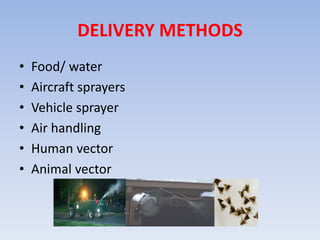
DELIVERY METHODS 
• Food/ water 
• Aircraft sprayers 
• Vehicle sprayer 
• Air handling 
• Human vector 
• Animal vector
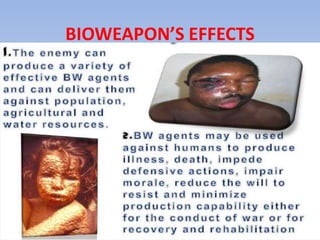
BIOWEAPON’S EFFECTS
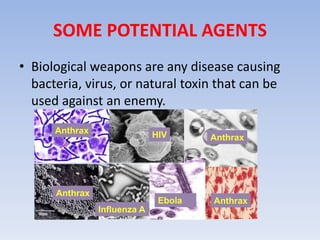
SOME POTENTIAL AGENTS 
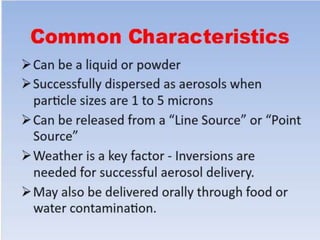
• Biological weapons are any disease causing 
bacteria, virus, or natural toxin that can be 
used against an enemy. 
Anthrax 
Anthrax 
Anthrax 
Anthrax 
HIV 
Ebola 
Influenza A
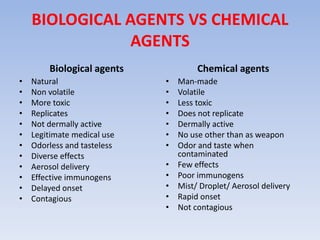
BIOLOGICAL AGENTS VS CHEMICAL 
AGENTS 
Biological agents 
• Natural 
• Non volatile 
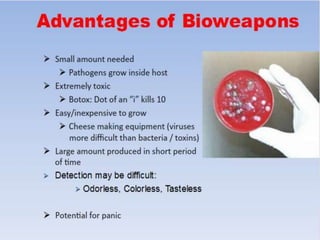
• More toxic 
• Replicates 
• Not dermally active 
• Legitimate medical use 
• Odorless and tasteless 
• Diverse effects 
• Aerosol delivery 
• Effective immunogens 
• Delayed onset 
• Contagious 
Chemical agents 
• Man-made 
• Volatile 
• Less toxic 
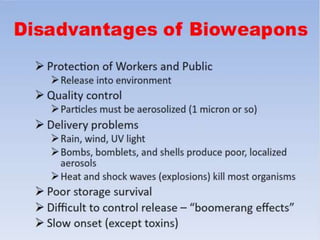
• Does not replicate 
• Dermally active 
• No use other than as weapon 
• Odor and taste when 
contaminated 
• Few effects 
• Poor immunogens 
• Mist/ Droplet/ Aerosol delivery 
• Rapid onset 
• Not contagious
CONCLUSION 
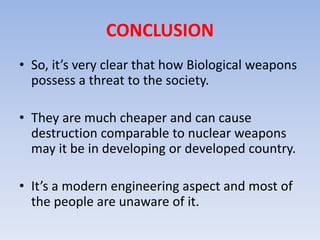
• So, it’s very clear that how Biological weapons 
possess a threat to the society. 
• They are much cheaper and can cause 
destruction comparable to nuclear weapons 
may it be in developing or developed country. 
• It’s a modern engineering aspect and most of 
the people are unaware of it.
THANK YOU!

Bioweapon

  • 1.
    "I know not,what the third world war would be fought with, but the fourth world war will be fought with sticks and stones!" Albert Einstein BIOWEAPONS Presented by:  Jacquis RABENANDRASANA Mahmoud Algharib Ahmed Mokhtar Mahmoud Salah Helal Supervised by:  Dr. Naglaa Abdallah
  • 2.
    GENERAL OUTLINE •Introduction • General features • Delivery methods • Effects • Some Potential agents • Biological agent compared by chemical agent • Advantages and disadvantages • Conclusion
  • 3.
    INTRODUCTION • Biologicalwarfare also known as germ warfare is the use of biological toxins or infectious agents such as bacteria, viruses, and fungi with an intent to kill or incapacitate humans, animals or plants as an act of biological weapons which often termed: “Bioweapons”
  • 4.
    GENERAL FEATURES Bioweapons are living organisms or replicating entities (viruses) that reproduce or replicate within their host victims.  These are often very hard to treat and multiply very fast as compared to normal viruses or bacteria or fungi.
  • 5.
     It maybe an artificially manufactured toxic substances that are used: - To intentionally interfere with the biological processes of a host. - To target living organisms such as humans, animals or vegetation. - To contaminate non living substances like air, water and soil.
  • 6.
     It mayalso be: - Lethal or non-lethal -Targeted against a single individual, a group of individuals, a group of people, or even an entire population. - Developed, acquired, stockpiled. -Deployed by nation states or non-national groups.
  • 7.
    DELIVERY METHODS •Food/ water • Aircraft sprayers • Vehicle sprayer • Air handling • Human vector • Animal vector
  • 8.
  • 9.
    SOME POTENTIAL AGENTS • Biological weapons are any disease causing bacteria, virus, or natural toxin that can be used against an enemy. Anthrax Anthrax Anthrax Anthrax HIV Ebola Influenza A
  • 15.
    BIOLOGICAL AGENTS VSCHEMICAL AGENTS Biological agents • Natural • Non volatile • More toxic • Replicates • Not dermally active • Legitimate medical use • Odorless and tasteless • Diverse effects • Aerosol delivery • Effective immunogens • Delayed onset • Contagious Chemical agents • Man-made • Volatile • Less toxic • Does not replicate • Dermally active • No use other than as weapon • Odor and taste when contaminated • Few effects • Poor immunogens • Mist/ Droplet/ Aerosol delivery • Rapid onset • Not contagious
  • 19.
    CONCLUSION • So,it’s very clear that how Biological weapons possess a threat to the society. • They are much cheaper and can cause destruction comparable to nuclear weapons may it be in developing or developed country. • It’s a modern engineering aspect and most of the people are unaware of it.
  • 20.