■ Defintion
■ Typesof biological weapons
■ Hazards of biological weapons
■ most common microbes used as biological weapons
■ WHO’s View on Biological weapons
■ CONTROL AND PREVENTION
3.
What Are BiologicalWeapons?
■ Biological weapons (bioweapons) are microorganisms (like bacteria, viruses, or
fungi) or toxins used to intentionally cause disease or death in humans, animals, or
plants.
■ They are a form of biological warfare, often invisible and hard to detect.
■ Unlike conventional weapons, they spread infections and can lead to epidemics.
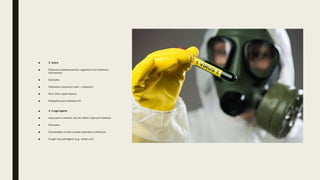
■ 3. Toxins
■Poisonous substances from organisms (not infectious
themselves).
■ Examples:
■ Clostridium botulinum toxin → Botulism
■ Ricin (from castor beans)
■ Staphylococcal enterotoxin B
■ 4. Fungal Agents
■ Less used in warfare, but can affect crops and livestock.
■ Examples:
■ Coccidioides immitis (causes respiratory infections)
■ Fungal crop pathogens (e.g., wheat rust)
7.
Hazards of Biological
Weapons
■High mortality and morbidity
■ Difficult to detect early
■ Rapid and uncontrollable spread
■ Psychological impact and public panic
■ Disruption of healthcare systems
■ Economic and agricultural damage
■ Potential misuse by terrorists or rogue states
■ Long-term environmental contamination
8.
most common microbesused as
biological weapons:
■ 1. Bacillus anthracis (Anthrax)
■ Transmission: Inhalation, contact, ingestion.
■ Morbidity: Fever, shock, tissue necrosis, skin ulcers, abdominal pain.
■ Mortality:80-90% untreated; treatable with antibiotics.
■ Treatment: Antibiotics (ciprofloxacin, doxycycline), antitoxin..
■ Use of Bacillus anthracis in Warfare:
■ World War I
■ World War II
■ 2001 USA Bioterrorism
9.
■ 2. VariolaVirus (Smallpox)
■ Transmission: Respiratory droplets and direct contact.
■ Morbidity: Fever, rash, organ failure, and severe scarring.
■ Mortality: 30% in unvaccinated individuals.
■ Treatment: No specific treatment; supportive care.
■ Use in Warfare
■ 18th Century
■ Cold War Era
11.
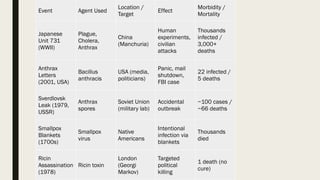
Event Agent Used
Location/
Target
Effect
Morbidity /
Mortality
Japanese
Unit 731
(WWII)
Plague,
Cholera,
Anthrax
China
(Manchuria)
Human
experiments,
civilian
attacks
Thousands
infected /
3,000+
deaths
Anthrax
Letters
(2001, USA)
Bacillus
anthracis
USA (media,
politicians)
Panic, mail
shutdown,
FBI case
22 infected /
5 deaths
Sverdlovsk
Leak (1979,
USSR)
Anthrax
spores
Soviet Union
(military lab)
Accidental
outbreak
~100 cases /
~66 deaths
Smallpox
Blankets
(1700s)
Smallpox
virus
Native
Americans
Intentional
infection via
blankets
Thousands
died
Ricin
Assassination
(1978)
Ricin toxin
London
(Georgi
Markov)
Targeted
political
killing
1 death (no
cure)
12.
WHO’s View onBiological weapons
■ Condemnation – WHO strongly condemns the use of biological weapons as a threat
to health and humanity.
■ WHO supports the Biological Weapons Convention to stop development and misuse
of dangerous pathogens.
■ Preparedness – WHO helps countries strengthen lab safety, disease surveillance,
and emergency health responses.
■ Health Impact – Biological weapons can cause large outbreaks, strain healthcare
systems, and lead to uncontrollable spread.
■ Surveillance andEarly Response
■ Developing monitoring systems for the early detection of biological threats and outbreaks.
■ Vaccination and Immunization
■ Providing vaccines to prevent known biological diseases.
■ Training and Preparedness
■ Training healthcare workers to manage biological emergency situations.
■ Infrastructure and Biosafety
■ Improving healthcare facilities to ensure proper infection control.
■ Community Awareness
■ Spreading information about biological infection prevention methods.
15.
■ Vaccination andits Role in Reducing Infections in Warfare
■ Prevents disease spread in crowded war zones
■ Protects soldiers from biological weapon exposure
■ Helps eradicate deadly infectious diseases
■ Reduces casualties and pressure on healthcare