Bioterrorism
Dr. M. Jane Esther
II YR MD(Microbiology) postgraduate,
CMCHRC, Trichy, Tamilnadu
Definition
• Terrorism : “The unlawful use of force and
violence against persons or property to
intimidate or coerce a government, the civilian
population, or any segment”
• Bioterrorism: bioterrorism attack is the
deliberate release of viruses, bacteria, toxins
or other harmful agents used to cause illness
or death in people, animals, or plants.
Bioterrorism
Why are they used?
• Can be easily disseminated, and can cause widespread fear
and panic beyond the actual physical damage
• Bioterrorism is an attractive weapon because biological
agents are relatively easy and inexpensive to obtain.
• The use of agents that do not cause harm to humans but
disrupt the economy have been discussed. Eg. Foot and
mouth disease virus
• Some bioterrorism agents, like the smallpox virus, can be
spread from person to person and some, like anthrax,
cannot.
Key Features of Biologic Agents Used as
Bioweapons
• High morbidity and mortality
• Potential for person-to-person spread
• Low infective dose and highly infectious by aerosol
• Lack of rapid diagnostic capability
• Lack of effective vaccine
• Potential to cause anxiety
• Environmental stability
• Potential to be “weaponized”
Earliest attempts at biological warfare
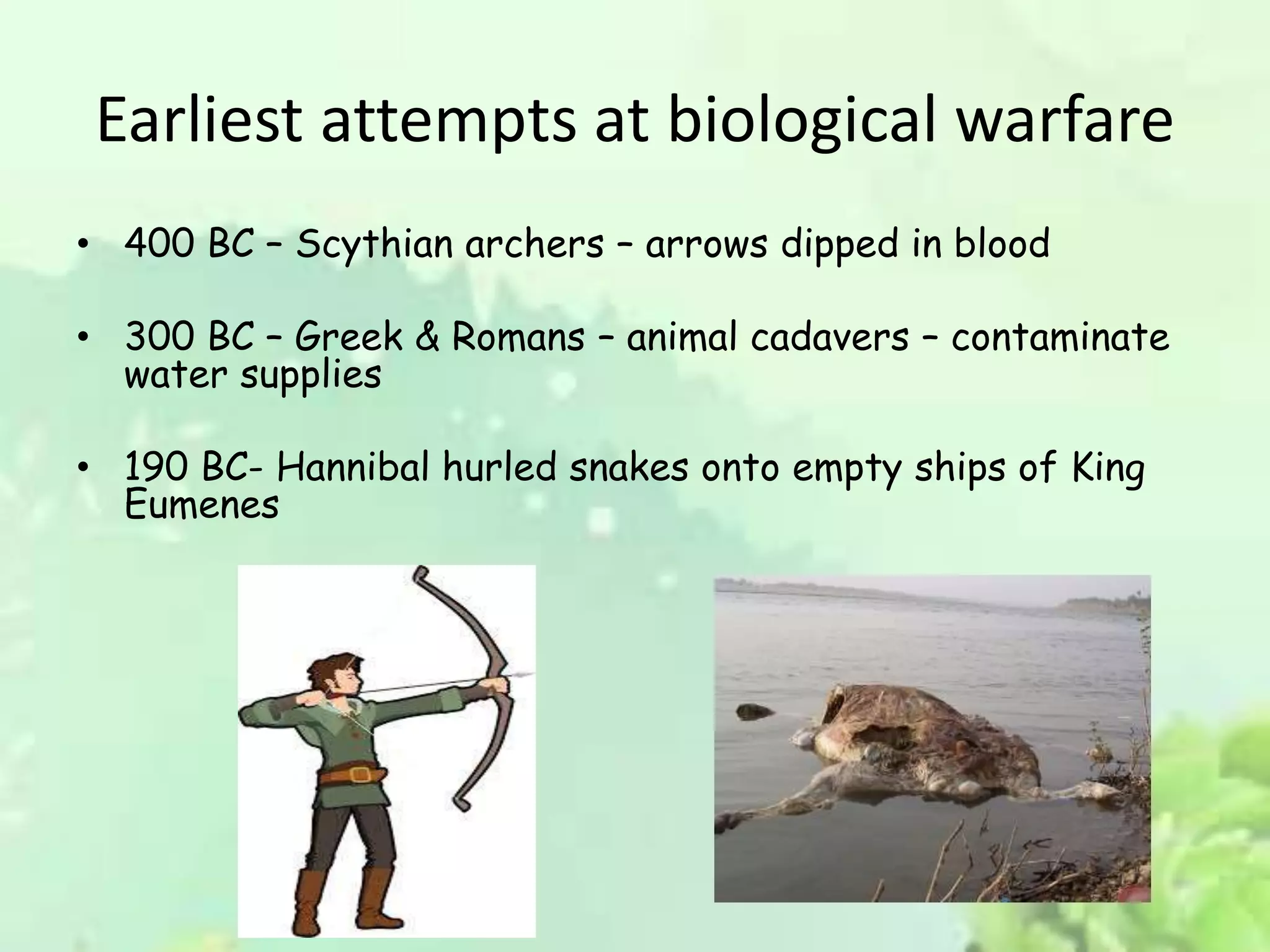
• 400 BC – Scythian archers – arrows dipped in blood
• 300 BC – Greek & Romans – animal cadavers – contaminate
water supplies
• 190 BC- Hannibal hurled snakes onto empty ships of King
Eumenes
• 1346 – Mongols catapulted bodies of plague victims over
city walls
• 1718 – Russians tried the same tactic against Sweden
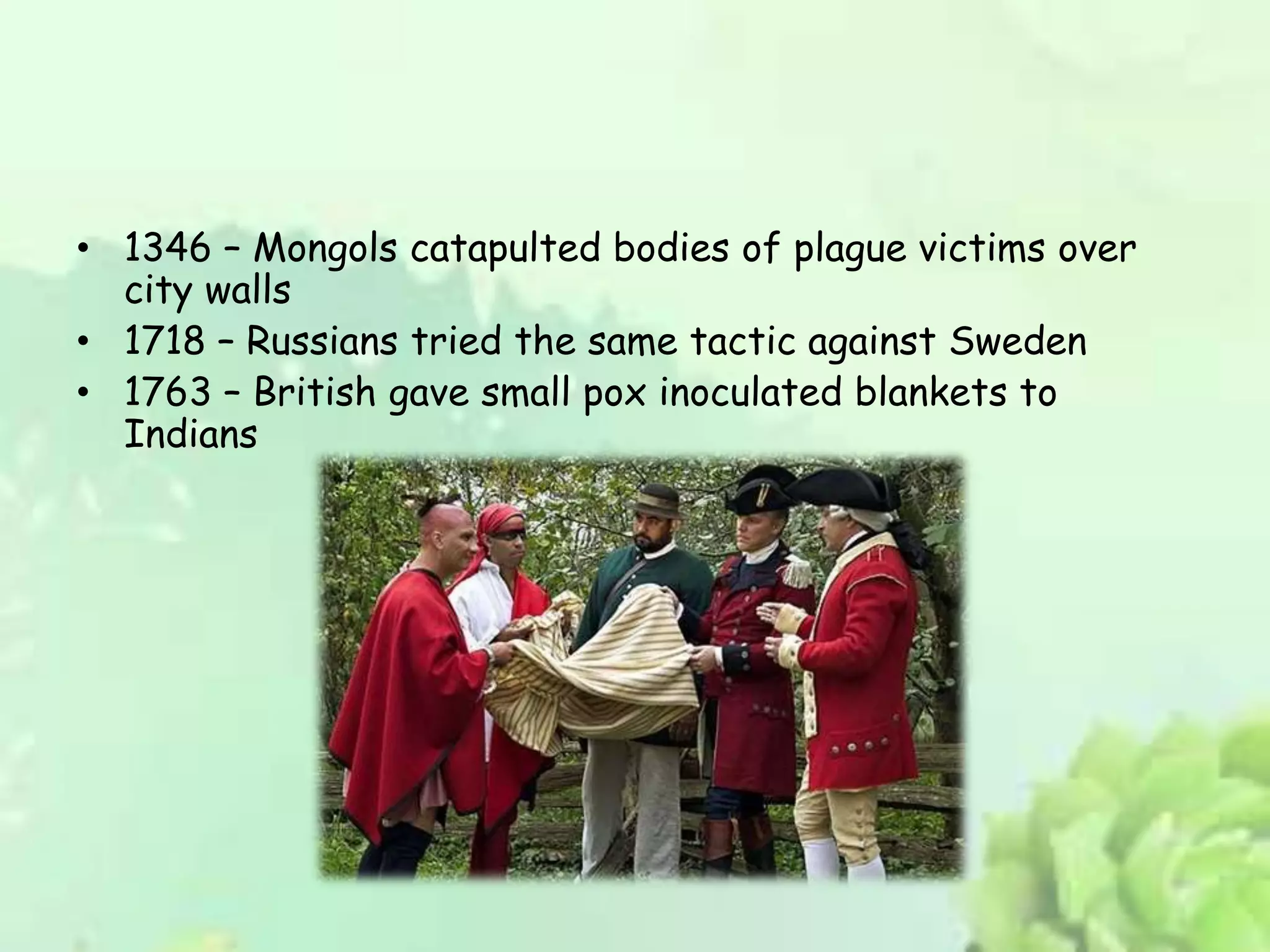
• 1763 – British gave small pox inoculated blankets to
Indians
20th century
• By the time World war 1 began, attempts to
use anthrax were directed at animal populations.
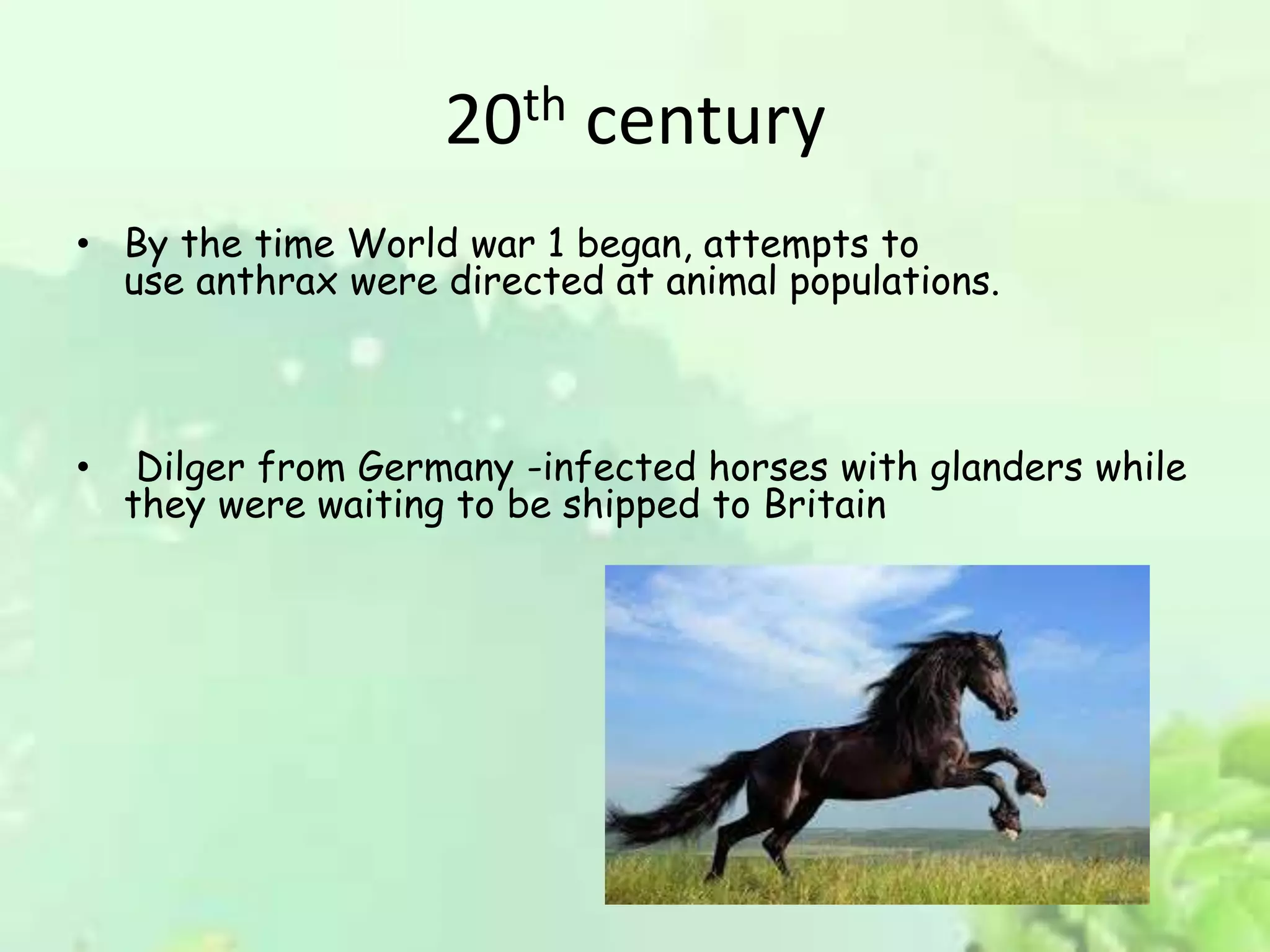
• Dilger from Germany -infected horses with glanders while
they were waiting to be shipped to Britain
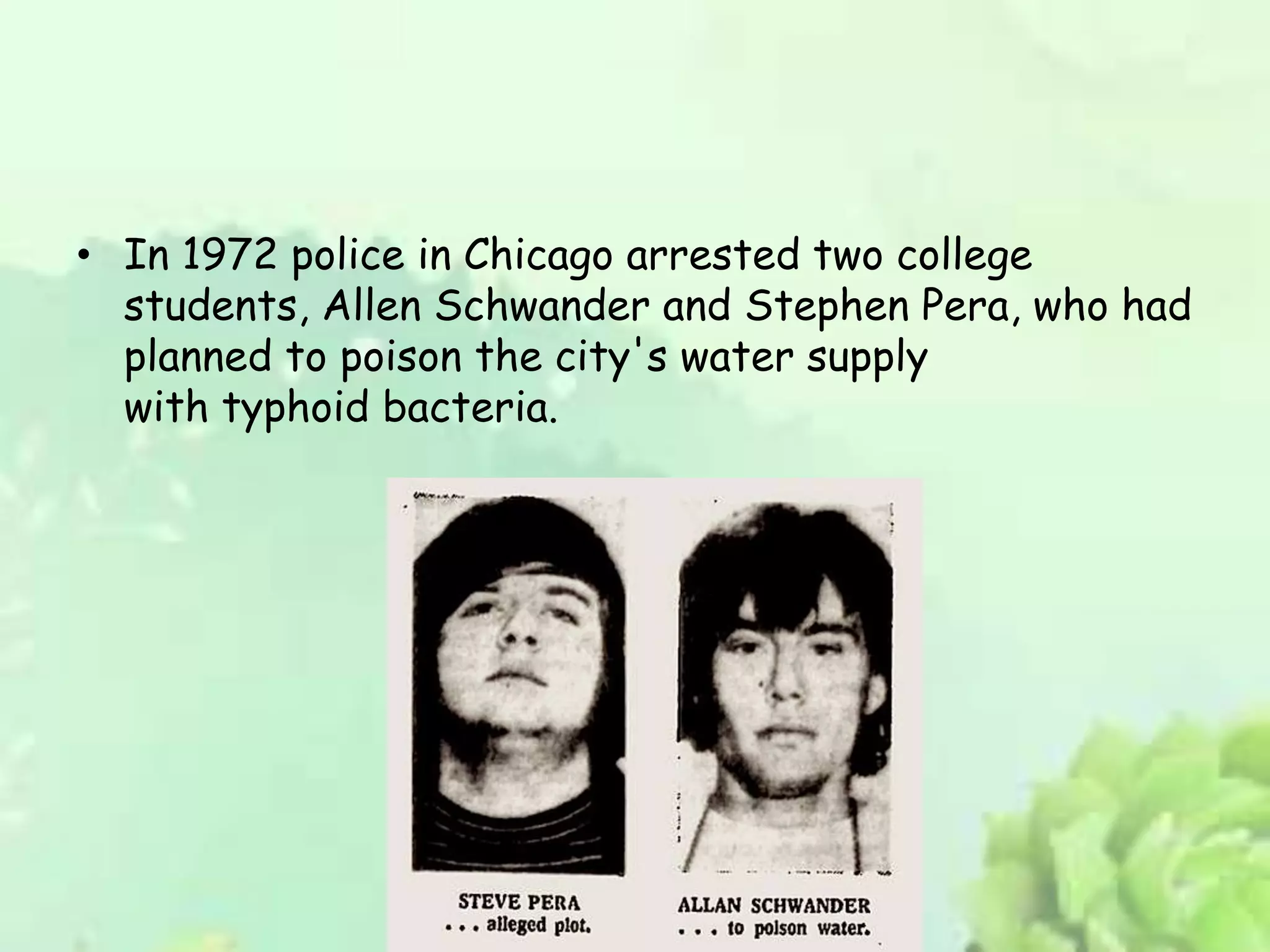
• In 1972 police in Chicago arrested two college
students, Allen Schwander and Stephen Pera, who had
planned to poison the city's water supply
with typhoid bacteria.
21st century
• In Oregon , followers of the Shree
Rajneesh attempted to control a local election by
incapacitating the local population – Salmonella
typhimurium.
• Letters laced with infectious anthrax were
concurrently delivered to news media offices and the
U.S Congress. The letters killed thousands of people
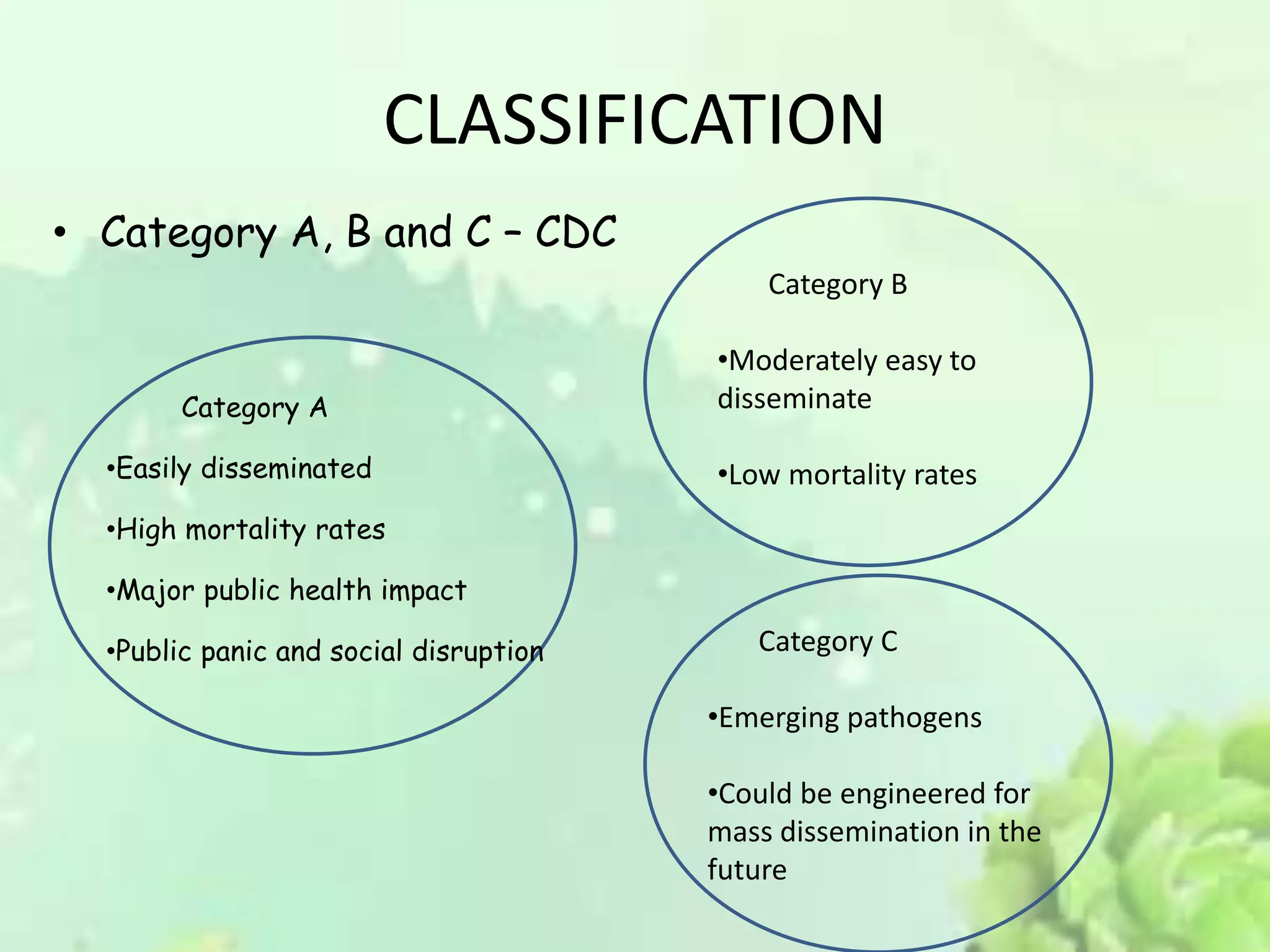
CLASSIFICATION
• Category A, B and C – CDC
Category A
•Easily disseminated
•High mortality rates
•Major public health impact
•Public panic and social disruption
Category B
•Moderately easy to
disseminate
•Low mortality rates
Category C
•Emerging pathogens
•Could be engineered for
mass dissemination in the
future
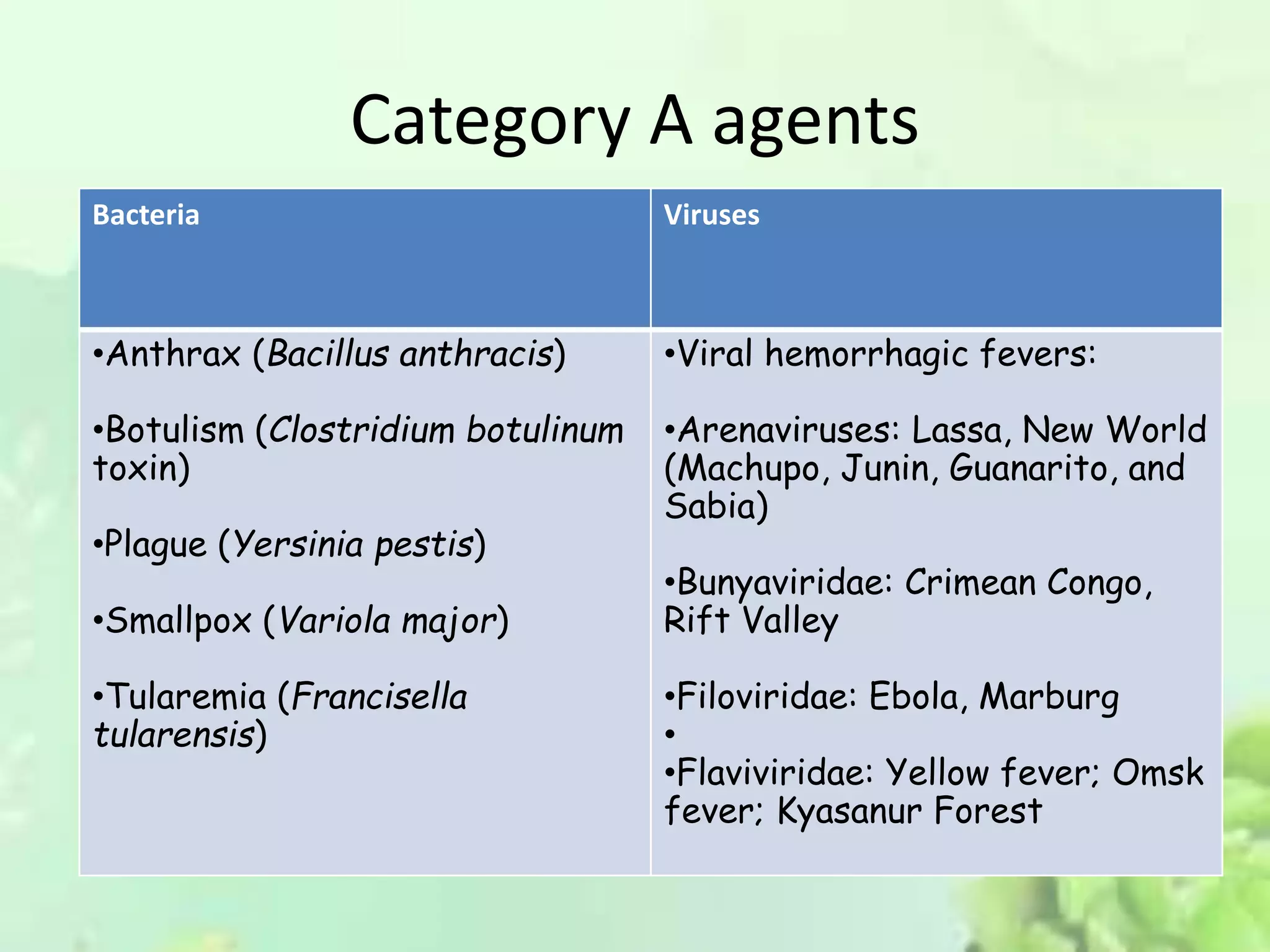
Category A agents
Bacteria Viruses
•Anthrax (Bacillus anthracis)
•Botulism (Clostridium botulinum
toxin)
•Plague (Yersinia pestis)
•Smallpox (Variola major)
•Tularemia (Francisella
tularensis)
•Viral hemorrhagic fevers:
•Arenaviruses: Lassa, New World
(Machupo, Junin, Guanarito, and
Sabia)
•Bunyaviridae: Crimean Congo,
Rift Valley
•Filoviridae: Ebola, Marburg
•
•Flaviviridae: Yellow fever; Omsk
fever; Kyasanur Forest
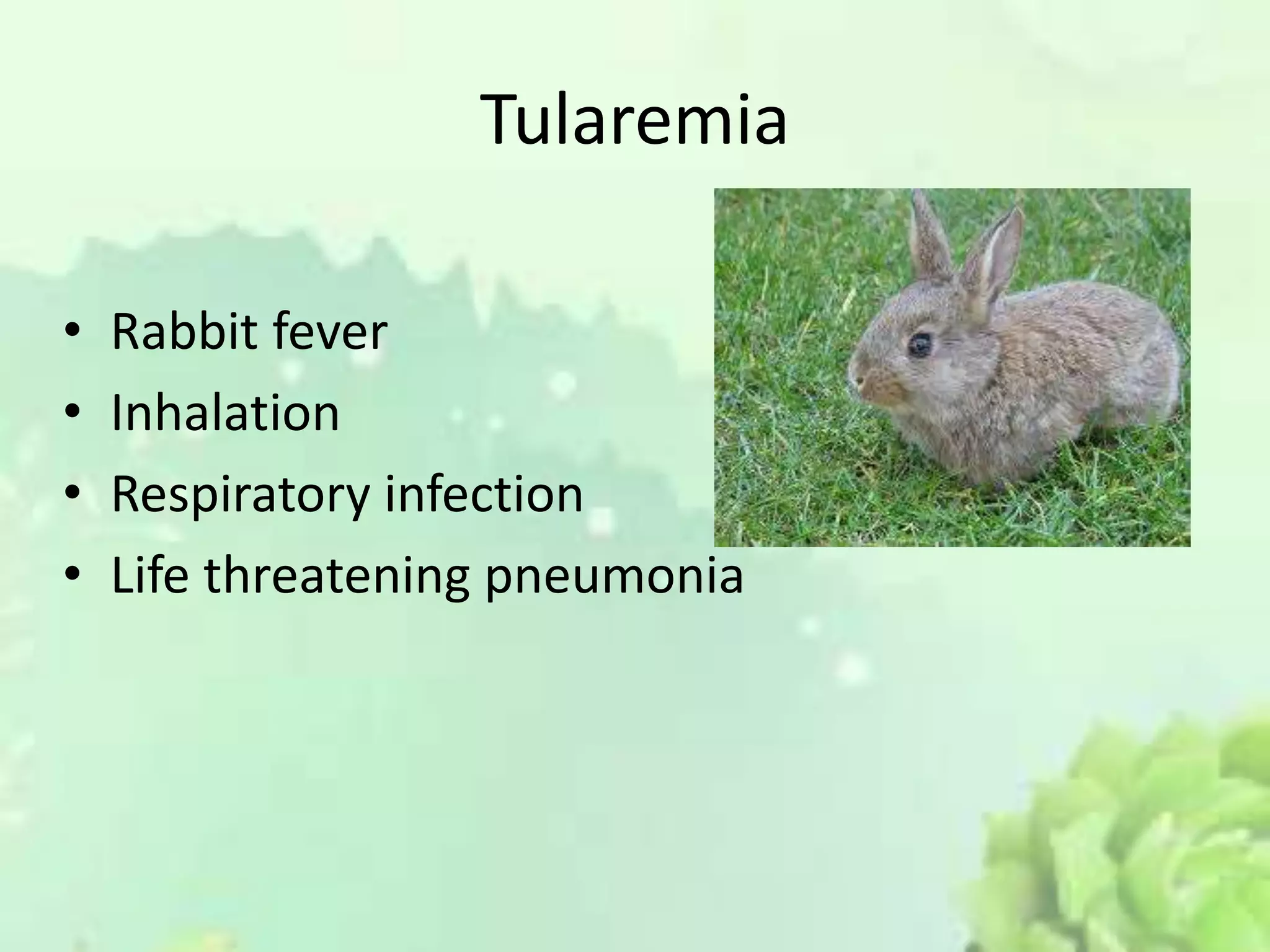
Tularemia
• Rabbit fever
• Inhalation
• Respiratory infection
• Life threatening pneumonia
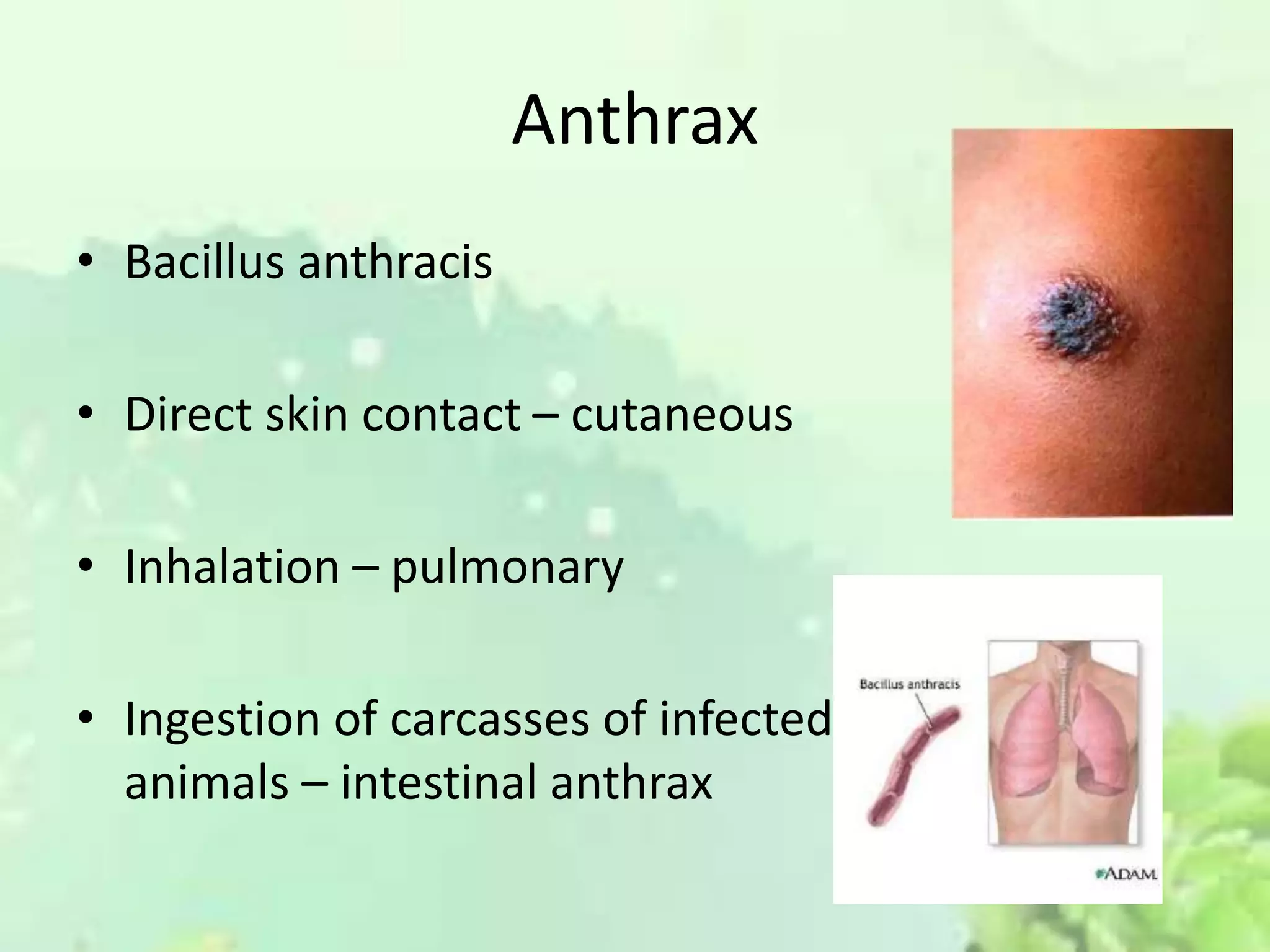
Anthrax
• Bacillus anthracis
• Direct skin contact – cutaneous
• Inhalation – pulmonary
• Ingestion of carcasses of infected
animals – intestinal anthrax
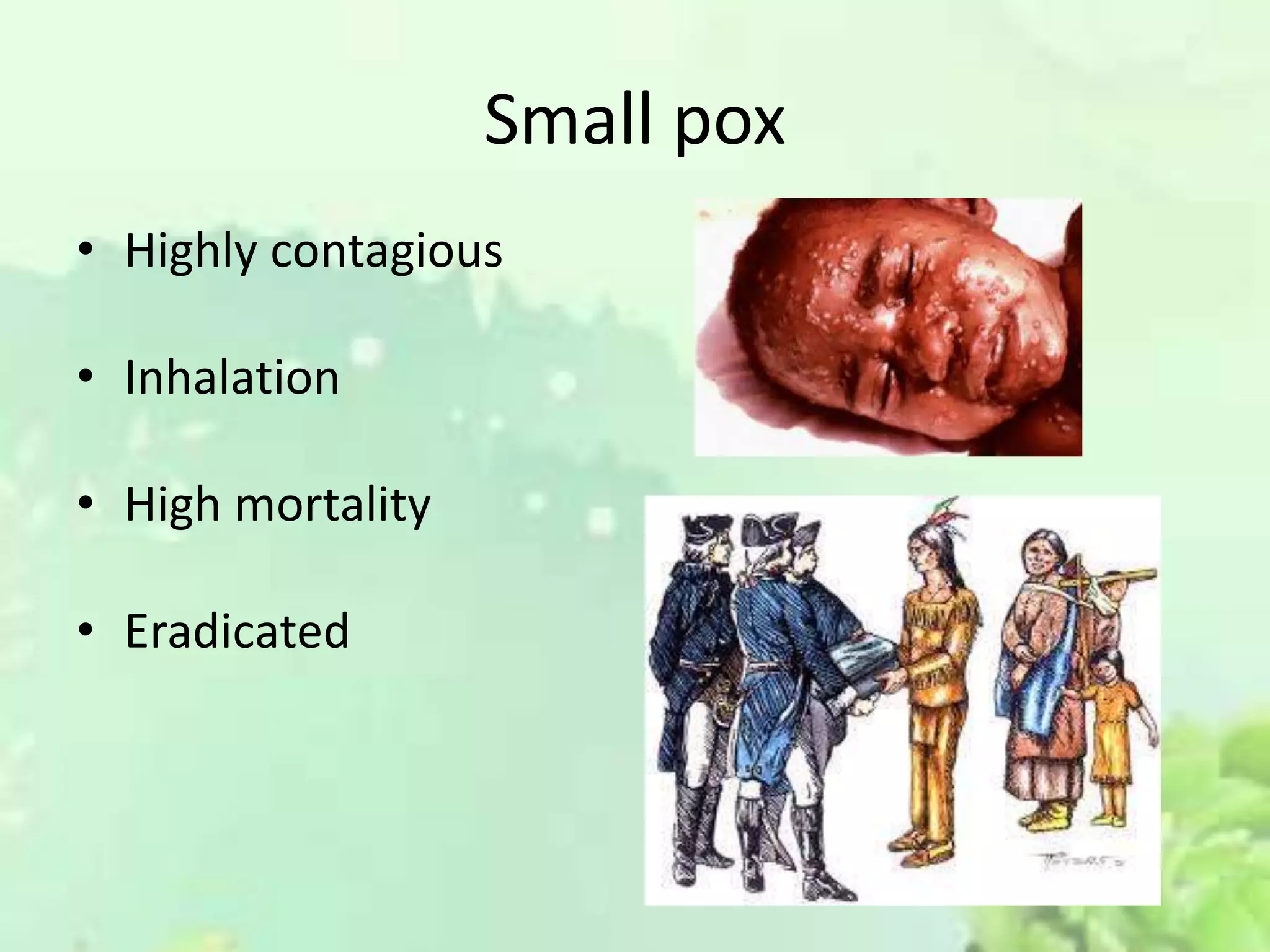
Small pox
• Highly contagious
• Inhalation
• High mortality
• Eradicated
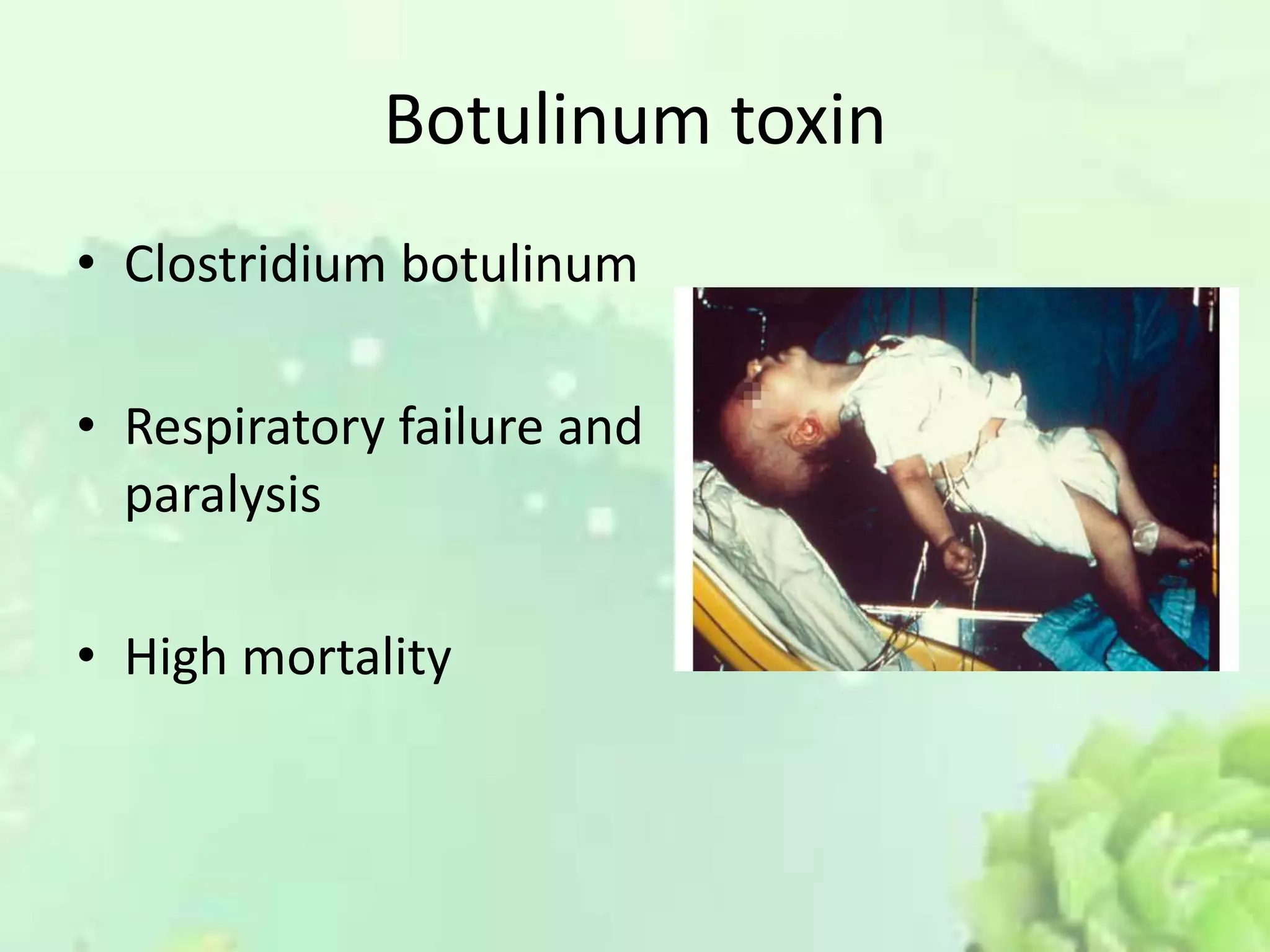
Botulinum toxin
• Clostridium botulinum
• Respiratory failure and
paralysis
• High mortality
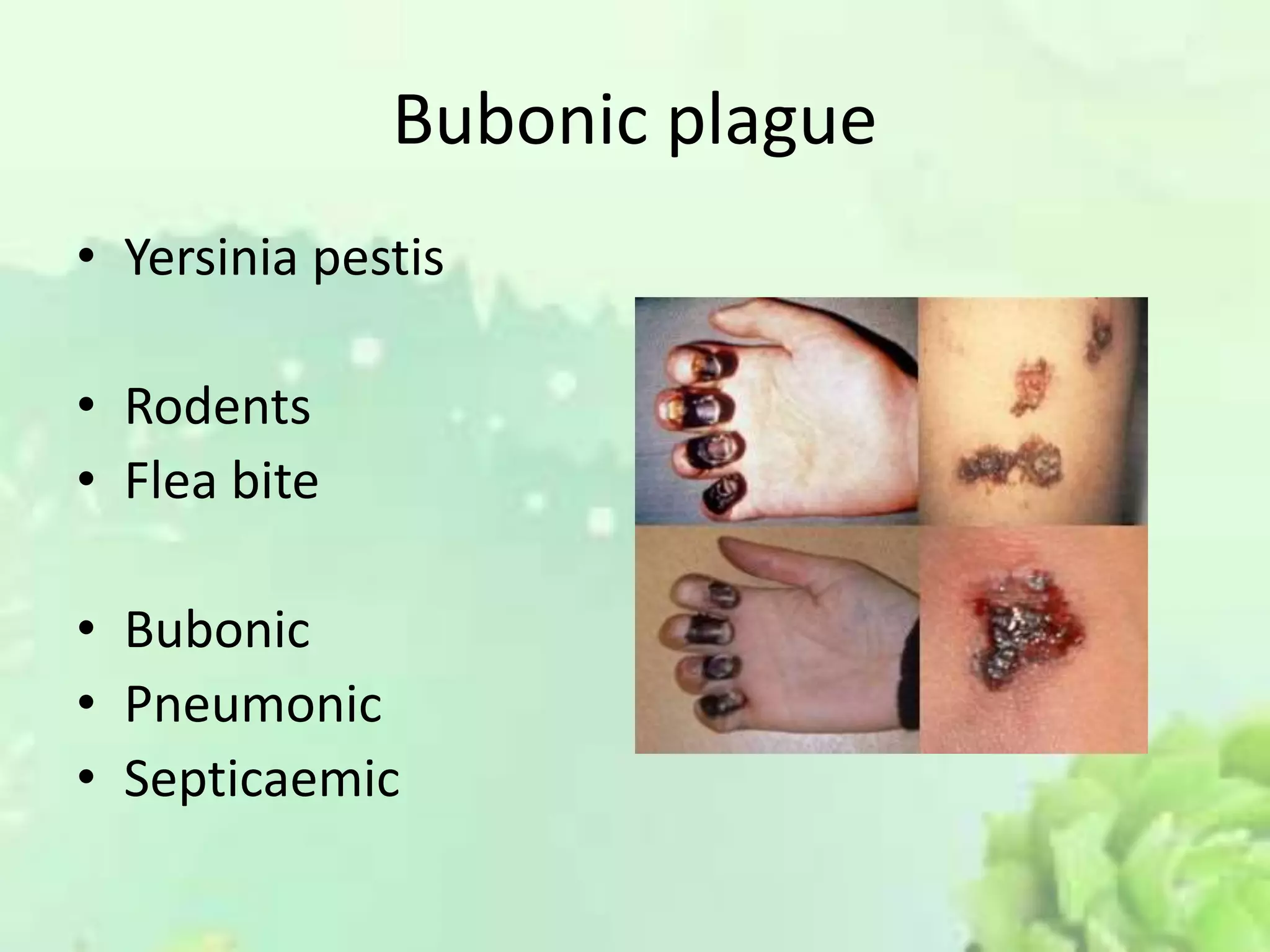
Bubonic plague
• Yersinia pestis
• Rodents
• Flea bite
• Bubonic
• Pneumonic
• Septicaemic
Category B agents
• Moderately easy to disseminate
• Result in moderate morbidity rates and low
mortality rates
• Require specifically enhanced diagnostic
capacity
Category B agents
• Brucellosis (Brucella spp.)
• Clostridium perfringens
• Glanders (Burkholderia mallei)
• Melioidosis (B. pseudomallei)
• Psittacosis (Chlamydia psittaci)
• Q fever (Coxiella burnetii)
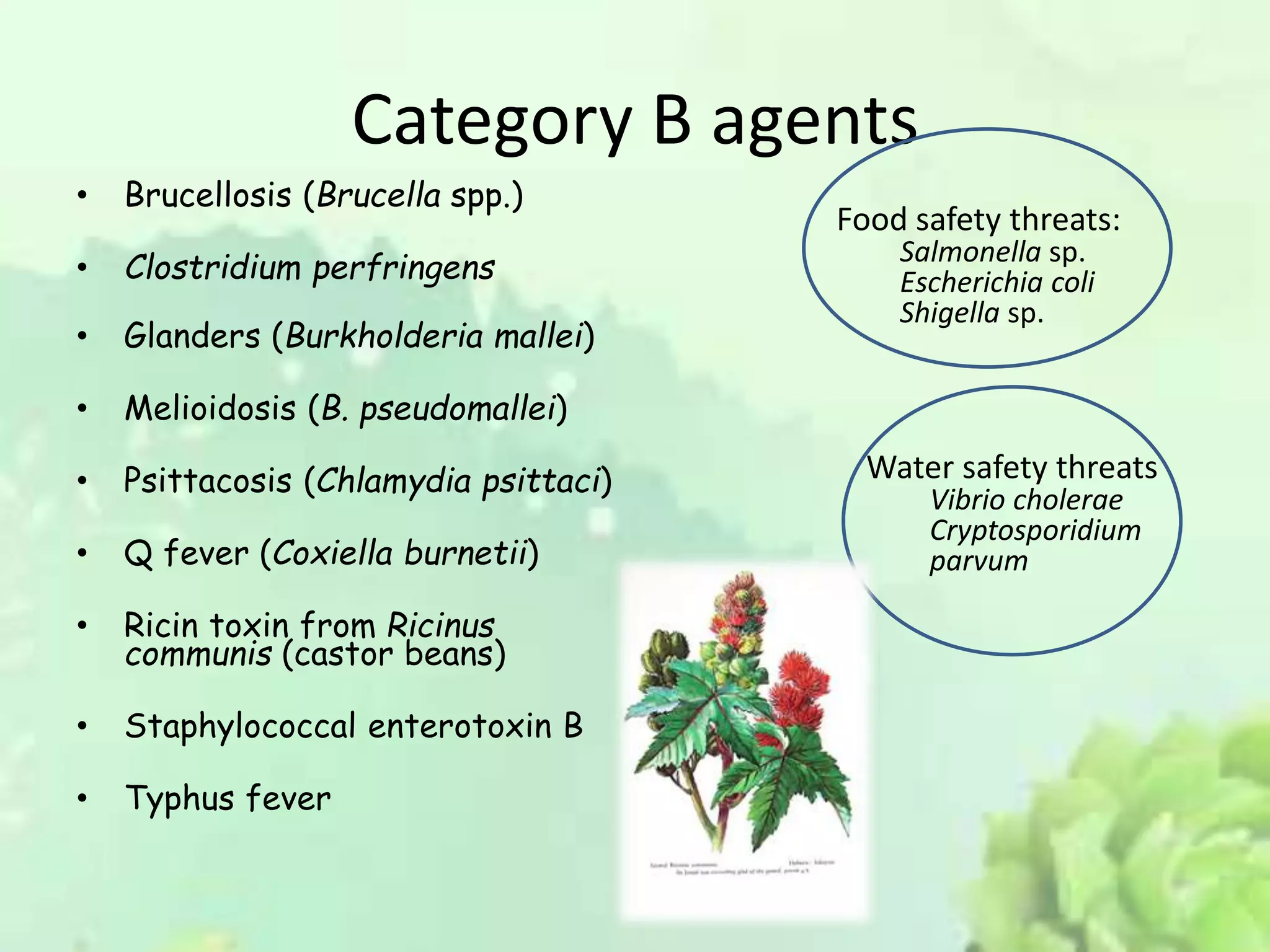
• Ricin toxin from Ricinus
communis (castor beans)
• Staphylococcal enterotoxin B
• Typhus fever
Food safety threats:
Salmonella sp.
Escherichia coli
Shigella sp.
Water safety threats
Vibrio cholerae
Cryptosporidium
parvum
Category C agents
• Include emerging pathogens
• Could be engineered for mass dissemination in the
future because of availability, ease of production,
ease of dissemination
• The recent emergence of novel viruses leading to
outbreaks of severe acute respiratory syndrome
(SARS), Nipah, hantavirus are examples
T2 - mycotoxins
• Tricothecene mycotoxins -are nonvolatile
compounds produced bi filamentous fungi
primarily of the genera Fusarium, Myrotecium,
Trichoderma, and Stachybotrys.
• Inhalation, Dermal, and Oral.
• Involve eyes, skin, respiratory and
gastrointestinal tracts.
• Death rate : 10 to 20 %
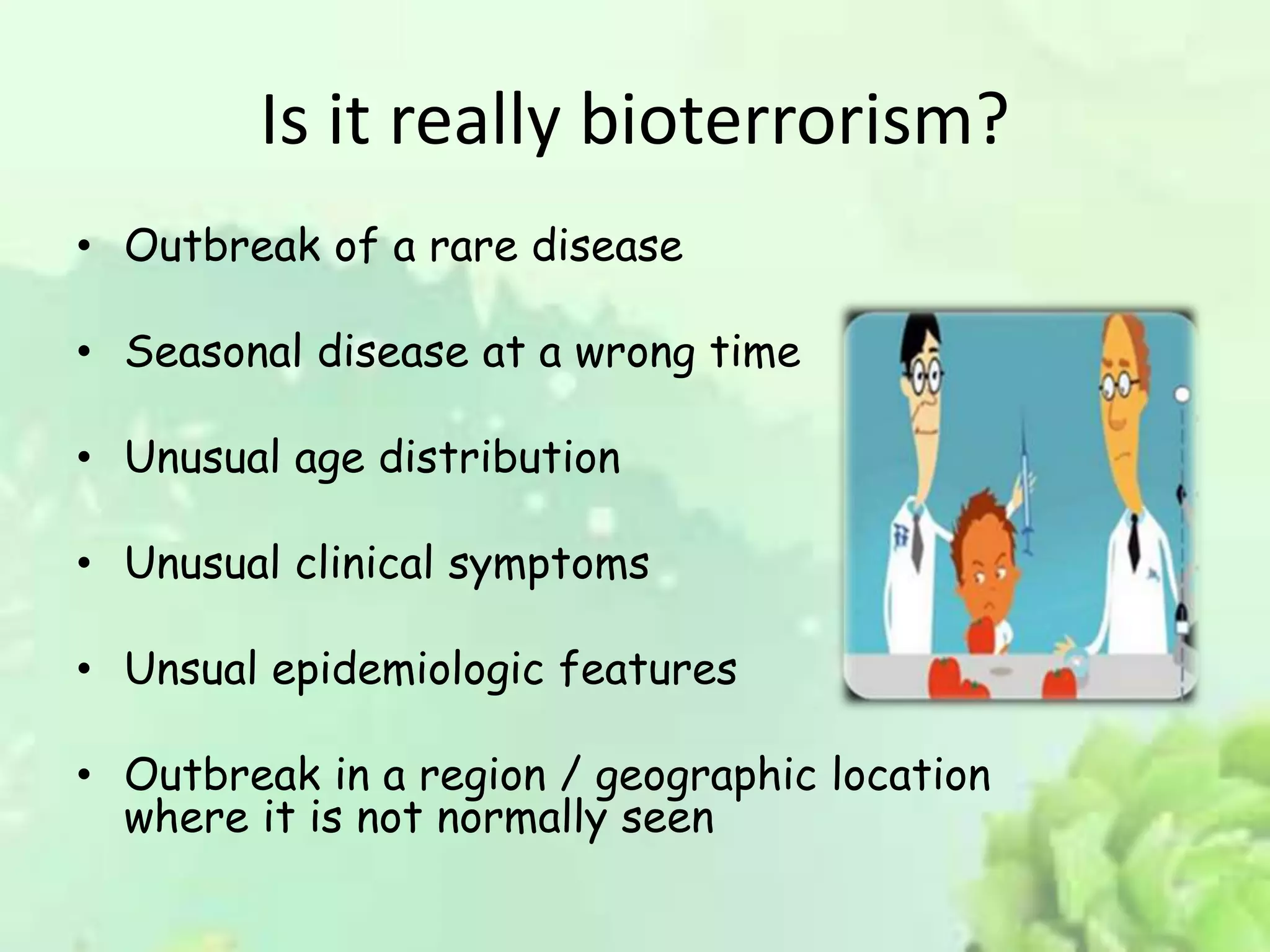
Is it really bioterrorism?
• Outbreak of a rare disease
• Seasonal disease at a wrong time
• Unusual age distribution
• Unusual clinical symptoms
• Unsual epidemiologic features
• Outbreak in a region / geographic location
where it is not normally seen
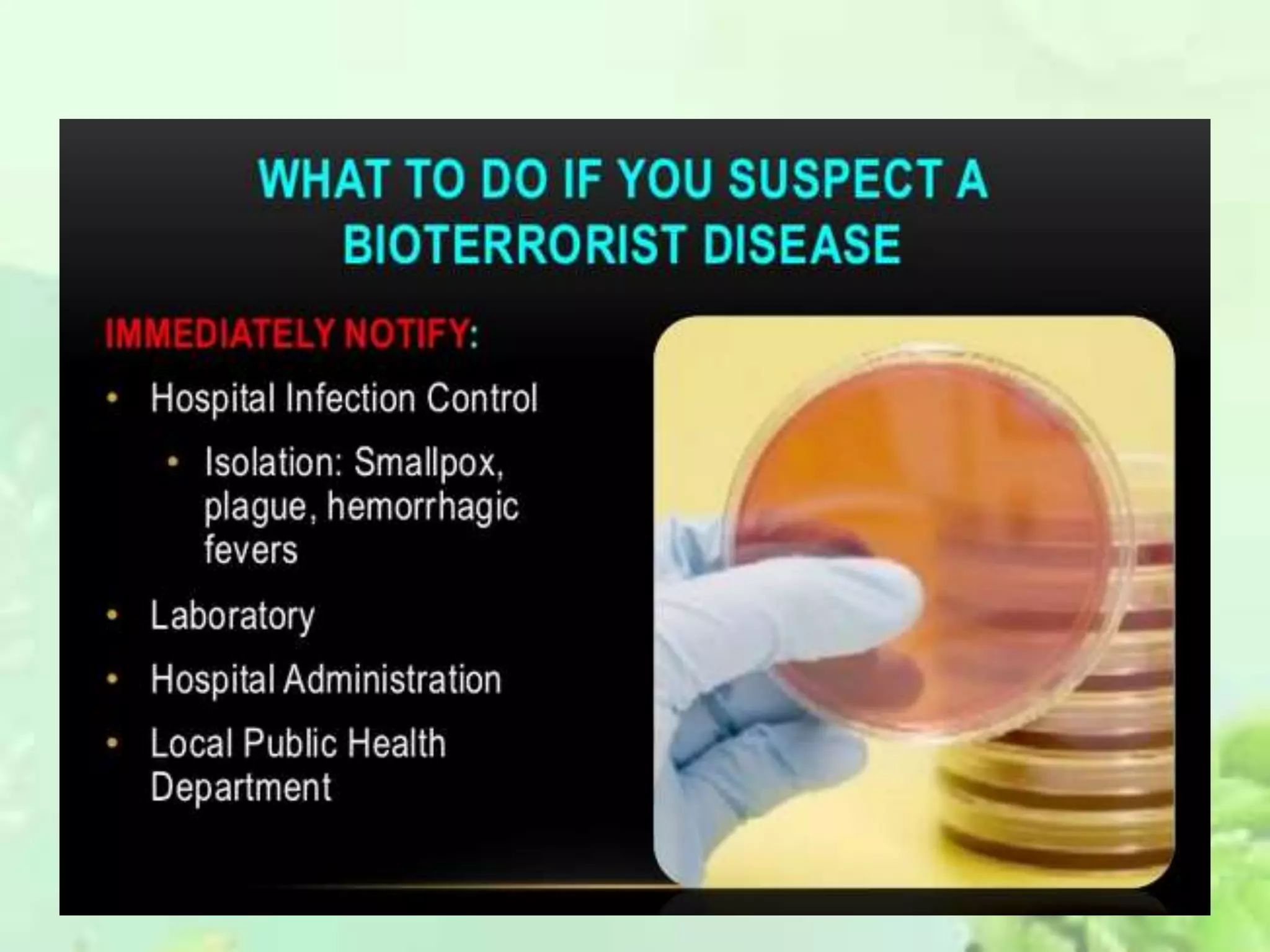
How to be prepared for a BT attack?
• Familiarize medical staffs with agents of BT
Incorporate into disaster planning –
• Decontamination & infection control
• Communication with key agencies- Laboratory, Respective
national health authorities
• Contacts to obtain stockpiled supplies – Antibiotics, Immune
sera, Vaccines, etc
• Security preparations
Preparedness
• Laboratories are working on advanced
detection systems to provide early warning,
identify contaminated areas and populations
at risk, and to facilitate prompt treatment.
References
• Bioterrorism – emergency preparedness and
response – CDC
• Bioterrorism – Dr.T.V.Rao ppt
• Bioterrorism – Infectious diseases- National
academics of science
Bioterrorism

Bioterrorism

  • 1.
    Bioterrorism Dr. M. JaneEsther II YR MD(Microbiology) postgraduate, CMCHRC, Trichy, Tamilnadu
  • 2.
    Definition • Terrorism :“The unlawful use of force and violence against persons or property to intimidate or coerce a government, the civilian population, or any segment” • Bioterrorism: bioterrorism attack is the deliberate release of viruses, bacteria, toxins or other harmful agents used to cause illness or death in people, animals, or plants.
  • 3.
  • 4.
    Why are theyused? • Can be easily disseminated, and can cause widespread fear and panic beyond the actual physical damage • Bioterrorism is an attractive weapon because biological agents are relatively easy and inexpensive to obtain. • The use of agents that do not cause harm to humans but disrupt the economy have been discussed. Eg. Foot and mouth disease virus • Some bioterrorism agents, like the smallpox virus, can be spread from person to person and some, like anthrax, cannot.
  • 5.
    Key Features ofBiologic Agents Used as Bioweapons • High morbidity and mortality • Potential for person-to-person spread • Low infective dose and highly infectious by aerosol • Lack of rapid diagnostic capability • Lack of effective vaccine • Potential to cause anxiety • Environmental stability • Potential to be “weaponized”
  • 6.
    Earliest attempts atbiological warfare • 400 BC – Scythian archers – arrows dipped in blood • 300 BC – Greek & Romans – animal cadavers – contaminate water supplies • 190 BC- Hannibal hurled snakes onto empty ships of King Eumenes
  • 7.
    • 1346 –Mongols catapulted bodies of plague victims over city walls • 1718 – Russians tried the same tactic against Sweden • 1763 – British gave small pox inoculated blankets to Indians
  • 8.
    20th century • Bythe time World war 1 began, attempts to use anthrax were directed at animal populations. • Dilger from Germany -infected horses with glanders while they were waiting to be shipped to Britain
  • 9.
    • In 1972police in Chicago arrested two college students, Allen Schwander and Stephen Pera, who had planned to poison the city's water supply with typhoid bacteria.
  • 10.
    21st century • InOregon , followers of the Shree Rajneesh attempted to control a local election by incapacitating the local population – Salmonella typhimurium. • Letters laced with infectious anthrax were concurrently delivered to news media offices and the U.S Congress. The letters killed thousands of people
  • 12.
    CLASSIFICATION • Category A,B and C – CDC Category A •Easily disseminated •High mortality rates •Major public health impact •Public panic and social disruption Category B •Moderately easy to disseminate •Low mortality rates Category C •Emerging pathogens •Could be engineered for mass dissemination in the future
  • 13.
    Category A agents BacteriaViruses •Anthrax (Bacillus anthracis) •Botulism (Clostridium botulinum toxin) •Plague (Yersinia pestis) •Smallpox (Variola major) •Tularemia (Francisella tularensis) •Viral hemorrhagic fevers: •Arenaviruses: Lassa, New World (Machupo, Junin, Guanarito, and Sabia) •Bunyaviridae: Crimean Congo, Rift Valley •Filoviridae: Ebola, Marburg • •Flaviviridae: Yellow fever; Omsk fever; Kyasanur Forest
  • 14.
    Tularemia • Rabbit fever •Inhalation • Respiratory infection • Life threatening pneumonia
  • 15.
    Anthrax • Bacillus anthracis •Direct skin contact – cutaneous • Inhalation – pulmonary • Ingestion of carcasses of infected animals – intestinal anthrax
  • 16.
    Small pox • Highlycontagious • Inhalation • High mortality • Eradicated
  • 17.
    Botulinum toxin • Clostridiumbotulinum • Respiratory failure and paralysis • High mortality
  • 18.
    Bubonic plague • Yersiniapestis • Rodents • Flea bite • Bubonic • Pneumonic • Septicaemic
  • 19.
    Category B agents •Moderately easy to disseminate • Result in moderate morbidity rates and low mortality rates • Require specifically enhanced diagnostic capacity
  • 20.
    Category B agents •Brucellosis (Brucella spp.) • Clostridium perfringens • Glanders (Burkholderia mallei) • Melioidosis (B. pseudomallei) • Psittacosis (Chlamydia psittaci) • Q fever (Coxiella burnetii) • Ricin toxin from Ricinus communis (castor beans) • Staphylococcal enterotoxin B • Typhus fever Food safety threats: Salmonella sp. Escherichia coli Shigella sp. Water safety threats Vibrio cholerae Cryptosporidium parvum
  • 21.
    Category C agents •Include emerging pathogens • Could be engineered for mass dissemination in the future because of availability, ease of production, ease of dissemination • The recent emergence of novel viruses leading to outbreaks of severe acute respiratory syndrome (SARS), Nipah, hantavirus are examples
  • 22.
    T2 - mycotoxins •Tricothecene mycotoxins -are nonvolatile compounds produced bi filamentous fungi primarily of the genera Fusarium, Myrotecium, Trichoderma, and Stachybotrys. • Inhalation, Dermal, and Oral. • Involve eyes, skin, respiratory and gastrointestinal tracts. • Death rate : 10 to 20 %
  • 23.
    Is it reallybioterrorism? • Outbreak of a rare disease • Seasonal disease at a wrong time • Unusual age distribution • Unusual clinical symptoms • Unsual epidemiologic features • Outbreak in a region / geographic location where it is not normally seen
  • 24.
    How to beprepared for a BT attack? • Familiarize medical staffs with agents of BT Incorporate into disaster planning – • Decontamination & infection control • Communication with key agencies- Laboratory, Respective national health authorities • Contacts to obtain stockpiled supplies – Antibiotics, Immune sera, Vaccines, etc • Security preparations
  • 26.
    Preparedness • Laboratories areworking on advanced detection systems to provide early warning, identify contaminated areas and populations at risk, and to facilitate prompt treatment.
  • 27.
    References • Bioterrorism –emergency preparedness and response – CDC • Bioterrorism – Dr.T.V.Rao ppt • Bioterrorism – Infectious diseases- National academics of science