BY
 G.N.GREESHMA
 D.DEEPTHI REDDY
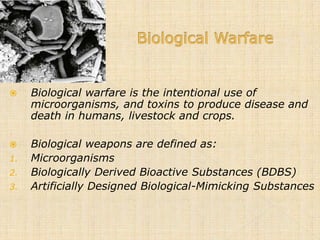
    Biological warfare is the intentional use of
     microorganisms, and toxins to produce disease and
     death in humans, livestock and crops.

    Biological weapons are defined as:
1.   Microorganisms
2.   Biologically Derived Bioactive Substances (BDBS)
3.   Artificially Designed Biological-Mimicking Substances
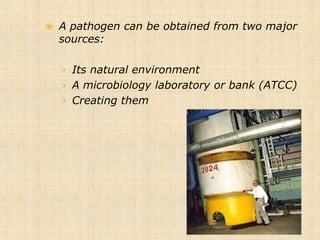
   A pathogen can be obtained from two major
    sources:

    › Its natural environment
    › A microbiology laboratory or bank (ATCC)
    › Creating them
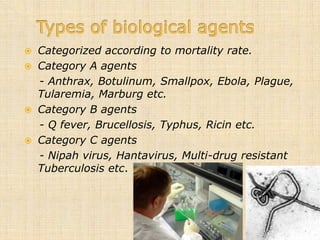
   Categorized according to mortality rate.
   Category A agents
    - Anthrax, Botulinum, Smallpox, Ebola, Plague,
    Tularemia, Marburg etc.
   Category B agents
    - Q fever, Brucellosis, Typhus, Ricin etc.
   Category C agents
    - Nipah virus, Hantavirus, Multi-drug resistant
    Tuberculosis etc.
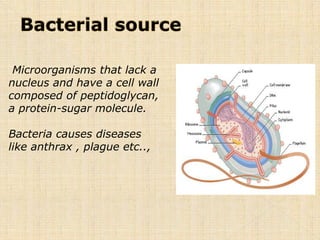
Microorganisms that lack a
nucleus and have a cell wall
composed of peptidoglycan,
a protein-sugar molecule.

Bacteria causes diseases
like anthrax , plague etc..,
   Anthrax occurs naturally in cattle. It is normally
    transmitted to man through cuts on the arms and
    hands.
   Plague or “black death” is transmitted to man
    from rats through the bite of infected fleas.
   The bacteria can be air borne and be transmitted
    to man through the respiratory tract causing
    pneumonic plague (bleeding in lungs).
   Untreated plague has a mortality rate of 90 -
    100%. It is a highly communicable biological
    warfare agent
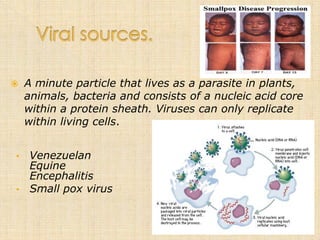
   A minute particle that lives as a parasite in plants,
    animals, bacteria and consists of a nucleic acid core
    within a protein sheath. Viruses can only replicate
    within living cells.


•    Venezuelan
     Equine
     Encephalitis
•    Small pox virus
   Small pox is the only virus that has been
    eradicated from the earth. It exists only in
    laboratories.
   The vaccine for smallpox is effective if given
    2-4 days after exposure, but before illness.
   VEE or Venezuelan Equine Encephalitis is an
    alpha virus that primarily affects horses. It is
    spread to humans via mosquito bites.
    Mortality from this virus is 5% and nearly all
    deaths occur in children or those with
    compromised immune systems.
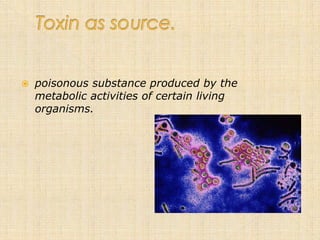
   poisonous substance produced by the
    metabolic activities of certain living
    organisms.
1.Botulinum : found in soil, and enters body
   through digestive system and by inhalation.
2. Neurotoxins which attack the central nervous
   system.
3. Cytotoxins which are cell poisons.
4.Ricin :Ricin causes red blood cells to agglutinate
   (clump together) and burst by hemolysis
   (liberation of hemoglobin). normally enters the
   body by ingestion, enter by inhalation if in
   aerosolized form.
   Gas release and aerosol releases via airplanes,
    submarines, bombs, artillery and missiles
   HCN missiles and central burster missiles.
   Poisoned arrows, bullets, grenades, letters.
   Food delivery: food, coffee, water, creams, juice
   Blankets given in war to soldiers by rival soldiers.
   Poisoning by adding M.O’s to water in specific area.


                             January 12, 2005
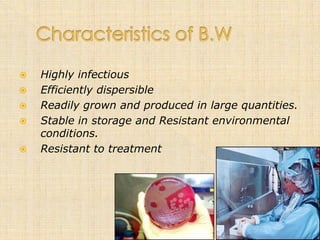
   Highly infectious
   Efficiently dispersible
   Readily grown and produced in large quantities.
   Stable in storage and Resistant environmental
    conditions.
   Resistant to treatment
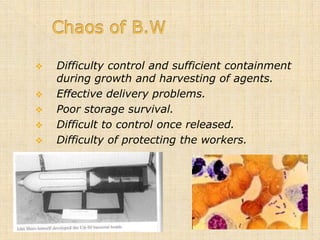
   Difficulty control and sufficient containment
    during growth and harvesting of agents.
   Effective delivery problems.
   Poor storage survival.
   Difficult to control once released.
   Difficulty of protecting the workers.
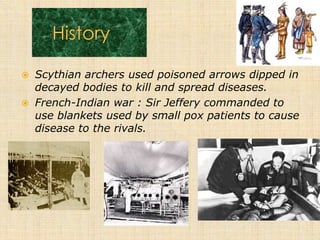
   Scythian archers used poisoned arrows dipped in
    decayed bodies to kill and spread diseases.
   French-Indian war : Sir Jeffery commanded to
    use blankets used by small pox patients to cause
    disease to the rivals.
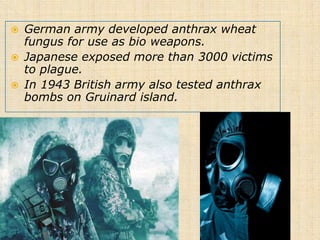
   German army developed anthrax wheat
    fungus for use as bio weapons.
   Japanese exposed more than 3000 victims
    to plague.
   In 1943 British army also tested anthrax
    bombs on Gruinard island.
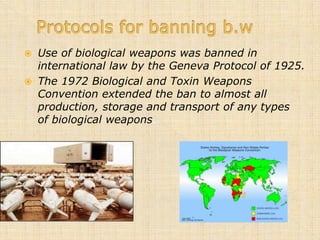
   Use of biological weapons was banned in
    international law by the Geneva Protocol of 1925.
   The 1972 Biological and Toxin Weapons
    Convention extended the ban to almost all
    production, storage and transport of any types
    of biological weapons.
   There are number of bio-terrorism recently.
   1984 Rajneeshee salmonella attack
     -attempted to control a local election by
    infecting salad bars in 10 restaurants with
    Salmonella typhimurium in the small town of
    Oregon.
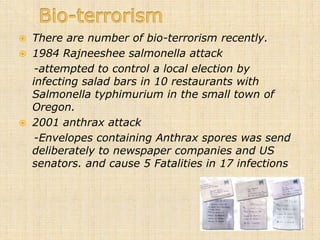
   2001 anthrax attack
     -Envelopes containing Anthrax spores was send
    deliberately to newspaper companies and US
    senators. and cause 5 Fatalities in 17 infections.
: Initiation of immediate therapy and supportive care provides the best chance for survival from these potentially lethal and devastating infections. A high index of suspicion must be maintained, especially in the setting of a sudden influx of cases with what are often relatively nonspecific symptoms.


                           Development of rapid detection and Public
                            education and awareness campaign.
                           Initiation of immediate therapy, supportive care
                            provides the best chance for survival from these
                            devastating infections.
                           A high index of suspicion must be maintained, in
                            cases with what are often relatively nonspecific
                            symptoms.


                                                                                                                                                                                                                                                                                                     January 12, 2005
Biowarfare

Biowarfare

  • 1.
  • 2.
    Biological warfare is the intentional use of microorganisms, and toxins to produce disease and death in humans, livestock and crops.  Biological weapons are defined as: 1. Microorganisms 2. Biologically Derived Bioactive Substances (BDBS) 3. Artificially Designed Biological-Mimicking Substances
  • 3.
    A pathogen can be obtained from two major sources: › Its natural environment › A microbiology laboratory or bank (ATCC) › Creating them
  • 4.
    Categorized according to mortality rate.  Category A agents - Anthrax, Botulinum, Smallpox, Ebola, Plague, Tularemia, Marburg etc.  Category B agents - Q fever, Brucellosis, Typhus, Ricin etc.  Category C agents - Nipah virus, Hantavirus, Multi-drug resistant Tuberculosis etc.
  • 5.
    Microorganisms that lacka nucleus and have a cell wall composed of peptidoglycan, a protein-sugar molecule. Bacteria causes diseases like anthrax , plague etc..,
  • 6.
    Anthrax occurs naturally in cattle. It is normally transmitted to man through cuts on the arms and hands.  Plague or “black death” is transmitted to man from rats through the bite of infected fleas.  The bacteria can be air borne and be transmitted to man through the respiratory tract causing pneumonic plague (bleeding in lungs).  Untreated plague has a mortality rate of 90 - 100%. It is a highly communicable biological warfare agent
  • 7.
    A minute particle that lives as a parasite in plants, animals, bacteria and consists of a nucleic acid core within a protein sheath. Viruses can only replicate within living cells. • Venezuelan Equine Encephalitis • Small pox virus
  • 8.
    Small pox is the only virus that has been eradicated from the earth. It exists only in laboratories.  The vaccine for smallpox is effective if given 2-4 days after exposure, but before illness.  VEE or Venezuelan Equine Encephalitis is an alpha virus that primarily affects horses. It is spread to humans via mosquito bites. Mortality from this virus is 5% and nearly all deaths occur in children or those with compromised immune systems.
  • 9.
    poisonous substance produced by the metabolic activities of certain living organisms.
  • 10.
    1.Botulinum : foundin soil, and enters body through digestive system and by inhalation. 2. Neurotoxins which attack the central nervous system. 3. Cytotoxins which are cell poisons. 4.Ricin :Ricin causes red blood cells to agglutinate (clump together) and burst by hemolysis (liberation of hemoglobin). normally enters the body by ingestion, enter by inhalation if in aerosolized form.
  • 11.
    Gas release and aerosol releases via airplanes, submarines, bombs, artillery and missiles  HCN missiles and central burster missiles.  Poisoned arrows, bullets, grenades, letters.  Food delivery: food, coffee, water, creams, juice  Blankets given in war to soldiers by rival soldiers.  Poisoning by adding M.O’s to water in specific area. January 12, 2005
  • 12.
    Highly infectious  Efficiently dispersible  Readily grown and produced in large quantities.  Stable in storage and Resistant environmental conditions.  Resistant to treatment
  • 13.
    Difficulty control and sufficient containment during growth and harvesting of agents.  Effective delivery problems.  Poor storage survival.  Difficult to control once released.  Difficulty of protecting the workers.
  • 14.
    Scythian archers used poisoned arrows dipped in decayed bodies to kill and spread diseases.  French-Indian war : Sir Jeffery commanded to use blankets used by small pox patients to cause disease to the rivals.
  • 15.
    German army developed anthrax wheat fungus for use as bio weapons.  Japanese exposed more than 3000 victims to plague.  In 1943 British army also tested anthrax bombs on Gruinard island.
  • 16.
    Use of biological weapons was banned in international law by the Geneva Protocol of 1925.  The 1972 Biological and Toxin Weapons Convention extended the ban to almost all production, storage and transport of any types of biological weapons.
  • 17.
    There are number of bio-terrorism recently.  1984 Rajneeshee salmonella attack -attempted to control a local election by infecting salad bars in 10 restaurants with Salmonella typhimurium in the small town of Oregon.  2001 anthrax attack -Envelopes containing Anthrax spores was send deliberately to newspaper companies and US senators. and cause 5 Fatalities in 17 infections.
  • 18.
    : Initiation ofimmediate therapy and supportive care provides the best chance for survival from these potentially lethal and devastating infections. A high index of suspicion must be maintained, especially in the setting of a sudden influx of cases with what are often relatively nonspecific symptoms.  Development of rapid detection and Public education and awareness campaign.  Initiation of immediate therapy, supportive care provides the best chance for survival from these devastating infections.  A high index of suspicion must be maintained, in cases with what are often relatively nonspecific symptoms. January 12, 2005