Biotechnology:
Basic concepts, Principles
and scope
Dr. Shriram Kunjam
Assistant Professor
Department of Botany
Govt. V.Y.T. PG Autonomous College, Durg (Chhattisgarh)
Email: shriramkunjam07@gmail.com
Introduction
The utilization of biological processes, organisms or systems to
produce products that are anticipated to improve human lives is
termed biotechnology.
In prehistoric times, a primitive form of biotechnology was
practiced by agriculturalists who established better-quality species
of plants and animals by methods of cross-pollination or cross-
breeding
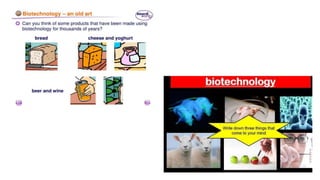
Previous forms of biotechnology include the training and
selective breeding of animals, the cultivation of crops and the
utilization of micro-organisms to produce products such as
cheese, yogurt, bread, beer and wine. Early agriculture
concentrated on producing food.
The most primitive type of biotechnology is the cultivation of
plants and the training (in particular the domestication) of
animals.
The domestication of animals stretches back over 10 000 years, when our
ancestors also started maintaining plants as a reliable source of food.
The earliest examples of such domesticated plants are rice, barley and
wheat.
Wild animals were also controlled to produce milk or meat.
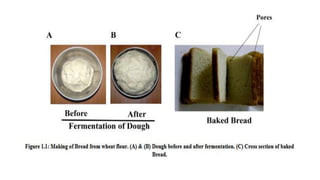
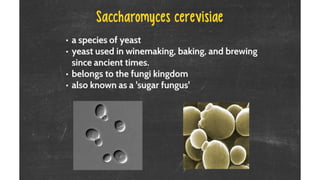
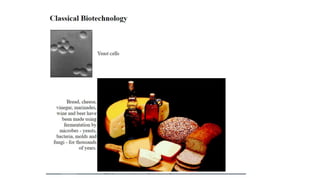
The ancient production of cheese, yogurt and bread from micro-
organisms is also reported.
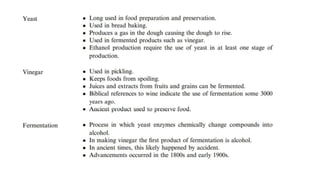
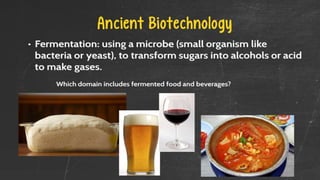
Various alcoholic drinks such as beer and wine were developed during
this period, when the process of fermentation was first discovered
Concepts of Biotechnology
The word ‘biotechnology’ has been derived from two
simple terms of science,
Biology and Technology.
As the name suggests “It is the assembly of technology
in science of biology”.
Biotechnology: A Basic Requirement
• In general, biotechnology uses either living material or biological
products to create new products for their use in various
pharmaceutical, medical, agricultural, and environmental
applications, with the ultimate goal to benefit humanity,
• for example, production of recombinant proteins, resistant crops,
vegetables, higher milk producing animals, and the list is endless.
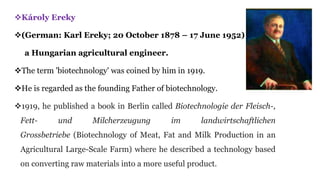
Károly Ereky
(German: Karl Ereky; 20 October 1878 – 17 June 1952) was
a Hungarian agricultural engineer.
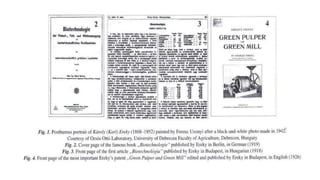
The term 'biotechnology' was coined by him in 1919.
He is regarded as the founding Father of biotechnology.
1919, he published a book in Berlin called Biotechnologie der Fleisch-,
Fett- und Milcherzeugung im landwirtschaftlichen
Grossbetriebe (Biotechnology of Meat, Fat and Milk Production in an
Agricultural Large-Scale Farm) where he described a technology based
on converting raw materials into a more useful product.
Definition of Biotechnology
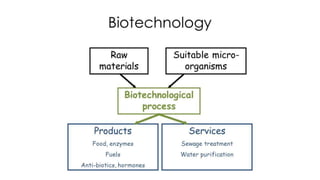
We can define biotechnology as a set of techniques that are employed to
manipulate living organisms, or utilize biological agents or their
components, to produce useful products/services.
Biotechnology, broadly defined, includes any technique that uses living
organisms, or parts of such organisms, to make or modify products, to
improve plants or animals, or to develop microorganisms for specific use.
It ranges from traditional biotechnology to the most advanced modern
biotechnology.
Most simply it may be defined as:
• “The regulated and controlled use of the biological agents
for the manufacture of useful products or for generating
beneficial services”.
• Biotechnology is the integrated use of biochemistry,
microbiology and engineering sciences in order to achieve
technological applications of the capabilities of
microorganisms, cultured cells/tissues and parts thereof.
(‘European Federation of Biotechnology’)
Biotechnology is 'the controlled use of biological agents,
such as microorganisms or cellular components for
beneficial use (US National Science Foundation).
According to IUPAC (International Union of Pure and Applied
Chemistry), biotechnology means “the application of
biochemistry, biology, microbiology and chemical
engineering to industrial processes and products and on
environment.”
Traditional and Modern Biotechnology:
• The art of biotechnology is very old.
• It is as old as human civilization.
• It actually began when man started the domestication of useful
plants and animals and started utilizing microbes for making
various beverages (like wine, beer), curd, vinegar, etc.
It is as follows:
• Old Biotechnology is the one which involves the exploitation and
utilization of natural resources.
• New Biotechnology involves the use of
recombinant DNA technology,
enzyme engineering,
genetic engineering practices, etc.,
for developing newer or improved capabilities of biological agents for
production of beneficial services or products.
Historical Advancement of Biotechnology
• Biotechnology related activities depend on two parameters:
 Technological advancement and
 Knowledge of available biota.
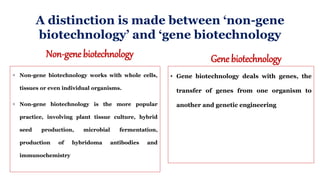
A distinction is made between ‘non-gene
biotechnology’ and ‘gene biotechnology
Non-gene biotechnology
 Non-gene biotechnology works with whole cells,
tissues or even individual organisms.
 Non-gene biotechnology is the more popular
practice, involving plant tissue culture, hybrid
seed production, microbial fermentation,
production of hybridoma antibodies and
immunochemistry
Gene biotechnology
• Gene biotechnology deals with genes, the
transfer of genes from one organism to
another and genetic engineering
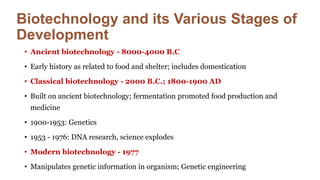
Biotechnology and its Various Stages of
Development
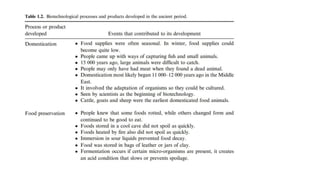
• Ancient biotechnology - 8000-4000 B.C
• Early history as related to food and shelter; includes domestication
• Classical biotechnology - 2000 B.C.; 1800-1900 AD
• Built on ancient biotechnology; fermentation promoted food production and
medicine
• 1900-1953: Genetics
• 1953 - 1976: DNA research, science explodes
• Modern biotechnology - 1977
• Manipulates genetic information in organism; Genetic engineering
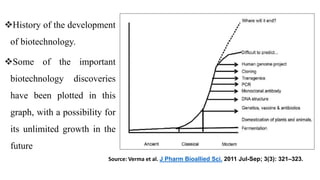
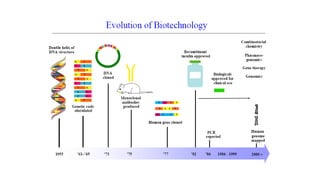
History of the development
of biotechnology.
Some of the important
biotechnology discoveries
have been plotted in this
graph, with a possibility for
its unlimited growth in the
future
Source: Verma et al. J Pharm Bioallied Sci. 2011 Jul-Sep; 3(3): 321–323.
Ancient biotechnology (pre-1800)
• In the period before the year 1800, some events that were based
on common observations about nature can be categorized as
biotechnological developments.
• Three important basic needs of human civilization are food,
clothes and shelter.
• In the ancient era the paucity of food led to the domestication of
food products, formally called ‘agriculture’.
Classical Biotechnology
• The second phase of evolution and development of
biotechnology can be called 'Classical Biotechnology’.
• This phase existed from 1800 to almost the middle of the
twentieth century.
• During this period various observations started pouring in, with
scientific evidences.
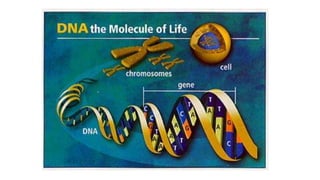
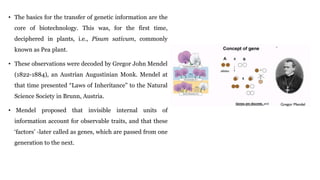
• The basics for the transfer of genetic information are the
core of biotechnology. This was, for the first time,
deciphered in plants, i.e., Pisum sativum, commonly
known as Pea plant.
• These observations were decoded by Gregor John Mendel
(1822-1884), an Austrian Augustinian Monk. Mendel at
that time presented “Laws of Inheritance” to the Natural
Science Society in Brunn, Austria.
• Mendel proposed that invisible internal units of
information account for observable traits, and that these
‘factors’ -later called as genes, which are passed from one
generation to the next.
Modern Biotechnology (1945-present)
• The Second World War became a major impediment in
scientific discoveries. After the end of the second world war
some, very crucial discoveries were reported, which paved the
path for modern biotechnology.
• The origins of biotechnology culminate with the birth of genetic engineering.
• There were two key events that have come to be seen as scientific breakthroughs
beginning the era that would unite genetics with biotechnology:
• One was the 1953 discovery of the structure of DNA, by Watson and Crick, and
• the other was the 1973 discovery by Cohen and Boyer of a recombinant DNA
technique by which a section of DNA was cut from the plasmid of an E. coli
bacterium and transferred into the DNA of another.
• Popularly referred to as “genetic engineering,” it came to be defined as the basis
of new biotechnology.
Various technologies and their uses
• Genetic Engineering (Recombinant DNA) Technology
• The use of cellular enzymes to manipulate DNA
• Transferring DNA between unrelated organisms
• Protein Engineering Technology
• Improve existing/create novel proteins to make useful products
• Antisense or RNAi Technology
• Block or decrease the production of certain proteins
• Cell and Tissue Culture Technology
• Grow cells/tissues under laboratory conditions to produce an entire organism, or to produce new
products
• Bioinformatics Technology
• Computational analysis of biological data, e.g., sequence analysis macromolecular structures, high-
throughput profiling data analysis
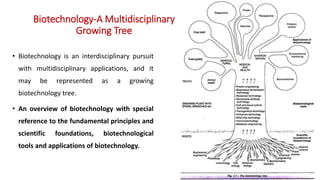
• Biotechnology is an interdisciplinary pursuit
with multidisciplinary applications, and it
may be represented as a growing
biotechnology tree.
• An overview of biotechnology with special
reference to the fundamental principles and
scientific foundations, biotechnological
tools and applications of biotechnology.
Biotechnology-A Multidisciplinary
Growing Tree
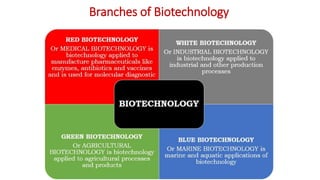
Branches of Biotechnology
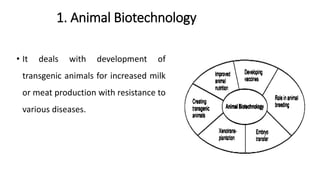
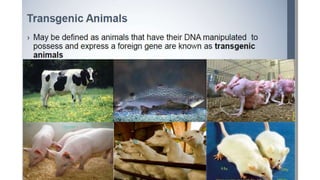
1. Animal Biotechnology
• It deals with development of
transgenic animals for increased milk
or meat production with resistance to
various diseases.
2. Medical Biotechnology
1. Diagnose & treat different diseases with effective recombinant
therapeutic drugs
2. Protect from dangerous diseases
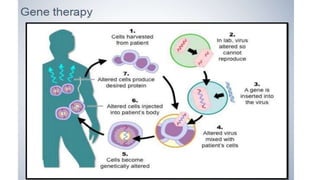
3. Through gene therapy new & healthy genes can be inserted to
replace damaged cells
4. Targeted action of drug by thorough study of genomics
3. Industrial Biotechnology
• It deals with commercial production of various useful organic
substances such as
acetic acid, citric acid,
acetone, glycerine, etc.,
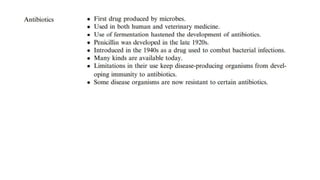
antibiotics like
penicillin, streptomycin, mitomycin, etc. through the use of
microorganisms especially fungi and bacteria.
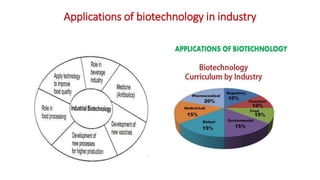
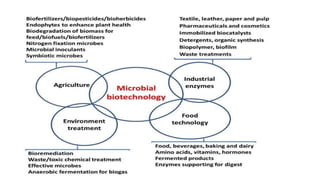
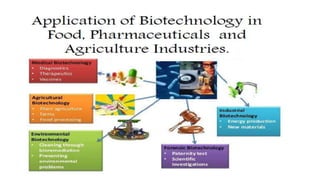
Applications of biotechnology in industry
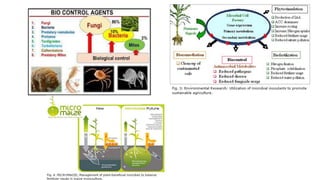
4. Environmental Biotechnology
• It deals with detoxification of waste and industrial effluents,
treatment of sewage water, and control of plant diseases and insects
through the use of biological agents such as viruses, bacteria, fungi,
etc.
5. Plant Biotechnology
• It deals with development of transgenic plants with resistance to
biotic and abiotic stresses;
• development of haploids,
• embryo rescue,
• clonal multiplication,
• cryopreservation, etc.
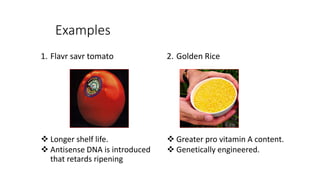
Examples
1. Flavr savr tomato
 Longer shelf life.
 Antisense DNA is introduced
that retards ripening
2. Golden Rice
 Greater pro vitamin A content.
 Genetically engineered.
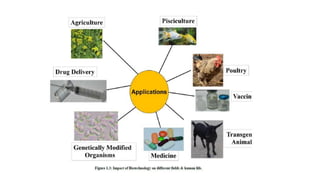
APPLICATIONS
OF
BIOTECHNOLOGY
Application of biotechnology
in agriculture- Bt crops
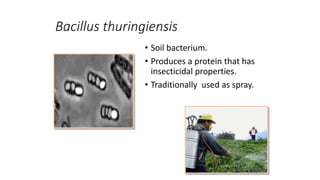
Bacillus thuringiensis
• Soil bacterium.
• Produces a protein that has
insecticidal properties.
• Traditionally used as spray.
Mechanism of Bt
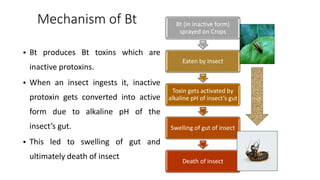
• Bt produces Bt toxins which are
inactive protoxins.
• When an insect ingests it, inactive
protoxin gets converted into active
form due to alkaline pH of the
insect’s gut.
• This led to swelling of gut and
ultimately death of insect
Bt (in inactive form)
sprayed on Crops
Eaten by insect
Toxin gets activated by
alkaline pH of insect’s gut
Swelling of gut of insect
Death of insect
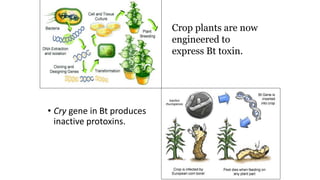
• Cry gene in Bt produces
inactive protoxins.
Crop plants are now
engineered to
express Bt toxin.
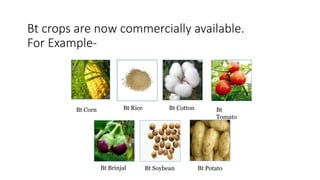
Bt crops are now commercially available.
For Example-
Bt Rice Bt Cotton Bt
Tomato
Bt Brinjal Bt Soybean Bt Potato
Bt Corn
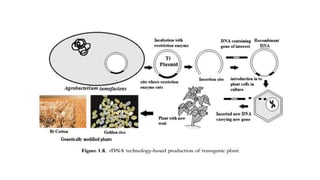
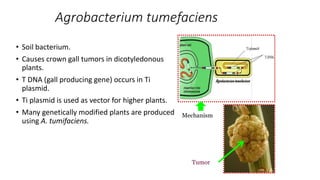
Agrobacterium tumefaciens
• Soil bacterium.
• Causes crown gall tumors in dicotyledonous
plants.
• T DNA (gall producing gene) occurs in Ti
plasmid.
• Ti plasmid is used as vector for higher plants.
• Many genetically modified plants are produced
using A. tumifaciens.
Tumor
Mechanism
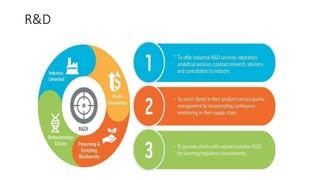
R&D
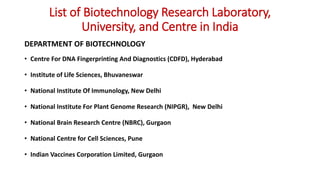
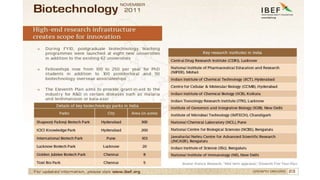
List of Biotechnology Research Laboratory,
University, and Centre in India
DEPARTMENT OF BIOTECHNOLOGY
• Centre For DNA Fingerprinting And Diagnostics (CDFD), Hyderabad
• Institute of Life Sciences, Bhuvaneswar
• National Institute Of Immunology, New Delhi
• National Institute For Plant Genome Research (NIPGR), New Delhi
• National Brain Research Centre (NBRC), Gurgaon
• National Centre for Cell Sciences, Pune
• Indian Vaccines Corporation Limited, Gurgaon
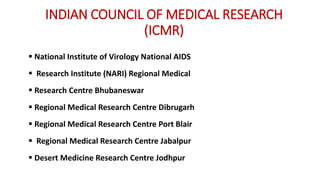
INDIAN COUNCIL OF MEDICAL RESEARCH
(ICMR)
 National Institute of Virology National AIDS
 Research Institute (NARI) Regional Medical
 Research Centre Bhubaneswar
 Regional Medical Research Centre Dibrugarh
 Regional Medical Research Centre Port Blair
 Regional Medical Research Centre Jabalpur
 Desert Medicine Research Centre Jodhpur
• CDRI - Central Drug Research Institute, Lucknow
• CFTRI - Central Food Technological Research Institute, Mysore
• CIMAP - Central Institute of Medicinal & Aromatic Plants, Lucknow
• ITRC - Industrial Toxicology Research Centre, Lucknow
• NBRI - National Botanical Research Institute, Lucknow
• NEERI - National Environmental Engineering Research Institute, Nagpur
• CCMB - Centre for Cellular & Molecular Biology, Hyderabad
COUNCIL OF SCIENTIFIC & INDUSTRIAL RESEARCH (CSIR) INSTITUTE IN INDIA
COUNCIL OF SCIENTIFIC & INDUSTRIAL
RESEARCH (CSIR) INSTITUTE IN INDIA
5. DRDO
DRDO is working in various areas of military technology which include
aeronautics, armaments, combat vehicles, electronics, instrumentation
engineering systems, missiles, materials, naval systems, advanced
computing, simulation and life sciences.
6. ICMR
The Indian Council of Medical Research (ICMR), New Delhi, the apex body in
India for the formulation, coordination and promotion of biomedical
research, is one of the oldest medical research bodies in the world.
Biotechnology: Basic concepts, Principles and Scope

Biotechnology: Basic concepts, Principles and Scope

  • 1.
    Biotechnology: Basic concepts, Principles andscope Dr. Shriram Kunjam Assistant Professor Department of Botany Govt. V.Y.T. PG Autonomous College, Durg (Chhattisgarh) Email: shriramkunjam07@gmail.com
  • 2.
    Introduction The utilization ofbiological processes, organisms or systems to produce products that are anticipated to improve human lives is termed biotechnology. In prehistoric times, a primitive form of biotechnology was practiced by agriculturalists who established better-quality species of plants and animals by methods of cross-pollination or cross- breeding
  • 3.
    Previous forms ofbiotechnology include the training and selective breeding of animals, the cultivation of crops and the utilization of micro-organisms to produce products such as cheese, yogurt, bread, beer and wine. Early agriculture concentrated on producing food. The most primitive type of biotechnology is the cultivation of plants and the training (in particular the domestication) of animals.
  • 4.
    The domestication ofanimals stretches back over 10 000 years, when our ancestors also started maintaining plants as a reliable source of food. The earliest examples of such domesticated plants are rice, barley and wheat. Wild animals were also controlled to produce milk or meat. The ancient production of cheese, yogurt and bread from micro- organisms is also reported. Various alcoholic drinks such as beer and wine were developed during this period, when the process of fermentation was first discovered
  • 5.
    Concepts of Biotechnology Theword ‘biotechnology’ has been derived from two simple terms of science, Biology and Technology. As the name suggests “It is the assembly of technology in science of biology”.
  • 6.
    Biotechnology: A BasicRequirement • In general, biotechnology uses either living material or biological products to create new products for their use in various pharmaceutical, medical, agricultural, and environmental applications, with the ultimate goal to benefit humanity, • for example, production of recombinant proteins, resistant crops, vegetables, higher milk producing animals, and the list is endless.
  • 7.
    Károly Ereky (German: KarlEreky; 20 October 1878 – 17 June 1952) was a Hungarian agricultural engineer. The term 'biotechnology' was coined by him in 1919. He is regarded as the founding Father of biotechnology. 1919, he published a book in Berlin called Biotechnologie der Fleisch-, Fett- und Milcherzeugung im landwirtschaftlichen Grossbetriebe (Biotechnology of Meat, Fat and Milk Production in an Agricultural Large-Scale Farm) where he described a technology based on converting raw materials into a more useful product.
  • 9.
    Definition of Biotechnology Wecan define biotechnology as a set of techniques that are employed to manipulate living organisms, or utilize biological agents or their components, to produce useful products/services. Biotechnology, broadly defined, includes any technique that uses living organisms, or parts of such organisms, to make or modify products, to improve plants or animals, or to develop microorganisms for specific use. It ranges from traditional biotechnology to the most advanced modern biotechnology.
  • 10.
    Most simply itmay be defined as: • “The regulated and controlled use of the biological agents for the manufacture of useful products or for generating beneficial services”. • Biotechnology is the integrated use of biochemistry, microbiology and engineering sciences in order to achieve technological applications of the capabilities of microorganisms, cultured cells/tissues and parts thereof. (‘European Federation of Biotechnology’)
  • 11.
    Biotechnology is 'thecontrolled use of biological agents, such as microorganisms or cellular components for beneficial use (US National Science Foundation). According to IUPAC (International Union of Pure and Applied Chemistry), biotechnology means “the application of biochemistry, biology, microbiology and chemical engineering to industrial processes and products and on environment.”
  • 12.
    Traditional and ModernBiotechnology: • The art of biotechnology is very old. • It is as old as human civilization. • It actually began when man started the domestication of useful plants and animals and started utilizing microbes for making various beverages (like wine, beer), curd, vinegar, etc.
  • 15.
    It is asfollows: • Old Biotechnology is the one which involves the exploitation and utilization of natural resources. • New Biotechnology involves the use of recombinant DNA technology, enzyme engineering, genetic engineering practices, etc., for developing newer or improved capabilities of biological agents for production of beneficial services or products.
  • 16.
    Historical Advancement ofBiotechnology • Biotechnology related activities depend on two parameters:  Technological advancement and  Knowledge of available biota.
  • 17.
    A distinction ismade between ‘non-gene biotechnology’ and ‘gene biotechnology Non-gene biotechnology  Non-gene biotechnology works with whole cells, tissues or even individual organisms.  Non-gene biotechnology is the more popular practice, involving plant tissue culture, hybrid seed production, microbial fermentation, production of hybridoma antibodies and immunochemistry Gene biotechnology • Gene biotechnology deals with genes, the transfer of genes from one organism to another and genetic engineering
  • 18.
    Biotechnology and itsVarious Stages of Development • Ancient biotechnology - 8000-4000 B.C • Early history as related to food and shelter; includes domestication • Classical biotechnology - 2000 B.C.; 1800-1900 AD • Built on ancient biotechnology; fermentation promoted food production and medicine • 1900-1953: Genetics • 1953 - 1976: DNA research, science explodes • Modern biotechnology - 1977 • Manipulates genetic information in organism; Genetic engineering
  • 19.
    History of thedevelopment of biotechnology. Some of the important biotechnology discoveries have been plotted in this graph, with a possibility for its unlimited growth in the future Source: Verma et al. J Pharm Bioallied Sci. 2011 Jul-Sep; 3(3): 321–323.
  • 20.
    Ancient biotechnology (pre-1800) •In the period before the year 1800, some events that were based on common observations about nature can be categorized as biotechnological developments. • Three important basic needs of human civilization are food, clothes and shelter. • In the ancient era the paucity of food led to the domestication of food products, formally called ‘agriculture’.
  • 28.
    Classical Biotechnology • Thesecond phase of evolution and development of biotechnology can be called 'Classical Biotechnology’. • This phase existed from 1800 to almost the middle of the twentieth century. • During this period various observations started pouring in, with scientific evidences.
  • 29.
    • The basicsfor the transfer of genetic information are the core of biotechnology. This was, for the first time, deciphered in plants, i.e., Pisum sativum, commonly known as Pea plant. • These observations were decoded by Gregor John Mendel (1822-1884), an Austrian Augustinian Monk. Mendel at that time presented “Laws of Inheritance” to the Natural Science Society in Brunn, Austria. • Mendel proposed that invisible internal units of information account for observable traits, and that these ‘factors’ -later called as genes, which are passed from one generation to the next.
  • 33.
    Modern Biotechnology (1945-present) •The Second World War became a major impediment in scientific discoveries. After the end of the second world war some, very crucial discoveries were reported, which paved the path for modern biotechnology.
  • 34.
    • The originsof biotechnology culminate with the birth of genetic engineering. • There were two key events that have come to be seen as scientific breakthroughs beginning the era that would unite genetics with biotechnology: • One was the 1953 discovery of the structure of DNA, by Watson and Crick, and • the other was the 1973 discovery by Cohen and Boyer of a recombinant DNA technique by which a section of DNA was cut from the plasmid of an E. coli bacterium and transferred into the DNA of another. • Popularly referred to as “genetic engineering,” it came to be defined as the basis of new biotechnology.
  • 35.
    Various technologies andtheir uses • Genetic Engineering (Recombinant DNA) Technology • The use of cellular enzymes to manipulate DNA • Transferring DNA between unrelated organisms • Protein Engineering Technology • Improve existing/create novel proteins to make useful products • Antisense or RNAi Technology • Block or decrease the production of certain proteins • Cell and Tissue Culture Technology • Grow cells/tissues under laboratory conditions to produce an entire organism, or to produce new products • Bioinformatics Technology • Computational analysis of biological data, e.g., sequence analysis macromolecular structures, high- throughput profiling data analysis
  • 36.
    • Biotechnology isan interdisciplinary pursuit with multidisciplinary applications, and it may be represented as a growing biotechnology tree. • An overview of biotechnology with special reference to the fundamental principles and scientific foundations, biotechnological tools and applications of biotechnology. Biotechnology-A Multidisciplinary Growing Tree
  • 37.
  • 38.
    1. Animal Biotechnology •It deals with development of transgenic animals for increased milk or meat production with resistance to various diseases.
  • 40.
    2. Medical Biotechnology 1.Diagnose & treat different diseases with effective recombinant therapeutic drugs 2. Protect from dangerous diseases 3. Through gene therapy new & healthy genes can be inserted to replace damaged cells 4. Targeted action of drug by thorough study of genomics
  • 42.
    3. Industrial Biotechnology •It deals with commercial production of various useful organic substances such as acetic acid, citric acid, acetone, glycerine, etc., antibiotics like penicillin, streptomycin, mitomycin, etc. through the use of microorganisms especially fungi and bacteria.
  • 43.
  • 45.
    4. Environmental Biotechnology •It deals with detoxification of waste and industrial effluents, treatment of sewage water, and control of plant diseases and insects through the use of biological agents such as viruses, bacteria, fungi, etc.
  • 47.
    5. Plant Biotechnology •It deals with development of transgenic plants with resistance to biotic and abiotic stresses; • development of haploids, • embryo rescue, • clonal multiplication, • cryopreservation, etc.
  • 50.
    Examples 1. Flavr savrtomato  Longer shelf life.  Antisense DNA is introduced that retards ripening 2. Golden Rice  Greater pro vitamin A content.  Genetically engineered.
  • 51.
  • 53.
    Application of biotechnology inagriculture- Bt crops
  • 54.
    Bacillus thuringiensis • Soilbacterium. • Produces a protein that has insecticidal properties. • Traditionally used as spray.
  • 55.
    Mechanism of Bt •Bt produces Bt toxins which are inactive protoxins. • When an insect ingests it, inactive protoxin gets converted into active form due to alkaline pH of the insect’s gut. • This led to swelling of gut and ultimately death of insect Bt (in inactive form) sprayed on Crops Eaten by insect Toxin gets activated by alkaline pH of insect’s gut Swelling of gut of insect Death of insect
  • 56.
    • Cry genein Bt produces inactive protoxins. Crop plants are now engineered to express Bt toxin.
  • 57.
    Bt crops arenow commercially available. For Example- Bt Rice Bt Cotton Bt Tomato Bt Brinjal Bt Soybean Bt Potato Bt Corn
  • 58.
    Agrobacterium tumefaciens • Soilbacterium. • Causes crown gall tumors in dicotyledonous plants. • T DNA (gall producing gene) occurs in Ti plasmid. • Ti plasmid is used as vector for higher plants. • Many genetically modified plants are produced using A. tumifaciens. Tumor Mechanism
  • 62.
  • 63.
    List of BiotechnologyResearch Laboratory, University, and Centre in India DEPARTMENT OF BIOTECHNOLOGY • Centre For DNA Fingerprinting And Diagnostics (CDFD), Hyderabad • Institute of Life Sciences, Bhuvaneswar • National Institute Of Immunology, New Delhi • National Institute For Plant Genome Research (NIPGR), New Delhi • National Brain Research Centre (NBRC), Gurgaon • National Centre for Cell Sciences, Pune • Indian Vaccines Corporation Limited, Gurgaon
  • 64.
    INDIAN COUNCIL OFMEDICAL RESEARCH (ICMR)  National Institute of Virology National AIDS  Research Institute (NARI) Regional Medical  Research Centre Bhubaneswar  Regional Medical Research Centre Dibrugarh  Regional Medical Research Centre Port Blair  Regional Medical Research Centre Jabalpur  Desert Medicine Research Centre Jodhpur
  • 65.
    • CDRI -Central Drug Research Institute, Lucknow • CFTRI - Central Food Technological Research Institute, Mysore • CIMAP - Central Institute of Medicinal & Aromatic Plants, Lucknow • ITRC - Industrial Toxicology Research Centre, Lucknow • NBRI - National Botanical Research Institute, Lucknow • NEERI - National Environmental Engineering Research Institute, Nagpur • CCMB - Centre for Cellular & Molecular Biology, Hyderabad COUNCIL OF SCIENTIFIC & INDUSTRIAL RESEARCH (CSIR) INSTITUTE IN INDIA
  • 66.
    COUNCIL OF SCIENTIFIC& INDUSTRIAL RESEARCH (CSIR) INSTITUTE IN INDIA
  • 68.
    5. DRDO DRDO isworking in various areas of military technology which include aeronautics, armaments, combat vehicles, electronics, instrumentation engineering systems, missiles, materials, naval systems, advanced computing, simulation and life sciences. 6. ICMR The Indian Council of Medical Research (ICMR), New Delhi, the apex body in India for the formulation, coordination and promotion of biomedical research, is one of the oldest medical research bodies in the world.