Downloaded 282 times
![Introduction
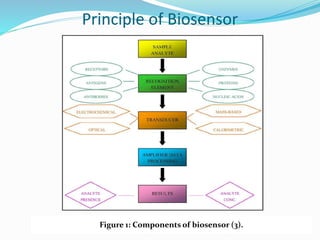
Biosensor is an analytical device which uses
enzymes, antibody, tissues that converts biological
response into electrical, thermal or optical signals[1].
Biosensor consists of two components: first the
“sensing element” and second is the “transducers”.
Sensing element may be either enzymes, antibodies,
DNA, tissues or whole cells which then transduces the
biochemical reaction into electrical signals[1].](https://image.slidesharecdn.com/techseminarppt-190408123450/85/Biosensors-Their-types-3-320.jpg)
![History
Leland C Clark is the father of biosensor[2].
He invented the glucose biosensor to determine
the glucose level in the sample.
Enzyme based biosensor was reported by Updike
and Hicks in 1967[2].](https://image.slidesharecdn.com/techseminarppt-190408123450/85/Biosensors-Their-types-4-320.jpg)
![Working of Biosensor
Figure 2: Working Of Biosensor [4].](https://image.slidesharecdn.com/techseminarppt-190408123450/85/Biosensors-Their-types-6-320.jpg)
![Types of Biosensor:
1. Optical Biosensor
Principle:
Optical biosensors are the devices that utilize the
principle of optical measurements (absorbance,
fluorescence, chemiluminescence etc.)[6].
Aborbance α Analyte concentration
Components :
Biorecognition element.
Light source.
Optical transducer.
Display.](https://image.slidesharecdn.com/techseminarppt-190408123450/85/Biosensors-Their-types-7-320.jpg)
![Working of Optical Biosensor
Figure 3: Working of Optical Biosensor [5].](https://image.slidesharecdn.com/techseminarppt-190408123450/85/Biosensors-Their-types-8-320.jpg)
![Contd
Applications
Estimation of blood glucose level
Glucose biosensor comprises of immobilized
enzymes such as glucose oxidase, Horse reddish
peroxidase and chromogen (toulidine)[6].
The intensity of the colour of the dye can be
measured by using a portable reflectance meter.
Glucose strip production is a very big industry
worldwide [6].](https://image.slidesharecdn.com/techseminarppt-190408123450/85/Biosensors-Their-types-9-320.jpg)
![2. Thermal Biosensor:
Principle:
Heat generated α Analyte concentration[1].
Components of Thermal Biosensor:
1. Thermal sensor.
2. Enzyme immobilized / free on the thermal sensors.
3. Thermocouple.
4. Display.](https://image.slidesharecdn.com/techseminarppt-190408123450/85/Biosensors-Their-types-10-320.jpg)
![Contd
2. Thermal Biosensor Working:
Figure 4: Working Of Thermal Biosensor [7].](https://image.slidesharecdn.com/techseminarppt-190408123450/85/Biosensors-Their-types-11-320.jpg)
![Contd
Applications:
Thermometric biosensors are in use for the estimation of
serum cholesterol. When cholesterol gets oxidized by
the enzyme cholesterol oxidase, heat is generated which
can be measured [6].
Cholesterol catalysis by Cholesterol oxidase [8].](https://image.slidesharecdn.com/techseminarppt-190408123450/85/Biosensors-Their-types-12-320.jpg)
![3. Electrochemical Biosensor
Principle:
Electricity or voltage generated α Analyte Concentration
[1].
Components:
Biorecognition element.
Transducer.
Display.](https://image.slidesharecdn.com/techseminarppt-190408123450/85/Biosensors-Their-types-13-320.jpg)
![Contd
Figure 5:Working of EC biosensor[9].](https://image.slidesharecdn.com/techseminarppt-190408123450/85/Biosensors-Their-types-14-320.jpg)
![5.DNA Biosensor
Principle:
Fluroscence α Concentration of Target DNA [6].
Components:
DNA immobilized onto chip.
Transducer.
Display.](https://image.slidesharecdn.com/techseminarppt-190408123450/85/Biosensors-Their-types-15-320.jpg)
![Contd
Figure 6: working of DNA Biosensor [10].](https://image.slidesharecdn.com/techseminarppt-190408123450/85/Biosensors-Their-types-16-320.jpg)
![Contd
Applications:
DNA biosensors are used for detecting DNA and
known as bio detectors. DNA sensors are used to
isolate and detect the strength of single DNA-DNA
interaction.
Detection of SNP.
DNA sequencing is very important for drug discovery
and diagnosis of genetic disorders [11].](https://image.slidesharecdn.com/techseminarppt-190408123450/85/Biosensors-Their-types-17-320.jpg)
![Applications of Biosensor
1. Glucose Biosensor for Diagnosis of Diabetis
Diabetis Mellitus is a Metabolic disorder
characterized by hyperglycemia.
Causes for Diabetis Mellitus :
Pancreas ineffeciency to produce insulin for
controlling the blood glucose level.
Mutation in the receptors.
Two types of Diabetis Mellitus :- IDDM & NIDDM
[12].](https://image.slidesharecdn.com/techseminarppt-190408123450/85/Biosensors-Their-types-18-320.jpg)
![Contd
Principle:
NADPH production α Glucose Concentration.
Fabrication:
Carbon paste was prepared by mixing carbon powder
and mineral oil in the ratio of 4:1 [13].
To the Carbon paste RBC [biological component]
extracted from 2 ml of blood sample was mixed
thoroughly for 30 minutes to form uniform
mixture[13].
The carbon paste is packed at the tip of 5 cm glass
tube and electrical circuit consisting of copper wire is
then inserted at the other end of glass tube [13].](https://image.slidesharecdn.com/techseminarppt-190408123450/85/Biosensors-Their-types-19-320.jpg)
![Contd
Instrumentation:
Glucose biosensor is a three electrode system. It consists
of reference electrode, working electrode and auxiliary
electrode [13].
Ag/AgCl is used as reference electrode and platinum
wire is used as auxiliary electrode. These electrodes are
placed in a electrochemical cell of 40ml capacity [13].](https://image.slidesharecdn.com/techseminarppt-190408123450/85/Biosensors-Their-types-20-320.jpg)
![Contd
Working Principle:
Glucose biosensor consists of Hexo kinase, G-6-PD and RBCs.
When the biosensor comes in contact with glucose in the sample.
RBC is pentrates into RBC by enzyme Glucose permease.
Then glucose is catalysed by hexokinase to produce Glucose 6 Phosphate.
G-6-P is catalysed by G-6-PD into 6-Phospogluconate with the oxidation of NADP
into NADPH2 [13].](https://image.slidesharecdn.com/techseminarppt-190408123450/85/Biosensors-Their-types-21-320.jpg)
![Contd
Figure 7: NADPH Production in the biosensor [13].](https://image.slidesharecdn.com/techseminarppt-190408123450/85/Biosensors-Their-types-22-320.jpg)
![2.PAPER BASED BIOSENSOR FOR WATER
ANALYSIS
Presence of contaminants in water is a major concern,
contaminants such as pesticides, micro organisms, heavy
metals and chemicals released by various industries [14].
Detection of contaminants in water is important before
releasing the water into the environment. Development of
biosensors helps to detect water contaminants in fast, accurate
and rapid detection[14].
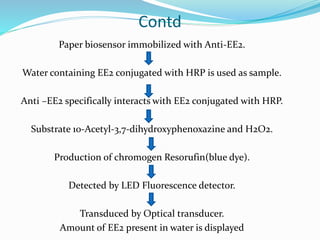
Paper based biosensor is the developing technique used for
analysing the water quality[14].
Paper analytical technique in combination with biosensor
serves as a new technique for qualitative and quantitative
analysis of water [14].
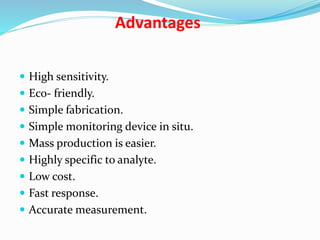
The key advantage of this technique is portable, low cost and
efficient[14].](https://image.slidesharecdn.com/techseminarppt-190408123450/85/Biosensors-Their-types-23-320.jpg)
![Contd
According to World Health Organization [WHO] and
Environment Protection Act [EPA], the Maximum
contaminant level [MCL] are been prescribed for water
released by various industries.
SL.
NO
COMPONENT MCL RANGE [µg L-1]
1 Arsenic 10
2 Mercury 2-6
3 Lead 10
4 Uranium 30
5 Cadmium 3-5
TABLE 1: List of contaminats and their allowable ranges in water [14].](https://image.slidesharecdn.com/techseminarppt-190408123450/85/Biosensors-Their-types-24-320.jpg)
![Contd
Instrumentation:
SL
NO
PAPER PROPERTIES
1 Cellulose filter paper Hydrophilic, permeable to aqueous
solution and available with various
pore size and thickness
2 Chromatography paper Separation of nanoparticles and
applicable for agglutination based
assay.
3 Nitrocellulose membrane Hydrophobic and retention of
components due to electrostatic
interaction.
4 Printing paper Microfluidic channel creation for
sample analysis.
TABLE 2: Paper types used in biosensors fabrication [14].](https://image.slidesharecdn.com/techseminarppt-190408123450/85/Biosensors-Their-types-25-320.jpg)
![Contd
Fabrication:
FIG 8: A Represents Wax Printing [14].](https://image.slidesharecdn.com/techseminarppt-190408123450/85/Biosensors-Their-types-26-320.jpg)
![References
1. Saraju P Mohanty et.al. “Biosensors : A Tutorial
Review”,IEEE Potentials, 25[2], 35-40 [2006].
2. Payoshnee Bhalinge et.al. “Biosensors: nanotools of
detection- A review”, Int J of Healthcare and biomedical
research, 04, 26-39 [2016].
3. Nicola stefano fracchilla, Silvia Artuso Agostino
cortelezzi. “Biosensors in Clinical Practice : Focus on
Oncohematology”, Journal of sensors, 13(5) , 6423-6447
[2013].
4. https://www.eduhk.hk/biotech/eng/classrm/explain/ge
ne16.jpg.
5. https://pubs.rsc.org/services/images/RSCpubs.ePlatfor
m.Service.FreeContent.ImageService.svc/ImageService/
Articleimage/2016/RA/c5ra15269k/c5ra15269k-f5_hi-
res.gif](https://image.slidesharecdn.com/techseminarppt-190408123450/85/Biosensors-Their-types-31-320.jpg)
![Contd
6.http://www.biologydiscussion.com/enzymes/biosens
ors/biosensors-features-principle-and-types-with-
diagram/10240.
7.https://www.cell.com/cms/attachment/538394/37414
51/gr1.Journalpg
8. http://file.scirp.org/Html/1-2270015/203ec242-b8aa-
4353-a3b6-fc9f95baa105.jpg
9. Jitendra kumar et.al. biosensor for environmental
and clinical monitoring, BARC NEWS LETTER, 324,
34-38 [2012].
10.https://ars.els-cdn.com/content/image/1-s2.0-
S016599361200146X-gr1](https://image.slidesharecdn.com/techseminarppt-190408123450/85/Biosensors-Their-types-32-320.jpg)
![Contd
11. C Bartic et.al. “Organic thin film transistor as transducer for
bioanalytical applications”, Journal of Analytical and
Bioanalytical Chemistry, 384 354-365 [2006].
12.AL. Galant, R. C. Kaufman, and J. D. Wilson, “Glucose:
detection and analysis,” Journal of Food Chemistry, 88, 149–160
[2015].
13.Amandeep Kaur and Neelam Verma. “Electrochemical
biosensor for monitoring insulin in normal individual and
diabetic mellitus patients, European journal of experimental
biology, 2[2], 389-395 [2012].
14.Celine I L Justino et.al. “Recent progress in environmental
monitoring: A Review”, J of sensor basel, 17, [2017].
15.](https://image.slidesharecdn.com/techseminarppt-190408123450/85/Biosensors-Their-types-33-320.jpg)



The document is a technical seminar presentation on biosensors, covering their introduction, history, principles, types, applications, and advantages/disadvantages. It explains the functioning of various biosensors, such as glucose, thermal, electrochemical, and DNA biosensors, and their applications in medical diagnostics and environmental monitoring. It also discusses the fabrication and instrumentation of biosensors and highlights the benefits and limitations of these analytical devices.


