Presentation by
Mrs.D.Madhuri M.Pharm .,(Ph.D)
Assistant Professor,
Department of Pharmaceutics,
University college of Pharmaceutical Sciences,
Acharya Nagarjuna University
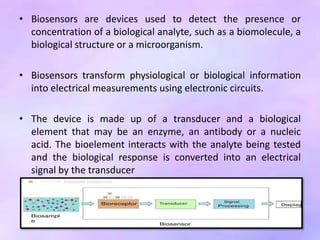
• Biosensors are devices used to detect the presence or
concentration of a biological analyte, such as a biomolecule, a
biological structure or a microorganism.
• Biosensors transform physiological or biological information
into electrical measurements using electronic circuits.
• The device is made up of a transducer and a biological
element that may be an enzyme, an antibody or a nucleic
acid. The bioelement interacts with the analyte being tested
and the biological response is converted into an electrical
signal by the transducer
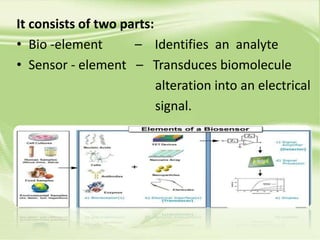
It consists of two parts:
• Bio -element – Identifies an analyte
• Sensor - element – Transduces biomolecule
alteration into an electrical
signal.
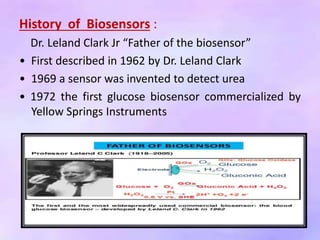
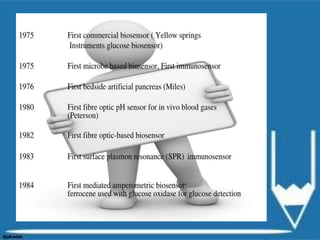
History of Biosensors :
Dr. Leland Clark Jr “Father of the biosensor”
• First described in 1962 by Dr. Leland Clark
• 1969 a sensor was invented to detect urea
• 1972 the first glucose biosensor commercialized by
Yellow Springs Instruments
Working Principle of
Biosensors:
It involves :
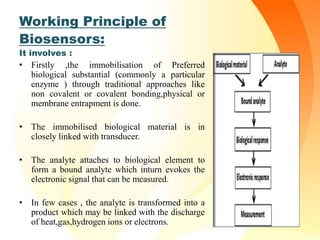
• Firstly ,the immobilisation of Preferred
biological substantial (commonly a particular
enzyme ) through traditional approaches like
non covalent or covalent bonding,physical or
membrane entrapment is done.
• The immobilised biological material is in
closely linked with transducer.
• The analyte attaches to biological element to
form a bound analyte which inturn evokes the
electronic signal that can be measured.
• In few cases , the analyte is transformed into a
product which may be linked with the discharge
of heat,gas,hydrogen ions or electrons.
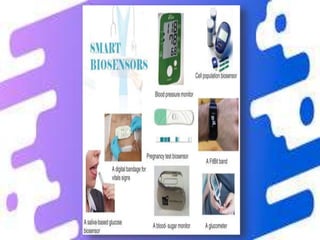
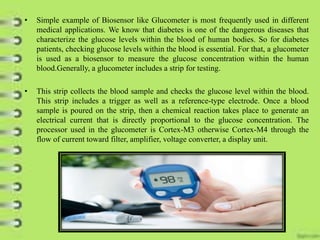
• Simple example of Biosensor like Glucometer is most frequently used in different
medical applications. We know that diabetes is one of the dangerous diseases that
characterize the glucose levels within the blood of human bodies. So for diabetes
patients, checking glucose levels within the blood is essential. For that, a glucometer
is used as a biosensor to measure the glucose concentration within the human
blood.Generally, a glucometer includes a strip for testing.
• This strip collects the blood sample and checks the glucose level within the blood.
This strip includes a trigger as well as a reference-type electrode. Once a blood
sample is poured on the strip, then a chemical reaction takes place to generate an
electrical current that is directly proportional to the glucose concentration. The
processor used in the glucometer is Cortex-M3 otherwise Cortex-M4 through the
flow of current toward filter, amplifier, voltage converter, a display unit.
Basic characteristics of Biosensors:
• Accuracy : Incorrect positive and incorrect negative results generated
by biosensor should be little or rather nil.
• Evaluation time : Biosensors should evoke a real-time response particularly
when unpreserved food stuffs are being verified.
• Sensitivity : Biosensors must detect incorrect negative outcomes,
which lowers the analyzing sensitivity.
• Reproducing : Every testing done by biosensors should be very
reproducible and simple to calibrate.
• Robust : The biosensor must reluctant to fluctations in pH ,ionic
strength,temperature ,and be serializable.
• Validation : The biosensor assay should be expatriate in contradiction of
current standard technique.
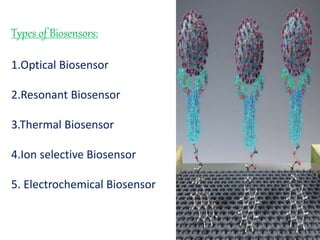
Types of Biosensors:
1.Optical Biosensor
2.Resonant Biosensor
3.Thermal Biosensor
4.Ion selective Biosensor
5. Electrochemical Biosensor
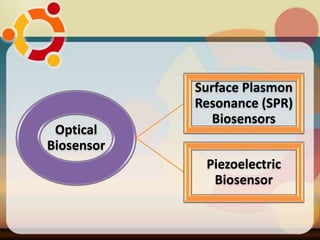
Optical
Biosensor
Surface Plasmon
Resonance (SPR)
Biosensors
Piezoelectric
Biosensor
Optical Biosensors :
• Optical biosensors have exhibited worthwhile
performance in detecting biological systems and
promoting significant advances in clinical
diagnostics, drug discovery, food process control,
and environmental monitoring.
• Optical detection is based on the measurement of
luminescence, fluorescence, colour changes, by the
measurement of absorbance, reflectance or
fluorescence emissions that occur in the ultraviolet
(UV), visible, or near-infrared (NIR) spectral regions.
Resonant Biosensor:
It involve the coupling of an acoustic wave transducer
with an antibody (Bio-element) when the analyte
fragment (or antigen) gets linked to the membrane.The
mass of the membrane fluctuates.The subsequent
variation in mass consequently variates the resonant
frequency of the transducer.
Thermal Biosensor:
• These are assembled by merging the immobilized
enzymes molecules with temperature sensors. When
the analyte reacts with the enzymes heat reaction of
enzymes is measured and is regulated compared to the
analyte concentration.
• Thermal biosensors comprise the recognition of
insecticides and pathogenic microorganism.
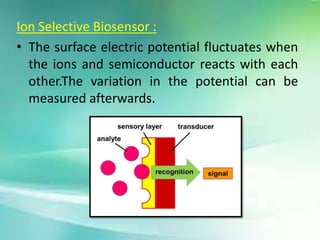
Ion Selective Biosensor :
• The surface electric potential fluctuates when
the ions and semiconductor reacts with each
other.The variation in the potential can be
measured afterwards.
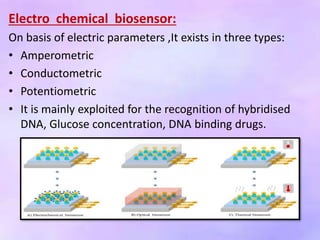
Electro chemical biosensor:
On basis of electric parameters ,It exists in three types:
• Amperometric
• Conductometric
• Potentiometric
• It is mainly exploited for the recognition of hybridised
DNA, Glucose concentration, DNA binding drugs.
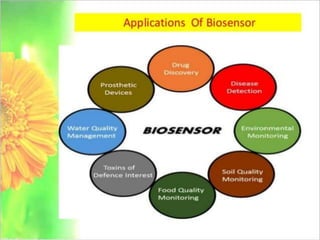
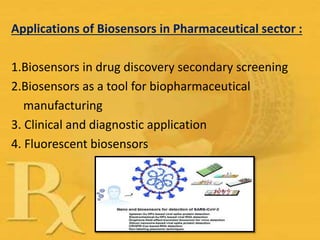
Applications of Biosensors in Pharmaceutical sector :
1.Biosensors in drug discovery secondary screening
2.Biosensors as a tool for biopharmaceutical
manufacturing
3. Clinical and diagnostic application
4. Fluorescent biosensors
Biosensors ppt

Biosensors ppt

  • 1.
    Presentation by Mrs.D.Madhuri M.Pharm.,(Ph.D) Assistant Professor, Department of Pharmaceutics, University college of Pharmaceutical Sciences, Acharya Nagarjuna University
  • 3.
    • Biosensors aredevices used to detect the presence or concentration of a biological analyte, such as a biomolecule, a biological structure or a microorganism. • Biosensors transform physiological or biological information into electrical measurements using electronic circuits. • The device is made up of a transducer and a biological element that may be an enzyme, an antibody or a nucleic acid. The bioelement interacts with the analyte being tested and the biological response is converted into an electrical signal by the transducer
  • 4.
    It consists oftwo parts: • Bio -element – Identifies an analyte • Sensor - element – Transduces biomolecule alteration into an electrical signal.
  • 5.
    History of Biosensors: Dr. Leland Clark Jr “Father of the biosensor” • First described in 1962 by Dr. Leland Clark • 1969 a sensor was invented to detect urea • 1972 the first glucose biosensor commercialized by Yellow Springs Instruments
  • 10.
    Working Principle of Biosensors: Itinvolves : • Firstly ,the immobilisation of Preferred biological substantial (commonly a particular enzyme ) through traditional approaches like non covalent or covalent bonding,physical or membrane entrapment is done. • The immobilised biological material is in closely linked with transducer. • The analyte attaches to biological element to form a bound analyte which inturn evokes the electronic signal that can be measured. • In few cases , the analyte is transformed into a product which may be linked with the discharge of heat,gas,hydrogen ions or electrons.
  • 11.
    • Simple exampleof Biosensor like Glucometer is most frequently used in different medical applications. We know that diabetes is one of the dangerous diseases that characterize the glucose levels within the blood of human bodies. So for diabetes patients, checking glucose levels within the blood is essential. For that, a glucometer is used as a biosensor to measure the glucose concentration within the human blood.Generally, a glucometer includes a strip for testing. • This strip collects the blood sample and checks the glucose level within the blood. This strip includes a trigger as well as a reference-type electrode. Once a blood sample is poured on the strip, then a chemical reaction takes place to generate an electrical current that is directly proportional to the glucose concentration. The processor used in the glucometer is Cortex-M3 otherwise Cortex-M4 through the flow of current toward filter, amplifier, voltage converter, a display unit.
  • 12.
    Basic characteristics ofBiosensors: • Accuracy : Incorrect positive and incorrect negative results generated by biosensor should be little or rather nil. • Evaluation time : Biosensors should evoke a real-time response particularly when unpreserved food stuffs are being verified. • Sensitivity : Biosensors must detect incorrect negative outcomes, which lowers the analyzing sensitivity. • Reproducing : Every testing done by biosensors should be very reproducible and simple to calibrate. • Robust : The biosensor must reluctant to fluctations in pH ,ionic strength,temperature ,and be serializable. • Validation : The biosensor assay should be expatriate in contradiction of current standard technique.
  • 13.
    Types of Biosensors: 1.OpticalBiosensor 2.Resonant Biosensor 3.Thermal Biosensor 4.Ion selective Biosensor 5. Electrochemical Biosensor
  • 14.
  • 15.
    Optical Biosensors : •Optical biosensors have exhibited worthwhile performance in detecting biological systems and promoting significant advances in clinical diagnostics, drug discovery, food process control, and environmental monitoring. • Optical detection is based on the measurement of luminescence, fluorescence, colour changes, by the measurement of absorbance, reflectance or fluorescence emissions that occur in the ultraviolet (UV), visible, or near-infrared (NIR) spectral regions.
  • 16.
    Resonant Biosensor: It involvethe coupling of an acoustic wave transducer with an antibody (Bio-element) when the analyte fragment (or antigen) gets linked to the membrane.The mass of the membrane fluctuates.The subsequent variation in mass consequently variates the resonant frequency of the transducer.
  • 17.
    Thermal Biosensor: • Theseare assembled by merging the immobilized enzymes molecules with temperature sensors. When the analyte reacts with the enzymes heat reaction of enzymes is measured and is regulated compared to the analyte concentration. • Thermal biosensors comprise the recognition of insecticides and pathogenic microorganism.
  • 18.
    Ion Selective Biosensor: • The surface electric potential fluctuates when the ions and semiconductor reacts with each other.The variation in the potential can be measured afterwards.
  • 19.
    Electro chemical biosensor: Onbasis of electric parameters ,It exists in three types: • Amperometric • Conductometric • Potentiometric • It is mainly exploited for the recognition of hybridised DNA, Glucose concentration, DNA binding drugs.
  • 20.
    Applications of Biosensorsin Pharmaceutical sector : 1.Biosensors in drug discovery secondary screening 2.Biosensors as a tool for biopharmaceutical manufacturing 3. Clinical and diagnostic application 4. Fluorescent biosensors