Definition
Introduction
Types
Principle
Definition
• A biosensor is an analytical device, used for
the detection of an analyte, that combines a
biological component with a physicochemical
detector.
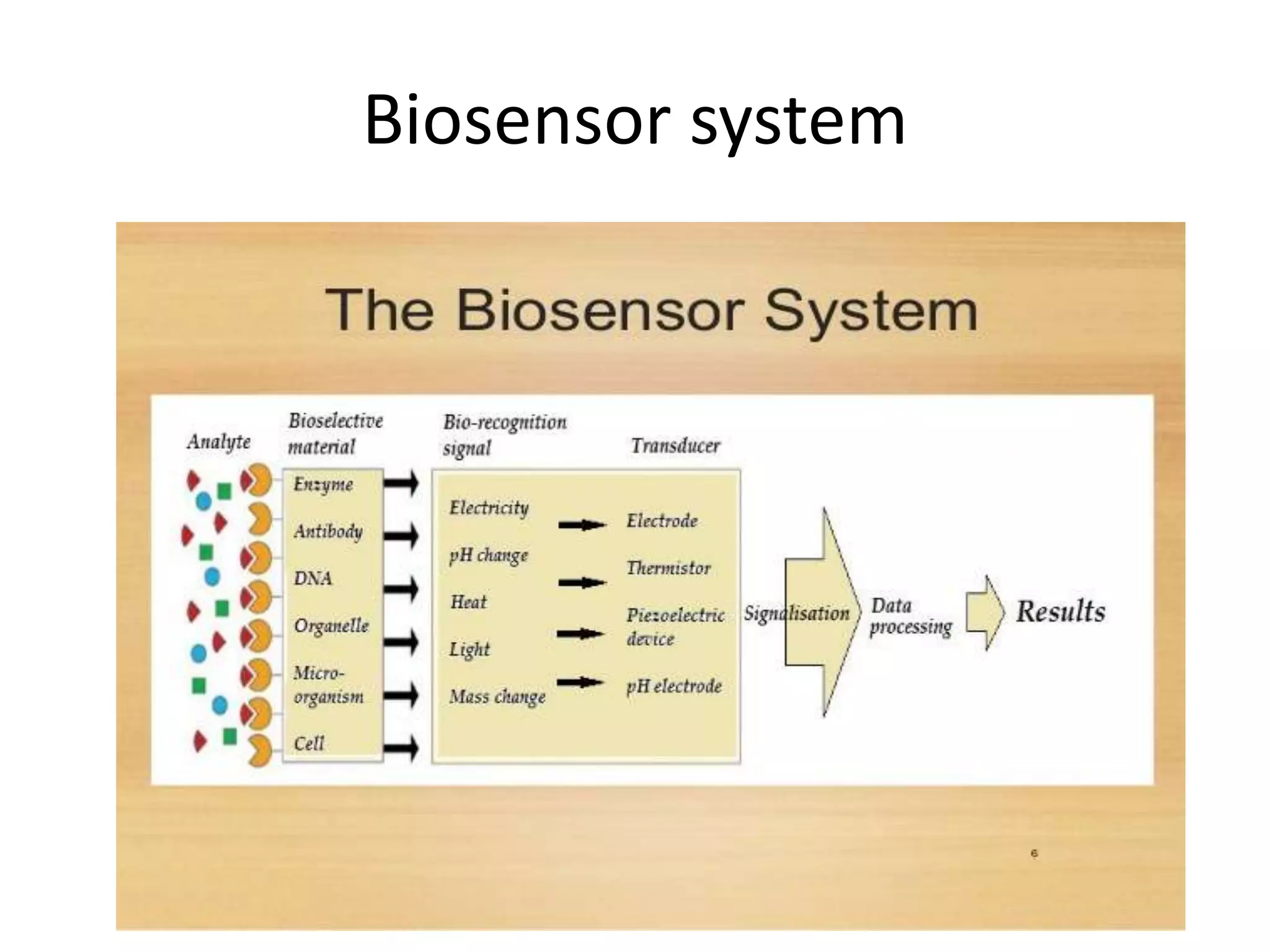
Biosensor system
Introduction
• A biosensor is a sensing device comprised of a
combination of a specific biological element and
a transducer.
• A specific biological element recognizes a specific
analyte and the changes in the biomolecule are
usually converted into and electrical signal (
which is in turn calibrated to a specific scale ) by a
transducer.
• It detects, records and transmits information
regarding a physiological change or process.
A successful biosensor must possess at least
some of the following beneficial features:
• The biocatalyst must be highly specific for the purpose
of the analyses, be stable under normal storage
conditions and, except in the case of colorimetric
enzyme strips
• The reaction should be as independent of such physical
parameters as stirring, pH and temperature as is
manageable. This would allow the analysis of samples
with minimal pre-treatment.
• The response should be accurate, precise, reproducible
and linear over the useful analytical range, without
dilution or concentration. It should also be free from
electrical noise.
• If the biosensor is to be used for invasive monitoring in
clinical situations, the probe must be tiny and
biocompatible, having no toxic or antigenic effects. If it
is to be used in fermenters it should be serializable.
This is preferably performed by autoclaving but no
biosensor enzymes can presently withstand such
drastic wet-heat treatment. In either case, the
biosensor should not be prone to fouling or
proteolysis.
• The complete biosensor should be cheap, small,
portable and capable of being used by semi-skilled
operators.
Glucometer
• Current glucometers use test strips containing
glucose oxidase, an enzyme that reacts to
glucose in the blood droplet,
• When the strip is inserted into the meter, the
flux of the glucose reaction generates an
electrical signal
• The glucometer is calibrated so the number
appearing in its digital readout corresponds to
the strength of the electrical current
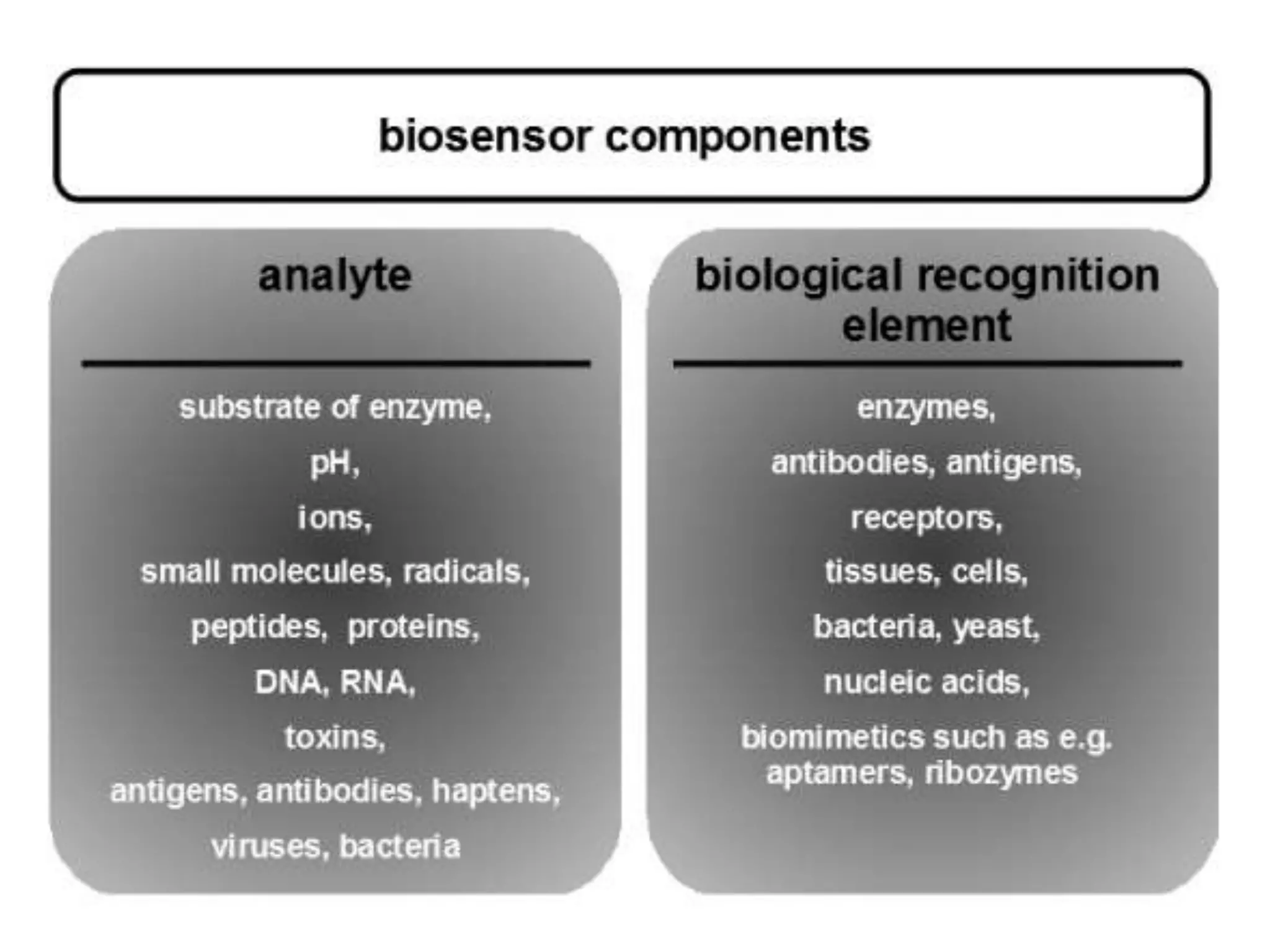
Bio-element
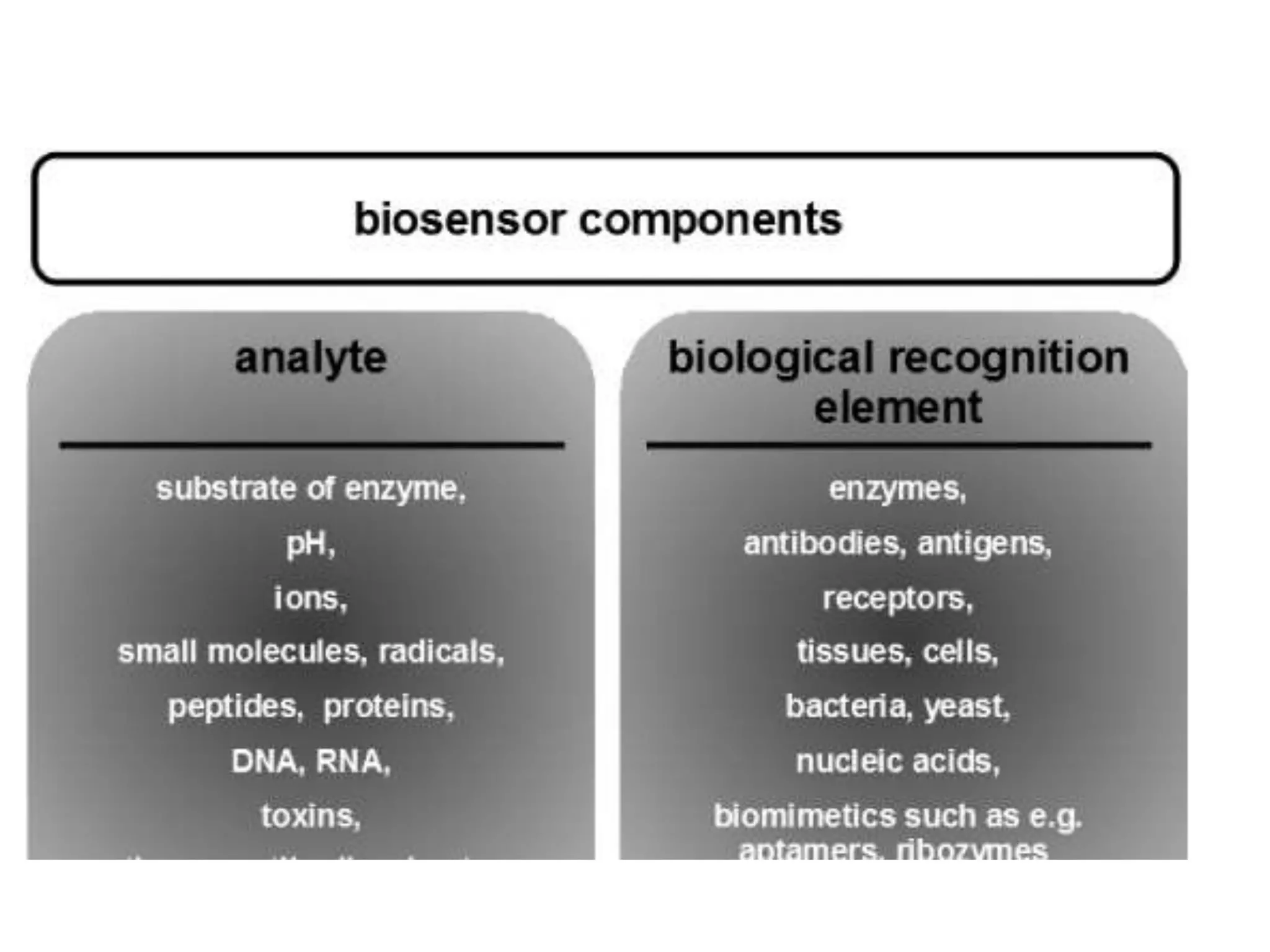
• It is a typically complex chemical system usually
extracted or derived directly from a biological
organism.
• Types
• Enzymes
• Oxidase
• Polysaccharide
• Antibiotics
• Tissue
• Nucleic acid
Conti…
• Function
• To interact specifically with a target compound
i.e compound to be detected.
• It must be capable of detecting the presence
of a target compound in the test solution.
• The ability of a bio-element to interact
specifically with the target compound
(specifically) is the basis for biosensor.
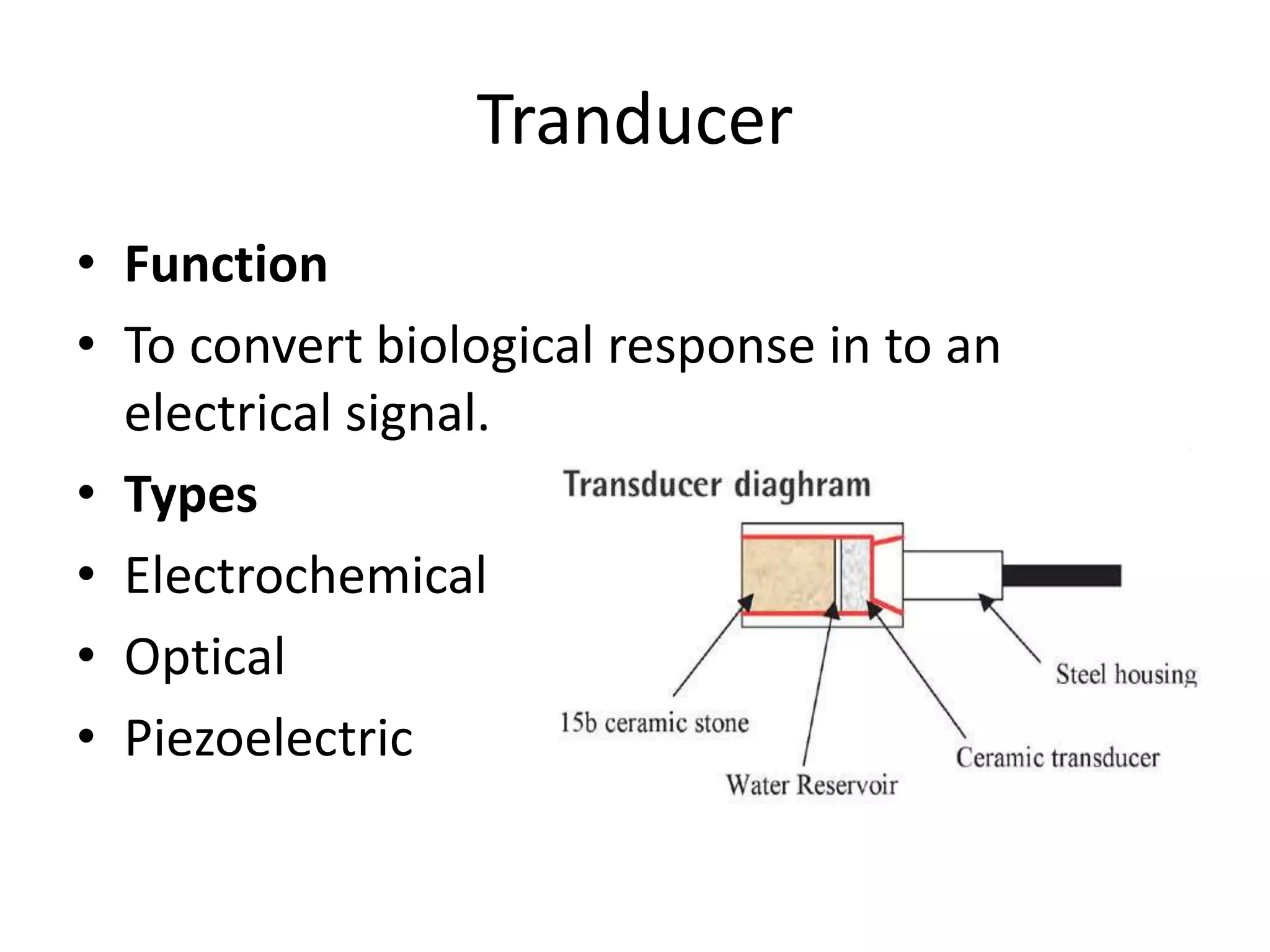
Tranducer
• Function
• To convert biological response in to an
electrical signal.
• Types
• Electrochemical
• Optical
• Piezoelectric
Response From Bio-element
• Heat absorbed (or liberated) during the
interaction.
• Movement of electrons produced in a redox
reaction.
• Light absorbed ( or liberated ) during the
interaction.
• Effect due to mass of reactants or products.
Types Of Biosensors
• Electrochemical biosensor
• Optical biosensor
• Thermal biosensor
• Resonant biosensor
• Ion-sensitive biosensor
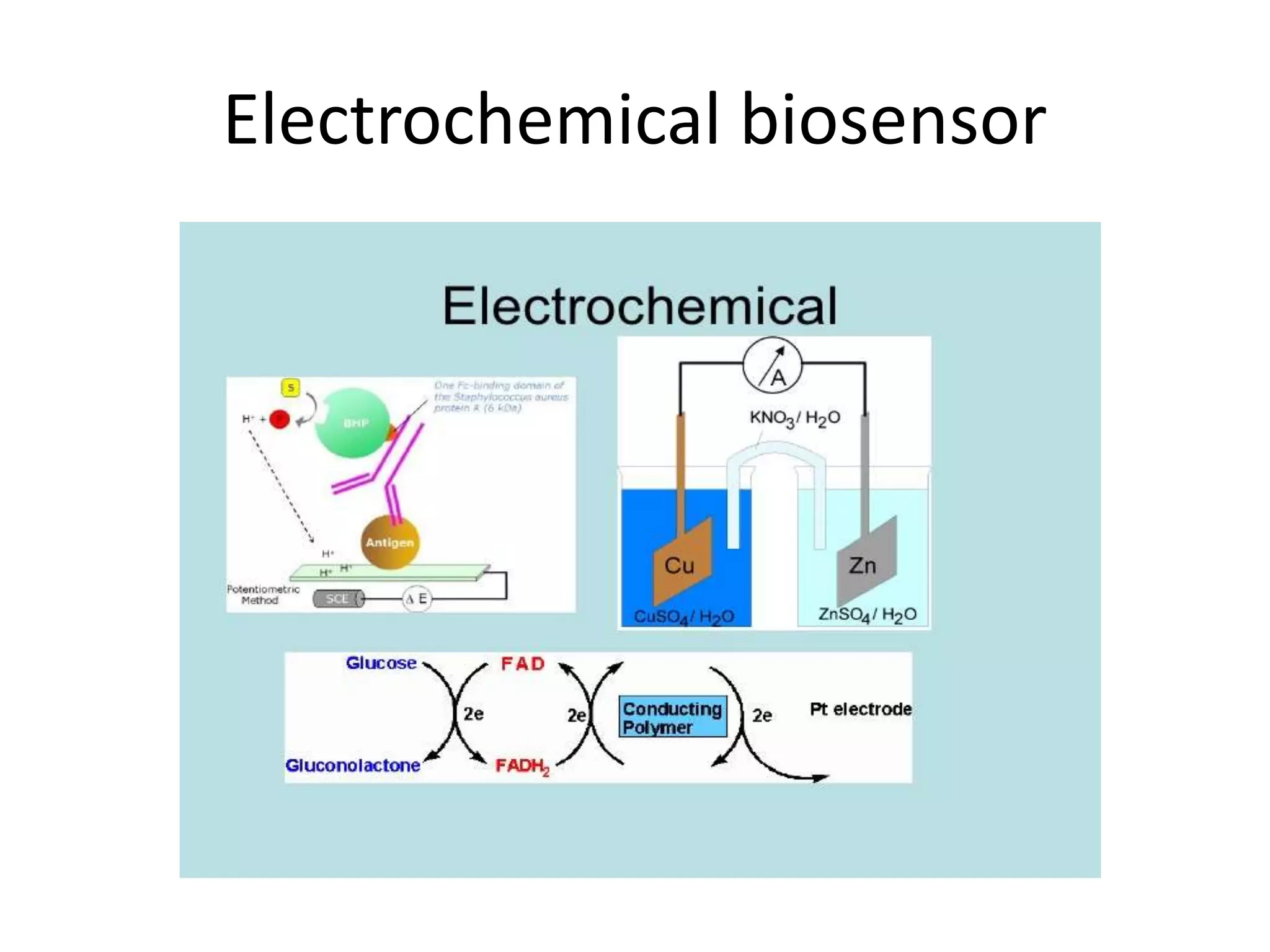
Electrochemical biosensor
• Principle:
• Many chemical reactions produce or consume
ions or electrons which in turn cause some
change in the electrical properties of the solution
which can be sensed out and used as measuring
parameter.
• Classification:
1. Amperometric Biosensors
2. Conductimetric Biosensors
3. Potentiometric Biosensors
Electrochemical biosensor
Amperometric Biosensors
• The high sensitivity biosensor can detect
electro-active species present in biological test
samples.
• Since the biological test samples may not be
intrinsically electro-active, enzymes are
needed to catalyze the production of radio-
active species.
• In this case, the measured parameters is
current.
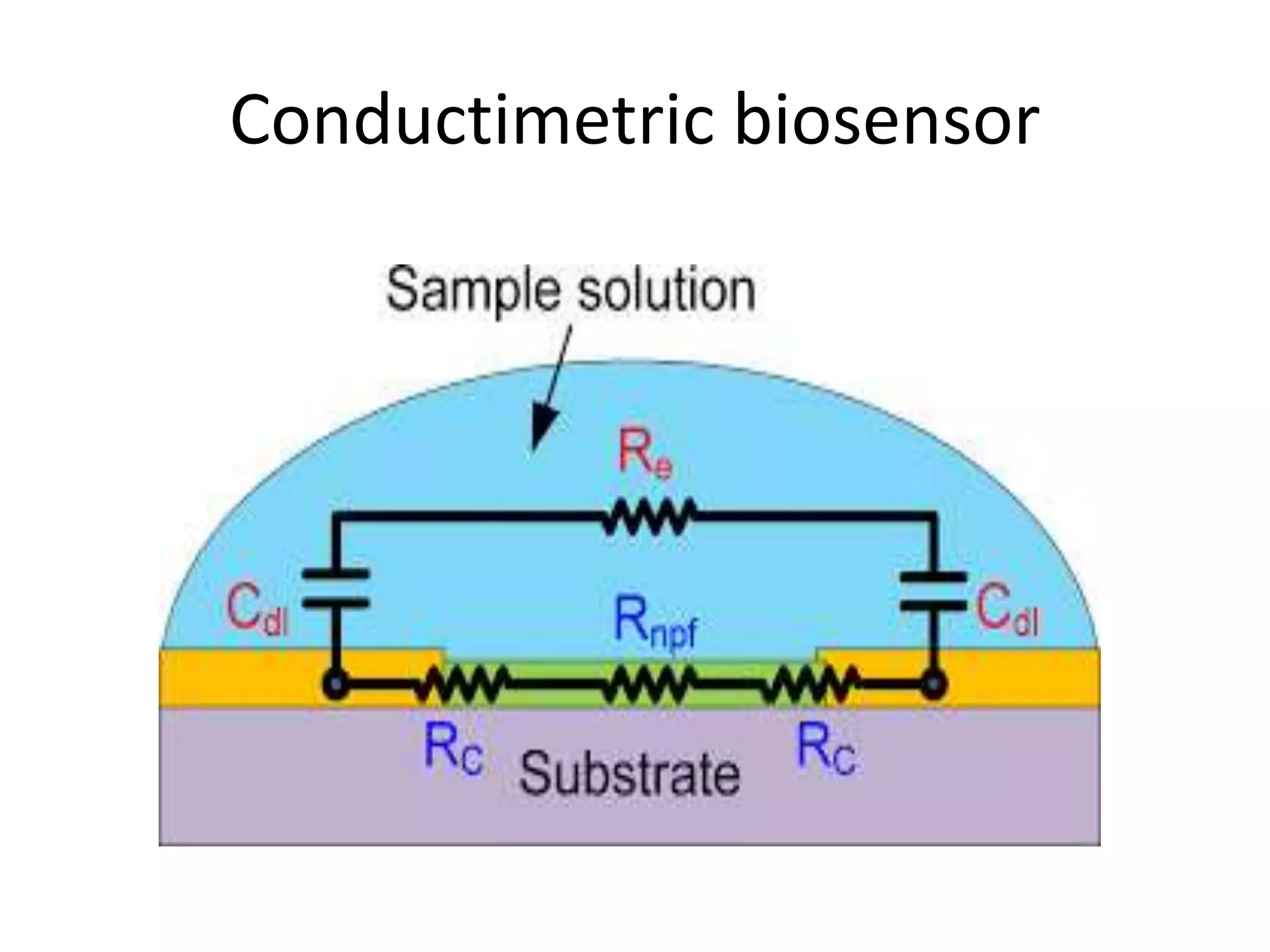
Conductimetric Biosensors
• The measured parameter is the electrical
conductance resistance of the solution.
• When electrochemical reactions produce ions or
electrons, the overall conductivity or resistivity of
the solution changes. This change is measured
and calibrated to a proper scale (Conductance
measurements have relatively low sensitivity).
• The electric field is generated using a sinusoidal
voltage (AC) which in minimizing undesirable
effects such as Faradaic process, double layer
charging and concentration polarization.
Conductimetric biosensor
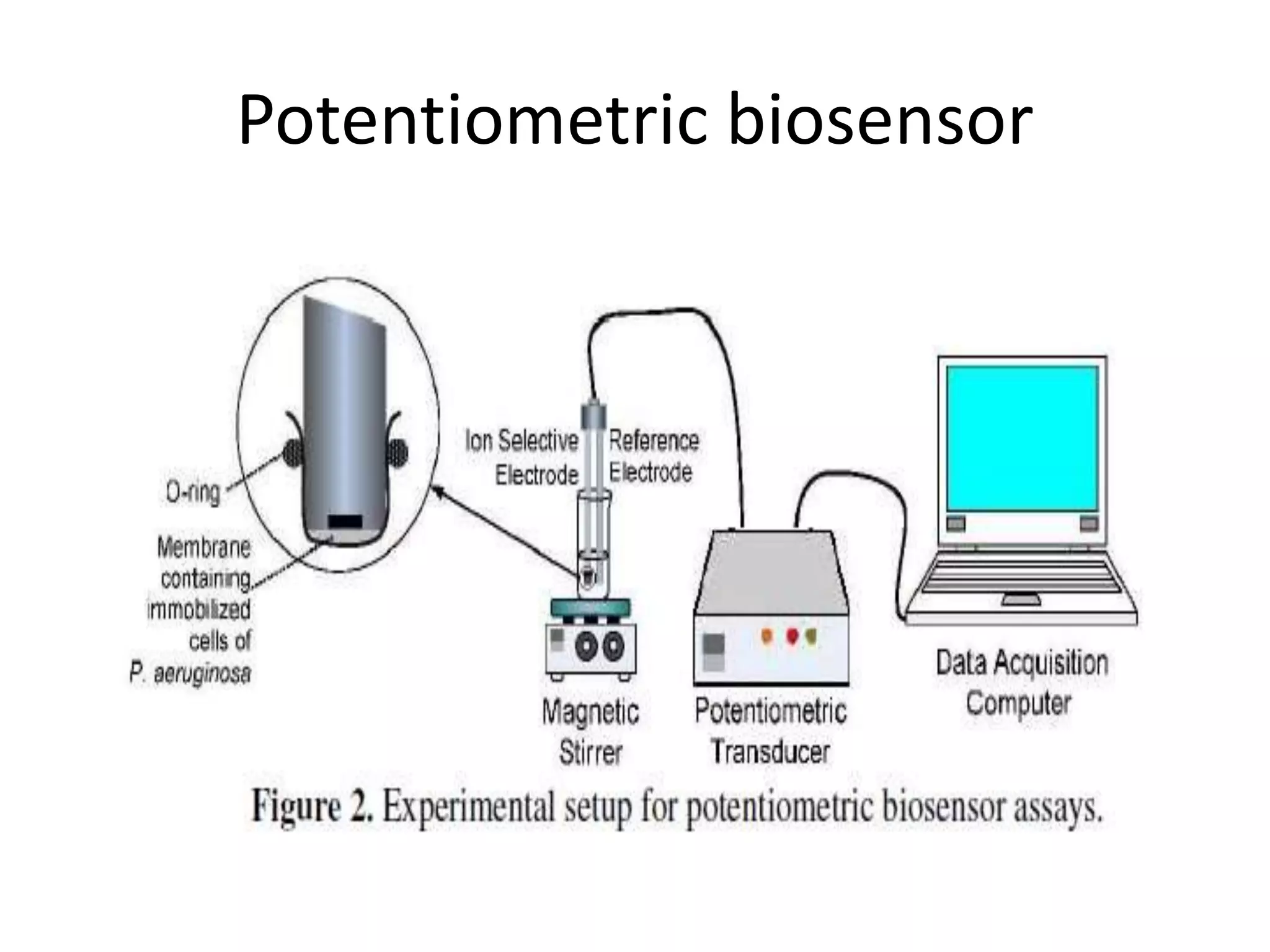
Potentiometric biosensors
• In this type of sensor the measured parameter is
oxidation or reduction potential of an
electrochemical reaction.
• The working principle relies on the fact that
where a ramp voltage is applied to an electrode
in solution, a current flow occurs because of
electrochemical reactions.
• The voltage at which these reaction occurs
indicate a particular reaction and particular
species.
Potentiometric biosensor
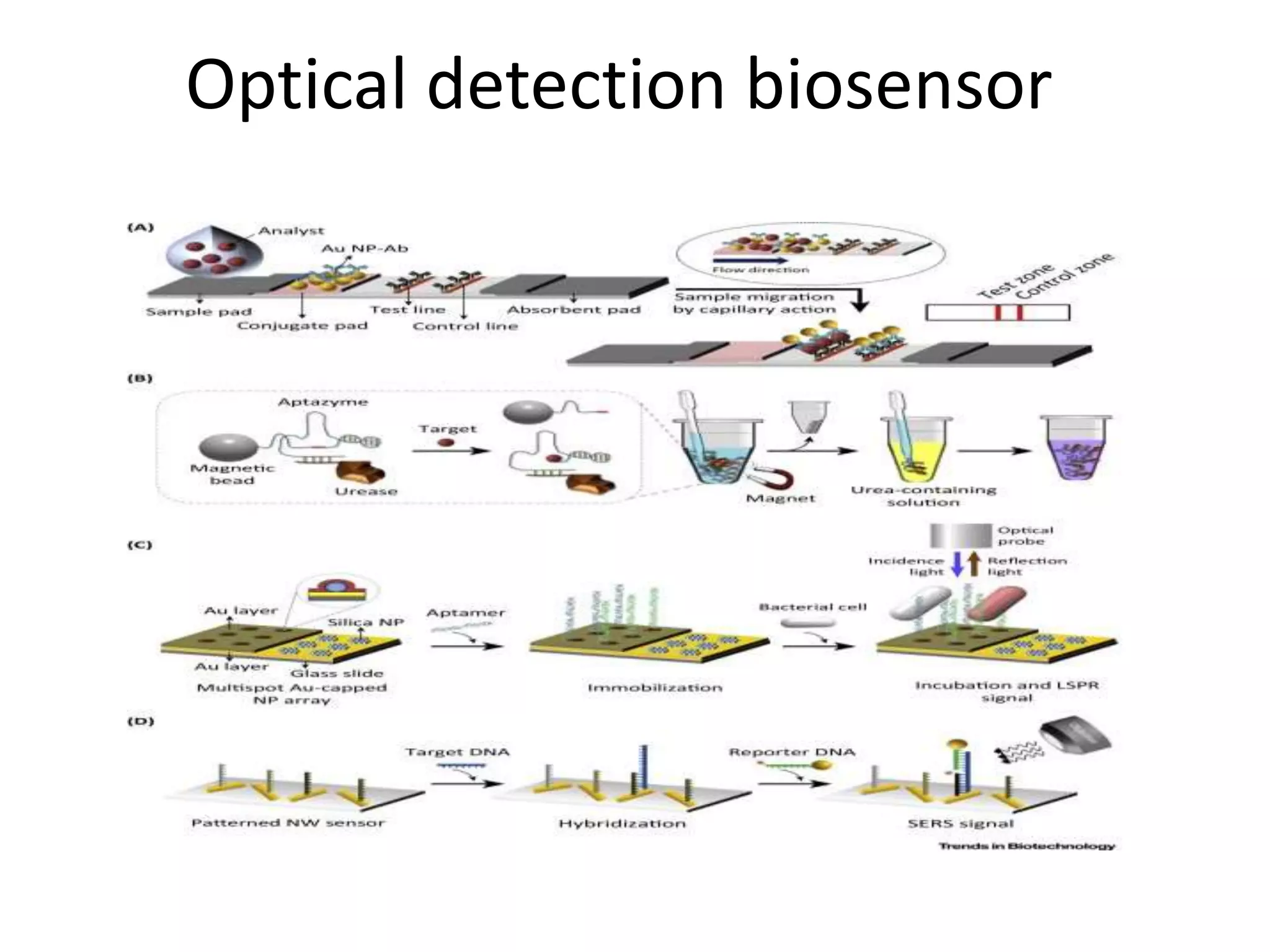
Optical detection biosensor
• The output transduced signal that is measured is light
for this type of biosensor.
• The biosensor can be made based on optical
diffraction. In optical diffraction based devices, a silicon
wafer is coated with a protein via covalent bonds. The
wafer is exposed to UV light through a photo-mask and
the antibodies becomeinactive in the exposed regions.
When the diced wafer chips are incubated in an
analyte, antigen-antibody bindings are formed in the
active regions , thus creating a diffraction grating. This
grating produces a diffraction signal when illuminated
with a light source such as laser. The resulting signal
can be measured.
Optical detection biosensor
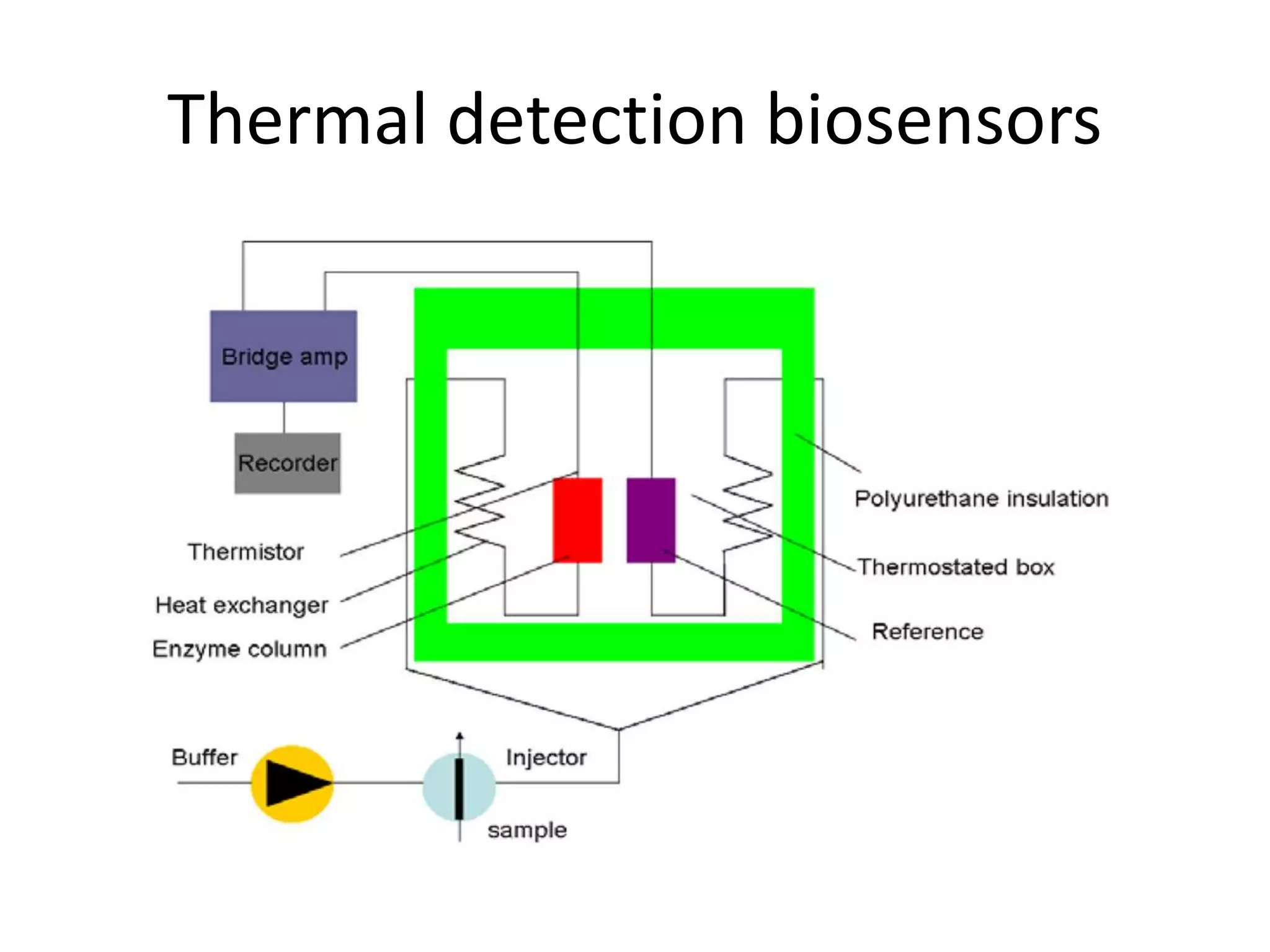
Thermal detection biosensors
• This type of biosensor work on the fundamental properties
of biological reactions, namely absorption or production of
heat , which in turn changes the temperature of the
medium in which the reaction takes place.
• They are constructed by combining immobilized enzymes
molecules with the temperature sensors. When the analyte
comes in contact with the enzyme is measured and is
calibrated against the analyte concentration.
• The total heat produced or absorbed is proportional to the
molar enthalpy and the total number of molecules in the
reaction.
Conti…
• The measurement of the temperature is typically
accomplished via a thermistor, and such devices are
known as enzyme thermistors. Their high sensitivity to
thermal changes makes thermistor ideal for such
applications.
• Unlike other transducers, thermal biosensors do not
need frequent recalibration and are insensitive to the
optical and electrochemical properties of the sample.
• Common applications of this type of biosensors
includes the detection of pesticides and pathogenic
bacteria.
Thermal detection biosensors
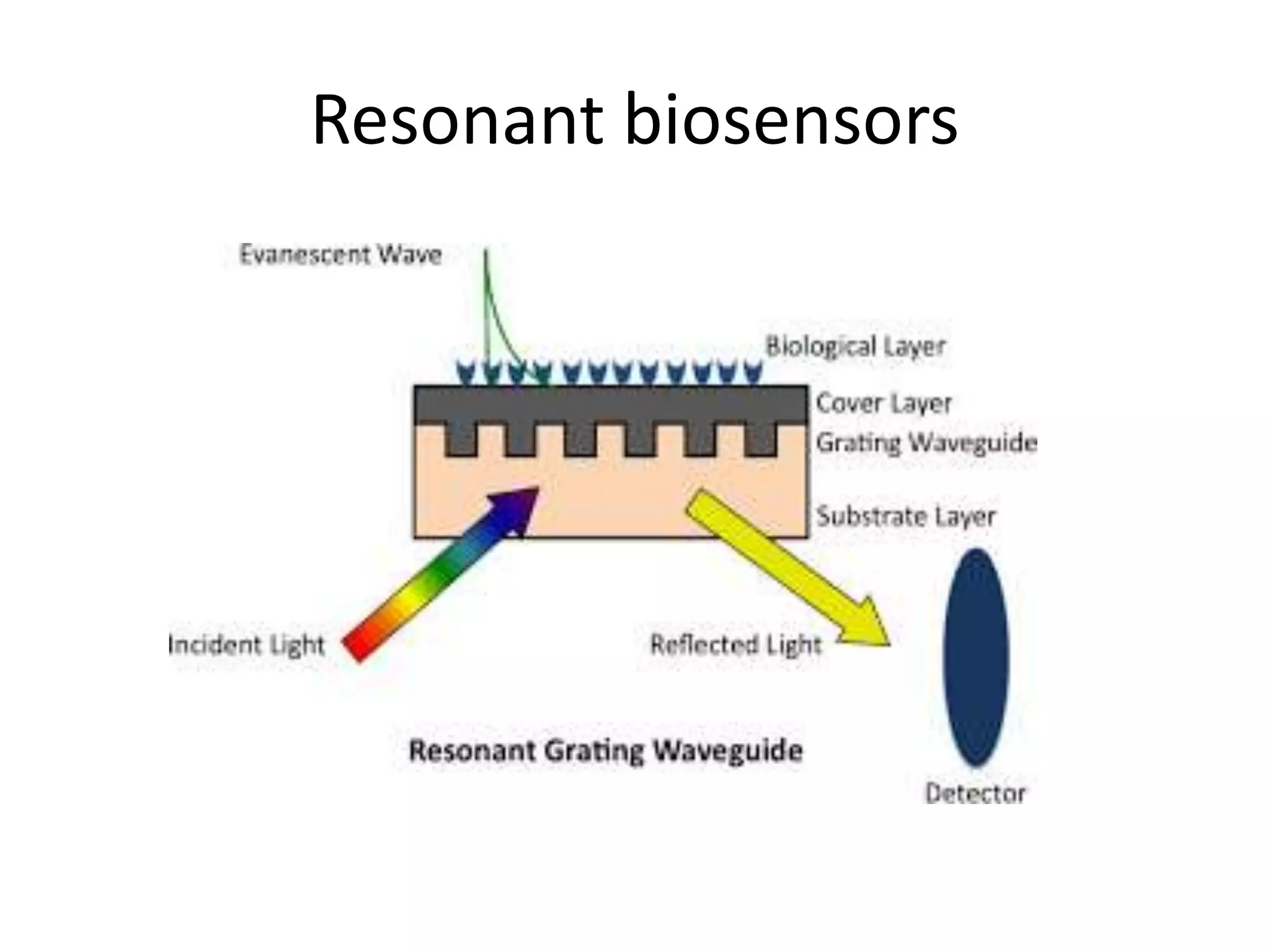
Resonant biosensors
• It utilize crystal which undergo an electric
deformation when an electrical potential is
applied to them. (Alternating potential (A.C)
produces a standing wave in the crystal at a
characteristic frequency)
• In this type of biosensor, an acoustic wave
transducer is coupled with an antibody (bio-
element).
Conti…
• When the analyte molecule (or antigen) gets
attached to the membrane, the mass of the
membrane, the mass of the membrane
changes. The resulting change in the mass
subsequently changes the resonant frequency
of the resonant frequency of the transducer.
This frequency change is then measured.
Resonant biosensors
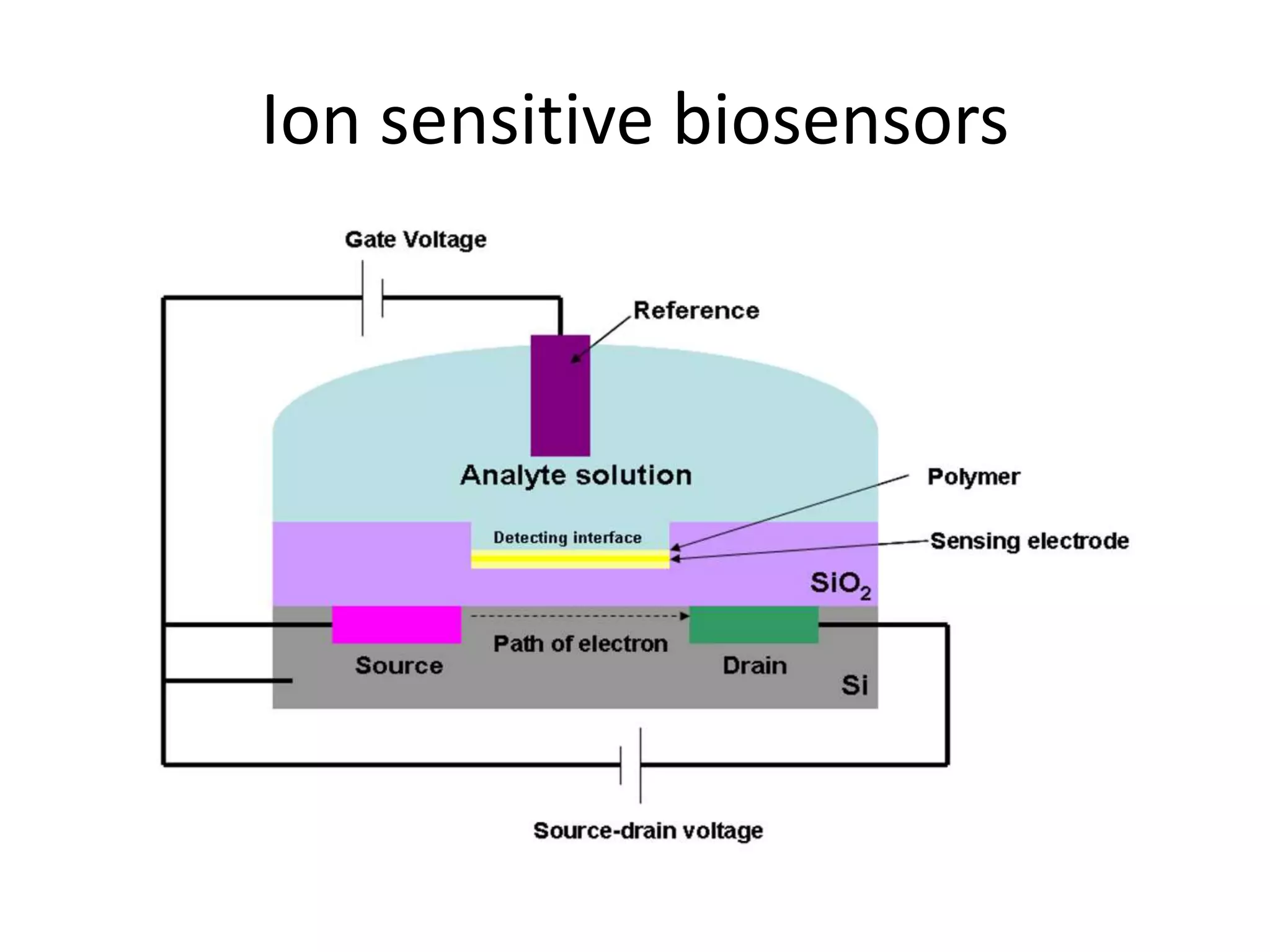
Ion sensitive biosensor
• These are semiconductor FETs having an ion-
sensitive surface.
• The surface electrical potential changes when the
ions and semiconductor interact. (This change in
the potential can be subsequently measured).
• The Ion sensitive Fielf Effect Transistor (ISFET) can
be constructed by covering the sensor electrode
with a polymer layer. This polymer layer is
selectively permeable to analyte ions. The ions
diffuse through the polymer layer and in return
cause a change in the FET surface potential.
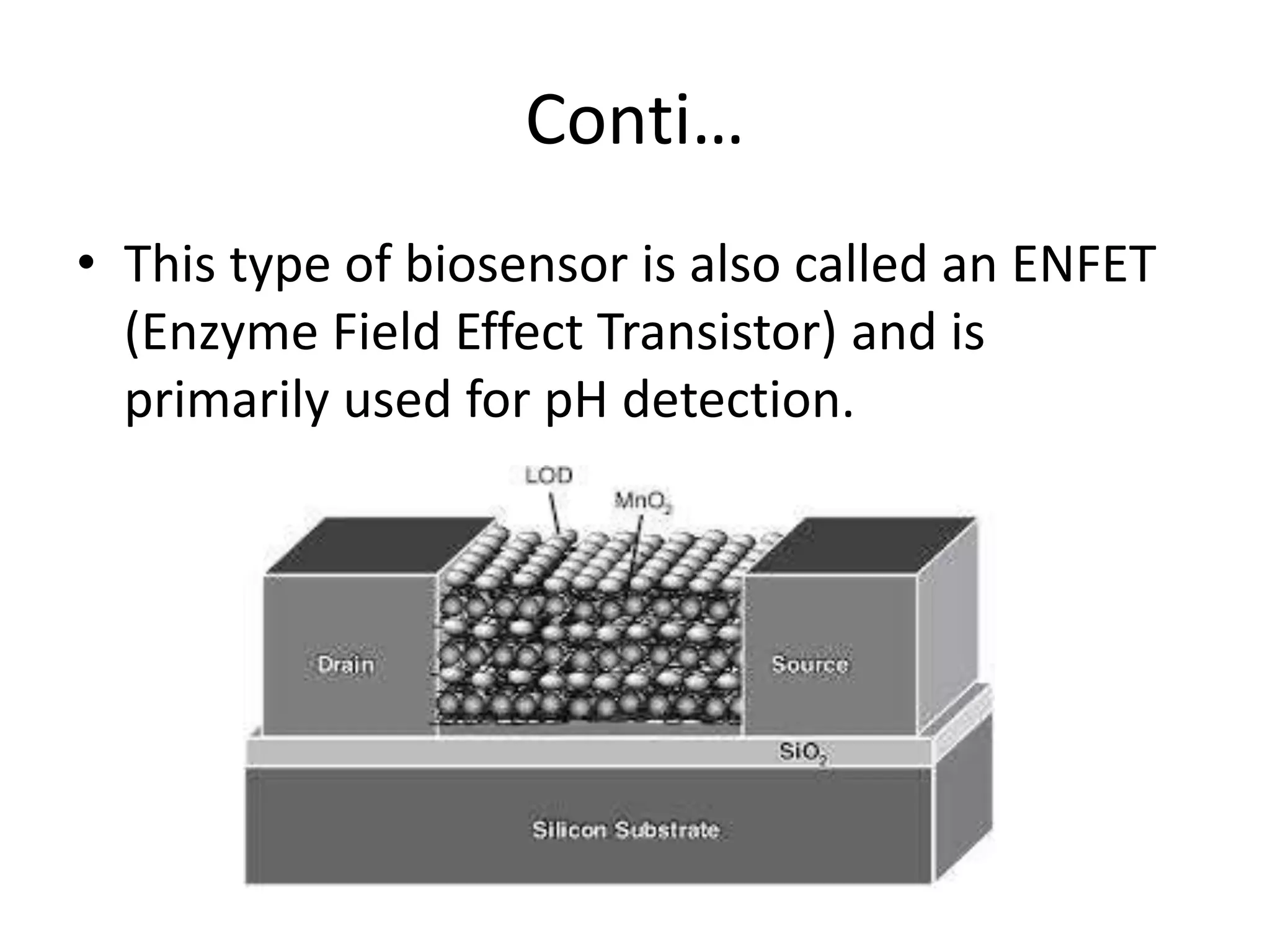
Conti…
• This type of biosensor is also called an ENFET
(Enzyme Field Effect Transistor) and is
primarily used for pH detection.
Ion sensitive biosensors
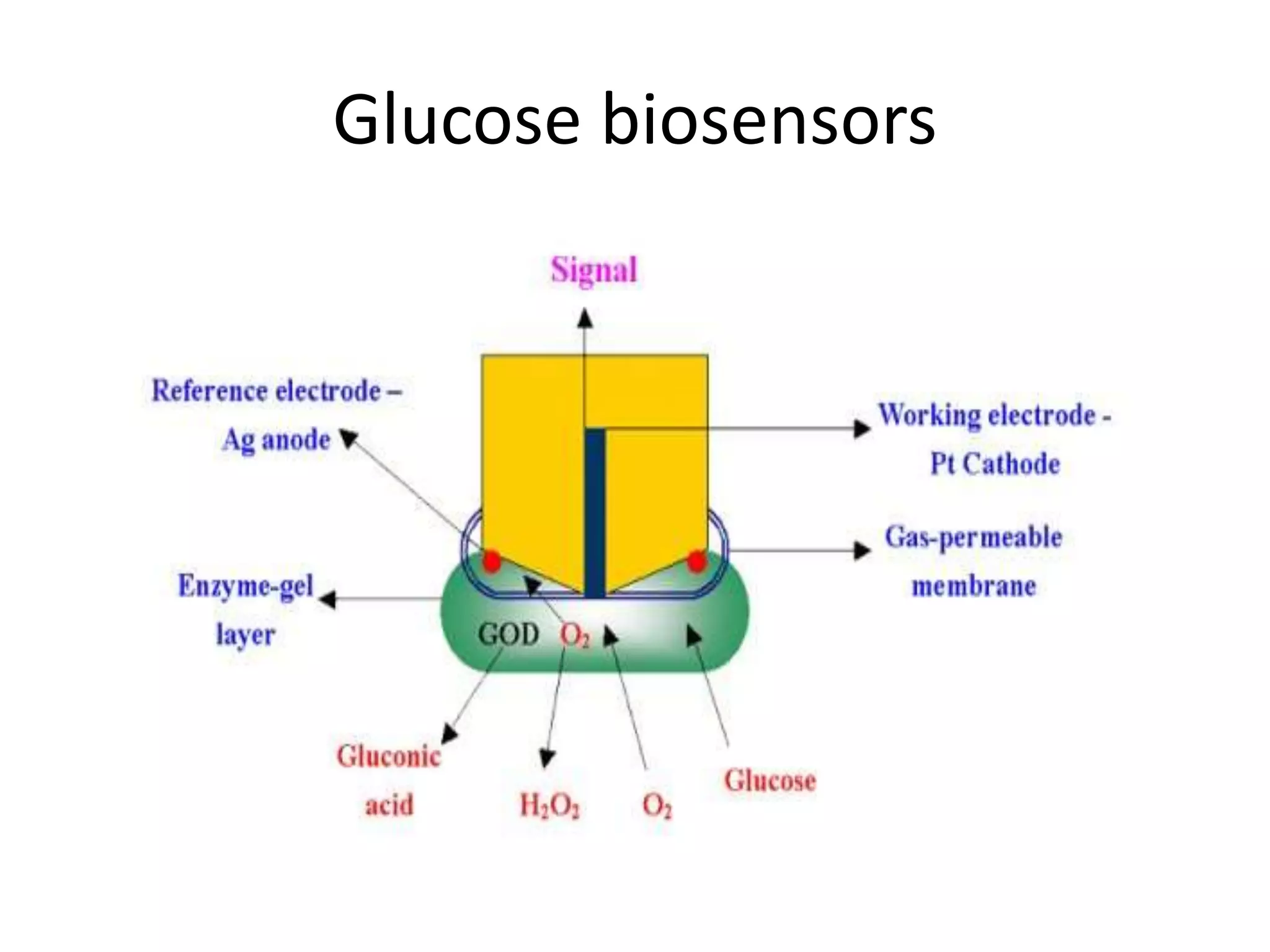
Glucose biosensors
• Glucose reacts with glucose oxidase to form
gluconic acid. Two electrons and two protons are
also produced.
• Glucose mediator reacts with surrounding oxygen
to form H2O2 and glucose oxidase.
• Now this glucose oxidase react with more
glucose.
• Higher the glucose content, the higher the
oxygen consumption.
• Glucose content can be detected by Pt-electrode.
Glucose biosensors
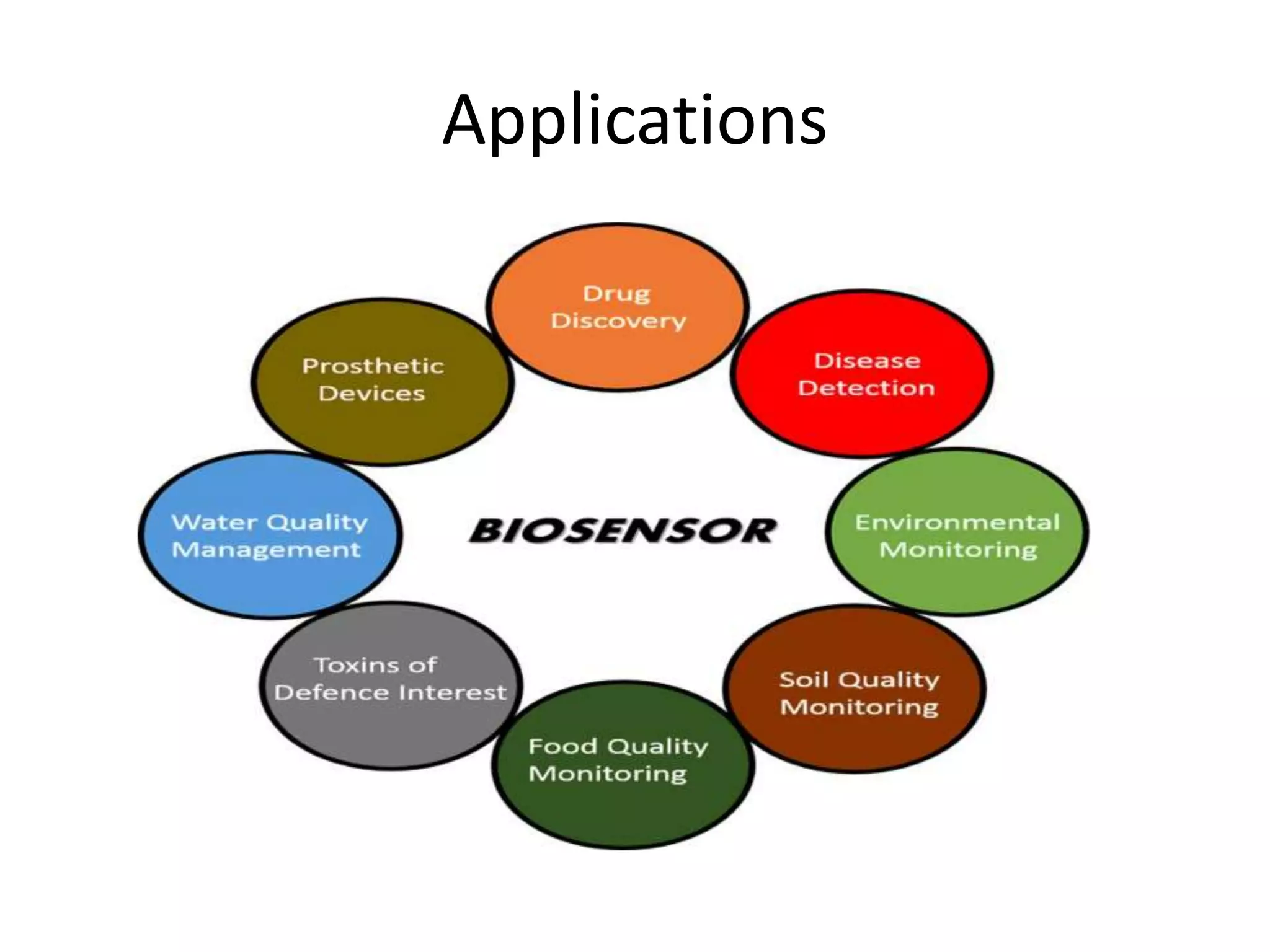
Applications
Conclusion
• As the potential threat to bioterrorism increase, there
is great need for a tool that can quickly, reliably and
accurately detect contaminating bio-agents in the
atmosphere.
• Biosensors can essentially serve as low-cost and highly
efficient devices for this purpose in addition to being
used in other day-to-day application.
• Biosensors are known as immuno-sensors,optrodes,
chemical, canaries, resonant mirrors, glucometers
biochips bio-computers and so on.

Biosensors-1g348yc.pptx

  • 2.
  • 3.
    Definition • A biosensoris an analytical device, used for the detection of an analyte, that combines a biological component with a physicochemical detector.
  • 4.
  • 5.
    Introduction • A biosensoris a sensing device comprised of a combination of a specific biological element and a transducer. • A specific biological element recognizes a specific analyte and the changes in the biomolecule are usually converted into and electrical signal ( which is in turn calibrated to a specific scale ) by a transducer. • It detects, records and transmits information regarding a physiological change or process.
  • 6.
    A successful biosensormust possess at least some of the following beneficial features: • The biocatalyst must be highly specific for the purpose of the analyses, be stable under normal storage conditions and, except in the case of colorimetric enzyme strips • The reaction should be as independent of such physical parameters as stirring, pH and temperature as is manageable. This would allow the analysis of samples with minimal pre-treatment. • The response should be accurate, precise, reproducible and linear over the useful analytical range, without dilution or concentration. It should also be free from electrical noise.
  • 7.
    • If thebiosensor is to be used for invasive monitoring in clinical situations, the probe must be tiny and biocompatible, having no toxic or antigenic effects. If it is to be used in fermenters it should be serializable. This is preferably performed by autoclaving but no biosensor enzymes can presently withstand such drastic wet-heat treatment. In either case, the biosensor should not be prone to fouling or proteolysis. • The complete biosensor should be cheap, small, portable and capable of being used by semi-skilled operators.
  • 8.
    Glucometer • Current glucometersuse test strips containing glucose oxidase, an enzyme that reacts to glucose in the blood droplet, • When the strip is inserted into the meter, the flux of the glucose reaction generates an electrical signal • The glucometer is calibrated so the number appearing in its digital readout corresponds to the strength of the electrical current
  • 9.
    Bio-element • It isa typically complex chemical system usually extracted or derived directly from a biological organism. • Types • Enzymes • Oxidase • Polysaccharide • Antibiotics • Tissue • Nucleic acid
  • 10.
    Conti… • Function • Tointeract specifically with a target compound i.e compound to be detected. • It must be capable of detecting the presence of a target compound in the test solution. • The ability of a bio-element to interact specifically with the target compound (specifically) is the basis for biosensor.
  • 11.
    Tranducer • Function • Toconvert biological response in to an electrical signal. • Types • Electrochemical • Optical • Piezoelectric
  • 12.
    Response From Bio-element •Heat absorbed (or liberated) during the interaction. • Movement of electrons produced in a redox reaction. • Light absorbed ( or liberated ) during the interaction. • Effect due to mass of reactants or products.
  • 13.
    Types Of Biosensors •Electrochemical biosensor • Optical biosensor • Thermal biosensor • Resonant biosensor • Ion-sensitive biosensor
  • 14.
    Electrochemical biosensor • Principle: •Many chemical reactions produce or consume ions or electrons which in turn cause some change in the electrical properties of the solution which can be sensed out and used as measuring parameter. • Classification: 1. Amperometric Biosensors 2. Conductimetric Biosensors 3. Potentiometric Biosensors
  • 15.
  • 16.
    Amperometric Biosensors • Thehigh sensitivity biosensor can detect electro-active species present in biological test samples. • Since the biological test samples may not be intrinsically electro-active, enzymes are needed to catalyze the production of radio- active species. • In this case, the measured parameters is current.
  • 21.
    Conductimetric Biosensors • Themeasured parameter is the electrical conductance resistance of the solution. • When electrochemical reactions produce ions or electrons, the overall conductivity or resistivity of the solution changes. This change is measured and calibrated to a proper scale (Conductance measurements have relatively low sensitivity). • The electric field is generated using a sinusoidal voltage (AC) which in minimizing undesirable effects such as Faradaic process, double layer charging and concentration polarization.
  • 22.
  • 23.
    Potentiometric biosensors • Inthis type of sensor the measured parameter is oxidation or reduction potential of an electrochemical reaction. • The working principle relies on the fact that where a ramp voltage is applied to an electrode in solution, a current flow occurs because of electrochemical reactions. • The voltage at which these reaction occurs indicate a particular reaction and particular species.
  • 24.
  • 25.
    Optical detection biosensor •The output transduced signal that is measured is light for this type of biosensor. • The biosensor can be made based on optical diffraction. In optical diffraction based devices, a silicon wafer is coated with a protein via covalent bonds. The wafer is exposed to UV light through a photo-mask and the antibodies becomeinactive in the exposed regions. When the diced wafer chips are incubated in an analyte, antigen-antibody bindings are formed in the active regions , thus creating a diffraction grating. This grating produces a diffraction signal when illuminated with a light source such as laser. The resulting signal can be measured.
  • 26.
  • 27.
    Thermal detection biosensors •This type of biosensor work on the fundamental properties of biological reactions, namely absorption or production of heat , which in turn changes the temperature of the medium in which the reaction takes place. • They are constructed by combining immobilized enzymes molecules with the temperature sensors. When the analyte comes in contact with the enzyme is measured and is calibrated against the analyte concentration. • The total heat produced or absorbed is proportional to the molar enthalpy and the total number of molecules in the reaction.
  • 28.
    Conti… • The measurementof the temperature is typically accomplished via a thermistor, and such devices are known as enzyme thermistors. Their high sensitivity to thermal changes makes thermistor ideal for such applications. • Unlike other transducers, thermal biosensors do not need frequent recalibration and are insensitive to the optical and electrochemical properties of the sample. • Common applications of this type of biosensors includes the detection of pesticides and pathogenic bacteria.
  • 29.
  • 30.
    Resonant biosensors • Itutilize crystal which undergo an electric deformation when an electrical potential is applied to them. (Alternating potential (A.C) produces a standing wave in the crystal at a characteristic frequency) • In this type of biosensor, an acoustic wave transducer is coupled with an antibody (bio- element).
  • 31.
    Conti… • When theanalyte molecule (or antigen) gets attached to the membrane, the mass of the membrane, the mass of the membrane changes. The resulting change in the mass subsequently changes the resonant frequency of the resonant frequency of the transducer. This frequency change is then measured.
  • 32.
  • 33.
    Ion sensitive biosensor •These are semiconductor FETs having an ion- sensitive surface. • The surface electrical potential changes when the ions and semiconductor interact. (This change in the potential can be subsequently measured). • The Ion sensitive Fielf Effect Transistor (ISFET) can be constructed by covering the sensor electrode with a polymer layer. This polymer layer is selectively permeable to analyte ions. The ions diffuse through the polymer layer and in return cause a change in the FET surface potential.
  • 34.
    Conti… • This typeof biosensor is also called an ENFET (Enzyme Field Effect Transistor) and is primarily used for pH detection.
  • 35.
  • 36.
    Glucose biosensors • Glucosereacts with glucose oxidase to form gluconic acid. Two electrons and two protons are also produced. • Glucose mediator reacts with surrounding oxygen to form H2O2 and glucose oxidase. • Now this glucose oxidase react with more glucose. • Higher the glucose content, the higher the oxygen consumption. • Glucose content can be detected by Pt-electrode.
  • 37.
  • 38.
  • 39.
    Conclusion • As thepotential threat to bioterrorism increase, there is great need for a tool that can quickly, reliably and accurately detect contaminating bio-agents in the atmosphere. • Biosensors can essentially serve as low-cost and highly efficient devices for this purpose in addition to being used in other day-to-day application. • Biosensors are known as immuno-sensors,optrodes, chemical, canaries, resonant mirrors, glucometers biochips bio-computers and so on.