(NAST-625): Self Assembly of
Nanostructures
By:
Sudama Chaurasiya
M. Tech IInd Sem. (NAST)
“Center for Nanoscience and Technology”
PONDICHERRY UNIVERSITY
BIO-INSPIRED APPROACH
FOR COMPLEX
SUPERSTRUCTURES
CONTENTS
• Introduction
• What is Bio-Inspired Designing.
• Typical biological materials with function integration.
• Examples of biological materials bioinspired structures
• Approaches/Methods to create superstructures.
• Conclusion
• References
INTRODUCTION
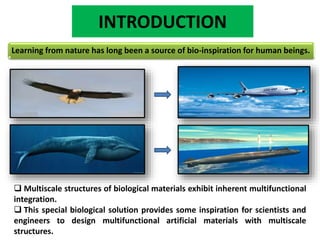
Learning from nature has long been a source of bio-inspiration for human beings.
 Multiscale structures of biological materials exhibit inherent multifunctional
integration.
 This special biological solution provides some inspiration for scientists and
engineers to design multifunctional artificial materials with multiscale
structures.
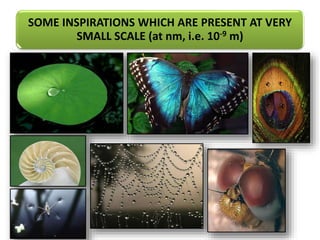
SOME INSPIRATIONS WHICH ARE PRESENT AT VERY
SMALL SCALE (at nm, i.e. 10-9 m)
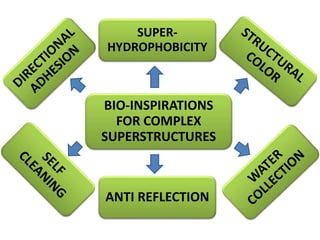
BIO-INSPIRATIONS
FOR COMPLEX
SUPERSTRUCTURES
SUPER-
HYDROPHOBICITY
ANTI REFLECTION
WHAT IS BIO INSPIRED DESIGN?
• Bio inspired design is studying the structure and
function of biological systems as models and designing
or engineering the new materials and machines.
• It is widely regarded as being synonymous with
biomimicry, biomimesis, biognosis and similar to
biomimetics.
• The term biomimetics is derived from the Greek word
bios, “life” and the suffix mimetic, “having an aptitude
for mimicry”.
• Multiscale structures of biological materials exhibit
inherent multifunctional integration and bio inspired
design uses these properties.
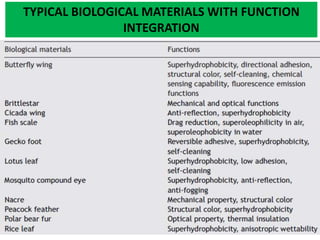
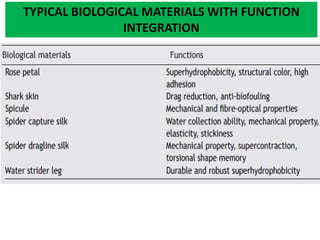
TYPICAL BIOLOGICAL MATERIALS WITH FUNCTION
INTEGRATION
TYPICAL BIOLOGICAL MATERIALS WITH FUNCTION
INTEGRATION
EXAMPLES OF BIOLOGICAL MATERIALS BIOINSPIRED STRUCTURES
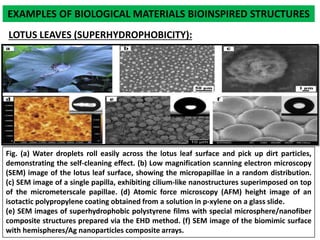
Fig. (a) Water droplets roll easily across the lotus leaf surface and pick up dirt particles,
demonstrating the self-cleaning effect. (b) Low magnification scanning electron microscopy
(SEM) image of the lotus leaf surface, showing the micropapillae in a random distribution.
(c) SEM image of a single papilla, exhibiting cilium-like nanostructures superimposed on top
of the micrometerscale papillae. (d) Atomic force microscopy (AFM) height image of an
isotactic polypropylene coating obtained from a solution in p-xylene on a glass slide.
(e) SEM images of superhydrophobic polystyrene films with special microsphere/nanofiber
composite structures prepared via the EHD method. (f) SEM image of the biomimic surface
with hemispheres/Ag nanoparticles composite arrays.
LOTUS LEAVES (SUPERHYDROPHOBICITY):
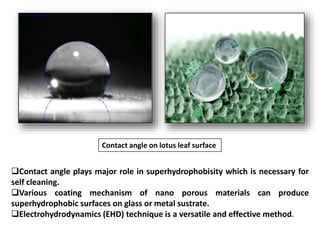
Contact angle plays major role in superhydrophobisity which is necessary for
self cleaning.
Various coating mechanism of nano porous materials can produce
superhydrophobic surfaces on glass or metal sustrate.
Electrohydrodynamics (EHD) technique is a versatile and effective method.
Contact angle on lotus leaf surface
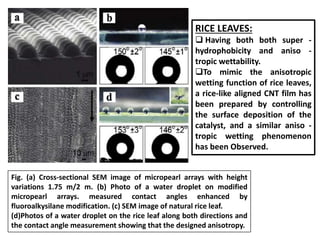
Fig. (a) Cross-sectional SEM image of micropearl arrays with height
variations 1.75 m/2 m. (b) Photo of a water droplet on modified
micropearl arrays. measured contact angles enhanced by
fluoroalkysilane modification. (c) SEM image of natural rice leaf.
(d)Photos of a water droplet on the rice leaf along both directions and
the contact angle measurement showing that the designed anisotropy.
RICE LEAVES:
 Having both both super -
hydrophobicity and aniso -
tropic wettability.
To mimic the anisotropic
wetting function of rice leaves,
a rice-like aligned CNT film has
been prepared by controlling
the surface deposition of the
catalyst, and a similar aniso -
tropic wetting phenomenon
has been Observed.
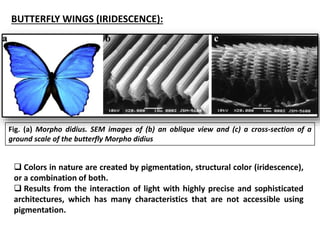
BUTTERFLY WINGS (IRIDESCENCE):
Fig. (a) Morpho didius. SEM images of (b) an oblique view and (c) a cross-section of a
ground scale of the butterfly Morpho didius
 Colors in nature are created by pigmentation, structural color (iridescence),
or a combination of both.
 Results from the interaction of light with highly precise and sophisticated
architectures, which has many characteristics that are not accessible using
pigmentation.
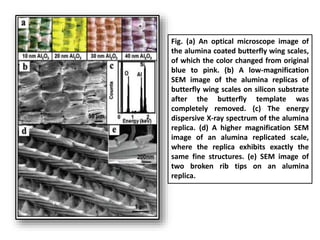
Fig. (a) An optical microscope image of
the alumina coated butterfly wing scales,
of which the color changed from original
blue to pink. (b) A low-magnification
SEM image of the alumina replicas of
butterfly wing scales on silicon substrate
after the butterfly template was
completely removed. (c) The energy
dispersive X-ray spectrum of the alumina
replica. (d) A higher magnification SEM
image of an alumina replicated scale,
where the replica exhibits exactly the
same fine structures. (e) SEM image of
two broken rib tips on an alumina
replica.
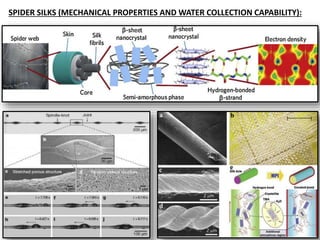
SPIDER SILKS (MECHANICAL PROPERTIES AND WATER COLLECTION CAPABILITY):
 Artificial dragline spider silk has been fabricated by spinning
soluble recombinant dragline silk proteins (ADF-3; 60 kDa)
produced in mammalian cells under modest shear and
coagulation conditions.
 Single-walled carbon nanotubes (SWNTs)-PVA composite
fibers has been fabricated by spinning method , which are
tougher than spider silk and any other natural or synthetic
organic fiber reported previously.
 Fibers possess periodic spindle-knots made of random
nanofibrils separated by joints made of aligned nanofibrils.
 Artificial fibers that mimic the structural features of wet-
rebuilt spider silk and exhibit the directional water-collecting
ability.
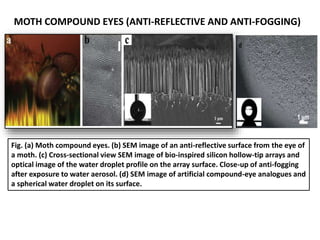
Fig. (a) Moth compound eyes. (b) SEM image of an anti-reflective surface from the eye of
a moth. (c) Cross-sectional view SEM image of bio-inspired silicon hollow-tip arrays and
optical image of the water droplet profile on the array surface. Close-up of anti-fogging
after exposure to water aerosol. (d) SEM image of artificial compound-eye analogues and
a spherical water droplet on its surface.
MOTH COMPOUND EYES (ANTI-REFLECTIVE AND ANTI-FOGGING)
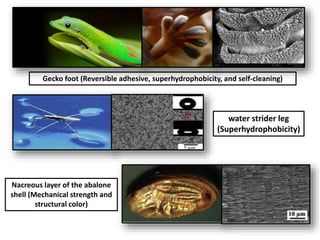
Gecko foot (Reversible adhesive, superhydrophobicity, and self-cleaning)
water strider leg
(Superhydrophobicity)
Nacreous layer of the abalone
shell (Mechanical strength and
structural color)
PAH-SPEEK/PAA: poly(allylamine hydrochloride) (PAH)-sulfonated poly(ether ether ketone)
(SPEEK)/poly(acrylic acid) (PAA); PDMS: polydimethylsiloxane; PUA: Polyurethane acrylate;
Upy: 2-ureido-4[1H]-pyrimidone.
MATERIALS AND METHODS/APPROACHES TO CREATE
SUPERSTRUCTURES.
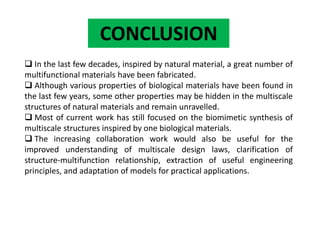
CONCLUSION
 In the last few decades, inspired by natural material, a great number of
multifunctional materials have been fabricated.
 Although various properties of biological materials have been found in
the last few years, some other properties may be hidden in the multiscale
structures of natural materials and remain unravelled.
 Most of current work has still focused on the biomimetic synthesis of
multiscale structures inspired by one biological materials.
 The increasing collaboration work would also be useful for the
improved understanding of multiscale design laws, clarification of
structure-multifunction relationship, extraction of useful engineering
principles, and adaptation of models for practical applications.
REFERENCES
1. “Bio-inspired design of multiscale structures for function integration” by Kesong
Liua, Lei Jianga Elsevier Nano Today (2011) 6, (155—175)
2. http://en.wikipedia.org/wiki/Biomimetics
3. “Bio-inspired fabrication of antireflection nanostructures by replicating fly eyes” by
Jingyun Huang, XudongWang and Zhong LinWang IOP Nanotechnology 19 (2008)
025602 (6pp)
FOR YOUR KIND ATTENTION

Bio inspired materials ppt

  • 1.
    (NAST-625): Self Assemblyof Nanostructures By: Sudama Chaurasiya M. Tech IInd Sem. (NAST) “Center for Nanoscience and Technology” PONDICHERRY UNIVERSITY BIO-INSPIRED APPROACH FOR COMPLEX SUPERSTRUCTURES
  • 2.
    CONTENTS • Introduction • Whatis Bio-Inspired Designing. • Typical biological materials with function integration. • Examples of biological materials bioinspired structures • Approaches/Methods to create superstructures. • Conclusion • References
  • 3.
    INTRODUCTION Learning from naturehas long been a source of bio-inspiration for human beings.  Multiscale structures of biological materials exhibit inherent multifunctional integration.  This special biological solution provides some inspiration for scientists and engineers to design multifunctional artificial materials with multiscale structures.
  • 4.
    SOME INSPIRATIONS WHICHARE PRESENT AT VERY SMALL SCALE (at nm, i.e. 10-9 m)
  • 5.
  • 6.
    WHAT IS BIOINSPIRED DESIGN? • Bio inspired design is studying the structure and function of biological systems as models and designing or engineering the new materials and machines. • It is widely regarded as being synonymous with biomimicry, biomimesis, biognosis and similar to biomimetics. • The term biomimetics is derived from the Greek word bios, “life” and the suffix mimetic, “having an aptitude for mimicry”. • Multiscale structures of biological materials exhibit inherent multifunctional integration and bio inspired design uses these properties.
  • 7.
    TYPICAL BIOLOGICAL MATERIALSWITH FUNCTION INTEGRATION
  • 8.
    TYPICAL BIOLOGICAL MATERIALSWITH FUNCTION INTEGRATION
  • 9.
    EXAMPLES OF BIOLOGICALMATERIALS BIOINSPIRED STRUCTURES Fig. (a) Water droplets roll easily across the lotus leaf surface and pick up dirt particles, demonstrating the self-cleaning effect. (b) Low magnification scanning electron microscopy (SEM) image of the lotus leaf surface, showing the micropapillae in a random distribution. (c) SEM image of a single papilla, exhibiting cilium-like nanostructures superimposed on top of the micrometerscale papillae. (d) Atomic force microscopy (AFM) height image of an isotactic polypropylene coating obtained from a solution in p-xylene on a glass slide. (e) SEM images of superhydrophobic polystyrene films with special microsphere/nanofiber composite structures prepared via the EHD method. (f) SEM image of the biomimic surface with hemispheres/Ag nanoparticles composite arrays. LOTUS LEAVES (SUPERHYDROPHOBICITY):
  • 10.
    Contact angle playsmajor role in superhydrophobisity which is necessary for self cleaning. Various coating mechanism of nano porous materials can produce superhydrophobic surfaces on glass or metal sustrate. Electrohydrodynamics (EHD) technique is a versatile and effective method. Contact angle on lotus leaf surface
  • 11.
    Fig. (a) Cross-sectionalSEM image of micropearl arrays with height variations 1.75 m/2 m. (b) Photo of a water droplet on modified micropearl arrays. measured contact angles enhanced by fluoroalkysilane modification. (c) SEM image of natural rice leaf. (d)Photos of a water droplet on the rice leaf along both directions and the contact angle measurement showing that the designed anisotropy. RICE LEAVES:  Having both both super - hydrophobicity and aniso - tropic wettability. To mimic the anisotropic wetting function of rice leaves, a rice-like aligned CNT film has been prepared by controlling the surface deposition of the catalyst, and a similar aniso - tropic wetting phenomenon has been Observed.
  • 12.
    BUTTERFLY WINGS (IRIDESCENCE): Fig.(a) Morpho didius. SEM images of (b) an oblique view and (c) a cross-section of a ground scale of the butterfly Morpho didius  Colors in nature are created by pigmentation, structural color (iridescence), or a combination of both.  Results from the interaction of light with highly precise and sophisticated architectures, which has many characteristics that are not accessible using pigmentation.
  • 13.
    Fig. (a) Anoptical microscope image of the alumina coated butterfly wing scales, of which the color changed from original blue to pink. (b) A low-magnification SEM image of the alumina replicas of butterfly wing scales on silicon substrate after the butterfly template was completely removed. (c) The energy dispersive X-ray spectrum of the alumina replica. (d) A higher magnification SEM image of an alumina replicated scale, where the replica exhibits exactly the same fine structures. (e) SEM image of two broken rib tips on an alumina replica.
  • 14.
    SPIDER SILKS (MECHANICALPROPERTIES AND WATER COLLECTION CAPABILITY):
  • 15.
     Artificial draglinespider silk has been fabricated by spinning soluble recombinant dragline silk proteins (ADF-3; 60 kDa) produced in mammalian cells under modest shear and coagulation conditions.  Single-walled carbon nanotubes (SWNTs)-PVA composite fibers has been fabricated by spinning method , which are tougher than spider silk and any other natural or synthetic organic fiber reported previously.  Fibers possess periodic spindle-knots made of random nanofibrils separated by joints made of aligned nanofibrils.  Artificial fibers that mimic the structural features of wet- rebuilt spider silk and exhibit the directional water-collecting ability.
  • 16.
    Fig. (a) Mothcompound eyes. (b) SEM image of an anti-reflective surface from the eye of a moth. (c) Cross-sectional view SEM image of bio-inspired silicon hollow-tip arrays and optical image of the water droplet profile on the array surface. Close-up of anti-fogging after exposure to water aerosol. (d) SEM image of artificial compound-eye analogues and a spherical water droplet on its surface. MOTH COMPOUND EYES (ANTI-REFLECTIVE AND ANTI-FOGGING)
  • 17.
    Gecko foot (Reversibleadhesive, superhydrophobicity, and self-cleaning) water strider leg (Superhydrophobicity) Nacreous layer of the abalone shell (Mechanical strength and structural color)
  • 18.
    PAH-SPEEK/PAA: poly(allylamine hydrochloride)(PAH)-sulfonated poly(ether ether ketone) (SPEEK)/poly(acrylic acid) (PAA); PDMS: polydimethylsiloxane; PUA: Polyurethane acrylate; Upy: 2-ureido-4[1H]-pyrimidone. MATERIALS AND METHODS/APPROACHES TO CREATE SUPERSTRUCTURES.
  • 19.
    CONCLUSION  In thelast few decades, inspired by natural material, a great number of multifunctional materials have been fabricated.  Although various properties of biological materials have been found in the last few years, some other properties may be hidden in the multiscale structures of natural materials and remain unravelled.  Most of current work has still focused on the biomimetic synthesis of multiscale structures inspired by one biological materials.  The increasing collaboration work would also be useful for the improved understanding of multiscale design laws, clarification of structure-multifunction relationship, extraction of useful engineering principles, and adaptation of models for practical applications.
  • 20.
    REFERENCES 1. “Bio-inspired designof multiscale structures for function integration” by Kesong Liua, Lei Jianga Elsevier Nano Today (2011) 6, (155—175) 2. http://en.wikipedia.org/wiki/Biomimetics 3. “Bio-inspired fabrication of antireflection nanostructures by replicating fly eyes” by Jingyun Huang, XudongWang and Zhong LinWang IOP Nanotechnology 19 (2008) 025602 (6pp)
  • 21.
    FOR YOUR KINDATTENTION