INNOVATIVE NANOTECHNOLOGY
ADVANCEMENT
INFIELD OFHEALTH
PRSENTED BY :
RAHUL KUMAR YADAV – 11500318054
SHAHID AKHTAR - 11500318033
TANISHK SAHJRA -11500318009
Whatis
Nanotechnology?
Whatis
Nanotechnology?
Whatis
Nanotechnology?
WHATIS
NANOTECHNOLOGY
 Nanotechnology is the engineering of
functional systems at the molecular
level. The field combines elements of
physics and molecular chemistry with
engineering to take advantage of
unique properties that occur at
nanoscale.
 One practical example of this
technology is the use of tiny carbon
nanotubes to transport drugs to
specific cells. Not only do these
nanotubes have low toxicity and a
stable structure, they’re an ideal
container for transporting drugs
directly to the desired cells.
TheFutureof
Nanotechnologyin
Medicine
 Around the world, researchers are
increasingly thinking smaller to solve some
of the biggest problems in medicine.
 Though most biological processes happen at
the nano level, it wasn’t until recently that
new technological advancements helped in
opening up the possibility of nanomedicine
to healthcare researchers and professionals.
Nanomedicine
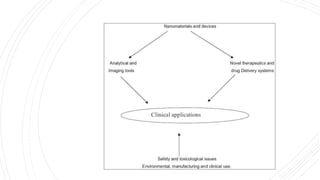
 The field of “Nanomedicine” is the science and technology
of diagnosing, treating, and preventing disease and
traumatic injury, of relieving pain, and of preserving and
improving human health, using nanoscale structured
materials, biotechnology, and genetic engineering, and
eventually complex machine systems and nono-robots. It
was perceived as embracing five main subdisciplines that
in many ways are overlapping by common technical issues
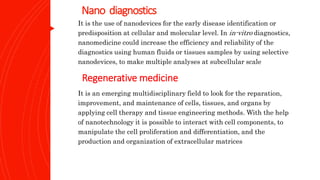
Nano diagnostics
It is the use of nanodevices for the early disease identification or
predisposition at cellular and molecular level. In in-vitro diagnostics,
nanomedicine could increase the efficiency and reliability of the
diagnostics using human fluids or tissues samples by using selective
nanodevices, to make multiple analyses at subcellular scale
Regenerative medicine
It is an emerging multidisciplinary field to look for the reparation,
improvement, and maintenance of cells, tissues, and organs by
applying cell therapy and tissue engineering methods. With the help
of nanotechnology it is possible to interact with cell components, to
manipulate the cell proliferation and differentiation, and the
production and organization of extracellular matrices
Applicationsin
medicine
 Within 10–20 years it should become possible to construct
machines on the micrometer scale made up of parts on the
nanometer scale. Subassemblies of such devices may include
such as useful robotic components as 100 nm manipulate
arms, 10 nm sorting rotors for molecule by molecule reagent
purification, and smooth super hard surfaces made of
automatically flawless diamond.
 Nano computers would assume the important task of
activating, controlling, and deactivating such
nanomechanical devices. Nano computers would store and
execute mission plans, receive and process external signals
and stimuli, communicate with other nano computers or
external control and monitoring devices, and possess
contextual knowledge to ensure safe functioning of the
nanomechanical devices. Such technology has enormous
medical and dental implications.
Nanoroboticmicrobivores
 Artificial phagocytes called microbivores could patrol the
bloodstream, seeking out and digesting unwanted pathogens
including bacteria, viruses, or fungi. Microbivores would
achieve complete clearance of even the most severe
septicemic infections in hours or less. The nanorobots do not
increase the risk of sepsis or septic shock because the
pathogens are completely digested into harmless sugars,
amino acids, and the like, which are the only effluents from
the nanorobot.
Surgicalnanorobotics
 A surgical nanorobot, programmed or guided by a human
surgeon, could act as a semiautonomous on site surgeon
inside the human body, when introduced into the body
through vascular system or cavities. Such a device could
perform various functions such as searching for pathology
and then diagnosing and correcting lesions by
nanomanipulation, coordinated by an onboard computer
while maintaining contact with the supervising surgeon
via coded ultrasound signals
Toothrepair
 Nanorobotic manufacture and installation of a
biologically autologous whole replacement tooth that
includes both mineral and cellular components, that is,
‘complete dentition replacement therapy’ should become
feasible within the time and economic constraints of a
typical office visit through the use of an affordable
desktop manufacturing facility, which would fabricate
the new tooth in the dentist's office.
And many more applications...
CONCLUSION
 The visions described in this article may sound
unlikely, implausible, or even heretic. Yet, the
theoretical and applied research to turn them into
reality is progressing rapidly. Nanotechnology will
change dentistry, healthcare, and human life more
profoundly than many developments of the past. As
with all technologies, nanotechnology carries a
significant potential for misuse and abuse on a scale
and scope never seen before. However, they also
have potential to bring about significant benefits,
such as improved health, better use of natural
resources, and reduced environmental pollution.
These truly are the days of miracle and wonder.
REFERENCES
REFERENCES
 1. Rocco Castoro. U F expects big things from the science of small,
nanotechnology. Think Small. The POST 02-2005.
 2. Feynman RP. There's plenty of room at the bottom. Eng
Sci. 1960;23:22–36. [Google Scholar]
 3. Drexler KE. New era of nanotechnology. New York: Anchor
Press; 1986. Engines of creation: The coming era of
nanotechnology; pp. 99–129. [Google Scholar]
 4. Freitas RA., Jr . Basic capabilities. Vol 1. Texas: Landes
Bioscience; 1999. Nanomedicine. Available
from: http//www.nanomedicine.com [last accessed on 2000 Sep 26]
Georgetown. [Google Scholar]
 5. European Science Foundation. Nanomedicine. Forward look on
Nanomedicine. 2005 [Google Scholar]

Nano electronics in medical field!

  • 1.
    INNOVATIVE NANOTECHNOLOGY ADVANCEMENT INFIELD OFHEALTH PRSENTEDBY : RAHUL KUMAR YADAV – 11500318054 SHAHID AKHTAR - 11500318033 TANISHK SAHJRA -11500318009
  • 2.
    Whatis Nanotechnology? Whatis Nanotechnology? Whatis Nanotechnology? WHATIS NANOTECHNOLOGY  Nanotechnology isthe engineering of functional systems at the molecular level. The field combines elements of physics and molecular chemistry with engineering to take advantage of unique properties that occur at nanoscale.  One practical example of this technology is the use of tiny carbon nanotubes to transport drugs to specific cells. Not only do these nanotubes have low toxicity and a stable structure, they’re an ideal container for transporting drugs directly to the desired cells.
  • 3.
    TheFutureof Nanotechnologyin Medicine  Around theworld, researchers are increasingly thinking smaller to solve some of the biggest problems in medicine.  Though most biological processes happen at the nano level, it wasn’t until recently that new technological advancements helped in opening up the possibility of nanomedicine to healthcare researchers and professionals.
  • 4.
    Nanomedicine  The fieldof “Nanomedicine” is the science and technology of diagnosing, treating, and preventing disease and traumatic injury, of relieving pain, and of preserving and improving human health, using nanoscale structured materials, biotechnology, and genetic engineering, and eventually complex machine systems and nono-robots. It was perceived as embracing five main subdisciplines that in many ways are overlapping by common technical issues
  • 6.
    Nano diagnostics It isthe use of nanodevices for the early disease identification or predisposition at cellular and molecular level. In in-vitro diagnostics, nanomedicine could increase the efficiency and reliability of the diagnostics using human fluids or tissues samples by using selective nanodevices, to make multiple analyses at subcellular scale Regenerative medicine It is an emerging multidisciplinary field to look for the reparation, improvement, and maintenance of cells, tissues, and organs by applying cell therapy and tissue engineering methods. With the help of nanotechnology it is possible to interact with cell components, to manipulate the cell proliferation and differentiation, and the production and organization of extracellular matrices
  • 7.
    Applicationsin medicine  Within 10–20years it should become possible to construct machines on the micrometer scale made up of parts on the nanometer scale. Subassemblies of such devices may include such as useful robotic components as 100 nm manipulate arms, 10 nm sorting rotors for molecule by molecule reagent purification, and smooth super hard surfaces made of automatically flawless diamond.  Nano computers would assume the important task of activating, controlling, and deactivating such nanomechanical devices. Nano computers would store and execute mission plans, receive and process external signals and stimuli, communicate with other nano computers or external control and monitoring devices, and possess contextual knowledge to ensure safe functioning of the nanomechanical devices. Such technology has enormous medical and dental implications.
  • 8.
    Nanoroboticmicrobivores  Artificial phagocytescalled microbivores could patrol the bloodstream, seeking out and digesting unwanted pathogens including bacteria, viruses, or fungi. Microbivores would achieve complete clearance of even the most severe septicemic infections in hours or less. The nanorobots do not increase the risk of sepsis or septic shock because the pathogens are completely digested into harmless sugars, amino acids, and the like, which are the only effluents from the nanorobot.
  • 9.
    Surgicalnanorobotics  A surgicalnanorobot, programmed or guided by a human surgeon, could act as a semiautonomous on site surgeon inside the human body, when introduced into the body through vascular system or cavities. Such a device could perform various functions such as searching for pathology and then diagnosing and correcting lesions by nanomanipulation, coordinated by an onboard computer while maintaining contact with the supervising surgeon via coded ultrasound signals
  • 10.
    Toothrepair  Nanorobotic manufactureand installation of a biologically autologous whole replacement tooth that includes both mineral and cellular components, that is, ‘complete dentition replacement therapy’ should become feasible within the time and economic constraints of a typical office visit through the use of an affordable desktop manufacturing facility, which would fabricate the new tooth in the dentist's office. And many more applications...
  • 11.
    CONCLUSION  The visionsdescribed in this article may sound unlikely, implausible, or even heretic. Yet, the theoretical and applied research to turn them into reality is progressing rapidly. Nanotechnology will change dentistry, healthcare, and human life more profoundly than many developments of the past. As with all technologies, nanotechnology carries a significant potential for misuse and abuse on a scale and scope never seen before. However, they also have potential to bring about significant benefits, such as improved health, better use of natural resources, and reduced environmental pollution. These truly are the days of miracle and wonder.
  • 12.
    REFERENCES REFERENCES  1. RoccoCastoro. U F expects big things from the science of small, nanotechnology. Think Small. The POST 02-2005.  2. Feynman RP. There's plenty of room at the bottom. Eng Sci. 1960;23:22–36. [Google Scholar]  3. Drexler KE. New era of nanotechnology. New York: Anchor Press; 1986. Engines of creation: The coming era of nanotechnology; pp. 99–129. [Google Scholar]  4. Freitas RA., Jr . Basic capabilities. Vol 1. Texas: Landes Bioscience; 1999. Nanomedicine. Available from: http//www.nanomedicine.com [last accessed on 2000 Sep 26] Georgetown. [Google Scholar]  5. European Science Foundation. Nanomedicine. Forward look on Nanomedicine. 2005 [Google Scholar]