BIOMOLECULES
By, K. P. Komal, Assistant professor, Govt. Science College, Chitradurga
2018-19
1
A
Lecture Notes On,
BIOMOLECULES
For B.Sc. Students
BIOMOLECULES
By, K. P. Komal, Assistant professor, Govt. Science College, Chitradurga
2018-19
2
CARBOHYDRATES:
• Carbohydrates are often known as sugars, they are soluble in water and sweet in
taste.
• They are the most abundant class of biomolecules in nature, based on mass.
• Carbohydrates are also known as saccharides, in Greek sakcharon mean sugar or
sweetness.
• They are widely distributed molecules in plant and animal tissues. They are
important energy source required for various metabolic activities, the energy is
derived by oxidation. Plants are richer in carbohydrates than animals.
Definition
Carbohydrate is an organic compound, it comprises of only oxygen, carbon and
hydrogen. The oxygen: hydrogen ratio is usually is 2:1. The empirical formula
being (CH2O)n.
“Carbohydrates are hydrates of carbon, technically they are polyhydroxy
aldehydes or ketones”.
General properties of carbohydrates are,
• Carbohydrates acts as energy reserve, also stores fuels and metabolic
intermediates.
• Ribose and deoxyribose sugars forms the structural frame of the genetic material,
RNA and DNA.
• Polysaccharides like cellulose are the structural element in the cell wall of the
bacteria and plants.
• Carbohydrates are linked to proteins and lipids that play important roles in the
cell interaction.
• Carbohydrates are the organic compounds; they are aldehydes or ketones with
many hydroxyl groups.
Physical properties of Carbohydrates:
BIOMOLECULES
By, K. P. Komal, Assistant professor, Govt. Science College, Chitradurga
2018-19
3
▪ Isomerism: Two broad categories of isomers are :
(i) Structural isomers.
(ii) Stereo isomers.
• The structural isomers are defined as isomers having same molecule formula
but different structures.
• The stereo isomers have same molecular and structural formula but differ in
configuration i.e. arrangement of atoms in space. Stereo isomers are further
sub grouped into
1. optical isomers and
2. Geometrical isomers.
1. Optical isomerism is a characteristic feature of compounds with asymmetric
carbon atom known as chiral center. Chiral center refers to the carbon atom
having four different groups attached to it. When a beam of polarized light is
passed through a solution of an optical isomer, it will be rotated either to the right
or left. This leads to two possibilities by which atoms can be arranged as shown in
figure below :
D- Glyceraldehyde L- Glyceraldehyde
2. Geometrical isomerism:
D- Represents the hydroxyl group on right hand side, whereas L- represents
hydroxyl group on the left hand side. These two forms reflect mirror image
of each other’s and called enantiomers. The stereoisomers which are not
enantiomers are termed as distereoisomers.
BIOMOLECULES
By, K. P. Komal, Assistant professor, Govt. Science College, Chitradurga
2018-19
4
In the figure above, I and II, III and IV are enantiomers whereas I, III, IV and II, III,
IV are diastereomers.
• Enantiomers have same physical properties like melting point, boiling point,
solubility in various solvents but they rotate plane polarized light in opposite
directions. Those which rotate plane polarized light in clock wise direction are
called dextrorotatory (represented by +) and those which rotate in anti-clock wise
direction are called levorotatory (represented by -). Thus D - Glucose can exist as
both dextrorotatory (+) and Levorotatory (-) .
• Van’t Hoff formula of 2n works gives the numbers of possible optical isomers,
where n is the number of chiral carbon. A triose will have two optical isomers and
a tetrose will have four .
• D - Glucose and D - Mannose have different configuration only at C - 2 carbon.
Such carbohydrates which differ in configuration only at one carbon atom are
designated as epimers of each other.
If D and L isomers are present in equal concentration, it is known as
racemic mixture. Racemic mixtures do not exhibit any optical activity.
Oxidation/reduction
Figure - A positive Benedict’s test starting at left and moving right
BIOMOLECULES
By, K. P. Komal, Assistant professor, Govt. Science College, Chitradurga
2018-19
5
The last considerations for simple sugars relative to their structure are their
chemical reactivity and modification. Sugars that are readily oxidized are called
‘reducing sugars’ because their oxidation causes other reacting molecules to be reduced.
A test for reducing sugars is known as Benedict’s test. In it, sugars are mixed and
heated with an alkaline solution containing Cu++. Reducing sugars will donate an
electron to Cu++, converting it to Cu+, which will produce cuprous oxide Cu2O, as an
orange precipitate. Since Cu++ solution is blue, the change of color provides an easy
visual indication of a reducing sugar.
Figure - Reducing and non-reducing sugars
The aldehyde group of aldoses is very susceptible to oxidation, whereas ketoses are
less so, but can easily be oxidized if, like fructose, they contain an α-hydroxyl and can
tautomerize to an aldose. Most monosaccharides are reducing sugars. This includes all of
the common ones galactose, glucose, fructose, ribose, xylose, and mannose. Some
disaccharides, such as lactose and maltose are reducing sugars since they have at least
one anomeric carbon free, allowing that part of the sugar to linearize and yield an
aldose. Sucrose, on the other hand has no anomeric carbons free - both are involved in
a glycosidic linkage, so they cannot linearize and thus it is not a reducing sugar.
Oxidation and reduction of sugars can occur in cells. As we will see,
phosphorylation of sugars occurs routinely during metabolism.
Classification
Carbohydrates are classified into three groups based on hydrolysis,
BIOMOLECULES
By, K. P. Komal, Assistant professor, Govt. Science College, Chitradurga
2018-19
6
1) Monosaccharides or Monosachoroses
Monosaccharides are often called simple sugars, these are compound which
possess a free aldehyde or ketone group. They are the simplest sugars and cannot be
hydrolyzed. The general formula is Cn (H2O)n or CnH2nOn. The monosaccharides are
subdivided into trioses, tetrose, pentoses, hexoses, heptoses etc., and also as aldoses or
ketoses depending upon whether they contain aldehyde or ketone group.
Examples of monosaccharides are Fructose, Erythrulose, Ribulose.
BIOMOLECULES
By, K. P. Komal, Assistant professor, Govt. Science College, Chitradurga
2018-19
7
2) Oligosaccharides or Oligosaccharoses
In Greek, Oligo means few. Oligosaccharides are compound sugars that yield 2
to 10 molecules of the same or different monosaccharides on hydrolysis.
Oligosaccharides yielding 2 molecules of monosaccharides on hydrolysis are
known as a disaccharide, and the ones yielding 3 or 4 monosaccharides are known as
trisaccharides and tetrasaccharides respectively and so on. The general formula of
disaccharides is Cn(H2O)n-1and that of trisaccharides is Cn(H2O)n-2 and so on.
Example of disaccharides is sucrose, lactose, maltose etc. and trisaccharides are
Raffinose, Rabinose.
BIOMOLECULES
By, K. P. Komal, Assistant professor, Govt. Science College, Chitradurga
2018-19
8
3) Polysaccharides or Polysaccharoses
In Greek, poly means many. Polysaccharides are compound sugars and yield
more than 10 molecules of monosaccharides on hydrolysis. They are further classified
depending on the type of molecules produced as a result of hydrolysis. They may be
homopolysaccharides i.e., monosaccharides of the same type or heteropolysaccharides
i.e., monosaccharides of different types. The general formula is (C6H10O5)x.
Example of homopolysaccharides are starch, glycogen, cellulose, pectin.
Heteropolysaccharides are Hyaluronic acid, Chondroitin sulphate etc.
BIOMOLECULES
By, K. P. Komal, Assistant professor, Govt. Science College, Chitradurga
2018-19
9
Structure of Carbohydrates
There are three types of structural representations of carbohydrates:
• Open chain structure.
• Hemi-acetal structure.
• Haworth structure.
Open chain structure - It is the long straight chain form of carbohydrates.
Example:
BIOMOLECULES
By, K. P. Komal, Assistant professor, Govt. Science College, Chitradurga
2018-19
10
Hemi-acetal structure - Here the 1st carbon of the glucose condenses with the –OH
group of the 5th carbon to form a ring structure.
Haworth structure - It is the presence of pyranose ring structure.
BIOMOLECULES
By, K. P. Komal, Assistant professor, Govt. Science College, Chitradurga
2018-19
11
Functions of Carbohydrates
• Carbohydrates are chief energy source, in many animals; they are instant source
of energy. Glucose is broken down by glycolysis/ kreb's cycle to yield ATP.
• Glucose is the source of storage of energy. It is stored as glycogen in animals and
starch in plants.
• Stored carbohydrates act as energy source instead of proteins.
• Carbohydrates are intermediates in biosynthesis of fats and proteins.
• Carbohydrates aid in regulation of nerve tissue and are the energy source for
brain.
• Carbohydrates get associated with lipids and proteins to form surface antigens,
receptor molecules, vitamins and antibiotics.
• They form structural and protective components, like in cell wall of plants and
microorganisms.
• In animals they are important constituent of connective tissues.
• They participate in biological transport, cell-cell communication and activation of
growth factors.
• Carbohydrates that is rich in fiber content help to prevent constipation.
• Also they help in modulation of immune system.
SL.NO NAME FUNCTION
1 RIBOSE
• Ribose primarily occurs as D-ribose.
• It is an aldopentose, a monosaccharide containing five
carbon atoms that has an aldehyde functional group at
one end. Typically, this species exists in the cyclic form.
• Ribose composes the backbone for RNA and relates to
deoxyribose, as found in DNA, by removal of the hydroxy
group on the 2' Carbon.
BIOMOLECULES
By, K. P. Komal, Assistant professor, Govt. Science College, Chitradurga
2018-19
12
• Ribose is less resistant to hydrolysis and will cause tension
in RNA due to the negative charge of the Phosphodiester
bridge and the hydroxyl group on the 2' Carbon.
• The hydroxyl group has the capability to attack the
phosphodiester bond that typically links it to another
ribose, thereby forming a cyclic form of the sugar. An
example of this is cyclic Adenosine Monophosphate
(cAMP).
• Provide a backbone for DNA and RNA
• Restores ATP in the body
• Improve muscle stamina
• Regulate blood circulation in the heart.
2 GLUCOSE
• Glucose is an important monosaccharide in that it
provides both energy and structure to many organisms.
• Glucose molecules can be broken down in glycolysis,
providing energy and precursors for cellular respiration.
• If a cell does not need any more energy at the moment,
glucose can be stored by combining it with other
monosaccharide.
• Plants store these long chains as starch, which can be
disassembled and used as energy later.
• Animals store chains of glucose in the
polysaccharide glycogen, which can store a lot of energy.
3 GALACTOSE
• Galactose is a monosaccharide produced in many
organisms, especially mammals.
• Mammals use galactose in milk, to give energy to their
offspring.
BIOMOLECULES
By, K. P. Komal, Assistant professor, Govt. Science College, Chitradurga
2018-19
13
• Galactose is combined with glucose to form the
disaccharide lactose.
• The bonds in lactose hold a lot of energy, and special
enzymes are created by newborn mammals to break
these bonds apart. Once being weaned of their mother’s
milk, the enzymes that break lactose down into glucose
and galactose monosaccharides are lost.
• Galactose has various biological functions and serves in
neural and immunological processes.
• Galactose is a component of several macromolecules
(cerebrosides, gangliosides and mucoproteins), which are
important constituents of nerve cells membrane.
• Galactose is also a component of the molecules present on
blood cells that determine the ABO blood types.
4 MANNOSE
• Mannose, packaged as the nutritional supplement "d-
mannose", is a sugar monomer of the aldohexose series
of carbohydrates.
• Mannose is a C-2 epimer of glucose.
• Mannose is important in human metabolism, especially
in the glycosylation of certain proteins.
• Several congenital disorders of glycosylationare associated
with mutations in enzymes involved in mannose
metabolism.
• Mannose is not an essential nutrient; it can be produced
in the human body from glucose, or converted into
glucose. Mannose provides 2-5 kilocalories per gram.
• Mannose is partially excreted in the urine.
BIOMOLECULES
By, K. P. Komal, Assistant professor, Govt. Science College, Chitradurga
2018-19
14
5 FRUCTOSE
• French chemist Augustin-Pierre Debrunfaut first
discovered fruit sugar.
• It is found in trees, berries, honey, flowers, vine and tree
fruits, and most root vegetables.
• It is often bonded with sucrose to form a disaccharide.
• Commercially this sugar has been derived from corn,
sugar cane, and sugar beets. But if taken in excess, it can
cause obesity, insulin resistance just to name a few.
• Fructose has a cyclic structure.
• Due to the presence of the keto group, it results in the
formation of intramolecular hemiacetal.
• In this arrangement, C5-OH combines with the ketonic
group present in the second position.
• Crystalline fructose is used in enhancing the taste in food
industries.
• It is used in flavored water, energy drinks, low-calorie
products, etc.
• Fruit sugar is used in the manufacturing of soft moist
cookies, nutrition bars, reduced calorie products etc.
Derived monosaccharide:
The important functional groups present in monosaccharides are hydroxyl and
carbonyl groups. The hydroxyl group forms esters, usually with phosphoric acid or is
replaced by a hydrogen or amino group. The carbonyl group undergoes reduction or
oxidation to produce number of derived monosaccharides.
Deoxy sugars
• In sugars, the hydroxyl group is replaced by hydrogen to produce deoxy
sugars (devoid of oxygen). The important deoxy sugar is 2-deoxy ribose
that occurs in deoxy ribonucleic acid.
BIOMOLECULES
By, K. P. Komal, Assistant professor, Govt. Science College, Chitradurga
2018-19
15
• Other important deoxy sugars are L-fucose and L. rhamnose. The
substitution of the hydroxyl group at C-6 of L. galactose or L.mannose
with hydrogen produces fucose or rhamnose respectively.
• L-fucose occurs in the cell wall polysaccharides namely hemicelluloses and L-
rhamnose occurs in pectic polysaccharides namely rhamnogalacturonan. These
deoxy sugars are also found in the complex oligosaccharide components of
glycoproteins and glycolipids.
Amino sugars
The hydroxyl group,
usually at C-2, is replaced by
an amino group to produce
amino sugars such as
glucosamine, galactosamine
and mannosamine. The
amino group may be
condensed with acetic acid
to produce N-acetyl amino
sugars, for example, N-acetyl
glucosamine. This glucosamine derivative is important constituent of many structural
polymers (chitin, bacterial cell wall polysaccharides etc.)
BIOMOLECULES
By, K. P. Komal, Assistant professor, Govt. Science College, Chitradurga
2018-19
16
N-Acetyl-glucosamine
Polyols (alditols)
Both aldoses and ketoses are reduced to polyhydric alcohols (polyols) when
treated with enzymes, sodium amalgam, and hydrogen under high pressure with
catalyst or sodium borohydride. Each aldose yields the corresponding alcohol upon
reduction. A ketose forms two alcohols because of the appearance of a new asymmetric
carbon atom in the process.
By this reduction process, the following sugars give rise to their respective alcohols
under specified conditions.
Glucose Sorbitol
Fructose Sorbitol and mannitol
Mannose Mannitol
Glyceraldehyde Glycerol
Erythrose Erythritol
Ribose Ribitol
Galactose Dulcitol
BIOMOLECULES
By, K. P. Komal, Assistant professor, Govt. Science College, Chitradurga
2018-19
17
• Polyols occur in many plant products. Sorbitol was first isolated from the berries
of mountain ash (Sorbus aucuparia). Commercially sorbitol is manufactured by the
hydrogenation of glucose. Mannitol occurs in many terrestrial and marine plants.
Potential food applications of polyols include confectionery products, bakery
products, deserts, jams and marmalade. Sorbitol is an excellent moisture
conditioner and is used in pharmaceutical preparations such as elixirs and
syrups. Sorbitol, as a humectant in creams and lotions helps to stabilize the water
content, providing better moisture control. The use of sorbitol or xylitol in
toothpaste and mouthwashes is highly desirable.
Sugar acids/ oxidation products:
When aldoses are oxidized under proper conditions with different types of
oxidizing agents, three types of acids are produced, namely aldonic acids, uronic acids
and aldaric acids or saccharic acids
a) Aldonic acid
• Oxidation of an aldose with bromine water at neutral pH converts the aldehyde
group (C1) to a carboxyl group yields Aldonic acidHydrobromous acid formed
by the reaction of water with bromine acts as an oxidizing agent
• Ketoses are not readily oxidized by bromine waterAldoses are not only oxidized
by bromine water but also by the alkaline iodine solution
BIOMOLECULES
By, K. P. Komal, Assistant professor, Govt. Science College, Chitradurga
2018-19
18
b) Uronic acid
• When aldoses are oxidised with hydrogen peroxide (H2O2) uronic acids are
formed. In this reaction only primary alcohol group(C6) is oxidized to carboxyl
group, whereas the aldehyde group remains unchanged. Uronic acids are
constituents of pectic polysaccharides
c) Aldaric or saccharic acid
• When aldoses are oxidised with nitric acid, saccharic acids are formed. Both
aldehyde (C1)and primary alcohol groups (C6) are oxidised to carboxyl groups.
Glucose on oxidation with nitric acid produces glucaric or glucosaccharic acid.
the aldaric acid produced from galactose is called as mucic acid
Disaccharides:
SL.NO NAME FUNCTION
1 LACTOSE
• Lactose is the principal sugar (or carbohydrate) naturally
found in milk and dairy.
• Lactose is composed of glucose and galactose, two simpler
sugars used as energy directly by our body.
• Lactase, an enzyme, splits lactose into glucose
and galactose.
• Human milk contains 7.2% of lactose (only 4.7% of lactose
in cow’s milk), which provides up to 50% of an infant’s
energy needs (cow milk provides up to 30% of an infant’s
energy needs). Although glucose could be found in several
types of foods, lactose is the only source of galactose.
• According to more recent studies, lactose may play a role
BIOMOLECULES
By, K. P. Komal, Assistant professor, Govt. Science College, Chitradurga
2018-19
19
in the absorption of calciumand other minerals such as
copper and zinc, especially during infancy. Moreover, if it is
not digested in the small intestine, lactose may be used by
the intestinal microbiota (the microorganism population
that lives in the digestive tract) as a nutrient (prebiotic).
Lactose and other milk sugars also promote the growth of
bifidobacteria in the gut and may play a life-long role in
countering the aging-associated decline of some immune
functions.
2 MALTOSE
• Maltose is called known as malt sugar.
• It is a disaccharide composed of two glucose molecules
connected with an alpha 1,4 glycosidic bond.
• Maltose is not an essential nutrient. In plants, maltose is
formed when starch is broken down for food. In the small
intestinal lining, the enzymes maltase and isomaltase break
down maltose to two glucose molecules, which are then
absorbed.
• Maltose and its digestion product glucose attract water
from the intestinal wall (osmotic effect) so they can cause
diarrhea if consumed in excess.
• Maltose, including maltose released from the digestion of
starch in mouth, can promote dental caries.
• Individuals with a congenital sucrase-isomaltase
deficiency may experience bloating and diarrhea after
ingesting maltose, sucrose or starch.
• Maltose has a high glycemic index (GI = 105) and can cause
greater blood glucose spikes than sucrose.
• An antidiabetic drug acarbose inhibits the digestion of
maltose, which results in slower glucose absorption and
lower blood glucose spikes after carbohydrate meals.
BIOMOLECULES
By, K. P. Komal, Assistant professor, Govt. Science College, Chitradurga
2018-19
20
3
SUCROSE
• Sucrose is a sweet crystalline solid compound commonly
known as table sugar.
• The most common source of sucrose is sugar cane.
However, you can also obtain it from other sources, such as
sugar beets and ripened fruits.
• Glucose and fructose are the two compounds forming
sucrose. When consumed in large quantities, sucrose can
prove harmful to health.
• Intestinal enzyme sucrose hydrolyses sucrose.
Homopolysaccharides:
Name of the
Polysaccharide
Composition Occurrence Functions
Starch
Polymer of glucose
containing a straight
chain of glucose molecules
(amylose) and a branched
chain of glucose molecules
(amylopectin)
In several plant
species as main
storage
carbohydrate
storage of reserve
food
Glycogen Polymer of glucose
Animals
(equivalent of
starch)
Storage of reserve
food
Callose Polymer of glucose
Different regions
of plant, in sieve
tubes of phloem
Formed often as a
response to wounds
Insulin Polymer of fructose
In roots and
tubers (like
Dahlia)
Storage of reserve
food
BIOMOLECULES
By, K. P. Komal, Assistant professor, Govt. Science College, Chitradurga
2018-19
21
Cellulose Polymer of glucose Plant cell wall Cell wall matrix
Pectin
Polymer of galactose and
its derivatives
Plant cell wall Cell wall matrix
Hemi cellulose
Polymer of pentoses and
sugar acids
Plant cell wall Cell wall matrix
Lignin Polymer of glucose
Plant cell wall
(dead cells like
sclerenchyma)
Cell wall matrix
Chitin Polymer of glucose
Body wall of
arthropods. In
some fungi also
Exoskeleton
Impermeable to
water
Murein
Polysaccharide cross linked
with amino acids
Cell wall of
prokaryotic cells
Structural
protection
Hyaluronic acid Polymer of sugar acids
Connective tissue
matrix, Outer
coat of
mammalian eggs
Ground substance,
protection
Chrondroitin
sulphate
Polymer of sugar acids
Connective tissue
matrix
Ground substance
Heparin
Closely related to
chrondroitin
Connective tissue
cells
Anticoagulant
Gums and mucilages
Polymers of sugars and
sugar acids
Gums - bark or
trees. Mucilages -
flower
Retain water in
dry seasons
Heteropolysaccharides:
BIOMOLECULES
By, K. P. Komal, Assistant professor, Govt. Science College, Chitradurga
2018-19
22
• In general, heteropolysaccharides (heteroglycans) contain two or more different
monosaccharide units. Although a few representatives contain three or more
different monosaccharides, most naturally occurring heteroglycans contain only
two different ones and are closely associated with lipid or protein.
• The complex nature of these substances has made detailed structural studies
extremely difficult.
• The major heteropolysaccharides include the connective-tissue polysaccharides,
the blood group substances, glycoproteins (combinations of carbohydrates and
proteins) such as gamma globulin, and glycolipids (combinations of carbohydrates
and lipids), particularly those found in the central nervous system of animals and
in a wide variety of plant gums.
Heteropolysaccharides
Heteropolysaccharides Component sugars Functions
Distribution
hyaluronic acid
D-glucuronic acid and N-
acetyl-D-glucosamine
lubricant,
shock absorber,
water binding
connective
tissue, skin
chondroitin-4-
sulfate*
D-glucuronic acid and
N-acetyl-D-
galactosamine-4-O-
sulfate
calcium
accumulation,
cartilage and
bone formation
cartilage
heparin*
D-glucuronic acid, L-
iduronic acid, N-sulfo-D-
glucosamine
anticoagulant
mast cells,
blood
BIOMOLECULES
By, K. P. Komal, Assistant professor, Govt. Science College, Chitradurga
2018-19
23
Heteropolysaccharides
gamma globulin*
N-acetyl-hexosamine, D-
mannose, D-galactose
antibody
Blood
blood group
substance*
D-glucosamine,
D-galactosamine,
L-fucose, D-galactose
blood group
specificity
cell surfaces,
especially red
blood cells
*Covalently linked to protein; the proportion of protein to carbohydrate in such complex molecules varies
from about 10% protein in the case of chondroitin-4-sulfate to better than 95% for gamma globulin.
• The most important heteropolysaccharides are found in the connective tissues of
all animals and include a group of large molecules that vary in size, shape, and
interaction with other body substances. They have a structural role, and the
structures of individual connective-tissue polysaccharides are related to specific
animal functions; hyaluronic acid, for example, the major component of joint fluid
in animals, functions as a lubricating agent and shock absorber.
• The connective-tissue heteropolysaccharides contain acidic groups (uronic acids or
sulfate groups) and can bind both water and inorganic metal ions. They can also
play a role in other physiological functions; e.g., in the accumulation of calcium
before bone formation. Ion-binding ability also appears to be related to the
anticoagulant activity of the heteropolysaccharides heparin.
• The size of the carbohydrate portion of glycoproteins such as gamma globulin or
hen-egg albumin is usually between five and 10 monosaccharide units; several
such units occur in some glycoprotein molecules. The function of the carbohydrate
component has not yet been established except for glycoproteins associated with
cell surfaces; in this case, they appear to act as antigenic determinants—i.e., they
are capable of inducing the formation of specific antibodies.
Glycosaminoglycans
BIOMOLECULES
By, K. P. Komal, Assistant professor, Govt. Science College, Chitradurga
2018-19
24
• Another variation on the polysaccharide theme is found in polymers known as the
glycosaminoglycans.Previously known as mucopolysaccharides, glycosaminoglycans
are polymers of unbranched repeating disaccharides.
• The repeating units of the disaccharide core of the molecules typically have an
amino sugar (N-Acetylglucosamine or N-Acetylgalactosamine) and a uronic sugar
(glucuronic acid or iduronic acid) or galactose.
• Glycosaminoglycans vary considerably in molecular mass, disaccharide structure,
and sulfation.
• The presence of uronic acid residues and sulfates in glycosaminoglycans causes
them to be polyanionic. As such, they are capable of binding many cations
including sodium, potassium, and calcium.
• Glycosaminoglycans are organized in four groups - those found in connective
tissue (linked to collagen) and they also act as lubricants for joints (hyaluronic
acid in synovial fluid), as anti-clotting agents (heparin) and as components of
mucus where they help to protect against infection.
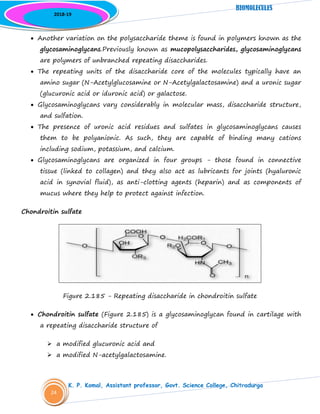
Chondroitin sulfate
Figure 2.185 - Repeating disaccharide in chondroitin sulfate
• Chondroitin sulfate (Figure 2.185) is a glycosaminoglycan found in cartilage with
a repeating disaccharide structure of
➢ a modified glucuronic acid and
➢ a modified N-acetylgalactosamine.
BIOMOLECULES
By, K. P. Komal, Assistant professor, Govt. Science College, Chitradurga
2018-19
25
• At least one of the sugars of the disaccharide will have a covalently bound sulfate
on it, giving the polymer a polyanionic character.
• Chondroitin sulfate chains will typically have over 100 individual sugars and the
chemical composition of each one can vary.
• It is a structural component of cartilage and helps to give it the ability to resist
compression. Involved in the synthesis of osteocyte and cartilage.
• Chondroitin sulfate is used as a dietary supplement to treat joint pain and
osteoarthritis, though its ability to provide relief is not clear.
• In cells, the compound is a component of the extracellular matrix. It can be linked
to proteins through serine residues to form proteoglycans, such as aggrecan,
versican, brevican, and neurocan.
• These substances are prominent in the extracellular matrix of the brain. In the
form of aggrecan, chondroitin sulfate is a major component of cartilage.
• Loss of chondroitin sulfate from cartilage is an issue in osteoarthritis.
• It shows mild anticoagulant activity.
Heparin
Figure 2.186 - Repeating sulfated disaccharide in heparin
BIOMOLECULES
By, K. P. Komal, Assistant professor, Govt. Science College, Chitradurga
2018-19
26
➢ Heparin (Figures 2.186 & 2.187) is a modified polysaccharide whose biological
function is unclear, but whose ability to prevent clotting of blood is used for
medical purposes.
➢ Heparin does not dissolve blood clots. Rather, it acts to prevent conversion of
fibrinogen to fibrin.
➢ Whether or not heparin is actually used by the body for its anticoagulation
property is uncertain.
➢ It is stored in the secretary granules of mast cells and released at the point of
injury and it has been proposed it is a protection against bacteria and other
foreign materials.
➢ It is found in skin, vitreous humor, synovial fluid, umbilical cord and ovum, loose
connective tissues etc.
Figure 2.187 - Two structures for heparin
➢ Heparin has abundant sulfates and is, in fact, the molecule with the highest
negative charge density known.
➢ Its size varies from 3 kDa to 30 kDa, with an average of about 15 kDa.
➢ The repeating disaccharide of 2-Osulfated iduronic acid and 6-O-sulfated, N-
sulfated glucosamine, occupies about 85% of the molecule.
➢ Copper salts of heparin help stimulate the synthesis of blood vessels (angiogenic).
Hyaluronic acid
BIOMOLECULES
By, K. P. Komal, Assistant professor, Govt. Science College, Chitradurga
2018-19
27
Figure 2.188 - Repeating disaccharide of hyaluronic acid
➢ Hyaluronic acid (also known as hyaluronan or hyaluronate) is a glycosaminoglycan
found in connective, epithelial, and nerve tissues.
➢ It is an unusual glycosaminoglycan (Figure 2.188), lacking sulfate, is made by
hyaluronan synthases on the inner face of the plasma membrane and has a
molecular weight in the millions.
➢ An average adult body contains about 15 grams of HA, one third of which is
replaced every day.
➢ The repeating unit in hyaluronic acid is a disaccharide structure of D-glucuronic
acid joined to D-N-acetylglucosamine.
➢ The compound, which can have upwards of 25,000 units of the disaccharide, is
delivered directly into the extracellular matrix by enzymes from its plasma
membrane site of synthesis.
➢ It is an important component of the extracellular matrix, where it assists in cell
proliferation and migration.
➢ The polymer provides an open hydrated matrix to facilitate general cell migration
whereas directed cell migration occurs via the interaction between hyaluronic acid
and specific cell surface receptors.
➢ HA interaction with the receptor RHAMM (Receptor for Hyaluronan Mediated
Motility) has been shown to be involved in wound repair as well as tumor
progression.
BIOMOLECULES
By, K. P. Komal, Assistant professor, Govt. Science College, Chitradurga
2018-19
28
Synovial Fluid
Figure 2.189 - Synovial fluid in joint lubrication Wikipedia
➢ The function of hyaluronic acid has traditionally been described as providing
lubrication in synovial fluid (the lubricating material in animal joints - Figure
2.189).
➢ Along with the proteoglycan called lubricin, hyaluronic acid turns water into
lubricating material. Hyaluronic acid is present as a coat around each cell of
articular cartilage and forms complexes with proteoglycans that absorb water,
giving resilience (resistance to compression) to cartilage.
➢ Aging causes a decrease in size of hyaluronans, but an increase in concentration.
Function in skin
➢ Hyaluronic acid is a major component of skin and has functions in tissue repair.
With exposure to excess UVB radiation, cells in the dermis produce less
hyaluronan and increase its degradation.
➢ For some cancers the plasma level of hyaluronic acid correlates with malignancy.
➢ Hyaluronic acid levels have been used as a marker for prostate and breast cancer
and to follow disease progression.
➢ The compound can to used to induce healing after cataract surgery.
BIOMOLECULES
By, K. P. Komal, Assistant professor, Govt. Science College, Chitradurga
2018-19
29
➢ Hyaluronic acid is also abundant in the granulation tissue matrix that replaces a
fibrin clot during the healing of wounds.
➢ In wound healing, it is thought that large polymers of hyaluronic acid appear
early and they physically make room for white blood cells to mediate an immune
response.
Breakdown Breakdown of hyaluronic acid is catalyzed by enzymes known as
hyaluronidases. Humans have seven types of such enzymes, some of which act as tumor
suppressors. Smaller hyaluronan fragments can induce inflammatory response in
macrophages and dendritic cells after tissue damage. They can also perform
proangiogenic functions.
Proteoglycans
Glycosaminoglycans are commonly found attached to proteins and these are referred to
as proteoglycans. Linkage between the protein and the glycosaminoglycan is made
through a serine side-chain. Proteoglycans are made by glycosylation of target proteins
in the Golgi apparatus.
Keratan sulphate:
➢ Keratan sulfate (KS), also called keratosulfate, is any of several sulfated
glycosaminoglycans (structural carbohydrates) that have been found especially in
the cornea, cartilage, and bone.
➢ It is also synthesized in the central nervous systemwhere it participates both
in development and in the glial scar formation following an injury. Keratan
sulfates are large, highly hydrated molecules which in joints can act as a cushion
to absorb mechanical shock.
BIOMOLECULES
By, K. P. Komal, Assistant professor, Govt. Science College, Chitradurga
2018-19
30
➢ Like other glycosaminoglycans keratan sulfate is a linear polymer that consists of
a repeating disaccharide unit.
➢ Keratan sulfate occurs as a proteoglycan (PG) in which KS chains are attached
to cell-surface or extracellular matrix proteins, termed core proteins. KS core
proteins include lumican, keratocan, mimecan, fibromodulin, PRELP,
osteoadherin, and aggrecan.
➢ It is present in cornea, cartilage, horny structures like, horn, nails, hair etc.
➢ The basic repeating disaccharide unit within keratan sulfate is -3Galβ1-
4GlcNAcβ1-.
➢ This can be sulfated at carbon position 6 (C6) of either or both the Gal or
GlcNAc monosaccharides. However, the detailed primary structure of specific KS
types are best considered to be composed of three regions:
✓ A linkage region, at one end of which the KS chain is linked to the core
protein.
✓ A repeat region, composed of the -3Galβ1-4GlcNAcβ1- repeating
disaccharide unit and
✓ A chain capping region, occurring at the opposite end of the KS chain to
the protein linkage region.
BIOMOLECULES
By, K. P. Komal, Assistant professor, Govt. Science College, Chitradurga
2018-19
31
➢ The monosaccharide mannose is found within the linkage region of keratan sulfate
type I (KSI).
➢ Disaccharides within the repeating region of KSII may be fucosylated and N-
Acetyl neuraminic acid caps the end of all keratan sulfate type II (KSII) chains
and up to 70% of KSI type chains.
Dermatan sulfate
➢ Dermatan sulfate is a glycosaminoglycan (formerly called a mucopolysaccharide)
found mostly in skin, but also in blood vessels, heart valves, tendons, and lungs.
➢ It is also referred to as chondroitin sulfate B, although it is no longer classified as
a form of chondroitin sulfate by most sources. The formula is C14H21NO15S.
Function
➢ Dermatan sulfate may have roles in coagulation, cardiovascular
disease, carcinogenesis, infection, wound repair, maintains the shape of
galactosamine 4-sulfate skin and fibrosis.
BIOMOLECULES
By, K. P. Komal, Assistant professor, Govt. Science College, Chitradurga
2018-19
32
BIOMOLECULES
By, K. P. Komal, Assistant professor, Govt. Science College, Chitradurga
2018-19
33
Amino acids:
• Definition of Amino Acid:
Amino acids are organic acids which contain both basic (amino - NH2) and
acidic (carboxyl COOH) groups and have general formula,
H
|
R-C-COOH
|
NH2
• Amino acids are a crucial, yet basic unit of protein, and they contain an amino
group and a carboxylic group.
• They play an extensive role in gene expression processes, which includes the
adjustment of protein functions that facilitate messenger RNA (mRNA)
translation.
• In nature, almost all of them are α-amino acids. They have been discovered in:
bacteria; fungi; algae; various other plants.
• These amino acids are present in bigger molecules as:
• Essential components of peptides and proteins
• Basic structures for
- Amines
• Other types of amide
• Acidic structures
- Carboxylic acids; phenols
• Esterified structures
- Ethyl acetate is an example of an ester, as is ethyl ethanoate.
- When carboxylic acids and alcohols are combined, they create an
esterified structure, and they lose a molecule of water during when
Combining.
- The hydrogen on the carboxyl group of acetic acid is replaced with
an ethyl group.
• Alkylated structures
BIOMOLECULES
By, K. P. Komal, Assistant professor, Govt. Science College, Chitradurga
2018-19
34
- Non-polar side chains (alkyl groups)
- Polar (amides, alcohol - depending on how many side chains they
have)
- Leucine is an example of an alkylated structure.
• Amino acids also exist in free form.
• In particular, 20 very important amino acids are crucial for life as they contain
peptides and proteins and are known to be the building blocks for all living things.
• They are contained in living cells where they are used for protein synthesis.
• These amino acids are controlled by genetics. But not all natural amino acids
reside here. In fact, some very unusual amino acids are contained in plant seeds,
where they are not crucial to the mature plant. However, they ward off
predators and such for protection, giving off toxins or other unpleasant
characteristics in order to help certain plant species survive.
• As mentioned above, amino acids are imperative for sustaining the health of the
human body. They largely promote the:
• Production of hormones
• Structure of muscles
• Human nervous system's healthy functioning
• Health of vital organs
• Normal cellular structure
• If amino acids are deficient, then protein synthesis does not occur.
• In addition to other positive body functions and growth, without alpha-amino
acids, a person may experience fatigue, irritability, hormonal imbalances, and
sometimes even depression.
Classifications of Amino Acids
Experts classify amino acids based on a variety of features, including whether people
can acquire them through diet. Accordingly, scientists recognize three amino acid types:
1. Non-essential
2. Essential
3. Conditionally essential
BIOMOLECULES
By, K. P. Komal, Assistant professor, Govt. Science College, Chitradurga
2018-19
35
However, the classification as essential or nonessential does not actually reflect their
importance, as all 20 amino acids are necessary for human health.
• Eight of these amino acids are essential (or indispensable) and cannot be produced
by the body. They are:
• Leucine
• Isoleucine
• Lysine
• Threonine
• Methionine
• Phenylalanine
• Valine
• Tryptophan
• Histidine is an amino acid that is categorized as semi-essential since the human
body doesn't always need it to properly function; therefore, dietary sources of it
are not always essential.
• Meanwhile, conditionally essential amino acids aren't usually required in the
human diet, but do become essential under certain circumstances.
• Finally, nonessential amino acids are produced by the human body either from
essential amino acids or from normal protein breakdowns. Nonessential amino
acids include:
• Asparagine
• Alanine
• Arginine
• Aspartic acid
• Cysteine
• Glutamic acid
• Glutamine
• Proline
• Glycine
• Tyrosine
• Serine
BIOMOLECULES
By, K. P. Komal, Assistant professor, Govt. Science College, Chitradurga
2018-19
36
An additional amino acids' classification depends upon the side chain structure, and
experts recognize these five as:
• Cysteine and Methionine (amino acids containing sulfur)
• Asparagine, Serine, Threonine, and Glutamine (neutral amino acids)
• Glutamic acid and Aspartic acid (acidic); and Arginine and Lysine (basic)
• Leucine, Isoleucine, Glycine, Valine, and Alanine (aliphatic amino acids)
• Phenylalanine, Tryptophan, and Tyrosine (aromatic amino acids)
One final amino acid classification is categorized by the side chain structure that divides
the list of 20 amino acids into four groups - two of which are the main groups and
two that are subgroups. They are:
1. Non-polar
2. Polar
3. Acidic and polar
4. Basic and polar
• For example, side chains having pure hydrocarbon alkyl or aromatic groups are
considered non-polar, and these amino acids are comprised of Phenylalanine,
Glycine, Valine, Leucine, Alanine, Isoleucine, Proline, Methionine, and Tryptophan.
• Meanwhile, if the side chain contains different polar groups like amides, acids, and
alcohols, they are classified as polar. Their list includes Tyrosine, Serine,
Asparagine, Threonine, Glutamine, and Cysteine.
• If the side chain contains a carboxylic acid, the amino acids in the acidic-polar
classification are Aspartic Acid and Glutamic Acid.
• Furthermore, if the side chain consists of a carboxylic acid and basic-polar, these
amino acids are Lysine, Arginine, and Histidine.
Properties of Amino Acids
BIOMOLECULES
By, K. P. Komal, Assistant professor, Govt. Science College, Chitradurga
2018-19
37
• The properties of α-amino acids are complex, yet simplistic in that every molecule
of an amino acid involves two functional groups: carboxyl (-COOH) and amino (-
NH2).
• As well, each molecule contains a side chain or an R group. And while alanine is
an example of a standard amino acid (which is used in the biosynthesis of
proteins), each R group has very different properties and functions.
Table of common amino acid abbreviations and properties
Name Three letter
code
One letter
code
Molecular
Weight
Molecular
Formula
pKa pKb pKx pl
Alanine Ala A 89.10 C3H7NO2 2.34 9.69 – 6.00
Arginine Arg R 174.20 C6H14N4O2 2.17 9.04 12.48 10.76
Asparagine Asn N 132.12 C4H8N2O3 2.02 8.80 – 5.41
Aspartic acid Asp D 133.11 C4H7NO4 1.88 9.60 3.65 2.77
Cysteine Cys C 121.16 C3H7NO2S 1.96 10.28 8.18 5.07
Glutamic acid Glu E 147.13 C5H9NO4 2.19 9.67 4.25 3.22
Glutamine Gln Q 146.15 C5H10N2O3 2.17 9.13 – 5.65
Glycine Gly G 75.07 C2H5NO2 2.34 9.60 – 5.97
Histidine His H 155.16 C6H9N3O2 1.82 9.17 6.00 7.59
Hydroxyproline Hyp O 131.13 C5H9NO3 1.82 9.65 – –
Isoleucine Ile I 131.18 C6H13NO2 2.36 9.60 – 6.02
Leucine Leu L 131.18 C6H13NO2 2.36 9.60 – 5.98
Lysine Lys K 146.19 C6H14N2O2 2.18 8.95 10.53 9.74
Methionine Met M 149.21 C5H11NO2S 2.28 9.21 – 5.74
Phenylalanine Phe F 165.19 C9H11NO2 1.83 9.13 – 5.48
BIOMOLECULES
By, K. P. Komal, Assistant professor, Govt. Science College, Chitradurga
2018-19
38
Proline Pro P 115.13 C5H9NO2 1.99 10.60 – 6.30
Pyroglutamatic Glp U 139.11 C5H7NO3 – – – 5.68
Serine Ser S 105.09 C3H7NO3 2.21 9.15 – 5.68
Threonine Thr T 119.12 C4H9NO3 2.09 9.10 – 5.60
Tryptophan Trp W 204.23 C11H12N2O2 2.83 9.39 – 5.89
Tyrosine Tyr Y 181.19 C9H11NO3 2.20 9.11 10.07 5.66
Valine Val V 117.15 C5H11NO2 2.32 9.62 – 5.96
• Amino acids are crystalline solids which have the capacity to dissolve in water.
Meanwhile, they only dissolve sparingly in organic solvents, and the extent of their
solubility depends on the size and nature of the side chain.
• Amino acids feature very high melting points - up to 200-300°C with other properties
varying for each particular amino acid.
20 Amino Acids and their Functions:
Only twenty amino acids are most normally found as compounds of human peptides
and proteins. These naturally occurring amino acids are used by cells so as to synthesize
peptides and proteins. They are typically identified by this rather generic formula:
H2NCHRCOOH.
The primary difference among the twenty amino acids is the structure of the R group.
Non-polar, aliphatic residues
Glycine (G/Gly). Slices DNA in order to produce different amino
acids. One of the three most important glycogenic amino acids.
Alanine (A/Ala). Important source of energy for muscle. One of
the three most important glycogenic amino acids. The primary
amino acid in sugar metabolism. Boosts immune system by
producing antibodies.
BIOMOLECULES
By, K. P. Komal, Assistant professor, Govt. Science College, Chitradurga
2018-19
39
Valine (V/Val). Essential for muscle development.
Leucine (L/Leu). Beneficial for skin, bone and tissue wound
healing.
Isoleucine (I/Ile). Necessary for the synthesis of hemoglobin.
Proline (P/Pro). Critical component of cartilage; aids in joint
health, tendons and ligaments. Keeps heart muscle strong.
Aromatic residues
Phenylalanine (F/Phe). Beneficial for healthy nervous
system. It boosts memory and learning.
Tyrosine (Y/Tyr). Precursor of dopamine, norepinephrine
and adrenaline. Increases energy, improves mental clarity
and concentration, can treat some depressions.
Tryptophan (W/Trp). Necessary for neurotransmitter
serotonin (synthesis). Effective sleep aid, due to conversion
to serotonin. Reduces anxiety and some forms of
depression. Treats migraine headaches. Stimulates growth
hormone.
Polar, non-charged residues
BIOMOLECULES
By, K. P. Komal, Assistant professor, Govt. Science College, Chitradurga
2018-19
40
Serine (S/Ser). One of the three most important glycogenic
amino acids, the others being alanine and glycine. Maintains
blood sugar levels, and boosts immune system. Myelin sheaths
contain serine.
Threonine (T/Thr). Required for formation of collagen. Helps
prevent fatty deposits in liver. Aids in antibodies' production.
Cysteine (C/Cys). Protective against radiation, pollution, and
ultra-violet light. Detoxifier; necessary for growth and repair
of skin.
Methionine (M/Met). An antioxidant. Helps in breakdown of
fats and aids in reducing muscle degeneration.
Asparagine (N/Asn). One of the two main excitatory
neurotransmitters.
Glutamine (Q/Gln). Essential for helping to maintain normal
and steady blood sugar levels. Helps muscle strength and
endurance. Gastrointestinal function; provides energy to small
intestines.
Positively charged residues
Lysine (K/Lys). Component of muscle protein, and is
needed in the synthesis of enzymes and hormones. It is
also a precursor for L-carathine, which is essential for
healthy nervous system function.
BIOMOLECULES
By, K. P. Komal, Assistant professor, Govt. Science College, Chitradurga
2018-19
41
Arginine (R/Arg). One of the two main excitatory
neurotransmitters. May increase endurance and
decrease fatigue. Detoxifies harmful chemicals. Involved
in DNA synthesis.
Histidine (H/His). Found in high concentrations in
hemoglobin. Treats anemia; has been used to treat
rheumatoid arthritis.
Negatively charged residues
Aspartate (D/Asp). Increases stamina and helps protect the
liver; DNA and RNA metabolism; immune system function.
Glutamate (E/Glu). Neurotransmitter that is involved in DNA
synthesis.
Non-standard amino acids:
A nonstandard amino acid is an amino acid that occurs naturally in cells but do not
participate in peptide synthesis. Some nonstandard amino acids are constituents of
peptides, but they are generated by modification of standard amino acids in the
peptide molecule. Some examples are as follows;
Sl. no Name Function
1
GABA (Gamma-
Aminobutyric
acid)
• It is an inhibitory Neurotransmitter of the brain,
involved in muscle relaxation, sleep, diminished
emotional reaction and sedation.
• GABA derived from-Glutamic Acid via glutamate
decarboxylase (removes alpha carboxyl group).
BIOMOLECULES
By, K. P. Komal, Assistant professor, Govt. Science College, Chitradurga
2018-19
42
2
Serotonin
• Neurotransmitter of the brain, modulates mood,
appetite, sexual activity, aggression, body
temperature, sleep, smooth muscle constriction.
• Serotonin vs Aggression high levels correlated with
aggressive behavior, low levels correlated with
depression.
3
Melatonin
• Hormone; secreted by the pineal gland during
darkness; linked to circadian rhythms and sleep-
wake cycles
4
Thyroxine
• Hormone; secreted by the thyroid; increases rates of
chemical reactions and metabolism in almost all
cells of the body.
5
Indole-3-Acetic
Acid
• Hormone; major plant hormone, stimulates cell
growth and elongation, rooting; inhibits axillary bud
development.
6
Carboxyglutamate
• Found in proteins that bind Ca2+ ions, including
prothrombin for blood clotting and Osteocalcin in
bone
7 4-Hydroxyproline • Found in plant cell walls and collagen of connective
tissues
8
5-Hydroxylysine • Also found in collagen of connective tissues
9
o-Phosphoserine • Phosphorylated derivative of -OH containing AA's;
involved in signaling and gene expression.
BIOMOLECULES
By, K. P. Komal, Assistant professor, Govt. Science College, Chitradurga
2018-19
43
Non-protein amino acids:
Citrulline
• These amino acids are never found in protein structure but perform several
biological functions.
BIOMOLECULES
By, K. P. Komal, Assistant professor, Govt. Science College, Chitradurga
2018-19
44
Properties of amino acids:
Isomerism
• The alpha amino acids are the most common form found in nature, but only
when occurring in the L-isomer.
• The alpha carbon is a chiral carbon atom, with the exception of glycine which has
two indistinguishable hydrogen atoms on the alpha carbon. Therefore, all alpha
amino acids but glycine can exist in either of two enantiomers, called L or D
amino acids, which are mirror images of each other.
• While L-amino acids represent all of the amino acids found in proteins during
translation in the ribosome, D-amino acids are found in some proteins produced
by enzyme post translational modifications after translation and translocation to
the endoplasmic reticulum, as in exotic sea-dwelling organisms such as cone
snails. They are also abundant components of the peptidoglycan cell walls of
bacteria, and D-serine may act as a neurotransmitter in the brain.
• D-amino acids are used in racemic crystallography to create centrosymmetric
crystals, which (depending on the protein) may allow for easier and more robust
protein structure determination.
• Side chains
Lysine with carbon atoms labeled by position
• In amino acids that have a carbon chain attached to the α–carbon (such as lysine,
shown to the right) the carbons are labeled in order as α, β, γ, δ, and so on. In
BIOMOLECULES
By, K. P. Komal, Assistant professor, Govt. Science College, Chitradurga
2018-19
45
some amino acids, the amine group is attached to the β or γ-carbon, and these
are therefore referred to as beta or gamma amino acids.
• The side chain can make an amino acid a weak acid or a weak base, and
a hydrophile if the side chain is polar or a hydrophobe if it is nonpolar
Zwitterions
An amino acid in its (1) un-ionized and (2) zwitterionic forms
• The α-carboxylic acid group of amino acids is a weak acid, meaning that it
releases a hydron (such as a proton) at moderate pH values.
• In other words, carboxylic acid groups (−CO2H) can be deprotonated to become
negative carboxylates (−CO2
−).
• The negatively charged carboxylate ion predominates at pH values greater than
the pKa of the carboxylic acid group.
• In a complementary fashion, the α-amine of amino acids is a weak base,
meaning that it accepts a proton at moderate pH values. In other words, α-
amino groups (NH2−) can be protonated to become positive α-ammonium groups
(+NH3−). The positively charged α-ammonium group predominates at pH values
less than the pKa of the α-ammonium group.
• Because all amino acids contain amine and carboxylic acid functional groups, they
share amphiprotic properties. Below pH 2.2, the predominant form will have a
neutral carboxylic acid group and a positive α-ammonium ion (net charge +1),
and above pH 9.4, a negative carboxylate and neutral α-amino group (net charge
−1). But at pH between 2.2 and 9.4, an amino acid usually contains both a
negative carboxylate and a positive α-ammonium group, as shown in structure
(2) on the right, so has net zero charge. This molecular state is known as
a zwitterion, from the German Zwitter meaning "hermaphrodite" or "hybrid".
BIOMOLECULES
By, K. P. Komal, Assistant professor, Govt. Science College, Chitradurga
2018-19
46
• The fully neutral form (structure (1) on the left) is a very minor species in
aqueous solution throughout the pH range (less than 1 part in 107). Amino acids
exist as zwitterions also in the solid phase, and crystallize with salt-like properties
unlike typical organic acids or amines.
Isoelectric point
Composite of titration curves of twenty proteinogenic amino acids grouped by side chain category
BIOMOLECULES
By, K. P. Komal, Assistant professor, Govt. Science College, Chitradurga
2018-19
47
• At pH values between the two pKa values, the zwitterion predominates, but
coexists in dynamic equilibrium with small amounts of net negative and net
positive ions. At the exact midpoint between the two pKa values, the trace
amount of net negative and trace of net positive ions exactly balance, so that
average net charge of all forms present is zero. This pH is known as the isoelectric
point pI, so pI = ½(pKa1 + pKa2).
• The individual amino acids all have slightly different pKa values, so have different
isoelectric points.
• For amino acids with charged side chains, the pKa of the side chain is involved.
Thus for Asp, Glu with negative side chains, pI = ½(pKa1 + pKaR), where pKaR is
the side chain pKa. Cysteine also has potentially negative side chain with pKaR =
8.14, so pI should be calculated as for Asp and Glu, even though the side chain is
not significantly charged at neutral pH. For His, Lys, and Arg with positive side
chains, pI = ½(pKaR + pKa2). Amino acids have zero mobility in electrophoresis at
their isoelectric point, although this behaviour is more usually exploited for
peptides and proteins than single amino acids. Zwitterions have minimum
solubility at their isoelectric point and some amino acids (in particular, with non-
polar side chains) can be isolated by precipitation from water by adjusting the pH
to the required isoelectric point.
Acid Base Properties Of Amino Acids
All amino acid contains an acidic carboxylic group and a basic amino group. It can form
a zwitter ion at pH=7. Zwitter ion forms when carboxylic group releases it proton and
remains in an anionic form and NH2 group takes a proton and remains in a cationic
form. At this pH it is called isoelectronic point.
BIOMOLECULES
By, K. P. Komal, Assistant professor, Govt. Science College, Chitradurga
2018-19
48
At this isoelectric point, the positive ion does not move towards anode and negative
charge does not move towards cathode.
When a base is added to the amino acid increasing the pH of the solution, then positive
charge on the NH3
+ is removed and the molecule becomes an anion. This anion moves
toward the positively charged anode.
In the presence of an acid, the carboxylate anion takes one proton from the acid
solution and becomes neutral. The net amino acid becomes cationic charged and moves
towards the anionic charged cathode.
Peptide bond formation:
• A peptide bond is a chemical bond formed between two molecules when the
carboxyl group of one molecule reacts with the amino group of the other
molecule, releasing a molecule of water (H2O).
• This is a dehydration synthesis reaction (also known as a condensation reaction),
and usually occurs between amino acids.
• The resulting CO-NH bond is called a peptide bond, and the resulting molecule is
an amide.
• The four-atom functional group -C(=O)NH- is called an amide group or (in the
context of proteins) a peptide group.
BIOMOLECULES
By, K. P. Komal, Assistant professor, Govt. Science College, Chitradurga
2018-19
49
• Polypeptides and proteins are chains of amino acids held together by peptide
bonds, as is the backbone of PNA.
Peptide bond formation via dehydration reaction.
• The formation of the peptide bond consumes energy, which, in organisms, is
derived from ATP.
• Peptides and proteins are chains of amino acids held together by peptide bonds
(and sometimes by a few isopeptide bonds).
Peptides:
• Peptides are short chains of amino acid monomers linked by peptide (amide)
bonds.
• Peptides are distinguished from proteins on the basis of size, and as an arbitrary
benchmark can be understood to contain approximately 50 or fewer amino acids.
• Proteins consist of one or more polypeptides arranged in a biologically functional
way, often bound to ligands such as coenzymes and cofactors, or to another
BIOMOLECULES
By, K. P. Komal, Assistant professor, Govt. Science College, Chitradurga
2018-19
50
protein or other macromolecule (DNA, RNA, etc.), or to complex macromolecular
assemblies.
• Finally, while aspects of the lab techniques applied to peptides versus polypeptides
and proteins differ (e.g., the specifics of electrophoresis, chromatography, etc.),
the size boundaries that distinguish peptides from polypeptides and proteins are
not absolute: long peptides such as amyloid beta have been referred to as
proteins, and smaller proteins like insulin have been considered peptides.
• Amino acids that have been incorporated into peptides are termed "residues" due
to the release of either a hydrogen ion from the amine end or a hydroxyl ion
(OH−) from the carboxyl (COOH) end, or both, as a water molecule is released
during formation of each amide bond.
• All peptides except cyclic peptides have an N-terminal and C-terminal residue at
the end of the peptide.
Glutathione:
• Glutathione (GSH) is an antioxidant in plants, animals, fungi, and some bacteria
and archaea.
• Glutathione is capable of preventing damage to important cellular components
caused by reactive oxygen species such as free radicals, peroxides, lipid peroxides,
and heavy metals. It is a tripeptide with a gamma peptide linkage between
the carboxyl group of the glutamate side chain and the amine group of cysteine,
and the carboxyl group of cysteine is attached by normal peptide linkage to
a glycine.
• Thiol groups are reducing agents, existing at a concentration around 5 mM in
animal cells.
BIOMOLECULES
By, K. P. Komal, Assistant professor, Govt. Science College, Chitradurga
2018-19
51
• Glutathione reduces disulfide bonds formed within cytoplasmic proteins to
cysteines by serving as an electron donor. In the process, glutathione is converted
to its oxidized form, glutathione disulfide (GSSG), also called L-(–)-glutathione.
• Once oxidized, glutathione can be reduced back by glutathione reductase,
using NADPH as an electron donor.[3] The ratio of reduced glutathione to oxidized
glutathione within cells is often used as a measure of cellular oxidative stress.[4][5]
Function
Glutathione has multiple functions:
• It maintains levels of reduced glutaredoxin and glutathione peroxidase.
• It is one of the major endogenous antioxidants produced by the cells, participating
directly in the neutralization of free radicals and reactive oxygen compounds, as well
as maintaining exogenous antioxidants such as vitamins C and E in their reduced
(active) forms.
• Regulation of the nitric oxide cycle is critical for life, but can be problematic if
unregulated. Glutathione enhances the function of citrulline as part of the nitric
oxide cycle.
• It is used in metabolic and biochemical reactions such as DNA synthesis and repair,
protein synthesis, prostaglandin synthesis, amino acid transport, and enzyme
activation. Thus, every system in the body can be affected by the state of the
glutathione system, especially the immune system, the nervous system, the
gastrointestinal system, and the lungs.
• It has a vital function in iron metabolism. Yeast cells depleted of GSH or
containing toxic levels of GSH show an intense iron starvation-like response and
impairment of the activity of extramitochondrial ISC enzymes thus inhibiting
oxidative endoplasmic reticulum folding, followed by death.
• It has roles in progression of the cell cycle, including cell death.
• GSH levels regulate redox changes to nuclear proteins necessary for the initiation
of cell differentiation. Differences in GSH levels also determine the expressed mode of
cell death, being either apoptosis or cell necrosis. Manageably low levels result in the
BIOMOLECULES
By, K. P. Komal, Assistant professor, Govt. Science College, Chitradurga
2018-19
52
systematic breakage of the cell whereas excessively low levels result in rapid cell
death.
Oxytocin:
• Oxytocin (Oxt) is a peptide hormone and neuropeptide.
• Oxytocin is normally produced by the paraventricular nucleus of the
hypothalamus and released by the posterior pituitary.
• It plays a role in social bonding, sexual reproduction, childbirth, and the period
after childbirth.
• Oxytocin is released into the bloodstream as a hormone in response to stretching
of the cervix and uterusduring labor and with stimulation of the nipples
from breastfeeding.
• This helps with birth, bonding with the baby, and milk production.
• Oxytocin was discovered by Henry Dale in 1906. Its molecular structure was
determined in 1952. Oxytocin is also used as a medication to facilitate childbirth.
• Estrogen has been found to increase the secretion of oxytocin and to increase
the expression of its receptor, the oxytocin receptor, in the brain.[16] In women, a
single dose of estradiol has been found to be sufficient to increase circulating
oxytocin concentrations.
Biological function
• Oxytocin has peripheral (hormonal) actions, and also has actions in the brain. Its
actions are mediated by specific, oxytocin receptors. The oxytocin receptor is a G-
BIOMOLECULES
By, K. P. Komal, Assistant professor, Govt. Science College, Chitradurga
2018-19
53
protein-coupled receptor that requires magnesium and cholesterol. It belongs to
the rhodopsin-type (class I) group of G-protein-coupled receptors.
• Studies have looked at oxytocin's role in various behaviors, including orgasm, social
recognition, pair bonding, anxiety, and maternal behaviors.
Physiological
• Milk ejection reflex/Letdown reflex: in lactating (breastfeeding) mothers, oxytocin
acts at the mammary glands, causing milk to be 'let down' into lactiferous ducts,
from where it can be excreted via the nipple.
• Uterine contraction: important for cervical dilation before birth, oxytocin causes
contractions during the second and third stages of labor.
• Due to its similarity to vasopressin, it can reduce the excretion of urine slightly. In
several species, oxytocin can stimulate sodium excretion from the kidneys
(natriuresis), and, in humans, high doses can result in low sodium levels
(hyponatremia).
• Cardiac effects: oxytocin and oxytocin receptors are also found in the heart in
some rodents, and the hormone may play a role in the embryonal development of
the heart by promoting cardiomyocyte differentiation.
• Preparing fetal neurons for delivery: crossing the placenta, maternal oxytocin
reaches the fetal brain and induces a switch in the action of
neurotransmitter GABA from excitatory to inhibitory on fetal cortical neurons. This
silences the fetal brain for the period of delivery and reduces its vulnerability
to hypoxic damage.
Vasopressin:
BIOMOLECULES
By, K. P. Komal, Assistant professor, Govt. Science College, Chitradurga
2018-19
54
• Vasopressin, also called antidiuretic hormone (ADH), arginine vasopressin(AVP)
or argipressin, is a hormone synthesized as a peptide prohormone in neurons in
the hypothalamus, and is converted to AVP. It then travels down the axon of that
cell, which terminates in the posterior pituitary, and is released from vesicles into
the circulation in response to extracellular fluid hypertonicity (hyperosmolality).
• AVP has two primary functions. First, it increases the amount of solute-free
water reabsorbed back into the circulation from the filtrate in the kidney
tubules of the nephrons. Second, AVP constricts arterioles, which increases
peripheral vascular resistance and raises arterial blood pressure.
• A third function is possible. Some AVP may be released directly into the brain
from the hypothalamus, and may play an important role in social
behavior, sexual motivation and pair bonding, and maternal responses to stress.
• Vasopressin induces differentiation of stem cells into cardiomyocytes and
promotes heart muscle homeostasis.
• It has a very short half-life, between 16–24 minutes.
Function
• Vasopressin regulates the tonicity of body fluids. It is released from the posterior
pituitary in response to hypertonicity and causes the kidneys to reabsorb solute-
free water and return it to the circulation from the tubules of the nephron, thus
returning the tonicity of the body fluids toward normal. An incidental
consequence of this renal reabsorption of water is concentrated urine and reduced
urine volume. AVP released in high concentrations may also raise blood pressure
by inducing moderate vasoconstriction.
• AVP also may have a variety of neurological effects on the brain. It may influence
pair-bonding in voles. The high-density distributions of vasopressin receptor
AVPr1a in prairie vole ventral forebrain regions have been shown to facilitate and
coordinate reward circuits during partner preference formation, critical for pair
bond formation.
BIOMOLECULES
By, K. P. Komal, Assistant professor, Govt. Science College, Chitradurga
2018-19
55
• A very similar substance, lysine vasopressin (LVP) or lypressin, has the same
function in pigs and is used in human AVP deficiency.
In Kidney
Vasopressin has three main effects which are,
1. Increasing the water permeability of initial and cortical collecting tubules (ICT &
CCT), as well as outer and inner medullary collecting duct (OMCD & IMCD) in
the kidney, thus allowing water reabsorption and excretion of more concentrated
urine, i.e., antidiuresis. This occurs through increased transcription and insertion
of water channels (Aquaporin-2) into the apical membrane of collecting tubule
and collecting duct epithelial cells. Aquaporins allow water to move down their
osmotic gradient and out of the nephron, increasing the amount of water re-
absorbed from the filtrate (forming urine) back into the bloodstream. This effect
is mediated by V2 receptors. Vasopressin also increases the concentration of
calcium in the collecting duct cells, by episodic release from intracellular stores.
Vasopressin, acting through cAMP, also increases transcription of the aquaporin-
2 gene, thus increasing the total number of aquaporin-2 molecules in collecting
duct cells.
2. Increasing permeability of the inner medullary portion of the collecting duct
to urea by regulating the cell surface expression of urea transporters, which
facilitates its reabsorption into the medullary interstitium as it travels down the
concentration gradient created by removing water from the connecting
tubule, cortical collecting duct, and outer medullary collecting duct.
3. Acute increase of sodium absorption across the ascending loop of henle. This adds
to the countercurrent multiplicationwhich aids in proper water reabsorption later
in the distal tubule and collecting duct.
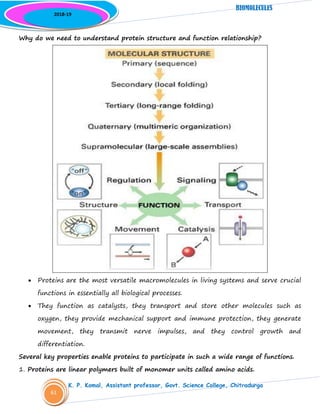
Proteins:
• Proteins are large organic compounds made of amino acids arranged in a linear
chain and joined together between the carboxyl atom of one amino acid and the
amine nitrogen of another. This bond is called a peptide bond.
BIOMOLECULES
By, K. P. Komal, Assistant professor, Govt. Science College, Chitradurga
2018-19
56
• The sequence of amino acids in a protein is defined by a gene and encoded in the
genetic code.
• Proteins can also work together to achieve a particular function, and they often
associate to form stable complexes.
• Many proteins are enzymes that catalyze biochemical reactions, and are vital to
metabolism.
• Other proteins have structural or mechanical functions, such as the proteins in
the cytoskeleton, which forms a system of scaffolding that maintains cell shape.
• Proteins are also important in cell signaling, immune responses, cell adhesion, and
the cell cycle.
• Protein is also a necessary component in our diet, since animals cannot synthesize
all the amino acids and must obtain essential amino acids from food.
• Through the process of digestion, animals break down ingested protein into free
amino acids that can be used for protein synthesis.
Protein classification based on shape
On the basis of their shape, proteins may be divided into two classes: fibrous and
globular.
Fibrous proteins
• They have primarily mechanical and structural functions, providing support to the
cells as well as the whole organism.
• These proteins are insoluble in water as they contain, both internally and on their
surface, many hydrophobic amino acids.
• The presence on their surface of hydrophobic amino acids facilitates their
packaging into very complex supramolecular structures.
• In vertebrates, these proteins provide external protection, support and shape; in
fact, thanks to their structural properties, they ensure flexibility and/or strength.
Some fibrous proteins, such as α-keratins, are only partially hydrolyzed in the
intestine.
Here are some examples.
BIOMOLECULES
By, K. P. Komal, Assistant professor, Govt. Science College, Chitradurga
2018-19
57
• Fibroin
It is produced by spiders and insects. An example is that produced by the
silkworm, Bombyx mori.
• Collagen
The term “collagen” indicates not a single protein but a family of structurally
related proteins (at least 29 different types), which constitute the main protein
component of connective tissue, and more generally, the extracellular scaffolding
of multicellular organisms. In vertebrates, they represent about 25-30% of
all proteins.
They are found in different tissues and organs, such as tendons and the organic
matrix of bone, where they are present in very high percentages, but also in
cartilage and in the cornea of the eye.
In the different tissues, they form different structures, each capable of satisfying a
particular need. For example, in the cornea, the molecules are arranged in an
almost crystalline array, so that they are virtually transparent, while in the skin
they form fibers not very intertwined and directed in all directions, which ensure
the tensile strength of the skin itself.
• Elastin
This protein provides elasticity to the skin and blood vessels, a consequence of
its random coiled structure, that differs from the structures of the α-keratins
and collagens.
Globular proteins
• They have a compact and more or less spherical structure, more complex than
fibrous proteins.
• They are generally soluble in water but can also be found inserted into
biological membranes (transmembrane proteins), thus in a hydrophobic
environment.
Unlike fibrous proteins, that have structural and mechanical functions, they act
as:
✓ enzymes;
✓ hormones;
BIOMOLECULES
By, K. P. Komal, Assistant professor, Govt. Science College, Chitradurga
2018-19
58
✓ membrane transporters and receptors;
✓ transporters of triglycerides, fatty acids and oxygen in the blood;
✓ immunoglobulins or antibodies;
✓ grain and legume storage proteins.
Examples of globular proteins are myoglobin, hemoglobin, and cytochrome c.
At the intestinal level, most of the globular proteins of animal origin are hydrolyzed
almost entirely to amino acids.
Protein classification based on biological functions
The multitude of functions that proteins perform is the consequence of both
the folding of the polypeptide chain, therefore of their three-dimensional structure, and
the presence of many different functional groups in the amino acid side chains, such as
thiols, alcohols, thioethers, carboxamides, carboxylic acids and different basic groups.
From the functional point of view, they may be divided into several groups.
Enzymes (biochemical catalysts).
In living organisms, almost all reactions are catalyzed by
specific proteins called enzymes. They have a high catalytic power, increasing the
rate of the reaction in which they are involved at least by factor 106. Therefore,
life as we know could not exist without their “facilitating action”.
Almost all known enzymes, and in the human body they are thousand,
are proteins (except some catalytic RNA molecules called ribozymes, that is,
ribonucleic acid enzymes).
Transport proteins
Many small molecules, organic and inorganic, are transported in the
bloodstream and extracellular fluids, across the cell membranes, and inside the
cells from one compartment to another, by specific proteins.
Examples are:
✓ hemoglobin, that carries oxygen from the alveolar blood vessels to tissue
capillaries;
✓ transferrin, which carries iron in the blood;
membrane carriers;
BIOMOLECULES
By, K. P. Komal, Assistant professor, Govt. Science College, Chitradurga
2018-19
59
✓ fatty acid binding proteins (FABP), that is, the proteinsinvolved in the
intracellular transport of fatty acids;
✓ proteins of plasma lipoproteins, macromolecular complexes
of proteins and lipids responsible for the transport of triglycerides, which
are otherwise insoluble in water;
✓ albumin, that carries free fatty acids, bilirubin, thyroid hormones, and
certain medications such as aspirin and penicillin, in the blood.
Many of these proteins also play a protective role, since the bound molecules, such
as fatty acids, may be harmful for the organism when present in free form.
Storage proteins
Examples are:
ferritin, that stores iron intracellularly in a non-toxic form;
milk caseins, that act as a reserve of amino acids for the milk;
egg yolk phosvitin, that contains high amounts of phosphorus;
prolamins and glutelins, the storage proteins of cereals.
Mechanical support
Proteins have a pivotal role in the stabilization of many structures. Examples are α-
keratins, collagen and elastin. The same cytoskeletal system, the scaffold of the cell, is
made of proteins.
✓ They generate movement.
✓ They are involved in nerve transmission.
An example is the receptor for acetylcholine at synapses.
✓ They control development and differentiation.
Some proteins are involved in the regulation of gene expression. An example is the nerve
growth factor (NGF), discovered by Rita Levi-Montalcini, that plays a leading role in the
formation of neural networks.
Hormones
Many hormones are proteins.They are regulatory molecules involved in the control of
many cellular functions, from metabolism to reproduction. Examples are insulin,
glucagon, and thyroid-stimulating hormone (TSH).
BIOMOLECULES
By, K. P. Komal, Assistant professor, Govt. Science College, Chitradurga
2018-19
60
• Storage of energy. Proteins, and in particular the amino acids that constitute
them, act as energy storage, second in size only to the adipose tissue, that in
particular conditions, such as prolonged fasting, may become essential for
survival. However, their reduction of more than 30% leads to a decrease of the
contraction capacity of respiratory muscle, immune function, and organ
function, that are not compatible with life. Therefore, proteins are an
extremely valuable fuel.
Protein classification based on solubility
The different globular proteins can be classified based on their solubility in different
solvents, such as water, salt and alcohol
Structure
Most proteins fold into unique 3-dimensional structures. The shape into which a protein
naturally folds is known as its native conformation. Although many proteins can fold
unassisted, simply through the chemical properties of their amino acids, others require
the aid of molecular chaperones to fold into their native states. Biochemists often refer
to four distinct aspects of a protein's structure:
Primary structure: the amino acid sequence. A protein is a polyamide.
Secondary structure: regularly repeating local structures stabilized by hydrogen
bonds. The most common examples are the α-helix, β-sheet and turns. Because
secondary structures are local, many regions of different secondary structure can
be present in the same protein molecule.
Tertiary structure: the overall shape of a single protein molecule; the spatial
relationship of the secondary structures to one another. Tertiary structure is
generally stabilized by nonlocal interactions, most commonly the formation of
a hydrophobic core, but also through salt bridges, hydrogen bonds, disulfide
bonds, and even posttranslational modifications. The term "tertiary structure" is
often used as synonymous with the term fold. The tertiary structure is what
controls the basic function of the protein.
Quaternary structure: the structure formed by several protein molecules
(polypeptide chains), usually called protein subunits in this context, which function
as a single protein complex.
BIOMOLECULES
By, K. P. Komal, Assistant professor, Govt. Science College, Chitradurga
2018-19
61
Why do we need to understand protein structure and function relationship?
• Proteins are the most versatile macromolecules in living systems and serve crucial
functions in essentially all biological processes.
• They function as catalysts, they transport and store other molecules such as
oxygen, they provide mechanical support and immune protection, they generate
movement, they transmit nerve impulses, and they control growth and
differentiation.
Several key properties enable proteins to participate in such a wide range of functions.
1. Proteins are linear polymers built of monomer units called amino acids.
BIOMOLECULES
By, K. P. Komal, Assistant professor, Govt. Science College, Chitradurga
2018-19
62
The construction of a vast array of macromolecules from a limited number of monomer
building blocks is a recurring theme in biochemistry. The function of a protein is directly
dependent on its three-dimensional structure. Remarkably, proteins spontaneously fold
up into three-dimensional structures that are determined by the sequence of amino
acids in the protein polymer. Thus, proteins are the embodiment of the transition from
the one-dimensional world of sequences to the three-dimensional world of molecules
capable of diverse activities.
2. Proteins contain a wide range of functional groups.
These functional groups include alcohols, thiols, thioethers, carboxylic acids,
carboxamides, and a variety of basic groups. When combined in various sequences, this
array of functional groups accounts for the broad spectrum of protein function. For
instance, the chemical reactivity associated with these groups is essential to the function
of enzymes, the proteins that catalyze specific chemical reactions in biological systems
3. Proteins can interact with one another and with other biological macromolecules to
form complex assemblies.
The proteins within these assemblies can act synergistically to generate capabilities not
afforded by the individual component proteins these assemblies include macro-
molecular machines that carry out the accurate replication of DNA, the transmission of
signals within cells, and many other essential processes.
4. Some proteins are quite rigid, whereas others display limited flexibility.
Rigid units can function as structural elements in the cytoskeleton (the internal
scaffolding within cells) or in connective tissue. Parts of proteins with limited flexibility
may act as hinges, springs, and levers that are crucial to protein function, to the
assembly of proteins with one another and with other molecules into complex units,
and to the transmission of information within and between cells.
BIOMOLECULES
By, K. P. Komal, Assistant professor, Govt. Science College, Chitradurga
2018-19
63
Lipids:
• Lipids are a heterogeneous group of organic compounds that are insoluble in
water and soluble in non-polar organic solvents.
• They naturally occur in most plants, animals, microorganisms and are used as cell
membrane components, energy storage molecules, insulation, and hormones.
• In the human body, these molecules can be synthesized in the liver and are and
generally found in the oil, butter, whole milk, cheese, fried foods, and also in some
red meats.
Properties of lipids:
• Lipids may be either liquids or non-crystalline solids at room temperature.
• Pure fats and oils are colourless, odourless, and tasteless.
• They are energy-rich organic molecules
• Insoluble in water
• Soluble in organic solvents like alcohol, chloroform, acetone, benzene, etc.
• No ionic charges
• Solid triglycerols (Fats) have high proportions of saturated fatty acids.
BIOMOLECULES
By, K. P. Komal, Assistant professor, Govt. Science College, Chitradurga
2018-19
64
• Liquid triglycerols (Oils) have high proportions of unsaturated fatty acids.
1. Hydrolysis of triglycerols
Triglycerols like any other esters react with water to form their carboxylic acid and
alcohol– a process known as hydrolysis.
2. Saponification:
Triacylglycerols may be hydrolyzed by several procedures, the most common of which
utilizes alkali or enzymes called lipases. Alkaline hydrolysis is termed saponification
because one of the products of the hydrolysis is a soap, generally sodium or potassium
salts of fatty acids.
3. Hydrogenation
The carbon-carbon double bonds in unsaturated fatty acids can be hydrogenated by
reacting with hydrogen to produce saturated fatty acids.
4. Halogenation
Unsaturated fatty acids, whether they are free or combined as esters in fats and oils,
react with halogens by addition at the double bond(s). The reaction results in the
decolorization of the halogen solution.
5. Rancidity:
The term rancid is applied to any fat or oil that develops a disagreeable odor.
Hydrolysis and oxidation reactions are responsible for causing rancidity. Oxidative
rancidity occurs in triacylglycerols containing unsaturated fatty acids.
Structure of lipid:
• Lipids are made of the elements Carbon, Hydrogen and Oxygen, but have a much
lower proportion of water than other molecules such as carbohydrates.
• Unlike polysaccharides and proteins, lipids are not polymers—they lack a repea-
ting monomeric unit.
• They are made from two molecules: Glycerol and Fatty Acids.
BIOMOLECULES
By, K. P. Komal, Assistant professor, Govt. Science College, Chitradurga
2018-19
65
• A glycerol molecule is made up of three carbon atoms with a hydroxyl group
attached to it and hydrogen atoms occupying the remaining positions.
• Fatty acids consist of an acid group at one end of the molecule and a
hydrocarbon chain, which is usually denoted by the letter ‘R’.
• They may be saturated or unsaturated.
• A fatty acid is saturated if every possible bond is made with a Hydrogen atom,
such that there exist no C=C bonds.
• Saturated fatty acids, on the other hand, do contain C=C bonds.
Monounsaturated fatty acids have one C=C bond, and polyunsaturated have more
than one C=C bond.
Structure of Triglycerides
• Triglycerides are lipids consisting of one glycerol molecule bonded with three fatty
acid molecules.
• The bonds between the molecules are covalent and are called Ester bonds.
• They are formed during a condensation reaction.
• The charges are evenly distributed around the molecule so hydrogen bonds to not
form with water molecules making them insoluble in water.
Classification of lipid:
Lipids can be classified according to their hydrolysis products and according to
similarities in their molecular structures. Three major subclasses are recognized:
1. Simple lipids
(a) Fats and oils which yield fatty acids and glycerol upon hydrolysis.
(b) Waxes, which yield fatty acids and long-chain alcohols upon hydrolysis.
Fats and Oils
• Both types of compounds are called triacylglycerols because they are esters
composed of three fatty acids joined to glycerol, trihydroxy alcohol.
BIOMOLECULES
By, K. P. Komal, Assistant professor, Govt. Science College, Chitradurga
2018-19
66
• The difference is on the basis of their physical states at room temperature. It is
customary to call a lipid a fat if it is solid at 25°C, and oil if it is a liquid at the
same temperature.
• These differences in melting points reflect differences in the degree of
unsaturation of the constituent fatty acids.
Saponification number:
1. The number of milligrams of KOH required to saponify 1 gram of fat or oil.
2. The amount of alkali needed to saponify a given quantity of fat will depend upon the
number of-COOH group present. It is inversely proportional to the average molecular
weight of the fatty acids in the fat i.e. the fats containing short chain fatty acids will
have more -COOH groups per gram than long chain fatty acids—this will take up more
alkali and, hence, will have higher saponification number.
Example:
• Butter—containing a larger proportion of short chain fatty acids such as butyric
and caproic acids, has relatively high saponification number 220 to 230.
Acid number:
1. The number of milligrams of KOH required to neutralize the free fatty acids of 1
gram of fat.
2. Significance: The acid number indicates the degree of rancidity of the given fat.
Iodine number:
1. This is the amount (in grams) of iodine absorbed by 100 grams of fat.
2. This is the measure of the degree of unsaturation of a fat.
Significance: If the fat contains higher number of unsaturated fatty acids, it becomes
essential for the protection of heart disease. These unsaturated fatty acids, combined
with the cholesterol, are oxidized in the liver—producing bile acids, bile salts, vit., D,
gonadotrophin hormones. They prevent atherosclerosis.
BIOMOLECULES
By, K. P. Komal, Assistant professor, Govt. Science College, Chitradurga
2018-19
67
Waxes
• Wax is an ester of long-chain alcohol (usually mono-hydroxy) and a fatty acid.
• The acids and alcohols normally found in waxes have chains of the order of 12-
34 carbon atoms in length.
2. Compound lipids
(a) Phospholipids, which yield fatty acids, glycerol, amino alcohol sphingosine,
phosphoric acid and nitrogen-containing alcohol upon hydrolysis.
They may be glycerophospholipids or sphingophospholipid depending upon the
alcohol group present (glycerol or sphingosine).
(b) Glycolipids, which yield fatty acids, sphingosine or glycerol, and a carbo-
hydrate upon hydrolysis.
They may also be glyceroglycolipids or sphingoglycolipid depending upon the
alcohol group present (glycerol or sphingosine).
3. Derived lipids:
Hydrolysis product of simple and compound lipids is called derived lipids. They include
fatty acid, glycerol, sphingosine and steroid derivatives.
Steroid derivatives are phenanthrene structures that are quite different from lipids
made up of fatty acids.
Functions:
It is established that lipids play extremely important roles in the normal functions of a
cell. Not only do lipids serve as highly reduced storage forms of energy, but they also
play an intimate role in the structure of cell membrane and organellar membranes.
Lipids perform many functions, such as:
1. Energy Storage
2. Making Biological Membranes
3. Insulation
4. Protection – e.g. protecting plant leaves from drying up
BIOMOLECULES
By, K. P. Komal, Assistant professor, Govt. Science College, Chitradurga
2018-19
68
5. Buoyancy
6. Acting as hormones
7. Act as the structural component of the body and provide the hydrophobic barrier
that permits partitioning of the aqueous contents of the cell and subcellular
structures.
8. Lipids are major sources of energy in animals and high lipid-containing seeds.
9. Activators of enzymes eg. glucose-6-phosphatase, stearyl CoA desaturase and ω-
monooxygenase, and β-hydroxybutyric dehydrogenase (a mitochondrial enzyme)
require phosphatidylcholine micelles for activation.
BIOMOLECULES
By, K. P. Komal, Assistant professor, Govt. Science College, Chitradurga
2018-19
69
Nucleic acid:
Roles of DNA and RNA in cells
• Nucleic acids, and DNA in particular, are key macromolecules for the continuity
of life. DNA bears the hereditary information that’s passed on from parents to
children, providing instructions for how (and when) to make the many proteins
needed to build and maintain functioning cells, tissues, and organisms.
• Nucleic acids, macromolecules made out of units called nucleotides, come in two
naturally occurring varieties: deoxyribonucleic acid (DNA) and ribonucleic
acid (RNA).
• DNA is the genetic material found in living organisms, all the way from single-
celled bacteria to multicellular mammals. Some viruses use RNA, not DNA, as
their genetic material, but aren’t technically considered to be alive (since they
cannot reproduce without help from a host).
DNA in cells
• In eukaryotes, such as plants and animals, DNA is found in the nucleus, a
specialized, membrane-bound vault in the cell, as well as in certain other types
of organelles (such as mitochondria and the chloroplasts of plants).
• In prokaryotes, such as bacteria, the DNA is not enclosed in a membranous
envelope, although it's located in a specialized cell region called the nucleoid.
• In eukaryotes, DNA is typically broken up into a number of very long, linear
pieces called chromosomes, while in prokaryotes such as bacteria, chromosomes
are much smaller and often circular (ring-shaped). A chromosome may contain
tens of thousands of genes, each providing instructions on how to make a
particular product needed by the cell.
From DNA to RNA to proteins
BIOMOLECULES
By, K. P. Komal, Assistant professor, Govt. Science College, Chitradurga
2018-19
70
• Many genes encode protein products, meaning that they specify the sequence of
amino acids used to build a particular protein. Before this information can be
used for protein synthesis, however, an RNA copy (transcript) of the gene must
first be made. This type of RNA is called a messenger RNA (mRNA), as it serves as
a messenger between DNA and the ribosomes, molecular machines that read
mRNA sequences and use them to build proteins. This progression from DNA to
RNA to protein is called the “central dogma” of molecular biology.
• Importantly, not all genes encode protein products. For instance, some genes
specify ribosomal RNAs (rRNAs), which serve as structural components of
ribosomes, or transfer RNAs (tRNAs), cloverleaf-shaped RNA molecules that bring
amino acids to the ribosome for protein synthesis. Still other RNA molecules, such
as tiny microRNAs (miRNAs), act as regulators of other genes, and new types of
non-protein-coding RNAs are being discovered all the time.
Nucleotides
DNA and RNA are polymers (in the case of DNA, often very long polymers), and are
made up of monomers known as nucleotides. When these monomers combine, the
resulting chain is called a polynucleotide (poly- = "many").
Each nucleotide is made up of three parts: a nitrogen-containing ring structure called a
nitrogenous base, a five-carbon sugar, and at least one phosphate group. The sugar
BIOMOLECULES
By, K. P. Komal, Assistant professor, Govt. Science College, Chitradurga
2018-19
71
molecule has a central position in the nucleotide, with the base attached to one of its
carbons and the phosphate group (or groups) attached to another.
Nitrogenous bases
The nitrogenous bases of nucleotides are organic (carbon-based) molecules made up of
nitrogen-containing ring structures.
Each nucleotide in DNA contains one of four possible nitrogenous bases: adenine (A),
guanine (G) cytosine (C), and thymine (T). Adenine and guanine are purines, meaning
BIOMOLECULES
By, K. P. Komal, Assistant professor, Govt. Science College, Chitradurga
2018-19
72
that their structures contain two fused carbon-nitrogen rings. Cytosine and thymine, in
contrast, are pyrimidines and have a single carbon-nitrogen ring. RNA nucleotides may
also bear adenine, guanine and cytosine bases, but instead of thymine they have
another pyrimidine base called uracil (U). As shown in the figure above, each base has a
unique structure, with its own set of functional groups attached to the ring structure.
In molecular biology shorthand, the nitrogenous bases are often just referred to by their
one-letter symbols, A, T, G, C, and U. DNA contains A, T, G, and C, while RNA
contains A, U, G, and C (that is, U is swapped in for T).
Sugars
In addition to having slightly different sets of bases, DNA and RNA nucleotides also have
slightly different sugars. The five-carbon sugar in DNA is called deoxyribose, while in
RNA, the sugar is ribose. These two are very similar in structure, with just one
difference: the second carbon of ribose bears a hydroxyl group, while the equivalent
carbon of deoxyribose has a hydrogen instead. The carbon atoms of a nucleotide’s sugar
molecule are numbered as 1′, 2′, 3′, 4′, and 5′ (1′ is read as “one prime”), as shown in
the figure above. In a nucleotide, the sugar occupies a central position, with the base
attached to its 1′ carbon and the phosphate group (or groups) attached to its 5′ carbon.
Phosphate
Nucleotides may have a single phosphate group, or a chain of up to three phosphate
groups, attached to the 5’ carbon of the sugar. In a cell, a nucleotide about to be added
to the end of a polynucleotide chain will bear a series of three phosphate groups. When
the nucleotide joins the growing DNA or RNA chain, it loses two phosphate groups. So,
in a chain of DNA or RNA, each nucleotide has just one phosphate group.
DNA is double helix:
On the basis of X-ray diffraction data of Wilkins and Franklin, Watson and Crick
(1953) proposed a model for DNA structure. It is composed of two right-handed helical
BIOMOLECULES
By, K. P. Komal, Assistant professor, Govt. Science College, Chitradurga
2018-19
73
polynucleotide chains that form a double helix around the same central axis. The two
strands are antiparallel, meaning that their 3′, 5′ phosphodiester links run in opposite
directions. The bases are stacked inside the helix in a plane perpendicular to the helical
axis.
The two strands are held together by hydrogen bonds present between pairs of bases.
Since there is a fixed distance between two pentose sugars in the opposite strands, only
certain base pairs can fit into the structure.
As shown in figure two hydrogen bonds are formed between A and T, three are formed
between С and G, therefore a CG pair is more stable than AT pair. In addition to
hydrogen bonds, hydrophobic interactions established between the stacked bases are
important in maintaining the double helical structure.
BIOMOLECULES
By, K. P. Komal, Assistant professor, Govt. Science College, Chitradurga
2018-19
74
The axial sequence of bases along one polynucleotide chain may vary considerably, but
on the other chain the sequence must be complementary, as given below —
Because of this property, order of bases on one chain, the other chain is complimentary.
During duplication the two chains dissociate and each one serves as a template for the
synthesis of a new complementary chain.
Separation of DNA strands:
DNA double helix is preserved by weak interactions (i.e., hydrogen bonds and
hydrophobic interactions between stacked bases); two strands may be separated by
heating or alkaline pH. This separation is called melting or denaturation of DNA. The
melting point depends on AT/GC ratio. Breakage of GC pairs needs higher temperature
to that of AT pairs.
If DNA is cooled slowly after denaturation, double helical conformation will be restored.
This process is called renaturation or annealing and this is the base-pairing properties
of nucleotides.
DNA renaturation can be used to estimate the size (number of nucleotides) of the
genome of a given organism. A large genome (e.g., calf) take more time to reanneal
than a small genome (e.g., E. coli). This is because the individual sequences take longer
time to find the correct partners.
Single stranded DNA will also anneal to complimentary RNA, resulting in a hybrid
molecule in which one strand is DNA and the other is RNA. Molecular hybridization is a
very powerful method for characterizing RNAs since RNA; molecule will hybridize only
to DNA from which it was transcribed.
BIOMOLECULES
By, K. P. Komal, Assistant professor, Govt. Science College, Chitradurga
2018-19
75
Ribonucleic acid (RNA):
RNA is present in considerable amounts in the nucleolus and is also found in small
amounts on chromosomes. The major part of the cells RNA is in the cytoplasmic
ribosomes. A small amount of RNA is also present in mitochondria and chloroplasts.
Transfer RNA and mRNA are present in solution in the cytoplasmic matrix unless
affixed to the ribosomes. The RNA content of nucleus and cytoplasm varies with activity
cycles of the cell. The cytoplasmic RNA increases in quantity during cell growth
preceding mitosis and is partitioned equally between the daughter cells.
RNA accumulates in both nucleus (especially in nucleolus) and cytoplasm during high
metabolic activity or growth, as in regenerating nerve cells, active neurons, gland cells,
cells infected with virus and tumor cells. Actively metabolizing yeast cells contain a large
amount of RNA, but starved yeast cells have little RNA. Infact, starved cells in general
show RNA depletion.
RNA also varies with other physiological conditions such as lack of oxygen and presence
of metabolic poisons. RNA is labile in dividing cells and also in active cells that are not
dividing.
Structure of RNA:
BIOMOLECULES
By, K. P. Komal, Assistant professor, Govt. Science College, Chitradurga
2018-19
76
RNA is a long-chain molecule built up of repeating nucleotide units linked by 3′ to 5′
phosphate diester bonds. Sugar component of RNA is ribose and three out of four bases,
adenine, guanine and cytosine are the same as in DNA, and the fourth base is uracil in
place of thymine of DNA, Uracil has one methyl group less.
Polynucleotide:
Nucleotides are joined together to form a polynucleotide chain by a covalent linkage
between the phosphoric acid residue of one nucleotide and 3′ carbon of the sugar on the
next nucleotide. This linkage is often called a 3′, 5′ phosphodiester bond, because the
phosphate is esterified to two OH groups, one attached to the 3′ carbon and one
attached to the 5′ carbon.
The backbone of a polynucleotide chain thus consists of alternating sugar and phosphate
units.
The sequence of nucleotides in DNA and RNA is the key to their genetic functions, just
as the sequence of amino acids determines the biological activity of a particular protein.
Even though both DNA and RNA are usually composed of only four different
nucleotides, the number of possible sequences of nucleotides is enormous in a large
polymer.
RNA usually exists as a single-stranded polynucleotide chain and have no regular helical
configuration. The linear chain is thought to be folded in many ways, with certain
nucleotides pairing off and forming short double-stranded regions.
Messenger RNA (mRNA)
Messenger RNA (mRNA) is an intermediate between a protein-coding gene and its
protein product. If a cell needs to make a particular protein, the gene encoding the
BIOMOLECULES
By, K. P. Komal, Assistant professor, Govt. Science College, Chitradurga
2018-19
77
protein will be turned “on,” meaning an RNA-polymerizing enzyme will come and
make an RNA copy, or transcript, of the gene’s DNA sequence. The transcript carries
the same information as the DNA sequence of its gene. However, in the RNA molecule,
the base T is replaced with U. For instance, if a DNA coding strand has the sequence 5’-
AATTGCGC-3’, the sequence of the corresponding RNA will be 5’-AAUUGCGC-3’.
Once an mRNA has been produced, it will associate with a ribosome, a molecular
machine that specializes in assembling proteins out of amino acids. The ribosome uses
the information in the mRNA to make a protein of a specific sequence, “reading out”
the mRNA’s nucleotides in groups of three (called codons) and adding a particular
amino acid for each codon.
Image of a ribosome (made of proteins and rRNA) bound to an mRNA, with tRNAs
bringing amino acids to be added to the growing chain. The tRNA that binds, and thus
the amino acid that's added, at a given moment is determined by the sequence of the
mRNA that is being "read" at that time.
Ribosomal RNA (rRNA) and transfer RNA (tRNA)
Ribosomal RNA (rRNA) is a major component of ribosomes, where it helps mRNA bind
in the right spot so its sequence information can be read out. Some rRNAs also act as
enzymes, meaning that they help accelerate (catalyze) chemical reactions – in this case,
BIOMOLECULES
By, K. P. Komal, Assistant professor, Govt. Science College, Chitradurga
2018-19
78
the formation of bonds that link amino acids to form a protein. RNAs that act as
enzymes are known as ribozymes.
Transfer RNAs (tRNAs) are also involved in protein synthesis, but their job is to act as
carriers – to bring amino acids to the ribosome, ensuring that the amino acid added to
the chain is the one specified by the mRNA. Transfer RNAs consist of a single strand of
RNA, but this strand has complementary segments that stick together to make double-
stranded regions. This base-pairing creates a complex 3D structure important to the
function of the molecule.
Regulatory RNA (miRNAs and siRNAs)
Some types of non-coding RNAs (RNAs that do not encode proteins) help regulate the
expression of other genes. Such RNAs may be called regulatory RNAs. For
example, microRNAs (miRNAs) and small interfering RNAs siRNAs are small regulatory
RNA molecules about 22 nucleotides long. They bind to specific mRNA molecules (with
partly or fully complementary sequences) and reduce their stability or interfere with
their translation, providing a way for the cell to decrease or fine-tune levels of these
mRNAs.
Significance of nucleic acids:
Deoxyribonucleic acids and ribonucleic acids are the key centres which control all the
metabolic activities of cell and in turn the whole organism.
(1) If there occurs any deficiency in the DNA amount, nucleus loses its capacity to
support adenosine triphosphate (ATP) synthesis.
(2) Nucleus also becomes inefficient to incorporate amino acids into proteins.
(3) Besides, DNA is the main genetic material constituting genes and chromosomes
which carry hereditary information from generation to generation. DNA helps in the
BIOMOLECULES
By, K. P. Komal, Assistant professor, Govt. Science College, Chitradurga
2018-19
79
RNA synthesis in the cell. If the loops of amphibian oocytic chromosome (lamp brush)
are exposed to actinomycin (which has the property to fuse with DNA and thereby
causing decrease in DNA amount), RNA synthesis is inhibited.
(4) Recently, McConnell and Cameron (1968) have produced the evidence that RNA
amount increases the intelligence and learning capacity of men.

Biomolecules for B.Sc

  • 1.
    BIOMOLECULES By, K. P.Komal, Assistant professor, Govt. Science College, Chitradurga 2018-19 1 A Lecture Notes On, BIOMOLECULES For B.Sc. Students
  • 2.
    BIOMOLECULES By, K. P.Komal, Assistant professor, Govt. Science College, Chitradurga 2018-19 2 CARBOHYDRATES: • Carbohydrates are often known as sugars, they are soluble in water and sweet in taste. • They are the most abundant class of biomolecules in nature, based on mass. • Carbohydrates are also known as saccharides, in Greek sakcharon mean sugar or sweetness. • They are widely distributed molecules in plant and animal tissues. They are important energy source required for various metabolic activities, the energy is derived by oxidation. Plants are richer in carbohydrates than animals. Definition Carbohydrate is an organic compound, it comprises of only oxygen, carbon and hydrogen. The oxygen: hydrogen ratio is usually is 2:1. The empirical formula being (CH2O)n. “Carbohydrates are hydrates of carbon, technically they are polyhydroxy aldehydes or ketones”. General properties of carbohydrates are, • Carbohydrates acts as energy reserve, also stores fuels and metabolic intermediates. • Ribose and deoxyribose sugars forms the structural frame of the genetic material, RNA and DNA. • Polysaccharides like cellulose are the structural element in the cell wall of the bacteria and plants. • Carbohydrates are linked to proteins and lipids that play important roles in the cell interaction. • Carbohydrates are the organic compounds; they are aldehydes or ketones with many hydroxyl groups. Physical properties of Carbohydrates:
  • 3.
    BIOMOLECULES By, K. P.Komal, Assistant professor, Govt. Science College, Chitradurga 2018-19 3 ▪ Isomerism: Two broad categories of isomers are : (i) Structural isomers. (ii) Stereo isomers. • The structural isomers are defined as isomers having same molecule formula but different structures. • The stereo isomers have same molecular and structural formula but differ in configuration i.e. arrangement of atoms in space. Stereo isomers are further sub grouped into 1. optical isomers and 2. Geometrical isomers. 1. Optical isomerism is a characteristic feature of compounds with asymmetric carbon atom known as chiral center. Chiral center refers to the carbon atom having four different groups attached to it. When a beam of polarized light is passed through a solution of an optical isomer, it will be rotated either to the right or left. This leads to two possibilities by which atoms can be arranged as shown in figure below : D- Glyceraldehyde L- Glyceraldehyde 2. Geometrical isomerism: D- Represents the hydroxyl group on right hand side, whereas L- represents hydroxyl group on the left hand side. These two forms reflect mirror image of each other’s and called enantiomers. The stereoisomers which are not enantiomers are termed as distereoisomers.
  • 4.
    BIOMOLECULES By, K. P.Komal, Assistant professor, Govt. Science College, Chitradurga 2018-19 4 In the figure above, I and II, III and IV are enantiomers whereas I, III, IV and II, III, IV are diastereomers. • Enantiomers have same physical properties like melting point, boiling point, solubility in various solvents but they rotate plane polarized light in opposite directions. Those which rotate plane polarized light in clock wise direction are called dextrorotatory (represented by +) and those which rotate in anti-clock wise direction are called levorotatory (represented by -). Thus D - Glucose can exist as both dextrorotatory (+) and Levorotatory (-) . • Van’t Hoff formula of 2n works gives the numbers of possible optical isomers, where n is the number of chiral carbon. A triose will have two optical isomers and a tetrose will have four . • D - Glucose and D - Mannose have different configuration only at C - 2 carbon. Such carbohydrates which differ in configuration only at one carbon atom are designated as epimers of each other. If D and L isomers are present in equal concentration, it is known as racemic mixture. Racemic mixtures do not exhibit any optical activity. Oxidation/reduction Figure - A positive Benedict’s test starting at left and moving right
  • 5.
    BIOMOLECULES By, K. P.Komal, Assistant professor, Govt. Science College, Chitradurga 2018-19 5 The last considerations for simple sugars relative to their structure are their chemical reactivity and modification. Sugars that are readily oxidized are called ‘reducing sugars’ because their oxidation causes other reacting molecules to be reduced. A test for reducing sugars is known as Benedict’s test. In it, sugars are mixed and heated with an alkaline solution containing Cu++. Reducing sugars will donate an electron to Cu++, converting it to Cu+, which will produce cuprous oxide Cu2O, as an orange precipitate. Since Cu++ solution is blue, the change of color provides an easy visual indication of a reducing sugar. Figure - Reducing and non-reducing sugars The aldehyde group of aldoses is very susceptible to oxidation, whereas ketoses are less so, but can easily be oxidized if, like fructose, they contain an α-hydroxyl and can tautomerize to an aldose. Most monosaccharides are reducing sugars. This includes all of the common ones galactose, glucose, fructose, ribose, xylose, and mannose. Some disaccharides, such as lactose and maltose are reducing sugars since they have at least one anomeric carbon free, allowing that part of the sugar to linearize and yield an aldose. Sucrose, on the other hand has no anomeric carbons free - both are involved in a glycosidic linkage, so they cannot linearize and thus it is not a reducing sugar. Oxidation and reduction of sugars can occur in cells. As we will see, phosphorylation of sugars occurs routinely during metabolism. Classification Carbohydrates are classified into three groups based on hydrolysis,
  • 6.
    BIOMOLECULES By, K. P.Komal, Assistant professor, Govt. Science College, Chitradurga 2018-19 6 1) Monosaccharides or Monosachoroses Monosaccharides are often called simple sugars, these are compound which possess a free aldehyde or ketone group. They are the simplest sugars and cannot be hydrolyzed. The general formula is Cn (H2O)n or CnH2nOn. The monosaccharides are subdivided into trioses, tetrose, pentoses, hexoses, heptoses etc., and also as aldoses or ketoses depending upon whether they contain aldehyde or ketone group. Examples of monosaccharides are Fructose, Erythrulose, Ribulose.
  • 7.
    BIOMOLECULES By, K. P.Komal, Assistant professor, Govt. Science College, Chitradurga 2018-19 7 2) Oligosaccharides or Oligosaccharoses In Greek, Oligo means few. Oligosaccharides are compound sugars that yield 2 to 10 molecules of the same or different monosaccharides on hydrolysis. Oligosaccharides yielding 2 molecules of monosaccharides on hydrolysis are known as a disaccharide, and the ones yielding 3 or 4 monosaccharides are known as trisaccharides and tetrasaccharides respectively and so on. The general formula of disaccharides is Cn(H2O)n-1and that of trisaccharides is Cn(H2O)n-2 and so on. Example of disaccharides is sucrose, lactose, maltose etc. and trisaccharides are Raffinose, Rabinose.
  • 8.
    BIOMOLECULES By, K. P.Komal, Assistant professor, Govt. Science College, Chitradurga 2018-19 8 3) Polysaccharides or Polysaccharoses In Greek, poly means many. Polysaccharides are compound sugars and yield more than 10 molecules of monosaccharides on hydrolysis. They are further classified depending on the type of molecules produced as a result of hydrolysis. They may be homopolysaccharides i.e., monosaccharides of the same type or heteropolysaccharides i.e., monosaccharides of different types. The general formula is (C6H10O5)x. Example of homopolysaccharides are starch, glycogen, cellulose, pectin. Heteropolysaccharides are Hyaluronic acid, Chondroitin sulphate etc.
  • 9.
    BIOMOLECULES By, K. P.Komal, Assistant professor, Govt. Science College, Chitradurga 2018-19 9 Structure of Carbohydrates There are three types of structural representations of carbohydrates: • Open chain structure. • Hemi-acetal structure. • Haworth structure. Open chain structure - It is the long straight chain form of carbohydrates. Example:
  • 10.
    BIOMOLECULES By, K. P.Komal, Assistant professor, Govt. Science College, Chitradurga 2018-19 10 Hemi-acetal structure - Here the 1st carbon of the glucose condenses with the –OH group of the 5th carbon to form a ring structure. Haworth structure - It is the presence of pyranose ring structure.
  • 11.
    BIOMOLECULES By, K. P.Komal, Assistant professor, Govt. Science College, Chitradurga 2018-19 11 Functions of Carbohydrates • Carbohydrates are chief energy source, in many animals; they are instant source of energy. Glucose is broken down by glycolysis/ kreb's cycle to yield ATP. • Glucose is the source of storage of energy. It is stored as glycogen in animals and starch in plants. • Stored carbohydrates act as energy source instead of proteins. • Carbohydrates are intermediates in biosynthesis of fats and proteins. • Carbohydrates aid in regulation of nerve tissue and are the energy source for brain. • Carbohydrates get associated with lipids and proteins to form surface antigens, receptor molecules, vitamins and antibiotics. • They form structural and protective components, like in cell wall of plants and microorganisms. • In animals they are important constituent of connective tissues. • They participate in biological transport, cell-cell communication and activation of growth factors. • Carbohydrates that is rich in fiber content help to prevent constipation. • Also they help in modulation of immune system. SL.NO NAME FUNCTION 1 RIBOSE • Ribose primarily occurs as D-ribose. • It is an aldopentose, a monosaccharide containing five carbon atoms that has an aldehyde functional group at one end. Typically, this species exists in the cyclic form. • Ribose composes the backbone for RNA and relates to deoxyribose, as found in DNA, by removal of the hydroxy group on the 2' Carbon.
  • 12.
    BIOMOLECULES By, K. P.Komal, Assistant professor, Govt. Science College, Chitradurga 2018-19 12 • Ribose is less resistant to hydrolysis and will cause tension in RNA due to the negative charge of the Phosphodiester bridge and the hydroxyl group on the 2' Carbon. • The hydroxyl group has the capability to attack the phosphodiester bond that typically links it to another ribose, thereby forming a cyclic form of the sugar. An example of this is cyclic Adenosine Monophosphate (cAMP). • Provide a backbone for DNA and RNA • Restores ATP in the body • Improve muscle stamina • Regulate blood circulation in the heart. 2 GLUCOSE • Glucose is an important monosaccharide in that it provides both energy and structure to many organisms. • Glucose molecules can be broken down in glycolysis, providing energy and precursors for cellular respiration. • If a cell does not need any more energy at the moment, glucose can be stored by combining it with other monosaccharide. • Plants store these long chains as starch, which can be disassembled and used as energy later. • Animals store chains of glucose in the polysaccharide glycogen, which can store a lot of energy. 3 GALACTOSE • Galactose is a monosaccharide produced in many organisms, especially mammals. • Mammals use galactose in milk, to give energy to their offspring.
  • 13.
    BIOMOLECULES By, K. P.Komal, Assistant professor, Govt. Science College, Chitradurga 2018-19 13 • Galactose is combined with glucose to form the disaccharide lactose. • The bonds in lactose hold a lot of energy, and special enzymes are created by newborn mammals to break these bonds apart. Once being weaned of their mother’s milk, the enzymes that break lactose down into glucose and galactose monosaccharides are lost. • Galactose has various biological functions and serves in neural and immunological processes. • Galactose is a component of several macromolecules (cerebrosides, gangliosides and mucoproteins), which are important constituents of nerve cells membrane. • Galactose is also a component of the molecules present on blood cells that determine the ABO blood types. 4 MANNOSE • Mannose, packaged as the nutritional supplement "d- mannose", is a sugar monomer of the aldohexose series of carbohydrates. • Mannose is a C-2 epimer of glucose. • Mannose is important in human metabolism, especially in the glycosylation of certain proteins. • Several congenital disorders of glycosylationare associated with mutations in enzymes involved in mannose metabolism. • Mannose is not an essential nutrient; it can be produced in the human body from glucose, or converted into glucose. Mannose provides 2-5 kilocalories per gram. • Mannose is partially excreted in the urine.
  • 14.
    BIOMOLECULES By, K. P.Komal, Assistant professor, Govt. Science College, Chitradurga 2018-19 14 5 FRUCTOSE • French chemist Augustin-Pierre Debrunfaut first discovered fruit sugar. • It is found in trees, berries, honey, flowers, vine and tree fruits, and most root vegetables. • It is often bonded with sucrose to form a disaccharide. • Commercially this sugar has been derived from corn, sugar cane, and sugar beets. But if taken in excess, it can cause obesity, insulin resistance just to name a few. • Fructose has a cyclic structure. • Due to the presence of the keto group, it results in the formation of intramolecular hemiacetal. • In this arrangement, C5-OH combines with the ketonic group present in the second position. • Crystalline fructose is used in enhancing the taste in food industries. • It is used in flavored water, energy drinks, low-calorie products, etc. • Fruit sugar is used in the manufacturing of soft moist cookies, nutrition bars, reduced calorie products etc. Derived monosaccharide: The important functional groups present in monosaccharides are hydroxyl and carbonyl groups. The hydroxyl group forms esters, usually with phosphoric acid or is replaced by a hydrogen or amino group. The carbonyl group undergoes reduction or oxidation to produce number of derived monosaccharides. Deoxy sugars • In sugars, the hydroxyl group is replaced by hydrogen to produce deoxy sugars (devoid of oxygen). The important deoxy sugar is 2-deoxy ribose that occurs in deoxy ribonucleic acid.
  • 15.
    BIOMOLECULES By, K. P.Komal, Assistant professor, Govt. Science College, Chitradurga 2018-19 15 • Other important deoxy sugars are L-fucose and L. rhamnose. The substitution of the hydroxyl group at C-6 of L. galactose or L.mannose with hydrogen produces fucose or rhamnose respectively. • L-fucose occurs in the cell wall polysaccharides namely hemicelluloses and L- rhamnose occurs in pectic polysaccharides namely rhamnogalacturonan. These deoxy sugars are also found in the complex oligosaccharide components of glycoproteins and glycolipids. Amino sugars The hydroxyl group, usually at C-2, is replaced by an amino group to produce amino sugars such as glucosamine, galactosamine and mannosamine. The amino group may be condensed with acetic acid to produce N-acetyl amino sugars, for example, N-acetyl glucosamine. This glucosamine derivative is important constituent of many structural polymers (chitin, bacterial cell wall polysaccharides etc.)
  • 16.
    BIOMOLECULES By, K. P.Komal, Assistant professor, Govt. Science College, Chitradurga 2018-19 16 N-Acetyl-glucosamine Polyols (alditols) Both aldoses and ketoses are reduced to polyhydric alcohols (polyols) when treated with enzymes, sodium amalgam, and hydrogen under high pressure with catalyst or sodium borohydride. Each aldose yields the corresponding alcohol upon reduction. A ketose forms two alcohols because of the appearance of a new asymmetric carbon atom in the process. By this reduction process, the following sugars give rise to their respective alcohols under specified conditions. Glucose Sorbitol Fructose Sorbitol and mannitol Mannose Mannitol Glyceraldehyde Glycerol Erythrose Erythritol Ribose Ribitol Galactose Dulcitol
  • 17.
    BIOMOLECULES By, K. P.Komal, Assistant professor, Govt. Science College, Chitradurga 2018-19 17 • Polyols occur in many plant products. Sorbitol was first isolated from the berries of mountain ash (Sorbus aucuparia). Commercially sorbitol is manufactured by the hydrogenation of glucose. Mannitol occurs in many terrestrial and marine plants. Potential food applications of polyols include confectionery products, bakery products, deserts, jams and marmalade. Sorbitol is an excellent moisture conditioner and is used in pharmaceutical preparations such as elixirs and syrups. Sorbitol, as a humectant in creams and lotions helps to stabilize the water content, providing better moisture control. The use of sorbitol or xylitol in toothpaste and mouthwashes is highly desirable. Sugar acids/ oxidation products: When aldoses are oxidized under proper conditions with different types of oxidizing agents, three types of acids are produced, namely aldonic acids, uronic acids and aldaric acids or saccharic acids a) Aldonic acid • Oxidation of an aldose with bromine water at neutral pH converts the aldehyde group (C1) to a carboxyl group yields Aldonic acidHydrobromous acid formed by the reaction of water with bromine acts as an oxidizing agent • Ketoses are not readily oxidized by bromine waterAldoses are not only oxidized by bromine water but also by the alkaline iodine solution
  • 18.
    BIOMOLECULES By, K. P.Komal, Assistant professor, Govt. Science College, Chitradurga 2018-19 18 b) Uronic acid • When aldoses are oxidised with hydrogen peroxide (H2O2) uronic acids are formed. In this reaction only primary alcohol group(C6) is oxidized to carboxyl group, whereas the aldehyde group remains unchanged. Uronic acids are constituents of pectic polysaccharides c) Aldaric or saccharic acid • When aldoses are oxidised with nitric acid, saccharic acids are formed. Both aldehyde (C1)and primary alcohol groups (C6) are oxidised to carboxyl groups. Glucose on oxidation with nitric acid produces glucaric or glucosaccharic acid. the aldaric acid produced from galactose is called as mucic acid Disaccharides: SL.NO NAME FUNCTION 1 LACTOSE • Lactose is the principal sugar (or carbohydrate) naturally found in milk and dairy. • Lactose is composed of glucose and galactose, two simpler sugars used as energy directly by our body. • Lactase, an enzyme, splits lactose into glucose and galactose. • Human milk contains 7.2% of lactose (only 4.7% of lactose in cow’s milk), which provides up to 50% of an infant’s energy needs (cow milk provides up to 30% of an infant’s energy needs). Although glucose could be found in several types of foods, lactose is the only source of galactose. • According to more recent studies, lactose may play a role
  • 19.
    BIOMOLECULES By, K. P.Komal, Assistant professor, Govt. Science College, Chitradurga 2018-19 19 in the absorption of calciumand other minerals such as copper and zinc, especially during infancy. Moreover, if it is not digested in the small intestine, lactose may be used by the intestinal microbiota (the microorganism population that lives in the digestive tract) as a nutrient (prebiotic). Lactose and other milk sugars also promote the growth of bifidobacteria in the gut and may play a life-long role in countering the aging-associated decline of some immune functions. 2 MALTOSE • Maltose is called known as malt sugar. • It is a disaccharide composed of two glucose molecules connected with an alpha 1,4 glycosidic bond. • Maltose is not an essential nutrient. In plants, maltose is formed when starch is broken down for food. In the small intestinal lining, the enzymes maltase and isomaltase break down maltose to two glucose molecules, which are then absorbed. • Maltose and its digestion product glucose attract water from the intestinal wall (osmotic effect) so they can cause diarrhea if consumed in excess. • Maltose, including maltose released from the digestion of starch in mouth, can promote dental caries. • Individuals with a congenital sucrase-isomaltase deficiency may experience bloating and diarrhea after ingesting maltose, sucrose or starch. • Maltose has a high glycemic index (GI = 105) and can cause greater blood glucose spikes than sucrose. • An antidiabetic drug acarbose inhibits the digestion of maltose, which results in slower glucose absorption and lower blood glucose spikes after carbohydrate meals.
  • 20.
    BIOMOLECULES By, K. P.Komal, Assistant professor, Govt. Science College, Chitradurga 2018-19 20 3 SUCROSE • Sucrose is a sweet crystalline solid compound commonly known as table sugar. • The most common source of sucrose is sugar cane. However, you can also obtain it from other sources, such as sugar beets and ripened fruits. • Glucose and fructose are the two compounds forming sucrose. When consumed in large quantities, sucrose can prove harmful to health. • Intestinal enzyme sucrose hydrolyses sucrose. Homopolysaccharides: Name of the Polysaccharide Composition Occurrence Functions Starch Polymer of glucose containing a straight chain of glucose molecules (amylose) and a branched chain of glucose molecules (amylopectin) In several plant species as main storage carbohydrate storage of reserve food Glycogen Polymer of glucose Animals (equivalent of starch) Storage of reserve food Callose Polymer of glucose Different regions of plant, in sieve tubes of phloem Formed often as a response to wounds Insulin Polymer of fructose In roots and tubers (like Dahlia) Storage of reserve food
  • 21.
    BIOMOLECULES By, K. P.Komal, Assistant professor, Govt. Science College, Chitradurga 2018-19 21 Cellulose Polymer of glucose Plant cell wall Cell wall matrix Pectin Polymer of galactose and its derivatives Plant cell wall Cell wall matrix Hemi cellulose Polymer of pentoses and sugar acids Plant cell wall Cell wall matrix Lignin Polymer of glucose Plant cell wall (dead cells like sclerenchyma) Cell wall matrix Chitin Polymer of glucose Body wall of arthropods. In some fungi also Exoskeleton Impermeable to water Murein Polysaccharide cross linked with amino acids Cell wall of prokaryotic cells Structural protection Hyaluronic acid Polymer of sugar acids Connective tissue matrix, Outer coat of mammalian eggs Ground substance, protection Chrondroitin sulphate Polymer of sugar acids Connective tissue matrix Ground substance Heparin Closely related to chrondroitin Connective tissue cells Anticoagulant Gums and mucilages Polymers of sugars and sugar acids Gums - bark or trees. Mucilages - flower Retain water in dry seasons Heteropolysaccharides:
  • 22.
    BIOMOLECULES By, K. P.Komal, Assistant professor, Govt. Science College, Chitradurga 2018-19 22 • In general, heteropolysaccharides (heteroglycans) contain two or more different monosaccharide units. Although a few representatives contain three or more different monosaccharides, most naturally occurring heteroglycans contain only two different ones and are closely associated with lipid or protein. • The complex nature of these substances has made detailed structural studies extremely difficult. • The major heteropolysaccharides include the connective-tissue polysaccharides, the blood group substances, glycoproteins (combinations of carbohydrates and proteins) such as gamma globulin, and glycolipids (combinations of carbohydrates and lipids), particularly those found in the central nervous system of animals and in a wide variety of plant gums. Heteropolysaccharides Heteropolysaccharides Component sugars Functions Distribution hyaluronic acid D-glucuronic acid and N- acetyl-D-glucosamine lubricant, shock absorber, water binding connective tissue, skin chondroitin-4- sulfate* D-glucuronic acid and N-acetyl-D- galactosamine-4-O- sulfate calcium accumulation, cartilage and bone formation cartilage heparin* D-glucuronic acid, L- iduronic acid, N-sulfo-D- glucosamine anticoagulant mast cells, blood
  • 23.
    BIOMOLECULES By, K. P.Komal, Assistant professor, Govt. Science College, Chitradurga 2018-19 23 Heteropolysaccharides gamma globulin* N-acetyl-hexosamine, D- mannose, D-galactose antibody Blood blood group substance* D-glucosamine, D-galactosamine, L-fucose, D-galactose blood group specificity cell surfaces, especially red blood cells *Covalently linked to protein; the proportion of protein to carbohydrate in such complex molecules varies from about 10% protein in the case of chondroitin-4-sulfate to better than 95% for gamma globulin. • The most important heteropolysaccharides are found in the connective tissues of all animals and include a group of large molecules that vary in size, shape, and interaction with other body substances. They have a structural role, and the structures of individual connective-tissue polysaccharides are related to specific animal functions; hyaluronic acid, for example, the major component of joint fluid in animals, functions as a lubricating agent and shock absorber. • The connective-tissue heteropolysaccharides contain acidic groups (uronic acids or sulfate groups) and can bind both water and inorganic metal ions. They can also play a role in other physiological functions; e.g., in the accumulation of calcium before bone formation. Ion-binding ability also appears to be related to the anticoagulant activity of the heteropolysaccharides heparin. • The size of the carbohydrate portion of glycoproteins such as gamma globulin or hen-egg albumin is usually between five and 10 monosaccharide units; several such units occur in some glycoprotein molecules. The function of the carbohydrate component has not yet been established except for glycoproteins associated with cell surfaces; in this case, they appear to act as antigenic determinants—i.e., they are capable of inducing the formation of specific antibodies. Glycosaminoglycans
  • 24.
    BIOMOLECULES By, K. P.Komal, Assistant professor, Govt. Science College, Chitradurga 2018-19 24 • Another variation on the polysaccharide theme is found in polymers known as the glycosaminoglycans.Previously known as mucopolysaccharides, glycosaminoglycans are polymers of unbranched repeating disaccharides. • The repeating units of the disaccharide core of the molecules typically have an amino sugar (N-Acetylglucosamine or N-Acetylgalactosamine) and a uronic sugar (glucuronic acid or iduronic acid) or galactose. • Glycosaminoglycans vary considerably in molecular mass, disaccharide structure, and sulfation. • The presence of uronic acid residues and sulfates in glycosaminoglycans causes them to be polyanionic. As such, they are capable of binding many cations including sodium, potassium, and calcium. • Glycosaminoglycans are organized in four groups - those found in connective tissue (linked to collagen) and they also act as lubricants for joints (hyaluronic acid in synovial fluid), as anti-clotting agents (heparin) and as components of mucus where they help to protect against infection. Chondroitin sulfate Figure 2.185 - Repeating disaccharide in chondroitin sulfate • Chondroitin sulfate (Figure 2.185) is a glycosaminoglycan found in cartilage with a repeating disaccharide structure of ➢ a modified glucuronic acid and ➢ a modified N-acetylgalactosamine.
  • 25.
    BIOMOLECULES By, K. P.Komal, Assistant professor, Govt. Science College, Chitradurga 2018-19 25 • At least one of the sugars of the disaccharide will have a covalently bound sulfate on it, giving the polymer a polyanionic character. • Chondroitin sulfate chains will typically have over 100 individual sugars and the chemical composition of each one can vary. • It is a structural component of cartilage and helps to give it the ability to resist compression. Involved in the synthesis of osteocyte and cartilage. • Chondroitin sulfate is used as a dietary supplement to treat joint pain and osteoarthritis, though its ability to provide relief is not clear. • In cells, the compound is a component of the extracellular matrix. It can be linked to proteins through serine residues to form proteoglycans, such as aggrecan, versican, brevican, and neurocan. • These substances are prominent in the extracellular matrix of the brain. In the form of aggrecan, chondroitin sulfate is a major component of cartilage. • Loss of chondroitin sulfate from cartilage is an issue in osteoarthritis. • It shows mild anticoagulant activity. Heparin Figure 2.186 - Repeating sulfated disaccharide in heparin
  • 26.
    BIOMOLECULES By, K. P.Komal, Assistant professor, Govt. Science College, Chitradurga 2018-19 26 ➢ Heparin (Figures 2.186 & 2.187) is a modified polysaccharide whose biological function is unclear, but whose ability to prevent clotting of blood is used for medical purposes. ➢ Heparin does not dissolve blood clots. Rather, it acts to prevent conversion of fibrinogen to fibrin. ➢ Whether or not heparin is actually used by the body for its anticoagulation property is uncertain. ➢ It is stored in the secretary granules of mast cells and released at the point of injury and it has been proposed it is a protection against bacteria and other foreign materials. ➢ It is found in skin, vitreous humor, synovial fluid, umbilical cord and ovum, loose connective tissues etc. Figure 2.187 - Two structures for heparin ➢ Heparin has abundant sulfates and is, in fact, the molecule with the highest negative charge density known. ➢ Its size varies from 3 kDa to 30 kDa, with an average of about 15 kDa. ➢ The repeating disaccharide of 2-Osulfated iduronic acid and 6-O-sulfated, N- sulfated glucosamine, occupies about 85% of the molecule. ➢ Copper salts of heparin help stimulate the synthesis of blood vessels (angiogenic). Hyaluronic acid
  • 27.
    BIOMOLECULES By, K. P.Komal, Assistant professor, Govt. Science College, Chitradurga 2018-19 27 Figure 2.188 - Repeating disaccharide of hyaluronic acid ➢ Hyaluronic acid (also known as hyaluronan or hyaluronate) is a glycosaminoglycan found in connective, epithelial, and nerve tissues. ➢ It is an unusual glycosaminoglycan (Figure 2.188), lacking sulfate, is made by hyaluronan synthases on the inner face of the plasma membrane and has a molecular weight in the millions. ➢ An average adult body contains about 15 grams of HA, one third of which is replaced every day. ➢ The repeating unit in hyaluronic acid is a disaccharide structure of D-glucuronic acid joined to D-N-acetylglucosamine. ➢ The compound, which can have upwards of 25,000 units of the disaccharide, is delivered directly into the extracellular matrix by enzymes from its plasma membrane site of synthesis. ➢ It is an important component of the extracellular matrix, where it assists in cell proliferation and migration. ➢ The polymer provides an open hydrated matrix to facilitate general cell migration whereas directed cell migration occurs via the interaction between hyaluronic acid and specific cell surface receptors. ➢ HA interaction with the receptor RHAMM (Receptor for Hyaluronan Mediated Motility) has been shown to be involved in wound repair as well as tumor progression.
  • 28.
    BIOMOLECULES By, K. P.Komal, Assistant professor, Govt. Science College, Chitradurga 2018-19 28 Synovial Fluid Figure 2.189 - Synovial fluid in joint lubrication Wikipedia ➢ The function of hyaluronic acid has traditionally been described as providing lubrication in synovial fluid (the lubricating material in animal joints - Figure 2.189). ➢ Along with the proteoglycan called lubricin, hyaluronic acid turns water into lubricating material. Hyaluronic acid is present as a coat around each cell of articular cartilage and forms complexes with proteoglycans that absorb water, giving resilience (resistance to compression) to cartilage. ➢ Aging causes a decrease in size of hyaluronans, but an increase in concentration. Function in skin ➢ Hyaluronic acid is a major component of skin and has functions in tissue repair. With exposure to excess UVB radiation, cells in the dermis produce less hyaluronan and increase its degradation. ➢ For some cancers the plasma level of hyaluronic acid correlates with malignancy. ➢ Hyaluronic acid levels have been used as a marker for prostate and breast cancer and to follow disease progression. ➢ The compound can to used to induce healing after cataract surgery.
  • 29.
    BIOMOLECULES By, K. P.Komal, Assistant professor, Govt. Science College, Chitradurga 2018-19 29 ➢ Hyaluronic acid is also abundant in the granulation tissue matrix that replaces a fibrin clot during the healing of wounds. ➢ In wound healing, it is thought that large polymers of hyaluronic acid appear early and they physically make room for white blood cells to mediate an immune response. Breakdown Breakdown of hyaluronic acid is catalyzed by enzymes known as hyaluronidases. Humans have seven types of such enzymes, some of which act as tumor suppressors. Smaller hyaluronan fragments can induce inflammatory response in macrophages and dendritic cells after tissue damage. They can also perform proangiogenic functions. Proteoglycans Glycosaminoglycans are commonly found attached to proteins and these are referred to as proteoglycans. Linkage between the protein and the glycosaminoglycan is made through a serine side-chain. Proteoglycans are made by glycosylation of target proteins in the Golgi apparatus. Keratan sulphate: ➢ Keratan sulfate (KS), also called keratosulfate, is any of several sulfated glycosaminoglycans (structural carbohydrates) that have been found especially in the cornea, cartilage, and bone. ➢ It is also synthesized in the central nervous systemwhere it participates both in development and in the glial scar formation following an injury. Keratan sulfates are large, highly hydrated molecules which in joints can act as a cushion to absorb mechanical shock.
  • 30.
    BIOMOLECULES By, K. P.Komal, Assistant professor, Govt. Science College, Chitradurga 2018-19 30 ➢ Like other glycosaminoglycans keratan sulfate is a linear polymer that consists of a repeating disaccharide unit. ➢ Keratan sulfate occurs as a proteoglycan (PG) in which KS chains are attached to cell-surface or extracellular matrix proteins, termed core proteins. KS core proteins include lumican, keratocan, mimecan, fibromodulin, PRELP, osteoadherin, and aggrecan. ➢ It is present in cornea, cartilage, horny structures like, horn, nails, hair etc. ➢ The basic repeating disaccharide unit within keratan sulfate is -3Galβ1- 4GlcNAcβ1-. ➢ This can be sulfated at carbon position 6 (C6) of either or both the Gal or GlcNAc monosaccharides. However, the detailed primary structure of specific KS types are best considered to be composed of three regions: ✓ A linkage region, at one end of which the KS chain is linked to the core protein. ✓ A repeat region, composed of the -3Galβ1-4GlcNAcβ1- repeating disaccharide unit and ✓ A chain capping region, occurring at the opposite end of the KS chain to the protein linkage region.
  • 31.
    BIOMOLECULES By, K. P.Komal, Assistant professor, Govt. Science College, Chitradurga 2018-19 31 ➢ The monosaccharide mannose is found within the linkage region of keratan sulfate type I (KSI). ➢ Disaccharides within the repeating region of KSII may be fucosylated and N- Acetyl neuraminic acid caps the end of all keratan sulfate type II (KSII) chains and up to 70% of KSI type chains. Dermatan sulfate ➢ Dermatan sulfate is a glycosaminoglycan (formerly called a mucopolysaccharide) found mostly in skin, but also in blood vessels, heart valves, tendons, and lungs. ➢ It is also referred to as chondroitin sulfate B, although it is no longer classified as a form of chondroitin sulfate by most sources. The formula is C14H21NO15S. Function ➢ Dermatan sulfate may have roles in coagulation, cardiovascular disease, carcinogenesis, infection, wound repair, maintains the shape of galactosamine 4-sulfate skin and fibrosis.
  • 32.
    BIOMOLECULES By, K. P.Komal, Assistant professor, Govt. Science College, Chitradurga 2018-19 32
  • 33.
    BIOMOLECULES By, K. P.Komal, Assistant professor, Govt. Science College, Chitradurga 2018-19 33 Amino acids: • Definition of Amino Acid: Amino acids are organic acids which contain both basic (amino - NH2) and acidic (carboxyl COOH) groups and have general formula, H | R-C-COOH | NH2 • Amino acids are a crucial, yet basic unit of protein, and they contain an amino group and a carboxylic group. • They play an extensive role in gene expression processes, which includes the adjustment of protein functions that facilitate messenger RNA (mRNA) translation. • In nature, almost all of them are α-amino acids. They have been discovered in: bacteria; fungi; algae; various other plants. • These amino acids are present in bigger molecules as: • Essential components of peptides and proteins • Basic structures for - Amines • Other types of amide • Acidic structures - Carboxylic acids; phenols • Esterified structures - Ethyl acetate is an example of an ester, as is ethyl ethanoate. - When carboxylic acids and alcohols are combined, they create an esterified structure, and they lose a molecule of water during when Combining. - The hydrogen on the carboxyl group of acetic acid is replaced with an ethyl group. • Alkylated structures
  • 34.
    BIOMOLECULES By, K. P.Komal, Assistant professor, Govt. Science College, Chitradurga 2018-19 34 - Non-polar side chains (alkyl groups) - Polar (amides, alcohol - depending on how many side chains they have) - Leucine is an example of an alkylated structure. • Amino acids also exist in free form. • In particular, 20 very important amino acids are crucial for life as they contain peptides and proteins and are known to be the building blocks for all living things. • They are contained in living cells where they are used for protein synthesis. • These amino acids are controlled by genetics. But not all natural amino acids reside here. In fact, some very unusual amino acids are contained in plant seeds, where they are not crucial to the mature plant. However, they ward off predators and such for protection, giving off toxins or other unpleasant characteristics in order to help certain plant species survive. • As mentioned above, amino acids are imperative for sustaining the health of the human body. They largely promote the: • Production of hormones • Structure of muscles • Human nervous system's healthy functioning • Health of vital organs • Normal cellular structure • If amino acids are deficient, then protein synthesis does not occur. • In addition to other positive body functions and growth, without alpha-amino acids, a person may experience fatigue, irritability, hormonal imbalances, and sometimes even depression. Classifications of Amino Acids Experts classify amino acids based on a variety of features, including whether people can acquire them through diet. Accordingly, scientists recognize three amino acid types: 1. Non-essential 2. Essential 3. Conditionally essential
  • 35.
    BIOMOLECULES By, K. P.Komal, Assistant professor, Govt. Science College, Chitradurga 2018-19 35 However, the classification as essential or nonessential does not actually reflect their importance, as all 20 amino acids are necessary for human health. • Eight of these amino acids are essential (or indispensable) and cannot be produced by the body. They are: • Leucine • Isoleucine • Lysine • Threonine • Methionine • Phenylalanine • Valine • Tryptophan • Histidine is an amino acid that is categorized as semi-essential since the human body doesn't always need it to properly function; therefore, dietary sources of it are not always essential. • Meanwhile, conditionally essential amino acids aren't usually required in the human diet, but do become essential under certain circumstances. • Finally, nonessential amino acids are produced by the human body either from essential amino acids or from normal protein breakdowns. Nonessential amino acids include: • Asparagine • Alanine • Arginine • Aspartic acid • Cysteine • Glutamic acid • Glutamine • Proline • Glycine • Tyrosine • Serine
  • 36.
    BIOMOLECULES By, K. P.Komal, Assistant professor, Govt. Science College, Chitradurga 2018-19 36 An additional amino acids' classification depends upon the side chain structure, and experts recognize these five as: • Cysteine and Methionine (amino acids containing sulfur) • Asparagine, Serine, Threonine, and Glutamine (neutral amino acids) • Glutamic acid and Aspartic acid (acidic); and Arginine and Lysine (basic) • Leucine, Isoleucine, Glycine, Valine, and Alanine (aliphatic amino acids) • Phenylalanine, Tryptophan, and Tyrosine (aromatic amino acids) One final amino acid classification is categorized by the side chain structure that divides the list of 20 amino acids into four groups - two of which are the main groups and two that are subgroups. They are: 1. Non-polar 2. Polar 3. Acidic and polar 4. Basic and polar • For example, side chains having pure hydrocarbon alkyl or aromatic groups are considered non-polar, and these amino acids are comprised of Phenylalanine, Glycine, Valine, Leucine, Alanine, Isoleucine, Proline, Methionine, and Tryptophan. • Meanwhile, if the side chain contains different polar groups like amides, acids, and alcohols, they are classified as polar. Their list includes Tyrosine, Serine, Asparagine, Threonine, Glutamine, and Cysteine. • If the side chain contains a carboxylic acid, the amino acids in the acidic-polar classification are Aspartic Acid and Glutamic Acid. • Furthermore, if the side chain consists of a carboxylic acid and basic-polar, these amino acids are Lysine, Arginine, and Histidine. Properties of Amino Acids
  • 37.
    BIOMOLECULES By, K. P.Komal, Assistant professor, Govt. Science College, Chitradurga 2018-19 37 • The properties of α-amino acids are complex, yet simplistic in that every molecule of an amino acid involves two functional groups: carboxyl (-COOH) and amino (- NH2). • As well, each molecule contains a side chain or an R group. And while alanine is an example of a standard amino acid (which is used in the biosynthesis of proteins), each R group has very different properties and functions. Table of common amino acid abbreviations and properties Name Three letter code One letter code Molecular Weight Molecular Formula pKa pKb pKx pl Alanine Ala A 89.10 C3H7NO2 2.34 9.69 – 6.00 Arginine Arg R 174.20 C6H14N4O2 2.17 9.04 12.48 10.76 Asparagine Asn N 132.12 C4H8N2O3 2.02 8.80 – 5.41 Aspartic acid Asp D 133.11 C4H7NO4 1.88 9.60 3.65 2.77 Cysteine Cys C 121.16 C3H7NO2S 1.96 10.28 8.18 5.07 Glutamic acid Glu E 147.13 C5H9NO4 2.19 9.67 4.25 3.22 Glutamine Gln Q 146.15 C5H10N2O3 2.17 9.13 – 5.65 Glycine Gly G 75.07 C2H5NO2 2.34 9.60 – 5.97 Histidine His H 155.16 C6H9N3O2 1.82 9.17 6.00 7.59 Hydroxyproline Hyp O 131.13 C5H9NO3 1.82 9.65 – – Isoleucine Ile I 131.18 C6H13NO2 2.36 9.60 – 6.02 Leucine Leu L 131.18 C6H13NO2 2.36 9.60 – 5.98 Lysine Lys K 146.19 C6H14N2O2 2.18 8.95 10.53 9.74 Methionine Met M 149.21 C5H11NO2S 2.28 9.21 – 5.74 Phenylalanine Phe F 165.19 C9H11NO2 1.83 9.13 – 5.48
  • 38.
    BIOMOLECULES By, K. P.Komal, Assistant professor, Govt. Science College, Chitradurga 2018-19 38 Proline Pro P 115.13 C5H9NO2 1.99 10.60 – 6.30 Pyroglutamatic Glp U 139.11 C5H7NO3 – – – 5.68 Serine Ser S 105.09 C3H7NO3 2.21 9.15 – 5.68 Threonine Thr T 119.12 C4H9NO3 2.09 9.10 – 5.60 Tryptophan Trp W 204.23 C11H12N2O2 2.83 9.39 – 5.89 Tyrosine Tyr Y 181.19 C9H11NO3 2.20 9.11 10.07 5.66 Valine Val V 117.15 C5H11NO2 2.32 9.62 – 5.96 • Amino acids are crystalline solids which have the capacity to dissolve in water. Meanwhile, they only dissolve sparingly in organic solvents, and the extent of their solubility depends on the size and nature of the side chain. • Amino acids feature very high melting points - up to 200-300°C with other properties varying for each particular amino acid. 20 Amino Acids and their Functions: Only twenty amino acids are most normally found as compounds of human peptides and proteins. These naturally occurring amino acids are used by cells so as to synthesize peptides and proteins. They are typically identified by this rather generic formula: H2NCHRCOOH. The primary difference among the twenty amino acids is the structure of the R group. Non-polar, aliphatic residues Glycine (G/Gly). Slices DNA in order to produce different amino acids. One of the three most important glycogenic amino acids. Alanine (A/Ala). Important source of energy for muscle. One of the three most important glycogenic amino acids. The primary amino acid in sugar metabolism. Boosts immune system by producing antibodies.
  • 39.
    BIOMOLECULES By, K. P.Komal, Assistant professor, Govt. Science College, Chitradurga 2018-19 39 Valine (V/Val). Essential for muscle development. Leucine (L/Leu). Beneficial for skin, bone and tissue wound healing. Isoleucine (I/Ile). Necessary for the synthesis of hemoglobin. Proline (P/Pro). Critical component of cartilage; aids in joint health, tendons and ligaments. Keeps heart muscle strong. Aromatic residues Phenylalanine (F/Phe). Beneficial for healthy nervous system. It boosts memory and learning. Tyrosine (Y/Tyr). Precursor of dopamine, norepinephrine and adrenaline. Increases energy, improves mental clarity and concentration, can treat some depressions. Tryptophan (W/Trp). Necessary for neurotransmitter serotonin (synthesis). Effective sleep aid, due to conversion to serotonin. Reduces anxiety and some forms of depression. Treats migraine headaches. Stimulates growth hormone. Polar, non-charged residues
  • 40.
    BIOMOLECULES By, K. P.Komal, Assistant professor, Govt. Science College, Chitradurga 2018-19 40 Serine (S/Ser). One of the three most important glycogenic amino acids, the others being alanine and glycine. Maintains blood sugar levels, and boosts immune system. Myelin sheaths contain serine. Threonine (T/Thr). Required for formation of collagen. Helps prevent fatty deposits in liver. Aids in antibodies' production. Cysteine (C/Cys). Protective against radiation, pollution, and ultra-violet light. Detoxifier; necessary for growth and repair of skin. Methionine (M/Met). An antioxidant. Helps in breakdown of fats and aids in reducing muscle degeneration. Asparagine (N/Asn). One of the two main excitatory neurotransmitters. Glutamine (Q/Gln). Essential for helping to maintain normal and steady blood sugar levels. Helps muscle strength and endurance. Gastrointestinal function; provides energy to small intestines. Positively charged residues Lysine (K/Lys). Component of muscle protein, and is needed in the synthesis of enzymes and hormones. It is also a precursor for L-carathine, which is essential for healthy nervous system function.
  • 41.
    BIOMOLECULES By, K. P.Komal, Assistant professor, Govt. Science College, Chitradurga 2018-19 41 Arginine (R/Arg). One of the two main excitatory neurotransmitters. May increase endurance and decrease fatigue. Detoxifies harmful chemicals. Involved in DNA synthesis. Histidine (H/His). Found in high concentrations in hemoglobin. Treats anemia; has been used to treat rheumatoid arthritis. Negatively charged residues Aspartate (D/Asp). Increases stamina and helps protect the liver; DNA and RNA metabolism; immune system function. Glutamate (E/Glu). Neurotransmitter that is involved in DNA synthesis. Non-standard amino acids: A nonstandard amino acid is an amino acid that occurs naturally in cells but do not participate in peptide synthesis. Some nonstandard amino acids are constituents of peptides, but they are generated by modification of standard amino acids in the peptide molecule. Some examples are as follows; Sl. no Name Function 1 GABA (Gamma- Aminobutyric acid) • It is an inhibitory Neurotransmitter of the brain, involved in muscle relaxation, sleep, diminished emotional reaction and sedation. • GABA derived from-Glutamic Acid via glutamate decarboxylase (removes alpha carboxyl group).
  • 42.
    BIOMOLECULES By, K. P.Komal, Assistant professor, Govt. Science College, Chitradurga 2018-19 42 2 Serotonin • Neurotransmitter of the brain, modulates mood, appetite, sexual activity, aggression, body temperature, sleep, smooth muscle constriction. • Serotonin vs Aggression high levels correlated with aggressive behavior, low levels correlated with depression. 3 Melatonin • Hormone; secreted by the pineal gland during darkness; linked to circadian rhythms and sleep- wake cycles 4 Thyroxine • Hormone; secreted by the thyroid; increases rates of chemical reactions and metabolism in almost all cells of the body. 5 Indole-3-Acetic Acid • Hormone; major plant hormone, stimulates cell growth and elongation, rooting; inhibits axillary bud development. 6 Carboxyglutamate • Found in proteins that bind Ca2+ ions, including prothrombin for blood clotting and Osteocalcin in bone 7 4-Hydroxyproline • Found in plant cell walls and collagen of connective tissues 8 5-Hydroxylysine • Also found in collagen of connective tissues 9 o-Phosphoserine • Phosphorylated derivative of -OH containing AA's; involved in signaling and gene expression.
  • 43.
    BIOMOLECULES By, K. P.Komal, Assistant professor, Govt. Science College, Chitradurga 2018-19 43 Non-protein amino acids: Citrulline • These amino acids are never found in protein structure but perform several biological functions.
  • 44.
    BIOMOLECULES By, K. P.Komal, Assistant professor, Govt. Science College, Chitradurga 2018-19 44 Properties of amino acids: Isomerism • The alpha amino acids are the most common form found in nature, but only when occurring in the L-isomer. • The alpha carbon is a chiral carbon atom, with the exception of glycine which has two indistinguishable hydrogen atoms on the alpha carbon. Therefore, all alpha amino acids but glycine can exist in either of two enantiomers, called L or D amino acids, which are mirror images of each other. • While L-amino acids represent all of the amino acids found in proteins during translation in the ribosome, D-amino acids are found in some proteins produced by enzyme post translational modifications after translation and translocation to the endoplasmic reticulum, as in exotic sea-dwelling organisms such as cone snails. They are also abundant components of the peptidoglycan cell walls of bacteria, and D-serine may act as a neurotransmitter in the brain. • D-amino acids are used in racemic crystallography to create centrosymmetric crystals, which (depending on the protein) may allow for easier and more robust protein structure determination. • Side chains Lysine with carbon atoms labeled by position • In amino acids that have a carbon chain attached to the α–carbon (such as lysine, shown to the right) the carbons are labeled in order as α, β, γ, δ, and so on. In
  • 45.
    BIOMOLECULES By, K. P.Komal, Assistant professor, Govt. Science College, Chitradurga 2018-19 45 some amino acids, the amine group is attached to the β or γ-carbon, and these are therefore referred to as beta or gamma amino acids. • The side chain can make an amino acid a weak acid or a weak base, and a hydrophile if the side chain is polar or a hydrophobe if it is nonpolar Zwitterions An amino acid in its (1) un-ionized and (2) zwitterionic forms • The α-carboxylic acid group of amino acids is a weak acid, meaning that it releases a hydron (such as a proton) at moderate pH values. • In other words, carboxylic acid groups (−CO2H) can be deprotonated to become negative carboxylates (−CO2 −). • The negatively charged carboxylate ion predominates at pH values greater than the pKa of the carboxylic acid group. • In a complementary fashion, the α-amine of amino acids is a weak base, meaning that it accepts a proton at moderate pH values. In other words, α- amino groups (NH2−) can be protonated to become positive α-ammonium groups (+NH3−). The positively charged α-ammonium group predominates at pH values less than the pKa of the α-ammonium group. • Because all amino acids contain amine and carboxylic acid functional groups, they share amphiprotic properties. Below pH 2.2, the predominant form will have a neutral carboxylic acid group and a positive α-ammonium ion (net charge +1), and above pH 9.4, a negative carboxylate and neutral α-amino group (net charge −1). But at pH between 2.2 and 9.4, an amino acid usually contains both a negative carboxylate and a positive α-ammonium group, as shown in structure (2) on the right, so has net zero charge. This molecular state is known as a zwitterion, from the German Zwitter meaning "hermaphrodite" or "hybrid".
  • 46.
    BIOMOLECULES By, K. P.Komal, Assistant professor, Govt. Science College, Chitradurga 2018-19 46 • The fully neutral form (structure (1) on the left) is a very minor species in aqueous solution throughout the pH range (less than 1 part in 107). Amino acids exist as zwitterions also in the solid phase, and crystallize with salt-like properties unlike typical organic acids or amines. Isoelectric point Composite of titration curves of twenty proteinogenic amino acids grouped by side chain category
  • 47.
    BIOMOLECULES By, K. P.Komal, Assistant professor, Govt. Science College, Chitradurga 2018-19 47 • At pH values between the two pKa values, the zwitterion predominates, but coexists in dynamic equilibrium with small amounts of net negative and net positive ions. At the exact midpoint between the two pKa values, the trace amount of net negative and trace of net positive ions exactly balance, so that average net charge of all forms present is zero. This pH is known as the isoelectric point pI, so pI = ½(pKa1 + pKa2). • The individual amino acids all have slightly different pKa values, so have different isoelectric points. • For amino acids with charged side chains, the pKa of the side chain is involved. Thus for Asp, Glu with negative side chains, pI = ½(pKa1 + pKaR), where pKaR is the side chain pKa. Cysteine also has potentially negative side chain with pKaR = 8.14, so pI should be calculated as for Asp and Glu, even though the side chain is not significantly charged at neutral pH. For His, Lys, and Arg with positive side chains, pI = ½(pKaR + pKa2). Amino acids have zero mobility in electrophoresis at their isoelectric point, although this behaviour is more usually exploited for peptides and proteins than single amino acids. Zwitterions have minimum solubility at their isoelectric point and some amino acids (in particular, with non- polar side chains) can be isolated by precipitation from water by adjusting the pH to the required isoelectric point. Acid Base Properties Of Amino Acids All amino acid contains an acidic carboxylic group and a basic amino group. It can form a zwitter ion at pH=7. Zwitter ion forms when carboxylic group releases it proton and remains in an anionic form and NH2 group takes a proton and remains in a cationic form. At this pH it is called isoelectronic point.
  • 48.
    BIOMOLECULES By, K. P.Komal, Assistant professor, Govt. Science College, Chitradurga 2018-19 48 At this isoelectric point, the positive ion does not move towards anode and negative charge does not move towards cathode. When a base is added to the amino acid increasing the pH of the solution, then positive charge on the NH3 + is removed and the molecule becomes an anion. This anion moves toward the positively charged anode. In the presence of an acid, the carboxylate anion takes one proton from the acid solution and becomes neutral. The net amino acid becomes cationic charged and moves towards the anionic charged cathode. Peptide bond formation: • A peptide bond is a chemical bond formed between two molecules when the carboxyl group of one molecule reacts with the amino group of the other molecule, releasing a molecule of water (H2O). • This is a dehydration synthesis reaction (also known as a condensation reaction), and usually occurs between amino acids. • The resulting CO-NH bond is called a peptide bond, and the resulting molecule is an amide. • The four-atom functional group -C(=O)NH- is called an amide group or (in the context of proteins) a peptide group.
  • 49.
    BIOMOLECULES By, K. P.Komal, Assistant professor, Govt. Science College, Chitradurga 2018-19 49 • Polypeptides and proteins are chains of amino acids held together by peptide bonds, as is the backbone of PNA. Peptide bond formation via dehydration reaction. • The formation of the peptide bond consumes energy, which, in organisms, is derived from ATP. • Peptides and proteins are chains of amino acids held together by peptide bonds (and sometimes by a few isopeptide bonds). Peptides: • Peptides are short chains of amino acid monomers linked by peptide (amide) bonds. • Peptides are distinguished from proteins on the basis of size, and as an arbitrary benchmark can be understood to contain approximately 50 or fewer amino acids. • Proteins consist of one or more polypeptides arranged in a biologically functional way, often bound to ligands such as coenzymes and cofactors, or to another
  • 50.
    BIOMOLECULES By, K. P.Komal, Assistant professor, Govt. Science College, Chitradurga 2018-19 50 protein or other macromolecule (DNA, RNA, etc.), or to complex macromolecular assemblies. • Finally, while aspects of the lab techniques applied to peptides versus polypeptides and proteins differ (e.g., the specifics of electrophoresis, chromatography, etc.), the size boundaries that distinguish peptides from polypeptides and proteins are not absolute: long peptides such as amyloid beta have been referred to as proteins, and smaller proteins like insulin have been considered peptides. • Amino acids that have been incorporated into peptides are termed "residues" due to the release of either a hydrogen ion from the amine end or a hydroxyl ion (OH−) from the carboxyl (COOH) end, or both, as a water molecule is released during formation of each amide bond. • All peptides except cyclic peptides have an N-terminal and C-terminal residue at the end of the peptide. Glutathione: • Glutathione (GSH) is an antioxidant in plants, animals, fungi, and some bacteria and archaea. • Glutathione is capable of preventing damage to important cellular components caused by reactive oxygen species such as free radicals, peroxides, lipid peroxides, and heavy metals. It is a tripeptide with a gamma peptide linkage between the carboxyl group of the glutamate side chain and the amine group of cysteine, and the carboxyl group of cysteine is attached by normal peptide linkage to a glycine. • Thiol groups are reducing agents, existing at a concentration around 5 mM in animal cells.
  • 51.
    BIOMOLECULES By, K. P.Komal, Assistant professor, Govt. Science College, Chitradurga 2018-19 51 • Glutathione reduces disulfide bonds formed within cytoplasmic proteins to cysteines by serving as an electron donor. In the process, glutathione is converted to its oxidized form, glutathione disulfide (GSSG), also called L-(–)-glutathione. • Once oxidized, glutathione can be reduced back by glutathione reductase, using NADPH as an electron donor.[3] The ratio of reduced glutathione to oxidized glutathione within cells is often used as a measure of cellular oxidative stress.[4][5] Function Glutathione has multiple functions: • It maintains levels of reduced glutaredoxin and glutathione peroxidase. • It is one of the major endogenous antioxidants produced by the cells, participating directly in the neutralization of free radicals and reactive oxygen compounds, as well as maintaining exogenous antioxidants such as vitamins C and E in their reduced (active) forms. • Regulation of the nitric oxide cycle is critical for life, but can be problematic if unregulated. Glutathione enhances the function of citrulline as part of the nitric oxide cycle. • It is used in metabolic and biochemical reactions such as DNA synthesis and repair, protein synthesis, prostaglandin synthesis, amino acid transport, and enzyme activation. Thus, every system in the body can be affected by the state of the glutathione system, especially the immune system, the nervous system, the gastrointestinal system, and the lungs. • It has a vital function in iron metabolism. Yeast cells depleted of GSH or containing toxic levels of GSH show an intense iron starvation-like response and impairment of the activity of extramitochondrial ISC enzymes thus inhibiting oxidative endoplasmic reticulum folding, followed by death. • It has roles in progression of the cell cycle, including cell death. • GSH levels regulate redox changes to nuclear proteins necessary for the initiation of cell differentiation. Differences in GSH levels also determine the expressed mode of cell death, being either apoptosis or cell necrosis. Manageably low levels result in the
  • 52.
    BIOMOLECULES By, K. P.Komal, Assistant professor, Govt. Science College, Chitradurga 2018-19 52 systematic breakage of the cell whereas excessively low levels result in rapid cell death. Oxytocin: • Oxytocin (Oxt) is a peptide hormone and neuropeptide. • Oxytocin is normally produced by the paraventricular nucleus of the hypothalamus and released by the posterior pituitary. • It plays a role in social bonding, sexual reproduction, childbirth, and the period after childbirth. • Oxytocin is released into the bloodstream as a hormone in response to stretching of the cervix and uterusduring labor and with stimulation of the nipples from breastfeeding. • This helps with birth, bonding with the baby, and milk production. • Oxytocin was discovered by Henry Dale in 1906. Its molecular structure was determined in 1952. Oxytocin is also used as a medication to facilitate childbirth. • Estrogen has been found to increase the secretion of oxytocin and to increase the expression of its receptor, the oxytocin receptor, in the brain.[16] In women, a single dose of estradiol has been found to be sufficient to increase circulating oxytocin concentrations. Biological function • Oxytocin has peripheral (hormonal) actions, and also has actions in the brain. Its actions are mediated by specific, oxytocin receptors. The oxytocin receptor is a G-
  • 53.
    BIOMOLECULES By, K. P.Komal, Assistant professor, Govt. Science College, Chitradurga 2018-19 53 protein-coupled receptor that requires magnesium and cholesterol. It belongs to the rhodopsin-type (class I) group of G-protein-coupled receptors. • Studies have looked at oxytocin's role in various behaviors, including orgasm, social recognition, pair bonding, anxiety, and maternal behaviors. Physiological • Milk ejection reflex/Letdown reflex: in lactating (breastfeeding) mothers, oxytocin acts at the mammary glands, causing milk to be 'let down' into lactiferous ducts, from where it can be excreted via the nipple. • Uterine contraction: important for cervical dilation before birth, oxytocin causes contractions during the second and third stages of labor. • Due to its similarity to vasopressin, it can reduce the excretion of urine slightly. In several species, oxytocin can stimulate sodium excretion from the kidneys (natriuresis), and, in humans, high doses can result in low sodium levels (hyponatremia). • Cardiac effects: oxytocin and oxytocin receptors are also found in the heart in some rodents, and the hormone may play a role in the embryonal development of the heart by promoting cardiomyocyte differentiation. • Preparing fetal neurons for delivery: crossing the placenta, maternal oxytocin reaches the fetal brain and induces a switch in the action of neurotransmitter GABA from excitatory to inhibitory on fetal cortical neurons. This silences the fetal brain for the period of delivery and reduces its vulnerability to hypoxic damage. Vasopressin:
  • 54.
    BIOMOLECULES By, K. P.Komal, Assistant professor, Govt. Science College, Chitradurga 2018-19 54 • Vasopressin, also called antidiuretic hormone (ADH), arginine vasopressin(AVP) or argipressin, is a hormone synthesized as a peptide prohormone in neurons in the hypothalamus, and is converted to AVP. It then travels down the axon of that cell, which terminates in the posterior pituitary, and is released from vesicles into the circulation in response to extracellular fluid hypertonicity (hyperosmolality). • AVP has two primary functions. First, it increases the amount of solute-free water reabsorbed back into the circulation from the filtrate in the kidney tubules of the nephrons. Second, AVP constricts arterioles, which increases peripheral vascular resistance and raises arterial blood pressure. • A third function is possible. Some AVP may be released directly into the brain from the hypothalamus, and may play an important role in social behavior, sexual motivation and pair bonding, and maternal responses to stress. • Vasopressin induces differentiation of stem cells into cardiomyocytes and promotes heart muscle homeostasis. • It has a very short half-life, between 16–24 minutes. Function • Vasopressin regulates the tonicity of body fluids. It is released from the posterior pituitary in response to hypertonicity and causes the kidneys to reabsorb solute- free water and return it to the circulation from the tubules of the nephron, thus returning the tonicity of the body fluids toward normal. An incidental consequence of this renal reabsorption of water is concentrated urine and reduced urine volume. AVP released in high concentrations may also raise blood pressure by inducing moderate vasoconstriction. • AVP also may have a variety of neurological effects on the brain. It may influence pair-bonding in voles. The high-density distributions of vasopressin receptor AVPr1a in prairie vole ventral forebrain regions have been shown to facilitate and coordinate reward circuits during partner preference formation, critical for pair bond formation.
  • 55.
    BIOMOLECULES By, K. P.Komal, Assistant professor, Govt. Science College, Chitradurga 2018-19 55 • A very similar substance, lysine vasopressin (LVP) or lypressin, has the same function in pigs and is used in human AVP deficiency. In Kidney Vasopressin has three main effects which are, 1. Increasing the water permeability of initial and cortical collecting tubules (ICT & CCT), as well as outer and inner medullary collecting duct (OMCD & IMCD) in the kidney, thus allowing water reabsorption and excretion of more concentrated urine, i.e., antidiuresis. This occurs through increased transcription and insertion of water channels (Aquaporin-2) into the apical membrane of collecting tubule and collecting duct epithelial cells. Aquaporins allow water to move down their osmotic gradient and out of the nephron, increasing the amount of water re- absorbed from the filtrate (forming urine) back into the bloodstream. This effect is mediated by V2 receptors. Vasopressin also increases the concentration of calcium in the collecting duct cells, by episodic release from intracellular stores. Vasopressin, acting through cAMP, also increases transcription of the aquaporin- 2 gene, thus increasing the total number of aquaporin-2 molecules in collecting duct cells. 2. Increasing permeability of the inner medullary portion of the collecting duct to urea by regulating the cell surface expression of urea transporters, which facilitates its reabsorption into the medullary interstitium as it travels down the concentration gradient created by removing water from the connecting tubule, cortical collecting duct, and outer medullary collecting duct. 3. Acute increase of sodium absorption across the ascending loop of henle. This adds to the countercurrent multiplicationwhich aids in proper water reabsorption later in the distal tubule and collecting duct. Proteins: • Proteins are large organic compounds made of amino acids arranged in a linear chain and joined together between the carboxyl atom of one amino acid and the amine nitrogen of another. This bond is called a peptide bond.
  • 56.
    BIOMOLECULES By, K. P.Komal, Assistant professor, Govt. Science College, Chitradurga 2018-19 56 • The sequence of amino acids in a protein is defined by a gene and encoded in the genetic code. • Proteins can also work together to achieve a particular function, and they often associate to form stable complexes. • Many proteins are enzymes that catalyze biochemical reactions, and are vital to metabolism. • Other proteins have structural or mechanical functions, such as the proteins in the cytoskeleton, which forms a system of scaffolding that maintains cell shape. • Proteins are also important in cell signaling, immune responses, cell adhesion, and the cell cycle. • Protein is also a necessary component in our diet, since animals cannot synthesize all the amino acids and must obtain essential amino acids from food. • Through the process of digestion, animals break down ingested protein into free amino acids that can be used for protein synthesis. Protein classification based on shape On the basis of their shape, proteins may be divided into two classes: fibrous and globular. Fibrous proteins • They have primarily mechanical and structural functions, providing support to the cells as well as the whole organism. • These proteins are insoluble in water as they contain, both internally and on their surface, many hydrophobic amino acids. • The presence on their surface of hydrophobic amino acids facilitates their packaging into very complex supramolecular structures. • In vertebrates, these proteins provide external protection, support and shape; in fact, thanks to their structural properties, they ensure flexibility and/or strength. Some fibrous proteins, such as α-keratins, are only partially hydrolyzed in the intestine. Here are some examples.
  • 57.
    BIOMOLECULES By, K. P.Komal, Assistant professor, Govt. Science College, Chitradurga 2018-19 57 • Fibroin It is produced by spiders and insects. An example is that produced by the silkworm, Bombyx mori. • Collagen The term “collagen” indicates not a single protein but a family of structurally related proteins (at least 29 different types), which constitute the main protein component of connective tissue, and more generally, the extracellular scaffolding of multicellular organisms. In vertebrates, they represent about 25-30% of all proteins. They are found in different tissues and organs, such as tendons and the organic matrix of bone, where they are present in very high percentages, but also in cartilage and in the cornea of the eye. In the different tissues, they form different structures, each capable of satisfying a particular need. For example, in the cornea, the molecules are arranged in an almost crystalline array, so that they are virtually transparent, while in the skin they form fibers not very intertwined and directed in all directions, which ensure the tensile strength of the skin itself. • Elastin This protein provides elasticity to the skin and blood vessels, a consequence of its random coiled structure, that differs from the structures of the α-keratins and collagens. Globular proteins • They have a compact and more or less spherical structure, more complex than fibrous proteins. • They are generally soluble in water but can also be found inserted into biological membranes (transmembrane proteins), thus in a hydrophobic environment. Unlike fibrous proteins, that have structural and mechanical functions, they act as: ✓ enzymes; ✓ hormones;
  • 58.
    BIOMOLECULES By, K. P.Komal, Assistant professor, Govt. Science College, Chitradurga 2018-19 58 ✓ membrane transporters and receptors; ✓ transporters of triglycerides, fatty acids and oxygen in the blood; ✓ immunoglobulins or antibodies; ✓ grain and legume storage proteins. Examples of globular proteins are myoglobin, hemoglobin, and cytochrome c. At the intestinal level, most of the globular proteins of animal origin are hydrolyzed almost entirely to amino acids. Protein classification based on biological functions The multitude of functions that proteins perform is the consequence of both the folding of the polypeptide chain, therefore of their three-dimensional structure, and the presence of many different functional groups in the amino acid side chains, such as thiols, alcohols, thioethers, carboxamides, carboxylic acids and different basic groups. From the functional point of view, they may be divided into several groups. Enzymes (biochemical catalysts). In living organisms, almost all reactions are catalyzed by specific proteins called enzymes. They have a high catalytic power, increasing the rate of the reaction in which they are involved at least by factor 106. Therefore, life as we know could not exist without their “facilitating action”. Almost all known enzymes, and in the human body they are thousand, are proteins (except some catalytic RNA molecules called ribozymes, that is, ribonucleic acid enzymes). Transport proteins Many small molecules, organic and inorganic, are transported in the bloodstream and extracellular fluids, across the cell membranes, and inside the cells from one compartment to another, by specific proteins. Examples are: ✓ hemoglobin, that carries oxygen from the alveolar blood vessels to tissue capillaries; ✓ transferrin, which carries iron in the blood; membrane carriers;
  • 59.
    BIOMOLECULES By, K. P.Komal, Assistant professor, Govt. Science College, Chitradurga 2018-19 59 ✓ fatty acid binding proteins (FABP), that is, the proteinsinvolved in the intracellular transport of fatty acids; ✓ proteins of plasma lipoproteins, macromolecular complexes of proteins and lipids responsible for the transport of triglycerides, which are otherwise insoluble in water; ✓ albumin, that carries free fatty acids, bilirubin, thyroid hormones, and certain medications such as aspirin and penicillin, in the blood. Many of these proteins also play a protective role, since the bound molecules, such as fatty acids, may be harmful for the organism when present in free form. Storage proteins Examples are: ferritin, that stores iron intracellularly in a non-toxic form; milk caseins, that act as a reserve of amino acids for the milk; egg yolk phosvitin, that contains high amounts of phosphorus; prolamins and glutelins, the storage proteins of cereals. Mechanical support Proteins have a pivotal role in the stabilization of many structures. Examples are α- keratins, collagen and elastin. The same cytoskeletal system, the scaffold of the cell, is made of proteins. ✓ They generate movement. ✓ They are involved in nerve transmission. An example is the receptor for acetylcholine at synapses. ✓ They control development and differentiation. Some proteins are involved in the regulation of gene expression. An example is the nerve growth factor (NGF), discovered by Rita Levi-Montalcini, that plays a leading role in the formation of neural networks. Hormones Many hormones are proteins.They are regulatory molecules involved in the control of many cellular functions, from metabolism to reproduction. Examples are insulin, glucagon, and thyroid-stimulating hormone (TSH).
  • 60.
    BIOMOLECULES By, K. P.Komal, Assistant professor, Govt. Science College, Chitradurga 2018-19 60 • Storage of energy. Proteins, and in particular the amino acids that constitute them, act as energy storage, second in size only to the adipose tissue, that in particular conditions, such as prolonged fasting, may become essential for survival. However, their reduction of more than 30% leads to a decrease of the contraction capacity of respiratory muscle, immune function, and organ function, that are not compatible with life. Therefore, proteins are an extremely valuable fuel. Protein classification based on solubility The different globular proteins can be classified based on their solubility in different solvents, such as water, salt and alcohol Structure Most proteins fold into unique 3-dimensional structures. The shape into which a protein naturally folds is known as its native conformation. Although many proteins can fold unassisted, simply through the chemical properties of their amino acids, others require the aid of molecular chaperones to fold into their native states. Biochemists often refer to four distinct aspects of a protein's structure: Primary structure: the amino acid sequence. A protein is a polyamide. Secondary structure: regularly repeating local structures stabilized by hydrogen bonds. The most common examples are the α-helix, β-sheet and turns. Because secondary structures are local, many regions of different secondary structure can be present in the same protein molecule. Tertiary structure: the overall shape of a single protein molecule; the spatial relationship of the secondary structures to one another. Tertiary structure is generally stabilized by nonlocal interactions, most commonly the formation of a hydrophobic core, but also through salt bridges, hydrogen bonds, disulfide bonds, and even posttranslational modifications. The term "tertiary structure" is often used as synonymous with the term fold. The tertiary structure is what controls the basic function of the protein. Quaternary structure: the structure formed by several protein molecules (polypeptide chains), usually called protein subunits in this context, which function as a single protein complex.
  • 61.
    BIOMOLECULES By, K. P.Komal, Assistant professor, Govt. Science College, Chitradurga 2018-19 61 Why do we need to understand protein structure and function relationship? • Proteins are the most versatile macromolecules in living systems and serve crucial functions in essentially all biological processes. • They function as catalysts, they transport and store other molecules such as oxygen, they provide mechanical support and immune protection, they generate movement, they transmit nerve impulses, and they control growth and differentiation. Several key properties enable proteins to participate in such a wide range of functions. 1. Proteins are linear polymers built of monomer units called amino acids.
  • 62.
    BIOMOLECULES By, K. P.Komal, Assistant professor, Govt. Science College, Chitradurga 2018-19 62 The construction of a vast array of macromolecules from a limited number of monomer building blocks is a recurring theme in biochemistry. The function of a protein is directly dependent on its three-dimensional structure. Remarkably, proteins spontaneously fold up into three-dimensional structures that are determined by the sequence of amino acids in the protein polymer. Thus, proteins are the embodiment of the transition from the one-dimensional world of sequences to the three-dimensional world of molecules capable of diverse activities. 2. Proteins contain a wide range of functional groups. These functional groups include alcohols, thiols, thioethers, carboxylic acids, carboxamides, and a variety of basic groups. When combined in various sequences, this array of functional groups accounts for the broad spectrum of protein function. For instance, the chemical reactivity associated with these groups is essential to the function of enzymes, the proteins that catalyze specific chemical reactions in biological systems 3. Proteins can interact with one another and with other biological macromolecules to form complex assemblies. The proteins within these assemblies can act synergistically to generate capabilities not afforded by the individual component proteins these assemblies include macro- molecular machines that carry out the accurate replication of DNA, the transmission of signals within cells, and many other essential processes. 4. Some proteins are quite rigid, whereas others display limited flexibility. Rigid units can function as structural elements in the cytoskeleton (the internal scaffolding within cells) or in connective tissue. Parts of proteins with limited flexibility may act as hinges, springs, and levers that are crucial to protein function, to the assembly of proteins with one another and with other molecules into complex units, and to the transmission of information within and between cells.
  • 63.
    BIOMOLECULES By, K. P.Komal, Assistant professor, Govt. Science College, Chitradurga 2018-19 63 Lipids: • Lipids are a heterogeneous group of organic compounds that are insoluble in water and soluble in non-polar organic solvents. • They naturally occur in most plants, animals, microorganisms and are used as cell membrane components, energy storage molecules, insulation, and hormones. • In the human body, these molecules can be synthesized in the liver and are and generally found in the oil, butter, whole milk, cheese, fried foods, and also in some red meats. Properties of lipids: • Lipids may be either liquids or non-crystalline solids at room temperature. • Pure fats and oils are colourless, odourless, and tasteless. • They are energy-rich organic molecules • Insoluble in water • Soluble in organic solvents like alcohol, chloroform, acetone, benzene, etc. • No ionic charges • Solid triglycerols (Fats) have high proportions of saturated fatty acids.
  • 64.
    BIOMOLECULES By, K. P.Komal, Assistant professor, Govt. Science College, Chitradurga 2018-19 64 • Liquid triglycerols (Oils) have high proportions of unsaturated fatty acids. 1. Hydrolysis of triglycerols Triglycerols like any other esters react with water to form their carboxylic acid and alcohol– a process known as hydrolysis. 2. Saponification: Triacylglycerols may be hydrolyzed by several procedures, the most common of which utilizes alkali or enzymes called lipases. Alkaline hydrolysis is termed saponification because one of the products of the hydrolysis is a soap, generally sodium or potassium salts of fatty acids. 3. Hydrogenation The carbon-carbon double bonds in unsaturated fatty acids can be hydrogenated by reacting with hydrogen to produce saturated fatty acids. 4. Halogenation Unsaturated fatty acids, whether they are free or combined as esters in fats and oils, react with halogens by addition at the double bond(s). The reaction results in the decolorization of the halogen solution. 5. Rancidity: The term rancid is applied to any fat or oil that develops a disagreeable odor. Hydrolysis and oxidation reactions are responsible for causing rancidity. Oxidative rancidity occurs in triacylglycerols containing unsaturated fatty acids. Structure of lipid: • Lipids are made of the elements Carbon, Hydrogen and Oxygen, but have a much lower proportion of water than other molecules such as carbohydrates. • Unlike polysaccharides and proteins, lipids are not polymers—they lack a repea- ting monomeric unit. • They are made from two molecules: Glycerol and Fatty Acids.
  • 65.
    BIOMOLECULES By, K. P.Komal, Assistant professor, Govt. Science College, Chitradurga 2018-19 65 • A glycerol molecule is made up of three carbon atoms with a hydroxyl group attached to it and hydrogen atoms occupying the remaining positions. • Fatty acids consist of an acid group at one end of the molecule and a hydrocarbon chain, which is usually denoted by the letter ‘R’. • They may be saturated or unsaturated. • A fatty acid is saturated if every possible bond is made with a Hydrogen atom, such that there exist no C=C bonds. • Saturated fatty acids, on the other hand, do contain C=C bonds. Monounsaturated fatty acids have one C=C bond, and polyunsaturated have more than one C=C bond. Structure of Triglycerides • Triglycerides are lipids consisting of one glycerol molecule bonded with three fatty acid molecules. • The bonds between the molecules are covalent and are called Ester bonds. • They are formed during a condensation reaction. • The charges are evenly distributed around the molecule so hydrogen bonds to not form with water molecules making them insoluble in water. Classification of lipid: Lipids can be classified according to their hydrolysis products and according to similarities in their molecular structures. Three major subclasses are recognized: 1. Simple lipids (a) Fats and oils which yield fatty acids and glycerol upon hydrolysis. (b) Waxes, which yield fatty acids and long-chain alcohols upon hydrolysis. Fats and Oils • Both types of compounds are called triacylglycerols because they are esters composed of three fatty acids joined to glycerol, trihydroxy alcohol.
  • 66.
    BIOMOLECULES By, K. P.Komal, Assistant professor, Govt. Science College, Chitradurga 2018-19 66 • The difference is on the basis of their physical states at room temperature. It is customary to call a lipid a fat if it is solid at 25°C, and oil if it is a liquid at the same temperature. • These differences in melting points reflect differences in the degree of unsaturation of the constituent fatty acids. Saponification number: 1. The number of milligrams of KOH required to saponify 1 gram of fat or oil. 2. The amount of alkali needed to saponify a given quantity of fat will depend upon the number of-COOH group present. It is inversely proportional to the average molecular weight of the fatty acids in the fat i.e. the fats containing short chain fatty acids will have more -COOH groups per gram than long chain fatty acids—this will take up more alkali and, hence, will have higher saponification number. Example: • Butter—containing a larger proportion of short chain fatty acids such as butyric and caproic acids, has relatively high saponification number 220 to 230. Acid number: 1. The number of milligrams of KOH required to neutralize the free fatty acids of 1 gram of fat. 2. Significance: The acid number indicates the degree of rancidity of the given fat. Iodine number: 1. This is the amount (in grams) of iodine absorbed by 100 grams of fat. 2. This is the measure of the degree of unsaturation of a fat. Significance: If the fat contains higher number of unsaturated fatty acids, it becomes essential for the protection of heart disease. These unsaturated fatty acids, combined with the cholesterol, are oxidized in the liver—producing bile acids, bile salts, vit., D, gonadotrophin hormones. They prevent atherosclerosis.
  • 67.
    BIOMOLECULES By, K. P.Komal, Assistant professor, Govt. Science College, Chitradurga 2018-19 67 Waxes • Wax is an ester of long-chain alcohol (usually mono-hydroxy) and a fatty acid. • The acids and alcohols normally found in waxes have chains of the order of 12- 34 carbon atoms in length. 2. Compound lipids (a) Phospholipids, which yield fatty acids, glycerol, amino alcohol sphingosine, phosphoric acid and nitrogen-containing alcohol upon hydrolysis. They may be glycerophospholipids or sphingophospholipid depending upon the alcohol group present (glycerol or sphingosine). (b) Glycolipids, which yield fatty acids, sphingosine or glycerol, and a carbo- hydrate upon hydrolysis. They may also be glyceroglycolipids or sphingoglycolipid depending upon the alcohol group present (glycerol or sphingosine). 3. Derived lipids: Hydrolysis product of simple and compound lipids is called derived lipids. They include fatty acid, glycerol, sphingosine and steroid derivatives. Steroid derivatives are phenanthrene structures that are quite different from lipids made up of fatty acids. Functions: It is established that lipids play extremely important roles in the normal functions of a cell. Not only do lipids serve as highly reduced storage forms of energy, but they also play an intimate role in the structure of cell membrane and organellar membranes. Lipids perform many functions, such as: 1. Energy Storage 2. Making Biological Membranes 3. Insulation 4. Protection – e.g. protecting plant leaves from drying up
  • 68.
    BIOMOLECULES By, K. P.Komal, Assistant professor, Govt. Science College, Chitradurga 2018-19 68 5. Buoyancy 6. Acting as hormones 7. Act as the structural component of the body and provide the hydrophobic barrier that permits partitioning of the aqueous contents of the cell and subcellular structures. 8. Lipids are major sources of energy in animals and high lipid-containing seeds. 9. Activators of enzymes eg. glucose-6-phosphatase, stearyl CoA desaturase and ω- monooxygenase, and β-hydroxybutyric dehydrogenase (a mitochondrial enzyme) require phosphatidylcholine micelles for activation.
  • 69.
    BIOMOLECULES By, K. P.Komal, Assistant professor, Govt. Science College, Chitradurga 2018-19 69 Nucleic acid: Roles of DNA and RNA in cells • Nucleic acids, and DNA in particular, are key macromolecules for the continuity of life. DNA bears the hereditary information that’s passed on from parents to children, providing instructions for how (and when) to make the many proteins needed to build and maintain functioning cells, tissues, and organisms. • Nucleic acids, macromolecules made out of units called nucleotides, come in two naturally occurring varieties: deoxyribonucleic acid (DNA) and ribonucleic acid (RNA). • DNA is the genetic material found in living organisms, all the way from single- celled bacteria to multicellular mammals. Some viruses use RNA, not DNA, as their genetic material, but aren’t technically considered to be alive (since they cannot reproduce without help from a host). DNA in cells • In eukaryotes, such as plants and animals, DNA is found in the nucleus, a specialized, membrane-bound vault in the cell, as well as in certain other types of organelles (such as mitochondria and the chloroplasts of plants). • In prokaryotes, such as bacteria, the DNA is not enclosed in a membranous envelope, although it's located in a specialized cell region called the nucleoid. • In eukaryotes, DNA is typically broken up into a number of very long, linear pieces called chromosomes, while in prokaryotes such as bacteria, chromosomes are much smaller and often circular (ring-shaped). A chromosome may contain tens of thousands of genes, each providing instructions on how to make a particular product needed by the cell. From DNA to RNA to proteins
  • 70.
    BIOMOLECULES By, K. P.Komal, Assistant professor, Govt. Science College, Chitradurga 2018-19 70 • Many genes encode protein products, meaning that they specify the sequence of amino acids used to build a particular protein. Before this information can be used for protein synthesis, however, an RNA copy (transcript) of the gene must first be made. This type of RNA is called a messenger RNA (mRNA), as it serves as a messenger between DNA and the ribosomes, molecular machines that read mRNA sequences and use them to build proteins. This progression from DNA to RNA to protein is called the “central dogma” of molecular biology. • Importantly, not all genes encode protein products. For instance, some genes specify ribosomal RNAs (rRNAs), which serve as structural components of ribosomes, or transfer RNAs (tRNAs), cloverleaf-shaped RNA molecules that bring amino acids to the ribosome for protein synthesis. Still other RNA molecules, such as tiny microRNAs (miRNAs), act as regulators of other genes, and new types of non-protein-coding RNAs are being discovered all the time. Nucleotides DNA and RNA are polymers (in the case of DNA, often very long polymers), and are made up of monomers known as nucleotides. When these monomers combine, the resulting chain is called a polynucleotide (poly- = "many"). Each nucleotide is made up of three parts: a nitrogen-containing ring structure called a nitrogenous base, a five-carbon sugar, and at least one phosphate group. The sugar
  • 71.
    BIOMOLECULES By, K. P.Komal, Assistant professor, Govt. Science College, Chitradurga 2018-19 71 molecule has a central position in the nucleotide, with the base attached to one of its carbons and the phosphate group (or groups) attached to another. Nitrogenous bases The nitrogenous bases of nucleotides are organic (carbon-based) molecules made up of nitrogen-containing ring structures. Each nucleotide in DNA contains one of four possible nitrogenous bases: adenine (A), guanine (G) cytosine (C), and thymine (T). Adenine and guanine are purines, meaning
  • 72.
    BIOMOLECULES By, K. P.Komal, Assistant professor, Govt. Science College, Chitradurga 2018-19 72 that their structures contain two fused carbon-nitrogen rings. Cytosine and thymine, in contrast, are pyrimidines and have a single carbon-nitrogen ring. RNA nucleotides may also bear adenine, guanine and cytosine bases, but instead of thymine they have another pyrimidine base called uracil (U). As shown in the figure above, each base has a unique structure, with its own set of functional groups attached to the ring structure. In molecular biology shorthand, the nitrogenous bases are often just referred to by their one-letter symbols, A, T, G, C, and U. DNA contains A, T, G, and C, while RNA contains A, U, G, and C (that is, U is swapped in for T). Sugars In addition to having slightly different sets of bases, DNA and RNA nucleotides also have slightly different sugars. The five-carbon sugar in DNA is called deoxyribose, while in RNA, the sugar is ribose. These two are very similar in structure, with just one difference: the second carbon of ribose bears a hydroxyl group, while the equivalent carbon of deoxyribose has a hydrogen instead. The carbon atoms of a nucleotide’s sugar molecule are numbered as 1′, 2′, 3′, 4′, and 5′ (1′ is read as “one prime”), as shown in the figure above. In a nucleotide, the sugar occupies a central position, with the base attached to its 1′ carbon and the phosphate group (or groups) attached to its 5′ carbon. Phosphate Nucleotides may have a single phosphate group, or a chain of up to three phosphate groups, attached to the 5’ carbon of the sugar. In a cell, a nucleotide about to be added to the end of a polynucleotide chain will bear a series of three phosphate groups. When the nucleotide joins the growing DNA or RNA chain, it loses two phosphate groups. So, in a chain of DNA or RNA, each nucleotide has just one phosphate group. DNA is double helix: On the basis of X-ray diffraction data of Wilkins and Franklin, Watson and Crick (1953) proposed a model for DNA structure. It is composed of two right-handed helical
  • 73.
    BIOMOLECULES By, K. P.Komal, Assistant professor, Govt. Science College, Chitradurga 2018-19 73 polynucleotide chains that form a double helix around the same central axis. The two strands are antiparallel, meaning that their 3′, 5′ phosphodiester links run in opposite directions. The bases are stacked inside the helix in a plane perpendicular to the helical axis. The two strands are held together by hydrogen bonds present between pairs of bases. Since there is a fixed distance between two pentose sugars in the opposite strands, only certain base pairs can fit into the structure. As shown in figure two hydrogen bonds are formed between A and T, three are formed between С and G, therefore a CG pair is more stable than AT pair. In addition to hydrogen bonds, hydrophobic interactions established between the stacked bases are important in maintaining the double helical structure.
  • 74.
    BIOMOLECULES By, K. P.Komal, Assistant professor, Govt. Science College, Chitradurga 2018-19 74 The axial sequence of bases along one polynucleotide chain may vary considerably, but on the other chain the sequence must be complementary, as given below — Because of this property, order of bases on one chain, the other chain is complimentary. During duplication the two chains dissociate and each one serves as a template for the synthesis of a new complementary chain. Separation of DNA strands: DNA double helix is preserved by weak interactions (i.e., hydrogen bonds and hydrophobic interactions between stacked bases); two strands may be separated by heating or alkaline pH. This separation is called melting or denaturation of DNA. The melting point depends on AT/GC ratio. Breakage of GC pairs needs higher temperature to that of AT pairs. If DNA is cooled slowly after denaturation, double helical conformation will be restored. This process is called renaturation or annealing and this is the base-pairing properties of nucleotides. DNA renaturation can be used to estimate the size (number of nucleotides) of the genome of a given organism. A large genome (e.g., calf) take more time to reanneal than a small genome (e.g., E. coli). This is because the individual sequences take longer time to find the correct partners. Single stranded DNA will also anneal to complimentary RNA, resulting in a hybrid molecule in which one strand is DNA and the other is RNA. Molecular hybridization is a very powerful method for characterizing RNAs since RNA; molecule will hybridize only to DNA from which it was transcribed.
  • 75.
    BIOMOLECULES By, K. P.Komal, Assistant professor, Govt. Science College, Chitradurga 2018-19 75 Ribonucleic acid (RNA): RNA is present in considerable amounts in the nucleolus and is also found in small amounts on chromosomes. The major part of the cells RNA is in the cytoplasmic ribosomes. A small amount of RNA is also present in mitochondria and chloroplasts. Transfer RNA and mRNA are present in solution in the cytoplasmic matrix unless affixed to the ribosomes. The RNA content of nucleus and cytoplasm varies with activity cycles of the cell. The cytoplasmic RNA increases in quantity during cell growth preceding mitosis and is partitioned equally between the daughter cells. RNA accumulates in both nucleus (especially in nucleolus) and cytoplasm during high metabolic activity or growth, as in regenerating nerve cells, active neurons, gland cells, cells infected with virus and tumor cells. Actively metabolizing yeast cells contain a large amount of RNA, but starved yeast cells have little RNA. Infact, starved cells in general show RNA depletion. RNA also varies with other physiological conditions such as lack of oxygen and presence of metabolic poisons. RNA is labile in dividing cells and also in active cells that are not dividing. Structure of RNA:
  • 76.
    BIOMOLECULES By, K. P.Komal, Assistant professor, Govt. Science College, Chitradurga 2018-19 76 RNA is a long-chain molecule built up of repeating nucleotide units linked by 3′ to 5′ phosphate diester bonds. Sugar component of RNA is ribose and three out of four bases, adenine, guanine and cytosine are the same as in DNA, and the fourth base is uracil in place of thymine of DNA, Uracil has one methyl group less. Polynucleotide: Nucleotides are joined together to form a polynucleotide chain by a covalent linkage between the phosphoric acid residue of one nucleotide and 3′ carbon of the sugar on the next nucleotide. This linkage is often called a 3′, 5′ phosphodiester bond, because the phosphate is esterified to two OH groups, one attached to the 3′ carbon and one attached to the 5′ carbon. The backbone of a polynucleotide chain thus consists of alternating sugar and phosphate units. The sequence of nucleotides in DNA and RNA is the key to their genetic functions, just as the sequence of amino acids determines the biological activity of a particular protein. Even though both DNA and RNA are usually composed of only four different nucleotides, the number of possible sequences of nucleotides is enormous in a large polymer. RNA usually exists as a single-stranded polynucleotide chain and have no regular helical configuration. The linear chain is thought to be folded in many ways, with certain nucleotides pairing off and forming short double-stranded regions. Messenger RNA (mRNA) Messenger RNA (mRNA) is an intermediate between a protein-coding gene and its protein product. If a cell needs to make a particular protein, the gene encoding the
  • 77.
    BIOMOLECULES By, K. P.Komal, Assistant professor, Govt. Science College, Chitradurga 2018-19 77 protein will be turned “on,” meaning an RNA-polymerizing enzyme will come and make an RNA copy, or transcript, of the gene’s DNA sequence. The transcript carries the same information as the DNA sequence of its gene. However, in the RNA molecule, the base T is replaced with U. For instance, if a DNA coding strand has the sequence 5’- AATTGCGC-3’, the sequence of the corresponding RNA will be 5’-AAUUGCGC-3’. Once an mRNA has been produced, it will associate with a ribosome, a molecular machine that specializes in assembling proteins out of amino acids. The ribosome uses the information in the mRNA to make a protein of a specific sequence, “reading out” the mRNA’s nucleotides in groups of three (called codons) and adding a particular amino acid for each codon. Image of a ribosome (made of proteins and rRNA) bound to an mRNA, with tRNAs bringing amino acids to be added to the growing chain. The tRNA that binds, and thus the amino acid that's added, at a given moment is determined by the sequence of the mRNA that is being "read" at that time. Ribosomal RNA (rRNA) and transfer RNA (tRNA) Ribosomal RNA (rRNA) is a major component of ribosomes, where it helps mRNA bind in the right spot so its sequence information can be read out. Some rRNAs also act as enzymes, meaning that they help accelerate (catalyze) chemical reactions – in this case,
  • 78.
    BIOMOLECULES By, K. P.Komal, Assistant professor, Govt. Science College, Chitradurga 2018-19 78 the formation of bonds that link amino acids to form a protein. RNAs that act as enzymes are known as ribozymes. Transfer RNAs (tRNAs) are also involved in protein synthesis, but their job is to act as carriers – to bring amino acids to the ribosome, ensuring that the amino acid added to the chain is the one specified by the mRNA. Transfer RNAs consist of a single strand of RNA, but this strand has complementary segments that stick together to make double- stranded regions. This base-pairing creates a complex 3D structure important to the function of the molecule. Regulatory RNA (miRNAs and siRNAs) Some types of non-coding RNAs (RNAs that do not encode proteins) help regulate the expression of other genes. Such RNAs may be called regulatory RNAs. For example, microRNAs (miRNAs) and small interfering RNAs siRNAs are small regulatory RNA molecules about 22 nucleotides long. They bind to specific mRNA molecules (with partly or fully complementary sequences) and reduce their stability or interfere with their translation, providing a way for the cell to decrease or fine-tune levels of these mRNAs. Significance of nucleic acids: Deoxyribonucleic acids and ribonucleic acids are the key centres which control all the metabolic activities of cell and in turn the whole organism. (1) If there occurs any deficiency in the DNA amount, nucleus loses its capacity to support adenosine triphosphate (ATP) synthesis. (2) Nucleus also becomes inefficient to incorporate amino acids into proteins. (3) Besides, DNA is the main genetic material constituting genes and chromosomes which carry hereditary information from generation to generation. DNA helps in the
  • 79.
    BIOMOLECULES By, K. P.Komal, Assistant professor, Govt. Science College, Chitradurga 2018-19 79 RNA synthesis in the cell. If the loops of amphibian oocytic chromosome (lamp brush) are exposed to actinomycin (which has the property to fuse with DNA and thereby causing decrease in DNA amount), RNA synthesis is inhibited. (4) Recently, McConnell and Cameron (1968) have produced the evidence that RNA amount increases the intelligence and learning capacity of men.