CARBOHYDRATES
(INTRODUCTION
AND
Dr. V. MANON MANI
ASSISTANT PROFESSOR
IN
LIFE SCIENCES
KRISTU JAYANTI COLLEGE
BENGALURU- 560077
Robert Hooke
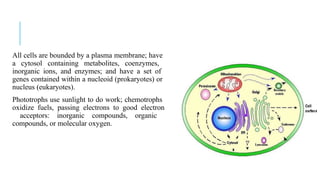
All cells are bounded by a plasma membrane; have
a cytosol containing metabolites, coenzymes,
inorganic ions, and enzymes; and have a set of
genes contained within a nucleoid (prokaryotes) or
nucleus (eukaryotes).
Phototrophs use sunlight to do work; chemotrophs
oxidize fuels, passing electrons to good electron
acceptors: inorganic compounds, organic
compounds, or molecular oxygen.
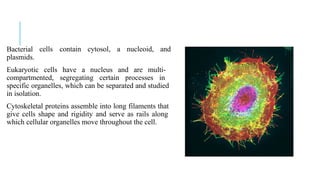
Bacterial
plasmids.
cells contain cytosol, a nucleoid, and
Eukaryotic cells have a nucleus and are multi-
compartmented, segregating certain processes in
specific organelles, which can be separated and studied
in isolation.
Cytoskeletal proteins assemble into long filaments that
give cells shape and rigidity and serve as rails along
which cellular organelles move throughout the cell.
Supramolecular complexes are held together
by non- covalent interactions and form a
hierarchy of structures, some visible with the
light microscope. When individual molecules
are removed from these complexes to be
studied in vitro, interactions important in the
living cell may be lost.
CARBOHYDRATES
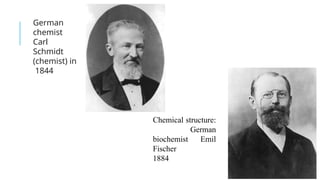
German
chemist
Carl
Schmidt
(chemist) in
1844
Chemical structure:
German
biochemist Emil
Fischer
1884
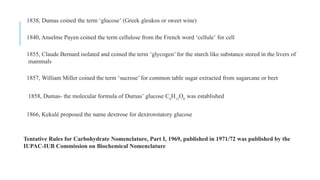
1838, Dumas coined the term ‘glucose’ (Greek gleukos or sweet wine)
1840, Anselme Payen coined the term cellulose from the French word ‘cellule’ for cell
1855, Claude Bernard isolated and coined the term ‘glycogen’ for the starch like substance stored in the livers of
mammals
1857, William Miller coined the term ‘sucrose’ for common table sugar extracted from sugarcane or beet
1858, Dumas- the molecular formula of Dumas’ glucose C6
H12
O6
was established
1866, Kekulé proposed the name dextrose for dextrorotatory glucose
Tentative Rules for Carbohydrate Nomenclature, Part I, 1969, published in 1971/72 was published by the
IUPAC-IUB Commission on Biochemical Nomenclature
CARBOHYDRATES
Carbohydrates - containing a group of naturally occurring
carbonyl compounds (aldehydes or ketones) - several
hydroxyl groups.
Carbon (C), hydrogen (H), and oxygen (O) atoms, -
hydrogen-oxygen atom ratio of 2:1 (as in water).
Empirical formula Cm(H2O)n
(where m and n may or may not be different) or
(CH2O)n
They are organic compounds organized in the form of
aldehydes or ketones with multiple hydroxyl groups coming
off the carbon chain.
The building blocks of all carbohydrates are simple sugars
called monosaccharides.
A monosaccharide can be a polyhydroxy aldehyde (aldose) or
a polyhydroxy ketone (ketose).
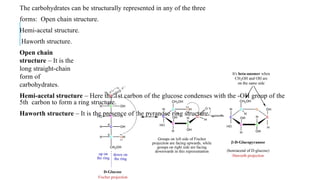
The carbohydrates can be structurally represented in any of the three
forms: Open chain structure.
Hemi-acetal structure.
Haworth structure.
Open chain
structure – It is the
long straight-chain
form of
carbohydrates.
Hemi-acetal structure – Here the 1st carbon of the glucose condenses with the -OH group of the
5th carbon to form a ring structure.
Haworth structure – It is the presence of the pyranose ring structure.
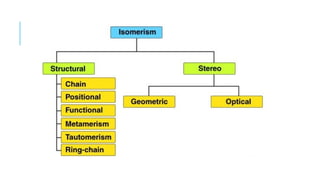
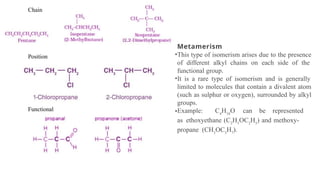
Chain
Position
Functional
Metamerism
•This type of isomerism arises due to the presence
of different alkyl chains on each side of the
functional group.
•It is a rare type of isomerism and is generally
limited to molecules that contain a divalent atom
(such as sulphur or oxygen), surrounded by alkyl
groups.
•Example: C4
H10
O can be represented
as ethoxyethane (C2
H5
OC2
H5
) and methoxy-
propane (CH3
OC3
H7
).
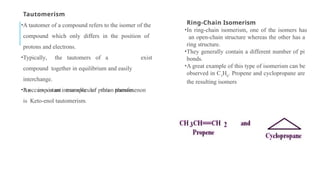
Tautomerism
•A tautomer of a compound refers to the isomer of the
compound which only differs in the position of
protons and electrons.
•Typically, the tautomers of a
compound together in equilibrium and easily
interchange.
•It occurs via an intramolecular proton transfer.
exist
•An important example of this phenomenon
is Keto-enol tautomerism.
Ring-Chain Isomerism
•In ring-chain isomerism, one of the isomers has
an open-chain structure whereas the other has a
ring structure.
•They generally contain a different number of pi
bonds.
•A great example of this type of isomerism can be
observed in C3
H6
. Propene and cyclopropane are
the resulting isomers
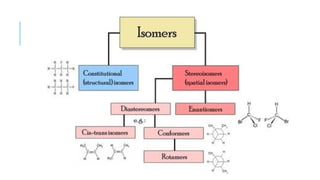
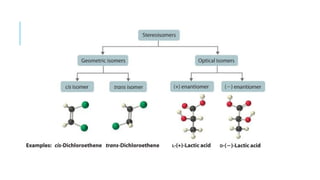
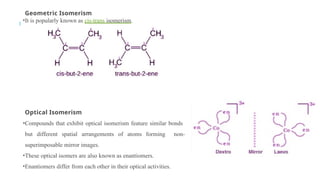
Geometric Isomerism
•It is popularly known as cis-trans isomerism.
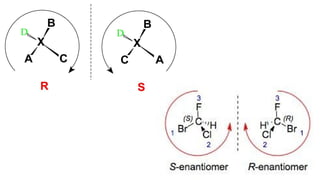
Optical Isomerism
•Compounds that exhibit optical isomerism feature similar bonds
but different spatial arrangements of atoms forming non-
superimposable mirror images.
•These optical isomers are also known as enantiomers.
•Enantiomers differ from each other in their optical activities.
PROPERTIES
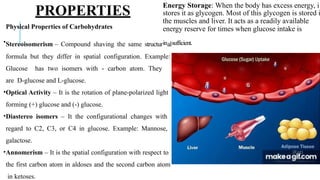
Energy Storage: When the body has excess energy, i
stores it as glycogen. Most of this glycogen is stored i
the muscles and liver. It acts as a readily available
energy reserve for times when glucose intake is
Physical Properties of Carbohydrates
•Stereoisomerism – Compound shaving the same structurinalsufficient.
formula but they differ in spatial configuration. Example:
Glucose has two isomers with - carbon atom. They
are D-glucose and L-glucose.
•Optical Activity – It is the rotation of plane-polarized light
forming (+) glucose and (-) glucose.
•Diastereo isomers – It the configurational changes with
regard to C2, C3, or C4 in glucose. Example: Mannose,
galactose.
•Annomerism – It is the spatial configuration with respect to
the first carbon atom in aldoses and the second carbon atom
in ketoses.
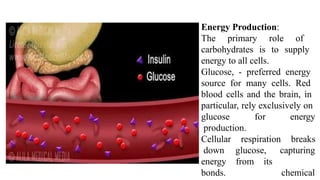
Energy Production:
The primary role of
carbohydrates is to supply
energy to all cells.
Glucose, - preferred energy
source for many cells. Red
blood cells and the brain, in
particular, rely exclusively on
glucose for energy
production.
respiration breaks
glucose,
from its
capturing
chemical
Cellular
down
energy
bonds.
Building Macromolecules: Carbohydrates contribute to the formation of larger molecules.
For instance, they play a role in constructing glycoproteins, which are essential for cell
communication and immune function.
Sparing Protein: Carbohydrates help spare protein by providing an alternative energy
source. When carbohydrates are available, the body uses them for energy, preserving
protein for other vital functions.
Assisting in Lipid Metabolism: Carbohydrates influence lipid metabolism by regulating
enzymes involved in fat breakdown and synthesis.
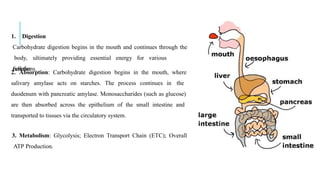
1. Digestion
Carbohydrate digestion begins in the mouth and continues through the
body, ultimately providing essential energy for various
cellular
functions.
2. Absorption: Carbohydrate digestion begins in the mouth, where
salivary amylase acts on starches. The process continues in the
duodenum with pancreatic amylase. Monosaccharides (such as glucose)
are then absorbed across the epithelium of the small intestine and
transported to tissues via the circulatory system.
3. Metabolism: Glycolysis; Electron Transport Chain (ETC); Overall
ATP Production.
Chemical Properties of Carbohydrates
•Osazone formation: Osazone are carbohydrate derivatives when sugars are reacted
with an excess of phenylhydrazine. eg. Glucosazone
•Benedict’s test: Reducing sugars when heated in the presence of an alkali gets
converted to powerful reducing species known as enediols.
•When Benedict’s reagent solution and reducing sugars are heated together, the
solution changes its color to orange-red/ brick red.
•Oxidation: Monosaccharides are reducing sugars if their carbonyl groups oxidize to
give carboxylic acids. In Benedict’s test, D-glucose is oxidized to D-gluconic acid thus,
glucose is considered a reducing sugar.
•Reduction to alcohols: The C=O groups in open-chain forms of carbohydrates can be
reduced to alcohols by sodium borohydride, NaBH4
, or catalytic hydrogenation (H2,
Ni, EtOH/H2O). The products are known as “alditols”.
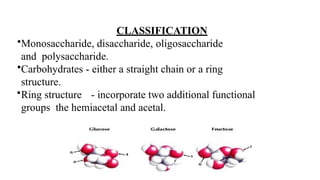
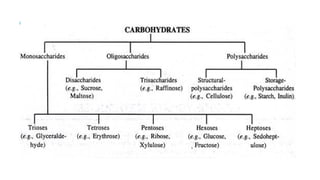
CLASSIFICATION
•Monosaccharide, disaccharide, oligosaccharide
and polysaccharide.
•Carbohydrates - either a straight chain or a ring
structure.
•Ring structure - incorporate two additional functional
groups the hemiacetal and acetal.
•Living organisms use carbohydrates as accessible energy to fuel cellular
reactions. They are the most abundant dietary source of energy (4kcal/gram) for
all living beings.
•Carbohydrates along with being the chief energy source, in many animals, are
instant sources of energy. Glucose is broken down by glycolysis/ Kreb’s
cycle to yield ATP.
•Serve as energy stores, fuels, and metabolic intermediates. It is stored as
glycogen in animals and starch in plants.
•Stored carbohydrates act as an energy source instead of proteins.
FUNCTIONS OF
CARBOHYDRATES
•They form structural and protective components, like in the cell wall of plants and
microorganisms. Structural elements in the cell walls of bacteria (peptidoglycan or murein),
plants (cellulose), and animals (chitin).
•Carbohydrates are intermediates in the biosynthesis of fats and proteins.
•Carbohydrates aid in the regulation of nerve tissue and is the energy source for the brain.
•Carbohydrates get associated with lipids and proteins to form surface antigens, receptor
molecules, vitamins, and antibiotics.
•Formation of the structural framework of RNA and DNA (ribonucleic acid and
deoxyribonucleic acid).
•They are linked to many proteins and lipids. Linked carbohydrates are important in cell-cell
communication and in interactions between cells and other elements in the cellular
environment.
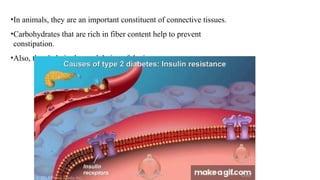
•In animals, they are an important constituent of connective tissues.
•Carbohydrates that are rich in fiber content help to prevent
constipation.
•Also, they help in the modulation of the immune system.
1. MONOSACCHARIDE :-
1.Monosaccharides - simplest carbohydrates.
2.Those carbohydrates- single polyhydroxy derivatives of
either aldehydes or ketones - Monosaccharides.
3.General formula (Cn
H2
O)n
.
4.Cannot be hydrolyzed .
5.Example - glucose,
fructose, galactose, xylose
and ribose.
6. Monosaccharides - simple
sugar.
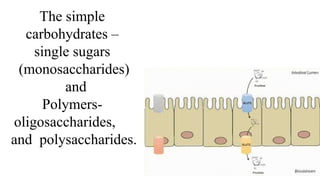
The simple
carbohydrates –
single sugars
(monosaccharides)
and
Polymers-
oligosaccharides,
and polysaccharides.
2. CHEMICAL CHARACTERISTICS OF MONOSACCHARIDE :-
1.One sugar - colourless, water soluble, crystalline solid.
2.Some monosaccharide - sweet taste.
3.The backbone - unbranched carbon chain - carbon atoms are linked
by single bonds.
to an
4.In open chain from one of the other carbons is double
bounded oxygen atom to from a carbonyl group.
5. Each of the other carbon atoms has a hydroxyl group.
6.Despite their high molecular weights, the presence of large numbers of OH
groups makes the monosaccharides much more water-soluble than most
molecules of similar MW.
7.Glucose can dissolve in minute amounts of water to make a syrup (1 g / 1
ml H2O).
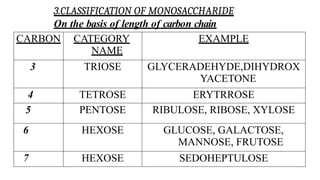
3.CLASSIFICATION OF MONOSACCHARIDE
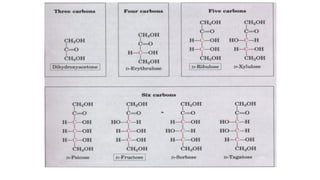
On the basis of length of carbon chain
CARBON CATEGORY
NAME
EXAMPLE
3 TRIOSE GLYCERADEHYDE,DIHYDROX
YACETONE
4 TETROSE ERYTRROSE
5 PENTOSE RIBULOSE, RIBOSE, XYLOSE
6 HEXOSE GLUCOSE, GALACTOSE,
MANNOSE, FRUTOSE
7 HEXOSE SEDOHEPTULOSE
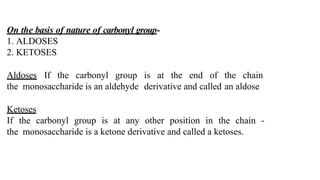
On the basis of nature of carbonyl group-
1. ALDOSES
2. KETOSES
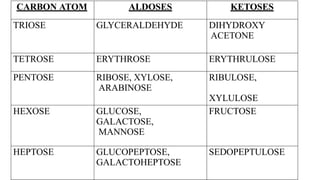
Aldoses If the carbonyl group is at the end of the chain
the monosaccharide is an aldehyde derivative and called an aldose
Ketoses
If the carbonyl group is at any other position in the chain -
the monosaccharide is a ketone derivative and called a ketoses.
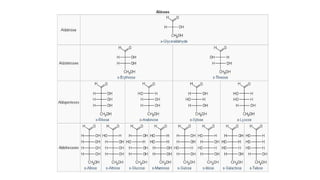
CARBON ATOM ALDOSES KETOSES
TRIOSE GLYCERALDEHYDE DIHYDROXY
ACETONE
TETROSE ERYTHROSE ERYTHRULOSE
PENTOSE RIBOSE, XYLOSE,
ARABINOSE
RIBULOSE,
XYLULOSE
HEXOSE GLUCOSE,
GALACTOSE,
MANNOSE
FRUCTOSE
HEPTOSE GLUCOPEPTOSE,
GALACTOHEPTOSE
SEDOPEPTULOSE
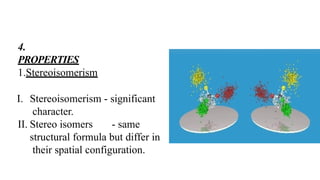
4.
PROPERTIES
1.Stereoisomerism
I. Stereoisomerism - significant
character.
II. Stereo isomers - same
structural formula but differ in
their spatial configuration.
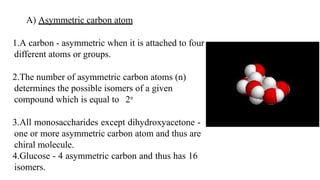
A) Asymmetric carbon atom
1.A carbon - asymmetric when it is attached to four
different atoms or groups.
2.The number of asymmetric carbon atoms (n)
determines the possible isomers of a given
compound which is equal to 2n
3.All monosaccharides except dihydroxyacetone -
one or more asymmetric carbon atom and thus are
chiral molecule.
4.Glucose - 4 asymmetric carbon and thus has 16
isomers.
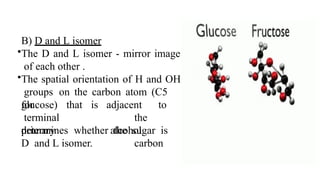
B) D and L isomer
•The D and L isomer - mirror image
of each other .
•The spatial orientation of H and OH
groups on the carbon atom (C5
for
glucose) that is
terminal
primary
adjacent to
the
alcohol
carbon
determines whether the sugar is
D and L isomer.
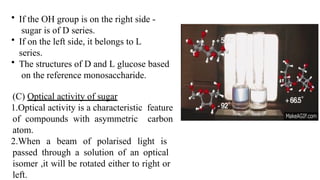
• If the OH group is on the right side -
sugar is of D series.
• If on the left side, it belongs to L
series.
• The structures of D and L glucose based
on the reference monosaccharide.
(C) Optical activity of sugar
1.Optical activity is a characteristic feature
of compounds with asymmetric carbon
atom.
2.When a beam of polarised light is
passed through a solution of an optical
isomer ,it will be rotated either to right or
left.
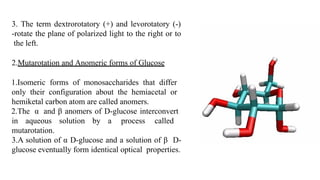
3. The term dextrorotatory (+) and levorotatory (-)
-rotate the plane of polarized light to the right or to
the left.
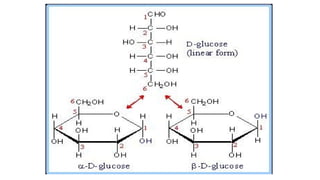
2.Mutarotation and Anomeric forms of Glucose
1.Isomeric forms of monosaccharides that differ
only their configuration about the hemiacetal or
hemiketal carbon atom are called anomers.
2.The α and β anomers of D-glucose interconvert
in aqueous solution by a process called
mutarotation.
3.A solution of α D-glucose and a solution of β D-
glucose eventually form identical optical properties.
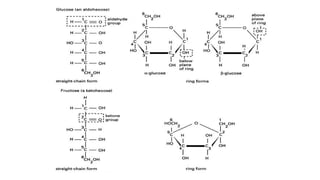
3.CYCLIC FORM OF MONOSACCHARIDES
•Monosaccharide - five or more carbon atoms in the backbone usually
occur in solution as cyclic or ring structure.
•In which the carbonyl group is not free as written but has formed a
covalent bond with one of the hydroxyl groups along the chain.
3.The aldehydes and Ketones moieties - five and
six carbon will spontaneously react with alcohol
groups present in neighbouring carbons to
produce intramolecular hemiacetals or hemiketal,
respectively.
4.This result in the formation of five or six
membered rings - 5 membered ring structures
resemble the organic molecule furon, derivatives
with this structure are termed furanoses.
5.Those with six numbered rings resemble the
organic molecules pyron and are termed as
pyranoses.
4. IMPORTANT CHEMICAL
REACTIONS OF
MONOSACCHARIDE
IODO COMPOUND
•An aldose sugar, when heated with
concentrated hydrodic acid (HI) loses all
of its oxygen and is converted into an iodo
compound (glucose to iodohexane,C6
H12
I)
ESTER FORMATION
•Sugar by virtue of the alcohol group,
readily form ESTER with acids.
•All the free OH groups are
ACETYLATION
•The acetylation with acetyl chloride indicates the presence of
present in the sugar.
•The presence of 5 OH group of glucose results in a penta
actate.
OH groups
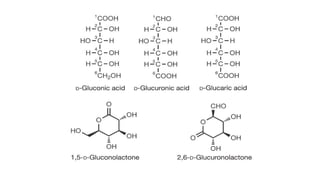
OXIDATION
• Oxidation of the aldehyde group forms ‘aldonic acids’.
•If the aldehyde group remains intact and the primary alcohol group is oxidized
‘uronic acid’ are formed .
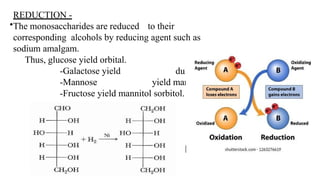
REDUCTION -
•The monosaccharides are reduced to their
corresponding alcohols by reducing agent such as
sodium amalgam.
Thus, glucose yield orbital.
-Galactose yield dulcitol.
-Mannose yield mannitol.
-Fructose yield mannitol sorbitol.
OSAZONE FORMATION
•It is nothing but the formation of crystalline derivatives of the sugars
which are valuable in the identification of sugars.
•These crystals are obtained by adding a mixture of phenyl hydrazine
hydrochloride and sodium acetate to the sugar solution and heating in a
boiling water bath.
•The carbonyl group and the next adjacent carbon are involved this
reaction .With an aldose the reaction is shown.
•The hydrazone then reacts with two additional molecules of
phenylhydrazine to from the osazons. The ketones also show similar
reaction.
OTHER REACTION
•The best known tests are reduction of
metallic hydroxides together with oxidation
of the sugar.
•The alkaline metal is kept in solution with
sodium potassium titrate (Fehling’s solution)
or sodium citrate (Benedict’s solution).
•Barford’s test distinguishes between
monosaccharides and disaccharides.
•The copper acetate in dilute acid is reduced
in 30 seconds by monosaccharides whereas
reduction of the same takes several minutes
by disaccharides.
Thank you…

Carbohydrates - monosaccharides- outline

  • 1.
    CARBOHYDRATES (INTRODUCTION AND Dr. V. MANONMANI ASSISTANT PROFESSOR IN LIFE SCIENCES KRISTU JAYANTI COLLEGE BENGALURU- 560077
  • 2.
  • 4.
    All cells arebounded by a plasma membrane; have a cytosol containing metabolites, coenzymes, inorganic ions, and enzymes; and have a set of genes contained within a nucleoid (prokaryotes) or nucleus (eukaryotes). Phototrophs use sunlight to do work; chemotrophs oxidize fuels, passing electrons to good electron acceptors: inorganic compounds, organic compounds, or molecular oxygen.
  • 5.
    Bacterial plasmids. cells contain cytosol,a nucleoid, and Eukaryotic cells have a nucleus and are multi- compartmented, segregating certain processes in specific organelles, which can be separated and studied in isolation. Cytoskeletal proteins assemble into long filaments that give cells shape and rigidity and serve as rails along which cellular organelles move throughout the cell.
  • 6.
    Supramolecular complexes areheld together by non- covalent interactions and form a hierarchy of structures, some visible with the light microscope. When individual molecules are removed from these complexes to be studied in vitro, interactions important in the living cell may be lost.
  • 7.
  • 8.
  • 9.
    1838, Dumas coinedthe term ‘glucose’ (Greek gleukos or sweet wine) 1840, Anselme Payen coined the term cellulose from the French word ‘cellule’ for cell 1855, Claude Bernard isolated and coined the term ‘glycogen’ for the starch like substance stored in the livers of mammals 1857, William Miller coined the term ‘sucrose’ for common table sugar extracted from sugarcane or beet 1858, Dumas- the molecular formula of Dumas’ glucose C6 H12 O6 was established 1866, Kekulé proposed the name dextrose for dextrorotatory glucose Tentative Rules for Carbohydrate Nomenclature, Part I, 1969, published in 1971/72 was published by the IUPAC-IUB Commission on Biochemical Nomenclature
  • 10.
    CARBOHYDRATES Carbohydrates - containinga group of naturally occurring carbonyl compounds (aldehydes or ketones) - several hydroxyl groups. Carbon (C), hydrogen (H), and oxygen (O) atoms, - hydrogen-oxygen atom ratio of 2:1 (as in water). Empirical formula Cm(H2O)n (where m and n may or may not be different) or (CH2O)n They are organic compounds organized in the form of aldehydes or ketones with multiple hydroxyl groups coming off the carbon chain. The building blocks of all carbohydrates are simple sugars called monosaccharides. A monosaccharide can be a polyhydroxy aldehyde (aldose) or a polyhydroxy ketone (ketose).
  • 11.
    The carbohydrates canbe structurally represented in any of the three forms: Open chain structure. Hemi-acetal structure. Haworth structure. Open chain structure – It is the long straight-chain form of carbohydrates. Hemi-acetal structure – Here the 1st carbon of the glucose condenses with the -OH group of the 5th carbon to form a ring structure. Haworth structure – It is the presence of the pyranose ring structure.
  • 15.
    Chain Position Functional Metamerism •This type ofisomerism arises due to the presence of different alkyl chains on each side of the functional group. •It is a rare type of isomerism and is generally limited to molecules that contain a divalent atom (such as sulphur or oxygen), surrounded by alkyl groups. •Example: C4 H10 O can be represented as ethoxyethane (C2 H5 OC2 H5 ) and methoxy- propane (CH3 OC3 H7 ).
  • 16.
    Tautomerism •A tautomer ofa compound refers to the isomer of the compound which only differs in the position of protons and electrons. •Typically, the tautomers of a compound together in equilibrium and easily interchange. •It occurs via an intramolecular proton transfer. exist •An important example of this phenomenon is Keto-enol tautomerism. Ring-Chain Isomerism •In ring-chain isomerism, one of the isomers has an open-chain structure whereas the other has a ring structure. •They generally contain a different number of pi bonds. •A great example of this type of isomerism can be observed in C3 H6 . Propene and cyclopropane are the resulting isomers
  • 18.
    Geometric Isomerism •It ispopularly known as cis-trans isomerism. Optical Isomerism •Compounds that exhibit optical isomerism feature similar bonds but different spatial arrangements of atoms forming non- superimposable mirror images. •These optical isomers are also known as enantiomers. •Enantiomers differ from each other in their optical activities.
  • 19.
    PROPERTIES Energy Storage: Whenthe body has excess energy, i stores it as glycogen. Most of this glycogen is stored i the muscles and liver. It acts as a readily available energy reserve for times when glucose intake is Physical Properties of Carbohydrates •Stereoisomerism – Compound shaving the same structurinalsufficient. formula but they differ in spatial configuration. Example: Glucose has two isomers with - carbon atom. They are D-glucose and L-glucose. •Optical Activity – It is the rotation of plane-polarized light forming (+) glucose and (-) glucose. •Diastereo isomers – It the configurational changes with regard to C2, C3, or C4 in glucose. Example: Mannose, galactose. •Annomerism – It is the spatial configuration with respect to the first carbon atom in aldoses and the second carbon atom in ketoses.
  • 20.
    Energy Production: The primaryrole of carbohydrates is to supply energy to all cells. Glucose, - preferred energy source for many cells. Red blood cells and the brain, in particular, rely exclusively on glucose for energy production. respiration breaks glucose, from its capturing chemical Cellular down energy bonds.
  • 21.
    Building Macromolecules: Carbohydratescontribute to the formation of larger molecules. For instance, they play a role in constructing glycoproteins, which are essential for cell communication and immune function. Sparing Protein: Carbohydrates help spare protein by providing an alternative energy source. When carbohydrates are available, the body uses them for energy, preserving protein for other vital functions. Assisting in Lipid Metabolism: Carbohydrates influence lipid metabolism by regulating enzymes involved in fat breakdown and synthesis.
  • 22.
    1. Digestion Carbohydrate digestionbegins in the mouth and continues through the body, ultimately providing essential energy for various cellular functions. 2. Absorption: Carbohydrate digestion begins in the mouth, where salivary amylase acts on starches. The process continues in the duodenum with pancreatic amylase. Monosaccharides (such as glucose) are then absorbed across the epithelium of the small intestine and transported to tissues via the circulatory system. 3. Metabolism: Glycolysis; Electron Transport Chain (ETC); Overall ATP Production.
  • 23.
    Chemical Properties ofCarbohydrates •Osazone formation: Osazone are carbohydrate derivatives when sugars are reacted with an excess of phenylhydrazine. eg. Glucosazone •Benedict’s test: Reducing sugars when heated in the presence of an alkali gets converted to powerful reducing species known as enediols. •When Benedict’s reagent solution and reducing sugars are heated together, the solution changes its color to orange-red/ brick red. •Oxidation: Monosaccharides are reducing sugars if their carbonyl groups oxidize to give carboxylic acids. In Benedict’s test, D-glucose is oxidized to D-gluconic acid thus, glucose is considered a reducing sugar. •Reduction to alcohols: The C=O groups in open-chain forms of carbohydrates can be reduced to alcohols by sodium borohydride, NaBH4 , or catalytic hydrogenation (H2, Ni, EtOH/H2O). The products are known as “alditols”.
  • 24.
    CLASSIFICATION •Monosaccharide, disaccharide, oligosaccharide andpolysaccharide. •Carbohydrates - either a straight chain or a ring structure. •Ring structure - incorporate two additional functional groups the hemiacetal and acetal.
  • 26.
    •Living organisms usecarbohydrates as accessible energy to fuel cellular reactions. They are the most abundant dietary source of energy (4kcal/gram) for all living beings. •Carbohydrates along with being the chief energy source, in many animals, are instant sources of energy. Glucose is broken down by glycolysis/ Kreb’s cycle to yield ATP. •Serve as energy stores, fuels, and metabolic intermediates. It is stored as glycogen in animals and starch in plants. •Stored carbohydrates act as an energy source instead of proteins. FUNCTIONS OF CARBOHYDRATES
  • 27.
    •They form structuraland protective components, like in the cell wall of plants and microorganisms. Structural elements in the cell walls of bacteria (peptidoglycan or murein), plants (cellulose), and animals (chitin). •Carbohydrates are intermediates in the biosynthesis of fats and proteins. •Carbohydrates aid in the regulation of nerve tissue and is the energy source for the brain. •Carbohydrates get associated with lipids and proteins to form surface antigens, receptor molecules, vitamins, and antibiotics. •Formation of the structural framework of RNA and DNA (ribonucleic acid and deoxyribonucleic acid). •They are linked to many proteins and lipids. Linked carbohydrates are important in cell-cell communication and in interactions between cells and other elements in the cellular environment.
  • 28.
    •In animals, theyare an important constituent of connective tissues. •Carbohydrates that are rich in fiber content help to prevent constipation. •Also, they help in the modulation of the immune system.
  • 29.
    1. MONOSACCHARIDE :- 1.Monosaccharides- simplest carbohydrates. 2.Those carbohydrates- single polyhydroxy derivatives of either aldehydes or ketones - Monosaccharides. 3.General formula (Cn H2 O)n . 4.Cannot be hydrolyzed . 5.Example - glucose, fructose, galactose, xylose and ribose. 6. Monosaccharides - simple sugar.
  • 30.
    The simple carbohydrates – singlesugars (monosaccharides) and Polymers- oligosaccharides, and polysaccharides.
  • 31.
    2. CHEMICAL CHARACTERISTICSOF MONOSACCHARIDE :- 1.One sugar - colourless, water soluble, crystalline solid. 2.Some monosaccharide - sweet taste. 3.The backbone - unbranched carbon chain - carbon atoms are linked by single bonds. to an 4.In open chain from one of the other carbons is double bounded oxygen atom to from a carbonyl group. 5. Each of the other carbon atoms has a hydroxyl group. 6.Despite their high molecular weights, the presence of large numbers of OH groups makes the monosaccharides much more water-soluble than most molecules of similar MW. 7.Glucose can dissolve in minute amounts of water to make a syrup (1 g / 1 ml H2O).
  • 32.
    3.CLASSIFICATION OF MONOSACCHARIDE Onthe basis of length of carbon chain CARBON CATEGORY NAME EXAMPLE 3 TRIOSE GLYCERADEHYDE,DIHYDROX YACETONE 4 TETROSE ERYTRROSE 5 PENTOSE RIBULOSE, RIBOSE, XYLOSE 6 HEXOSE GLUCOSE, GALACTOSE, MANNOSE, FRUTOSE 7 HEXOSE SEDOHEPTULOSE
  • 34.
    On the basisof nature of carbonyl group- 1. ALDOSES 2. KETOSES Aldoses If the carbonyl group is at the end of the chain the monosaccharide is an aldehyde derivative and called an aldose Ketoses If the carbonyl group is at any other position in the chain - the monosaccharide is a ketone derivative and called a ketoses.
  • 36.
    CARBON ATOM ALDOSESKETOSES TRIOSE GLYCERALDEHYDE DIHYDROXY ACETONE TETROSE ERYTHROSE ERYTHRULOSE PENTOSE RIBOSE, XYLOSE, ARABINOSE RIBULOSE, XYLULOSE HEXOSE GLUCOSE, GALACTOSE, MANNOSE FRUCTOSE HEPTOSE GLUCOPEPTOSE, GALACTOHEPTOSE SEDOPEPTULOSE
  • 37.
    4. PROPERTIES 1.Stereoisomerism I. Stereoisomerism -significant character. II. Stereo isomers - same structural formula but differ in their spatial configuration.
  • 38.
    A) Asymmetric carbonatom 1.A carbon - asymmetric when it is attached to four different atoms or groups. 2.The number of asymmetric carbon atoms (n) determines the possible isomers of a given compound which is equal to 2n 3.All monosaccharides except dihydroxyacetone - one or more asymmetric carbon atom and thus are chiral molecule. 4.Glucose - 4 asymmetric carbon and thus has 16 isomers.
  • 39.
    B) D andL isomer •The D and L isomer - mirror image of each other . •The spatial orientation of H and OH groups on the carbon atom (C5 for glucose) that is terminal primary adjacent to the alcohol carbon determines whether the sugar is D and L isomer.
  • 40.
    • If theOH group is on the right side - sugar is of D series. • If on the left side, it belongs to L series. • The structures of D and L glucose based on the reference monosaccharide. (C) Optical activity of sugar 1.Optical activity is a characteristic feature of compounds with asymmetric carbon atom. 2.When a beam of polarised light is passed through a solution of an optical isomer ,it will be rotated either to right or left.
  • 41.
    3. The termdextrorotatory (+) and levorotatory (-) -rotate the plane of polarized light to the right or to the left. 2.Mutarotation and Anomeric forms of Glucose 1.Isomeric forms of monosaccharides that differ only their configuration about the hemiacetal or hemiketal carbon atom are called anomers. 2.The α and β anomers of D-glucose interconvert in aqueous solution by a process called mutarotation. 3.A solution of α D-glucose and a solution of β D- glucose eventually form identical optical properties.
  • 43.
    3.CYCLIC FORM OFMONOSACCHARIDES •Monosaccharide - five or more carbon atoms in the backbone usually occur in solution as cyclic or ring structure. •In which the carbonyl group is not free as written but has formed a covalent bond with one of the hydroxyl groups along the chain.
  • 44.
    3.The aldehydes andKetones moieties - five and six carbon will spontaneously react with alcohol groups present in neighbouring carbons to produce intramolecular hemiacetals or hemiketal, respectively. 4.This result in the formation of five or six membered rings - 5 membered ring structures resemble the organic molecule furon, derivatives with this structure are termed furanoses. 5.Those with six numbered rings resemble the organic molecules pyron and are termed as pyranoses.
  • 46.
    4. IMPORTANT CHEMICAL REACTIONSOF MONOSACCHARIDE IODO COMPOUND •An aldose sugar, when heated with concentrated hydrodic acid (HI) loses all of its oxygen and is converted into an iodo compound (glucose to iodohexane,C6 H12 I) ESTER FORMATION •Sugar by virtue of the alcohol group, readily form ESTER with acids. •All the free OH groups are
  • 47.
    ACETYLATION •The acetylation withacetyl chloride indicates the presence of present in the sugar. •The presence of 5 OH group of glucose results in a penta actate. OH groups OXIDATION • Oxidation of the aldehyde group forms ‘aldonic acids’. •If the aldehyde group remains intact and the primary alcohol group is oxidized ‘uronic acid’ are formed .
  • 49.
    REDUCTION - •The monosaccharidesare reduced to their corresponding alcohols by reducing agent such as sodium amalgam. Thus, glucose yield orbital. -Galactose yield dulcitol. -Mannose yield mannitol. -Fructose yield mannitol sorbitol.
  • 50.
    OSAZONE FORMATION •It isnothing but the formation of crystalline derivatives of the sugars which are valuable in the identification of sugars. •These crystals are obtained by adding a mixture of phenyl hydrazine hydrochloride and sodium acetate to the sugar solution and heating in a boiling water bath. •The carbonyl group and the next adjacent carbon are involved this reaction .With an aldose the reaction is shown. •The hydrazone then reacts with two additional molecules of phenylhydrazine to from the osazons. The ketones also show similar reaction.
  • 51.
    OTHER REACTION •The bestknown tests are reduction of metallic hydroxides together with oxidation of the sugar. •The alkaline metal is kept in solution with sodium potassium titrate (Fehling’s solution) or sodium citrate (Benedict’s solution). •Barford’s test distinguishes between monosaccharides and disaccharides. •The copper acetate in dilute acid is reduced in 30 seconds by monosaccharides whereas reduction of the same takes several minutes by disaccharides.
  • 52.