BIOMEDICAL WASTE (BMW)
MANAGEMENT
Farida Khatun Biomedical Waste (BMW) Management
What is BMW?
It is defined as “Any solid and/or liquid waste including its container
and any intermediate product, which is generated during the diagnosis,
treatment or immunization of human beings or animals”.
2Biomedical Waste (BMW) ManagementFarida Khatun
HEALTHCARE WASTE CHARACTERIZATION
3
Healthcare Waste
85% Non-infectious
15% Infectious/
Hazardous
Farida Khatun Biomedical Waste (BMW) Management
CLASSIFICATION OF HOSPITAL WASTE
Non-Hazardous Waste
Bio-
degradable
Non bio-
degradable
Potentially Infectious Waste
Dressings,
swabs,
laboratory
wastes,
instruments
used in
patient care..
Potentially Toxic Waste
Radioactive Chemical Pharmaceutical
4Farida Khatun Biomedical Waste (BMW) Management
Categories of Persons Exposed to Risk
of Infection
Sanitation
workers
Medical &
Paramedical
staff
Patients
5Farida Khatun Biomedical Waste (BMW) Management
Major Difference between BMW Rules
1998 & 2016
1998 2016
1 Occupiers with more than 1000
beds required to obtain
Authorization
Every occupier generating BMW,
Including health camp or ayush
requires to obtain authorization
2 Operator duties absent Duties of the operator listed
3 Biomedical waste divided in ten
categories
Biomedical waste divided in 4
categories
4 Rules restricted to HCEs with
more than 1000 beds
Treatment and disposal of BMW
made mandatory for all the HCEs
5 No format for annual report A format for annual report appended
with the rules
6 Schedule I, II, III, IV,V Change of Schedule I, II, III, IV
Biomedical Waste (BMW) Management 6Farida Khatun
Duties of Operator
• To take all necessary steps to ensure that the BMW
collected from the occupier is transported, handled, stored,
treated & disposed of without any adverse effect to human
health & environment.
• To ensure timely collection of BMW from the health care
facilities.
• To inform the prescribed authority immediately regarding
the health care establishments/facilities, which are not
handling over the segregated BMW.
• To provide training of all its workers.
Biomedical Waste (BMW) Management 7Farida Khatun
Cont…
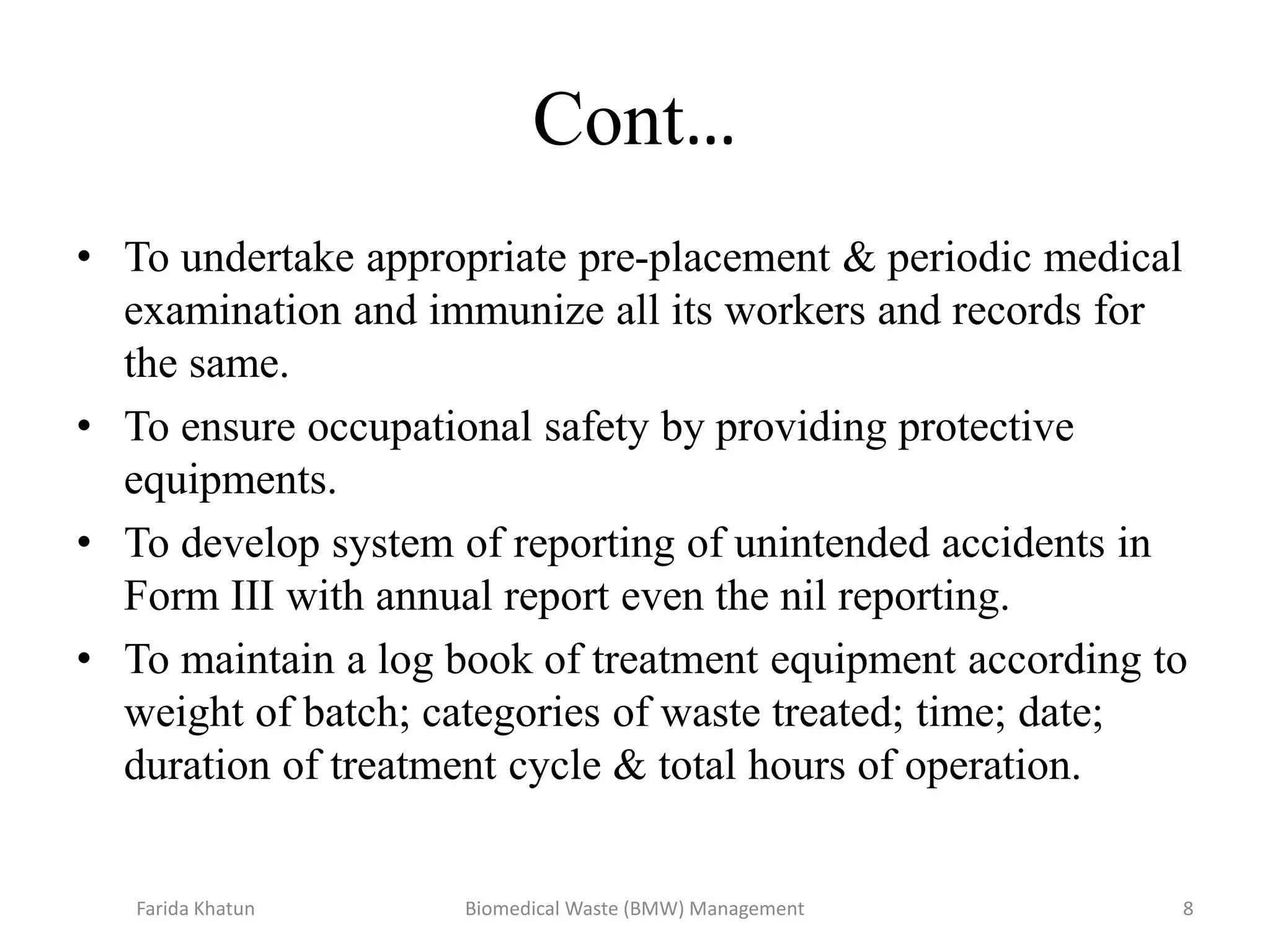
• To undertake appropriate pre-placement & periodic medical
examination and immunize all its workers and records for
the same.
• To ensure occupational safety by providing protective
equipments.
• To develop system of reporting of unintended accidents in
Form III with annual report even the nil reporting.
• To maintain a log book of treatment equipment according to
weight of batch; categories of waste treated; time; date;
duration of treatment cycle & total hours of operation.
Biomedical Waste (BMW) Management 8Farida Khatun
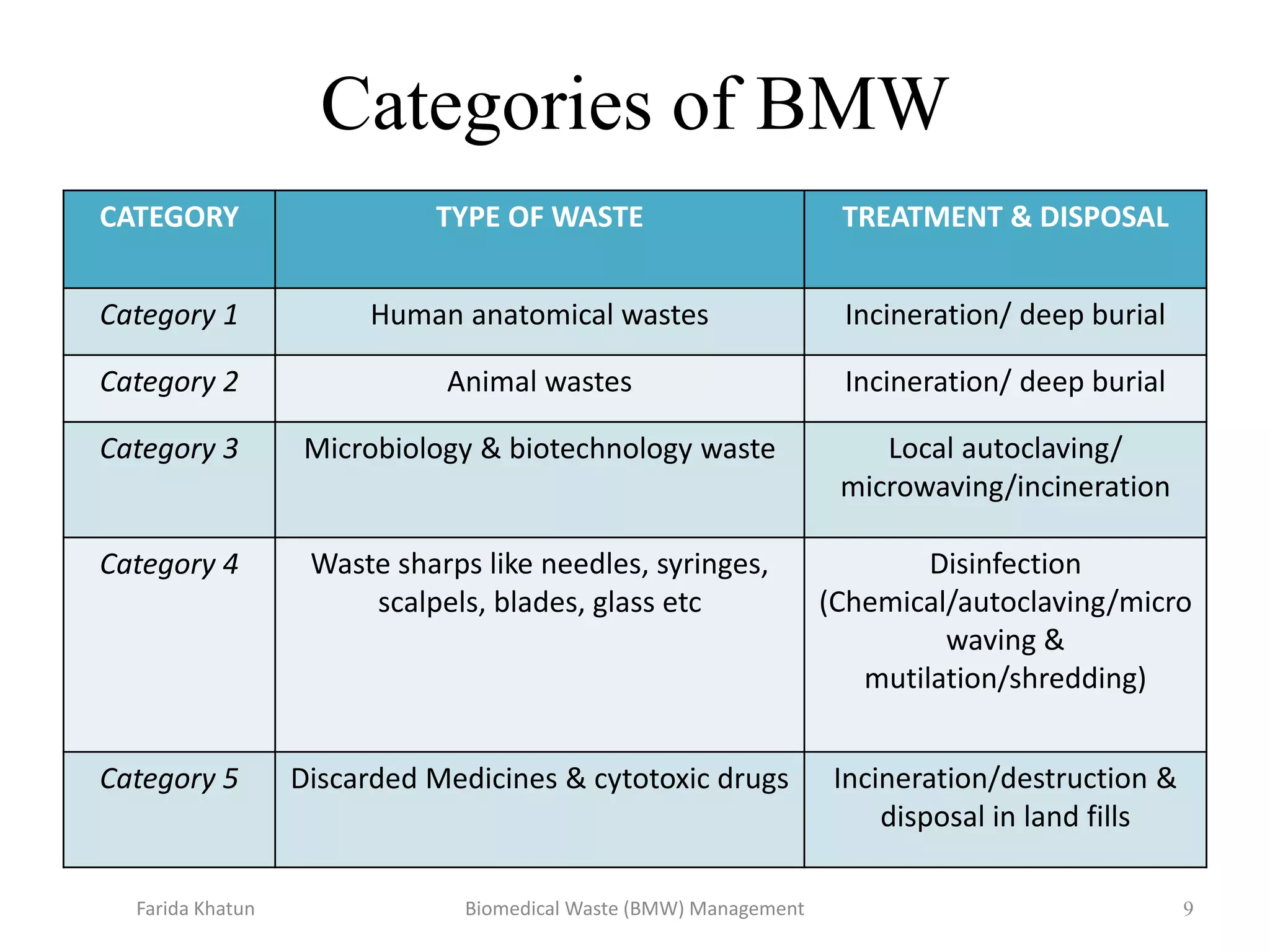
Categories of BMW
CATEGORY TYPE OF WASTE TREATMENT & DISPOSAL
Category 1 Human anatomical wastes Incineration/ deep burial
Category 2 Animal wastes Incineration/ deep burial
Category 3 Microbiology & biotechnology waste Local autoclaving/
microwaving/incineration
Category 4 Waste sharps like needles, syringes,
scalpels, blades, glass etc
Disinfection
(Chemical/autoclaving/micro
waving &
mutilation/shredding)
Category 5 Discarded Medicines & cytotoxic drugs Incineration/destruction &
disposal in land fills
9Farida Khatun Biomedical Waste (BMW) Management
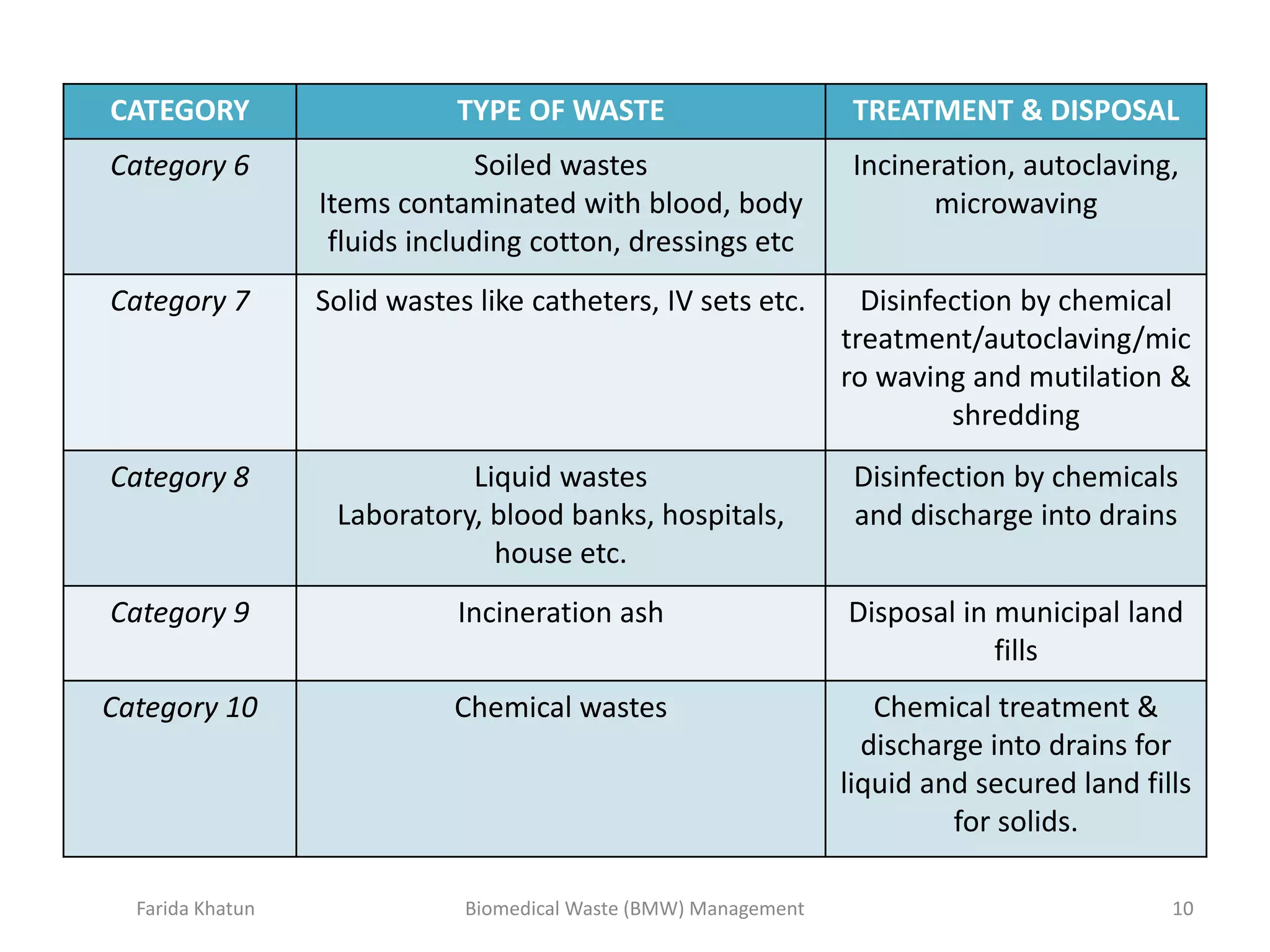
CATEGORY TYPE OF WASTE TREATMENT & DISPOSAL
Category 6 Soiled wastes
Items contaminated with blood, body
fluids including cotton, dressings etc
Incineration, autoclaving,
microwaving
Category 7 Solid wastes like catheters, IV sets etc. Disinfection by chemical
treatment/autoclaving/mic
ro waving and mutilation &
shredding
Category 8 Liquid wastes
Laboratory, blood banks, hospitals,
house etc.
Disinfection by chemicals
and discharge into drains
Category 9 Incineration ash Disposal in municipal land
fills
Category 10 Chemical wastes Chemical treatment &
discharge into drains for
liquid and secured land fills
for solids.
10Biomedical Waste (BMW) ManagementFarida Khatun
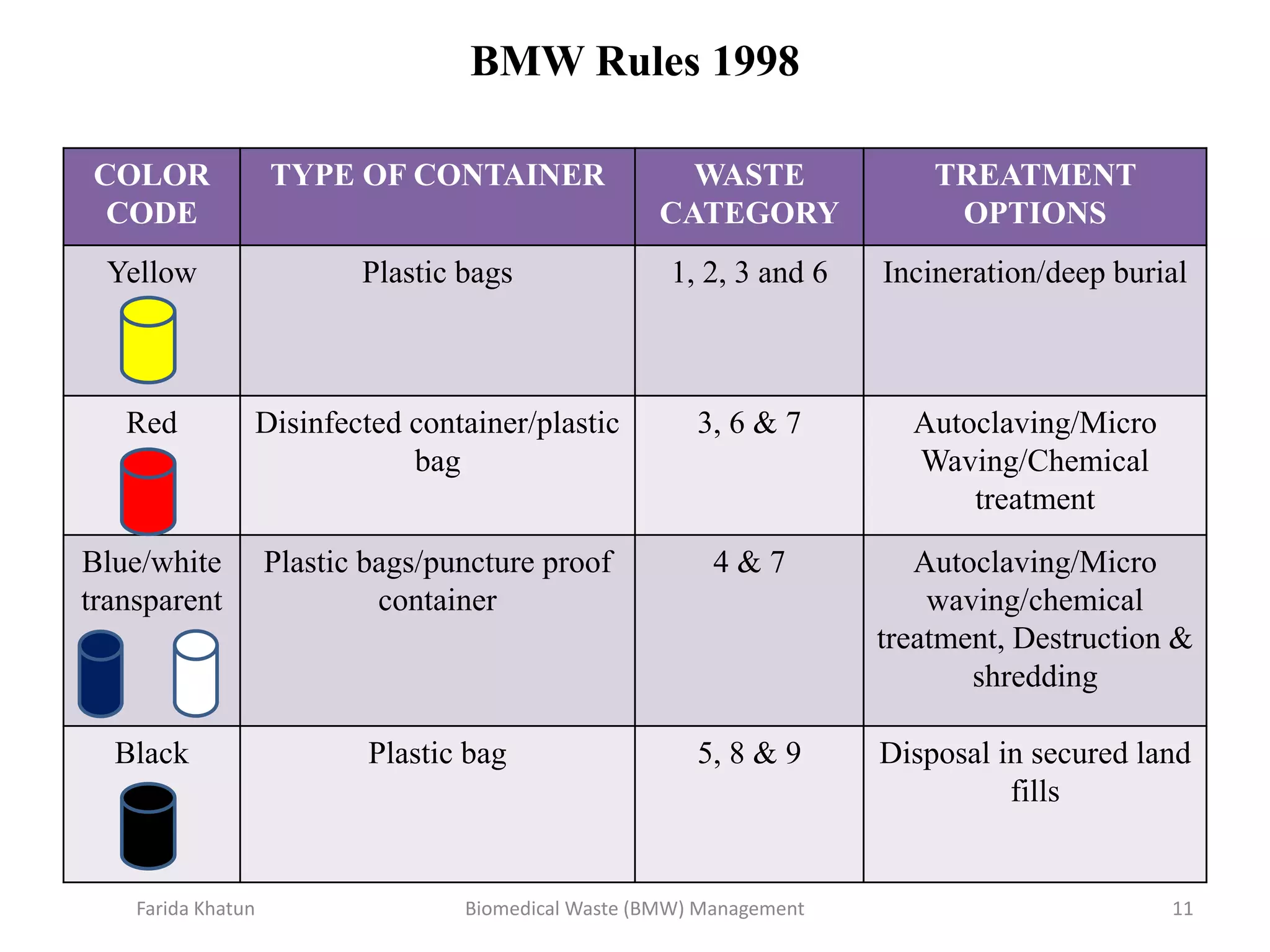
BMW Rules 1998
COLOR
CODE
TYPE OF CONTAINER WASTE
CATEGORY
TREATMENT
OPTIONS
Yellow Plastic bags 1, 2, 3 and 6 Incineration/deep burial
Red Disinfected container/plastic
bag
3, 6 & 7 Autoclaving/Micro
Waving/Chemical
treatment
Blue/white
transparent
Plastic bags/puncture proof
container
4 & 7 Autoclaving/Micro
waving/chemical
treatment, Destruction &
shredding
Black Plastic bag 5, 8 & 9 Disposal in secured land
fills
Biomedical Waste (BMW) Management 11Farida Khatun
BMW Rules 2016
Biomedical Waste (BMW) Management 12Farida Khatun
Health Hazards
Risk of HIV & HBV
Nosocomial
infections
Others..
Biomedical Waste (BMW) Management 13Farida Khatun
6/26/2019 14
Routes of Transmission
By ingestion
(contaminated
unwashed hands,
contaminated food
stuffs, water etc)
Intact or non
intact skin,
mucous
membranes
Inhalation of
dust particles
containing
germs
Biomedical Waste (BMW) Management 15Farida Khatun
Precautions
Medical & Paramedical staff should
be vaccinated against Hepatitis B
Using heavy duty gloves especially
while dealing with infectious wastes
Recapping needles should be
discouraged. In case, if unavoidable
single handed method should be used
Biomedical Waste (BMW) Management 16Farida Khatun
BIO-MEDICAL WASTE (MANAGEMENT &
HANDLING) RULES 1998
• BMW Rules have been adopted and notified with the objective
to stop the indiscriminate disposal of hospital waste/ bio-
medical waste and ensure that such waste is handled without
any adverse effect on the human health and environment.
• PUNITIVE STEPS against DEFAULTERS
Involves imprisonment up to five years or penalty up to rupees
one lakh or both, in case of continuation the penalty of rupees
five thousand per day up to one year and thereafter
imprisonment up to 7 years.
18Biomedical Waste (BMW) ManagementFarida Khatun
Steps for Effective BMW Management
Biomedical Waste (BMW) Management 19Farida Khatun
Waste Survey
Waste survey is an important component of the
waste management scheme. A survey helps in
evaluation both the type and quantity of waste
generated in hospitals.
Aims:
• Differentiate the types of waste
• Quantify the waste generated
• Determine the points of generation & type of
waste generated at each point
• Determine the level of generation &
disinfection within the hospital
• To find out the type of disposal carried out
Biomedical Waste (BMW) Management 20Farida Khatun
Steps in the management of hospital
waste include:
• Generation
• Segregation/separation
• Collection
• Transportation, storage
• Treatment
• Final disposal
Biomedical Waste (BMW) Management 21Farida Khatun
WHO GENERATES BMW?
• Waste generated by
– Healthcare facilities
– Research facilities
– Laboratories
22Farida Khatun Biomedical Waste (BMW) Management
Biomedical Waste (BMW) Management 23Farida Khatun
Segregation
• Segregation refers to the basic separation of different
categories of waste generated at source and thereby
reducing the risks as well as cost of handling and
disposal.
• Segregation is the most crucial step in bio-medical
waste management. Effective segregation alone can
ensure effective bio-medical waste management.
• The BMWs must be segregated in accordance to
guidelines laid down under schedule 1 of BMW
Rules, 1998.
Biomedical Waste (BMW) Management 24Farida Khatun
Collection
Biomedical Waste (BMW) Management 25
•The collection of biomedical waste involves use of different types of container .
• The containers/ bins should be placed in such a way that 100 % collection is achieved.
• Sharps must always be kept in puncture-proof containers to avoid injuries and infection
to the workers handling them.
Farida Khatun
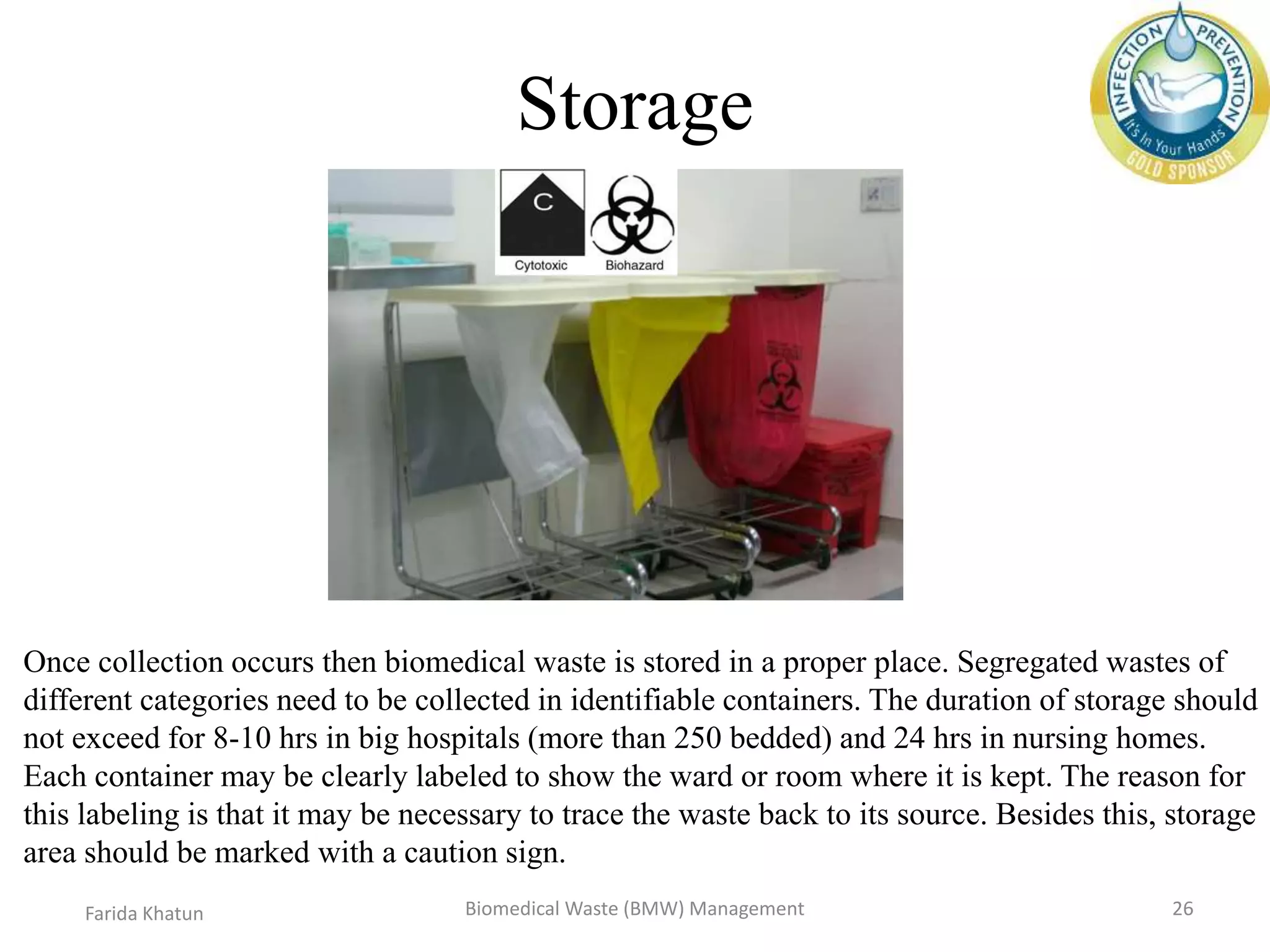
Storage
Biomedical Waste (BMW) Management 26
Once collection occurs then biomedical waste is stored in a proper place. Segregated wastes of
different categories need to be collected in identifiable containers. The duration of storage should
not exceed for 8-10 hrs in big hospitals (more than 250 bedded) and 24 hrs in nursing homes.
Each container may be clearly labeled to show the ward or room where it is kept. The reason for
this labeling is that it may be necessary to trace the waste back to its source. Besides this, storage
area should be marked with a caution sign.
Farida Khatun
Transport
27Biomedical Waste (BMW) ManagementFarida Khatun
Principles of Waste Management
• Develop a waste management plan that is
based on an assessment of the current situation
and which minimizes the amount of waste
generated
• Segregate clinical (infectious) waste from
nonclinical waste in dedicated containers.
• Transport waste in dedicated trolleys.
• Store waste in specified areas with restricted
access.
Biomedical Waste (BMW) Management 28Farida Khatun
• Collect and store sharps in sharps containers.
Sharps containers should be made of plastic or
metal and have a lid that can be closed. Mark
the storage areas with a biohazard symbol
• Ensure that the carts or trolleys used for the
transport of segregated waste collection are not
used for any other purpose – they should be
cleaned regularly
• Identify a storage area for waste prior to
treatment or being taken to final disposal area.
Biomedical Waste (BMW) Management 29Farida Khatun
Handling Devices
• Trolleys
• Wheelbarrows
• Chutes
30Biomedical Waste (BMW) ManagementFarida Khatun
DO’s &
DONT’s
Biomedical Waste (BMW) Management 31Farida Khatun
PPE
• Use appropriate PPE when segregating, packing,
transporting, and storing biomedical waste.
• Biomedical waste should be transported in a
closed container.
Biomedical Waste (BMW) Management 32Farida Khatun
Proper Disposal of Needles and Sharps
• Needles and sharps are the commonest mode of
transmission of blood-borne pathogens to the healthcare
worker
• Precautions should be taken to prevent injuries by sharp
instruments, especially hollow bore needles that have been
used for venepuncture or other vascular access procedures.
• Needles should not be recapped, bent or broken by hand.
Disposable needles and other sharps should be disposed
immediately after use into puncture-resistant containers
which should be located at the site of the procedure.
• When a needle has to be removed from a syringe, do it with
utmost care. Do not overfill a sharps container.
Biomedical Waste (BMW) Management 33Farida Khatun
Good Practice for Safe Handling and Disposal of
Sharps
• ALWAYS dispose of your own sharps.
• NEVER pass used sharps directly from one person to another.
• During exposure-prone procedures, the risk of injury should be
minimized by ensuring that the operator has the best possible
visibility; for example, by positioning the patient, adjusting the light
source, and controlling bleeding.
• Protect fingers from injury by using forceps instead of fingers for
guiding suturing.
• NEVER recap, bend or break disposable needles.
• Directly after use, place needles and syringes in a rigid container
until ready for disposal.
• Locate sharps disposal containers close to the point of use, for
example, in patient’s room, on the medicine trolley, and in the
treatment room.
Biomedical Waste (BMW) Management 34Farida Khatun
Treatment
• Chemical processes
• Thermal processes
• Mechanical processes
• Irradiation processes
• Biological processes
Biomedical Waste (BMW) Management 35Farida Khatun
6/26/2019 Biomedical Waste (BMW) Management 36
Chemical Processes
Biomedical Waste (BMW) Management 37Farida Khatun
Thermal Processes
Biomedical Waste (BMW) Management 38Farida Khatun
Mechanical Processes
Biomedical Waste (BMW) Management 39Farida Khatun
Irradiation Processes
• Exposes wastes to ultraviolet or ionizing
radiation in an enclosed chamber. These
systems require post shredding to render the
waste unrecognizable.
Biomedical Waste (BMW) Management 40Farida Khatun
Biological Processes
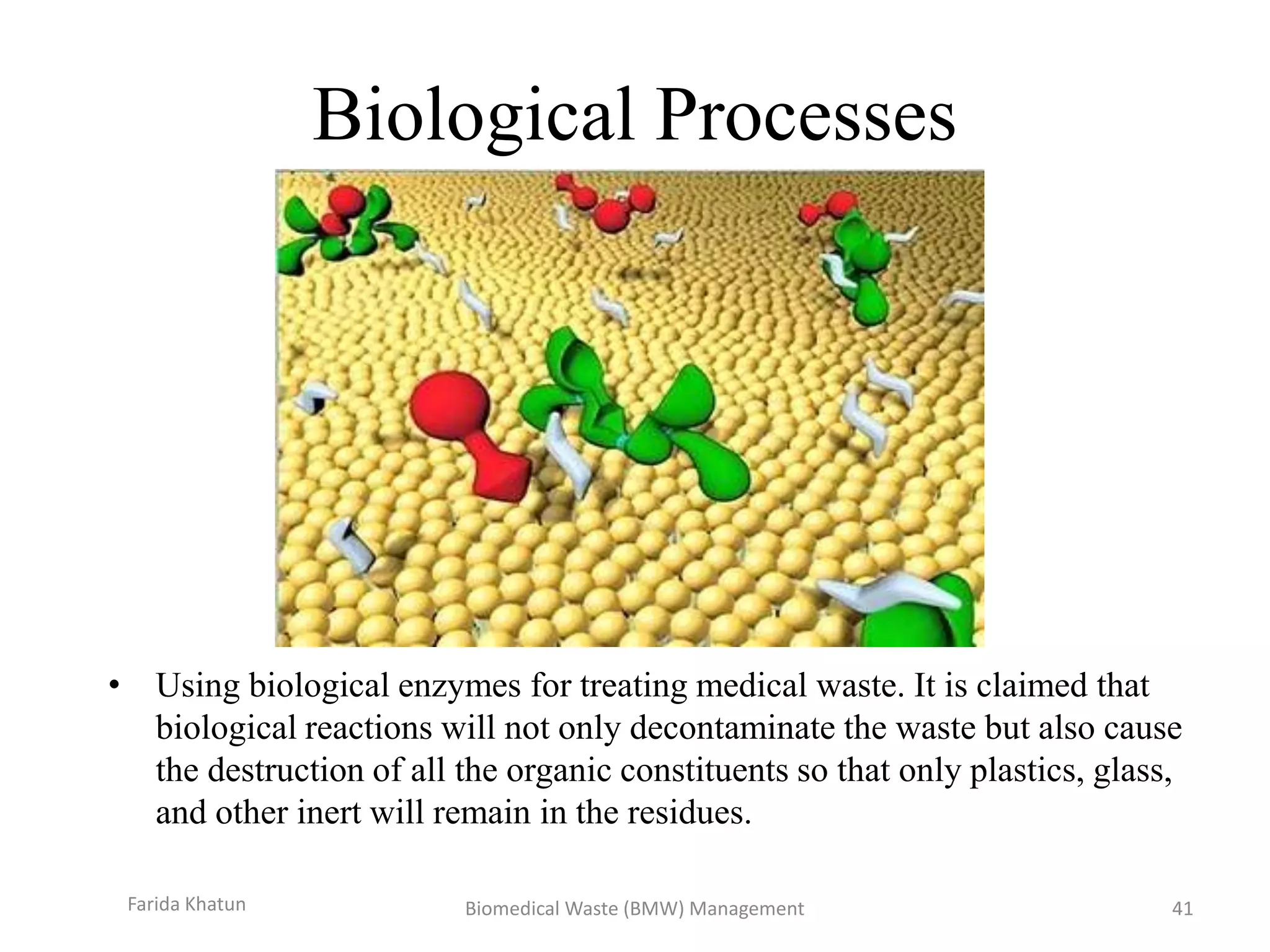
• Using biological enzymes for treating medical waste. It is claimed that
biological reactions will not only decontaminate the waste but also cause
the destruction of all the organic constituents so that only plastics, glass,
and other inert will remain in the residues.
Biomedical Waste (BMW) Management 41Farida Khatun
EMERGENCY RESPONSE PLAN
• Needle prick, cut, or injury to the handler
• An accidental spill of BMW inside or outside
hospital building.
Biomedical Waste (BMW) Management 42Farida Khatun
Conclusion
• We need innovative and radical measures to clean up the distressing picture of
lack of civic concern on the part of hospitals and slackness in government
implementation of bare minimum of rules, as waste generation particularly
biomedical waste imposes increasing direct and indirect costs on society.
• The challenge before us is to scientifically manage growing quantities of
biomedical waste that go beyond past practices.
43Farida Khatun Biomedical Waste (BMW) Management
Biomedical Waste (BMW) Management 44Farida Khatun

Bio-Medical Waste Management PPT

  • 1.
    BIOMEDICAL WASTE (BMW) MANAGEMENT FaridaKhatun Biomedical Waste (BMW) Management
  • 2.
    What is BMW? Itis defined as “Any solid and/or liquid waste including its container and any intermediate product, which is generated during the diagnosis, treatment or immunization of human beings or animals”. 2Biomedical Waste (BMW) ManagementFarida Khatun
  • 3.
    HEALTHCARE WASTE CHARACTERIZATION 3 HealthcareWaste 85% Non-infectious 15% Infectious/ Hazardous Farida Khatun Biomedical Waste (BMW) Management
  • 4.
    CLASSIFICATION OF HOSPITALWASTE Non-Hazardous Waste Bio- degradable Non bio- degradable Potentially Infectious Waste Dressings, swabs, laboratory wastes, instruments used in patient care.. Potentially Toxic Waste Radioactive Chemical Pharmaceutical 4Farida Khatun Biomedical Waste (BMW) Management
  • 5.
    Categories of PersonsExposed to Risk of Infection Sanitation workers Medical & Paramedical staff Patients 5Farida Khatun Biomedical Waste (BMW) Management
  • 6.
    Major Difference betweenBMW Rules 1998 & 2016 1998 2016 1 Occupiers with more than 1000 beds required to obtain Authorization Every occupier generating BMW, Including health camp or ayush requires to obtain authorization 2 Operator duties absent Duties of the operator listed 3 Biomedical waste divided in ten categories Biomedical waste divided in 4 categories 4 Rules restricted to HCEs with more than 1000 beds Treatment and disposal of BMW made mandatory for all the HCEs 5 No format for annual report A format for annual report appended with the rules 6 Schedule I, II, III, IV,V Change of Schedule I, II, III, IV Biomedical Waste (BMW) Management 6Farida Khatun
  • 7.
    Duties of Operator •To take all necessary steps to ensure that the BMW collected from the occupier is transported, handled, stored, treated & disposed of without any adverse effect to human health & environment. • To ensure timely collection of BMW from the health care facilities. • To inform the prescribed authority immediately regarding the health care establishments/facilities, which are not handling over the segregated BMW. • To provide training of all its workers. Biomedical Waste (BMW) Management 7Farida Khatun
  • 8.
    Cont… • To undertakeappropriate pre-placement & periodic medical examination and immunize all its workers and records for the same. • To ensure occupational safety by providing protective equipments. • To develop system of reporting of unintended accidents in Form III with annual report even the nil reporting. • To maintain a log book of treatment equipment according to weight of batch; categories of waste treated; time; date; duration of treatment cycle & total hours of operation. Biomedical Waste (BMW) Management 8Farida Khatun
  • 9.
    Categories of BMW CATEGORYTYPE OF WASTE TREATMENT & DISPOSAL Category 1 Human anatomical wastes Incineration/ deep burial Category 2 Animal wastes Incineration/ deep burial Category 3 Microbiology & biotechnology waste Local autoclaving/ microwaving/incineration Category 4 Waste sharps like needles, syringes, scalpels, blades, glass etc Disinfection (Chemical/autoclaving/micro waving & mutilation/shredding) Category 5 Discarded Medicines & cytotoxic drugs Incineration/destruction & disposal in land fills 9Farida Khatun Biomedical Waste (BMW) Management
  • 10.
    CATEGORY TYPE OFWASTE TREATMENT & DISPOSAL Category 6 Soiled wastes Items contaminated with blood, body fluids including cotton, dressings etc Incineration, autoclaving, microwaving Category 7 Solid wastes like catheters, IV sets etc. Disinfection by chemical treatment/autoclaving/mic ro waving and mutilation & shredding Category 8 Liquid wastes Laboratory, blood banks, hospitals, house etc. Disinfection by chemicals and discharge into drains Category 9 Incineration ash Disposal in municipal land fills Category 10 Chemical wastes Chemical treatment & discharge into drains for liquid and secured land fills for solids. 10Biomedical Waste (BMW) ManagementFarida Khatun
  • 11.
    BMW Rules 1998 COLOR CODE TYPEOF CONTAINER WASTE CATEGORY TREATMENT OPTIONS Yellow Plastic bags 1, 2, 3 and 6 Incineration/deep burial Red Disinfected container/plastic bag 3, 6 & 7 Autoclaving/Micro Waving/Chemical treatment Blue/white transparent Plastic bags/puncture proof container 4 & 7 Autoclaving/Micro waving/chemical treatment, Destruction & shredding Black Plastic bag 5, 8 & 9 Disposal in secured land fills Biomedical Waste (BMW) Management 11Farida Khatun
  • 12.
    BMW Rules 2016 BiomedicalWaste (BMW) Management 12Farida Khatun
  • 13.
    Health Hazards Risk ofHIV & HBV Nosocomial infections Others.. Biomedical Waste (BMW) Management 13Farida Khatun
  • 14.
  • 15.
    Routes of Transmission Byingestion (contaminated unwashed hands, contaminated food stuffs, water etc) Intact or non intact skin, mucous membranes Inhalation of dust particles containing germs Biomedical Waste (BMW) Management 15Farida Khatun
  • 16.
    Precautions Medical & Paramedicalstaff should be vaccinated against Hepatitis B Using heavy duty gloves especially while dealing with infectious wastes Recapping needles should be discouraged. In case, if unavoidable single handed method should be used Biomedical Waste (BMW) Management 16Farida Khatun
  • 17.
    BIO-MEDICAL WASTE (MANAGEMENT& HANDLING) RULES 1998 • BMW Rules have been adopted and notified with the objective to stop the indiscriminate disposal of hospital waste/ bio- medical waste and ensure that such waste is handled without any adverse effect on the human health and environment. • PUNITIVE STEPS against DEFAULTERS Involves imprisonment up to five years or penalty up to rupees one lakh or both, in case of continuation the penalty of rupees five thousand per day up to one year and thereafter imprisonment up to 7 years. 18Biomedical Waste (BMW) ManagementFarida Khatun
  • 18.
    Steps for EffectiveBMW Management Biomedical Waste (BMW) Management 19Farida Khatun
  • 19.
    Waste Survey Waste surveyis an important component of the waste management scheme. A survey helps in evaluation both the type and quantity of waste generated in hospitals. Aims: • Differentiate the types of waste • Quantify the waste generated • Determine the points of generation & type of waste generated at each point • Determine the level of generation & disinfection within the hospital • To find out the type of disposal carried out Biomedical Waste (BMW) Management 20Farida Khatun
  • 20.
    Steps in themanagement of hospital waste include: • Generation • Segregation/separation • Collection • Transportation, storage • Treatment • Final disposal Biomedical Waste (BMW) Management 21Farida Khatun
  • 21.
    WHO GENERATES BMW? •Waste generated by – Healthcare facilities – Research facilities – Laboratories 22Farida Khatun Biomedical Waste (BMW) Management
  • 22.
    Biomedical Waste (BMW)Management 23Farida Khatun
  • 23.
    Segregation • Segregation refersto the basic separation of different categories of waste generated at source and thereby reducing the risks as well as cost of handling and disposal. • Segregation is the most crucial step in bio-medical waste management. Effective segregation alone can ensure effective bio-medical waste management. • The BMWs must be segregated in accordance to guidelines laid down under schedule 1 of BMW Rules, 1998. Biomedical Waste (BMW) Management 24Farida Khatun
  • 24.
    Collection Biomedical Waste (BMW)Management 25 •The collection of biomedical waste involves use of different types of container . • The containers/ bins should be placed in such a way that 100 % collection is achieved. • Sharps must always be kept in puncture-proof containers to avoid injuries and infection to the workers handling them. Farida Khatun
  • 25.
    Storage Biomedical Waste (BMW)Management 26 Once collection occurs then biomedical waste is stored in a proper place. Segregated wastes of different categories need to be collected in identifiable containers. The duration of storage should not exceed for 8-10 hrs in big hospitals (more than 250 bedded) and 24 hrs in nursing homes. Each container may be clearly labeled to show the ward or room where it is kept. The reason for this labeling is that it may be necessary to trace the waste back to its source. Besides this, storage area should be marked with a caution sign. Farida Khatun
  • 26.
    Transport 27Biomedical Waste (BMW)ManagementFarida Khatun
  • 27.
    Principles of WasteManagement • Develop a waste management plan that is based on an assessment of the current situation and which minimizes the amount of waste generated • Segregate clinical (infectious) waste from nonclinical waste in dedicated containers. • Transport waste in dedicated trolleys. • Store waste in specified areas with restricted access. Biomedical Waste (BMW) Management 28Farida Khatun
  • 28.
    • Collect andstore sharps in sharps containers. Sharps containers should be made of plastic or metal and have a lid that can be closed. Mark the storage areas with a biohazard symbol • Ensure that the carts or trolleys used for the transport of segregated waste collection are not used for any other purpose – they should be cleaned regularly • Identify a storage area for waste prior to treatment or being taken to final disposal area. Biomedical Waste (BMW) Management 29Farida Khatun
  • 29.
    Handling Devices • Trolleys •Wheelbarrows • Chutes 30Biomedical Waste (BMW) ManagementFarida Khatun
  • 30.
    DO’s & DONT’s Biomedical Waste(BMW) Management 31Farida Khatun
  • 31.
    PPE • Use appropriatePPE when segregating, packing, transporting, and storing biomedical waste. • Biomedical waste should be transported in a closed container. Biomedical Waste (BMW) Management 32Farida Khatun
  • 32.
    Proper Disposal ofNeedles and Sharps • Needles and sharps are the commonest mode of transmission of blood-borne pathogens to the healthcare worker • Precautions should be taken to prevent injuries by sharp instruments, especially hollow bore needles that have been used for venepuncture or other vascular access procedures. • Needles should not be recapped, bent or broken by hand. Disposable needles and other sharps should be disposed immediately after use into puncture-resistant containers which should be located at the site of the procedure. • When a needle has to be removed from a syringe, do it with utmost care. Do not overfill a sharps container. Biomedical Waste (BMW) Management 33Farida Khatun
  • 33.
    Good Practice forSafe Handling and Disposal of Sharps • ALWAYS dispose of your own sharps. • NEVER pass used sharps directly from one person to another. • During exposure-prone procedures, the risk of injury should be minimized by ensuring that the operator has the best possible visibility; for example, by positioning the patient, adjusting the light source, and controlling bleeding. • Protect fingers from injury by using forceps instead of fingers for guiding suturing. • NEVER recap, bend or break disposable needles. • Directly after use, place needles and syringes in a rigid container until ready for disposal. • Locate sharps disposal containers close to the point of use, for example, in patient’s room, on the medicine trolley, and in the treatment room. Biomedical Waste (BMW) Management 34Farida Khatun
  • 34.
    Treatment • Chemical processes •Thermal processes • Mechanical processes • Irradiation processes • Biological processes Biomedical Waste (BMW) Management 35Farida Khatun
  • 35.
    6/26/2019 Biomedical Waste(BMW) Management 36
  • 36.
    Chemical Processes Biomedical Waste(BMW) Management 37Farida Khatun
  • 37.
    Thermal Processes Biomedical Waste(BMW) Management 38Farida Khatun
  • 38.
    Mechanical Processes Biomedical Waste(BMW) Management 39Farida Khatun
  • 39.
    Irradiation Processes • Exposeswastes to ultraviolet or ionizing radiation in an enclosed chamber. These systems require post shredding to render the waste unrecognizable. Biomedical Waste (BMW) Management 40Farida Khatun
  • 40.
    Biological Processes • Usingbiological enzymes for treating medical waste. It is claimed that biological reactions will not only decontaminate the waste but also cause the destruction of all the organic constituents so that only plastics, glass, and other inert will remain in the residues. Biomedical Waste (BMW) Management 41Farida Khatun
  • 41.
    EMERGENCY RESPONSE PLAN •Needle prick, cut, or injury to the handler • An accidental spill of BMW inside or outside hospital building. Biomedical Waste (BMW) Management 42Farida Khatun
  • 42.
    Conclusion • We needinnovative and radical measures to clean up the distressing picture of lack of civic concern on the part of hospitals and slackness in government implementation of bare minimum of rules, as waste generation particularly biomedical waste imposes increasing direct and indirect costs on society. • The challenge before us is to scientifically manage growing quantities of biomedical waste that go beyond past practices. 43Farida Khatun Biomedical Waste (BMW) Management
  • 43.
    Biomedical Waste (BMW)Management 44Farida Khatun

Editor's Notes

  • #26 The collection of biomedical waste involves use of different types of container from various sources of biomedical wastes like Operation Theatre, laboratory, wards, kitchen, corridor etc. The containers/ bins should be placed in such a way that 100 % collection is achieved. Sharps must always be kept in puncture-proof containers to avoid injuries and infection to the workers handling them.
  • #27 Once collection occurs then biomedical waste is stored in a proper place. Segregated wastes of different categories need to be collected in identifiable containers. The duration of storage should not exceed for 8-10 hrs in big hospitals (more than 250 bedded) and 24 hrs in nursing homes. Each container may be clearly labelled to show the ward or room where it is kept. The reason for this labelling is that it may be necessary to trace the waste back to its source. Besides this, storage area should be marked with a caution sign.
  • #28 The waste should be transported for treatment either in trolleys or in covered wheelbarrow. Manual loading should be avoided as far as for as possible. The bags / Container containing BMWs should be tied/ lidded before transportation. Before transporting the bag containing BMWs, it should be accompanied with a signed document by Nurse/ Doctor mentioning date, shift, quantity and destination. Special vehicles must be used so as to prevent access to, and direct contact with, the waste by the transportation operators, the scavengers and the public. The transport containers should be properly enclosed. The effects of traffic accidents should be considered in the design, and the driver must be trained in the procedures he must follow in case of an accidental spillage. It should also be possible to wash the interior of the containers thoroughly.
  • #32 Ensure 1. that the used product is mutilated. 2. that the used product is treated prior to disposal. 3. that the used product is segregated Do not 1. reuse plastic equipment. 2. mix plastic equipment with other wastes. 3. burn plastic waste.
  • #38 These processes use chemical that act as disinfectants. Sodium hypochlorit, dissolved chlorine dioxide, peracetic acid, hydrogen peroxide, dry inorganic chemical and ozone are examples of such chemical. Most chemical processes are water-intensive and require neutralising agents.
  • #39 Autoclaving, Microwaving, Incinerator & Hydroclaving
  • #40 These processes are used to change the physical form or characteristics of the waste either to facilitate waste handling or to process the waste in conjunction with other treatment steps. The two primary mechanical processes are Compaction - used to reduce the volume of the waste Shredding - used to destroy plastic and paper waste to prevent their reuse. Only the disinfected waste can be used in a shredder.
  • #44 We need innovative and radical measures to clean up the distressing picture of lack of civic concern on the part of hospitals and slackness in government implementation of bare minimum of rules, as waste generation particularly biomedical waste imposes increasing direct and indirect costs on society. The challenge before us, therefore, is to scientifically manage growing quantities of biomedical waste that go beyond past practices. If we want to protect our environment and health of community we must sensitize our selves to this important issue not only in the interest of health managers but also in the interest of community. Hopefully as these environmental health hazards are exposed, changes will be made to protect the future of our 'Earth' and the living beings that inhabit it!