Biomaterials
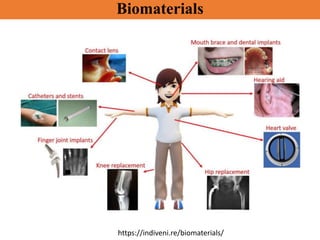
https://indiveni.re/biomaterials/
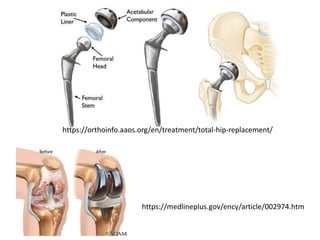
https://orthoinfo.aaos.org/en/treatment/total-hip-replacement/
https://medlineplus.gov/ency/article/002974.htm
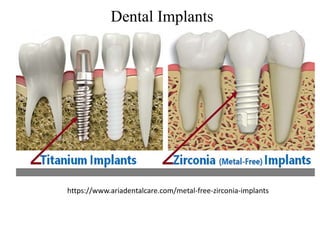
Dental Implants
https://www.ariadentalcare.com/metal-free-zirconia-implants
- Any material of natural or synthetic origin that comes
in contact with tissue, blood or biological fluids, and
intended for use in prosthetic, diagnostic, therapeutic
or storage application.
e.g. metals, ceramics, polymers, glasses, carbons,
composite materials
Biomaterials
https://www.youtube.com/watch?v=T_uMkdKS6wQ
Requirements of Biomaterials
A biomaterial should broadly satisfy the following
requirements
 Biocompatibility
 Biofunctionality
 Inert or specifically interactive
 Mechanically and chemically stable - tensile strength,
yield strength, elastic modulus, corrosion and fatigue
resistance, surface finish, creep, and hardness.
 Processable (for manufacturability)
Classification based on materials used
Metallic/Alloy Biomaterials
Ceramic Biomaterials
Polymeric Biomaterials
Composite Biomaterials
8
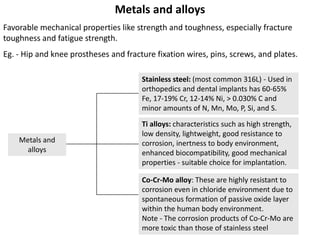
Metals and
alloys
Metals and alloys
Favorable mechanical properties like strength and toughness, especially fracture
toughness and fatigue strength.
Eg. - Hip and knee prostheses and fracture fixation wires, pins, screws, and plates.
Stainless steel: (most common 316L) - Used in
orthopedics and dental implants has 60-65%
Fe, 17-19% Cr, 12-14% Ni, > 0.030% C and
minor amounts of N, Mn, Mo, P, Si, and S.
Ti alloys: characteristics such as high strength,
low density, lightweight, good resistance to
corrosion, inertness to body environment,
enhanced biocompatibility, good mechanical
properties - suitable choice for implantation.
Co-Cr-Mo alloy: These are highly resistant to
corrosion even in chloride environment due to
spontaneous formation of passive oxide layer
within the human body environment.
Note - The corrosion products of Co-Cr-Mo are
more toxic than those of stainless steel
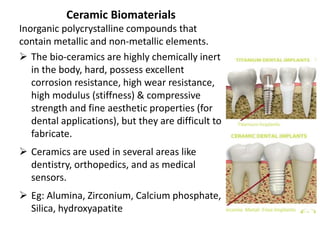
Ceramic Biomaterials
Inorganic polycrystalline compounds that
contain metallic and non-metallic elements.
 The bio-ceramics are highly chemically inert
in the body, hard, possess excellent
corrosion resistance, high wear resistance,
high modulus (stiffness) & compressive
strength and fine aesthetic properties (for
dental applications), but they are difficult to
fabricate.
 Ceramics are used in several areas like
dentistry, orthopedics, and as medical
sensors.
 Eg: Alumina, Zirconium, Calcium phosphate,
Silica, hydroxyapatite
Ceramic Biomaterials
Based on the interaction with biological system Ceramic
Biomaterials are classified in to
1. Bio inert materials: A material that retains its structure in the body after
implantation and does not induce any immunologic host reactions.
Eg. Alumina (Al2O3) is used in hip prostheses and dental implants, because of its
combination of corrosion resistance, good biocompatibility, high wear resistance
and high strength.
2. Bioactive materials: Materials that form direct chemical bonds with bone or
even with the soft tissue of a living organism.
Eg. Bioglass and glass-ceramics widely used for filling bone defects permit
modification of the surface that occurs upon implantation.
3. Bioresobable biomaterials: Materials that degrade by a hydrolytic breakdown
in the body, while they are being replaced by regenerating natural tissue; the
chemical byproducts of the degrading materials are absorbed and released via
metabolic processes of the body. Eg. Calcium phosphate ceramics
Polymeric Biomaterials:
Most widely used materials in biomedical applications.
The main advantages –
 The unique properties of these compared to metal or
ceramic materials are flexibility, ease of manufacture to
produce various shapes (latex, film, sheet and fibers), ease
of secondary processability, surface modification,
reasonable cost, resistance to biochemical attack, good
biocompatibility, light weight, availability in a wide variety of
compositions with tailorable physical and mechanical
properties.
 But they are leachable, absorb water and proteins, allows
surface contamination, wear and tear and difficult to
sterilize.
Polymeric Biomaterials
 Surfaces of materials are high-energy regions and
thereby facilitate chemical reactions that influence the
performance of biomaterials. Eg. Some biopolymers are
susceptible to chemical reactions that lead to
degradation through hydrolysis.
 Polymer hydrolysis involves the scission of susceptible
molecular groups by reaction with H2O, catalyzed by
acid, base or enzyme.
Polymeric Biomaterials
Molecular and structural factors influencing hydrolysis
are
a) Bond Stability - Susceptible linkages at bonds where
resonance stabilized intermediates are possible.
b) Hydrophobicity: ↑ hydrophobicity ⇒ ↓ hydrolysis
c) MW & architecture: higher MW ⇒ ↓ hydrolysis
d) Morphology: crystallinity ↓ hydrolysis crystallinity ↓
solubility porosity ↑ hydrolysis
e) Tg: less mobility ⇒ ↓ hydrolysis Rates of Hydrolysis:
anhydride > ester > amide > ether
Polymeric Biomaterials
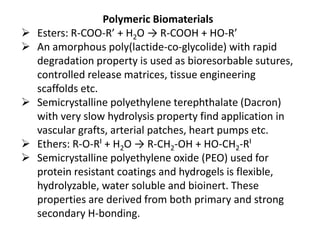
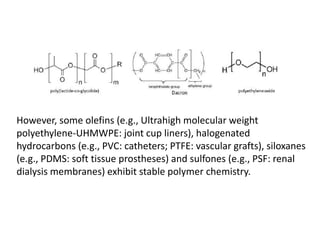
 Esters: R-COO-R’ + H2O → R-COOH + HO-R’
 An amorphous poly(lactide-co-glycolide) with rapid
degradation property is used as bioresorbable sutures,
controlled release matrices, tissue engineering
scaffolds etc.
 Semicrystalline polyethylene terephthalate (Dacron)
with very slow hydrolysis property find application in
vascular grafts, arterial patches, heart pumps etc.
 Ethers: R-O-Rˡ + H2O → R-CH2-OH + HO-CH2-Rˡ
 Semicrystalline polyethylene oxide (PEO) used for
protein resistant coatings and hydrogels is flexible,
hydrolyzable, water soluble and bioinert. These
properties are derived from both primary and strong
secondary H-bonding.
However, some olefins (e.g., Ultrahigh molecular weight
polyethylene-UHMWPE: joint cup liners), halogenated
hydrocarbons (e.g., PVC: catheters; PTFE: vascular grafts), siloxanes
(e.g., PDMS: soft tissue prostheses) and sulfones (e.g., PSF: renal
dialysis membranes) exhibit stable polymer chemistry.
Composite Biomaterials
 Natural biocomposites - bone, wood, dentin, cartilage, and
skin.
 Bone achieves most of its mechanical properties as a natural
composite material composed of calcium phosphate ceramics
in a highly organized polymeric collagen matrix.
 Biocomposites are composite materials composed of a
biodegradable matrix and biodegradable natural fibers as
reinforcement in order to obtain properties that improve
every one of the components.
 Composite materials allow a flexible design since their
structure and properties can be optimized and tailored to
specific applications. Eg. fiberglass with a polymeric matrix is
used in the current synthetic casting materials.

Biomaterials_ Modified October 2020.pptx

  • 1.
  • 2.
  • 3.
  • 4.
    - Any materialof natural or synthetic origin that comes in contact with tissue, blood or biological fluids, and intended for use in prosthetic, diagnostic, therapeutic or storage application. e.g. metals, ceramics, polymers, glasses, carbons, composite materials Biomaterials
  • 5.
  • 6.
    Requirements of Biomaterials Abiomaterial should broadly satisfy the following requirements  Biocompatibility  Biofunctionality  Inert or specifically interactive  Mechanically and chemically stable - tensile strength, yield strength, elastic modulus, corrosion and fatigue resistance, surface finish, creep, and hardness.  Processable (for manufacturability)
  • 7.
    Classification based onmaterials used Metallic/Alloy Biomaterials Ceramic Biomaterials Polymeric Biomaterials Composite Biomaterials
  • 8.
    8 Metals and alloys Metals andalloys Favorable mechanical properties like strength and toughness, especially fracture toughness and fatigue strength. Eg. - Hip and knee prostheses and fracture fixation wires, pins, screws, and plates. Stainless steel: (most common 316L) - Used in orthopedics and dental implants has 60-65% Fe, 17-19% Cr, 12-14% Ni, > 0.030% C and minor amounts of N, Mn, Mo, P, Si, and S. Ti alloys: characteristics such as high strength, low density, lightweight, good resistance to corrosion, inertness to body environment, enhanced biocompatibility, good mechanical properties - suitable choice for implantation. Co-Cr-Mo alloy: These are highly resistant to corrosion even in chloride environment due to spontaneous formation of passive oxide layer within the human body environment. Note - The corrosion products of Co-Cr-Mo are more toxic than those of stainless steel
  • 9.
    Ceramic Biomaterials Inorganic polycrystallinecompounds that contain metallic and non-metallic elements.  The bio-ceramics are highly chemically inert in the body, hard, possess excellent corrosion resistance, high wear resistance, high modulus (stiffness) & compressive strength and fine aesthetic properties (for dental applications), but they are difficult to fabricate.  Ceramics are used in several areas like dentistry, orthopedics, and as medical sensors.  Eg: Alumina, Zirconium, Calcium phosphate, Silica, hydroxyapatite
  • 10.
    Ceramic Biomaterials Based onthe interaction with biological system Ceramic Biomaterials are classified in to 1. Bio inert materials: A material that retains its structure in the body after implantation and does not induce any immunologic host reactions. Eg. Alumina (Al2O3) is used in hip prostheses and dental implants, because of its combination of corrosion resistance, good biocompatibility, high wear resistance and high strength. 2. Bioactive materials: Materials that form direct chemical bonds with bone or even with the soft tissue of a living organism. Eg. Bioglass and glass-ceramics widely used for filling bone defects permit modification of the surface that occurs upon implantation. 3. Bioresobable biomaterials: Materials that degrade by a hydrolytic breakdown in the body, while they are being replaced by regenerating natural tissue; the chemical byproducts of the degrading materials are absorbed and released via metabolic processes of the body. Eg. Calcium phosphate ceramics
  • 11.
    Polymeric Biomaterials: Most widelyused materials in biomedical applications. The main advantages –  The unique properties of these compared to metal or ceramic materials are flexibility, ease of manufacture to produce various shapes (latex, film, sheet and fibers), ease of secondary processability, surface modification, reasonable cost, resistance to biochemical attack, good biocompatibility, light weight, availability in a wide variety of compositions with tailorable physical and mechanical properties.  But they are leachable, absorb water and proteins, allows surface contamination, wear and tear and difficult to sterilize.
  • 12.
    Polymeric Biomaterials  Surfacesof materials are high-energy regions and thereby facilitate chemical reactions that influence the performance of biomaterials. Eg. Some biopolymers are susceptible to chemical reactions that lead to degradation through hydrolysis.  Polymer hydrolysis involves the scission of susceptible molecular groups by reaction with H2O, catalyzed by acid, base or enzyme.
  • 13.
    Polymeric Biomaterials Molecular andstructural factors influencing hydrolysis are a) Bond Stability - Susceptible linkages at bonds where resonance stabilized intermediates are possible. b) Hydrophobicity: ↑ hydrophobicity ⇒ ↓ hydrolysis c) MW & architecture: higher MW ⇒ ↓ hydrolysis d) Morphology: crystallinity ↓ hydrolysis crystallinity ↓ solubility porosity ↑ hydrolysis e) Tg: less mobility ⇒ ↓ hydrolysis Rates of Hydrolysis: anhydride > ester > amide > ether
  • 14.
    Polymeric Biomaterials  Esters:R-COO-R’ + H2O → R-COOH + HO-R’  An amorphous poly(lactide-co-glycolide) with rapid degradation property is used as bioresorbable sutures, controlled release matrices, tissue engineering scaffolds etc.  Semicrystalline polyethylene terephthalate (Dacron) with very slow hydrolysis property find application in vascular grafts, arterial patches, heart pumps etc.  Ethers: R-O-Rˡ + H2O → R-CH2-OH + HO-CH2-Rˡ  Semicrystalline polyethylene oxide (PEO) used for protein resistant coatings and hydrogels is flexible, hydrolyzable, water soluble and bioinert. These properties are derived from both primary and strong secondary H-bonding.
  • 15.
    However, some olefins(e.g., Ultrahigh molecular weight polyethylene-UHMWPE: joint cup liners), halogenated hydrocarbons (e.g., PVC: catheters; PTFE: vascular grafts), siloxanes (e.g., PDMS: soft tissue prostheses) and sulfones (e.g., PSF: renal dialysis membranes) exhibit stable polymer chemistry.
  • 16.
    Composite Biomaterials  Naturalbiocomposites - bone, wood, dentin, cartilage, and skin.  Bone achieves most of its mechanical properties as a natural composite material composed of calcium phosphate ceramics in a highly organized polymeric collagen matrix.  Biocomposites are composite materials composed of a biodegradable matrix and biodegradable natural fibers as reinforcement in order to obtain properties that improve every one of the components.  Composite materials allow a flexible design since their structure and properties can be optimized and tailored to specific applications. Eg. fiberglass with a polymeric matrix is used in the current synthetic casting materials.

Editor's Notes

  • #2 Biomaterials can have a benign function, or may be bioactive & used for a more interactive purpose, dental applications, surgery, & drug delivery. It is a synthetic material which can be used to replace part of a living system or to function in intimate contact with living tissue. Biomaterials are rarely used on their own but are more commonly integrated into devices or implants Classification of Bio Materials: (a) Based on materials used 1. Polymers: Nylon , Silicones, Teflon®, Dacron® 2. Metals: Titanium, Stainless steels, Co-Cr alloys , Gold 3. Ceramics: Aluminum oxide, Carbon, Hydroxyapatite 4. Composites: Carbon-carbon   (b) Based on the interaction with biological system. 1. Inert biomaterials: resistance to chemical or biological degradation 2. Bioactive biomaterials: slight interaction (positive response) 3. Biodegradable biomaterials: intended to dissolve or to be absorbed in vivo
  • #7 Biocompatibility the ability of a material to perform with an appropriate host response in a specific application. The biomaterials must neither degrade in its properties within the body (unless this is wanted), nor biomaterials/devices (and any degradation product) must cause any adverse reaction within the host´s body. Biocompatibility is strongly determined by the primary chemical structure of the material. Biofunctionality - The material must satisfy its design requirements. Eg: Articulation to allow movement (e.g. artificial knee joint), load transmission and stress distribution etc.
  • #8 Polymeric Biomaterials The major requirements of polymeric biomaterials are biocompatibility, sterilizability, adequate mechanical and physical properties, and manufacturability. The main advantages of the polymeric biomaterials compared to metal or ceramic materials are ease of manufacture to produce various shapes (latex, film, sheet and fibers), ease of secondary processability, reasonable cost, and availability with desired mechanical and physical properties 1. Polyvinylchloride: Blood and solution bag, surgical packaging, dialysis devices, catheter and connectors. 2. Polyethylene: Pharmaceutical bottle, nonwoven fabric, catheter, pouch, flexible container, and orthopedic implants. 3. Polypropylene: Disposable syringes, blood oxygenator membrane, suture, nonwoven fabric, and artificial vascular grafts. 4. Polymethylmetacrylate: Blood pump and reservoirs, membrane for blood dialyzer, implantable ocular lens, and bone cement. Metallic Biomaterials The first metal alloy developed specifically for human use was the “vanadium steel” It was used to manufacture bone fracture plates and screws. Most metals Fe, Cr, Co, Ni, Ti, Ta, Nb, Mo and W are used to make alloys for manufacturing implants. However, they can be tolerated by the body only in minute amounts. The biocompatibility of the metallic implant is of considerable concern because these implants can corrode in an in vivo environment. The consequences of corrosion are the disintegration of the implant material per se, which will weaken the implant, and the harmful effect of corrosion products on the surrounding tissues and organs.  Ceramic Biomaterials Ceramic biomaterials are generally hard. They should be non-toxic, non-carcinogenic, non-allergic, non-inflammatory and biocompatible, Ceramics used in fabricating implants can be classified as non-absorbable (relatively inert), bioactive or surface reactive (semi-inert) and biodegradable or resorbable (non-inert). Alumina, zirconia, silicone nitrides, and carbons are inert bioceramics. Certain glass ceramics and dense hydroxyapatites are semi-inert (bioreactive), and calcium phosphates & calcium aluminates are resorbable ceramics.  Composite Biomaterials When composite material is used as biomaterials, it is important that each constituent of the composite be biocompatible. Moreover, the interface between constituents should not be degraded by the body environment. Major uses of composites in biomaterial applications are in dental filling composites, reinforced methyl methacrylate bone cement and ultra-high-molecular-weight polyethylene, and orthopedic implants with porous surfaces. Moisture absorption by polymer constituents also causes swelling. Such swelling can be beneficial in dental composites since it offsets some of the shrinkage due to polymerization. Flexible composite bone plates are effective in promoting healing but particulate debris from composite bone.
  • #17 The use of composite materials for biomedical applications offers many new options and possibilities for implants design. The implant structure and its interactions with the surrounding tissues can be optimized by varying the constituents, the type, and distribution of the reinforcing phase and adding coupling agents.