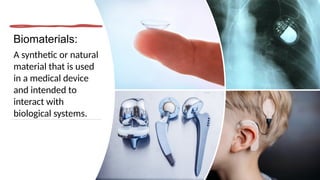
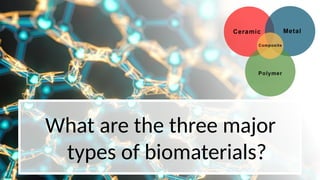
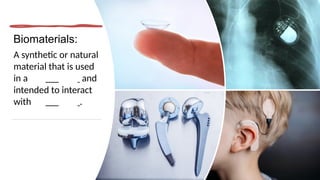
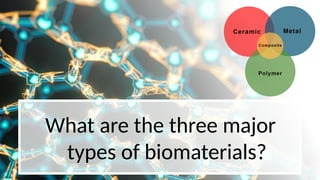
Biomaterials:
A synthetic ornatural
material that is used
in a medical device
and intended to
interact with
biological systems.
3.
Synthetic vs
Natural
• Synthetic:materials made through
chemical reactions, producing a
material with new properties
(stainless steel, titanium, etc.)
• Natural: materials found in
nature/biologically derived (silk,
collagen, gelatin, etc.)
• Combination: material made of both
synthetic and natural materials
4.
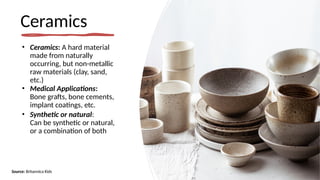
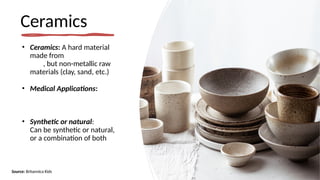
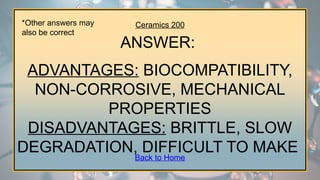
Ceramics
• Ceramics: Ahard material
made from naturally
occurring, but non-metallic
raw materials (clay, sand,
etc.)
• Medical Applications:
Bone grafts, bone cements,
implant coatings, etc.
• Synthetic or natural:
Can be synthetic or natural,
or a combination of both
Source: Britannica Kids
5.
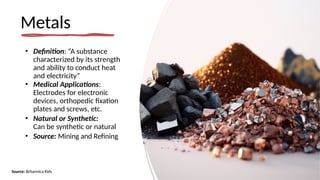
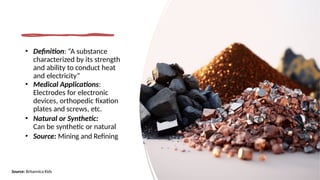
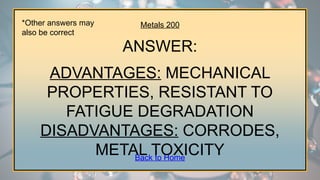
Metals
• Definition: “Asubstance
characterized by its strength
and ability to conduct heat
and electricity”
• Medical Applications:
Electrodes for electronic
devices, orthopedic fixation
plates and screws, etc.
• Natural or Synthetic:
Can be synthetic or natural
• Source: Mining and Refining
Source: Britannica Kids
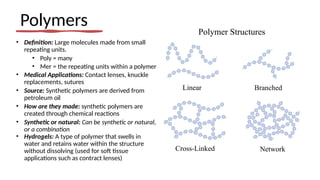
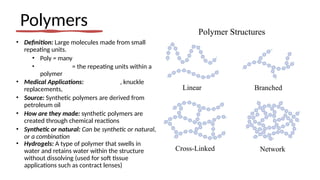
Polymers
• Definition: Largemolecules made from small
repeating units.
• Poly = many
• Mer = the repeating units within a polymer
• Medical Applications: Contact lenses, knuckle
replacements, sutures
• Source: Synthetic polymers are derived from
petroleum oil
• How are they made: synthetic polymers are
created through chemical reactions
• Synthetic or natural: Can be synthetic or natural,
or a combination
• Hydrogels: A type of polymer that swells in
water and retains water within the structure
without dissolving (used for soft tissue
applications such as contract lenses)
8.
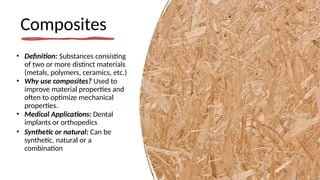
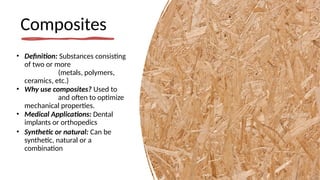
Composites
• Definition: Substancesconsisting
of two or more distinct materials
(metals, polymers, ceramics, etc.)
• Why use composites? Used to
improve material properties and
often to optimize mechanical
properties.
• Medical Applications: Dental
implants or orthopedics
• Synthetic or natural: Can be
synthetic, natural or a
combination
9.
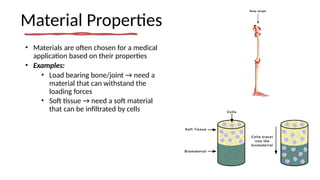
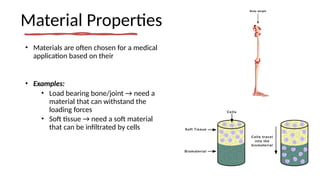
Material Properties
• Materialsare often chosen for a medical
application based on their properties
• Examples:
• Load bearing bone/joint → need a
material that can withstand the
loading forces
• Soft tissue → need a soft material
that can be infiltrated by cells
10.
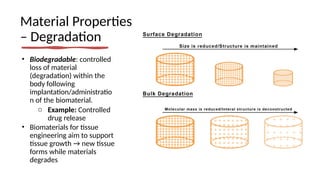
Material Properties
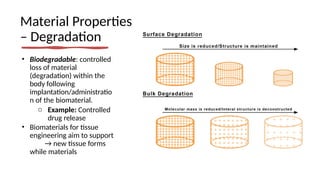
– Degradation
•Biodegradable: controlled
loss of material
(degradation) within the
body following
implantation/administratio
n of the biomaterial.
o Example: Controlled
drug release
• Biomaterials for tissue
engineering aim to support
tissue growth → new tissue
forms while materials
degrades
11.
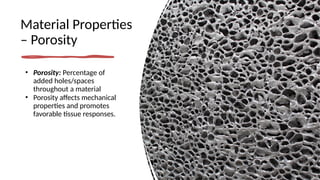
Material Properties
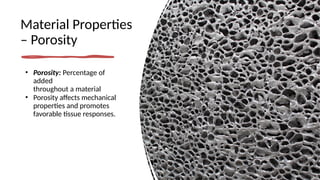
– Porosity
•Porosity: Percentage of
added holes/spaces
throughout a material
• Porosity affects mechanical
properties and promotes
favorable tissue responses.
12.
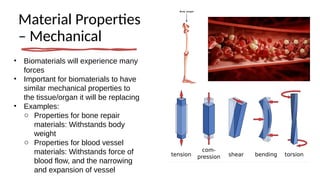
Material Properties
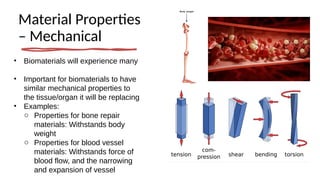
– Mechanical
•Biomaterials will experience many
forces
• Important for biomaterials to have
similar mechanical properties to
the tissue/organ it will be replacing
• Examples:
o Properties for bone repair
materials: Withstands body
weight
o Properties for blood vessel
materials: Withstands force of
blood flow, and the narrowing
and expansion of vessel
13.
Material Properties –
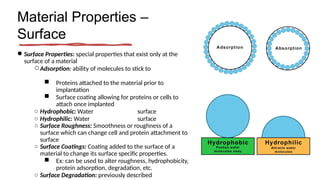
Surface
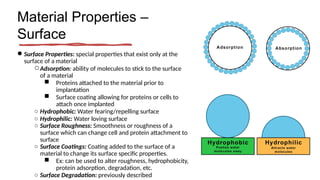
●Surface Properties: special properties that exist only at the
surface of a material
○Adsorption: ability of molecules to stick to the surface
of a material
■ Proteins attached to the material prior to
implantation
■ Surface coating allowing for proteins or cells to
attach once implanted
○ Hydrophobic: Water fearing/repelling surface
○ Hydrophilic: Water loving surface
○ Surface Roughness: Smoothness or roughness of a
surface which can change cell and protein attachment to
surface
○ Surface Coatings: Coating added to the surface of a
material to change its surface specific properties.
■ Ex: can be used to alter roughness, hydrophobicity,
protein adsorption, degradation, etc.
○ Surface Degradation: previously described
14.
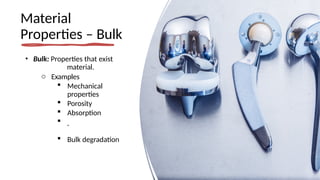
Material
Properties – Bulk
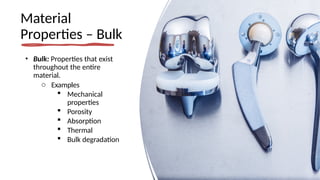
•Bulk: Properties that exist
throughout the entire
material.
o Examples
Mechanical
properties
Porosity
Absorption
Thermal
Bulk degradation
15.
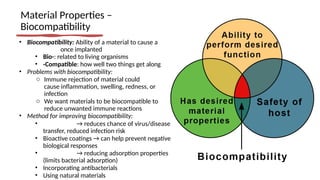
Material Properties –
Biocompatibility
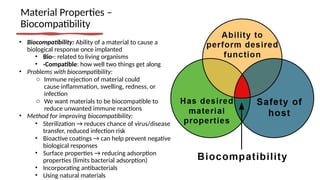
•Biocompatibility: Ability of a material to cause a
biological response once implanted
• Bio-: related to living organisms
• -Compatible: how well two things get along
• Problems with biocompatibility:
o Immune rejection of material could
cause inflammation, swelling, redness, or
infection
o We want materials to be biocompatible to
reduce unwanted immune reactions
• Method for improving biocompatibility:
• Sterilization → reduces chance of virus/disease
transfer, reduced infection risk
• Bioactive coatings → can help prevent negative
biological responses
• Surface properties → reducing adsorption
properties (limits bacterial adsorption)
• Incorporating antibacterials
• Using natural materials
Synthetic vs
Natural
• Synthetic:materials made through
chemical reactions, producing a
material with new properties
(stainless steel, titanium, etc.)
• Natural: materials found in
nature/biologically derived (silk,
collagen, gelatin, etc.)
• Combination: material made of both
synthetic and natural materials
20.
Ceramics
• Ceramics: Ahard material
made from
, but non-metallic raw
materials (clay, sand, etc.)
• Medical Applications:
• Synthetic or natural:
Can be synthetic or natural,
or a combination of both
Source: Britannica Kids
21.
• Definition: “Asubstance
characterized by its strength
and ability to conduct heat
and electricity”
• Medical Applications:
Electrodes for electronic
devices, orthopedic fixation
plates and screws, etc.
• Natural or Synthetic:
Can be synthetic or natural
• Source: Mining and Refining
Source: Britannica Kids
Polymers
• Definition: Largemolecules made from small
repeating units.
• Poly = many
• = the repeating units within a
polymer
• Medical Applications: , knuckle
replacements,
• Source: Synthetic polymers are derived from
petroleum oil
• How are they made: synthetic polymers are
created through chemical reactions
• Synthetic or natural: Can be synthetic or natural,
or a combination
• Hydrogels: A type of polymer that swells in
water and retains water within the structure
without dissolving (used for soft tissue
applications such as contract lenses)
24.
Composites
• Definition: Substancesconsisting
of two or more
(metals, polymers,
ceramics, etc.)
• Why use composites? Used to
and often to optimize
mechanical properties.
• Medical Applications: Dental
implants or orthopedics
• Synthetic or natural: Can be
synthetic, natural or a
combination
25.
Material Properties
• Materialsare often chosen for a medical
application based on their
• Examples:
• Load bearing bone/joint → need a
material that can withstand the
loading forces
• Soft tissue → need a soft material
that can be infiltrated by cells
26.
Material Properties
– Degradation
•Biodegradable: controlled
loss of material
(degradation) within the
body following
implantation/administratio
n of the biomaterial.
o Example: Controlled
drug release
• Biomaterials for tissue
engineering aim to support
→ new tissue forms
while materials
27.
Material Properties
– Porosity
•Porosity: Percentage of
added
throughout a material
• Porosity affects mechanical
properties and promotes
favorable tissue responses.
28.
Material Properties
– Mechanical
•Biomaterials will experience many
• Important for biomaterials to have
similar mechanical properties to
the tissue/organ it will be replacing
• Examples:
o Properties for bone repair
materials: Withstands body
weight
o Properties for blood vessel
materials: Withstands force of
blood flow, and the narrowing
and expansion of vessel
29.
Material Properties –
Surface
●Surface Properties: special properties that exist only at the
surface of a material
○Adsorption: ability of molecules to stick to
■ Proteins attached to the material prior to
implantation
■ Surface coating allowing for proteins or cells to
attach once implanted
○ Hydrophobic: Water surface
○ Hydrophilic: Water surface
○ Surface Roughness: Smoothness or roughness of a
surface which can change cell and protein attachment to
surface
○ Surface Coatings: Coating added to the surface of a
material to change its surface specific properties.
■ Ex: can be used to alter roughness, hydrophobicity,
protein adsorption, degradation, etc.
○ Surface Degradation: previously described
30.
Material
Properties – Bulk
•Bulk: Properties that exist
material.
o Examples
Mechanical
properties
Porosity
Absorption
Bulk degradation
31.
Material Properties –
Biocompatibility
•Biocompatibility: Ability of a material to cause a
once implanted
• Bio-: related to living organisms
• -Compatible: how well two things get along
• Problems with biocompatibility:
o Immune rejection of material could
cause inflammation, swelling, redness, or
infection
o We want materials to be biocompatible to
reduce unwanted immune reactions
• Method for improving biocompatibility:
• → reduces chance of virus/disease
transfer, reduced infection risk
• Bioactive coatings → can help prevent negative
biological responses
• → reducing adsorption properties
(limits bacterial adsorption)
• Incorporating antibacterials
• Using natural materials
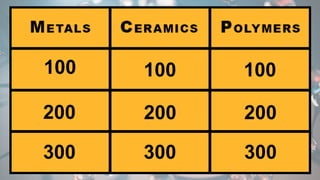
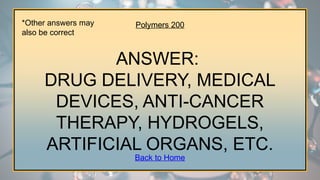
Polymers 200
ANSWER:
DRUG DELIVERY,MEDICAL
DEVICES, ANTI-CANCER
THERAPY, HYDROGELS,
ARTIFICIAL ORGANS, ETC.
*Other answers may
also be correct
Back to Home
53.
Polymers 300
ANSWER:
A POLYMERTHAT SWELLS IN
WATER AND RETAINS WATER
WITHIN THE STRUCTURE
WITHOUT DISSOLVING
Back to Home