11/23/2022 1
Introduction
to Modern Biomaterials
11/23/2022 2
Classes of Materials Used in
Medicine
11/23/2022 3
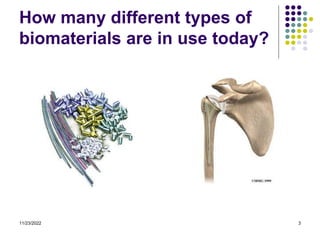
How many different types of
biomaterials are in use today?
11/23/2022 4
Fact-
The FDA regulates 100,000 different products that represent at
least 1,700 Different Types of Biomedical Devices
11/23/2022 5
Broad Classification-
Types of Biomaterials
 ceramics
 metals
 polymers, synthetic and natural
 composites
11/23/2022 6
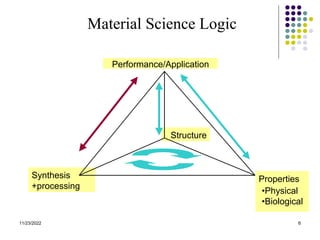
Material Science Logic
Synthesis
+processing
Structure
Performance/Application
Properties
•Physical
•Biological
11/23/2022 7
Ceramics
 Inorganic compounds that contain metallic and non-metallic
elements, for which inter-atomic bonding is ionic or covalent, and
which are generally formed at high temperatures.
 Derivation: From the Greek word "keramos" meaning the art and
science of making and using solid articles formed by the action of
heat on earthy raw materials.
 Most ceramics occur as minerals:
 (1) The abundance of elements and geochemical characteristics of
the earth’s crust govern mineral types.
 (2) Composition of Earth’s Crust: [84% = O + Si + Al]
O = 50% Fe = 5% K = 2.5%
Si = 26% Ca = 3% Mg = 2%
Al = 8% Na = 2.5% H = 1%
11/23/2022 8
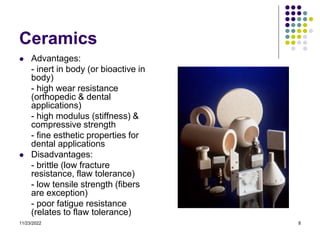
Ceramics
 Advantages:
- inert in body (or bioactive in
body)
- high wear resistance
(orthopedic & dental
applications)
- high modulus (stiffness) &
compressive strength
- fine esthetic properties for
dental applications
 Disadvantages:
- brittle (low fracture
resistance, flaw tolerance)
- low tensile strength (fibers
are exception)
- poor fatigue resistance
(relates to flaw tolerance)
11/23/2022 9
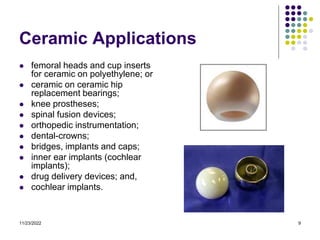
Ceramic Applications
 femoral heads and cup inserts
for ceramic on polyethylene; or
 ceramic on ceramic hip
replacement bearings;
 knee prostheses;
 spinal fusion devices;
 orthopedic instrumentation;
 dental-crowns;
 bridges, implants and caps;
 inner ear implants (cochlear
implants);
 drug delivery devices; and,
 cochlear implants.
11/23/2022 10
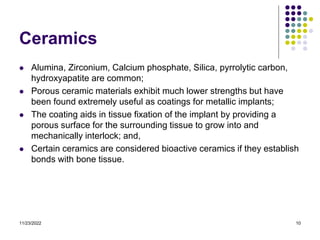
Ceramics
 Alumina, Zirconium, Calcium phosphate, Silica, pyrrolytic carbon,
hydroxyapatite are common;
 Porous ceramic materials exhibit much lower strengths but have
been found extremely useful as coatings for metallic implants;
 The coating aids in tissue fixation of the implant by providing a
porous surface for the surrounding tissue to grow into and
mechanically interlock; and,
 Certain ceramics are considered bioactive ceramics if they establish
bonds with bone tissue.
11/23/2022 11
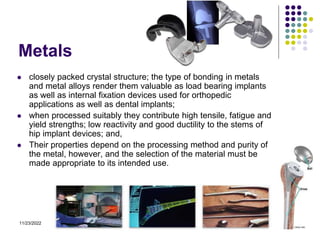
Metals
 closely packed crystal structure; the type of bonding in metals
and metal alloys render them valuable as load bearing implants
as well as internal fixation devices used for orthopedic
applications as well as dental implants;
 when processed suitably they contribute high tensile, fatigue and
yield strengths; low reactivity and good ductility to the stems of
hip implant devices; and,
 Their properties depend on the processing method and purity of
the metal, however, and the selection of the material must be
made appropriate to its intended use.
11/23/2022 12
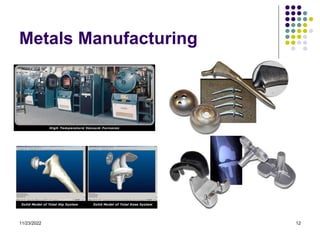
Metals Manufacturing
11/23/2022 13
Metals
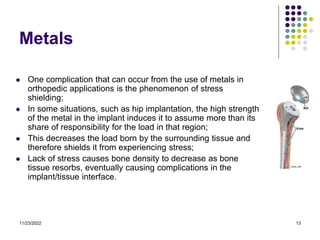
 One complication that can occur from the use of metals in
orthopedic applications is the phenomenon of stress
shielding;
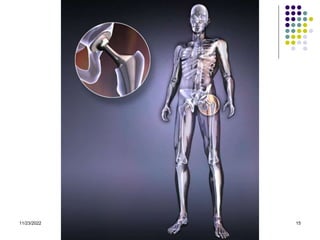
 In some situations, such as hip implantation, the high strength
of the metal in the implant induces it to assume more than its
share of responsibility for the load in that region;
 This decreases the load born by the surrounding tissue and
therefore shields it from experiencing stress;
 Lack of stress causes bone density to decrease as bone
tissue resorbs, eventually causing complications in the
implant/tissue interface.
11/23/2022 14
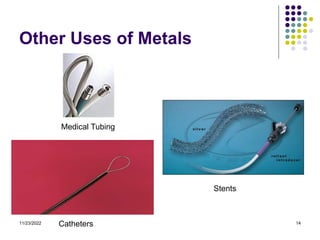
Other Uses of Metals
Medical Tubing
Catheters
Stents
11/23/2022 15
11/23/2022 16
Polymers
 consist of small repeating units strung together in long chains;
 flexible structure of polymers has enabled this group of materials
to be useful in applications from plastic garbage bags to rubber
tires;
 Even DNA has found this structure useful, storing genetic
information in thousands upon thousands of repeating
sequences of polymers;
 In many materials, processing conditions can induce the polymer
chains to link with each other along the length of the chain to
produce a wide variety of mechanical properties;
 These parameters are easily varied in order to suit current
biomedical applications.
11/23/2022 17
Polymers
 Hydrophilic
 Hydrophobic
 Biostable
 Biodegradable
 Natural
 Synthetic
 Highly processable
11/23/2022 18
Composites
 individual strengths and weaknesses of polymers, ceramics, and
metals benefit different applications;
 The porosity and hardness of ceramics support tissue integration
into the tissue/implants interface, but these properties could
hardly suit a ligament replacement;
 A composite material incorporates the desired characteristics of
different materials to meet the stringent demands of living tissue;
 Most composite designs combine strength and flexibility by
reinforcing a relatively flexible material with a harder, stronger
one; and,
 In some cases, one or more of these materials may be
degradable in order to encourage tissue integration.
11/23/2022 19
What Do Biomaterials All
Share in Common?
The answer is: that they were not originally
engineered for biomaterials applications!
11/23/2022 20
Bio-inertness vs. Bioactivity
Bioactive materials play a more aggressive
role in the body. While a biocompatible
material should affect the equilibrium of the
body as little as possible, a bioactive material
recruits specific interactions between the
material and surrounding tissue.
11/23/2022 21
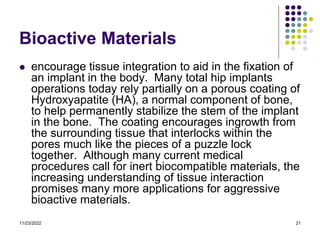
Bioactive Materials
 encourage tissue integration to aid in the fixation of
an implant in the body. Many total hip implants
operations today rely partially on a porous coating of
Hydroxyapatite (HA), a normal component of bone,
to help permanently stabilize the stem of the implant
in the bone. The coating encourages ingrowth from
the surrounding tissue that interlocks within the
pores much like the pieces of a puzzle lock
together. Although many current medical
procedures call for inert biocompatible materials, the
increasing understanding of tissue interaction
promises many more applications for aggressive
bioactive materials.
11/23/2022 22
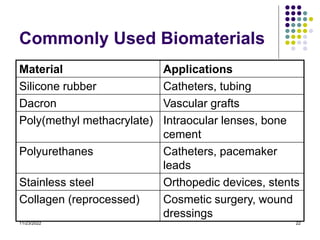
Commonly Used Biomaterials
Material Applications
Silicone rubber Catheters, tubing
Dacron Vascular grafts
Poly(methyl methacrylate) Intraocular lenses, bone
cement
Polyurethanes Catheters, pacemaker
leads
Stainless steel Orthopedic devices, stents
Collagen (reprocessed) Cosmetic surgery, wound
dressings
11/23/2022 23
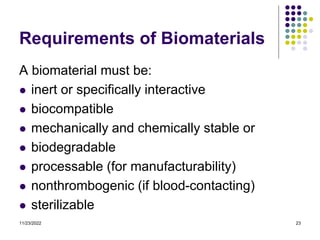
Requirements of Biomaterials
A biomaterial must be:
 inert or specifically interactive
 biocompatible
 mechanically and chemically stable or
 biodegradable
 processable (for manufacturability)
 nonthrombogenic (if blood-contacting)
 sterilizable
11/23/2022 24
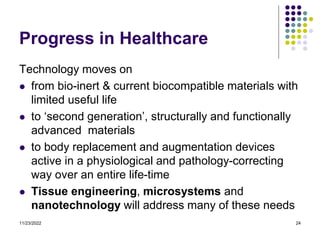
Progress in Healthcare
Technology moves on
 from bio-inert & current biocompatible materials with
limited useful life
 to ‘second generation’, structurally and functionally
advanced materials
 to body replacement and augmentation devices
active in a physiological and pathology-correcting
way over an entire life-time
 Tissue engineering, microsystems and
nanotechnology will address many of these needs

Intro to biomaterials.ppt

  • 1.
  • 2.
    11/23/2022 2 Classes ofMaterials Used in Medicine
  • 3.
    11/23/2022 3 How manydifferent types of biomaterials are in use today?
  • 4.
    11/23/2022 4 Fact- The FDAregulates 100,000 different products that represent at least 1,700 Different Types of Biomedical Devices
  • 5.
    11/23/2022 5 Broad Classification- Typesof Biomaterials  ceramics  metals  polymers, synthetic and natural  composites
  • 6.
    11/23/2022 6 Material ScienceLogic Synthesis +processing Structure Performance/Application Properties •Physical •Biological
  • 7.
    11/23/2022 7 Ceramics  Inorganiccompounds that contain metallic and non-metallic elements, for which inter-atomic bonding is ionic or covalent, and which are generally formed at high temperatures.  Derivation: From the Greek word "keramos" meaning the art and science of making and using solid articles formed by the action of heat on earthy raw materials.  Most ceramics occur as minerals:  (1) The abundance of elements and geochemical characteristics of the earth’s crust govern mineral types.  (2) Composition of Earth’s Crust: [84% = O + Si + Al] O = 50% Fe = 5% K = 2.5% Si = 26% Ca = 3% Mg = 2% Al = 8% Na = 2.5% H = 1%
  • 8.
    11/23/2022 8 Ceramics  Advantages: -inert in body (or bioactive in body) - high wear resistance (orthopedic & dental applications) - high modulus (stiffness) & compressive strength - fine esthetic properties for dental applications  Disadvantages: - brittle (low fracture resistance, flaw tolerance) - low tensile strength (fibers are exception) - poor fatigue resistance (relates to flaw tolerance)
  • 9.
    11/23/2022 9 Ceramic Applications femoral heads and cup inserts for ceramic on polyethylene; or  ceramic on ceramic hip replacement bearings;  knee prostheses;  spinal fusion devices;  orthopedic instrumentation;  dental-crowns;  bridges, implants and caps;  inner ear implants (cochlear implants);  drug delivery devices; and,  cochlear implants.
  • 10.
    11/23/2022 10 Ceramics  Alumina,Zirconium, Calcium phosphate, Silica, pyrrolytic carbon, hydroxyapatite are common;  Porous ceramic materials exhibit much lower strengths but have been found extremely useful as coatings for metallic implants;  The coating aids in tissue fixation of the implant by providing a porous surface for the surrounding tissue to grow into and mechanically interlock; and,  Certain ceramics are considered bioactive ceramics if they establish bonds with bone tissue.
  • 11.
    11/23/2022 11 Metals  closelypacked crystal structure; the type of bonding in metals and metal alloys render them valuable as load bearing implants as well as internal fixation devices used for orthopedic applications as well as dental implants;  when processed suitably they contribute high tensile, fatigue and yield strengths; low reactivity and good ductility to the stems of hip implant devices; and,  Their properties depend on the processing method and purity of the metal, however, and the selection of the material must be made appropriate to its intended use.
  • 12.
  • 13.
    11/23/2022 13 Metals  Onecomplication that can occur from the use of metals in orthopedic applications is the phenomenon of stress shielding;  In some situations, such as hip implantation, the high strength of the metal in the implant induces it to assume more than its share of responsibility for the load in that region;  This decreases the load born by the surrounding tissue and therefore shields it from experiencing stress;  Lack of stress causes bone density to decrease as bone tissue resorbs, eventually causing complications in the implant/tissue interface.
  • 14.
    11/23/2022 14 Other Usesof Metals Medical Tubing Catheters Stents
  • 15.
  • 16.
    11/23/2022 16 Polymers  consistof small repeating units strung together in long chains;  flexible structure of polymers has enabled this group of materials to be useful in applications from plastic garbage bags to rubber tires;  Even DNA has found this structure useful, storing genetic information in thousands upon thousands of repeating sequences of polymers;  In many materials, processing conditions can induce the polymer chains to link with each other along the length of the chain to produce a wide variety of mechanical properties;  These parameters are easily varied in order to suit current biomedical applications.
  • 17.
    11/23/2022 17 Polymers  Hydrophilic Hydrophobic  Biostable  Biodegradable  Natural  Synthetic  Highly processable
  • 18.
    11/23/2022 18 Composites  individualstrengths and weaknesses of polymers, ceramics, and metals benefit different applications;  The porosity and hardness of ceramics support tissue integration into the tissue/implants interface, but these properties could hardly suit a ligament replacement;  A composite material incorporates the desired characteristics of different materials to meet the stringent demands of living tissue;  Most composite designs combine strength and flexibility by reinforcing a relatively flexible material with a harder, stronger one; and,  In some cases, one or more of these materials may be degradable in order to encourage tissue integration.
  • 19.
    11/23/2022 19 What DoBiomaterials All Share in Common? The answer is: that they were not originally engineered for biomaterials applications!
  • 20.
    11/23/2022 20 Bio-inertness vs.Bioactivity Bioactive materials play a more aggressive role in the body. While a biocompatible material should affect the equilibrium of the body as little as possible, a bioactive material recruits specific interactions between the material and surrounding tissue.
  • 21.
    11/23/2022 21 Bioactive Materials encourage tissue integration to aid in the fixation of an implant in the body. Many total hip implants operations today rely partially on a porous coating of Hydroxyapatite (HA), a normal component of bone, to help permanently stabilize the stem of the implant in the bone. The coating encourages ingrowth from the surrounding tissue that interlocks within the pores much like the pieces of a puzzle lock together. Although many current medical procedures call for inert biocompatible materials, the increasing understanding of tissue interaction promises many more applications for aggressive bioactive materials.
  • 22.
    11/23/2022 22 Commonly UsedBiomaterials Material Applications Silicone rubber Catheters, tubing Dacron Vascular grafts Poly(methyl methacrylate) Intraocular lenses, bone cement Polyurethanes Catheters, pacemaker leads Stainless steel Orthopedic devices, stents Collagen (reprocessed) Cosmetic surgery, wound dressings
  • 23.
    11/23/2022 23 Requirements ofBiomaterials A biomaterial must be:  inert or specifically interactive  biocompatible  mechanically and chemically stable or  biodegradable  processable (for manufacturability)  nonthrombogenic (if blood-contacting)  sterilizable
  • 24.
    11/23/2022 24 Progress inHealthcare Technology moves on  from bio-inert & current biocompatible materials with limited useful life  to ‘second generation’, structurally and functionally advanced materials  to body replacement and augmentation devices active in a physiological and pathology-correcting way over an entire life-time  Tissue engineering, microsystems and nanotechnology will address many of these needs