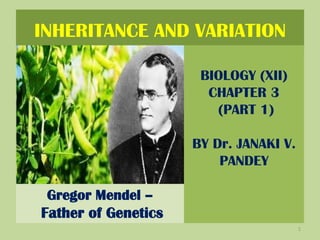
INHERITANCE AND VARIATION
Gregor Mendel –
Father of Genetics
1
BIOLOGY (XII)
CHAPTER 3
(PART 1)
BY Dr. JANAKI V.
PANDEY
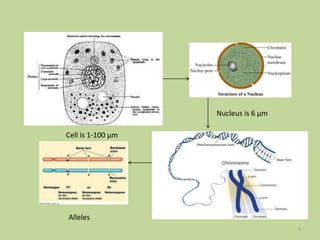
Alleles
Cell is 1-100 µm
Nucleus is 6 µm
2
CHROMOSOMES AND MECHANISM OF
INHERITANCE
Gregor Mendel gave the accurate
explanation for the mechanism of
inheritance by using hybridization
technique.
He stated that traits are not inherited physically but by
something called factor present inside the gametic cell.
The factors are located on separate chromosomes and
factors are transmitted from generation to generation.
The factors (gene) occur in pair in parent and separate
segregate from each other during gamete formation
without blending.
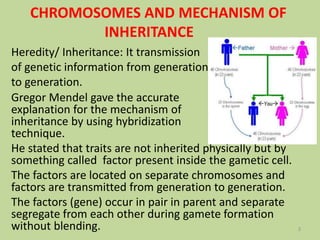
Heredity/ Inheritance: It transmission
of genetic information from generation
to generation.
3
Genetic Terminology
Factor: It is a unit of heredity. It is responsible for
inheritance and expression of character.
Gene: Gene: It is a particular segment of DNA
which is responsible for heredity.
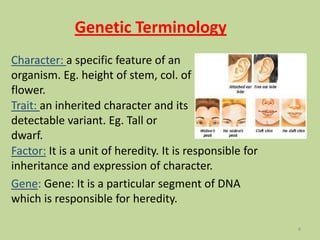
Character: a specific feature of an
organism. Eg. height of stem, col. of
flower.
Trait: an inherited character and its
detectable variant. Eg. Tall or
dwarf.
4
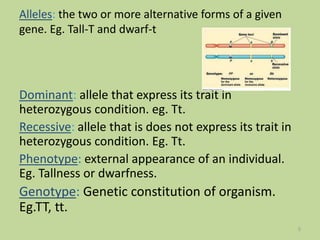
Alleles: the two or more alternative forms of a given
gene. Eg. Tall-T and dwarf-t
Dominant: allele that express its trait in
heterozygous condition. eg. Tt.
Recessive: allele that is does not express its trait in
heterozygous condition. Eg. Tt.
Phenotype: external appearance of an individual.
Eg. Tallness or dwarfness.
Genotype: Genetic constitution of organism.
Eg.TT, tt.
5
6
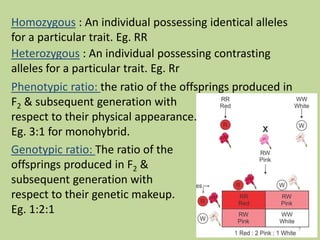
Homozygous : An individual possessing identical alleles
for a particular trait. Eg. RR
Phenotypic ratio: the ratio of the offsprings produced in
F2 & subsequent generation with
respect to their physical appearance.
Eg. 3:1 for monohybrid.
Genotypic ratio: The ratio of the
offsprings produced in F2 &
subsequent generation with
respect to their genetic makeup.
Eg. 1:2:1
Heterozygous : An individual possessing contrasting
alleles for a particular trait. Eg. Rr
7
Pureline: an individual or a
group of individuals which is homozygous or true
breeding for one or more traits. Eg. TT or tt.
Monohybrid: a hybrid produced from a cross between
two pure parents differing in single pair of contrasting
character. Eg. Tt.
Dihybrid: a hybrid produced from a cross between two
pure parents differing in two pairs of contrasting
character. Eg. RrYy.
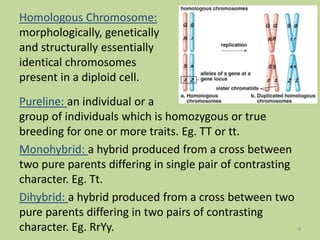
Homologous Chromosome:
morphologically, genetically
and structurally essentially
identical chromosomes
present in a diploid cell.
8
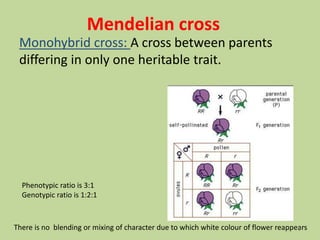
Mendelian cross
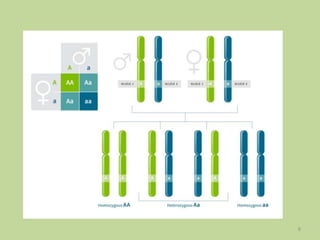
Monohybrid cross: A cross between parents
differing in only one heritable trait.
Phenotypic ratio is 3:1
Genotypic ratio is 1:2:1
There is no blending or mixing of character due to which white colour of flower reappears9
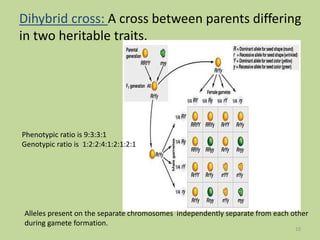
Dihybrid cross: A cross between parents differing
in two heritable traits.
Phenotypic ratio is 9:3:3:1
Genotypic ratio is 1:2:2:4:1:2:1:2:1
Alleles present on the separate chromosomes independently separate from each other
during gamete formation.
10
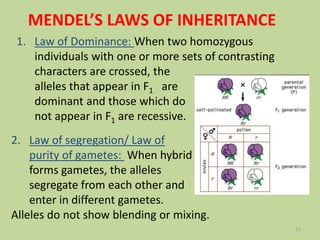
MENDEL’S LAWS OF INHERITANCE
1. Law of Dominance: When two homozygous
individuals with one or more sets of contrasting
characters are crossed, the
alleles that appear in F1 are
dominant and those which do
not appear in F1 are recessive.
2. Law of segregation/ Law of
purity of gametes: When hybrid
forms gametes, the alleles
segregate from each other and
enter in different gametes.
Alleles do not show blending or mixing.
11
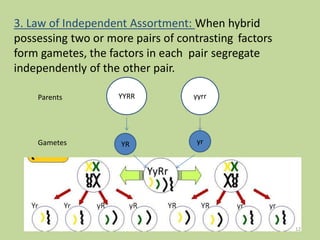
3. Law of Independent Assortment: When hybrid
possessing two or more pairs of contrasting factors
form gametes, the factors in each pair segregate
independently of the other pair.
YYRR yyrr
YR yr
Parents
Gametes
12
RR Rr
Rr rr
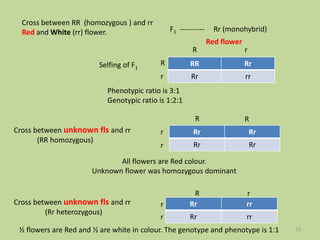
Cross between RR (homozygous ) and rr
Red and White (rr) flower.
R r
R
r
F1 ---------- Rr (monohybrid)
Phenotypic ratio is 3:1
Genotypic ratio is 1:2:1
Cross between unknown fls and rr
Selfing of F1
Red flower
Rr Rr
Rr Rr
R R
r
r
All flowers are Red colour.
Unknown flower was homozygous dominant
Cross between unknown fls and rr Rr rr
Rr rr
R r
r
r
½ flowers are Red and ½ are white in colour. The genotype and phenotype is 1:1
(RR homozygous)
(Rr heterozygous)
13
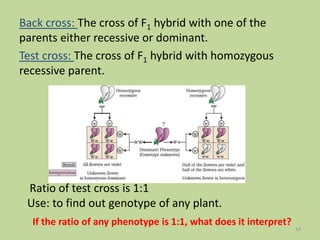
Back cross: The cross of F1 hybrid with one of the
parents either recessive or dominant.
Test cross: The cross of F1 hybrid with homozygous
recessive parent.
Ratio of test cross is 1:1
Use: to find out genotype of any plant.
If the ratio of any phenotype is 1:1, what does it interpret?
14
Gene Interaction
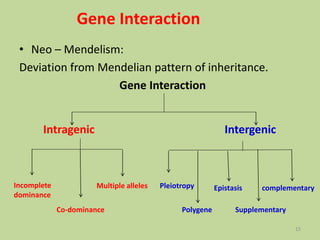
• Neo – Mendelism:
Deviation from Mendelian pattern of inheritance.
Gene Interaction
Intragenic Intergenic
Incomplete
dominance
Co-dominance
Multiple alleles Pleiotropy
Polygene
Epistasis
Supplementary
complementary
15
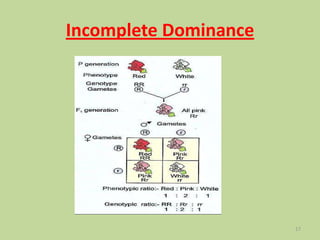
Incomplete Dominance
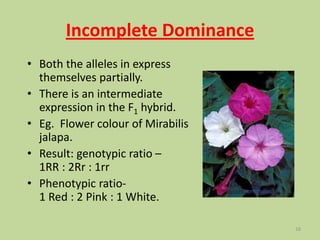
• Both the alleles in express
themselves partially.
• There is an intermediate
expression in the F1 hybrid.
• Eg. Flower colour of Mirabilis
jalapa.
• Result: genotypic ratio –
1RR : 2Rr : 1rr
• Phenotypic ratio-
1 Red : 2 Pink : 1 White.
16
Incomplete Dominance
17
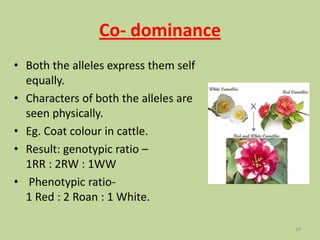
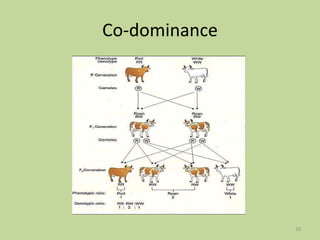
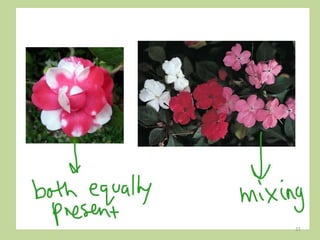
Co- dominance
• Both the alleles express them self
equally.
• Characters of both the alleles are
seen physically.
• Eg. Coat colour in cattle.
• Result: genotypic ratio –
1RR : 2RW : 1WW
• Phenotypic ratio-
1 Red : 2 Roan : 1 White.
18
Co-dominance
19
R r
R RR
RED
Rr
PINK
R Rr
PINK
rr
WHITE
?
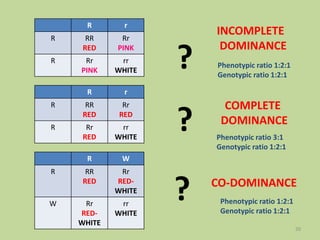
INCOMPLETE
DOMINANCE
Phenotypic ratio 1:2:1
Genotypic ratio 1:2:1
CO-DOMINANCE
Phenotypic ratio 3:1
Genotypic ratio 1:2:1
Phenotypic ratio 1:2:1
Genotypic ratio 1:2:1
?
?
COMPLETE
DOMINANCE
R r
R RR
RED
Rr
RED
R Rr
RED
rr
WHITE
R W
R RR
RED
Rr
RED-
WHITE
W Rr
RED-
WHITE
rr
WHITE
20
21
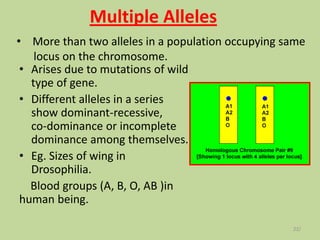
Multiple Alleles
• Arises due to mutations of wild
type of gene.
• Different alleles in a series
show dominant-recessive,
co-dominance or incomplete
dominance among themselves.
• Eg. Sizes of wing in
Drosophilia.
Blood groups (A, B, O, AB )in
human being.
• More than two alleles in a population occupying same
locus on the chromosome.
22/
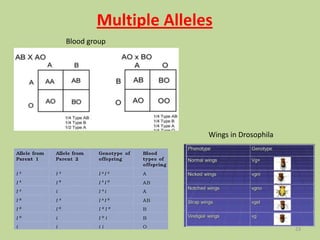
Multiple Alleles
Blood group
Wings in Drosophila
23
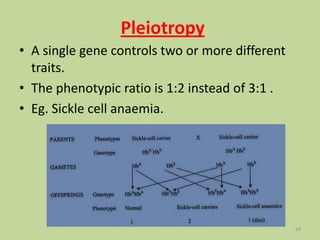
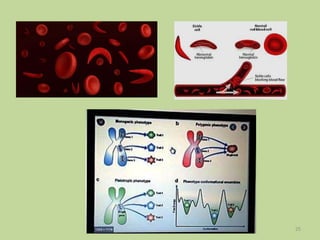
Pleiotropy
• A single gene controls two or more different
traits.
• The phenotypic ratio is 1:2 instead of 3:1 .
• Eg. Sickle cell anaemia.
24
25
Thank You All.
26

Inheritance and Variation

  • 1.
    INHERITANCE AND VARIATION GregorMendel – Father of Genetics 1 BIOLOGY (XII) CHAPTER 3 (PART 1) BY Dr. JANAKI V. PANDEY
  • 2.
    Alleles Cell is 1-100µm Nucleus is 6 µm 2
  • 3.
    CHROMOSOMES AND MECHANISMOF INHERITANCE Gregor Mendel gave the accurate explanation for the mechanism of inheritance by using hybridization technique. He stated that traits are not inherited physically but by something called factor present inside the gametic cell. The factors are located on separate chromosomes and factors are transmitted from generation to generation. The factors (gene) occur in pair in parent and separate segregate from each other during gamete formation without blending. Heredity/ Inheritance: It transmission of genetic information from generation to generation. 3
  • 4.
    Genetic Terminology Factor: Itis a unit of heredity. It is responsible for inheritance and expression of character. Gene: Gene: It is a particular segment of DNA which is responsible for heredity. Character: a specific feature of an organism. Eg. height of stem, col. of flower. Trait: an inherited character and its detectable variant. Eg. Tall or dwarf. 4
  • 5.
    Alleles: the twoor more alternative forms of a given gene. Eg. Tall-T and dwarf-t Dominant: allele that express its trait in heterozygous condition. eg. Tt. Recessive: allele that is does not express its trait in heterozygous condition. Eg. Tt. Phenotype: external appearance of an individual. Eg. Tallness or dwarfness. Genotype: Genetic constitution of organism. Eg.TT, tt. 5
  • 6.
  • 7.
    Homozygous : Anindividual possessing identical alleles for a particular trait. Eg. RR Phenotypic ratio: the ratio of the offsprings produced in F2 & subsequent generation with respect to their physical appearance. Eg. 3:1 for monohybrid. Genotypic ratio: The ratio of the offsprings produced in F2 & subsequent generation with respect to their genetic makeup. Eg. 1:2:1 Heterozygous : An individual possessing contrasting alleles for a particular trait. Eg. Rr 7
  • 8.
    Pureline: an individualor a group of individuals which is homozygous or true breeding for one or more traits. Eg. TT or tt. Monohybrid: a hybrid produced from a cross between two pure parents differing in single pair of contrasting character. Eg. Tt. Dihybrid: a hybrid produced from a cross between two pure parents differing in two pairs of contrasting character. Eg. RrYy. Homologous Chromosome: morphologically, genetically and structurally essentially identical chromosomes present in a diploid cell. 8
  • 9.
    Mendelian cross Monohybrid cross:A cross between parents differing in only one heritable trait. Phenotypic ratio is 3:1 Genotypic ratio is 1:2:1 There is no blending or mixing of character due to which white colour of flower reappears9
  • 10.
    Dihybrid cross: Across between parents differing in two heritable traits. Phenotypic ratio is 9:3:3:1 Genotypic ratio is 1:2:2:4:1:2:1:2:1 Alleles present on the separate chromosomes independently separate from each other during gamete formation. 10
  • 11.
    MENDEL’S LAWS OFINHERITANCE 1. Law of Dominance: When two homozygous individuals with one or more sets of contrasting characters are crossed, the alleles that appear in F1 are dominant and those which do not appear in F1 are recessive. 2. Law of segregation/ Law of purity of gametes: When hybrid forms gametes, the alleles segregate from each other and enter in different gametes. Alleles do not show blending or mixing. 11
  • 12.
    3. Law ofIndependent Assortment: When hybrid possessing two or more pairs of contrasting factors form gametes, the factors in each pair segregate independently of the other pair. YYRR yyrr YR yr Parents Gametes 12
  • 13.
    RR Rr Rr rr Crossbetween RR (homozygous ) and rr Red and White (rr) flower. R r R r F1 ---------- Rr (monohybrid) Phenotypic ratio is 3:1 Genotypic ratio is 1:2:1 Cross between unknown fls and rr Selfing of F1 Red flower Rr Rr Rr Rr R R r r All flowers are Red colour. Unknown flower was homozygous dominant Cross between unknown fls and rr Rr rr Rr rr R r r r ½ flowers are Red and ½ are white in colour. The genotype and phenotype is 1:1 (RR homozygous) (Rr heterozygous) 13
  • 14.
    Back cross: Thecross of F1 hybrid with one of the parents either recessive or dominant. Test cross: The cross of F1 hybrid with homozygous recessive parent. Ratio of test cross is 1:1 Use: to find out genotype of any plant. If the ratio of any phenotype is 1:1, what does it interpret? 14
  • 15.
    Gene Interaction • Neo– Mendelism: Deviation from Mendelian pattern of inheritance. Gene Interaction Intragenic Intergenic Incomplete dominance Co-dominance Multiple alleles Pleiotropy Polygene Epistasis Supplementary complementary 15
  • 16.
    Incomplete Dominance • Boththe alleles in express themselves partially. • There is an intermediate expression in the F1 hybrid. • Eg. Flower colour of Mirabilis jalapa. • Result: genotypic ratio – 1RR : 2Rr : 1rr • Phenotypic ratio- 1 Red : 2 Pink : 1 White. 16
  • 17.
  • 18.
    Co- dominance • Boththe alleles express them self equally. • Characters of both the alleles are seen physically. • Eg. Coat colour in cattle. • Result: genotypic ratio – 1RR : 2RW : 1WW • Phenotypic ratio- 1 Red : 2 Roan : 1 White. 18
  • 19.
  • 20.
    R r R RR RED Rr PINK RRr PINK rr WHITE ? INCOMPLETE DOMINANCE Phenotypic ratio 1:2:1 Genotypic ratio 1:2:1 CO-DOMINANCE Phenotypic ratio 3:1 Genotypic ratio 1:2:1 Phenotypic ratio 1:2:1 Genotypic ratio 1:2:1 ? ? COMPLETE DOMINANCE R r R RR RED Rr RED R Rr RED rr WHITE R W R RR RED Rr RED- WHITE W Rr RED- WHITE rr WHITE 20
  • 21.
  • 22.
    Multiple Alleles • Arisesdue to mutations of wild type of gene. • Different alleles in a series show dominant-recessive, co-dominance or incomplete dominance among themselves. • Eg. Sizes of wing in Drosophilia. Blood groups (A, B, O, AB )in human being. • More than two alleles in a population occupying same locus on the chromosome. 22/
  • 23.
  • 24.
    Pleiotropy • A singlegene controls two or more different traits. • The phenotypic ratio is 1:2 instead of 3:1 . • Eg. Sickle cell anaemia. 24
  • 25.
  • 26.