SPECIES COUNT…….
 About 8.7 million species is the new estimated
count of species on Earth
 All are different from each other
 WHY IT IS SO?
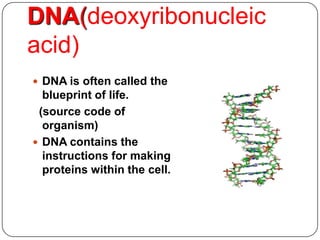
DNA(deoxyribonucleic
acid)
 DNA is often called the
blueprint of life.
(source code of
organism)
 DNA contains the
instructions for making
proteins within the cell.
3
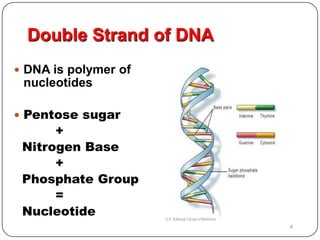
Double Strand of DNA
 DNA is polymer of
nucleotides
 Pentose sugar
+
Nitrogen Base
+
Phosphate Group
=
Nucleotide
4 4
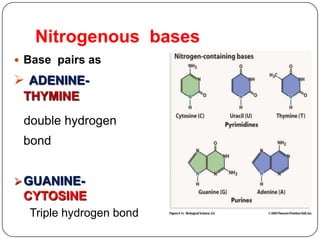
Nitrogenous bases
 Base pairs as
 ADENINE-
THYMINE
double hydrogen
bond
GUANINE-
CYTOSINE
Triple hydrogen bond
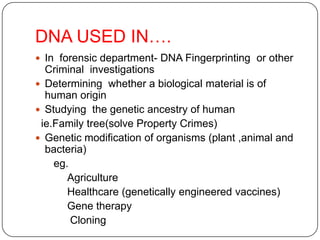
DNA USED IN….
 In forensic department- DNA Fingerprinting or other
Criminal investigations
 Determining whether a biological material is of
human origin
 Studying the genetic ancestry of human
ie.Family tree(solve Property Crimes)
 Genetic modification of organisms (plant ,animal and
bacteria)
eg.
Agriculture
Healthcare (genetically engineered vaccines)
Gene therapy
Cloning
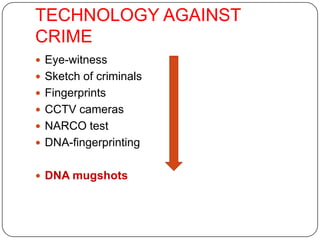
TECHNOLOGY AGAINST
CRIME
 Eye-witness
 Sketch of criminals
 Fingerprints
 CCTV cameras
 NARCO test
 DNA-fingerprinting
 DNA mugshots
How DNA is Used to Solve
Crimes?
 DNA is unique
 investigators collect DNA samples from crime
scenes
eg. few drops of blood, hair or dandruff
, weapon, sweat,etc.
 Get genome sequence or genetic code
 If samples doesn't match the victim then..
 compare it to samples from possible suspects
 If a suspect has left DNA at the crime
scene, they are definitely tied to the crime.
USING technique of DNA
MUGSHOTS…
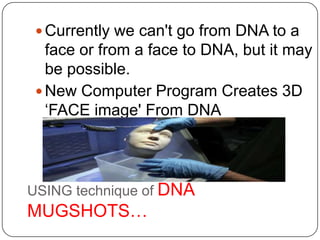
 Currently we can't go from DNA to a
face or from a face to DNA, but it may
be possible.
 New Computer Program Creates 3D
„FACE image' From DNA
MUGSHOTS FROM DNA
• Using genes to predict eye and hair colour is
relatively easy.
• But the complex structure of the face makes it
more valuable as a forensic tool — and more
difficult to connect to genetic variation.
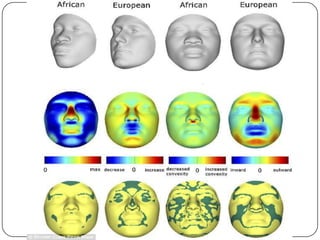
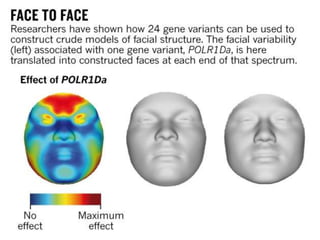
• 7000 different components of face are
compared by software and guessed which gene
will impact where.
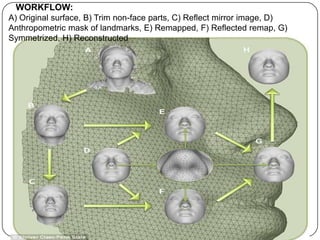
WORKFLOW:
A) Original surface, B) Trim non-face parts, C) Reflect mirror image, D)
Anthropometric mask of landmarks, E) Remapped, F) Reflected remap, G)
Symmetrized, H) Reconstructed
DNA PROFILING
A technique used by scientists to distinguish
between individuals of the same species using
only samples of their DNA
Stages of DNA Profiling
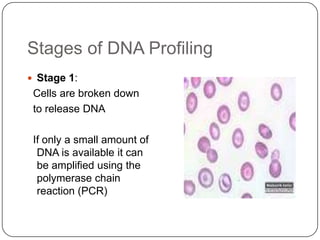
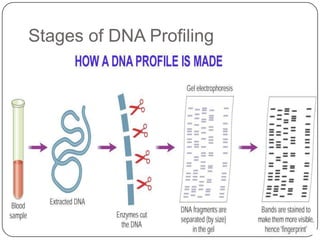
 Stage 1:
Cells are broken down
to release DNA
If only a small amount of
DNA is available it can
be amplified using the
polymerase chain
reaction (PCR)
Stages of DNA Profiling
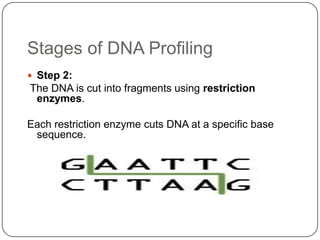
 Step 2:
The DNA is cut into fragments using restriction
enzymes.
Each restriction enzyme cuts DNA at a specific base
sequence.
Stages of DNA Profiling
 The sections of DNA that are cut out are called
restriction fragments.
 This yields thousands of restriction fragments of
all different sizes because the base sequences
being cut may be far apart (long fragment) or
close together (short fragment).
Stages of DNA Profiling
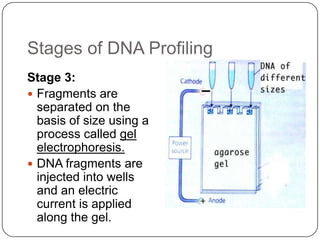
Stage 3:
 Fragments are
separated on the
basis of size using a
process called gel
electrophoresis.
 DNA fragments are
injected into wells
and an electric
current is applied
along the gel.
Stages of DNA Profiling
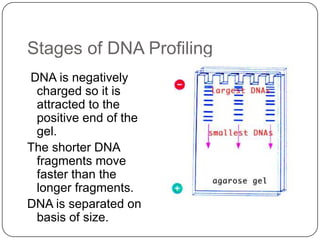
DNA is negatively
charged so it is
attracted to the
positive end of the
gel.
The shorter DNA
fragments move
faster than the
longer fragments.
DNA is separated on
basis of size.
Stages of DNA Profiling
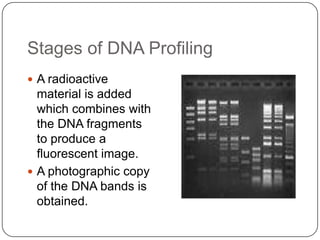
 A radioactive
material is added
which combines with
the DNA fragments
to produce a
fluorescent image.
 A photographic copy
of the DNA bands is
obtained.
Stages of DNA Profiling
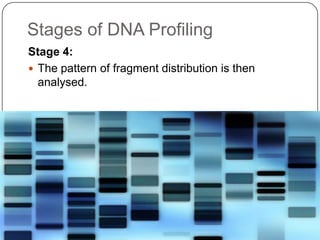
Stage 4:
 The pattern of fragment distribution is then
analysed.
Stages of DNA Profiling
Issues
23
Based on case readings, doubts fall into the following themes:
(1) coincidental profile matches
(2) unintentional attribution of DNA profile to another
(3) unfounded threats like planting of evidences and
eugenics
(4) breadth of database.
Of these four, only the first can be deliberated within the world
of “pure” science thereby crediting such doubts to DNA
technology itself.
Issues
24
Coincidental Profile Match
In the cases reviewed for the past years , evidentiary samples
from crime scenes are reported to be often incomplete or
partial DNA profiles. Limited quantities of DNA can make it
impossible to genotype at every locus (STR uses 13 loci as
markers). In some instances, the test yields no information
about the genotype at a particular locus; in some instances
one of the two alleles at a locus will become undetectable.
Issues
25
Unintentional attribution of DNA profile to another
Unintentional attribution of DNA profile to another could
be brought about by cross-contamination of
samples, accidental transfer of DNA from one sample to
another, mislabelling of samples, and misinterpretation of
samples.
Limitations
DNA evidence is powerful, but it does
have limitations.
•Fake DNA
Instances where criminals plant fake DNA
samples at a crime scene
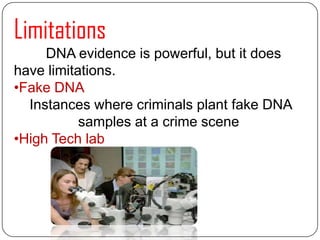
•High Tech lab
 Skilled peoples Required
plastic bags
direct sunlight
warmer conditions
may damage DNA. so officers must be skilled to
handle biological materials.
Advancements
New testing procedures
RFLP( restriction fragment length
polymorphism) analysis required large
amounts of relatively high-quality DNA.
Newer procedures require far less
DNA and can be completed faster.
Source of DNA
Science has devised ingenious ways
of extracting DNA from sources that used
to be too difficult or too contaminated to
use
 Expanding DNA database
The databases managed by the CODIS
(Combined DNA Index System) software continue to
expand.
Justice officials estimate the new collecting
requirements will add DNA from an additional 1.2
million people to the database each year
 Training To Investigators
Crime labs have developed formal protocols for
handling and processing evidence, reducing the
likelihood of contamination of samples
CONCLUSIO
N
• DNA MUGSHOTS is the most
sophisticated way to identify
living organisms.
•DNA cannot easily be altered
once it is left at a crime scene
which makes it a strong forensic
tool.
•laboratories carrying out DNA

DNA MUGSHOTS AGAINST CRIME

  • 2.
    SPECIES COUNT…….  About8.7 million species is the new estimated count of species on Earth  All are different from each other  WHY IT IS SO?
  • 3.
    DNA(deoxyribonucleic acid)  DNA isoften called the blueprint of life. (source code of organism)  DNA contains the instructions for making proteins within the cell. 3
  • 4.
    Double Strand ofDNA  DNA is polymer of nucleotides  Pentose sugar + Nitrogen Base + Phosphate Group = Nucleotide 4 4
  • 5.
    Nitrogenous bases  Basepairs as  ADENINE- THYMINE double hydrogen bond GUANINE- CYTOSINE Triple hydrogen bond
  • 6.
    DNA USED IN…. In forensic department- DNA Fingerprinting or other Criminal investigations  Determining whether a biological material is of human origin  Studying the genetic ancestry of human ie.Family tree(solve Property Crimes)  Genetic modification of organisms (plant ,animal and bacteria) eg. Agriculture Healthcare (genetically engineered vaccines) Gene therapy Cloning
  • 7.
    TECHNOLOGY AGAINST CRIME  Eye-witness Sketch of criminals  Fingerprints  CCTV cameras  NARCO test  DNA-fingerprinting  DNA mugshots
  • 8.
    How DNA isUsed to Solve Crimes?  DNA is unique  investigators collect DNA samples from crime scenes eg. few drops of blood, hair or dandruff , weapon, sweat,etc.  Get genome sequence or genetic code  If samples doesn't match the victim then..  compare it to samples from possible suspects  If a suspect has left DNA at the crime scene, they are definitely tied to the crime.
  • 9.
    USING technique ofDNA MUGSHOTS…  Currently we can't go from DNA to a face or from a face to DNA, but it may be possible.  New Computer Program Creates 3D „FACE image' From DNA
  • 10.
    MUGSHOTS FROM DNA •Using genes to predict eye and hair colour is relatively easy. • But the complex structure of the face makes it more valuable as a forensic tool — and more difficult to connect to genetic variation. • 7000 different components of face are compared by software and guessed which gene will impact where.
  • 13.
    WORKFLOW: A) Original surface,B) Trim non-face parts, C) Reflect mirror image, D) Anthropometric mask of landmarks, E) Remapped, F) Reflected remap, G) Symmetrized, H) Reconstructed
  • 14.
    DNA PROFILING A techniqueused by scientists to distinguish between individuals of the same species using only samples of their DNA
  • 15.
    Stages of DNAProfiling  Stage 1: Cells are broken down to release DNA If only a small amount of DNA is available it can be amplified using the polymerase chain reaction (PCR)
  • 16.
    Stages of DNAProfiling  Step 2: The DNA is cut into fragments using restriction enzymes. Each restriction enzyme cuts DNA at a specific base sequence.
  • 17.
    Stages of DNAProfiling  The sections of DNA that are cut out are called restriction fragments.  This yields thousands of restriction fragments of all different sizes because the base sequences being cut may be far apart (long fragment) or close together (short fragment).
  • 18.
    Stages of DNAProfiling Stage 3:  Fragments are separated on the basis of size using a process called gel electrophoresis.  DNA fragments are injected into wells and an electric current is applied along the gel.
  • 19.
    Stages of DNAProfiling DNA is negatively charged so it is attracted to the positive end of the gel. The shorter DNA fragments move faster than the longer fragments. DNA is separated on basis of size.
  • 20.
    Stages of DNAProfiling  A radioactive material is added which combines with the DNA fragments to produce a fluorescent image.  A photographic copy of the DNA bands is obtained.
  • 21.
    Stages of DNAProfiling Stage 4:  The pattern of fragment distribution is then analysed.
  • 22.
    Stages of DNAProfiling
  • 23.
    Issues 23 Based on casereadings, doubts fall into the following themes: (1) coincidental profile matches (2) unintentional attribution of DNA profile to another (3) unfounded threats like planting of evidences and eugenics (4) breadth of database. Of these four, only the first can be deliberated within the world of “pure” science thereby crediting such doubts to DNA technology itself.
  • 24.
    Issues 24 Coincidental Profile Match Inthe cases reviewed for the past years , evidentiary samples from crime scenes are reported to be often incomplete or partial DNA profiles. Limited quantities of DNA can make it impossible to genotype at every locus (STR uses 13 loci as markers). In some instances, the test yields no information about the genotype at a particular locus; in some instances one of the two alleles at a locus will become undetectable.
  • 25.
    Issues 25 Unintentional attribution ofDNA profile to another Unintentional attribution of DNA profile to another could be brought about by cross-contamination of samples, accidental transfer of DNA from one sample to another, mislabelling of samples, and misinterpretation of samples.
  • 26.
    Limitations DNA evidence ispowerful, but it does have limitations. •Fake DNA Instances where criminals plant fake DNA samples at a crime scene •High Tech lab
  • 27.
     Skilled peoplesRequired plastic bags direct sunlight warmer conditions may damage DNA. so officers must be skilled to handle biological materials.
  • 28.
    Advancements New testing procedures RFLP(restriction fragment length polymorphism) analysis required large amounts of relatively high-quality DNA. Newer procedures require far less DNA and can be completed faster. Source of DNA Science has devised ingenious ways of extracting DNA from sources that used to be too difficult or too contaminated to use
  • 29.
     Expanding DNAdatabase The databases managed by the CODIS (Combined DNA Index System) software continue to expand. Justice officials estimate the new collecting requirements will add DNA from an additional 1.2 million people to the database each year  Training To Investigators Crime labs have developed formal protocols for handling and processing evidence, reducing the likelihood of contamination of samples
  • 30.
    CONCLUSIO N • DNA MUGSHOTSis the most sophisticated way to identify living organisms. •DNA cannot easily be altered once it is left at a crime scene which makes it a strong forensic tool. •laboratories carrying out DNA