Green Buildings
What is a “Green Building”
“Green” Buildings are high performance structures that also meet
certain standards for reducing natural resource consumption
What is a “Green Building”?
• “Green” or “Sustainable” buildings are characterized by:
– efficient management of energy and water resources
– management of material resources and waste
– restoration and protection of environmental quality
– enhancement and protection of health and indoor environmental quality
What is a “Green Building”?
• Green Building standards include:
– Leadership in Energy and Environmental Design (LEED)
– Green Globes
– BuiltGreen
– Energy Star
– India Bureau of energy efficiency
Project Planning
• Construction – Reduce the amount of waste generated at a construction site
• Design – Building design details will help to reduce construction materials, and
energy/water requirements when completed
• Material Selection – Careful selection of construction materials will leave less of an
environmental impact
Construction
• The act of “building” a building
• 10-30% of Municipal Waste
Goals:
• 3 R- Reuse, Reduce, Recycle
• Higher quality
• Trained crew
• Design based on standard size
• Renovate existing buildings
Construction - Implementation
3 Rules of Green Building Construction:
• Greenest building is that which isn’t made
• Every building should be as small as possible
• Don’t contribute to urban sprawl
Implementation:
• Solar Panels, Solar equipment for energy
• Green Roofs, Rain Gardens, Green Space
• Packed Gravel
• Efficient plumbing, Insulation, windows
• Low VOC Paints
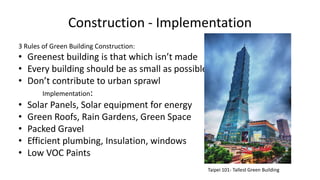
Taipei 101- Tallest Green Building
Building Design
Goal: To design the building so that it requires less energy/water and is
healthier for inhabitants when it is complete and in use
– Air ducts for an efficient and healthy air flow
– Insulation
– Windows designed for maximum daylight
– Passive Solar Control
– Solar Cells
– Heat Exchanger for climate control system
– Location
Building Design
• Central dehumidification system and dual flush toilets
• Building with trees shaded on west and east
• Central vacuum system
• Rain water collection
• Light colored exterior walls
• Lighting control using motion detection sensors
Principles Of Green Materials
• Choose products:
– made from environmentally attractive materials
– that are green because of what isn’t there
– that reduce environmental impacts during construction, renovation
or demolition
– that reduce environmental impacts of building operation
– that contribute to a safe, healthy indoor environment
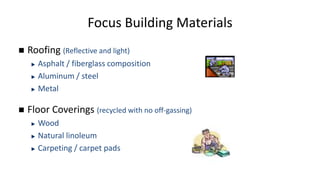
Focus Building Materials
 Roofing (Reflective and light)
Asphalt / fiberglass composition
Aluminum / steel
Metal
 Floor Coverings (recycled with no off-gassing)
Wood
Natural linoleum
Carpeting / carpet pads
• Doors
– Wood
– Fiberglass
– Steel with varying types of cores, from solid core
oak, maple, to old mahogany and hollow core
interiors
• Windows
– vinyl framed windows to wood framed,
– single pane
– double pane
– UV film
– argon gas filled.
Benefits of Green buildings
Buildings have an enormous impact on the
environment, human health, and the economy. The
successful adoption of green building strategies can
maximize both the economic and environmental
performance of buildings.
 Environmental benefits
Social benefits
Economic benefits
Obstacles
• 93% of consumers worry about their home’s environmental
performance. However, only 18% are willing to pay more to
reduce the impact.
• There are higher initial costs for Green Building
• One of the major issues that is faced in the construction of any
green building is the: Design and construction issues
Design & Construction Issues
Improper installation due to inexperience of contractors
Failure of innovative materials to meet performance
requirements
Unanticipated performance failures due to design or
construction flaws.
Construction Delays
Failure to maintain adequate records
The various steps involved in construction of any green building are
very often the root cause of delay in their completion.
– Timing
– Construction process
– Substitutions
– Commissioning
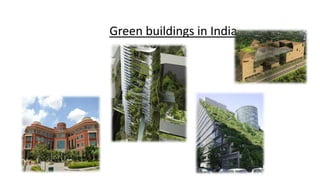
Green buildings in India
Support For Green Buildings
• 1) LEED
LEED has inspired hundreds of laws, incentive programs
LEED is intended to help building owners be
environmentally responsible.
LEED also has grown to more than 200 volunteers in nearly
20 committees with 150 professional staff.
LEED standards is being applied to more than 7,000 projects
in the United States and over 30 countries
Conclusions
• Green Building Certifications present a moving target
• Critical to work with clients early and continuously to determine goals and
objectives
• Focus on objective performance measures and clear allocation of risks and
responsibilities
• Green building issues are presented in nearly every phase of development – look for
opportunities to improve old practices and “boiler plate”
• Don’t get bogged down, but don’t be afraid to innovate

Green buildings

  • 1.
  • 2.
    What is a“Green Building” “Green” Buildings are high performance structures that also meet certain standards for reducing natural resource consumption
  • 3.
    What is a“Green Building”? • “Green” or “Sustainable” buildings are characterized by: – efficient management of energy and water resources – management of material resources and waste – restoration and protection of environmental quality – enhancement and protection of health and indoor environmental quality
  • 4.
    What is a“Green Building”? • Green Building standards include: – Leadership in Energy and Environmental Design (LEED) – Green Globes – BuiltGreen – Energy Star – India Bureau of energy efficiency
  • 5.
    Project Planning • Construction– Reduce the amount of waste generated at a construction site • Design – Building design details will help to reduce construction materials, and energy/water requirements when completed • Material Selection – Careful selection of construction materials will leave less of an environmental impact
  • 6.
    Construction • The actof “building” a building • 10-30% of Municipal Waste Goals: • 3 R- Reuse, Reduce, Recycle • Higher quality • Trained crew • Design based on standard size • Renovate existing buildings
  • 7.
    Construction - Implementation 3Rules of Green Building Construction: • Greenest building is that which isn’t made • Every building should be as small as possible • Don’t contribute to urban sprawl Implementation: • Solar Panels, Solar equipment for energy • Green Roofs, Rain Gardens, Green Space • Packed Gravel • Efficient plumbing, Insulation, windows • Low VOC Paints Taipei 101- Tallest Green Building
  • 8.
    Building Design Goal: Todesign the building so that it requires less energy/water and is healthier for inhabitants when it is complete and in use – Air ducts for an efficient and healthy air flow – Insulation – Windows designed for maximum daylight – Passive Solar Control – Solar Cells – Heat Exchanger for climate control system – Location
  • 9.
    Building Design • Centraldehumidification system and dual flush toilets • Building with trees shaded on west and east • Central vacuum system • Rain water collection • Light colored exterior walls • Lighting control using motion detection sensors
  • 10.
    Principles Of GreenMaterials • Choose products: – made from environmentally attractive materials – that are green because of what isn’t there – that reduce environmental impacts during construction, renovation or demolition – that reduce environmental impacts of building operation – that contribute to a safe, healthy indoor environment
  • 11.
    Focus Building Materials Roofing (Reflective and light) Asphalt / fiberglass composition Aluminum / steel Metal  Floor Coverings (recycled with no off-gassing) Wood Natural linoleum Carpeting / carpet pads
  • 12.
    • Doors – Wood –Fiberglass – Steel with varying types of cores, from solid core oak, maple, to old mahogany and hollow core interiors • Windows – vinyl framed windows to wood framed, – single pane – double pane – UV film – argon gas filled.
  • 13.
    Benefits of Greenbuildings Buildings have an enormous impact on the environment, human health, and the economy. The successful adoption of green building strategies can maximize both the economic and environmental performance of buildings.  Environmental benefits Social benefits Economic benefits
  • 14.
    Obstacles • 93% ofconsumers worry about their home’s environmental performance. However, only 18% are willing to pay more to reduce the impact. • There are higher initial costs for Green Building • One of the major issues that is faced in the construction of any green building is the: Design and construction issues
  • 15.
    Design & ConstructionIssues Improper installation due to inexperience of contractors Failure of innovative materials to meet performance requirements Unanticipated performance failures due to design or construction flaws. Construction Delays Failure to maintain adequate records
  • 16.
    The various stepsinvolved in construction of any green building are very often the root cause of delay in their completion. – Timing – Construction process – Substitutions – Commissioning
  • 17.
  • 18.
    Support For GreenBuildings • 1) LEED LEED has inspired hundreds of laws, incentive programs LEED is intended to help building owners be environmentally responsible. LEED also has grown to more than 200 volunteers in nearly 20 committees with 150 professional staff. LEED standards is being applied to more than 7,000 projects in the United States and over 30 countries
  • 19.
    Conclusions • Green BuildingCertifications present a moving target • Critical to work with clients early and continuously to determine goals and objectives • Focus on objective performance measures and clear allocation of risks and responsibilities • Green building issues are presented in nearly every phase of development – look for opportunities to improve old practices and “boiler plate” • Don’t get bogged down, but don’t be afraid to innovate