Mr. Suraj Dipak Gabale
Assistant Professor
Department of Microbiology,
Vivekanand College, Kolhapur
 Definitions:
 1) It is a mode of ATP generation in which
synthesis of ATP from ADP and inorganic
phosphate occurs by using energy released
during flow of electrons from substrate to O2,
NO3 or SO4.
 2) It is a mode of ATP generation in aerobic
organisms, in which energy released during
oxidation of substrate is used to synthesize ATP.
 In Oxidative phosphorylation substrate is oxidized which
causes release of electrons. These electrons flows
through membrane bound carriers like NADH2, FADH2
etc.
Respiratory Electron Transport Chain:
 The sequence of carriers' that mediates oxidation of
substrate and reduction of terminal electron acceptor is
known as respiratory ETC.
 It involves large no. of enzymes and electron carriers.
 In glycolysis, Krebs cycle electrons released after
oxidation of substrate enters ETC. The first electron
acceptor is NAD+ while in some cases it is FAD+.
 The terminal electron acceptor in aerobes is Oxygen
while in anaerobes it may nitrate, sulfate or carbonate.
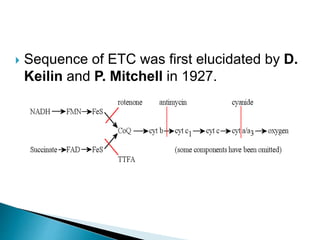
 Sequence of ETC was first elucidated by D.
Keilin and P. Mitchell in 1927.
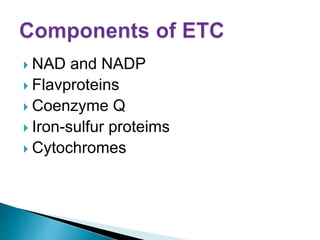
 NAD and NADP
 Flavproteins
 Coenzyme Q
 Iron-sulfur proteims
 Cytochromes
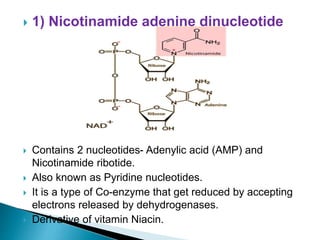
 1) Nicotinamide adenine dinucleotide
 Contains 2 nucleotides- Adenylic acid (AMP) and
Nicotinamide ribotide.
 Also known as Pyridine nucleotides.
 It is a type of Co-enzyme that get reduced by accepting
electrons released by dehydrogenases.
 Derivative of vitamin Niacin.
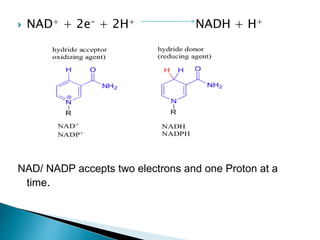
 NAD+ + 2e- + 2H+ NADH + H+
NAD/ NADP accepts two electrons and one Proton at a
time.
2) Flavoprotein:
 It is another class of enzymes that catalyse oxidation
reduction using flavin nucleotides (FMN or FAD).
 Tightly bound to enzymes (Prosthetic group).
 Derived from Riboflavin.
 Both FMN and Fad posseses same active sites capable
of undergoing reversible oxidation reduction.
 FAD + 2H+ + 2e- FADH2
 Oxidized flavoprotein- Absorption maxima 570nm
 Reduced flavoprotein- Absorption maxima 450nm
3) Coenzyme Q
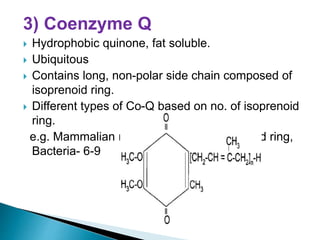
 Hydrophobic quinone, fat soluble.
 Ubiquitous
 Contains long, non-polar side chain composed of
isoprenoid ring.
 Different types of Co-Q based on no. of isoprenoid
ring.
e.g. Mammalian mitochondria- 10 isoprenoid ring,
Bacteria- 6-9
4) Cytochrome:
Initially discovered by McMunnin in animal cells.
Keilin carried detail work.
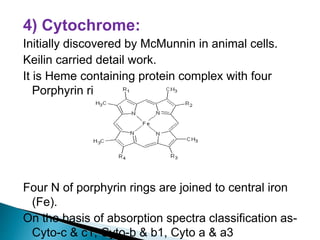
It is Heme containing protein complex with four
Porphyrin rings.
Four N of porphyrin rings are joined to central iron
(Fe).
On the basis of absorption spectra classification as-
Cyto-c & c1, Cyto-b & b1, Cyto a & a3
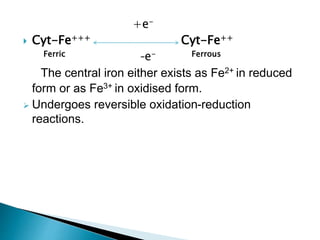
+e-
 Cyt-Fe+++ Cyt-Fe++
Ferric _e- Ferrous
The central iron either exists as Fe2+ in reduced
form or as Fe3+ in oxidised form.
 Undergoes reversible oxidation-reduction
reactions.
5) Iron-Sulfur protein:
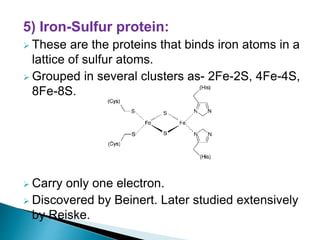
 These are the proteins that binds iron atoms in a
lattice of sulfur atoms.
 Grouped in several clusters as- 2Fe-2S, 4Fe-4S,
8Fe-8S.
 Carry only one electron.
 Discovered by Beinert. Later studied extensively
by Reiske.
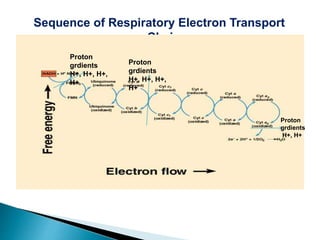
Sequence of Respiratory Electron Transport
Chain
Proton
grdients
H+, H+
Proton
grdients
H+, H+, H+,
H+
Proton
grdients
H+, H+, H+,
H+
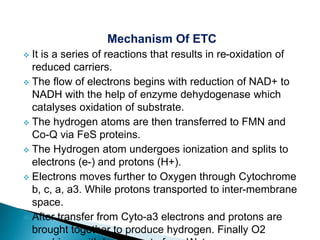
Mechanism Of ETC
 It is a series of reactions that results in re-oxidation of
reduced carriers.
 The flow of electrons begins with reduction of NAD+ to
NADH with the help of enzyme dehydogenase which
catalyses oxidation of substrate.
 The hydrogen atoms are then transferred to FMN and
Co-Q via FeS proteins.
 The Hydrogen atom undergoes ionization and splits to
electrons (e-) and protons (H+).
 Electrons moves further to Oxygen through Cytochrome
b, c, a, a3. While protons transported to inter-membrane
space.
 After transfer from Cyto-a3 electrons and protons are
brought together to produce hydrogen. Finally O2
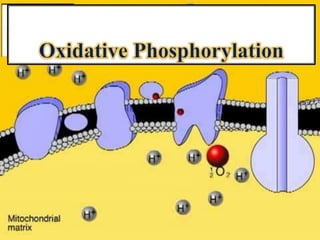
Protonmotive Force:
 Various hypothesis have been proposed to explain
mechanism of ATP generation.
 Most widely accepted model is “Chemiosmotic
hypothesis” proposed by Peter Mitchell 1978.
 According to this hypothesis, flow of electrons through the
carriers releases energy which drives protons outside
plasma membrane.
 Transfer of protons outside generates Proton gradient
(Difference in charge)
 Thus, energy released during transfer of electrons is
conserved as ‘Proton motive Force’.
 Proton motive Force is a form of potential energy that can
be used for:
a) Permease systems
b) Syntheis of ATP from ADP and Pi.
c) Rotation of flagellar motor
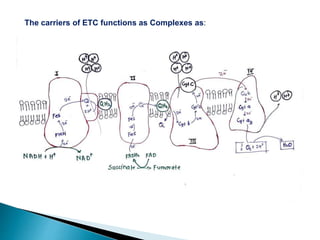
The carriers of ETC functions as Complexes as:
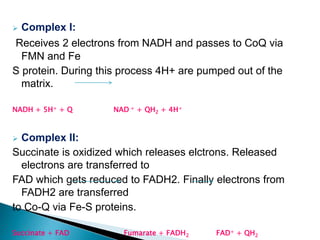
 Complex I:
Receives 2 electrons from NADH and passes to CoQ via
FMN and Fe
S protein. During this process 4H+ are pumped out of the
matrix.
NADH + 5H+ + Q NAD + + QH2 + 4H+
 Complex II:
Succinate is oxidized which releases elctrons. Released
electrons are transferred to
FAD which gets reduced to FADH2. Finally electrons from
FADH2 are transferred
to Co-Q via Fe-S proteins.
Succinate + FAD Fumarate + FADH2 FAD+ + QH2
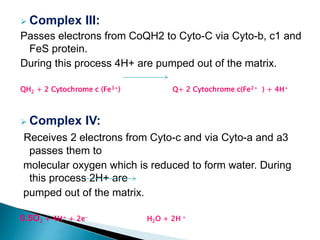
 Complex III:
Passes electrons from CoQH2 to Cyto-C via Cyto-b, c1 and
FeS protein.
During this process 4H+ are pumped out of the matrix.
QH2 + 2 Cytochrome c (Fe3+) Q+ 2 Cytochrome c(Fe2+ ) + 4H+
 Complex IV:
Receives 2 electrons from Cyto-c and via Cyto-a and a3
passes them to
molecular oxygen which is reduced to form water. During
this process 2H+ are
pumped out of the matrix.
0.5O2 + 4H+ + 2e- H2O + 2H +
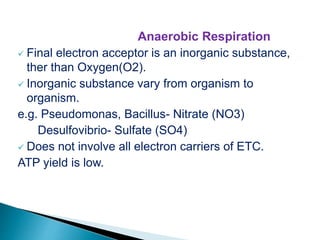
Anaerobic Respiration
 Final electron acceptor is an inorganic substance,
ther than Oxygen(O2).
 Inorganic substance vary from organism to
organism.
e.g. Pseudomonas, Bacillus- Nitrate (NO3)
Desulfovibrio- Sulfate (SO4)
 Does not involve all electron carriers of ETC.
ATP yield is low.

Bacterial electron transport chain and complexes in it

  • 1.
    Mr. Suraj DipakGabale Assistant Professor Department of Microbiology, Vivekanand College, Kolhapur
  • 3.
     Definitions:  1)It is a mode of ATP generation in which synthesis of ATP from ADP and inorganic phosphate occurs by using energy released during flow of electrons from substrate to O2, NO3 or SO4.  2) It is a mode of ATP generation in aerobic organisms, in which energy released during oxidation of substrate is used to synthesize ATP.
  • 4.
     In Oxidativephosphorylation substrate is oxidized which causes release of electrons. These electrons flows through membrane bound carriers like NADH2, FADH2 etc. Respiratory Electron Transport Chain:  The sequence of carriers' that mediates oxidation of substrate and reduction of terminal electron acceptor is known as respiratory ETC.  It involves large no. of enzymes and electron carriers.  In glycolysis, Krebs cycle electrons released after oxidation of substrate enters ETC. The first electron acceptor is NAD+ while in some cases it is FAD+.  The terminal electron acceptor in aerobes is Oxygen while in anaerobes it may nitrate, sulfate or carbonate.
  • 5.
     Sequence ofETC was first elucidated by D. Keilin and P. Mitchell in 1927.
  • 6.
     NAD andNADP  Flavproteins  Coenzyme Q  Iron-sulfur proteims  Cytochromes
  • 7.
     1) Nicotinamideadenine dinucleotide  Contains 2 nucleotides- Adenylic acid (AMP) and Nicotinamide ribotide.  Also known as Pyridine nucleotides.  It is a type of Co-enzyme that get reduced by accepting electrons released by dehydrogenases.  Derivative of vitamin Niacin.
  • 8.
     NAD+ +2e- + 2H+ NADH + H+ NAD/ NADP accepts two electrons and one Proton at a time.
  • 9.
    2) Flavoprotein:  Itis another class of enzymes that catalyse oxidation reduction using flavin nucleotides (FMN or FAD).  Tightly bound to enzymes (Prosthetic group).  Derived from Riboflavin.  Both FMN and Fad posseses same active sites capable of undergoing reversible oxidation reduction.  FAD + 2H+ + 2e- FADH2  Oxidized flavoprotein- Absorption maxima 570nm  Reduced flavoprotein- Absorption maxima 450nm
  • 10.
    3) Coenzyme Q Hydrophobic quinone, fat soluble.  Ubiquitous  Contains long, non-polar side chain composed of isoprenoid ring.  Different types of Co-Q based on no. of isoprenoid ring. e.g. Mammalian mitochondria- 10 isoprenoid ring, Bacteria- 6-9
  • 11.
    4) Cytochrome: Initially discoveredby McMunnin in animal cells. Keilin carried detail work. It is Heme containing protein complex with four Porphyrin rings. Four N of porphyrin rings are joined to central iron (Fe). On the basis of absorption spectra classification as- Cyto-c & c1, Cyto-b & b1, Cyto a & a3
  • 12.
    +e-  Cyt-Fe+++ Cyt-Fe++ Ferric_e- Ferrous The central iron either exists as Fe2+ in reduced form or as Fe3+ in oxidised form.  Undergoes reversible oxidation-reduction reactions.
  • 13.
    5) Iron-Sulfur protein: These are the proteins that binds iron atoms in a lattice of sulfur atoms.  Grouped in several clusters as- 2Fe-2S, 4Fe-4S, 8Fe-8S.  Carry only one electron.  Discovered by Beinert. Later studied extensively by Reiske.
  • 14.
    Sequence of RespiratoryElectron Transport Chain Proton grdients H+, H+ Proton grdients H+, H+, H+, H+ Proton grdients H+, H+, H+, H+
  • 15.
    Mechanism Of ETC It is a series of reactions that results in re-oxidation of reduced carriers.  The flow of electrons begins with reduction of NAD+ to NADH with the help of enzyme dehydogenase which catalyses oxidation of substrate.  The hydrogen atoms are then transferred to FMN and Co-Q via FeS proteins.  The Hydrogen atom undergoes ionization and splits to electrons (e-) and protons (H+).  Electrons moves further to Oxygen through Cytochrome b, c, a, a3. While protons transported to inter-membrane space.  After transfer from Cyto-a3 electrons and protons are brought together to produce hydrogen. Finally O2
  • 16.
    Protonmotive Force:  Varioushypothesis have been proposed to explain mechanism of ATP generation.  Most widely accepted model is “Chemiosmotic hypothesis” proposed by Peter Mitchell 1978.  According to this hypothesis, flow of electrons through the carriers releases energy which drives protons outside plasma membrane.  Transfer of protons outside generates Proton gradient (Difference in charge)  Thus, energy released during transfer of electrons is conserved as ‘Proton motive Force’.  Proton motive Force is a form of potential energy that can be used for: a) Permease systems b) Syntheis of ATP from ADP and Pi. c) Rotation of flagellar motor
  • 17.
    The carriers ofETC functions as Complexes as:
  • 18.
     Complex I: Receives2 electrons from NADH and passes to CoQ via FMN and Fe S protein. During this process 4H+ are pumped out of the matrix. NADH + 5H+ + Q NAD + + QH2 + 4H+  Complex II: Succinate is oxidized which releases elctrons. Released electrons are transferred to FAD which gets reduced to FADH2. Finally electrons from FADH2 are transferred to Co-Q via Fe-S proteins. Succinate + FAD Fumarate + FADH2 FAD+ + QH2
  • 19.
     Complex III: Passeselectrons from CoQH2 to Cyto-C via Cyto-b, c1 and FeS protein. During this process 4H+ are pumped out of the matrix. QH2 + 2 Cytochrome c (Fe3+) Q+ 2 Cytochrome c(Fe2+ ) + 4H+  Complex IV: Receives 2 electrons from Cyto-c and via Cyto-a and a3 passes them to molecular oxygen which is reduced to form water. During this process 2H+ are pumped out of the matrix. 0.5O2 + 4H+ + 2e- H2O + 2H +
  • 20.
    Anaerobic Respiration  Finalelectron acceptor is an inorganic substance, ther than Oxygen(O2).  Inorganic substance vary from organism to organism. e.g. Pseudomonas, Bacillus- Nitrate (NO3) Desulfovibrio- Sulfate (SO4)  Does not involve all electron carriers of ETC. ATP yield is low.