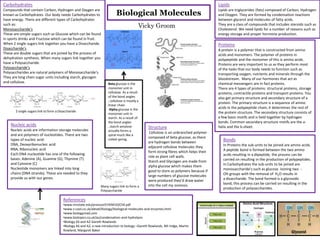
CarbohydratesCompounds that contain Carbon, Hydrogen and Oxygen are known as Carbohydrates. Our body needs Carbohydrates to have energy. There are different types of Carbohydrates such as:Monosaccharide'sThese are simple sugars such as Glucose which can be found in sports drinks and Fructose which can be found in fruit. When 2 single sugars link together you have a Disaccharide.Disaccharide’sThese are double sugars that are joined by the process of dehydration synthesis. When many sugars link together you have a Polysaccharide.Polysaccharide’sPolysaccharides are natural polymers of Monosaccharide's. They are long chain sugar units including starch, glycogen and cellulose.LipidsLipids are triglycerides (fats) composed of Carbon, Hydrogen and Oxygen. They are formed by condensation reactions between glycerol and molecules of fatty acids. They are a class of compounds that includes steroids such as Cholesterol. We need lipids for a number of reasons such as energy storage and proper hormone production. Biological MoleculesVicky GroomProteinsA protein is a polymer that is constructed from amino acids and monomers. The polymer of proteins in polypeptide and the monomer of this is amino acids. Proteins are very important to us as they perform most of the tasks that our body needs to function such as transporting oxygen, nutrients and minerals through the bloodstream.  Many of our hormones that act as chemical messengers are in fact proteins.There are 4 types of proteins: structural proteins, storage proteins, contractile proteins and transport proteins. You also get primary structure and secondary structure of a protein. The primary structure is a sequence of amino acids in the polypeptide chain, it determines the rest of the protein structure. The secondary structure consists of a few basic motifs and is held together by hydrogen bonds. Common secondary structure motifs are the a-helix and the b-sheet. Beta glucose is the monomer unit in cellulose. As a result of the bond angles , cellulose is mostly a linear chain Alpha glucose is the monomer unit in starch. As a result of the bond angles , starch-amylose actually forms a spiral much like a coiled spring.2 single sugars link to form a DisaccharideNucleic acidsNucleic acids are information storage molecules and are polymers of nucleotides. There are two types of nucleic acid:DNA, Deoxyribonucleic acidRNA, Ribonucleic acidEach DNA nucleotide has one of the following bases: Adenine (A), Guanine (G), Thymine (T) and Cytosine (C)Nucleotide monomers are linked into long chains (DNA strands). These are needed to they provide us with our genes.StructureCellulose is an unbranched polymer composed of beta glucose, as there are hydrogen bonds between adjacent cellulose molecules they form strong fibres which helps their role as plant cell walls.Starch and Glycogen are made from alpha glucose which makes them good to store as polymers because if large numbers of glucose molecules were produced they’d draw water into the cell my osmosis.BondsIn Proteins the sub-units to be joined are amino acids. A peptide bond is formed between the two amino acids resulting in a dipeptide, the process can be carried on resulting in the production of polypeptides.In Carbohydrates the sub-units to be joined are monosaccharide's such as glucose. Joining two  -OH groups with the removal of  H2O results in a disaccharide. The bond formed is a glycosidic bond, this process can be carried on resulting in the production of polysaccharides. Many sugars link to form a PolysaccharideReferenceswww.mnstate.edu/provost/CHEM102Chll.pdf

Biological molecules

  • 1.
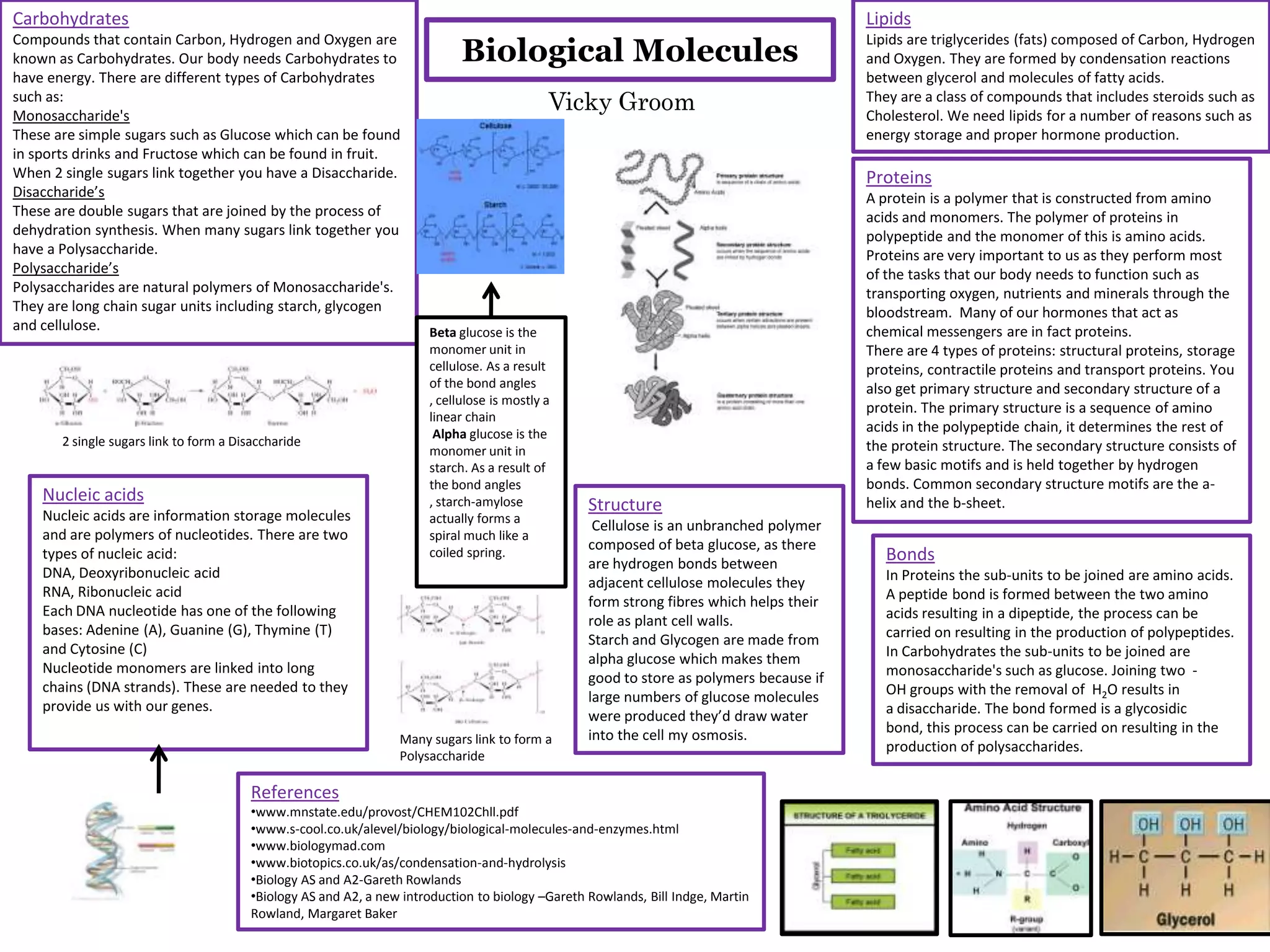
    CarbohydratesCompounds that containCarbon, Hydrogen and Oxygen are known as Carbohydrates. Our body needs Carbohydrates to have energy. There are different types of Carbohydrates such as:Monosaccharide'sThese are simple sugars such as Glucose which can be found in sports drinks and Fructose which can be found in fruit. When 2 single sugars link together you have a Disaccharide.Disaccharide’sThese are double sugars that are joined by the process of dehydration synthesis. When many sugars link together you have a Polysaccharide.Polysaccharide’sPolysaccharides are natural polymers of Monosaccharide's. They are long chain sugar units including starch, glycogen and cellulose.LipidsLipids are triglycerides (fats) composed of Carbon, Hydrogen and Oxygen. They are formed by condensation reactions between glycerol and molecules of fatty acids. They are a class of compounds that includes steroids such as Cholesterol. We need lipids for a number of reasons such as energy storage and proper hormone production. Biological MoleculesVicky GroomProteinsA protein is a polymer that is constructed from amino acids and monomers. The polymer of proteins in polypeptide and the monomer of this is amino acids. Proteins are very important to us as they perform most of the tasks that our body needs to function such as transporting oxygen, nutrients and minerals through the bloodstream. Many of our hormones that act as chemical messengers are in fact proteins.There are 4 types of proteins: structural proteins, storage proteins, contractile proteins and transport proteins. You also get primary structure and secondary structure of a protein. The primary structure is a sequence of amino acids in the polypeptide chain, it determines the rest of the protein structure. The secondary structure consists of a few basic motifs and is held together by hydrogen bonds. Common secondary structure motifs are the a-helix and the b-sheet. Beta glucose is the monomer unit in cellulose. As a result of the bond angles , cellulose is mostly a linear chain Alpha glucose is the monomer unit in starch. As a result of the bond angles , starch-amylose actually forms a spiral much like a coiled spring.2 single sugars link to form a DisaccharideNucleic acidsNucleic acids are information storage molecules and are polymers of nucleotides. There are two types of nucleic acid:DNA, Deoxyribonucleic acidRNA, Ribonucleic acidEach DNA nucleotide has one of the following bases: Adenine (A), Guanine (G), Thymine (T) and Cytosine (C)Nucleotide monomers are linked into long chains (DNA strands). These are needed to they provide us with our genes.StructureCellulose is an unbranched polymer composed of beta glucose, as there are hydrogen bonds between adjacent cellulose molecules they form strong fibres which helps their role as plant cell walls.Starch and Glycogen are made from alpha glucose which makes them good to store as polymers because if large numbers of glucose molecules were produced they’d draw water into the cell my osmosis.BondsIn Proteins the sub-units to be joined are amino acids. A peptide bond is formed between the two amino acids resulting in a dipeptide, the process can be carried on resulting in the production of polypeptides.In Carbohydrates the sub-units to be joined are monosaccharide's such as glucose. Joining two  -OH groups with the removal of  H2O results in a disaccharide. The bond formed is a glycosidic bond, this process can be carried on resulting in the production of polysaccharides. Many sugars link to form a PolysaccharideReferenceswww.mnstate.edu/provost/CHEM102Chll.pdf