Outline
• Introduction of biofuels
• Why biofuels
• Classification of biofuels
• Types of biofuels
• Biofuel feedstock
• Process and manufacturing of biofuels
• Applications advantages and disadvantages of biofuels.
Introduction
•Biofuels are renewable substitutes for fossil
fuels that are mainly produced from crop plants
such as corn, soybeans, wheat and sugarcane.
•Animal fats and other byproducts along with
household food waste, can also be used to
make biofuels.
Why biofuels?
There are many reasons why we are interested
in biofuels:
•To reduce our dependence of biofuels.
•To lower emission of green house gases.
•To bring business to rural economics.
•They are biodegradable and contribute to
sustainability.
Classification of biofuels.
First generation: biofuels made from sugar, starch,
vegetable oil or animal fats using conventional
technology.
Second generation: biofuels are produced from
non food crops such as cellulosic biofuels and
waste Biomass.
Third generation: biofuels are produced from
extracting oil of algae – sometimes referred to as
“oligae”.
Types of biofuels:
•Bioethanol
•Lipid derived biofuels Main types
•BtL fuels
•Biomethane
•Biohydrogen
Bioethanol
•Bioethanol is an alcohol made by fermentation mostly
from carbohydrates.
•Wheat/ grain/ corn / sugarcane can be used to produce
ethanol (basically any plants that composed large amount
of sugars).
•Bioethanol is produced in three ways:
Feedstock production
Sugar crops Sugarcane
Starch crops
Starch crops
Cellulosic feed stock
Bioethanol production
Feedstock production: harvesting, reception, Storage
Physical treatment: milling
Saccarification: Conversion of starch and cellulose into sugar
Chemical treatment: dilution of sugars with water and addition
of yeast or other organisms.
Fermentation: production of ethanol In solution with water along
with waste and by products.
Distillation: separation of ethanol
Dehydration: Removal of the remaining water by molecular
sieves (anhrour ethanol)
Co-product preparation: Drying of the alcohol free stillage (mash)
for high-value animal feed
Sugar to ethanol process
Grain to ethanol process
Distillation and Dehydration Process
• Ethanol produced by fermentation results in a solution of ethanol in
water.
• For ethanol to be used as fuel, water must be removed
Advantages Disadvantages
• Ethanol is renewable resources
• Ethanol burns more cleanly in air
than petroleum
• The use of ethanol reduce
Carbon-di-oxide emissions
• Large amount leads to problems
like Soil erosion and Deforestation.
• Typical current engines would
requires modifications.
• Demands strong technical
knowledge.
Applications of Bioethanol
Carbon Reduction: Using bioethanol as a biofuel helps reduce overall carbon emissions,
contributing to global efforts to combat climate change and promote a more sustainable
energy future.
Transportation: It is commonly used as an alternative fuel for vehicles, either in pure form
or blended with gasoline. Bioethanol can be a renewable and more environmentally friendly
option for powering cars and other modes of transportation.
Flex-Fuel Vehicles: Bioethanol is compatible with flex-fuel vehicles, allowing drivers to use
different ethanol-gasoline blends, promoting flexibility and reducing reliance on traditional
fossil fuels.
Aviation Fuel: Ongoing research explores the use of bioethanol in aviation to create more
sustainable jet fuels, aiming to reduce the carbon footprint of air travel.
Lipid-derived biofuels
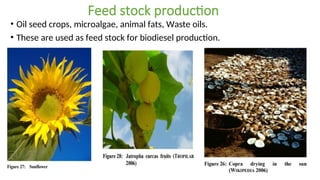
Feed stock production
• Oil seed crops, microalgae, animal fats, Waste oils.
• These are used as feed stock for biodiesel production.
Fuel production
Steps involved:
Oil extraction
Oil refining
Transesterification
Oil extraction
Oil refining
Degumming: The first purification step of oil refining is the removal of
phosphatides, also known as degumming.
Deacidification: It is an important step for edible oils as the development of
rancid flavors of free fatty acids (FFA) are prevented.
Bleaching: Colorants are removed. This process step enhances storage life of
the biofuel.
Deodorization: odorous substances (ketone, aldehyde) are removed by steam
distillation.
Dehydration: traces of water may decrease conversion in the transesterification
process of biodiesel production
Trans-esterification
• Is the process by which the refined oil molecule is “cracked” and the
glycerin is removed, resulting in glycerin soap and methyl or ethyl esters
(biodiesel).
Advantages Disadvantages
• Biodiesel is environment friendly.
• It can help reducing dependency on
foreign oil.
• it helps to lubricate the engine
Itself, decreasing engine wear.
• It can be used in almost any diesel
with little or no engine modification.
• It is safer than conventional diesel.
• Less global warming.
• Biodiesel emission Increases Oxides
of nitrogen(nox) in atmosphere.
• Biodiesel behaves as a solvent.
• Slightly decreases fuel economy.
• Cost varies according to feedstock
and market conditions
• Pure biodiesels has significant
problem with lower temperature.
Applications of biodiesel
•Railway usage
•Cleaning oil spills
•As a heating oil
•Biodiesel in generators
•Vehicles
Future Aspects of Biofuels
 The development of new technologies for processing and using
biofuels is steadily progressing.
Biofuels are becoming more and more competitive compared to fossil
fuels.
The use of biofuels features a number of advantages suitable for
achieving energy, environmental, agricultural and trade policies.
As a result, biofuels are emerging as a popular step towards a more
sustainable transportation sector, and several European countries have
introduced advanced policies to support the production and use of
biofuels.
Conclusion
• Debate about the impact of biofuels on food crises
continues.
• Some argue that biofuels can contribute to food shortages
by diverting crops from food production to fuel, while
others emphasize advancements in sustainable biofuel
technologies that minimize these concerns.
• It remains a complex issue with ongoing discussions about
finding a balance between renewable energy goals and
food security.
Conclusion
 Balancing energy needs with environmental and food security concerns
is essential for a sustainable biofuel future.
 There are a number of biological products that can be used as biofuels,
including wood, grasses, oils, sugars and starches.
 Wood and grasses are good biofuels because they grow relatively
quickly.
 Biodiesel is produced from oil crops, bioethanol is produced from crops
with a high sugar content and biogas is produced from the breakdown of
organic matter.
Reference
• Biofuel technology hand book version.
• www.slide share.net
Biofuels............................ .ppt

Biofuels............................ .ppt

  • 2.
    Outline • Introduction ofbiofuels • Why biofuels • Classification of biofuels • Types of biofuels • Biofuel feedstock • Process and manufacturing of biofuels • Applications advantages and disadvantages of biofuels.
  • 3.
    Introduction •Biofuels are renewablesubstitutes for fossil fuels that are mainly produced from crop plants such as corn, soybeans, wheat and sugarcane. •Animal fats and other byproducts along with household food waste, can also be used to make biofuels.
  • 4.
    Why biofuels? There aremany reasons why we are interested in biofuels: •To reduce our dependence of biofuels. •To lower emission of green house gases. •To bring business to rural economics. •They are biodegradable and contribute to sustainability.
  • 5.
    Classification of biofuels. Firstgeneration: biofuels made from sugar, starch, vegetable oil or animal fats using conventional technology. Second generation: biofuels are produced from non food crops such as cellulosic biofuels and waste Biomass. Third generation: biofuels are produced from extracting oil of algae – sometimes referred to as “oligae”.
  • 6.
    Types of biofuels: •Bioethanol •Lipidderived biofuels Main types •BtL fuels •Biomethane •Biohydrogen
  • 8.
    Bioethanol •Bioethanol is analcohol made by fermentation mostly from carbohydrates. •Wheat/ grain/ corn / sugarcane can be used to produce ethanol (basically any plants that composed large amount of sugars). •Bioethanol is produced in three ways:
  • 9.
  • 10.
  • 11.
  • 12.
    Bioethanol production Feedstock production:harvesting, reception, Storage Physical treatment: milling Saccarification: Conversion of starch and cellulose into sugar Chemical treatment: dilution of sugars with water and addition of yeast or other organisms. Fermentation: production of ethanol In solution with water along with waste and by products. Distillation: separation of ethanol Dehydration: Removal of the remaining water by molecular sieves (anhrour ethanol) Co-product preparation: Drying of the alcohol free stillage (mash) for high-value animal feed
  • 13.
  • 14.
  • 15.
    Distillation and DehydrationProcess • Ethanol produced by fermentation results in a solution of ethanol in water. • For ethanol to be used as fuel, water must be removed
  • 16.
    Advantages Disadvantages • Ethanolis renewable resources • Ethanol burns more cleanly in air than petroleum • The use of ethanol reduce Carbon-di-oxide emissions • Large amount leads to problems like Soil erosion and Deforestation. • Typical current engines would requires modifications. • Demands strong technical knowledge.
  • 18.
    Applications of Bioethanol CarbonReduction: Using bioethanol as a biofuel helps reduce overall carbon emissions, contributing to global efforts to combat climate change and promote a more sustainable energy future. Transportation: It is commonly used as an alternative fuel for vehicles, either in pure form or blended with gasoline. Bioethanol can be a renewable and more environmentally friendly option for powering cars and other modes of transportation. Flex-Fuel Vehicles: Bioethanol is compatible with flex-fuel vehicles, allowing drivers to use different ethanol-gasoline blends, promoting flexibility and reducing reliance on traditional fossil fuels. Aviation Fuel: Ongoing research explores the use of bioethanol in aviation to create more sustainable jet fuels, aiming to reduce the carbon footprint of air travel.
  • 20.
  • 21.
    Feed stock production •Oil seed crops, microalgae, animal fats, Waste oils. • These are used as feed stock for biodiesel production.
  • 23.
    Fuel production Steps involved: Oilextraction Oil refining Transesterification
  • 24.
  • 25.
    Oil refining Degumming: Thefirst purification step of oil refining is the removal of phosphatides, also known as degumming. Deacidification: It is an important step for edible oils as the development of rancid flavors of free fatty acids (FFA) are prevented. Bleaching: Colorants are removed. This process step enhances storage life of the biofuel. Deodorization: odorous substances (ketone, aldehyde) are removed by steam distillation. Dehydration: traces of water may decrease conversion in the transesterification process of biodiesel production
  • 27.
    Trans-esterification • Is theprocess by which the refined oil molecule is “cracked” and the glycerin is removed, resulting in glycerin soap and methyl or ethyl esters (biodiesel).
  • 30.
    Advantages Disadvantages • Biodieselis environment friendly. • It can help reducing dependency on foreign oil. • it helps to lubricate the engine Itself, decreasing engine wear. • It can be used in almost any diesel with little or no engine modification. • It is safer than conventional diesel. • Less global warming. • Biodiesel emission Increases Oxides of nitrogen(nox) in atmosphere. • Biodiesel behaves as a solvent. • Slightly decreases fuel economy. • Cost varies according to feedstock and market conditions • Pure biodiesels has significant problem with lower temperature.
  • 31.
    Applications of biodiesel •Railwayusage •Cleaning oil spills •As a heating oil •Biodiesel in generators •Vehicles
  • 32.
    Future Aspects ofBiofuels  The development of new technologies for processing and using biofuels is steadily progressing. Biofuels are becoming more and more competitive compared to fossil fuels. The use of biofuels features a number of advantages suitable for achieving energy, environmental, agricultural and trade policies. As a result, biofuels are emerging as a popular step towards a more sustainable transportation sector, and several European countries have introduced advanced policies to support the production and use of biofuels.
  • 35.
    Conclusion • Debate aboutthe impact of biofuels on food crises continues. • Some argue that biofuels can contribute to food shortages by diverting crops from food production to fuel, while others emphasize advancements in sustainable biofuel technologies that minimize these concerns. • It remains a complex issue with ongoing discussions about finding a balance between renewable energy goals and food security.
  • 36.
    Conclusion  Balancing energyneeds with environmental and food security concerns is essential for a sustainable biofuel future.  There are a number of biological products that can be used as biofuels, including wood, grasses, oils, sugars and starches.  Wood and grasses are good biofuels because they grow relatively quickly.  Biodiesel is produced from oil crops, bioethanol is produced from crops with a high sugar content and biogas is produced from the breakdown of organic matter.
  • 37.
    Reference • Biofuel technologyhand book version. • www.slide share.net