BIOFEEDBACK
BIKRAMADITYA SAHOO
(MPT 2nd Sem)
History & philosophy
Biofeedback is one of the earliest behavioural medicine
treatments and has been practiced in clinical settings
since the 1970’s.
Biofeedback achieves its results through
psychophysiological (mind-body) self-regulation. Today,
biofeedback is used widely by physicians, nurses,
psychologists, physical therapists, drug rehabilitation
counselors, dentists and other professionals to treat an
array of disorders.
In biofeedback therapy, individuals are trained on
electronic monitors to exert control over vital bodily
processes, such as heart rate, respiration, blood
pressure, muscular tension, and brain activity.
Definitions
"Bio" means life. "Feedback" is returning knowledge
to origin. Then "biofeedback" means returning the
biological knowledge created by the origin to origin
in order to make the origin understand and control
that knowledge.
“A method of controlling the system by re-inserting
into it the results of its past performances” -
Wiener,1948.
The idea behind biofeedback is that, by harnessing the
power of your mind and becoming aware of what's
going on inside your body, you can gain more control
over your health.
Biofeedback is built on the concept of “mind over
matter.” The idea is that, with proper techniques, you
can change your health by being mindful of how your
body responds to stressors and other stimuli.
Principle
 Two aspect-
1. It should be appropriate for the change
required,
2. It should be easily recognized and used by
the patient.
Purpose
To enhance an individual's
awareness of physical
reactions to physical,
emotional, or
psychological stress , and
their influence on their
own physiological
responses.
To develop self regulation
skills that play a role in
improving health and
well-being.
Biofeedback is aimed at combating stress through
relaxation techniques. You consciously manipulate your
breathing, heart rate, and other usually “involuntary”
functions to override your body’s response to stressful
situations.
Biofeedback appears to be most effective for conditions
that are heavily influenced by stress. Some examples
include: learning disorders, eating disorders, bedwetting,
and muscles spasms.
Stages
Rest
RecoverStress
Biofeedback
equipments
Electromyograph-
provides data on
muscle tension
Galvanic skin response (skin
conductance)-
A change in the
electrical resistance of
the skin caused by
emotional stress,
measurable with a
sensitive galvanometer,
e.g. in lie-detector tests.
Precisely monitors stress
levels by translating tiny
tension-related changes in
skin conductance into a
rising or falling tone.
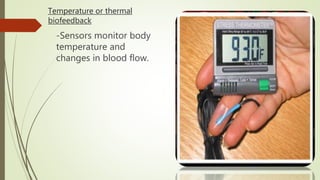
Temperature or thermal
biofeedback
-Sensors monitor body
temperature and
changes in blood flow.
Heart rate
biofeedback
-A pulse monitor placed
on the fingertip monitors
pulse rate,
-Increases in heart rate
are associated with
emotional arousal, such
as being angry or fearful,
-Decreases in heart rate
are associated with
relaxation.
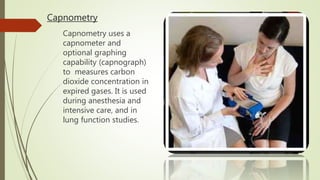
Capnometry
Capnometry uses a
capnometer and
optional graphing
capability (capnograph)
to measures carbon
dioxide concentration in
expired gases. It is used
during anesthesia and
intensive care, and in
lung function studies.
EEG
Sensors attached to the
scalp monitor brain
wave activity in different
parts of the brain.
Electrodermographs
(EDG)
This measures sweating
and can be used for
pain and anxiety.
Pneumographs
measures chest expansion,
chest contraction, and
respiration rate.
Photoplethysmographs (PPG)
provides data on blood flow
through a digit (for example, a
finger), blood volume pulse,
heart rate, and heart rate
variability.
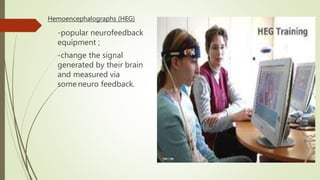
Hemoencephalographs (HEG)
-popular neurofeedback
equipment ;
-change the signal
generated by their brain
and measured via
some neuro feedback.
Rheoencephalograp
hs (REG)
measures blood blow in
the brain
Air pressure devices
commonly used to
measure muscle
performance.
Mechanism
Biofeedback may utilizes electronic sensors, or
electrodes, attached to various parts of the body to
detect changes in physical responses.
Signals then inform the individual of these changes
by means of visual or auditory signals such as a light
display or a series of beeps.
While the individual views or listens to feedback, he
or she begins to recognize thoughts, feelings, and
mental images that influence his or her physical
reactions.
By monitoring this mind-body connection, the
individual can use the same thoughts, feelings, and
mental images as cues or reminders to become more
relaxed, or to change heartbeat, brain wave patterns,
body temperature, and other body functions.
The individual uses trial-and-error to change the
signals change in the desired direction.
Static biofeedback
stabilizer
 For example, individuals trying to control their blood pressure
levels may see a light flash whenever the pressure drops below a
certain level.
 They may then try to remember what their thoughts and feelings
were at the moment and deliberately maintain them to keep the
blood pressure level low.
 Through training, the individual learns to control the targeted
physical response and, over time, is able to recognize what is
required to reduce problematic symptoms.
 Eventually, the external biofeedback becomes unnecessary as the
individual learns to perceive internal physical responses and make
the desired changes. The individual then has a powerful, portable,
and self administered treatment tool to deal with problematic
symptoms.
Uses
 Migraines,
 Headaches,
 Anxiety,
 Urinary incontinence,
 Chronic pain disorder,
 Hypertension,
 Seizure,
 Stroke,
 Cerebral palsy,
 Post-Orthopaedic surgery,
 Raynaud’s disease,
 Attention deficit hyperactivity disorder (ADHD)
 Chronic obstructive pulmonary disease (COPD),
 Constipation,
 Epilepsy,
 Rheumatoid arthritis.
Dosage
Each biofeedback therapy section lasts about
30 minutes. Usually, you can start to see
biofeedback benefits within 10 sessions or
less. E.g.- high blood pressure, can take 20 or
more sessions to improve.
Recent advances
“Effects of biofeedback treatment on gait in
children with cerebral palsy”-Ebril et al.
“Audio-Biofeedback Improves Balance in Patients
With Bilateral Vestibular Loss”-Marco Dozza et al.
“Visual EMG Biofeedback to Improve Ankle
Function in Hemiparetic Gait”-D.H.Gates et al.
“Biofeedback Intervention for Stress, Anxiety, and
Depression among Graduate Students in Public
Health Nursing”-Paul et al.
Fig 1. Experimental setup. The
centre of pressure (COP)
displacements illustrated are
from 1 participant with BVL
standing on the foam with
eyes closed, with (light grey)
and without (dark grey) ABF
information available. The
smaller the dimension of the
COP displacement in the
graphs, the smaller is the
participant’s sway.
Consequently, the graphs
show how, using ABF, people
can reduce their postural
sway. Abbreviation: Acc-
acceleration.
Ongoing Research
De Charms, R. C., Maeda, F., Glover, G.H., Ludlow, D.,
Pauly, J.M., Soneji, D., & Mackey, S.C. (2005).
Learned volitional control over brain fMRI activation
and pain and developed a real-time fMRI for the
purpose of training the brain to activate its own
endogenous opiates. deCharms believes this will
revolutionize the treatment of chronic pain.
Proceedings of the National Academy of Sciences
USA.
Biofeedback
Biofeedback

Biofeedback

  • 1.
  • 2.
    History & philosophy Biofeedbackis one of the earliest behavioural medicine treatments and has been practiced in clinical settings since the 1970’s. Biofeedback achieves its results through psychophysiological (mind-body) self-regulation. Today, biofeedback is used widely by physicians, nurses, psychologists, physical therapists, drug rehabilitation counselors, dentists and other professionals to treat an array of disorders. In biofeedback therapy, individuals are trained on electronic monitors to exert control over vital bodily processes, such as heart rate, respiration, blood pressure, muscular tension, and brain activity.
  • 3.
    Definitions "Bio" means life."Feedback" is returning knowledge to origin. Then "biofeedback" means returning the biological knowledge created by the origin to origin in order to make the origin understand and control that knowledge. “A method of controlling the system by re-inserting into it the results of its past performances” - Wiener,1948.
  • 4.
    The idea behindbiofeedback is that, by harnessing the power of your mind and becoming aware of what's going on inside your body, you can gain more control over your health. Biofeedback is built on the concept of “mind over matter.” The idea is that, with proper techniques, you can change your health by being mindful of how your body responds to stressors and other stimuli.
  • 5.
    Principle  Two aspect- 1.It should be appropriate for the change required, 2. It should be easily recognized and used by the patient.
  • 6.
    Purpose To enhance anindividual's awareness of physical reactions to physical, emotional, or psychological stress , and their influence on their own physiological responses. To develop self regulation skills that play a role in improving health and well-being.
  • 7.
    Biofeedback is aimedat combating stress through relaxation techniques. You consciously manipulate your breathing, heart rate, and other usually “involuntary” functions to override your body’s response to stressful situations. Biofeedback appears to be most effective for conditions that are heavily influenced by stress. Some examples include: learning disorders, eating disorders, bedwetting, and muscles spasms.
  • 8.
  • 9.
  • 10.
    Galvanic skin response(skin conductance)- A change in the electrical resistance of the skin caused by emotional stress, measurable with a sensitive galvanometer, e.g. in lie-detector tests.
  • 11.
    Precisely monitors stress levelsby translating tiny tension-related changes in skin conductance into a rising or falling tone.
  • 12.
    Temperature or thermal biofeedback -Sensorsmonitor body temperature and changes in blood flow.
  • 13.
    Heart rate biofeedback -A pulsemonitor placed on the fingertip monitors pulse rate, -Increases in heart rate are associated with emotional arousal, such as being angry or fearful, -Decreases in heart rate are associated with relaxation.
  • 14.
    Capnometry Capnometry uses a capnometerand optional graphing capability (capnograph) to measures carbon dioxide concentration in expired gases. It is used during anesthesia and intensive care, and in lung function studies.
  • 15.
    EEG Sensors attached tothe scalp monitor brain wave activity in different parts of the brain.
  • 16.
    Electrodermographs (EDG) This measures sweating andcan be used for pain and anxiety.
  • 17.
    Pneumographs measures chest expansion, chestcontraction, and respiration rate.
  • 18.
    Photoplethysmographs (PPG) provides dataon blood flow through a digit (for example, a finger), blood volume pulse, heart rate, and heart rate variability.
  • 19.
    Hemoencephalographs (HEG) -popular neurofeedback equipment; -change the signal generated by their brain and measured via some neuro feedback.
  • 20.
  • 21.
    Air pressure devices commonlyused to measure muscle performance.
  • 22.
    Mechanism Biofeedback may utilizeselectronic sensors, or electrodes, attached to various parts of the body to detect changes in physical responses. Signals then inform the individual of these changes by means of visual or auditory signals such as a light display or a series of beeps. While the individual views or listens to feedback, he or she begins to recognize thoughts, feelings, and mental images that influence his or her physical reactions.
  • 23.
    By monitoring thismind-body connection, the individual can use the same thoughts, feelings, and mental images as cues or reminders to become more relaxed, or to change heartbeat, brain wave patterns, body temperature, and other body functions. The individual uses trial-and-error to change the signals change in the desired direction.
  • 24.
  • 25.
     For example,individuals trying to control their blood pressure levels may see a light flash whenever the pressure drops below a certain level.  They may then try to remember what their thoughts and feelings were at the moment and deliberately maintain them to keep the blood pressure level low.  Through training, the individual learns to control the targeted physical response and, over time, is able to recognize what is required to reduce problematic symptoms.  Eventually, the external biofeedback becomes unnecessary as the individual learns to perceive internal physical responses and make the desired changes. The individual then has a powerful, portable, and self administered treatment tool to deal with problematic symptoms.
  • 26.
    Uses  Migraines,  Headaches, Anxiety,  Urinary incontinence,  Chronic pain disorder,  Hypertension,  Seizure,  Stroke,  Cerebral palsy,  Post-Orthopaedic surgery,  Raynaud’s disease,  Attention deficit hyperactivity disorder (ADHD)
  • 27.
     Chronic obstructivepulmonary disease (COPD),  Constipation,  Epilepsy,  Rheumatoid arthritis.
  • 28.
    Dosage Each biofeedback therapysection lasts about 30 minutes. Usually, you can start to see biofeedback benefits within 10 sessions or less. E.g.- high blood pressure, can take 20 or more sessions to improve.
  • 29.
    Recent advances “Effects ofbiofeedback treatment on gait in children with cerebral palsy”-Ebril et al. “Audio-Biofeedback Improves Balance in Patients With Bilateral Vestibular Loss”-Marco Dozza et al. “Visual EMG Biofeedback to Improve Ankle Function in Hemiparetic Gait”-D.H.Gates et al. “Biofeedback Intervention for Stress, Anxiety, and Depression among Graduate Students in Public Health Nursing”-Paul et al.
  • 30.
    Fig 1. Experimentalsetup. The centre of pressure (COP) displacements illustrated are from 1 participant with BVL standing on the foam with eyes closed, with (light grey) and without (dark grey) ABF information available. The smaller the dimension of the COP displacement in the graphs, the smaller is the participant’s sway. Consequently, the graphs show how, using ABF, people can reduce their postural sway. Abbreviation: Acc- acceleration.
  • 31.
    Ongoing Research De Charms,R. C., Maeda, F., Glover, G.H., Ludlow, D., Pauly, J.M., Soneji, D., & Mackey, S.C. (2005). Learned volitional control over brain fMRI activation and pain and developed a real-time fMRI for the purpose of training the brain to activate its own endogenous opiates. deCharms believes this will revolutionize the treatment of chronic pain. Proceedings of the National Academy of Sciences USA.