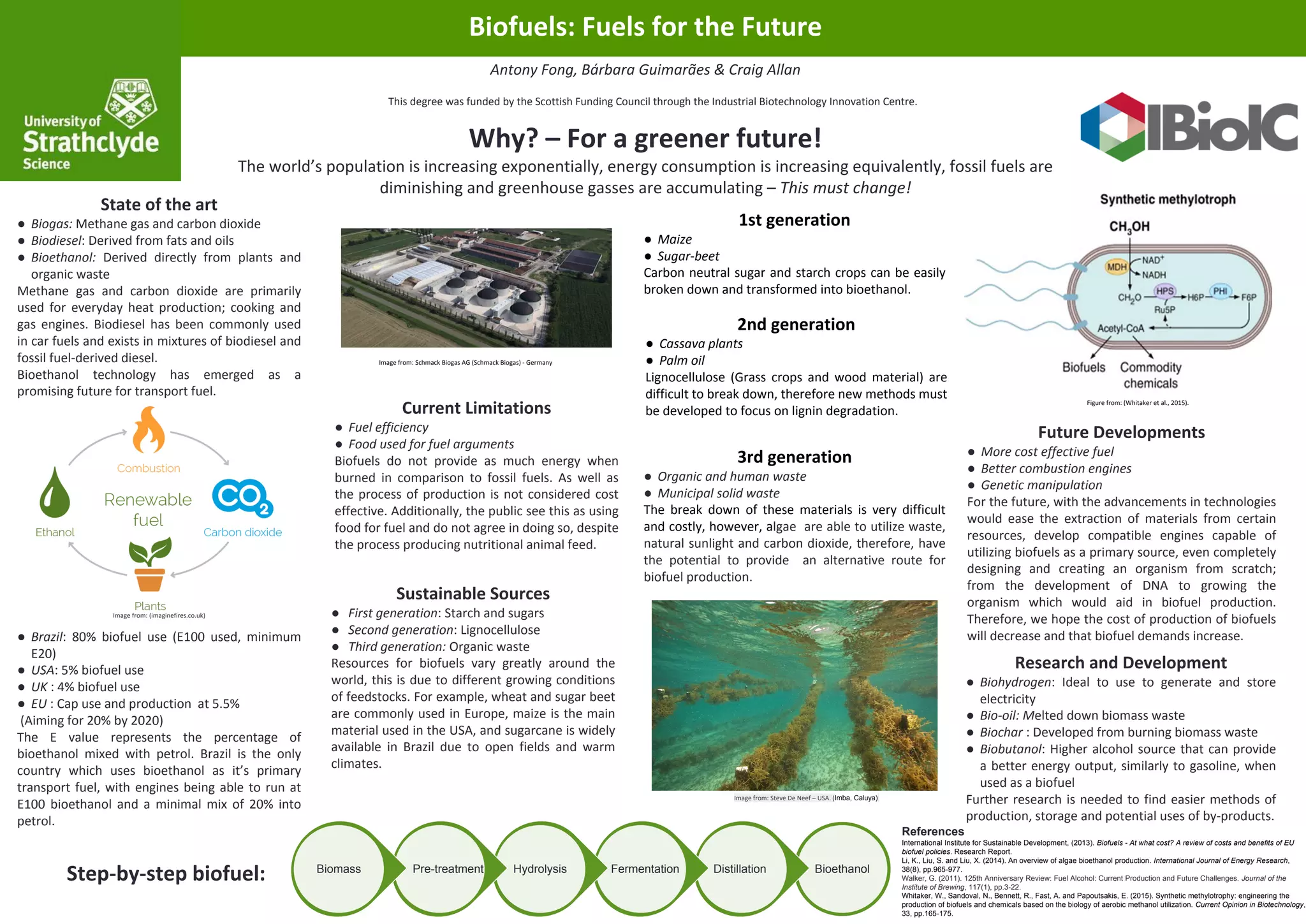
BioethanolDistillationFermentationHydrolysisPre-treatmentBiomass
Research and Development
● Biohydrogen: Ideal to use to generate and store
electricity
● Bio-oil: Melted down biomass waste
● Biochar : Developed from burning biomass waste
● Biobutanol: Higher alcohol source that can provide
a better energy output, similarly to gasoline, when
used as a biofuel
Further research is needed to find easier methods of
production, storage and potential uses of by-products.
Antony Fong, Bárbara Guimarães & Craig Allan
Sustainable Sources
● First generation: Starch and sugars
● Second generation: Lignocellulose
● Third generation: Organic waste
Resources for biofuels vary greatly around the
world, this is due to different growing conditions
of feedstocks. For example, wheat and sugar beet
are commonly used in Europe, maize is the main
material used in the USA, and sugarcane is widely
available in Brazil due to open fields and warm
climates.
Future Developments
● More cost effective fuel
● Better combustion engines
● Genetic manipulation
For the future, with the advancements in technologies
would ease the extraction of materials from certain
resources, develop compatible engines capable of
utilizing biofuels as a primary source, even completely
designing and creating an organism from scratch;
from the development of DNA to growing the
organism which would aid in biofuel production.
Therefore, we hope the cost of production of biofuels
will decrease and that biofuel demands increase.
Current Limitations
● Fuel efficiency
● Food used for fuel arguments
Biofuels do not provide as much energy when
burned in comparison to fossil fuels. As well as
the process of production is not considered cost
effective. Additionally, the public see this as using
food for fuel and do not agree in doing so, despite
the process producing nutritional animal feed.
State of the art
● Biogas: Methane gas and carbon dioxide
● Biodiesel: Derived from fats and oils
● Bioethanol: Derived directly from plants and
organic waste
Methane gas and carbon dioxide are primarily
used for everyday heat production; cooking and
gas engines. Biodiesel has been commonly used
in car fuels and exists in mixtures of biodiesel and
fossil fuel-derived diesel.
Bioethanol technology has emerged as a
promising future for transport fuel.
Image from: (imaginefires.co.uk)
● Brazil: 80% biofuel use (E100 used, minimum
E20)
● USA: 5% biofuel use
● UK : 4% biofuel use
● EU : Cap use and production at 5.5%
(Aiming for 20% by 2020)
The E value represents the percentage of
bioethanol mixed with petrol. Brazil is the only
country which uses bioethanol as it’s primary
transport fuel, with engines being able to run at
E100 bioethanol and a minimal mix of 20% into
petrol.
Step-by-step biofuel:
Why? – For a greener future!
The world’s population is increasing exponentially, energy consumption is increasing equivalently, fossil fuels are
diminishing and greenhouse gasses are accumulating – This must change!
Biofuels: Fuels for the Future
References
International Institute for Sustainable Development, (2013). Biofuels - At what cost? A review of costs and benefits of EU
biofuel policies. Research Report.
Li, K., Liu, S. and Liu, X. (2014). An overview of algae bioethanol production. International Journal of Energy Research,
38(8), pp.965-977.
Walker, G. (2011). 125th Anniversary Review: Fuel Alcohol: Current Production and Future Challenges. Journal of the
Institute of Brewing, 117(1), pp.3-22.
Whitaker, W., Sandoval, N., Bennett, R., Fast, A. and Papoutsakis, E. (2015). Synthetic methylotrophy: engineering the
production of biofuels and chemicals based on the biology of aerobic methanol utilization. Current Opinion in Biotechnology,
33, pp.165-175.
This degree was funded by the Scottish Funding Council through the Industrial Biotechnology Innovation Centre.
1st generation
● Maize
● Sugar-beet
Carbon neutral sugar and starch crops can be easily
broken down and transformed into bioethanol.
2nd generation
● Cassava plants
● Palm oil
Lignocellulose (Grass crops and wood material) are
difficult to break down, therefore new methods must
be developed to focus on lignin degradation.
3rd generation
● Organic and human waste
● Municipal solid waste
The break down of these materials is very difficult
and costly, however, algae are able to utilize waste,
natural sunlight and carbon dioxide, therefore, have
the potential to provide an alternative route for
biofuel production.
Image from: Schmack Biogas AG (Schmack Biogas) - Germany
Image from: Steve De Neef – USA. (Imba, Caluya)
Figure from: (Whitaker et al., 2015).

Presentation Final Final

  • 1.
    BioethanolDistillationFermentationHydrolysisPre-treatmentBiomass Research and Development ●Biohydrogen: Ideal to use to generate and store electricity ● Bio-oil: Melted down biomass waste ● Biochar : Developed from burning biomass waste ● Biobutanol: Higher alcohol source that can provide a better energy output, similarly to gasoline, when used as a biofuel Further research is needed to find easier methods of production, storage and potential uses of by-products. Antony Fong, Bárbara Guimarães & Craig Allan Sustainable Sources ● First generation: Starch and sugars ● Second generation: Lignocellulose ● Third generation: Organic waste Resources for biofuels vary greatly around the world, this is due to different growing conditions of feedstocks. For example, wheat and sugar beet are commonly used in Europe, maize is the main material used in the USA, and sugarcane is widely available in Brazil due to open fields and warm climates. Future Developments ● More cost effective fuel ● Better combustion engines ● Genetic manipulation For the future, with the advancements in technologies would ease the extraction of materials from certain resources, develop compatible engines capable of utilizing biofuels as a primary source, even completely designing and creating an organism from scratch; from the development of DNA to growing the organism which would aid in biofuel production. Therefore, we hope the cost of production of biofuels will decrease and that biofuel demands increase. Current Limitations ● Fuel efficiency ● Food used for fuel arguments Biofuels do not provide as much energy when burned in comparison to fossil fuels. As well as the process of production is not considered cost effective. Additionally, the public see this as using food for fuel and do not agree in doing so, despite the process producing nutritional animal feed. State of the art ● Biogas: Methane gas and carbon dioxide ● Biodiesel: Derived from fats and oils ● Bioethanol: Derived directly from plants and organic waste Methane gas and carbon dioxide are primarily used for everyday heat production; cooking and gas engines. Biodiesel has been commonly used in car fuels and exists in mixtures of biodiesel and fossil fuel-derived diesel. Bioethanol technology has emerged as a promising future for transport fuel. Image from: (imaginefires.co.uk) ● Brazil: 80% biofuel use (E100 used, minimum E20) ● USA: 5% biofuel use ● UK : 4% biofuel use ● EU : Cap use and production at 5.5% (Aiming for 20% by 2020) The E value represents the percentage of bioethanol mixed with petrol. Brazil is the only country which uses bioethanol as it’s primary transport fuel, with engines being able to run at E100 bioethanol and a minimal mix of 20% into petrol. Step-by-step biofuel: Why? – For a greener future! The world’s population is increasing exponentially, energy consumption is increasing equivalently, fossil fuels are diminishing and greenhouse gasses are accumulating – This must change! Biofuels: Fuels for the Future References International Institute for Sustainable Development, (2013). Biofuels - At what cost? A review of costs and benefits of EU biofuel policies. Research Report. Li, K., Liu, S. and Liu, X. (2014). An overview of algae bioethanol production. International Journal of Energy Research, 38(8), pp.965-977. Walker, G. (2011). 125th Anniversary Review: Fuel Alcohol: Current Production and Future Challenges. Journal of the Institute of Brewing, 117(1), pp.3-22. Whitaker, W., Sandoval, N., Bennett, R., Fast, A. and Papoutsakis, E. (2015). Synthetic methylotrophy: engineering the production of biofuels and chemicals based on the biology of aerobic methanol utilization. Current Opinion in Biotechnology, 33, pp.165-175. This degree was funded by the Scottish Funding Council through the Industrial Biotechnology Innovation Centre. 1st generation ● Maize ● Sugar-beet Carbon neutral sugar and starch crops can be easily broken down and transformed into bioethanol. 2nd generation ● Cassava plants ● Palm oil Lignocellulose (Grass crops and wood material) are difficult to break down, therefore new methods must be developed to focus on lignin degradation. 3rd generation ● Organic and human waste ● Municipal solid waste The break down of these materials is very difficult and costly, however, algae are able to utilize waste, natural sunlight and carbon dioxide, therefore, have the potential to provide an alternative route for biofuel production. Image from: Schmack Biogas AG (Schmack Biogas) - Germany Image from: Steve De Neef – USA. (Imba, Caluya) Figure from: (Whitaker et al., 2015).