Bioenergy
Arpan Deyasi
Dept of ECE, RCCIIT, Kolkata, India
Course: EI605D
5/4/2020 1Arpan Deyasi, RCCIIT
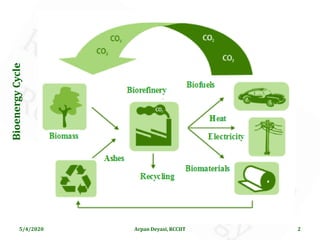
BioenergyCycle
5/4/2020 2Arpan Deyasi, RCCIIT
Biogas
5/4/2020 3Arpan Deyasi, RCCIIT
5/4/2020 4Arpan Deyasi, RCCIIT
Gas obtained from organic sources
Biogas Energy
Produced through breakdown of organic waste by
bacteria in absence of oxygen
It is a mixture of methane (65%), CO2, H2, H2S
5/4/2020 Arpan Deyasi, RCCIIT 5
Biogas Plant
1. Fixed dome type
2. Floating gas holder type
5/4/2020 Arpan Deyasi, RCCIIT 6
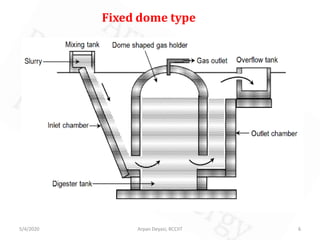
Fixed dome type
5/4/2020 Arpan Deyasi, RCCIIT 7
Fixed dome type
Various forms of biomass are mixed with proportionate quantities of
water in mixing tank, called slurry
Slurry is fed into digester through inlet chamber
After partial filling of digester, plant is kept for a certain time period
In this time-period, anaerobic bacteria present in the biomass
ferments the slurry in presence of water
Biogas is formed, which starts collecting in the dome of digester
5/4/2020 Arpan Deyasi, RCCIIT 8
Fixed dome type
Pressure exerted by generated biogas forces the slurry to exit
through outlet chamber
Spent slurry overflows into overflow tank
It is manually removed
Biogas is removed through gas valve when required,
and supplied through pipeline
5/4/2020 Arpan Deyasi, RCCIIT 9
Fixed dome type: Features
•Requires locally and easily available materials for slurry
•Inexpensive
•Production cost is very low
5/4/2020 Arpan Deyasi, RCCIIT 10
Floating gas holder type
5/4/2020 Arpan Deyasi, RCCIIT 11
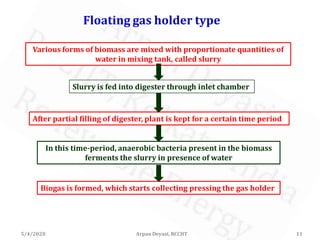
Various forms of biomass are mixed with proportionate quantities of
water in mixing tank, called slurry
Slurry is fed into digester through inlet chamber
After partial filling of digester, plant is kept for a certain time period
In this time-period, anaerobic bacteria present in the biomass
ferments the slurry in presence of water
Biogas is formed, which starts collecting pressing the gas holder
Floating gas holder type
5/4/2020 Arpan Deyasi, RCCIIT 12
Floating gas holder type
Produced biogas, being lighter, rises up and is started collecting
inside gas holder
Gas holder starts moving up, but can’t rise above a certain level
Pressure is exerted on slurry, which goes outside through outlet
chamber and moves to the overflow tank
Gas valve is open to supply the biogas
5/4/2020 Arpan Deyasi, RCCIIT 13
Floating gas holder type: Features
•Expensive
•Requires periodic maintenance
•Steel drum may damaged
Biogas can be directly used for cooking by supplying the gas though
pipes to households from the plant
Biogas has been effectively used as a fuel in industrial high
compression spark ignition engines
To generate electricity an induction generator can be used and is
the simplest to interface to the electrical grid
Induction generators derive their voltage, phase, and frequency
from the utility and cannot be used for stand-by power
If a power outage occurs generator will cease to operate.
Synchronous generator can also be used to connect to the grid
Biogas can also be used as fuel in a hot water heater if hydrogen
sulphide is removed from the gas supply
5/4/2020 14Arpan Deyasi, RCCIIT
Uses of Biogas
It can be used directly for cooking, or heating water from
the abundantly available dung and dried plant leaves in
rural areas
5/4/2020 15Arpan Deyasi, RCCIIT
Advantages of Biogas
Reduces air and water pollution, less greenhouse gas emission
Partially solve waste management problems in agriculture
and food industry
5/4/2020 Arpan Deyasi, RCCIIT 16
Capacity determined by availability of dung,
not suitable for varying loads
Not feasible to locate at all the locations
Not attractive in large scale
Disadvantages of Biogas
Biomass
5/4/2020 17Arpan Deyasi, RCCIIT
Biomass Energy
Source: micro-organism growing on water and land,
and their derivatives
Biomass can be converted into modern energy forms such
as liquid and gaseous fuels, electricity, and process heat to
provide energy services needed by rural and urban
populations and also by industry
5/4/2020 18Arpan Deyasi, RCCIIT
5/4/2020 19Arpan Deyasi, RCCIIT
BiomassSources
Classification of Biomass Energy
5/4/2020 20Arpan Deyasi, RCCIIT
Biomass from cultivation (field, crop, forest,…)
Biomass derived from organic waste
Different ways of extracting energy from biomass
The different methods of biomass extraction can be
broadly be classified as:
a) Anaerobic Digestion
b) Gasification
c) Liquefaction
5/4/2020 21Arpan Deyasi, RCCIIT
It is a biochemical degradation process that converts complex
organic material, such as animal manure, into methane and other
by-products
It is a natural process of decomposition
Chemical reactions take place through biological oxidation
5/4/2020 22Arpan Deyasi, RCCIIT
Anaerobic Digestion
5/4/2020 Arpan Deyasi, RCCIIT 23
Anaerobic digester is a device that promotes the decomposition
of manure or “digestion” of the organics in manure to simple
organics and gaseous biogas products
Biogas is formed by the activity of anaerobic bacteria. Microbial
growth and biogas production are very slow at ambient
temperatures
Anaerobic Digester
5/4/2020 Arpan Deyasi, RCCIIT 24
Anaerobic Digester
5/4/2020 Arpan Deyasi, RCCIIT 25
Advantages of Anaerobic Digestion
Produces methane and CO2 which can be used as fuel
Reduces the volatile content of sludge
Reduction in number of pathogens
Liquid is easily devoid of waters as it forms a separate
layer without solid
5/4/2020 Arpan Deyasi, RCCIIT 26
Disadvantages of Anaerobic Digestion
Possible formation of explosive gases
Slow process, requires constant monitoring
Difficult for maintenance and cleaning job
Gasification is a process that exposes a solid fuel to high
temperatures and limited oxygen, to produce a gaseous
fuel
This is a mix of gases such as carbon monoxide, carbon
dioxide, nitrogen, hydrogen and methane
It is a thermo-chemical conversion process
5/4/2020 27Arpan Deyasi, RCCIIT
Gasification
5/4/2020 Arpan Deyasi, RCCIIT 28
Gasification Process
5/4/2020 Arpan Deyasi, RCCIIT 29
Gasification Process
1. Drying of Fuel
Fuel wood pellets are heated and dried at the top of
gasifier unit. Moisture content in the wood pellets is
removed
2. Pyrolysis
Gaseous products from de-volatilization are
partially burnt with the existing air
5/4/2020 Arpan Deyasi, RCCIIT 30
Gasification Process
3. Combustion
Output obtained from pyrolysis process reacts with
the remaining char in absence of oxygen at very high
temperature (800°C – 1000°C)
4. Reduction
Hot gas formed in the combustion process is
converted into producer gas
5/4/2020 31Arpan Deyasi, RCCIIT
convenience – one of the resultant gases, methane, can
be treated in a similar way as natural gas, and used for
the same purposes
It produces a fuel that has had many impurities removed
and will therefore cause fewer pollution problems when
burnt
Advantages of Gasification
This can be used to make almost any hydrocarbon (e.g.,
methane and methanol), which can then be substituted
for fossil fuels
5/4/2020 Arpan Deyasi, RCCIIT 32
Disadvantages of Gasification
Complex equipment required
High maintenance cost
5/4/2020 Arpan Deyasi, RCCIIT 33
Liquefaction
Biomass energy is
converted into liquid
phase at low
temperature and high
pressure in presence of
catalysts
5/4/2020 Arpan Deyasi, RCCIIT 34
Biodiesel
5/4/2020 35Arpan Deyasi, RCCIIT
Biodiesel
Alternative fuel without major change in existing technologies
Environment friendly, originated from organic source
5/4/2020 Arpan Deyasi, RCCIIT 36
Sources of Biodiesel
1. Algae
Algae come from stagnant ponds in the natural world, and more
recently in algae farms, which produce the plant for the specific
purpose of creating biofuel
Advantage of algae are (i) no CO2 back into the air, (ii) self-generating
biomass, (iii) can produce up to 300 times more oil per acre than
conventional crops
2. Carbohydrate (sugars) rich biomaterial
It comes from the fermentation of starches derived from agricultural
products like corn, sugar cane, wheat, beets, and other existing food
crops, or from inedible cellulose from the same
5/4/2020 Arpan Deyasi, RCCIIT 37
Sources of Biodiesel
3. Oils rich biomaterial
It comes from existing food crops like rapeseed (aka Canola),
sunflower, corn, and others, after it has been used for other
purposes, i.e food preparation
4. Agriculture wastes (organic and inorganic sources)
It comes from agricultural waste which is concentrated into
charcoal-like biomass by heating it
Very little processing required, low-tech, naturally holds CO2 rather
than releasing it into the air
5/4/2020 38Arpan Deyasi, RCCIIT
Production of Biodiesel
5/4/2020 Arpan Deyasi, RCCIIT 39
Usability of Biodiesel
Vehicular use
Railway usage
Aircraft
As a heating oil
Cleaning oil spills
In generators
5/4/2020 40Arpan Deyasi, RCCIIT
Advantages of Biodiesel
It contains less polycyclic aromatic hydrocarbons, which
is the cause of cancer
Fewer emission of greenhouse gases
Free of sulphur and lead, non-toxic
Can be blended with conventional diesel fuel, shorter
ignition delay compared with conventional fuel
5/4/2020 41Arpan Deyasi, RCCIIT
Disadvantages of Biodiesel
Impact on food security
Problem in overall Carbon balance
More expensive
Release NO which creates smog
Causes problem at low temperature
5/4/2020 Arpan Deyasi, EI605D 42
References
1. Non conventional Energy, A. V. Desai, New Age International
Publishers Ltd.
2. Renewable energy resources and emerging technologies, D.P.
Kothari, Prentice Hall of India Pvt. Ltd.
3. Er. R K Rajput, Non-Conventional Energy Sources and Utilisation
(Energy Engineering), S. Chand Publishing
4. B.H Khan, Non Conventioanl Energy Resources, Tata McGraw-Hill
Education

Bioenergy

  • 1.
    Bioenergy Arpan Deyasi Dept ofECE, RCCIIT, Kolkata, India Course: EI605D 5/4/2020 1Arpan Deyasi, RCCIIT
  • 2.
  • 3.
  • 4.
    5/4/2020 4Arpan Deyasi,RCCIIT Gas obtained from organic sources Biogas Energy Produced through breakdown of organic waste by bacteria in absence of oxygen It is a mixture of methane (65%), CO2, H2, H2S
  • 5.
    5/4/2020 Arpan Deyasi,RCCIIT 5 Biogas Plant 1. Fixed dome type 2. Floating gas holder type
  • 6.
    5/4/2020 Arpan Deyasi,RCCIIT 6 Fixed dome type
  • 7.
    5/4/2020 Arpan Deyasi,RCCIIT 7 Fixed dome type Various forms of biomass are mixed with proportionate quantities of water in mixing tank, called slurry Slurry is fed into digester through inlet chamber After partial filling of digester, plant is kept for a certain time period In this time-period, anaerobic bacteria present in the biomass ferments the slurry in presence of water Biogas is formed, which starts collecting in the dome of digester
  • 8.
    5/4/2020 Arpan Deyasi,RCCIIT 8 Fixed dome type Pressure exerted by generated biogas forces the slurry to exit through outlet chamber Spent slurry overflows into overflow tank It is manually removed Biogas is removed through gas valve when required, and supplied through pipeline
  • 9.
    5/4/2020 Arpan Deyasi,RCCIIT 9 Fixed dome type: Features •Requires locally and easily available materials for slurry •Inexpensive •Production cost is very low
  • 10.
    5/4/2020 Arpan Deyasi,RCCIIT 10 Floating gas holder type
  • 11.
    5/4/2020 Arpan Deyasi,RCCIIT 11 Various forms of biomass are mixed with proportionate quantities of water in mixing tank, called slurry Slurry is fed into digester through inlet chamber After partial filling of digester, plant is kept for a certain time period In this time-period, anaerobic bacteria present in the biomass ferments the slurry in presence of water Biogas is formed, which starts collecting pressing the gas holder Floating gas holder type
  • 12.
    5/4/2020 Arpan Deyasi,RCCIIT 12 Floating gas holder type Produced biogas, being lighter, rises up and is started collecting inside gas holder Gas holder starts moving up, but can’t rise above a certain level Pressure is exerted on slurry, which goes outside through outlet chamber and moves to the overflow tank Gas valve is open to supply the biogas
  • 13.
    5/4/2020 Arpan Deyasi,RCCIIT 13 Floating gas holder type: Features •Expensive •Requires periodic maintenance •Steel drum may damaged
  • 14.
    Biogas can bedirectly used for cooking by supplying the gas though pipes to households from the plant Biogas has been effectively used as a fuel in industrial high compression spark ignition engines To generate electricity an induction generator can be used and is the simplest to interface to the electrical grid Induction generators derive their voltage, phase, and frequency from the utility and cannot be used for stand-by power If a power outage occurs generator will cease to operate. Synchronous generator can also be used to connect to the grid Biogas can also be used as fuel in a hot water heater if hydrogen sulphide is removed from the gas supply 5/4/2020 14Arpan Deyasi, RCCIIT Uses of Biogas
  • 15.
    It can beused directly for cooking, or heating water from the abundantly available dung and dried plant leaves in rural areas 5/4/2020 15Arpan Deyasi, RCCIIT Advantages of Biogas Reduces air and water pollution, less greenhouse gas emission Partially solve waste management problems in agriculture and food industry
  • 16.
    5/4/2020 Arpan Deyasi,RCCIIT 16 Capacity determined by availability of dung, not suitable for varying loads Not feasible to locate at all the locations Not attractive in large scale Disadvantages of Biogas
  • 17.
  • 18.
    Biomass Energy Source: micro-organismgrowing on water and land, and their derivatives Biomass can be converted into modern energy forms such as liquid and gaseous fuels, electricity, and process heat to provide energy services needed by rural and urban populations and also by industry 5/4/2020 18Arpan Deyasi, RCCIIT
  • 19.
    5/4/2020 19Arpan Deyasi,RCCIIT BiomassSources
  • 20.
    Classification of BiomassEnergy 5/4/2020 20Arpan Deyasi, RCCIIT Biomass from cultivation (field, crop, forest,…) Biomass derived from organic waste
  • 21.
    Different ways ofextracting energy from biomass The different methods of biomass extraction can be broadly be classified as: a) Anaerobic Digestion b) Gasification c) Liquefaction 5/4/2020 21Arpan Deyasi, RCCIIT
  • 22.
    It is abiochemical degradation process that converts complex organic material, such as animal manure, into methane and other by-products It is a natural process of decomposition Chemical reactions take place through biological oxidation 5/4/2020 22Arpan Deyasi, RCCIIT Anaerobic Digestion
  • 23.
    5/4/2020 Arpan Deyasi,RCCIIT 23 Anaerobic digester is a device that promotes the decomposition of manure or “digestion” of the organics in manure to simple organics and gaseous biogas products Biogas is formed by the activity of anaerobic bacteria. Microbial growth and biogas production are very slow at ambient temperatures Anaerobic Digester
  • 24.
    5/4/2020 Arpan Deyasi,RCCIIT 24 Anaerobic Digester
  • 25.
    5/4/2020 Arpan Deyasi,RCCIIT 25 Advantages of Anaerobic Digestion Produces methane and CO2 which can be used as fuel Reduces the volatile content of sludge Reduction in number of pathogens Liquid is easily devoid of waters as it forms a separate layer without solid
  • 26.
    5/4/2020 Arpan Deyasi,RCCIIT 26 Disadvantages of Anaerobic Digestion Possible formation of explosive gases Slow process, requires constant monitoring Difficult for maintenance and cleaning job
  • 27.
    Gasification is aprocess that exposes a solid fuel to high temperatures and limited oxygen, to produce a gaseous fuel This is a mix of gases such as carbon monoxide, carbon dioxide, nitrogen, hydrogen and methane It is a thermo-chemical conversion process 5/4/2020 27Arpan Deyasi, RCCIIT Gasification
  • 28.
    5/4/2020 Arpan Deyasi,RCCIIT 28 Gasification Process
  • 29.
    5/4/2020 Arpan Deyasi,RCCIIT 29 Gasification Process 1. Drying of Fuel Fuel wood pellets are heated and dried at the top of gasifier unit. Moisture content in the wood pellets is removed 2. Pyrolysis Gaseous products from de-volatilization are partially burnt with the existing air
  • 30.
    5/4/2020 Arpan Deyasi,RCCIIT 30 Gasification Process 3. Combustion Output obtained from pyrolysis process reacts with the remaining char in absence of oxygen at very high temperature (800°C – 1000°C) 4. Reduction Hot gas formed in the combustion process is converted into producer gas
  • 31.
    5/4/2020 31Arpan Deyasi,RCCIIT convenience – one of the resultant gases, methane, can be treated in a similar way as natural gas, and used for the same purposes It produces a fuel that has had many impurities removed and will therefore cause fewer pollution problems when burnt Advantages of Gasification This can be used to make almost any hydrocarbon (e.g., methane and methanol), which can then be substituted for fossil fuels
  • 32.
    5/4/2020 Arpan Deyasi,RCCIIT 32 Disadvantages of Gasification Complex equipment required High maintenance cost
  • 33.
    5/4/2020 Arpan Deyasi,RCCIIT 33 Liquefaction Biomass energy is converted into liquid phase at low temperature and high pressure in presence of catalysts
  • 34.
    5/4/2020 Arpan Deyasi,RCCIIT 34 Biodiesel
  • 35.
    5/4/2020 35Arpan Deyasi,RCCIIT Biodiesel Alternative fuel without major change in existing technologies Environment friendly, originated from organic source
  • 36.
    5/4/2020 Arpan Deyasi,RCCIIT 36 Sources of Biodiesel 1. Algae Algae come from stagnant ponds in the natural world, and more recently in algae farms, which produce the plant for the specific purpose of creating biofuel Advantage of algae are (i) no CO2 back into the air, (ii) self-generating biomass, (iii) can produce up to 300 times more oil per acre than conventional crops 2. Carbohydrate (sugars) rich biomaterial It comes from the fermentation of starches derived from agricultural products like corn, sugar cane, wheat, beets, and other existing food crops, or from inedible cellulose from the same
  • 37.
    5/4/2020 Arpan Deyasi,RCCIIT 37 Sources of Biodiesel 3. Oils rich biomaterial It comes from existing food crops like rapeseed (aka Canola), sunflower, corn, and others, after it has been used for other purposes, i.e food preparation 4. Agriculture wastes (organic and inorganic sources) It comes from agricultural waste which is concentrated into charcoal-like biomass by heating it Very little processing required, low-tech, naturally holds CO2 rather than releasing it into the air
  • 38.
    5/4/2020 38Arpan Deyasi,RCCIIT Production of Biodiesel
  • 39.
    5/4/2020 Arpan Deyasi,RCCIIT 39 Usability of Biodiesel Vehicular use Railway usage Aircraft As a heating oil Cleaning oil spills In generators
  • 40.
    5/4/2020 40Arpan Deyasi,RCCIIT Advantages of Biodiesel It contains less polycyclic aromatic hydrocarbons, which is the cause of cancer Fewer emission of greenhouse gases Free of sulphur and lead, non-toxic Can be blended with conventional diesel fuel, shorter ignition delay compared with conventional fuel
  • 41.
    5/4/2020 41Arpan Deyasi,RCCIIT Disadvantages of Biodiesel Impact on food security Problem in overall Carbon balance More expensive Release NO which creates smog Causes problem at low temperature
  • 42.
    5/4/2020 Arpan Deyasi,EI605D 42 References 1. Non conventional Energy, A. V. Desai, New Age International Publishers Ltd. 2. Renewable energy resources and emerging technologies, D.P. Kothari, Prentice Hall of India Pvt. Ltd. 3. Er. R K Rajput, Non-Conventional Energy Sources and Utilisation (Energy Engineering), S. Chand Publishing 4. B.H Khan, Non Conventioanl Energy Resources, Tata McGraw-Hill Education