Renewable Energy
Power Plants
21ME652
Module-3
Energy from Biomass
SUKRUTH SAGAR B P
Asst. Professor
Dept. of Mechanical Engineering,
ATMECE, Mysuru
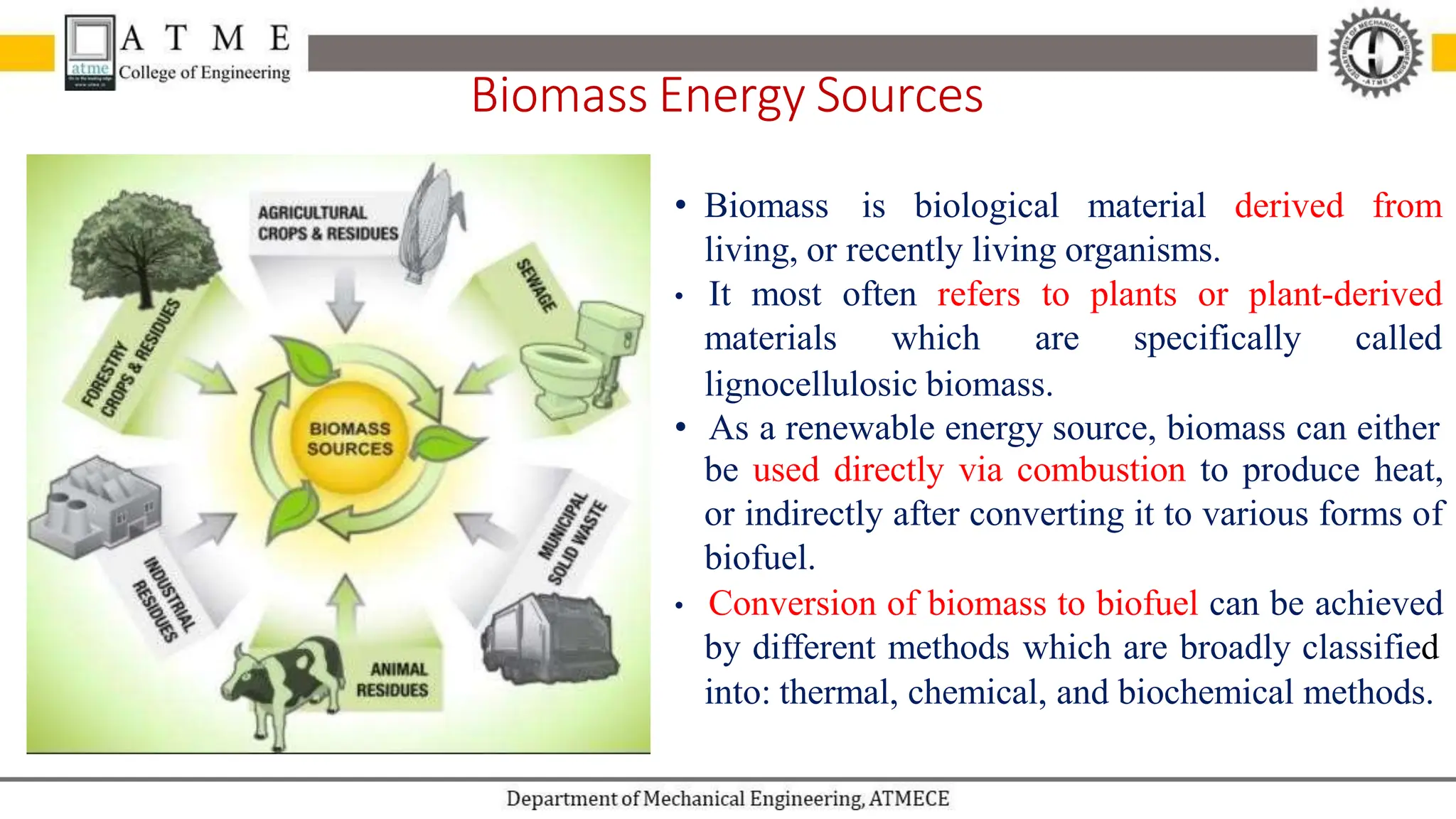
Biomass Energy Sources
• Biomass is biological material derived from
living, or recently living organisms.
• It most often refers to plants or plant-derived
materials which are specifically called
lignocellulosic biomass.
• As a renewable energy source, biomass can either
be used directly via combustion to produce heat,
or indirectly after converting it to various forms of
biofuel.
• Conversion of biomass to biofuel can be achieved
by different methods which are broadly classified
into: thermal, chemical, and biochemical methods.
Biomass Energy Cycle
Benefits of using Biomass
• Biomass used as a fuel reduces need for fossil fuels for the production of heat, steam,
and electricity for residential, industrial and agricultural use.
• Biomass is always available and can be produced as a renewable resource.
• Biomass fuel from agriculture wastes maybe a secondary product that adds value to
agricultural crop.
• Growing Biomass crops produce oxygen and use up carbon dioxide.
• The use of waste materials reduce landfill disposal and makes more space for
everything else.
• Carbon Dioxide which is released when Biomass fuel is burned, is taken in by plants.
• Less money spent on foreign oil.
Advantages
• Renewable energy resource.
• Using biomass energy reduce the dependence on foreign oil.
• The pollutant emissions from combustion of biomass are usually lower
than those from fossil fuel.
• Reduce the problems of waste disposal in urban areas and industry.
• The nitrogen rich bio digested slurry serves as a very good soil
conditioner and also improves the fertility of the soil.
• varying capacity can be installed.
Disadvantages
• Low energy density.
• Cost of collecting large quantities for commercial application
is significant.
• Not suitable for varying loads.
• Not feasible to set up at all locations.
Energy Plantation
• Energy plantation is a process of producing energy. Currently, fossil
fuels represent the prime energy sources in the world.
• By growing plants we can extract maximum solar energy, these are
economical and free from pollution.
• Energy farms are one of the best alternatives for present fuel crisis and
to replace fossil and nuclear energy sources.
Bio gas generation
• Decomposition of Animal wastes, human wastes, agricultural wastes,
waste of aquatic origin and industrial wastes generates biogas.
• Biogas is a mixture of Methane (50 to 65 %), Carbon dioxide (30 to
40%) and also traces of Hydrogen, hydrogen sulphide and Nitrogen.
• Biogas is a slow burning gas with Calorific value varies between 21000
to 23000 KJ/Kg .
Bio gas generation
• Biogas is mainly used for cooking applications and has been popularly
known as GOBAR GAS.
• Cow dung, poultry droppings are effectively used for biogas generation
• Biogas is produced by DIGESTION and PYROLYSIS Process.
• DIGESTION: is a biological process that occurs in the absence of
oxygen and in the presence of ANAEROBIC organisms.
Bio gas generation
• The container in whichdigestion process takes place is known
as DIGESTER.
• Types of organic decomposition:
1) AEROBIC DECOMPOSTION (Presence of oxygen)- The bacteria which grow
in the presence of OXYGEN are calledAEROBIC.
2) ANAEROBIC DECOMPOSTION (Absence of oxygen)- The bacteria which
grow in the absence of OXYGEN are calledANAEROBIC.
Bio gas generation
FERMENTATION:
• FERMENTATION is a
process of chemical
change in organic matter
brought about by living
organisms.
• STAGE I- Hydrolysis- The organic matter containing complex compounds
like carbohydrates, proteins, fats etc., is broken down through the influence
of water.
• STAGE II- ACID FORMING- The micro-organisms of anaerobic acid,
forms and produce acetic and propionic acids. This stage is also takes about
one day at 65o C and much of Carbon dioxide released in this stage.
Bio gas generation
• Methane forming- Anaerobic bacteria also known as Methane formers
slowly digest the products available from STAGE-II to produce
METHANE, carbon dioxide and small amount of hydrogen and other gases.
• This process takes about two weeks to complete at 25oC. in this stage
methane formation stage is carried out by the action ofAnaerobic bacteria.
Types of Biogas Plants
1. Floating Drum Type/KVIC (Khadi village industries commission)
Model/ constant pressure type biogas plant.
2. Fixed Dome type/ janata Model/ constant Volume type biogas plant.
Floating Drum type Biogas Plant
Characteristics of Floating drum type Biogas Plant
Advantages and Disadvantages
Advantages:
• High gas yield
• No problem of gas leakage
• Works under constant pressure naturally
• No problem of mixing of biogas with external air thus no danger of explosion
Disadvatages:
• High installation cost
• Heat is lost through metal gas holder
• Requires painting of drums to avoid corrosion at least twice a year
• Requires maintenance of pipes and joints
Fixed Dome type Biogas Plant
Both gas holder and the digester are combined.
Drum less type but similar to Floating drum model except steel drum a
fixed dome roof of masonry construction.
The dome roof in this model requires specialised design and skilled
masonry construction.
Skilled masons are required and complete plant is constructed below the
ground level.
Comparison
FEATURE FLOATING DRUM FIXED DOME TYPE
COST More due to steel drum Less
CORROSION YES NO
MAINTENANCE MORE (Painting and flexible
pipes)
Less
THERMAL INSULATION Bad (Heat loss due to steel
drum)
Good
GAS PRESSURE Constant variable
Masonry workmanship Average skill Specialized, skilled masons are
required.
Factors affecting Biogas generation(Problems)
PH/hydrogen ion generation
Low Temperature.
Loading rate.
Uniform feeding.
Diameter to depth ratio.
Nutrients
Total solid content.
Retention time.
Toxicity and pressure.
Applications
Food processing
Hotels/Restaurants
Textile dyeing
Village electrification
Tea/coffee processing
Galvanizing furnaces
Charcoal production
Plywood industries
Silk dyeing
Pumping and irrigation. Etc.,
Application of bio-gas in engines:
 Biogas in Diesel Engine applications
 Biogas generally has a high self-ignition temperature hence; it cannot be
directly used in a CI engine.
 So it is useful in dual fuel engines.
 The dual fuel engine is a modified diesel engine in which usually a
gaseous fuel called the primary fuel is inducted with air into the engine
cylinder.
 This fuel and air mixture does not auto ignite due to high octane
number.
 A small amount of diesel, usually called pilot fuel is injected for
promoting combustion.
 Biogas in Dual Fuel Engine applications
 In this case, the normal diesel fuel injection system still supplies a
certain amount of diesel fuel.
 The engine however sucks and compresses a mixture of air and biogas
fuel which has been prepared in external mixing device.
 The mixture is then ignited by and together with the diesel fuel sprayed
in.
 Biogas As Alternate Fuel In Diesel Engines
 Operation on diesel fuel alone is possible when biogas is not available.
 Any contribution of biogas from 0% to 85% can substitute a
corresponding part of diesel fuel.
 Performance remains as in 100% diesel fuel operation.
 Biogas in HCCI Engine applications
 The Homogeneous Charge Compression Ignition (HCCI) concept is a
potential for achieving a high thermal efficiency and low Nitrogen
Oxide (NO) emission.
 The HCCI engine with 50 % biogas as a primary fuel and 50% diesel
as pilot fuel is a major advantage over biogas diesel dual fuel mode.
Cogeneration Plant ( Biogas)
Cogeneration is the production of electricity and heat out of biogas.
 The cogeneration module consists of an engine which actuates an
alternator - generator of electric current.
 Biologically-derived gases can be utilised in biogas engines to generate
renewable power via cogeneration in the form of electricity and heat.
Biomass Gasification
Gasification is a process of converting raw biomass in to a variety of
gaseous , liquid or solid fuels that can be used directly in a power plant for
energy generation.
Gasifier: it is an equipment which can gasify a variety of biomass such as
wood waste, agricultural waste, roots of various crops etc.,
The gasifier is essentially a chemical reaction, where various complex
physical and chemical process takes place.
Types of Gasifiers
1. Up draught gasifier:Air entry is below the combustion zone and producer
gas escapes from top of gasifier. Suitable for charcoal in stationary engines
2. Down draught gasifier: Air entry is at the combustion zone and gas
escapes through the bottom of gasifier. Suitable for wood and agricultural
wastes.
3. Cross draught gasifier: Gasifier contains charcoal which acts as insulator
and dust filter. the gas flows around the gasifier in the annular space.
Up Draught gasifier
Up Draught gasifier
Down Draught gasifier
Cross Draught gasifier
Photosynthesis
• Photosynthesis is the process by which
plants, some bacteria, and some
protistans (Fungi) use the energy from
sunlight to produce sugar, which
cellular respiration converts into ATP
(Adenosine triphosphate), the "fuel"
used by all living things.
• The conversion of unusable sunlight
energy into usable chemical energy, is
associated with the actions of the green
pigment chlorophyll.
• 6H2O + 6CO2 ------> C6H12O6+ 6O2
Biomass Energy Conversion Technologies
Waste
Thermochemical
Processes
Biochemical
Processes
Gasification
Pyrolysis
Fermentation
Anaerobic
Digestion
Incineration Electricity
Gas or Fuel
Heavy oil
Ethanol
Biogas
Types of Biofuels
 Solid Biofuels: Such as wood can be directly burnt,
and heat could be utilized.
 Liquid Biofuels: Such as ethanol (fermentation of
starch or sugar) used directly and blended with
gasoline to run an IC engine.
Or as Biodiesel (made from oily seeds like Palm,
Pongemia, Jathropa etc.) blended with diesel for use
in IC engines.
 Gaseous Biofuels : Such as Biogas: Methane
produced by breakdown of organic matter by
anaerobic bacteria.
21me --- Energy from Biomass: Energy plantation, biogas production from organic wastes by anaerobic
fermentation, description of bio-gas plants, transportation of biogas, problems associated with bio-gas production,
application of biogas, application of biogas in engines, cogeneration plant, advantages & disadvantages.
18me --- Biomass Energy: Photosynthesis, photosynthetic oxygen production, energy plantation. Bio Chemical
Route: Biogas production from organic wastes by anaerobic fermentation, Bio gas plants-KVIC, Janta, Deenbhandu
models, factors affecting bio gas generation. Thermal gasification of biomass, updraft and downdraft

REPP Module 3 biomass- Biomass is biological material derived from living, or recently living organisms..pptx

  • 1.
    Renewable Energy Power Plants 21ME652 Module-3 Energyfrom Biomass SUKRUTH SAGAR B P Asst. Professor Dept. of Mechanical Engineering, ATMECE, Mysuru
  • 2.
    Biomass Energy Sources •Biomass is biological material derived from living, or recently living organisms. • It most often refers to plants or plant-derived materials which are specifically called lignocellulosic biomass. • As a renewable energy source, biomass can either be used directly via combustion to produce heat, or indirectly after converting it to various forms of biofuel. • Conversion of biomass to biofuel can be achieved by different methods which are broadly classified into: thermal, chemical, and biochemical methods.
  • 3.
  • 4.
    Benefits of usingBiomass • Biomass used as a fuel reduces need for fossil fuels for the production of heat, steam, and electricity for residential, industrial and agricultural use. • Biomass is always available and can be produced as a renewable resource. • Biomass fuel from agriculture wastes maybe a secondary product that adds value to agricultural crop. • Growing Biomass crops produce oxygen and use up carbon dioxide. • The use of waste materials reduce landfill disposal and makes more space for everything else. • Carbon Dioxide which is released when Biomass fuel is burned, is taken in by plants. • Less money spent on foreign oil.
  • 5.
    Advantages • Renewable energyresource. • Using biomass energy reduce the dependence on foreign oil. • The pollutant emissions from combustion of biomass are usually lower than those from fossil fuel. • Reduce the problems of waste disposal in urban areas and industry. • The nitrogen rich bio digested slurry serves as a very good soil conditioner and also improves the fertility of the soil. • varying capacity can be installed.
  • 6.
    Disadvantages • Low energydensity. • Cost of collecting large quantities for commercial application is significant. • Not suitable for varying loads. • Not feasible to set up at all locations.
  • 7.
    Energy Plantation • Energyplantation is a process of producing energy. Currently, fossil fuels represent the prime energy sources in the world. • By growing plants we can extract maximum solar energy, these are economical and free from pollution. • Energy farms are one of the best alternatives for present fuel crisis and to replace fossil and nuclear energy sources.
  • 8.
    Bio gas generation •Decomposition of Animal wastes, human wastes, agricultural wastes, waste of aquatic origin and industrial wastes generates biogas. • Biogas is a mixture of Methane (50 to 65 %), Carbon dioxide (30 to 40%) and also traces of Hydrogen, hydrogen sulphide and Nitrogen. • Biogas is a slow burning gas with Calorific value varies between 21000 to 23000 KJ/Kg .
  • 9.
    Bio gas generation •Biogas is mainly used for cooking applications and has been popularly known as GOBAR GAS. • Cow dung, poultry droppings are effectively used for biogas generation • Biogas is produced by DIGESTION and PYROLYSIS Process. • DIGESTION: is a biological process that occurs in the absence of oxygen and in the presence of ANAEROBIC organisms.
  • 10.
    Bio gas generation •The container in whichdigestion process takes place is known as DIGESTER. • Types of organic decomposition: 1) AEROBIC DECOMPOSTION (Presence of oxygen)- The bacteria which grow in the presence of OXYGEN are calledAEROBIC. 2) ANAEROBIC DECOMPOSTION (Absence of oxygen)- The bacteria which grow in the absence of OXYGEN are calledANAEROBIC.
  • 11.
    Bio gas generation FERMENTATION: •FERMENTATION is a process of chemical change in organic matter brought about by living organisms.
  • 12.
    • STAGE I-Hydrolysis- The organic matter containing complex compounds like carbohydrates, proteins, fats etc., is broken down through the influence of water. • STAGE II- ACID FORMING- The micro-organisms of anaerobic acid, forms and produce acetic and propionic acids. This stage is also takes about one day at 65o C and much of Carbon dioxide released in this stage.
  • 13.
    Bio gas generation •Methane forming- Anaerobic bacteria also known as Methane formers slowly digest the products available from STAGE-II to produce METHANE, carbon dioxide and small amount of hydrogen and other gases. • This process takes about two weeks to complete at 25oC. in this stage methane formation stage is carried out by the action ofAnaerobic bacteria.
  • 14.
    Types of BiogasPlants 1. Floating Drum Type/KVIC (Khadi village industries commission) Model/ constant pressure type biogas plant. 2. Fixed Dome type/ janata Model/ constant Volume type biogas plant.
  • 15.
    Floating Drum typeBiogas Plant
  • 16.
    Floating Drum typeBiogas Plant
  • 17.
    Characteristics of Floatingdrum type Biogas Plant
  • 18.
    Advantages and Disadvantages Advantages: •High gas yield • No problem of gas leakage • Works under constant pressure naturally • No problem of mixing of biogas with external air thus no danger of explosion Disadvatages: • High installation cost • Heat is lost through metal gas holder • Requires painting of drums to avoid corrosion at least twice a year • Requires maintenance of pipes and joints
  • 19.
    Fixed Dome typeBiogas Plant
  • 20.
    Fixed Dome typeBiogas Plant Both gas holder and the digester are combined. Drum less type but similar to Floating drum model except steel drum a fixed dome roof of masonry construction. The dome roof in this model requires specialised design and skilled masonry construction. Skilled masons are required and complete plant is constructed below the ground level.
  • 21.
    Comparison FEATURE FLOATING DRUMFIXED DOME TYPE COST More due to steel drum Less CORROSION YES NO MAINTENANCE MORE (Painting and flexible pipes) Less THERMAL INSULATION Bad (Heat loss due to steel drum) Good GAS PRESSURE Constant variable Masonry workmanship Average skill Specialized, skilled masons are required.
  • 22.
    Factors affecting Biogasgeneration(Problems) PH/hydrogen ion generation Low Temperature. Loading rate. Uniform feeding. Diameter to depth ratio. Nutrients Total solid content. Retention time. Toxicity and pressure.
  • 23.
    Applications Food processing Hotels/Restaurants Textile dyeing Villageelectrification Tea/coffee processing Galvanizing furnaces Charcoal production Plywood industries Silk dyeing Pumping and irrigation. Etc.,
  • 24.
    Application of bio-gasin engines:  Biogas in Diesel Engine applications  Biogas generally has a high self-ignition temperature hence; it cannot be directly used in a CI engine.  So it is useful in dual fuel engines.  The dual fuel engine is a modified diesel engine in which usually a gaseous fuel called the primary fuel is inducted with air into the engine cylinder.  This fuel and air mixture does not auto ignite due to high octane number.  A small amount of diesel, usually called pilot fuel is injected for promoting combustion.
  • 25.
     Biogas inDual Fuel Engine applications  In this case, the normal diesel fuel injection system still supplies a certain amount of diesel fuel.  The engine however sucks and compresses a mixture of air and biogas fuel which has been prepared in external mixing device.  The mixture is then ignited by and together with the diesel fuel sprayed in.
  • 26.
     Biogas AsAlternate Fuel In Diesel Engines  Operation on diesel fuel alone is possible when biogas is not available.  Any contribution of biogas from 0% to 85% can substitute a corresponding part of diesel fuel.  Performance remains as in 100% diesel fuel operation.
  • 27.
     Biogas inHCCI Engine applications  The Homogeneous Charge Compression Ignition (HCCI) concept is a potential for achieving a high thermal efficiency and low Nitrogen Oxide (NO) emission.  The HCCI engine with 50 % biogas as a primary fuel and 50% diesel as pilot fuel is a major advantage over biogas diesel dual fuel mode.
  • 28.
    Cogeneration Plant (Biogas) Cogeneration is the production of electricity and heat out of biogas.  The cogeneration module consists of an engine which actuates an alternator - generator of electric current.  Biologically-derived gases can be utilised in biogas engines to generate renewable power via cogeneration in the form of electricity and heat.
  • 31.
    Biomass Gasification Gasification isa process of converting raw biomass in to a variety of gaseous , liquid or solid fuels that can be used directly in a power plant for energy generation. Gasifier: it is an equipment which can gasify a variety of biomass such as wood waste, agricultural waste, roots of various crops etc., The gasifier is essentially a chemical reaction, where various complex physical and chemical process takes place.
  • 32.
    Types of Gasifiers 1.Up draught gasifier:Air entry is below the combustion zone and producer gas escapes from top of gasifier. Suitable for charcoal in stationary engines 2. Down draught gasifier: Air entry is at the combustion zone and gas escapes through the bottom of gasifier. Suitable for wood and agricultural wastes. 3. Cross draught gasifier: Gasifier contains charcoal which acts as insulator and dust filter. the gas flows around the gasifier in the annular space.
  • 33.
  • 34.
  • 35.
  • 36.
  • 37.
    Photosynthesis • Photosynthesis isthe process by which plants, some bacteria, and some protistans (Fungi) use the energy from sunlight to produce sugar, which cellular respiration converts into ATP (Adenosine triphosphate), the "fuel" used by all living things. • The conversion of unusable sunlight energy into usable chemical energy, is associated with the actions of the green pigment chlorophyll. • 6H2O + 6CO2 ------> C6H12O6+ 6O2
  • 38.
    Biomass Energy ConversionTechnologies Waste Thermochemical Processes Biochemical Processes Gasification Pyrolysis Fermentation Anaerobic Digestion Incineration Electricity Gas or Fuel Heavy oil Ethanol Biogas
  • 39.
    Types of Biofuels Solid Biofuels: Such as wood can be directly burnt, and heat could be utilized.  Liquid Biofuels: Such as ethanol (fermentation of starch or sugar) used directly and blended with gasoline to run an IC engine. Or as Biodiesel (made from oily seeds like Palm, Pongemia, Jathropa etc.) blended with diesel for use in IC engines.  Gaseous Biofuels : Such as Biogas: Methane produced by breakdown of organic matter by anaerobic bacteria.
  • 40.
    21me --- Energyfrom Biomass: Energy plantation, biogas production from organic wastes by anaerobic fermentation, description of bio-gas plants, transportation of biogas, problems associated with bio-gas production, application of biogas, application of biogas in engines, cogeneration plant, advantages & disadvantages. 18me --- Biomass Energy: Photosynthesis, photosynthetic oxygen production, energy plantation. Bio Chemical Route: Biogas production from organic wastes by anaerobic fermentation, Bio gas plants-KVIC, Janta, Deenbhandu models, factors affecting bio gas generation. Thermal gasification of biomass, updraft and downdraft