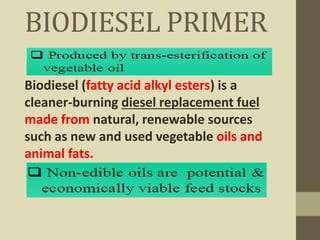
BIODIESEL PRIMER
Biodiesel (fatty acid alkyl esters) is a
cleaner-burning diesel replacement fuel
made from natural, renewable sources
such as new and used vegetable oils and
animal fats.
What is Biodiesel?
• Biodiesel (fatty acid alkyl esters) is a cleaner-
burning diesel replacement fuel made from
new and used vegetable oils and animal fats.
• Just like petroleum diesel, biodiesel operates
in compression-ignition engines.
• It is made by trans -esterification of oils
2
Just like petroleum diesel, biodiesel operates in
compression-ignition engines. Blends of up to
20% biodiesel (mixed with petroleum diesel fuels)
can be used in nearly all diesel equipment and
are compatible with most storage and distribution
equipment. These low level blends (20% and
less) don't require any engine modifications and
can provide the same payload capacity and as
diesel. 3
Using biodiesel in a conventional diesel engine
substantially reduces emissions of unburned
hydrocarbons, carbon monoxide, sulfates,
polycyclic aromatic hydrocarbons, nitrated
polycyclic aromatic hydrocarbons, and
particulate matter.
These reductions increase as the amount of
biodiesel blended into diesel fuel increases.
4
The use of biodiesel decreases the solid carbon fraction
of particulate matter (since the oxygen in biodiesel
enables more complete combustion to CO2) and
reduces the sulfate fraction (biodiesel contains less than
24 ppm sulfur), while the soluble, or hydrocarbon,
fraction stays the same or increases. Therefore,
biodiesel works well with new technologies such as
diesel oxidation catalysts (which reduce the soluble
fraction of diesel particulate but not the solid carbon
fraction).
5
• Emissions of nitrogen oxides increase
with the concentration of biodiesel in the
fuel.
• Some biodiesel produces more nitrogen
oxides than others, and some additives
have shown promise in modifying the
increases.
• More R&D is needed to resolve this
issue. 6
7
Biodiesel's Physical Characteristics:
Specific gravity 0.87 to 0.89
Kinematic viscosity @ 40°C 3.7 to 5.8
Cetane number 46 to 70
Higher heating value (btu/lb) 16,928
to 17,996
Sulfur, wt% 0.0 to 0.0024
Cloud point °C -11 to 16
Pour point °C -15 to 13
Iodine number 60 to 135
Lower heating value (btu/lb) 15,700
to 16,735
8
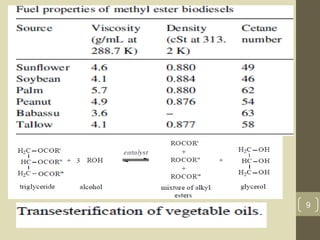
Biodiesel fuel is made from new or used
vegetable oils and animal fats. Fats and oils are
chemically reacted with an alcohol (methanol is
the usual choice) to produce chemical
compounds known as fatty acid methyl esters.
Biodiesel is the name given to these esters when
they're intended for use as fuel. Glycerol (used in
pharmaceuticals and cosmetics, among other
markets) is produced as a co-product.
9
10
Biodiesel can be produced by a variety of
esterification technologies. The oils and fats are
filtered and preprocessed to remove water and
contaminants. If free fatty acids are present, they can
be removed or transformed into biodiesel using
special pretreatment technologies. The pretreated oils
and fats are then mixed with an alcohol (usually
methanol) and a catalyst (usually sodium or potassium
hydroxide). The oil molecules (triglycerides) are
broken apart and reformed into esters and glycerol,
which are then separated from each other and purified
11
12
13
14
15
16
17
18

Biodiesel

  • 1.
    BIODIESEL PRIMER Biodiesel (fattyacid alkyl esters) is a cleaner-burning diesel replacement fuel made from natural, renewable sources such as new and used vegetable oils and animal fats.
  • 2.
    What is Biodiesel? •Biodiesel (fatty acid alkyl esters) is a cleaner- burning diesel replacement fuel made from new and used vegetable oils and animal fats. • Just like petroleum diesel, biodiesel operates in compression-ignition engines. • It is made by trans -esterification of oils 2
  • 3.
    Just like petroleumdiesel, biodiesel operates in compression-ignition engines. Blends of up to 20% biodiesel (mixed with petroleum diesel fuels) can be used in nearly all diesel equipment and are compatible with most storage and distribution equipment. These low level blends (20% and less) don't require any engine modifications and can provide the same payload capacity and as diesel. 3
  • 4.
    Using biodiesel ina conventional diesel engine substantially reduces emissions of unburned hydrocarbons, carbon monoxide, sulfates, polycyclic aromatic hydrocarbons, nitrated polycyclic aromatic hydrocarbons, and particulate matter. These reductions increase as the amount of biodiesel blended into diesel fuel increases. 4
  • 5.
    The use ofbiodiesel decreases the solid carbon fraction of particulate matter (since the oxygen in biodiesel enables more complete combustion to CO2) and reduces the sulfate fraction (biodiesel contains less than 24 ppm sulfur), while the soluble, or hydrocarbon, fraction stays the same or increases. Therefore, biodiesel works well with new technologies such as diesel oxidation catalysts (which reduce the soluble fraction of diesel particulate but not the solid carbon fraction). 5
  • 6.
    • Emissions ofnitrogen oxides increase with the concentration of biodiesel in the fuel. • Some biodiesel produces more nitrogen oxides than others, and some additives have shown promise in modifying the increases. • More R&D is needed to resolve this issue. 6
  • 7.
    7 Biodiesel's Physical Characteristics: Specificgravity 0.87 to 0.89 Kinematic viscosity @ 40°C 3.7 to 5.8 Cetane number 46 to 70 Higher heating value (btu/lb) 16,928 to 17,996 Sulfur, wt% 0.0 to 0.0024 Cloud point °C -11 to 16 Pour point °C -15 to 13 Iodine number 60 to 135 Lower heating value (btu/lb) 15,700 to 16,735
  • 8.
    8 Biodiesel fuel ismade from new or used vegetable oils and animal fats. Fats and oils are chemically reacted with an alcohol (methanol is the usual choice) to produce chemical compounds known as fatty acid methyl esters. Biodiesel is the name given to these esters when they're intended for use as fuel. Glycerol (used in pharmaceuticals and cosmetics, among other markets) is produced as a co-product.
  • 9.
  • 10.
    10 Biodiesel can beproduced by a variety of esterification technologies. The oils and fats are filtered and preprocessed to remove water and contaminants. If free fatty acids are present, they can be removed or transformed into biodiesel using special pretreatment technologies. The pretreated oils and fats are then mixed with an alcohol (usually methanol) and a catalyst (usually sodium or potassium hydroxide). The oil molecules (triglycerides) are broken apart and reformed into esters and glycerol, which are then separated from each other and purified
  • 11.
  • 12.
  • 13.
  • 14.
  • 15.
  • 16.
  • 17.
  • 18.