AMYLASES
Presented By-
Divya Singh
IVth semester
B.Tech. Biotechnology
OVERVIEW
 Introduction
 Classification
 α-Amylase
 β-Amylase
 γ-Amylase
 Industrial applications
 Production
INTRODUCTION
 Enzyme that catalyses the hydrolysis
of starch into sugars.
 As diatase,it was the first enzyme to
be discovered and isolated in 1833.
 Present in saliva of humans.
 Acts on α(1-4) glycosidic bond.
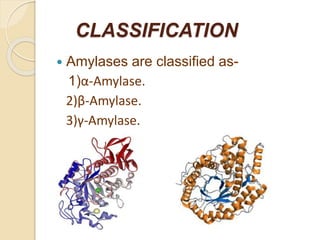
CLASSIFICATION
 Amylases are classified as-
1)α-Amylase.
2)β-Amylase.
3)γ-Amylase.
α-AMYLASE
 Are calcium metalloenzymes.
 Breaks down long chain carbohydrates.
 Faster acting than β-Amylase.
 Major digestive enzyme in animals.
 Optimum pH is 6.7-7.0.
 Also found in plant, fungi and bacteria.
β-AMYLASE
 Synthesised by bacteria, fungi and
plants.
 β-Amylase catalyses the hydrolysis of
the second α(1-4) glycosidic bond,
working from the non-reducing end.
 Present in seeds in an inactive form
prior to germination.
 Optimum pH is 4.0-5.0.
γ-AMYLASE
 It cleaves α(1-6) glycosidic linkages, and
the last α(1-4) glycosidic linkages at the
non-reducing end.
 Most acidic optimum pH is 3.
INDUSTRIAL APPLICATIONS
Starch conversion-
α-Amylase used for starch hydrolysis in
starch liquefaction process that converts
starch into fructose and glucose syrups.
Detergent industry-
Use of enzymes enhances the detergents
ability to remove tough stains and making
the detergent environmentally safe.
Food industry-
Amylases are used in processed food
industry such as baking, fruit juices,
starch syrups.
Fuel alcohol production-
The conversion of starch into ethanol
involves liquefaction and
saccharification, where starch is
converted into sugar using α-Amylase.
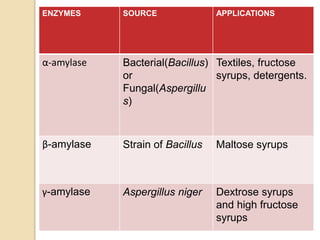
ENZYMES SOURCE APPLICATIONS
α-amylase Bacterial(Bacillus)
or
Fungal(Aspergillu
s)
Textiles, fructose
syrups, detergents.
β-amylase Strain of Bacillus Maltose syrups
γ-amylase Aspergillus niger Dextrose syrups
and high fructose
syrups
PRODUCTION
 SOURCES-
Can be isolated from plants, animals,
microorganisms.
Bacterial species- Bacillus
licheniformis, Bacillus
amyloliquefaciens.
Fungal species- Mostly Aspergillus
species and some species of
Penicllium.
 METHODS-
Two methods used –
1) Submerged fermentation-
Employs free flowing liquid substrates
like molasses and broth.
2) Solid state fermentation-
Solid substrates are used like bran,
bagasse, paper pulp.
SUBMERGED
FERMENTATION
 Employs free flowing liquid substrates
such as molasses and broth.
 The products yielded in fermentation
are secreted into the fermentation
broth.
 Suitable for microorganisms like
bacteria that require high moisture
content for their growth.
 ADVANTAGES-
Allows the utilization of genetically
modified organisms to a greater
extent.
The sterilization of medium and
purification of end products is easy.
The control of process parameters like
temperature, pH, aeration can be
done conveniently.
SOLID STATE
FERMENTATION
 Solid substrates are used like bran,
bagasse, paper pulp.
 Method for microbes which require less
moisture content for their growth.
 Fermentation takes place in the
absence of free water, being close to
the natural environment to which the
microorganisms are adapted.
 ADVANTAGES-
The nutrient-rich waste materials can
be easily recycled and used as
substrates.
Simpler equipments, higher volumetric
productivity, higher concentration of
products and lesser effluent
generation.
The substrates are used very slowly
and steadily.
CONCLUSION
 Nowadays enzymes are used for various
reactions because they are biodegradable
and can be produced using biological
sources.
 Amylases catalyses the hydrolysis of
starch into sugar.
 It has various applications like production
of fructose syrups, safe detergents, baked
products.
 Can be produced by SSF and SmF.
REFERENCES
 Sundarram Ajita, Murthy Krishna,
Pandurangappa Thirupathihalli.
“Amylase production and
applications”. Journal of applied and
environmental microbiology, 2014
2(4), pp 166-175.
 Salwa Elamin, Nasir Hassan.
“Amylase production”. Food and public
Health, 2012 2(1),30-35.
 Patel A.H.; “Industrial microbiology”,
‘published by Macmillan India Ltd’.
THANK YOU

Amylase ppt

  • 1.
    AMYLASES Presented By- Divya Singh IVthsemester B.Tech. Biotechnology
  • 2.
    OVERVIEW  Introduction  Classification α-Amylase  β-Amylase  γ-Amylase  Industrial applications  Production
  • 3.
    INTRODUCTION  Enzyme thatcatalyses the hydrolysis of starch into sugars.  As diatase,it was the first enzyme to be discovered and isolated in 1833.  Present in saliva of humans.  Acts on α(1-4) glycosidic bond.
  • 5.
    CLASSIFICATION  Amylases areclassified as- 1)α-Amylase. 2)β-Amylase. 3)γ-Amylase.
  • 6.
    α-AMYLASE  Are calciummetalloenzymes.  Breaks down long chain carbohydrates.  Faster acting than β-Amylase.  Major digestive enzyme in animals.  Optimum pH is 6.7-7.0.  Also found in plant, fungi and bacteria.
  • 7.
    β-AMYLASE  Synthesised bybacteria, fungi and plants.  β-Amylase catalyses the hydrolysis of the second α(1-4) glycosidic bond, working from the non-reducing end.  Present in seeds in an inactive form prior to germination.  Optimum pH is 4.0-5.0.
  • 8.
    γ-AMYLASE  It cleavesα(1-6) glycosidic linkages, and the last α(1-4) glycosidic linkages at the non-reducing end.  Most acidic optimum pH is 3.
  • 9.
    INDUSTRIAL APPLICATIONS Starch conversion- α-Amylaseused for starch hydrolysis in starch liquefaction process that converts starch into fructose and glucose syrups. Detergent industry- Use of enzymes enhances the detergents ability to remove tough stains and making the detergent environmentally safe.
  • 10.
    Food industry- Amylases areused in processed food industry such as baking, fruit juices, starch syrups. Fuel alcohol production- The conversion of starch into ethanol involves liquefaction and saccharification, where starch is converted into sugar using α-Amylase.
  • 11.
    ENZYMES SOURCE APPLICATIONS α-amylaseBacterial(Bacillus) or Fungal(Aspergillu s) Textiles, fructose syrups, detergents. β-amylase Strain of Bacillus Maltose syrups γ-amylase Aspergillus niger Dextrose syrups and high fructose syrups
  • 12.
    PRODUCTION  SOURCES- Can beisolated from plants, animals, microorganisms. Bacterial species- Bacillus licheniformis, Bacillus amyloliquefaciens. Fungal species- Mostly Aspergillus species and some species of Penicllium.
  • 13.
     METHODS- Two methodsused – 1) Submerged fermentation- Employs free flowing liquid substrates like molasses and broth. 2) Solid state fermentation- Solid substrates are used like bran, bagasse, paper pulp.
  • 14.
    SUBMERGED FERMENTATION  Employs freeflowing liquid substrates such as molasses and broth.  The products yielded in fermentation are secreted into the fermentation broth.  Suitable for microorganisms like bacteria that require high moisture content for their growth.
  • 15.
     ADVANTAGES- Allows theutilization of genetically modified organisms to a greater extent. The sterilization of medium and purification of end products is easy. The control of process parameters like temperature, pH, aeration can be done conveniently.
  • 16.
    SOLID STATE FERMENTATION  Solidsubstrates are used like bran, bagasse, paper pulp.  Method for microbes which require less moisture content for their growth.  Fermentation takes place in the absence of free water, being close to the natural environment to which the microorganisms are adapted.
  • 17.
     ADVANTAGES- The nutrient-richwaste materials can be easily recycled and used as substrates. Simpler equipments, higher volumetric productivity, higher concentration of products and lesser effluent generation. The substrates are used very slowly and steadily.
  • 18.
    CONCLUSION  Nowadays enzymesare used for various reactions because they are biodegradable and can be produced using biological sources.  Amylases catalyses the hydrolysis of starch into sugar.  It has various applications like production of fructose syrups, safe detergents, baked products.  Can be produced by SSF and SmF.
  • 19.
    REFERENCES  Sundarram Ajita,Murthy Krishna, Pandurangappa Thirupathihalli. “Amylase production and applications”. Journal of applied and environmental microbiology, 2014 2(4), pp 166-175.  Salwa Elamin, Nasir Hassan. “Amylase production”. Food and public Health, 2012 2(1),30-35.  Patel A.H.; “Industrial microbiology”, ‘published by Macmillan India Ltd’.
  • 20.