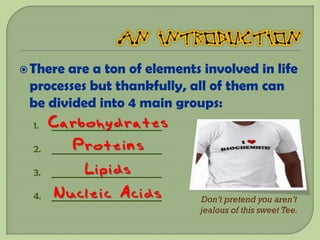




 Thereare a ton of elements involved in life
 processes but thankfully, all of them can
 be divided into 4 main groups:
  1.   Carbohydrates
       ______________________

  2.       Proteins
       ______________________

  3.          Lipids
       ______________________

  4.   Nucleic Acids
       ______________________   Don’t pretend you aren’t
                                jealous of this sweet Tee.
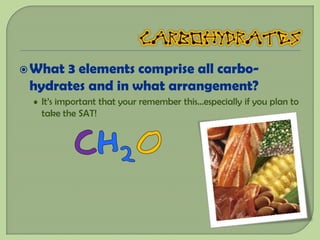
 What3 elements comprise all carbo-
 hydrates and in what arrangement?
 • It’s important that your remember this…especially if you plan to
  take the SAT!
 Most
     carbohydrates have a common suffix.
 What is it?


   “-ose”
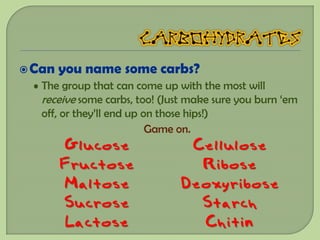
 Can   you name some carbs?
  • The group that can come up with the most will
   receive some carbs, too! (Just make sure you burn ‘em
   off, or they’ll end up on those hips!)
                           Game on.
        Glucose                    Cellulose
        Fructose                    Ribose
        Maltose                   Deoxyribose
        Sucrose                     Starch
        Lactose                     Chitin
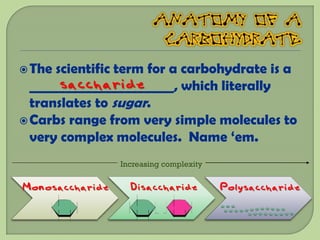
 The scientific term for a carbohydrate is a
       saccharide
  ______________________, which literally
  translates to sugar.
 Carbs range from very simple molecules to
  very complex molecules. Name ‘em.
                 Increasing complexity

Monosaccharide     Disaccharide          Polysaccharide
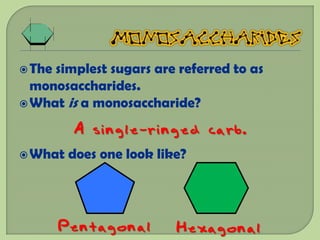
 Thesimplest sugars are referred to as
  monosaccharides.
 What is a monosaccharide?

         A single-ringed carb.
 What   does one look like?


        Pentagonal        Hexagonal
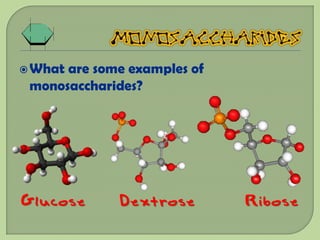
 Whatare some examples of
 monosaccharides?


Glucose      Dextrose        Ribose
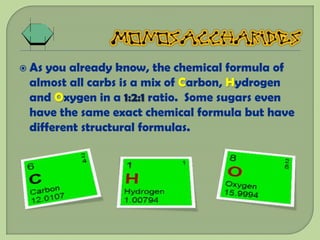
 Asyou already know, the chemical formula of
 almost all carbs is a mix of Carbon, Hydrogen
 and Oxygen in a 1:2:1 ratio. Some sugars even
 have the same exact chemical formula but have
 different structural formulas.
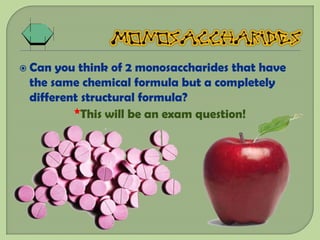
 Can you think of 2 monosaccharides that have
 the same chemical formula but a completely
 different structural formula?
         *This will be an exam question!
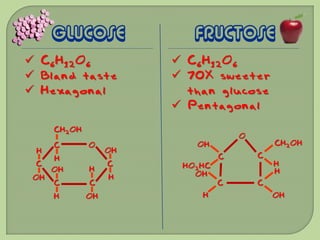
GLUCOSE              FRUCTOSE
 C6H12O6                C6H12O6
 Bland taste            70X sweeter
 Hexagonal               than glucose
                         Pentagonal
      CH2OH
                                     O
      C       O            OH                CH2OH
 H                 OH
      H                          C       C
 C                 C     HO2HC               H
      OH      H                              H
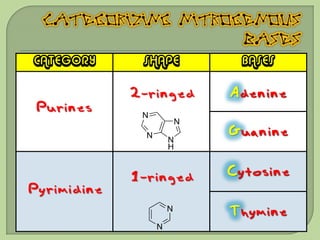
 OH                H       OH
      C       C                  C       C
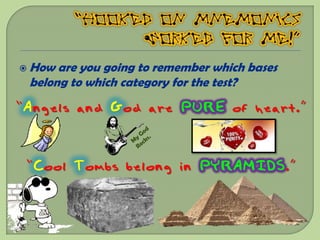
      H       OH            H                OH
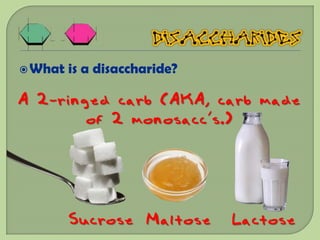
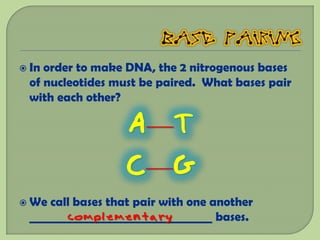
 What   is a disaccharide?

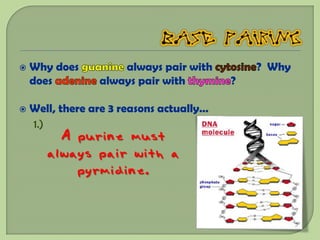
A 2-ringed carb (AKA, carb made
        of 2 monosacc’s.)


         Sucrose Maltose      Lactose
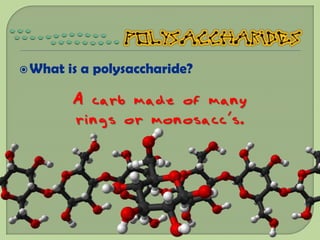
 What   is a polysaccharide?

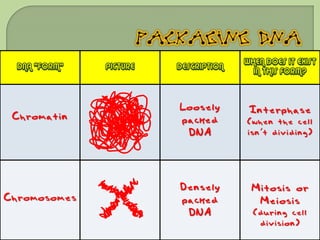
         A carb made of many
         rings or monosacc’s.
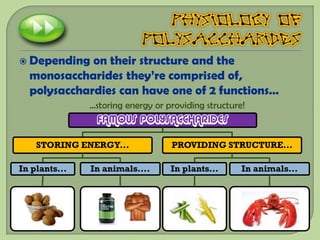
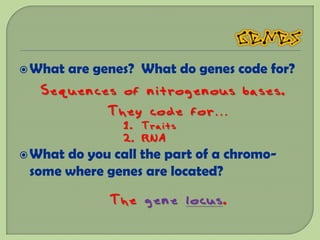
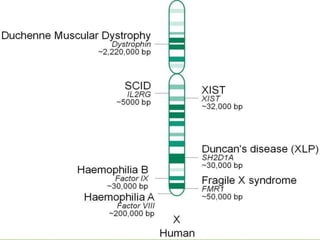
 Depending  on their structure and the
  monosaccharides they’re comprised of,
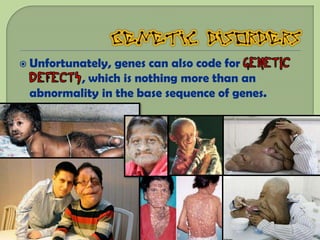
  polysacchardies can have one of 2 functions…
               …storing energy or providing structure!
                FAMOUS POLYSACCHARIDES

    STORING ENERGY...              PROVIDING STRUCTURE...

In plants...   In animals....      In plants...      In animals...
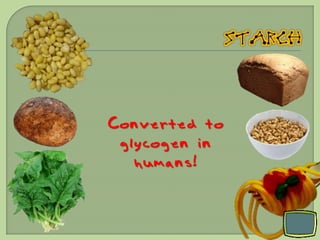
Converted to
 glycogen in
   humans!
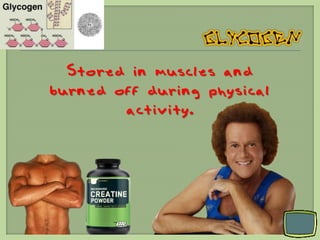
Stored in muscles and
burned off during physical
        activity.
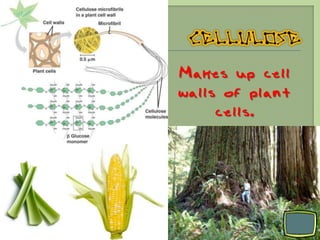
Makes up cell
walls of plant
     cells.
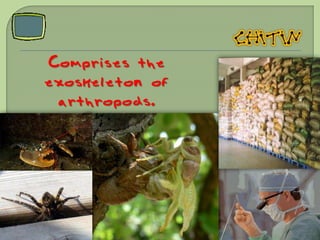
Comprises the
exoskeleton of
 arthropods.
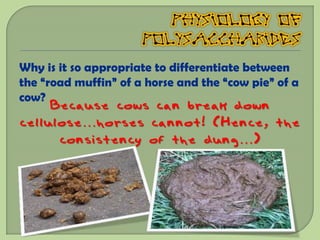
Why is it so appropriate to differentiate between
the “road muffin” of a horse and the “cow pie” of a
cow?
     Because cows can break down
cellulose…horses cannot! (Hence, the
      consistency of the dung…)
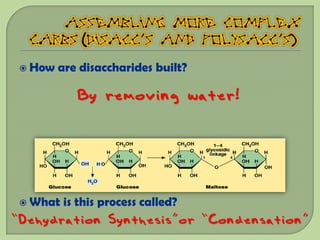
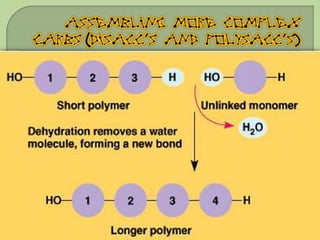
 How   are disaccharides built?

            By removing water!


  What   is this process called?
“Dehydration Synthesis”or “Condensation”
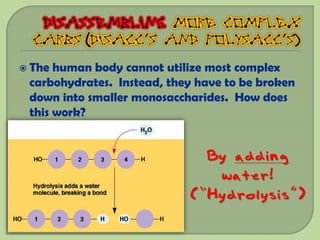
 The human body cannot utilize most complex
 carbohydrates. Instead, they have to be broken
 down into smaller monosaccharides. How does
 this work?


                              By adding
                               water!
                            (“Hydrolysis”)
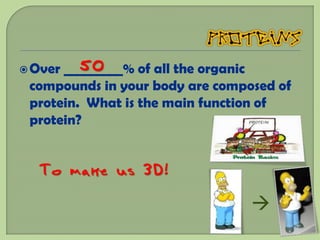
 Over   50
      _________% of all the organic
 compounds in your body are composed of
 protein. What is the main function of
 protein?


  To make us 3D!

                                 
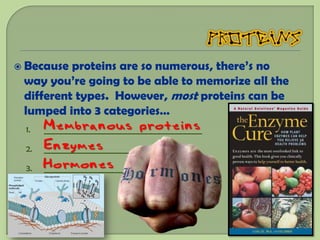
 Because proteins are so numerous, there’s no
 way you’re going to be able to memorize all the
 different types. However, most proteins can be
 lumped into 3 categories…
 1.   Membranous proteins
      _____________________________________
 2.   Enzymes
      _____________________________________
 3.   Hormones
      _____________________________________
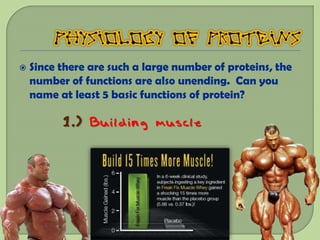
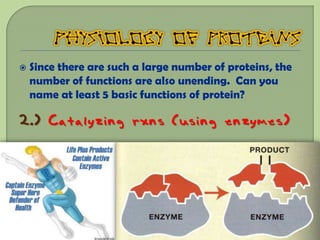
   Since there are such a large number of proteins, the
    number of functions are also unending. Can you
    name at least 5 basic functions of protein?

          1.) Building muscle
   Since there are such a large number of proteins, the
    number of functions are also unending. Can you
    name at least 5 basic functions of protein?

2.) Catalyzing rxns (using enzymes)
   Since there are such a large number of proteins, the
    number of functions are also unending. Can you
    name at least 5 basic functions of protein?

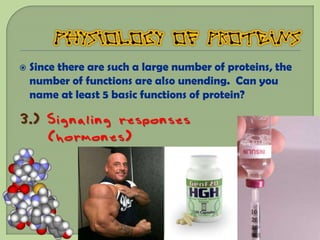
3.) Signaling responses
    (hormones)
   Since there are such a large number of proteins, the
    number of functions are also unending. Can you
    name at least 5 basic functions of protein?
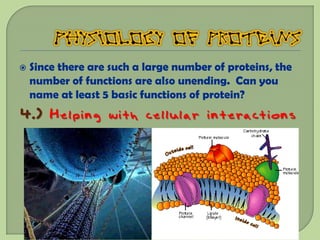
4.) Helping with cellular interactions
   Since there are such a large number of proteins, the
    number of functions are also unending. Can you
    name at least 5 basic functions of protein?
       5.) Provide structure/support
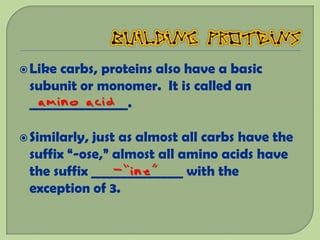
 Likecarbs, proteins also have a basic
 subunit or monomer. It is called an
  amino acid
 _______________.

 Similarly,just as almost all carbs have the
 suffix “-ose,” almost all amino acids have
 the suffix ______________ with the
                -“ine”
 exception of 3.
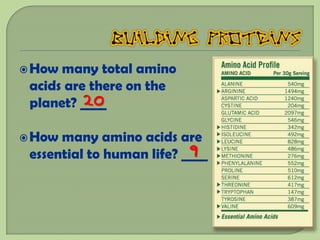
 How many total amino
 acids are there on the
          20
 planet? ____

 How many amino acids are
                           9
 essential to human life? ____
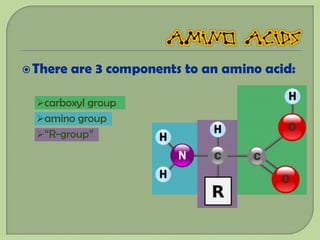
 There   are 3 components to an amino acid:

  carboxyl group
  amino group
  “R-group”
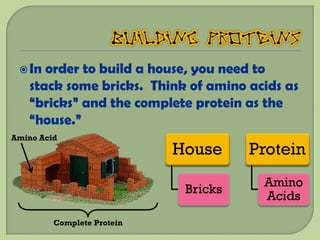
 In order to build a house, you need to
   stack some bricks. Think of amino acids as
   “bricks” and the complete protein as the
   “house.”
Amino Acid
                            House     Protein
                                       Amino
                             Bricks
                                       Acids
         Complete Protein
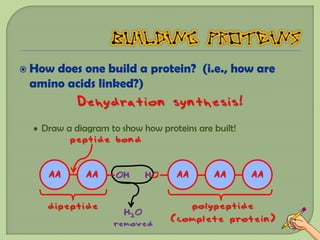
 Howdoes one build a protein? (i.e., how are
 amino acids linked?)
            Dehydration synthesis!
  • Draw a diagram to show how proteins are built!
          peptide bond


     AA       AA     OH     HO     AA       AA       AA


     dipeptide                       polypeptide
                      H2O
                    removed       (complete protein)
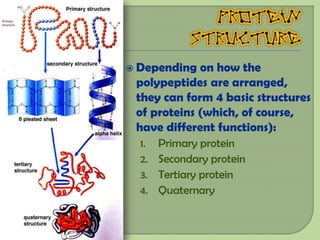
 Depending  on how the
 polypeptides are arranged,
 they can form 4 basic structures
 of proteins (which, of course,
 have different functions):
  1. Primary protein
  2. Secondary protein
  3. Tertiary protein
  4. Quaternary
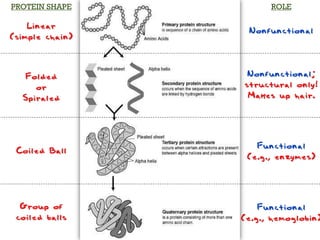
PROTEIN SHAPE          ROLE

    Linear
                  Nonfunctional
(simple chain)


  Folded          Nonfunctional;
     or          structural only!
  Spiraled        Makes up hair.


                    Functional
 Coiled Ball
                  (e.g., enzymes)


  Group of           Functional
 coiled balls    (e.g., hemoglobin)
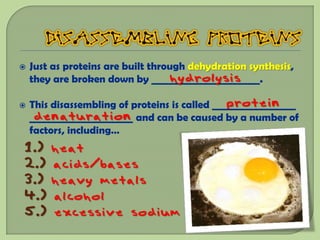
   Just as proteins are built through dehydration synthesis,
                                   hydrolysis
    they are broken down by ______________________.

                                               protein
    This disassembling of proteins is called _________________
     denaturation
    _____________________ and can be caused by a number of
    factors, including…
1.) heat
2.) acids/bases
3.) heavy metals
4.) alcohol
5.) excessive sodium
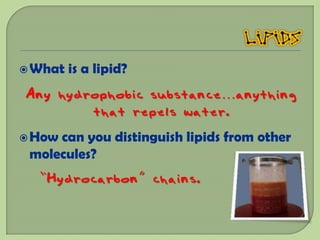
 What   is a lipid?
Any hydrophobic substance…anything
        that repels water.
 Howcan you distinguish lipids from other
 molecules?
  “Hydrocarbon” chains.
 Technically,   lipids are not synonymous
 with fats.

              Lipids≠ Fats
 What   is a lipid then?

  A CATEGORY that includes fats,
      among other substances.
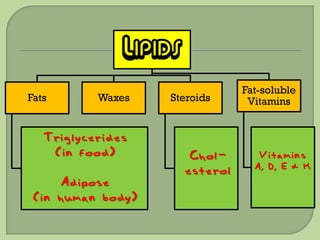
LIPIDS
                                  Fat-soluble
Fats       Waxes   Steroids        Vitamins


   Triglycerides
    (in food)            Chol-       Vitamins
                                    A, D, E & K
                        esterol
     Adipose
 (in human body)
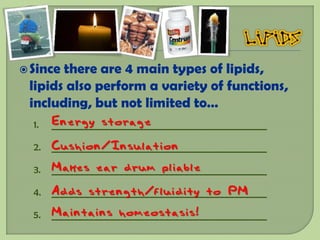
 Sincethere are 4 main types of lipids,
 lipids also perform a variety of functions,
 including, but not limited to…
  1.   Energy storage
       ___________________________________________
  2. Cushion/Insulation
     ___________________________________________
  3.   Makes ear drum pliable
       ___________________________________________
  4. Adds strength/fluidity to PM
     ___________________________________________
  5.   Maintains homeostasis!
       ___________________________________________
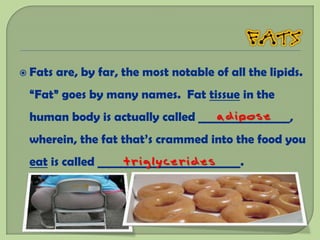
 Fats   are, by far, the most notable of all the lipids.
 “Fat” goes by many names. Fat tissue in the
                                  adipose
 human body is actually called ________________,
 wherein, the fat that’s crammed into the food you
                   triglycerides
 eat is called _________________________.
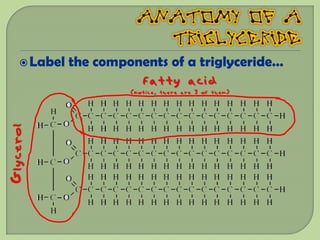
 Label   the components of a triglyceride…
                         fatty acid
                        (notice, there are 3 of them)
Glycerol
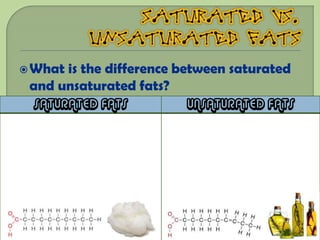
 Whatis the difference between saturated
 and unsaturated fats?
 SATURATED FATS          UNSATURATED FATS
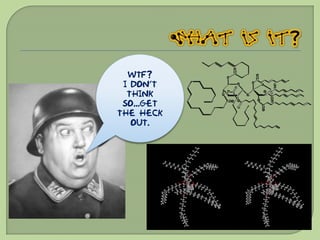
WTF?
 I don’t
  think
 so...get
the heck
   out.
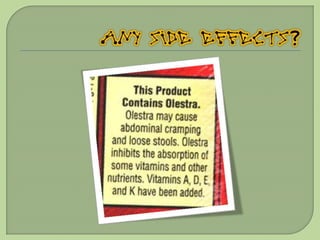
…but with the help of
Olestra, you can literally
make a hobby out it! 
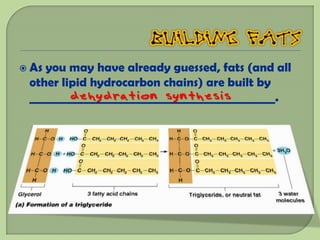
 Asyou may have already guessed, fats (and all
 other lipid hydrocarbon chains) are built by
         dehydration synthesis
 ___________________________________________.
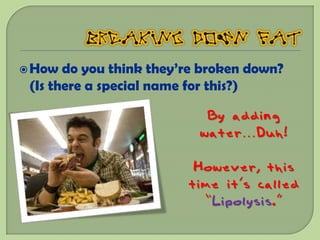
 How  do you think they’re broken down?
 (Is there a special name for this?)

                            By adding
                           water…Duh!

                          However, this
                         time it’s called
                           “Lipolysis.”
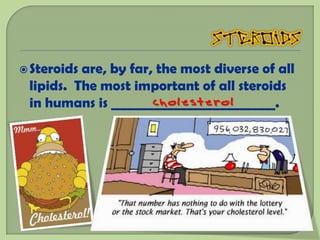
 Steroidsare, by far, the most diverse of all
 lipids. The most important of all steroids
                      cholesterol
 in humans is _________________________.
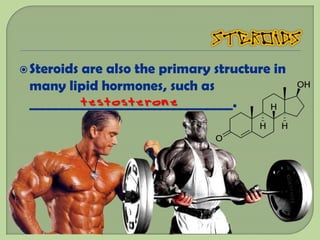
 Steroids
         are also the primary structure in
 many lipid hormones, such as
         testosterone
 _______________________________.
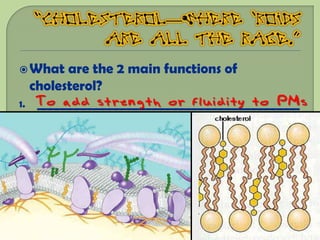
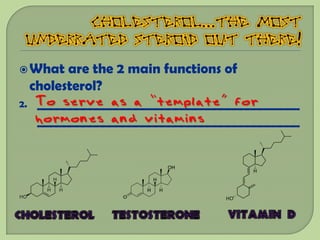
 What  are the 2 main functions of
  cholesterol?
1. To add strength or fluidity to PMs
   ________________________________________
 What  are the 2 main functions of
  cholesterol?
2. To serve as a “template” for
   ________________________________________
   hormones and vitamins
   ________________________________________
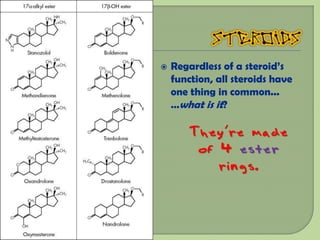
   Regardless of a steroid’s
    function, all steroids have
    one thing in common...
    …what is it?

        They’re made
         of 4 ester
            rings.
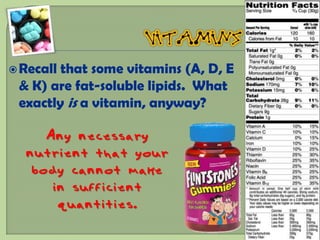
 Recallthat some vitamins (A, D, E
 & K) are fat-soluble lipids. What
 exactly is a vitamin, anyway?

     Any necessary
  nutrient that your
   body cannot make
      in sufficient
       quantities.
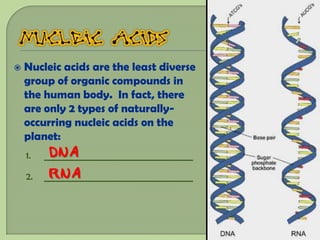
   Nucleic acids are the least diverse
    group of organic compounds in
    the human body. In fact, there
    are only 2 types of naturally-
    occurring nucleic acids on the
    planet:
    1.    DNA
         ________________________________
    2.    RNA
         ________________________________
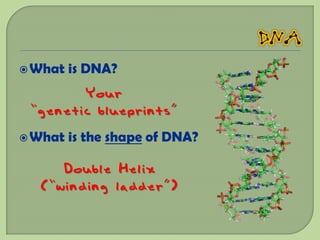
 What   is DNA?
        Your
 “genetic blueprints”
 What   is the shape of DNA?

     Double Helix
  (“winding ladder”)
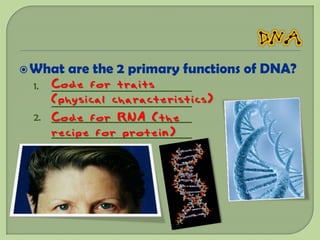
 What   are the 2 primary functions of DNA?
 1. Code for traits
    ____________________________
    (physical characteristics)
    ____________________________
    ____________________________
 2. Code for RNA (the
    recipe for protein)
    ____________________________
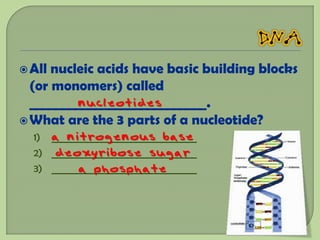
 All nucleic acids have basic building blocks
  (or monomers) called
  ___________________________.
           nucleotides
 What are the 3 parts of a nucleotide?
   1) a nitrogenous base
      _____________________________
       deoxyribose sugar
   2) _____________________________
           a phosphate
   3) _____________________________
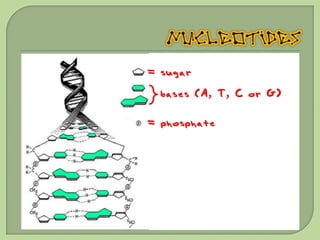
= sugar

  bases (A, T, C or G)

= phosphate
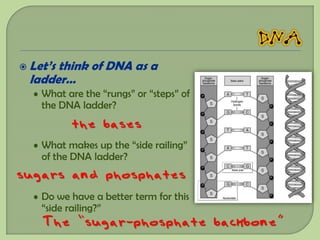
 Let’s
      think of DNA as a
 ladder…
  • What are the “rungs” or “steps” of
    the DNA ladder?
           the bases
  • What makes up the “side railing”
    of the DNA ladder?
sugars and phosphates
  • Do we have a better term for this
    “side railing?”
    The “sugar-phosphate backbone”
   All of the DNA in your body is made of around 6
    billion total nucleotides. Just to give you a refer-
    ence of how huge 6 billion is…if you were to try to
    count to 6,000,000,000 (1 number/second) you
    would finish by roughly your 208th birthday
   The craziest thing is…the majority of the 6 billion
    nucleotides are exactly the same.
   Every single nucleotide is made up of an identical
    molecule of deoxyribose sugar and an identical
    molecule of phosphate
 Sowhat, then, makes one human being
 different from another?
 The arrangement (or
  sequencing) of the
  nitrogenous bases!


       Let’s take a look.
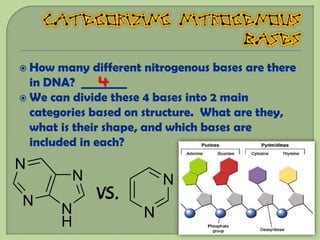
 How  many different nitrogenous bases are there
  in DNA? ________
               4
 We can divide these 4 bases into 2 main
  categories based on structure. What are they,
  what is their shape, and which bases are
  included in each?


             VS.
CATEGORY      SHAPE      BASES

             2-ringed   Adenine
 Purines
                        Guanine


             1-ringed   Cytosine
Pyrimidine
                        Thymine
 How are you going to remember which bases
 belong to which category for the test?
“Angels and God are PURE of heart.”


 “Cool Tombs belong in PYRAMIDS.”
 Inorder to make DNA, the 2 nitrogenous bases
 of nucleotides must be paired. What bases pair
 with each other?

                   A—T
                  C—G
 We call bases that pair with one another
        complementary
 ________________________________ bases.
   Why does         always pair with         ? Why
    does         always pair with         ?

   Well, there are 3 reasons actually…
    1.)
         A purine must
       always pair with a
           pyrmidine.
   Why does         always pair with         ? Why
    does         always pair with         ?

   Well, there are 3 reasons actually…
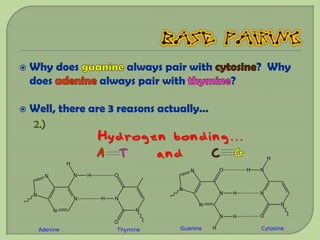
    2.)
                 Hydrogen bonding…
                        and
   Why does        always pair with            ? Why
    does        always pair with       ?

   Well, there are 3 reasons actually…
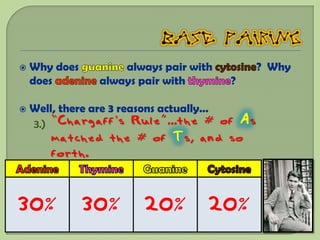
    3.) “Chargaff’s Rule”...the # of       As
       matched the # of Ts, and so
       forth.


30%            30%     20%         20%
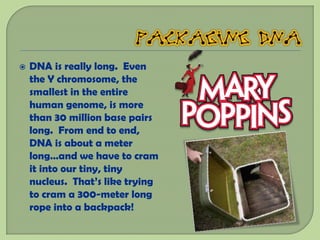
   DNA is really long. Even
    the Y chromosome, the
    smallest in the entire
    human genome, is more
    than 30 million base pairs
    long. From end to end,
    DNA is about a meter
    long…and we have to cram
    it into our tiny, tiny
    nucleus. That’s like trying
    to cram a 300-meter long
    rope into a backpack!
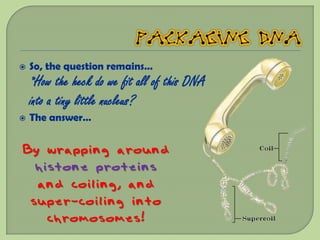
   So, the question remains…
    *How the heck do we fit all of this DNA
    into a tiny little nucleus?
   The answer…


By wrapping around
  histone proteins
  and coiling, and
 super-coiling into
    chromosomes!
WHEN DOES IT EXIST
  DNA “FORM”   PICTURE   DESCRIPTION
                                         IN THIS FORM?


                         Loosely        Interphase
 Chromatin               packed        (when the cell
                          DNA          isn’t dividing)


                         Densely        Mitosis or
Chromosomes              packed          Meiosis
                          DNA            (during cell
                                          division)
 What   are genes? What do genes code for?
  Sequences of nitrogenous bases.
          They code for…
                 1. Traits
                 2. RNA
 Whatdo you call the part of a chromo-
 some where genes are located?

               The gene locus.
 Unfortunately,genes can also code for
        , which is nothing more than an
 abnormality in the base sequence of genes.
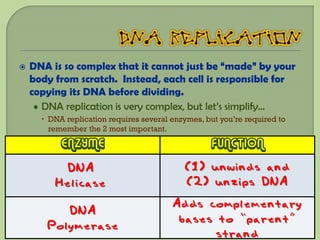
   DNA is so complex that it cannot just be “made” by your
    body from scratch. Instead, each cell is responsible for
    copying its DNA before dividing.
     • DNA replication is very complex, but let’s simplify…
       DNA replication requires several enzymes, but you’re required to
        remember the 2 most important.
           ENZYME                                  FUNCTION
          DNA                               (1) unwinds and
         Helicase                           (2) unzips DNA
                                         Adds complementary
          DNA
                                          bases to “parent”
       Polymerase
                                                strand
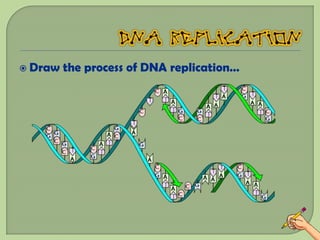
 Draw   the process of DNA replication…
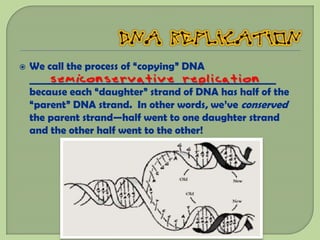
   We call the process of “copying” DNA
        semiconservative replication
    __________________________________________________
    because each “daughter” strand of DNA has half of the
    “parent” DNA strand. In other words, we’ve conserved
    the parent strand—half went to one daughter strand
    and the other half went to the other!
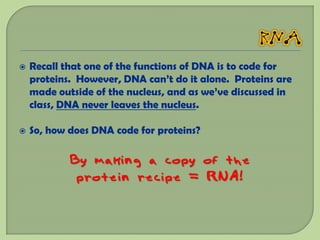
   Recall that one of the functions of DNA is to code for
    proteins. However, DNA can’t do it alone. Proteins are
    made outside of the nucleus, and as we’ve discussed in
    class, DNA never leaves the nucleus.

   So, how does DNA code for proteins?

            By making a copy of the
             protein recipe = RNA!
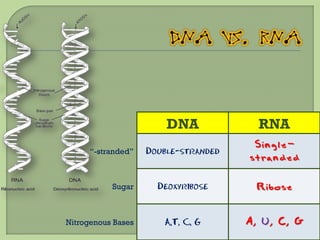
DNA             RNA
                                       Single-
      “-stranded”   Double-stranded
                                      stranded

           Sugar      Deoxyribose      Ribose


Nitrogenous Bases      A,T, C, G      A, U, C, G
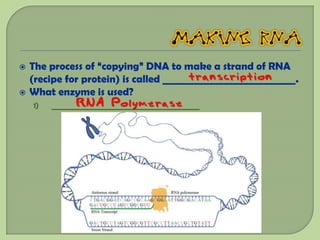
   The process of “copying” DNA to make a strand of RNA
                                        transcription
    (recipe for protein) is called ___________________________.
   What enzyme is used?
    1)         RNA Polymerase
         ______________________________________
Key
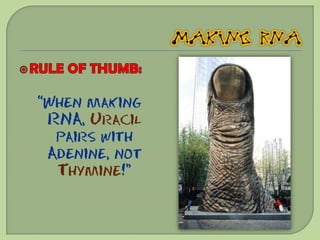
“When making
 RNA, Uracil
  pairs with
 Adenine, not
  Thymine!”
 Theprocess of building amino acids requires the
 cooperation of _______ and __________________
                  RNA           ribosomes
                  translation
 and is called __________________.

Biochemistry lecture

  • 2.
     Thereare aton of elements involved in life processes but thankfully, all of them can be divided into 4 main groups: 1. Carbohydrates ______________________ 2. Proteins ______________________ 3. Lipids ______________________ 4. Nucleic Acids ______________________ Don’t pretend you aren’t jealous of this sweet Tee.
  • 3.
     What3 elementscomprise all carbo- hydrates and in what arrangement? • It’s important that your remember this…especially if you plan to take the SAT!
  • 4.
     Most carbohydrates have a common suffix. What is it? “-ose”
  • 5.
     Can you name some carbs? • The group that can come up with the most will receive some carbs, too! (Just make sure you burn ‘em off, or they’ll end up on those hips!) Game on. Glucose Cellulose Fructose Ribose Maltose Deoxyribose Sucrose Starch Lactose Chitin
  • 6.
     The scientificterm for a carbohydrate is a saccharide ______________________, which literally translates to sugar.  Carbs range from very simple molecules to very complex molecules. Name ‘em. Increasing complexity Monosaccharide Disaccharide Polysaccharide
  • 7.
     Thesimplest sugarsare referred to as monosaccharides.  What is a monosaccharide? A single-ringed carb.  What does one look like? Pentagonal Hexagonal
  • 8.
     Whatare someexamples of monosaccharides? Glucose Dextrose Ribose
  • 9.
     Asyou alreadyknow, the chemical formula of almost all carbs is a mix of Carbon, Hydrogen and Oxygen in a 1:2:1 ratio. Some sugars even have the same exact chemical formula but have different structural formulas.
  • 10.
     Can youthink of 2 monosaccharides that have the same chemical formula but a completely different structural formula? *This will be an exam question!
  • 11.
    GLUCOSE FRUCTOSE  C6H12O6  C6H12O6  Bland taste  70X sweeter  Hexagonal than glucose  Pentagonal CH2OH O C O OH CH2OH H OH H C C C C HO2HC H OH H H OH H OH C C C C H OH H OH
  • 12.
     What is a disaccharide? A 2-ringed carb (AKA, carb made of 2 monosacc’s.) Sucrose Maltose Lactose
  • 13.
     What is a polysaccharide? A carb made of many rings or monosacc’s.
  • 14.
     Depending on their structure and the monosaccharides they’re comprised of, polysacchardies can have one of 2 functions… …storing energy or providing structure! FAMOUS POLYSACCHARIDES STORING ENERGY... PROVIDING STRUCTURE... In plants... In animals.... In plants... In animals...
  • 15.
  • 16.
    Stored in musclesand burned off during physical activity.
  • 17.
    Makes up cell wallsof plant cells.
  • 18.
  • 19.
    Why is itso appropriate to differentiate between the “road muffin” of a horse and the “cow pie” of a cow? Because cows can break down cellulose…horses cannot! (Hence, the consistency of the dung…)
  • 20.
     How are disaccharides built? By removing water!  What is this process called? “Dehydration Synthesis”or “Condensation”
  • 22.
     The humanbody cannot utilize most complex carbohydrates. Instead, they have to be broken down into smaller monosaccharides. How does this work? By adding water! (“Hydrolysis”)
  • 23.
     Over 50 _________% of all the organic compounds in your body are composed of protein. What is the main function of protein? To make us 3D! 
  • 24.
     Because proteinsare so numerous, there’s no way you’re going to be able to memorize all the different types. However, most proteins can be lumped into 3 categories… 1. Membranous proteins _____________________________________ 2. Enzymes _____________________________________ 3. Hormones _____________________________________
  • 25.
    Since there are such a large number of proteins, the number of functions are also unending. Can you name at least 5 basic functions of protein? 1.) Building muscle
  • 26.
    Since there are such a large number of proteins, the number of functions are also unending. Can you name at least 5 basic functions of protein? 2.) Catalyzing rxns (using enzymes)
  • 27.
    Since there are such a large number of proteins, the number of functions are also unending. Can you name at least 5 basic functions of protein? 3.) Signaling responses (hormones)
  • 28.
    Since there are such a large number of proteins, the number of functions are also unending. Can you name at least 5 basic functions of protein? 4.) Helping with cellular interactions
  • 29.
    Since there are such a large number of proteins, the number of functions are also unending. Can you name at least 5 basic functions of protein? 5.) Provide structure/support
  • 30.
     Likecarbs, proteinsalso have a basic subunit or monomer. It is called an amino acid _______________.  Similarly,just as almost all carbs have the suffix “-ose,” almost all amino acids have the suffix ______________ with the -“ine” exception of 3.
  • 31.
     How manytotal amino acids are there on the 20 planet? ____  How many amino acids are 9 essential to human life? ____
  • 33.
     There are 3 components to an amino acid: carboxyl group amino group “R-group”
  • 34.
     In orderto build a house, you need to stack some bricks. Think of amino acids as “bricks” and the complete protein as the “house.” Amino Acid House Protein Amino Bricks Acids Complete Protein
  • 35.
     Howdoes onebuild a protein? (i.e., how are amino acids linked?) Dehydration synthesis! • Draw a diagram to show how proteins are built! peptide bond AA AA OH HO AA AA AA dipeptide polypeptide H2O removed (complete protein)
  • 36.
     Depending on how the polypeptides are arranged, they can form 4 basic structures of proteins (which, of course, have different functions): 1. Primary protein 2. Secondary protein 3. Tertiary protein 4. Quaternary
  • 37.
    PROTEIN SHAPE ROLE Linear Nonfunctional (simple chain) Folded Nonfunctional; or structural only! Spiraled Makes up hair. Functional Coiled Ball (e.g., enzymes) Group of Functional coiled balls (e.g., hemoglobin)
  • 38.
    Just as proteins are built through dehydration synthesis, hydrolysis they are broken down by ______________________.  protein This disassembling of proteins is called _________________ denaturation _____________________ and can be caused by a number of factors, including… 1.) heat 2.) acids/bases 3.) heavy metals 4.) alcohol 5.) excessive sodium
  • 39.
     What is a lipid? Any hydrophobic substance…anything that repels water.  Howcan you distinguish lipids from other molecules? “Hydrocarbon” chains.
  • 40.
     Technically, lipids are not synonymous with fats. Lipids≠ Fats  What is a lipid then? A CATEGORY that includes fats, among other substances.
  • 41.
    LIPIDS Fat-soluble Fats Waxes Steroids Vitamins Triglycerides (in food) Chol- Vitamins A, D, E & K esterol Adipose (in human body)
  • 42.
     Sincethere are4 main types of lipids, lipids also perform a variety of functions, including, but not limited to… 1. Energy storage ___________________________________________ 2. Cushion/Insulation ___________________________________________ 3. Makes ear drum pliable ___________________________________________ 4. Adds strength/fluidity to PM ___________________________________________ 5. Maintains homeostasis! ___________________________________________
  • 43.
     Fats are, by far, the most notable of all the lipids. “Fat” goes by many names. Fat tissue in the adipose human body is actually called ________________, wherein, the fat that’s crammed into the food you triglycerides eat is called _________________________.
  • 44.
     Label the components of a triglyceride… fatty acid (notice, there are 3 of them) Glycerol
  • 45.
     Whatis thedifference between saturated and unsaturated fats? SATURATED FATS UNSATURATED FATS
  • 47.
    WTF? I don’t think so...get the heck out.
  • 49.
    …but with thehelp of Olestra, you can literally make a hobby out it! 
  • 51.
     Asyou mayhave already guessed, fats (and all other lipid hydrocarbon chains) are built by dehydration synthesis ___________________________________________.
  • 52.
     How do you think they’re broken down? (Is there a special name for this?) By adding water…Duh! However, this time it’s called “Lipolysis.”
  • 53.
     Steroidsare, byfar, the most diverse of all lipids. The most important of all steroids cholesterol in humans is _________________________.
  • 55.
     Steroids are also the primary structure in many lipid hormones, such as testosterone _______________________________.
  • 56.
     What are the 2 main functions of cholesterol? 1. To add strength or fluidity to PMs ________________________________________
  • 57.
     What are the 2 main functions of cholesterol? 2. To serve as a “template” for ________________________________________ hormones and vitamins ________________________________________
  • 58.
    Regardless of a steroid’s function, all steroids have one thing in common... …what is it? They’re made of 4 ester rings.
  • 59.
     Recallthat somevitamins (A, D, E & K) are fat-soluble lipids. What exactly is a vitamin, anyway? Any necessary nutrient that your body cannot make in sufficient quantities.
  • 60.
    Nucleic acids are the least diverse group of organic compounds in the human body. In fact, there are only 2 types of naturally- occurring nucleic acids on the planet: 1. DNA ________________________________ 2. RNA ________________________________
  • 61.
     What is DNA? Your “genetic blueprints”  What is the shape of DNA? Double Helix (“winding ladder”)
  • 62.
     What are the 2 primary functions of DNA? 1. Code for traits ____________________________ (physical characteristics) ____________________________ ____________________________ 2. Code for RNA (the recipe for protein) ____________________________
  • 63.
     All nucleicacids have basic building blocks (or monomers) called ___________________________. nucleotides  What are the 3 parts of a nucleotide? 1) a nitrogenous base _____________________________ deoxyribose sugar 2) _____________________________ a phosphate 3) _____________________________
  • 64.
    = sugar bases (A, T, C or G) = phosphate
  • 65.
     Let’s think of DNA as a ladder… • What are the “rungs” or “steps” of the DNA ladder? the bases • What makes up the “side railing” of the DNA ladder? sugars and phosphates • Do we have a better term for this “side railing?” The “sugar-phosphate backbone”
  • 66.
    All of the DNA in your body is made of around 6 billion total nucleotides. Just to give you a refer- ence of how huge 6 billion is…if you were to try to count to 6,000,000,000 (1 number/second) you would finish by roughly your 208th birthday  The craziest thing is…the majority of the 6 billion nucleotides are exactly the same.  Every single nucleotide is made up of an identical molecule of deoxyribose sugar and an identical molecule of phosphate
  • 67.
     Sowhat, then,makes one human being different from another? The arrangement (or sequencing) of the nitrogenous bases! Let’s take a look.
  • 68.
     How many different nitrogenous bases are there in DNA? ________ 4  We can divide these 4 bases into 2 main categories based on structure. What are they, what is their shape, and which bases are included in each? VS.
  • 69.
    CATEGORY SHAPE BASES 2-ringed Adenine Purines Guanine 1-ringed Cytosine Pyrimidine Thymine
  • 70.
     How areyou going to remember which bases belong to which category for the test? “Angels and God are PURE of heart.” “Cool Tombs belong in PYRAMIDS.”
  • 71.
     Inorder tomake DNA, the 2 nitrogenous bases of nucleotides must be paired. What bases pair with each other? A—T C—G  We call bases that pair with one another complementary ________________________________ bases.
  • 72.
    Why does always pair with ? Why does always pair with ?  Well, there are 3 reasons actually… 1.) A purine must always pair with a pyrmidine.
  • 73.
    Why does always pair with ? Why does always pair with ?  Well, there are 3 reasons actually… 2.) Hydrogen bonding… and
  • 74.
    Why does always pair with ? Why does always pair with ?  Well, there are 3 reasons actually… 3.) “Chargaff’s Rule”...the # of As matched the # of Ts, and so forth. 30% 30% 20% 20%
  • 75.
    DNA is really long. Even the Y chromosome, the smallest in the entire human genome, is more than 30 million base pairs long. From end to end, DNA is about a meter long…and we have to cram it into our tiny, tiny nucleus. That’s like trying to cram a 300-meter long rope into a backpack!
  • 76.
    So, the question remains… *How the heck do we fit all of this DNA into a tiny little nucleus?  The answer… By wrapping around histone proteins and coiling, and super-coiling into chromosomes!
  • 77.
    WHEN DOES ITEXIST DNA “FORM” PICTURE DESCRIPTION IN THIS FORM? Loosely Interphase Chromatin packed (when the cell DNA isn’t dividing) Densely Mitosis or Chromosomes packed Meiosis DNA (during cell division)
  • 78.
     What are genes? What do genes code for? Sequences of nitrogenous bases. They code for… 1. Traits 2. RNA  Whatdo you call the part of a chromo- some where genes are located? The gene locus.
  • 80.
     Unfortunately,genes canalso code for , which is nothing more than an abnormality in the base sequence of genes.
  • 81.
    DNA is so complex that it cannot just be “made” by your body from scratch. Instead, each cell is responsible for copying its DNA before dividing. • DNA replication is very complex, but let’s simplify…  DNA replication requires several enzymes, but you’re required to remember the 2 most important. ENZYME FUNCTION DNA (1) unwinds and Helicase (2) unzips DNA Adds complementary DNA bases to “parent” Polymerase strand
  • 82.
     Draw the process of DNA replication…
  • 83.
    We call the process of “copying” DNA semiconservative replication __________________________________________________ because each “daughter” strand of DNA has half of the “parent” DNA strand. In other words, we’ve conserved the parent strand—half went to one daughter strand and the other half went to the other!
  • 84.
    Recall that one of the functions of DNA is to code for proteins. However, DNA can’t do it alone. Proteins are made outside of the nucleus, and as we’ve discussed in class, DNA never leaves the nucleus.  So, how does DNA code for proteins? By making a copy of the protein recipe = RNA!
  • 85.
    DNA RNA Single- “-stranded” Double-stranded stranded Sugar Deoxyribose Ribose Nitrogenous Bases A,T, C, G A, U, C, G
  • 86.
    The process of “copying” DNA to make a strand of RNA transcription (recipe for protein) is called ___________________________.  What enzyme is used? 1) RNA Polymerase ______________________________________
  • 87.
  • 88.
    “When making RNA,Uracil pairs with Adenine, not Thymine!”
  • 89.
     Theprocess ofbuilding amino acids requires the cooperation of _______ and __________________ RNA ribosomes translation and is called __________________.

Editor's Notes

  • #81 Werewolf Syndrome,Progeria, Neurofibromatosis,