Unit One: Introduction to biochemistry
Definition and scope of biochemistry
o Biochemistry is the chemistry of life.
o is the study of chemical composition of living matter , and of the chemical
changes that occur in it during life process.
o is a special branch of organic chemistry that deals with matter inside the
living cell.
o is the application of chemistry to the study of biological processes at the
cellular and molecular level.
o Studying the structure and behavior of the complex molecules found in
biological material and the ways these molecules interact to form cells,
tissues and whole organism 02/11/2025
1
Scope of Biochemistry
o It deals with nature of chemical substance present in the living system, the
chemical transformations taking place there in and energetic changes taking
place in the body due these transformations.
o it deals with chemical nature, structure and functions of bio molecules.
Biochemistry involves the study of:
 Chemical constituents of living matter
 Chemical changes which occur in the organism during digestion, absorption
and excretion
 Chemical changes which occur during growth and multiplication of the
organism. 02/11/2025
2
Relevance of Biochemistry
 Biochemistry is a valuable subject in medicine without which there would
have been no such advancement in the field.
 Physiology: Biochemistry helps one understand the biochemical changes
and related physiological alteration in the body.
 Pathology: Pathology of any disease is studied through biochemical
changes.
 Based on the symptoms described by the patient, physician can get clue
on the biochemical change and the associated disorder.
 For example if a patient complains about stiffness in small joints, then
physician may predict it to be gout and get confirmed by evaluating uric
acid levels in the blood. As uric acid accumulation in blood results in gout.
02/11/2025
3
 Nutrition deficiency: The function and role of vitamins in body is described
by biochemistry.
 Hormonal deficiency: There are many disorders due to hormonal imbalance
in especially women and children. The formation, role of hormones in the
normal body function is taught in biochemistry by which the physician can
understand the concerned problem during treatment.
 Kidney function test: For example in kidney disorders, chemotherapy
treatment, urine test help understand the extent of excretion of drugs
or other metabolites, the change in pH, the colour of urine etc.
 Blood test: In diabetes, biochemical analytical test for blood glucose level
helps one understand the severity of diabetes disorder.
 Liver function tests helps understand the type of disease or damage to liver,
the effect of any medication on liver etc.
02/11/2025
4
02/11/2025
5
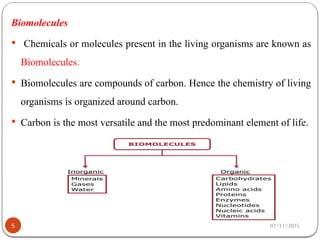
Biomolecules
 Chemicals or molecules present in the living organisms are known as
Biomolecules.
 Biomolecules are compounds of carbon. Hence the chemistry of living
organisms is organized around carbon.
 Carbon is the most versatile and the most predominant element of life.
Chemical composition of the cell
02/11/2025
6
 Chemical compounds in the cell can be divided into two major
group: Organic and Inorganic
Organic compounds
 Chemical compounds contain carbon.
 Are usually found in and originate from living organism.
 Usually consist of macromolecules (large molecules).
Inorganic compounds are:
 Chemical compounds that do not contain carbon.
 Usually a smaller and simpler than organic compounds.
 Founds in cells water, acids, alkalis and mineral salts.
02/11/2025
Organic compounds
There are 4 main group of organic compounds in cells:
I. Carbohydrates
II. Lipids
III. Proteins
IV. Nucleic acids
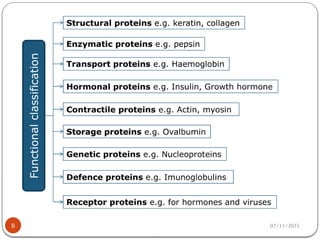
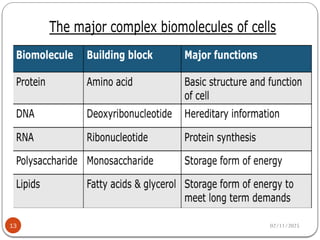
Proteins: Most abundant organic molecules of the living system.
 They form about 50% of the dry weight of the cell.
 They are most important for the architecture and functioning of the
cell.
 Proteins are polymers of amino acids.
7
02/11/2025
8
02/11/2025
9
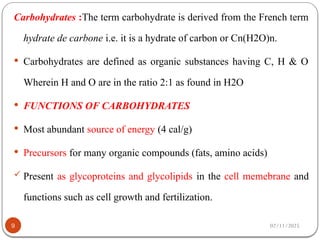
Carbohydrates :The term carbohydrate is derived from the French term
hydrate de carbone i.e. it is a hydrate of carbon or Cn(H2O)n.
 Carbohydrates are defined as organic substances having C, H & O
Wherein H and O are in the ratio 2:1 as found in H2O
 FUNCTIONS OF CARBOHYDRATES
 Most abundant source of energy (4 cal/g)
 Precursors for many organic compounds (fats, amino acids)
 Present as glycoproteins and glycolipids in the cell memebrane and
functions such as cell growth and fertilization.
02/11/2025
10
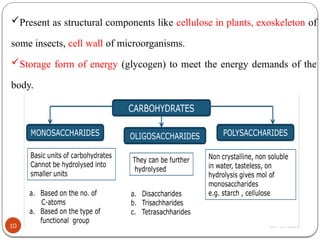
Present as structural components like cellulose in plants, exoskeleton of
some insects, cell wall of microorganisms.
Storage form of energy (glycogen) to meet the energy demands of the
body.
02/11/2025
11
 Lipids are the chief concentrated storage form of energy forming about
3.5% of the cell content.
 Lipids are organic substances relatively insoluble in water but soluble
in organic solvents (alcohol, ether)
Functions :
 They are the concentrated fuel reserve of the body.
 Lipids are constituents of membrane structure and regulate the
membrane permeability.
 They serve as source of fat soluble vitamins
 Lipids are important cellular metabolic regulators
 Lipids protect the internal organs and serve as insulating materials.
02/11/2025
12
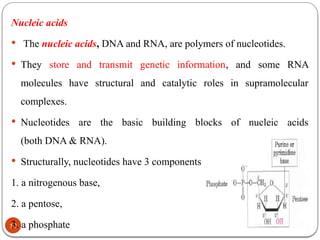
Nucleic acids
 The nucleic acids, DNA and RNA, are polymers of nucleotides.
 They store and transmit genetic information, and some RNA
molecules have structural and catalytic roles in supramolecular
complexes.
 Nucleotides are the basic building blocks of nucleic acids
(both DNA & RNA).
 Structurally, nucleotides have 3 components
1. a nitrogenous base,
2. a pentose,
3. a phosphate
02/11/2025
13
02/11/2025
14
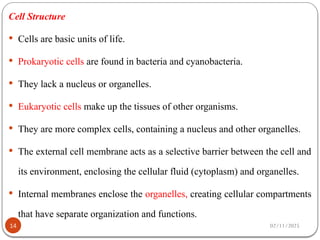
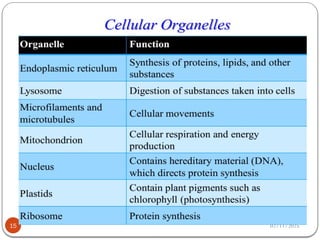
Cell Structure
 Cells are basic units of life.
 Prokaryotic cells are found in bacteria and cyanobacteria.
 They lack a nucleus or organelles.
 Eukaryotic cells make up the tissues of other organisms.
 They are more complex cells, containing a nucleus and other organelles.
 The external cell membrane acts as a selective barrier between the cell and
its environment, enclosing the cellular fluid (cytoplasm) and organelles.
 Internal membranes enclose the organelles, creating cellular compartments
that have separate organization and functions.
02/11/2025
15
02/11/2025
Functional Groups
16
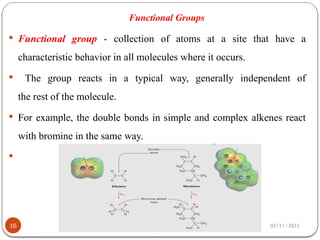
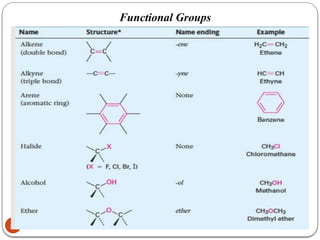
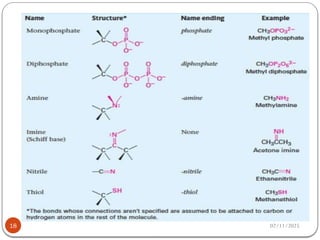
 Functional group - collection of atoms at a site that have a
characteristic behavior in all molecules where it occurs.
 The group reacts in a typical way, generally independent of
the rest of the molecule.
 For example, the double bonds in simple and complex alkenes react
with bromine in the same way.

02/11/2025
17
Functional Groups
02/11/2025
18
Biochemical Reactions
02/11/2025
19
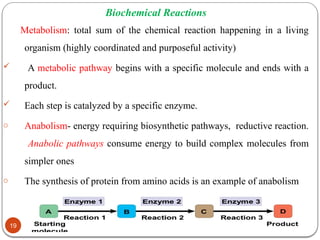
Metabolism: total sum of the chemical reaction happening in a living
organism (highly coordinated and purposeful activity)
 A metabolic pathway begins with a specific molecule and ends with a
product.
 Each step is catalyzed by a specific enzyme.
o Anabolism- energy requiring biosynthetic pathways, reductive reaction.
Anabolic pathways consume energy to build complex molecules from
simpler ones
o The synthesis of protein from amino acids is an example of anabolism
02/11/2025
20
o Catabolism- degradation of fuel molecules and the production of energy
for cellular function, oxidative reaction.
o Catabolic pathways release energy by breaking down complex
molecules into simpler compounds.
o Cellular respiration, the breakdown of glucose in the presence of
oxygen, is an example of a pathway of catabolism.
 The primary functions of metabolism are:
a. To obtain chemical energy from the degradation of energy rich
molecules.
b. Synthesis of molecules needed for cell structure and functioning (i.e.
proteins, nucleic acids, lipids, & CHO).
c. Removal of waste products.
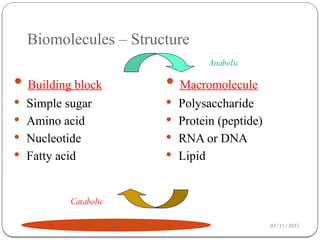
Biomolecules – Structure
02/11/2025
21
 Building block
 Simple sugar
 Amino acid
 Nucleotide
 Fatty acid
 Macromolecule
 Polysaccharide
 Protein (peptide)
 RNA or DNA
 Lipid
Anabolic
Catabolic
02/11/2025
22
Water and PH
Water
Water constitutes a principal end product of oxidative metabolism of
foods and most abundant substance of the body, making about 65% to
70% of body mass.
It solvate a wide range of organic molecules.
Water has a slightly ability to dissociate into hydroxide ions
and protons.
Structure of water:
Water is a dipole molecule with electrical charge distributed
asymmetrically about its molecule.
02/11/2025
23
Hydrogen bond exists between water molecules and by providing great
internal cohesive forces make water a liquid at room temperature and give
it solvent properties.
Hydrogen bond: it is an electrostatic attraction results between the Oxygen
atom of one water molecule and the Hydrogen of another.
Hydrogen bonding gives water its unusual properties.
Water has a high melting, boiling and heating of vaporization than most
other common solvents.
Polar in nature due to high electro negativity of oxygen relative to that of
hydrogen. Water is a compound that consists of two hydrogen atoms and
one oxygen atom attached together by two sigma bonds and with two lone
pairs of electrons around the oxygen.
02/11/2025
24
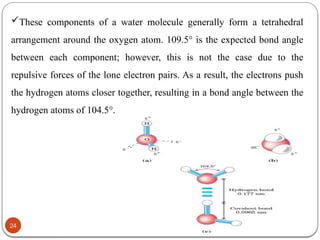
These components of a water molecule generally form a tetrahedral
arrangement around the oxygen atom. 109.5° is the expected bond angle
between each component; however, this is not the case due to the
repulsive forces of the lone electron pairs. As a result, the electrons push
the hydrogen atoms closer together, resulting in a bond angle between the
hydrogen atoms of 104.5°.
02/11/2025
25
pH: Power of hydrogen
•pH is a measure of the acidity or basicity of a solution.
•Pure water is said to be neutral, with a pH close to 7.0 at 25 °C .
•Solutions with a pH less than 7 are said to be acidic and solutions
with a pH greater than 7 are basic or alkaline.
•low pH indicates a high concentration of hydronium ions, while a
high pH indicates a low concentration
Mathematical definition
pH is defined as a negative decimal logarithm of the hydrogen ion
activity in a solution. pH+=-log(H+)
02/11/2025
26
Acid–Base Balance
Normal pH : 7.35-7.45
Acidosis: Physiological state resulting from abnormally low
plasma pH
Alkalosis: Physiological state resulting from abnormally high
plasma pH
 Acidemia: plasma pH < 7.35
Alkalemia: plasma pH > 7.45
Acid-base and buffers
 Earlier acids were defined as substances whose
aqueous solution turned blue litmus to red, neutralized
bases, reacted with active metals giving hydrogen and
tasted sour.
 Similarly bases were defined as substances whose
aqueous solutions turned red litmus to blue,
neutralized acids, tasted bitter.
02/11/2025
27
Buffers
 Buffers are aqueous systems that tend to resist changes in pH when small
amounts of acid (H) or base (OH) are added.
 First line of defense
 A buffer system consists of a weak acid (the proton donor) and its
conjugate base (the proton acceptor) and vise versa.
 A buffer is made by mixing a large volume of a weak acid or weak base
together with its conjugate.
 Buffers are effective at pHs that are within +/-1 pH unit of the pKa
 When hydrogen ions are added to a buffer, they will be neutralized by the
base in the buffer. Hydroxide ions will be neutralized by the acid.
02/11/2025
28
Buffers
 As an example, a mixture of equal concentrations of acetic acid and
acetate ion is a buffer system (CH3COOH/ CH3COO-).
 If a strong base is added to a buffer, the weak acid will give up its H+
in
order to transform the base (OH-
) into water (H2O) and the conjugate
base: HA + OH-
→ A-
+ H2O.
 Since the added OH-
is consumed by this reaction, the pH will change
only slightly.
 If a strong acid is added to a buffer, the weak base will react with the H+
from the strong acid to form the weak acid HA: H+
+ A-
→ HA.
 The H+
gets absorbed by the A-
instead of reacting with water to form
H3O+
(H+
), so the pH changes only slightly.
02/11/2025
29
02/11/2025
Buffers
 Two most common chemical buffer groups
– Bicarbonate
– Non bicarbonate (Hb, protein, phosphate)
 Blood buffer systems act instantaneously
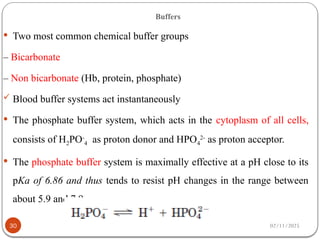
 The phosphate buffer system, which acts in the cytoplasm of all cells,
consists of H2PO-
4 as proton donor and HPO4
2-
as proton acceptor.
 The phosphate buffer system is maximally effective at a pH close to its
pKa of 6.86 and thus tends to resist pH changes in the range between
about 5.9 and 7.9.
30
Carbonic Acid-Bicarbonate Buffering System
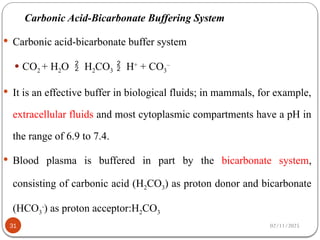
 Carbonic acid-bicarbonate buffer system
 CO2 + H2O  H2CO3  H+
+ CO3
–
 It is an effective buffer in biological fluids; in mammals, for example,
extracellular fluids and most cytoplasmic compartments have a pH in
the range of 6.9 to 7.4.
 Blood plasma is buffered in part by the bicarbonate system,
consisting of carbonic acid (H2CO3) as proton donor and bicarbonate
(HCO3
-
) as proton acceptor:H2CO3
02/11/2025
31
02/11/2025
Kassahun E
32
Protein buffer system
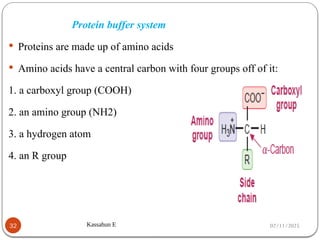
 Proteins are made up of amino acids
 Amino acids have a central carbon with four groups off of it:
1. a carboxyl group (COOH)
2. an amino group (NH2)
3. a hydrogen atom
4. an R group

Unit 1.pptx introduction to biochemistry

  • 1.
    Unit One: Introductionto biochemistry Definition and scope of biochemistry o Biochemistry is the chemistry of life. o is the study of chemical composition of living matter , and of the chemical changes that occur in it during life process. o is a special branch of organic chemistry that deals with matter inside the living cell. o is the application of chemistry to the study of biological processes at the cellular and molecular level. o Studying the structure and behavior of the complex molecules found in biological material and the ways these molecules interact to form cells, tissues and whole organism 02/11/2025 1
  • 2.
    Scope of Biochemistry oIt deals with nature of chemical substance present in the living system, the chemical transformations taking place there in and energetic changes taking place in the body due these transformations. o it deals with chemical nature, structure and functions of bio molecules. Biochemistry involves the study of:  Chemical constituents of living matter  Chemical changes which occur in the organism during digestion, absorption and excretion  Chemical changes which occur during growth and multiplication of the organism. 02/11/2025 2
  • 3.
    Relevance of Biochemistry Biochemistry is a valuable subject in medicine without which there would have been no such advancement in the field.  Physiology: Biochemistry helps one understand the biochemical changes and related physiological alteration in the body.  Pathology: Pathology of any disease is studied through biochemical changes.  Based on the symptoms described by the patient, physician can get clue on the biochemical change and the associated disorder.  For example if a patient complains about stiffness in small joints, then physician may predict it to be gout and get confirmed by evaluating uric acid levels in the blood. As uric acid accumulation in blood results in gout. 02/11/2025 3
  • 4.
     Nutrition deficiency:The function and role of vitamins in body is described by biochemistry.  Hormonal deficiency: There are many disorders due to hormonal imbalance in especially women and children. The formation, role of hormones in the normal body function is taught in biochemistry by which the physician can understand the concerned problem during treatment.  Kidney function test: For example in kidney disorders, chemotherapy treatment, urine test help understand the extent of excretion of drugs or other metabolites, the change in pH, the colour of urine etc.  Blood test: In diabetes, biochemical analytical test for blood glucose level helps one understand the severity of diabetes disorder.  Liver function tests helps understand the type of disease or damage to liver, the effect of any medication on liver etc. 02/11/2025 4
  • 5.
    02/11/2025 5 Biomolecules  Chemicals ormolecules present in the living organisms are known as Biomolecules.  Biomolecules are compounds of carbon. Hence the chemistry of living organisms is organized around carbon.  Carbon is the most versatile and the most predominant element of life.
  • 6.
    Chemical composition ofthe cell 02/11/2025 6  Chemical compounds in the cell can be divided into two major group: Organic and Inorganic Organic compounds  Chemical compounds contain carbon.  Are usually found in and originate from living organism.  Usually consist of macromolecules (large molecules). Inorganic compounds are:  Chemical compounds that do not contain carbon.  Usually a smaller and simpler than organic compounds.  Founds in cells water, acids, alkalis and mineral salts.
  • 7.
    02/11/2025 Organic compounds There are4 main group of organic compounds in cells: I. Carbohydrates II. Lipids III. Proteins IV. Nucleic acids Proteins: Most abundant organic molecules of the living system.  They form about 50% of the dry weight of the cell.  They are most important for the architecture and functioning of the cell.  Proteins are polymers of amino acids. 7
  • 8.
  • 9.
    02/11/2025 9 Carbohydrates :The termcarbohydrate is derived from the French term hydrate de carbone i.e. it is a hydrate of carbon or Cn(H2O)n.  Carbohydrates are defined as organic substances having C, H & O Wherein H and O are in the ratio 2:1 as found in H2O  FUNCTIONS OF CARBOHYDRATES  Most abundant source of energy (4 cal/g)  Precursors for many organic compounds (fats, amino acids)  Present as glycoproteins and glycolipids in the cell memebrane and functions such as cell growth and fertilization.
  • 10.
    02/11/2025 10 Present as structuralcomponents like cellulose in plants, exoskeleton of some insects, cell wall of microorganisms. Storage form of energy (glycogen) to meet the energy demands of the body.
  • 11.
    02/11/2025 11  Lipids arethe chief concentrated storage form of energy forming about 3.5% of the cell content.  Lipids are organic substances relatively insoluble in water but soluble in organic solvents (alcohol, ether) Functions :  They are the concentrated fuel reserve of the body.  Lipids are constituents of membrane structure and regulate the membrane permeability.  They serve as source of fat soluble vitamins  Lipids are important cellular metabolic regulators  Lipids protect the internal organs and serve as insulating materials.
  • 12.
    02/11/2025 12 Nucleic acids  Thenucleic acids, DNA and RNA, are polymers of nucleotides.  They store and transmit genetic information, and some RNA molecules have structural and catalytic roles in supramolecular complexes.  Nucleotides are the basic building blocks of nucleic acids (both DNA & RNA).  Structurally, nucleotides have 3 components 1. a nitrogenous base, 2. a pentose, 3. a phosphate
  • 13.
  • 14.
    02/11/2025 14 Cell Structure  Cellsare basic units of life.  Prokaryotic cells are found in bacteria and cyanobacteria.  They lack a nucleus or organelles.  Eukaryotic cells make up the tissues of other organisms.  They are more complex cells, containing a nucleus and other organelles.  The external cell membrane acts as a selective barrier between the cell and its environment, enclosing the cellular fluid (cytoplasm) and organelles.  Internal membranes enclose the organelles, creating cellular compartments that have separate organization and functions.
  • 15.
  • 16.
    02/11/2025 Functional Groups 16  Functionalgroup - collection of atoms at a site that have a characteristic behavior in all molecules where it occurs.  The group reacts in a typical way, generally independent of the rest of the molecule.  For example, the double bonds in simple and complex alkenes react with bromine in the same way. 
  • 17.
  • 18.
  • 19.
    Biochemical Reactions 02/11/2025 19 Metabolism: totalsum of the chemical reaction happening in a living organism (highly coordinated and purposeful activity)  A metabolic pathway begins with a specific molecule and ends with a product.  Each step is catalyzed by a specific enzyme. o Anabolism- energy requiring biosynthetic pathways, reductive reaction. Anabolic pathways consume energy to build complex molecules from simpler ones o The synthesis of protein from amino acids is an example of anabolism
  • 20.
    02/11/2025 20 o Catabolism- degradationof fuel molecules and the production of energy for cellular function, oxidative reaction. o Catabolic pathways release energy by breaking down complex molecules into simpler compounds. o Cellular respiration, the breakdown of glucose in the presence of oxygen, is an example of a pathway of catabolism.  The primary functions of metabolism are: a. To obtain chemical energy from the degradation of energy rich molecules. b. Synthesis of molecules needed for cell structure and functioning (i.e. proteins, nucleic acids, lipids, & CHO). c. Removal of waste products.
  • 21.
    Biomolecules – Structure 02/11/2025 21 Building block  Simple sugar  Amino acid  Nucleotide  Fatty acid  Macromolecule  Polysaccharide  Protein (peptide)  RNA or DNA  Lipid Anabolic Catabolic
  • 22.
    02/11/2025 22 Water and PH Water Waterconstitutes a principal end product of oxidative metabolism of foods and most abundant substance of the body, making about 65% to 70% of body mass. It solvate a wide range of organic molecules. Water has a slightly ability to dissociate into hydroxide ions and protons. Structure of water: Water is a dipole molecule with electrical charge distributed asymmetrically about its molecule.
  • 23.
    02/11/2025 23 Hydrogen bond existsbetween water molecules and by providing great internal cohesive forces make water a liquid at room temperature and give it solvent properties. Hydrogen bond: it is an electrostatic attraction results between the Oxygen atom of one water molecule and the Hydrogen of another. Hydrogen bonding gives water its unusual properties. Water has a high melting, boiling and heating of vaporization than most other common solvents. Polar in nature due to high electro negativity of oxygen relative to that of hydrogen. Water is a compound that consists of two hydrogen atoms and one oxygen atom attached together by two sigma bonds and with two lone pairs of electrons around the oxygen.
  • 24.
    02/11/2025 24 These components ofa water molecule generally form a tetrahedral arrangement around the oxygen atom. 109.5° is the expected bond angle between each component; however, this is not the case due to the repulsive forces of the lone electron pairs. As a result, the electrons push the hydrogen atoms closer together, resulting in a bond angle between the hydrogen atoms of 104.5°.
  • 25.
    02/11/2025 25 pH: Power ofhydrogen •pH is a measure of the acidity or basicity of a solution. •Pure water is said to be neutral, with a pH close to 7.0 at 25 °C . •Solutions with a pH less than 7 are said to be acidic and solutions with a pH greater than 7 are basic or alkaline. •low pH indicates a high concentration of hydronium ions, while a high pH indicates a low concentration Mathematical definition pH is defined as a negative decimal logarithm of the hydrogen ion activity in a solution. pH+=-log(H+)
  • 26.
    02/11/2025 26 Acid–Base Balance Normal pH: 7.35-7.45 Acidosis: Physiological state resulting from abnormally low plasma pH Alkalosis: Physiological state resulting from abnormally high plasma pH  Acidemia: plasma pH < 7.35 Alkalemia: plasma pH > 7.45
  • 27.
    Acid-base and buffers Earlier acids were defined as substances whose aqueous solution turned blue litmus to red, neutralized bases, reacted with active metals giving hydrogen and tasted sour.  Similarly bases were defined as substances whose aqueous solutions turned red litmus to blue, neutralized acids, tasted bitter. 02/11/2025 27
  • 28.
    Buffers  Buffers areaqueous systems that tend to resist changes in pH when small amounts of acid (H) or base (OH) are added.  First line of defense  A buffer system consists of a weak acid (the proton donor) and its conjugate base (the proton acceptor) and vise versa.  A buffer is made by mixing a large volume of a weak acid or weak base together with its conjugate.  Buffers are effective at pHs that are within +/-1 pH unit of the pKa  When hydrogen ions are added to a buffer, they will be neutralized by the base in the buffer. Hydroxide ions will be neutralized by the acid. 02/11/2025 28
  • 29.
    Buffers  As anexample, a mixture of equal concentrations of acetic acid and acetate ion is a buffer system (CH3COOH/ CH3COO-).  If a strong base is added to a buffer, the weak acid will give up its H+ in order to transform the base (OH- ) into water (H2O) and the conjugate base: HA + OH- → A- + H2O.  Since the added OH- is consumed by this reaction, the pH will change only slightly.  If a strong acid is added to a buffer, the weak base will react with the H+ from the strong acid to form the weak acid HA: H+ + A- → HA.  The H+ gets absorbed by the A- instead of reacting with water to form H3O+ (H+ ), so the pH changes only slightly. 02/11/2025 29
  • 30.
    02/11/2025 Buffers  Two mostcommon chemical buffer groups – Bicarbonate – Non bicarbonate (Hb, protein, phosphate)  Blood buffer systems act instantaneously  The phosphate buffer system, which acts in the cytoplasm of all cells, consists of H2PO- 4 as proton donor and HPO4 2- as proton acceptor.  The phosphate buffer system is maximally effective at a pH close to its pKa of 6.86 and thus tends to resist pH changes in the range between about 5.9 and 7.9. 30
  • 31.
    Carbonic Acid-Bicarbonate BufferingSystem  Carbonic acid-bicarbonate buffer system  CO2 + H2O  H2CO3  H+ + CO3 –  It is an effective buffer in biological fluids; in mammals, for example, extracellular fluids and most cytoplasmic compartments have a pH in the range of 6.9 to 7.4.  Blood plasma is buffered in part by the bicarbonate system, consisting of carbonic acid (H2CO3) as proton donor and bicarbonate (HCO3 - ) as proton acceptor:H2CO3 02/11/2025 31
  • 32.
    02/11/2025 Kassahun E 32 Protein buffersystem  Proteins are made up of amino acids  Amino acids have a central carbon with four groups off of it: 1. a carboxyl group (COOH) 2. an amino group (NH2) 3. a hydrogen atom 4. an R group