Population Growth
Biotic Potential=
-promotes positive growth
-intrinsic factors(litter size, gestation)
Environmental Resistance=
-limits growth
-extrinsic factor(weather, food supply)
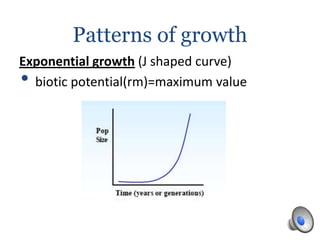
Patterns of growth
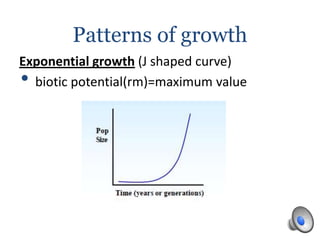
Exponential growth (J shaped curve)
• biotic potential(rm)=maximum value
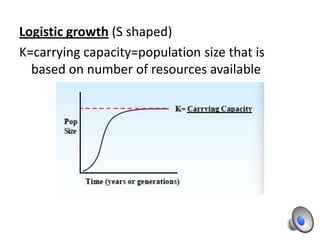
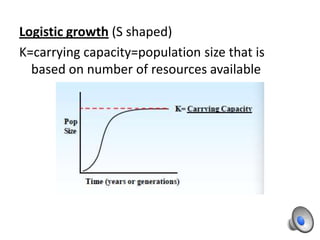
Logistic growth (S shaped)
K=carrying capacity=population size that is
based on number of resources available
Limiting factors:
Density dependent:
-competition
-disease
-predation
-food
Density independent:
-weather
-catastrophes
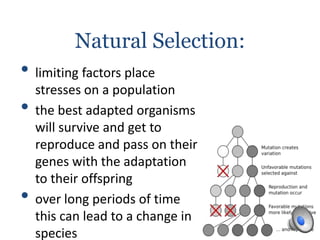
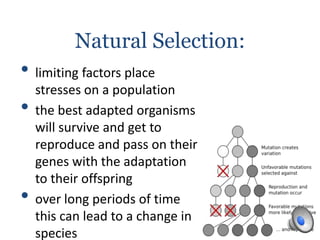
Natural Selection:
• limiting factors place
stresses on a population
• the best adapted organisms
will survive and get to
reproduce and pass on their
genes with the adaptation
to their offspring
• over long periods of time
this can lead to a change in
species
Population Growth
Biotic Potential=
-promotes positive growth
-intrinsic factors(litter size, gestation)
Environmental Resistance=
-limits growth
-extrinsic factor(weather, food supply)
Patterns of growth
Exponential growth (J shaped curve)
• biotic potential(rm)=maximum value
Logistic growth (S shaped)
K=carrying capacity=population size that is
based on number of resources available
Limiting factors:
Density dependent:
-competition
-disease
-predation
-food
Density independent:
-weather
-catastrophes
Natural Selection:
• limiting factors place
stresses on a population
• the best adapted organisms
will survive and get to
reproduce and pass on their
genes with the adaptation
to their offspring
• over long periods of time
this can lead to a change in
species
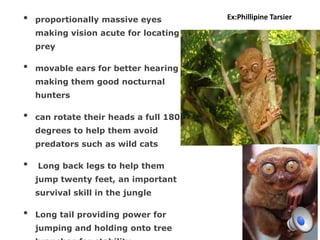
• proportionally massive eyes
making vision acute for locating
prey
• movable ears for better hearing
making them good nocturnal
hunters
• can rotate their heads a full 180
degrees to help them avoid
predators such as wild cats
• Long back legs to help them
jump twenty feet, an important
survival skill in the jungle
• Long tail providing power for
jumping and holding onto tree
Ex:Phillipine Tarsier
Survivorship curves:
-based on a cohort of individuals from birth until
death
-cohort=a group of individuals of the same age
-survivorship curves are meant to show the
number of individuals surviving at each age
for a particular species
-three types of curves
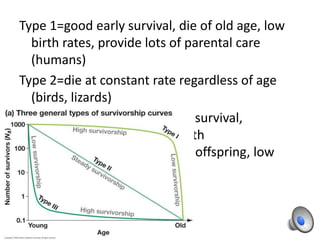
Type 1=good early survival, die of old age, low
birth rates, provide lots of parental care
(humans)
Type 2=die at constant rate regardless of age
(birds, lizards)
Type3 =poor early survival,
survival thatimproves with
age, lots of offspring, low
parental care
(fish,plants)
Life History Patterns:
r selected species: species inhabiting fluctuating
or unpredictable environments-environments
keep populations below carrying capacity (lots
of predation, competition over resources)
k selected species-species inhabiting
stable, predictable environments-keep
population size near carrying capacity and
resources are scarce

Bio351 tarahillextracredit

  • 1.
    Population Growth Biotic Potential= -promotespositive growth -intrinsic factors(litter size, gestation) Environmental Resistance= -limits growth -extrinsic factor(weather, food supply)
  • 2.
    Patterns of growth Exponentialgrowth (J shaped curve) • biotic potential(rm)=maximum value
  • 3.
    Logistic growth (Sshaped) K=carrying capacity=population size that is based on number of resources available
  • 4.
  • 5.
    Natural Selection: • limitingfactors place stresses on a population • the best adapted organisms will survive and get to reproduce and pass on their genes with the adaptation to their offspring • over long periods of time this can lead to a change in species
  • 6.
    Population Growth Biotic Potential= -promotespositive growth -intrinsic factors(litter size, gestation) Environmental Resistance= -limits growth -extrinsic factor(weather, food supply)
  • 7.
    Patterns of growth Exponentialgrowth (J shaped curve) • biotic potential(rm)=maximum value
  • 8.
    Logistic growth (Sshaped) K=carrying capacity=population size that is based on number of resources available
  • 9.
  • 10.
    Natural Selection: • limitingfactors place stresses on a population • the best adapted organisms will survive and get to reproduce and pass on their genes with the adaptation to their offspring • over long periods of time this can lead to a change in species
  • 11.
    • proportionally massiveeyes making vision acute for locating prey • movable ears for better hearing making them good nocturnal hunters • can rotate their heads a full 180 degrees to help them avoid predators such as wild cats • Long back legs to help them jump twenty feet, an important survival skill in the jungle • Long tail providing power for jumping and holding onto tree Ex:Phillipine Tarsier
  • 12.
    Survivorship curves: -based ona cohort of individuals from birth until death -cohort=a group of individuals of the same age -survivorship curves are meant to show the number of individuals surviving at each age for a particular species -three types of curves
  • 13.
    Type 1=good earlysurvival, die of old age, low birth rates, provide lots of parental care (humans) Type 2=die at constant rate regardless of age (birds, lizards) Type3 =poor early survival, survival thatimproves with age, lots of offspring, low parental care (fish,plants)
  • 14.
    Life History Patterns: rselected species: species inhabiting fluctuating or unpredictable environments-environments keep populations below carrying capacity (lots of predation, competition over resources) k selected species-species inhabiting stable, predictable environments-keep population size near carrying capacity and resources are scarce